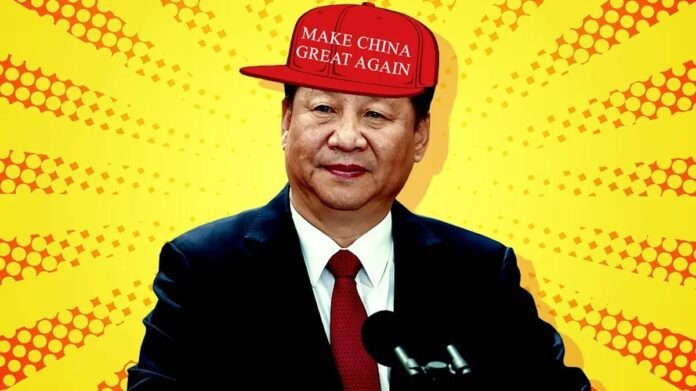
Western mainstream media and podcasters have dismissed the Trump-Xi summit in Beijing. When you listen to Jake Sullivan and Aaron Friedberg, China hawks from diagonally opposite political background – the liberal elite of the Democratic party and the Republican neoconservative camp – they are competing with each other to disparage the summit as “much ado about nothing.”
But they seem to have neglected, or deliberately ignored, a significant event when Xi at the state banquet publicly praised MAGA, adding a real foundation stone for rebuilding mutual trust between the two countries.
Although no agreement was signed on the Taiwan issue, to the relief of the China hawks, Trump acted swiftly to reciprocate Xi’s praise by publicly downplaying Taiwan’s strategic importance, refusing to defend Taiwan based on traditional logic of strengthening military deterrence and directly pressuring the Taiwanese government to make corresponding adjustments to arms sales, in order to handle the Taiwan Strait issue within the agreed common framework of “constructive strategic stability.”
This is a major breakthrough. Apart from Xi, only a very few world leaders have praised the MAGA movement. Foreign leaders, especially US allies, rarely comment on it at all. There are two reasons for this:
First, they disagree with Trump’s MAGA philosopthy – nationalistic populism and burden-shifting national security policy.
Second, they do not believe the movement can survive after Trump leaves office. Trumpism is considered an aberration in American history.
Even when a few leaders do comment, it is often out of some specific motive, ranging from neutral approval to public praise.
Rather than publicly praising MAGA, leaders who are well disposed to Trump either praise the man, the president, himself or appreciate certain aspects of his policies or are ideologically aligned with him.
Based on available information up to May 2026, high on the list of foreign leaders who have praised Trump is Vladimir Putin – though Putin has never explicitly mentioned by its name the “Make America Great Again” movement.
Putin praised Trump’s political style and criticized American “elitism” in a manner consistent with the MAGA slogan. In 2018, Putin stated that Trump possessed “keen political instincts” and praised his ability to connect with ordinary voters. However, Putin’s praise was not directed at the MAGA slogan itself, but rather indirectly praised its ideology. Putin’s comments focused selectively on populism and anti-establishment appeals.
Then there iss former Brazilian President Jair Bolsonaro, who has expressed admiration for Trump and his populist political approach.
Bolsonaro publicly praised Trump’s political ideology, calling him a “model” for Brazilian conservative politics. His praise suggests alignment with Trump’s nationalist, law-and-order rhetoric and questioning of globalist institutions – signature features of the MAGA movement.
Several Eastern European leaders – particularly Viktor Orbán of Hungary – have praised Trump-style nationalism and anti-immigrant policies, though they generally do not explicitly mention MAGA.
Orbán publicly praised Trump’s policies on immigration and nationalism. While Orbán didn’t directly mention “Make America Great Again,” he explicitly endorsed the populist and nationalist line it represents – but citing Hungary as a model instead.
Israel’s Benjamin Netanyahu praised Trump’s “America First” foreign policy, calling it the cornerstone of the “historic partnership” between the two countries during Trump’s presidency. This praise was directed at specific policies, not the MAGA movement itself.
Most other leaders who indirectly praise MAGA, such as Italy’s Giorgia Melloni, or France’s Marine le Pen, focus on his political style, or some of his policies, merely emphasizing ideological commonality with the MAGA movement.
However, at this Xi-Trump meeting, Xi Jinping openly and unreservedly compared the MAGA movement to China’s grand national project – the Chinese national rejuvenation movement – a form of praise never before heard.
President Xi Jinping’s comments on the movement are analytical and thoughtful praise.
Trump seems very pleased, as it is certainlybeneficial for his image and the midterm elections, alongside subtantial trade and other economic deals. .
According to reports, Xi Jinping stated,
This year also marks the 250th anniversary of American independence, and more than 300 million Americans are revitalizing their patriotic, innovative, and pioneering spirit, propelling American development onto a new journey.
The people of China and the United States are both great peoples, and realizing the great rejuvenation of the Chinese nation and making America great again can be done in parallel, mutually beneficial, and for the benefit of the world.
This statement highly praises Trump’s MAGA movement, even implying that the American people yearn for change and suggesting that the movement has effectively inspired Trump’s supporters.
Therefore, only Xi Jinping has directly and explicitly praised the MAGA movement (including its slogan and its political brand itself). This greatly boosts Trump’s tarnished domestic and international image.
Xi’s remarks, from the leader of the world’s second most powerful nation, are not purely political flattery such as Europeans pathetically offered when they called him “daddy,” but more thoughtful endorsement, representing the closest a foreign leader has come to explicitly acknowledging the positive value of the MAGA movement itself.
More interstingly, Xi Jinping also set a three-year timeframe, apparently hoping to use the remaining three years of President Trump’s term to normalize Sino-US relations.
At the same time, Xi is betraying real concerns about US policy reversal toward China after Trump’s departure.
However, even in the post-Trump era, the common-sense revolution launched by Trump may not fade away from American politics and is likely to continue to strengthen. A group of power restrainers – technologically minded and mission-bound young people represented by Vice President J D Vance – will carry the banner of the MAGA movement, as it holds immense appeal for the American working class who are disillusioned with globalization, immigration, and the establishment political elite.
Regarding China policy, if the MAGA movement under Trump could turn out to be a ballast for stabilizing political relationship between the two countries, the resurgence of China hawks will be effectively curbed, as the three-year stable and win-win situation will be evident to all.
Even if the Democrats come back to power, they will not dare to easily disrupt this constructive strategic stability and restart a new Cold War of “democracy versus autocracy.”
Avoiding the Thucydides trap between China and the US will safeguard both the process of “Making America Great Again” and the rejuvenation of the Chinese nation. These two movements can truly coexist and complement each other.
The establishment elite in the US refuse to accept the fact that, the MAGA movement is not just about Trump; it’s about the broader cultural and political change needed for the well-being of the American people. One of its core features, a de-ideologized foreign policy will help stop the chaotic pendulum in the most important relationship, the one between the US and China, to prevent an unthinable conflict for the sake of world peace.
The author is professor emeritus of the Graduate Institute of International and Development Studies, Geneva, Switzerland.





![Israeli forces demolish a two-story Palestinian house in the village of Ed-Deirat, part of the town of Yatta in the southern West Bank, while taking security measures in the area on May 4, 2026, in Hebron, West Bank, Palestine. [Wisam Hashlamoun - Anadolu Agency]](https://i0.wp.com/www.middleeastmonitor.com/wp-content/uploads/2026/05/AA-20260504-41285796-41285775-ISRAELI_FORCES_DEMOLISH_A_TWOSTORY_PALESTINIAN_HOUSE_IN_HEBRON.jpg?fit=920%2C613&ssl=1)






