The Ebola outbreak erupting from the Ituri province of the Democratic Republic of the Congo continues to escalate wildly, with cases nearing 750, deaths reported at 177, and around 1,400 contacts now being traced, the World Health Organization reported in a press briefing Friday. The latest numbers already place the outbreak as the third largest on record, though it was only first reported a week ago, on May 15. And WHO Director-General Tedros Adhanom Ghebreyesus said the outbreak is still “spreading rapidly.”
A revised WHO assessment has moved the risk level from “high” to “very high” at the national level, while risk remains “high” at the regional level and “low” at the global level, Tedros added.
WHO officials have acknowledged that a delay in detecting and responding to the outbreak enabled it to balloon, and that they are now racing to get ahead of the virus.
WHO representative Dr. Anne Ancia spoke during today’s briefing from the DRC, saying that when officials got to the area, they found the virus was “already rampant and silently disseminating for a few weeks already.” In the outbreak investigation so far, the earliest known suspected case was in a health worker, who developed symptoms on April 24 in Bunia, the capital city of Ituri. WHO only got word of a potential outbreak on May 5, with news of a cluster of deadly, unidentified infections that led to the deaths of four health workers. By the time a WHO team arrived, there were already 80 cases.
“Now we are sprinting behind [the virus] so that we can really try to control this outbreak, and because it is still transmitting for the time being, yes, the number [of cases] will keep rising for some time until we are really able to put all the response operation in place,” she said.
Their work is made harder by various challenges. The virus behind the Ebola outbreak is the uncommon Bundibugyo virus, which doesn’t have established vaccines or therapeutics. That leaves active case finding, isolation, and contact tracing as the primary tools to halt the spread. Moreover, the virus is spreading in areas with armed conflict, intense population mobility, weak health systems, and where millions face acute hunger and need humanitarian assistance.
Disease of compassion
As WHO and other partners scramble to prevent more deadly infections, public health experts in the US are criticizing the Trump administration’s role. The US had long been a global leader in Ebola responses in the region. But that is no longer the case given the Trump administration’s demolition of the US Agency for International Development (USAID), severe cuts to the Centers for Disease Control and Prevention, numerous public health leadership roles vacant, and complete withdrawal from the WHO.
In a New York Times opinion piece Thursday, Craig Spencer—an emergency medicine doctor and Brown University professor, who contracted Ebola while treating patients in Guinea in 2014 with Doctors Without Borders—wrote that the US has “abdicated its longstanding role as a leader in global health and humanitarian response.”
“I know how destructive the disease can be—and how unprepared we are for its return,” he wrote.
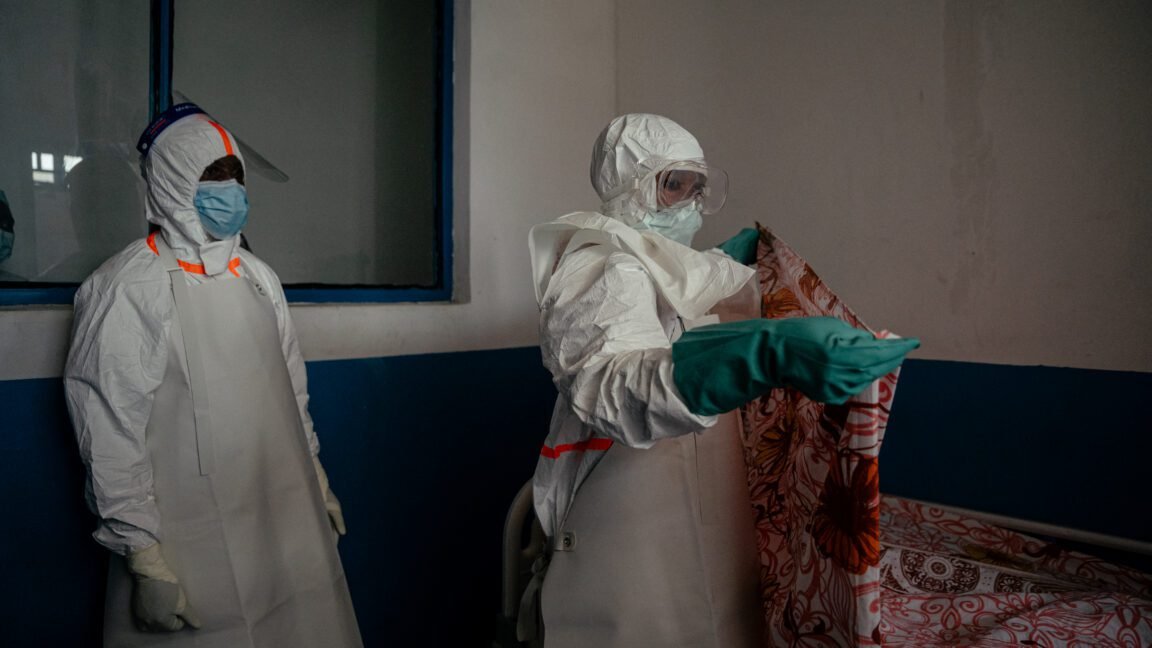
He noted reporting from the Times finding that the delay in detecting the outbreak was, in part, due to samples from infected patients being transported to a national lab in Kinshasa, Congo, at the wrong temperature. That task had previously been managed by USAID. The Times also reported that the US previously played a crucial role in logistics and delivering supplies, notably personal protective equipment, such as face shields, respirators, impermeable coveralls, and surgical hoods—supplies that health workers in DRC lacked for weeks at the start of the outbreak.
“My heart is breaking for those workers,” Megan Fotheringham, who was USAID’s deputy director of infectious diseases, including during the Ebola outbreak in Ituri between 2018 and 2020. “They are not protected, and they are putting their lives on the line.” She told the Times that if USAID was able to continue its work, it could have moved stockpiles of personal protective equipment within hours.
Spencer noted that he and others often refer to Ebola as a disease of compassion because it spreads via bodily fluids to those who have intimate contact with victims. “This means parents taking care of their sick children, family members who wash the bodies of their dead relatives, and health care providers who take care of patients at the most contagious stage of their illness,” he wrote. He recalled a family of seven being infected, with the parents caring for their children while battling the disease themselves, and only the parents survived.
Panic and neglect
Epidemiologists Katelyn Jetelina and Emily Smith pointed out Friday that, while the disease is one spread by compassion, this outbreak seems to be spreading by “the global withdrawal of it.”
In a CDC press briefing Friday morning, Satish Pillai, incident manager for CDC’s Ebola response, said that the US is ramping up resources and sending more field staff to the outbreak area. The Trump administration has also said it is funding the establishment of up to 50 treatment clinics in Ebola-affected regions of the DRC and Uganda. But Uganda, which has only reported two imported cases from DRC, responded by saying it was “not aware” of any such plans.
Pillai again dodged questions on why an American doctor infected in the outbreak and another exposed were sent to Germany and the Czech Republic, respectively, and not to the US. He also skirted questions about the US’s travel restrictions, which have also been criticized by public health experts.
With the US withdrawal from global health, the WHO has struggled to make up for the loss of funding and support. At the end of the press briefing, WHO officials were asked what the Ebola outbreak response was expected to cost and if the agency would have enough funds to cover it. Epidemic and pandemic management director Maria Van Kerkhove said the agency is still working on an estimate, but added that while funding was a challenge right now, the focus shouldn’t be on response costs.
“There’s billions of dollars that are spent on war every single day,” Van Kerkhove said. “So, there’s plenty of money that can be handled for this. And what is extremely frustrating is that money will come for a response. But what we actually need money for … is prevention. This constant, steady stream of funding to support national governments in the capacities that they have across surveillance, detection, research, infection prevention, control, workforce, building trust in communities, et cetera, regularly as opposed to going into this cycle of panic and neglect.”