Louisiana’s Tough-on-Crime Policies Stand to Cost Taxpayers Millions More for Years to Come
The day after a shooting last month killed a teenager and injured five people at the Mall of Louisiana, Gov. Jeff Landry blasted what he referred to as “hug-a-thug” policies — reforms put in place prior to his tenure when the state was trying to shed its reputation as the nation’s incarceration capital. He also demanded harsher penalties for violent minors.
“I’m done with them. It doesn’t matter how old they are,” Landry, a Republican, said during a news conference in Baton Rouge. “We’ve got 18,000 acres at Angola — if it was up to me, I would send them all there for the rest of their lives.”’
Landry’s push for harsher punishments that would keep people in prison longer came as little surprise. Soon after his 2024 inauguration, he won a package of tough-on-crime bills that drastically changed the state’s sentencing laws. A Landry spokesperson at the time brushed off concerns from civil rights groups and incarceration experts that it would swell the prison population and plunge the state into financial disaster, insisting that “less crime means greater economic opportunity for everyone.”
Two years later, the governor wants to add hundreds more beds in Louisiana’s largest prison and spend more on medical costs as prisoners stay longer behind bars. His proposed $798 million corrections budget, which the Republican-controlled legislature is expected to pass by June 1, represents a 9% increase from the inflation-adjusted total spent in fiscal year 2024, the last budget passed before his tenure. The increased budget is the first indication that the rising inmate population resulting from Landry’s policies is costing Louisiana taxpayers.
ProPublica and Verite News have spent more than two years investigating how Landry’s policies have impacted Louisiana’s criminal justice system. The number of prisoners paroled under Landry has plummeted to its lowest point in 20 years, due in part to a law he signed that cedes much of the power of the parole board to a computerized algorithm. And the prison population as a whole is expected to become older and sicker since Landry and the legislature eliminated medical parole.
Landry also ushered in a law that lowered the age at which the justice system must treat defendants as adults from 18 to 17 years old to combat what he characterized as an epidemic of violent crime committed by minors. But an investigation by ProPublica and Verite News found that 69% of 17-year olds in three of the state’s largest parishes were arrested for offenses that Louisiana law does not consider violent crimes.
Many experts say the full impact of these changes won’t be felt for at least another decade. The Crime and Justice Institute, a Boston-based nonpartisan public-safety research organization, predicts that by 2034, Landry’s rollback of inmates’ ability to shave time off their sentences through good behavior will double the size of the state’s prison population, double the number of nonviolent offenders being held and cost an estimated $2 billion for new prisons to accommodate the population.
Here is how Landry’s policies have already begun to impact Louisiana’s prisons and budget.
Prison Population Change
In the two years after Landry took office, the number of state prisoners has increased by about 8%, and Landry’s budget indicates that number will continue to rise. The governor is asking for an additional 688 beds at the state’s largest prison, the Louisiana State Penitentiary at Angola, which will require the hiring of 150 correctional officers.
A corrections department spokesperson said the increased capacity is necessary because under the previous administration, “beds were significantly decreased, correctional officer positions were cut, facilities closed, and funding [was] eliminated.”
In 2017, a bipartisan coalition of Louisiana legislators had passed an ambitious package of bills designed to reduce the number of nonviolent offenders behind bars — and with it the state’s nation-leading prison population.
By 2021, the number of nonviolent offenders in state prisons and jails dropped by 55% and the overall prison population by 26%, according to the U.S. Department of Justice.
Louisiana’s Prison Population Has Continued to Go Up Under Gov. Jeff Landry
After years of steady decline due to a bipartisan prison-reform package, the state’s incarcerated population started climbing again in 2022, after the height of the coronavirus pandemic, as courts reopened and crime rates rose. The increase has continued as a result of Landry’s criminal justice rollbacks.
Note: Prison population totals as of Dec. 31 of each year. Source: Louisiana Department of Public Safety and Corrections.Chris Alcantara/ProPublica
But in early 2024, Landry signed a series of bills that repealed most of those reforms. The governor and his allies in the legislature eliminated parole for anyone convicted of a crime committed after Aug. 1, 2024, and required prisoners to serve at least 85% of their sentences before they can reduce their time through good behavior. The elimination of parole also got rid of medical parole and put additional restrictions on medical furlough — both of which had been offered to severely ill or injured inmates.
The rising number of prisoners has applied additional pressure on overcrowded local jails, where more than half of Louisiana’s inmates are held instead of state-run prisons. Landry is asking the legislature for an additional $17 million to increase the rate paid to local sheriffs to house state inmates by $3 per day, from $26 to $29.
Louisiana Has More State Prisoners in Local Jails Than Any Other State in the Nation
More than half of Louisiana inmates are held in local jails instead of state-run prisons.
Note: Data as of 2023. Source: Department of Justice report on prison population released in September.Chris Alcantara/ProPublica
Some lawmakers and prison reform advocates say there are indications that the Department of Corrections is seeing the need for a shift in strategy.
State Rep. Mandie Landry (no relation), a Democrat from New Orleans, said corrections department officials asked her to sponsor a bill that allows prisoners who earn an associate’s degree to shave 90 days off their sentences. And while that might not seem like much, she said, it’s a move in the right direction. “I think they’re realizing that what the legislature did a few years ago is going to explode into a nightmare in prison,” she said.
The legislature passed the bipartisan bill in April.
A corrections department spokesperson declined to respond to questions concerning the impact of Landry’s policies on the prison population and corrections budget, how those policies are impacting inmate medical care and if the department is seeking to gradually reverse any of Landry’s policies. Landry’s spokesperson did not respond to requests for comment.
Rising Corrections Budget
Landry is asking for an additional $82 million for next year’s corrections budget — 11% more than currently allotted. Over the past decade, the amount of state tax dollars spent on correctional services has fluctuated, especially during the coronavirus pandemic, when federal aid temporarily supplemented the corrections budget. But Landry’s policies will ensure the need for additional funds, said James Austin, a national corrections policy expert.
Landry’s Proposed Budget Could Push Statewide Prison Spending to Its Highest Level in a Decade
The actual spending in 2027 by the Department of Corrections could be even higher, based on past trends.
Note: Louisiana’s fiscal year runs from July 1 to June 30. Fiscal years 2016 to 2025 represent actual taxpayer spending on corrections after adjusting for inflation, using the most recent rate as of April. The amount of state funding dropped in fiscal years 2020 and 2021 because the state used federal pandemic aid to supplement its corrections budget. A key reason for the state funding increase in fiscal year 2025 was the cost of major repairs at two prisons. The figures for fiscal year 2026 represent the department’s budget as of December 2025 plus an additional amount the Landry administration has requested through June. Source: Louisiana Division of Administration.Chris Alcantara/ProPublica
While overall state spending during Landry’s tenure is projected to drop by 2% when adjusted for inflation, corrections spending will increase by 9% if the governor’s proposed budget passes.
“There’s no indication that the need for more beds and more staff is going to flatten out. And I don’t think this governor will talk about increasing taxes,” Austin said. “All that’s left is to cut programs in other areas.”
A new report by the Center on Budget and Policy Priorities in Washington, D.C., determined that the proposed increase in corrections spending would come at the expense of education. Landry has proposed cutting $165 million in education funding, including $40 million for state colleges and universities and $125 million for K-12 education, including teacher pay. (Landry backed a measure that would have paid for teacher raises by liquidating three education trust funds, but voters rejected the proposal in the May 16 election.)
“They have made the decision to boost the funding for prisons while deprioritizing the investments in teachers,” said Michael Mitchell, author of the report.
The state is forced to make cuts because Landry and the Republican-controlled legislature pushed through their 2024 criminal justice bills in less than two weeks without the typical debate over costs, said Sarah Omojola, director of the Louisiana office of the Vera Institute of Justice, a nonprofit focused on criminal justice reform.
“These rollbacks were very partisan and not supported by research, data or even fiscally sound policy,” Omojola said. “They just approved the bills before the legislative staff even computed what the full expenses were.”
A Landry spokesperson did not respond to requests for comment.
Rep. Debbie Villio, a Republican from Kenner who sponsored the 2024 bills that eliminated parole and significantly reduced the ability of prisoners to reduce their sentences through good behavior, did not respond to a request for comment.
“It is my position that this legislation will not ramp up prison population and costs,” Villio texted the Times-Picayune at the time the bills were passed.
An Older, Sicker Prison Population
The need for additional healthcare funds is yet another indicator of the costs associated with Landry’s changes to the state’s sentencing laws, said Bruce Reilly, deputy director of Voice of the Experienced, a New Orleans nonprofit that advocates for the rights of incarcerated people. Without the benefit of parole or the ability to reduce their sentences through good behavior, inmates will spend more time behind bars. That extra time will create an older and sicker population, Reilly said.
The number of older prisoners was already on the rise prior to Landry due, in part, to lengthy sentences secured in the 1980s to 2000s by previous New Orleans district attorneys.
Landry has asked for an increase of $14.3 million to pay for medical care in prisons for the next fiscal year, which begins in July. The administration is also asking for an additional $33 million for the current fiscal year to pay for medical care, overtime and supplies.
Louisiana Prisoners Over the Age of 70 Experienced the Highest Change in Population Since 2019
Since Landry took office in 2024, the population of prisoners over 70 has gone up 28%, while the overall prison population rose by 8%. Prisoners over 70 typically represent a small portion of the overall prison population.
Note: Prison totals used to calculate the rate for each age group are from Dec. 31 of each year. Source: Louisiana Department of Public Safety and Corrections.Chris Alcantara/ProPublica
A 2024 investigation by Verite News and ProPublica detailed allegations of unconstitutional medical care provided to inmates being held in Angola’s medical ward. Austin, the corrections expert, said that a medical system that for decades has struggled to care for its most vulnerable will “only worsen” under the strain of a rapidly expanding and aging population.
In March, a federal appeals court threw out a lower-court order to have a court-appointed team oversee medical care at Angola, calling the proposed remedy “micromanagement” that violated the federal Prison Litigation Reform Act. The case has been sent back to the lower court.
For years, as both attorney general and governor, Landry has defended Angola’s healthcare system, claiming that inmates are entitled to only “adequate” medical care — not specialized care or the best care possible.
The legislature proposed two healthcare bills this year that would reduce medical costs. One that would restore medical parole and medical furlough as exceptions to the elimination of parole recently passed. Another, which would expand the time an inmate can be released into hospice, is still being considered.
Current law allows prison officials to release terminally ill prisoners two months prior to their expected death, which is the shortest hospice-release window in the country, according to Families Against Mandatory Minimums, a nonprofit focused on criminal justice reform. The proposed bill would double that time to four months, which would still be the shortest by a wide margin. Alabama, South Carolina and Tennessee have the next shortest window, at six months.
“These people are on their death bed. Some of these people don’t even realize they’re in prison,” said corrections secretary Gary Westcott at a March hearing on the proposed bill. And the costs associated with caring for these inmates can be extraordinarily high, Westcott said.
“We’re talking about changing diapers, feeding them. Most of them cannot do anything on their own,” he said, noting that once they are transferred to a hospital, those costs are picked up by Medicaid.
Soaring solar and a surge in hydro push more coal off the US grid
Last year, the first few months of data from the US grid suggested that fears of a data-center-driven surge in demand were becoming a reality. Demand had risen by about 3 percent, triggering a surge in coal, interrupting what had been a long downward trend. But over the course of the year, both trends slowed considerably.
A year later, all of that seems to be in the past, as the US has returned to its normal pattern: slow growth, with renewables pushing coal off the grid. The one oddity is that hydroelectric production has surged without a corresponding increase in capacity, likely due to unusually warm weather in the western US causing the snowpack to melt early. That may have consequences later in the year.
Pushing fossil fuels out
Overall demand in the US grew by only 1.5 percent in the first quarter of 2026 compared to the same period the year before. Often, changes in demand during this part of the year are driven by weather-related heating demand. But the US had an unusual combination set of weather conditions to start 2026, with the western half baking in unseasonal warm temperatures, while the eastern half suffered a deep freeze. So we’ll probably need data from more of the year before we read too much into the small rise in demand we’ve seen so far.
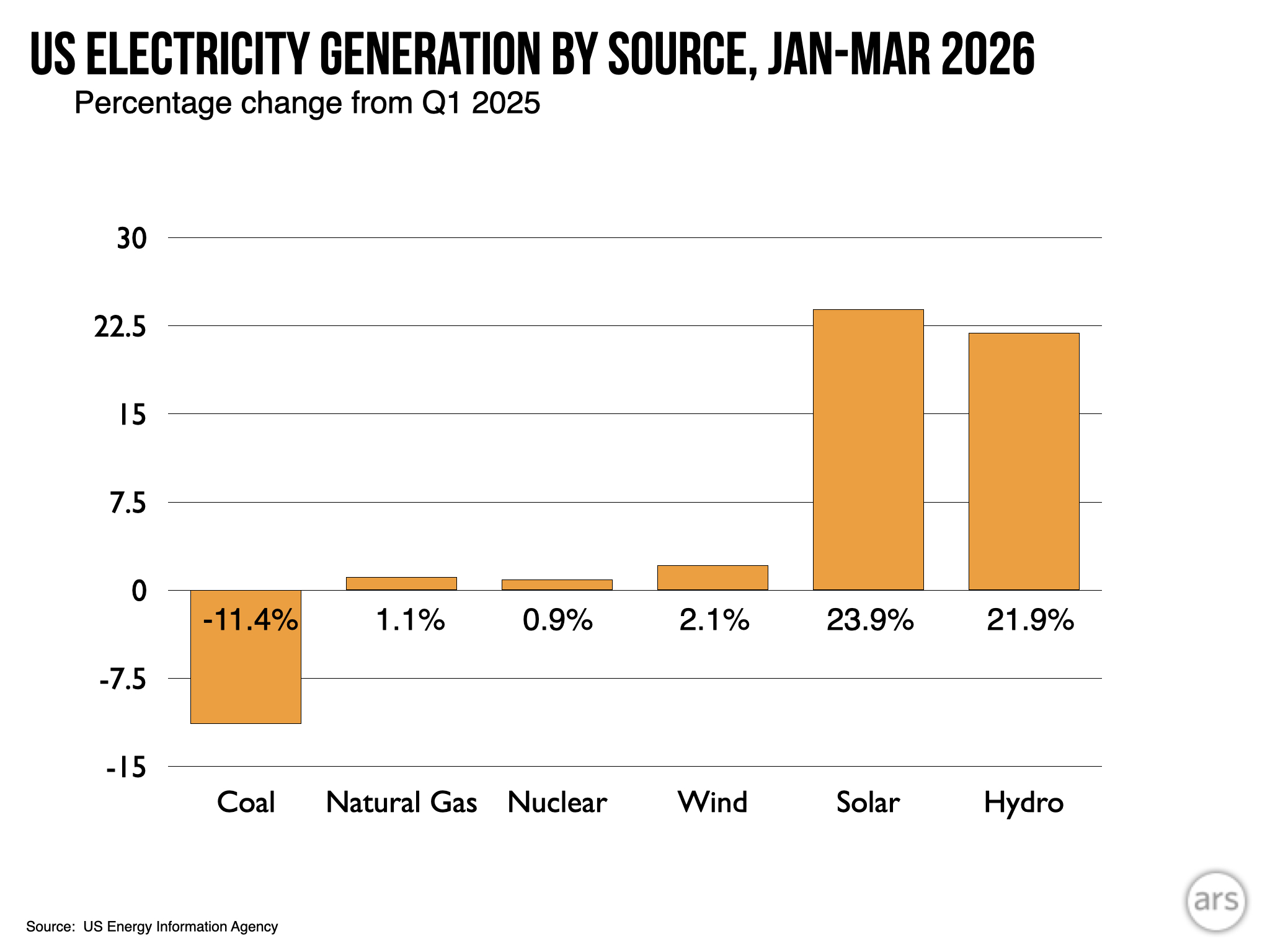
As has been the case for a while now, the biggest trend on the US grid was the growth of solar. Compared to the same quarter the year earlier, solar was up by 24 percent. On its own, that was enough to offset 80 percent of the rising demand. Overall, the output of the major renewables (wind, solar, and hydro) grew by 11 percent compared to the same period the year prior, or about 1.8 times the growth in demand.
Wind and hydro are up, coal is down compared to this period a year earlier.
Credit: John Timmer
Wind and hydro are up, coal is down compared to this period a year earlier. Credit: John Timmer
Given that renewable growth greatly exceeded demand, there was nowhere to go for fossil fuels but down. Overall, they saw a drop of about 3 percent year-over-year, with an absolute change similar in magnitude (if not sign) to the growth in demand. But natural gas use actually grew slightly in the first quarter, which meant coal took an even greater hit, with its use dropping by over 10 percent. That may change as the Persian Gulf conflict drives global natural gas prices higher, but it was not yet a major factor in this data.
As mentioned above, the most unusual event was a surge in hydroelectric generation; it rose by 22 percent in the first quarter. In absolute terms, this was about the same as solar growth; in contrast to solar, however, it came without a building boom, as no major new dams have been completed.
This happened at a time when winter temperatures were unusually warm in the west and likely represent the early loss of snowpack. (Though snowpack in the Colorado River basin is unusually low due to a lack of precipitation.) If that turns out to be a major factor, we’ll likely see a relative drop in productivity over the summer and autumn, canceling out the early surge.
Against the current
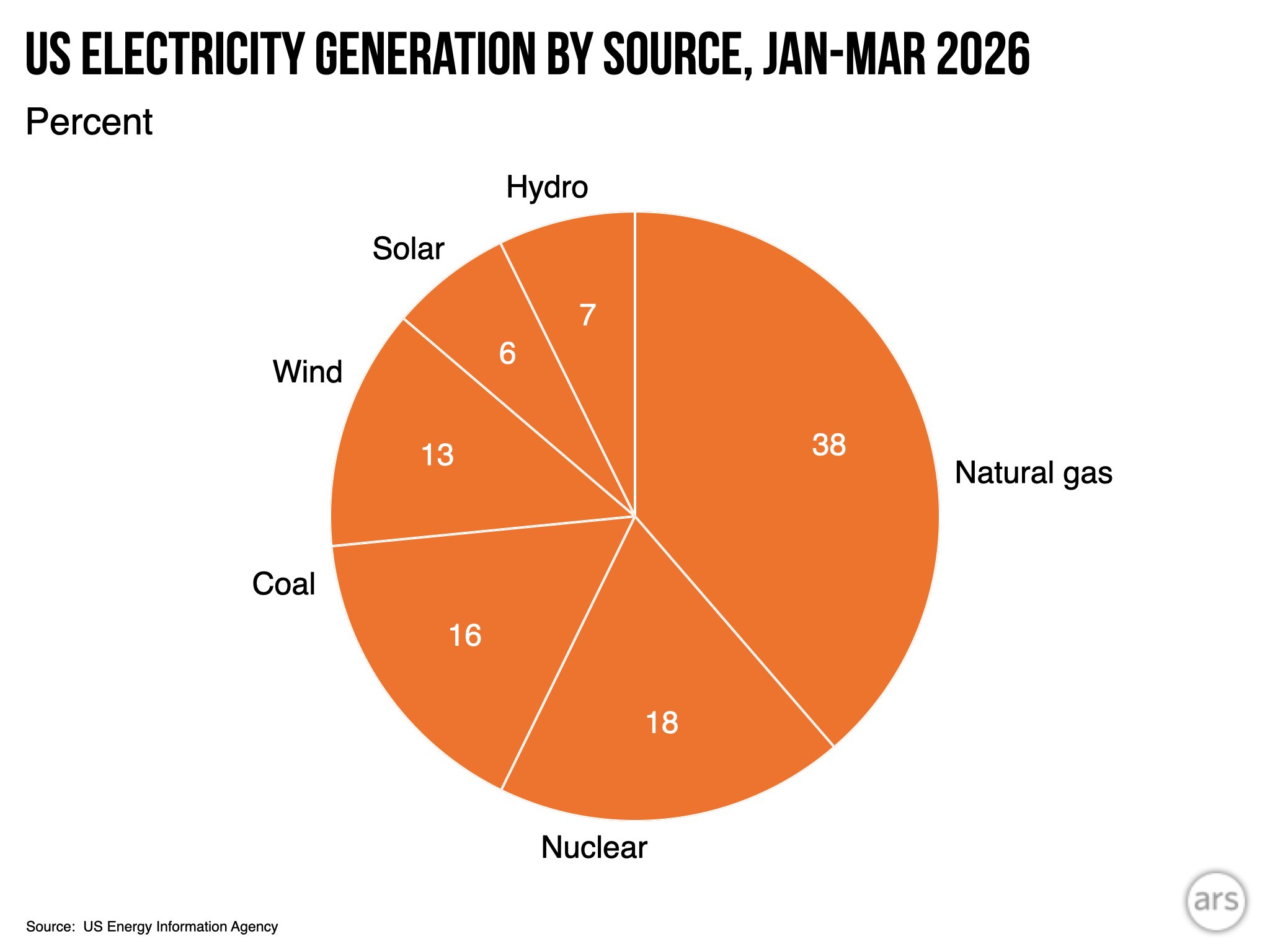
Overall, fossil fuels continue to generate about half the electricity put onto the grid, a figure that doesn’t change when you account for small-scale solar projects that produce power that never appears on the grid. The three major renewable technologies accounted for more than a quarter of the total. When nuclear power is also considered for emissions-free electricity, the total exceeds 45 percent.
While solar and hydro have swapped places, little else changed since 2025.
John Timmer
While solar and hydro have swapped places, little else changed since 2025. John Timmer
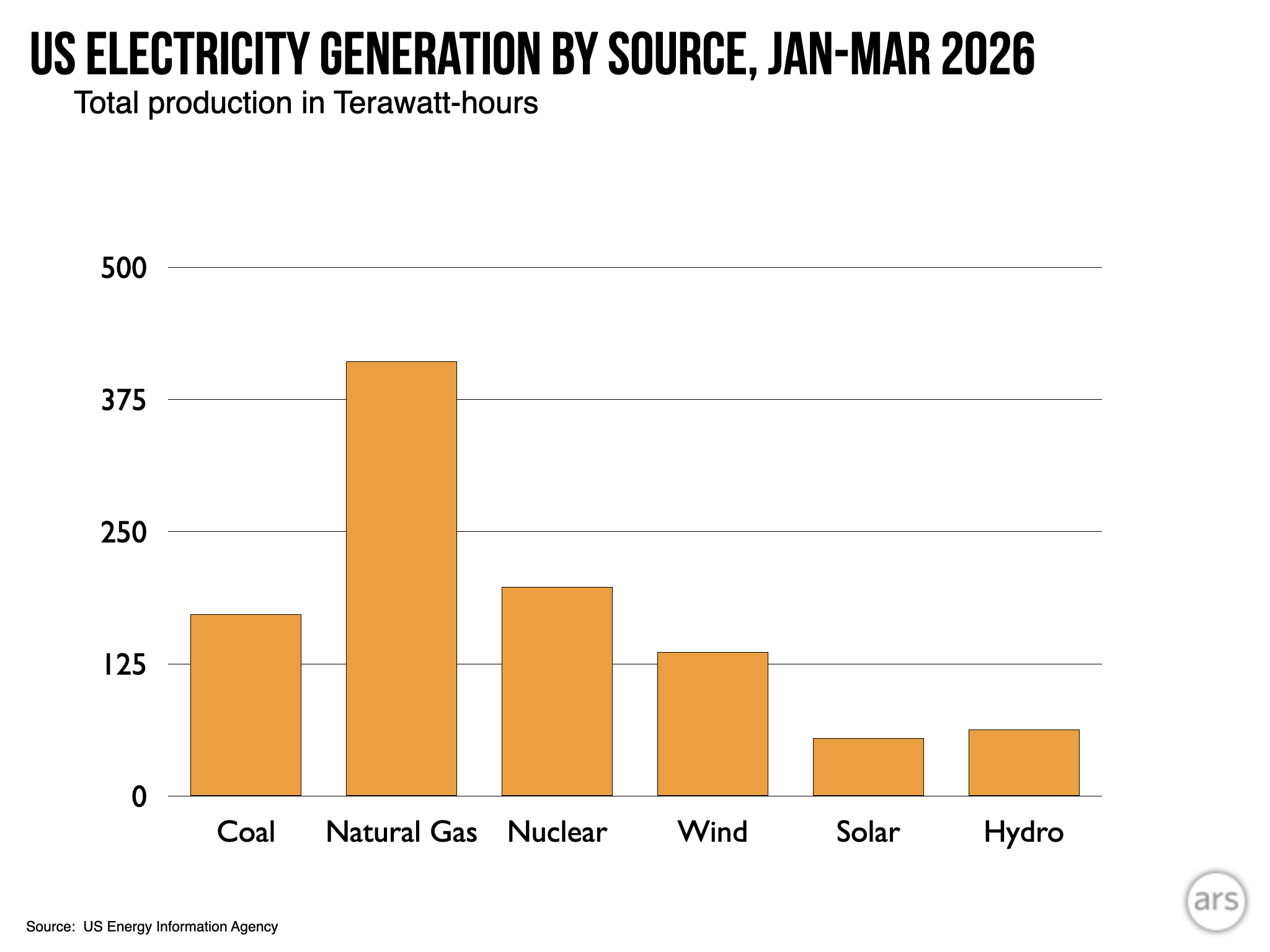
While natural gas continues to dominate, the carbon-free sources to its right have pushed coal down.
John Timmer
While natural gas continues to dominate, the carbon-free sources to its right have pushed coal down. John Timmer
While solar and hydro have swapped places, little else changed since 2025. John Timmer
While natural gas continues to dominate, the carbon-free sources to its right have pushed coal down. John Timmer
The major change compared to last year’s data is that the surge in hydro moved it slightly ahead of solar, which had passed it as a source of US electricity in 2025. That’s very likely to reverse before the year is over. We’re still building lots of solar projects, its peak months of productivity are just starting, and as mentioned above, hydro is likely to drop considerably before the year is over.
The most notable thing about the trends in generation is how they are roughly the reverse of the Trump Administration’s priorities. Despite multiple attempts to block its development, renewable power continues to grow, and wind is likely to benefit from the opening of the US’s first large offshore wind farms in 2025 and 2026. Meanwhile, coal is dropping even as the administration is ordering plants to stay open past their planned closure dates.
A lawsuit is in progress to challenge the legality of those orders, and the fact that coal is dropping would seemingly support the view that the orders are unnecessary.
This Easy Yogurt Cake is one of those simple, foolproof recipes you’ll find yourself making again and again. It’s soft, moist, lightly sweet, and bursting with fresh lemon flavor. Best of all, everything comes together in one bowl with minimal cleanup.
Made with basic pantry ingredients and creamy yogurt, this cake is perfect for breakfast, snack time, dessert, or even an afternoon coffee break. A light glaze of warm apricot or orange jam adds a beautiful shine and a delicate fruity finish that makes this humble loaf feel extra special.
If you love easy homemade cakes that taste comforting and wholesome, this yogurt cake deserves a permanent spot in your recipe collection.
Why You’ll Love This Yogurt Cake
Super easy to make – One bowl and simple ingredients.
Moist and fluffy texture – Thanks to the yogurt and oil.
Low in sugar – Lightly sweet without being overly rich.
Budget-friendly recipe – Made with affordable everyday ingredients.
Versatile – Customize with chocolate chips, berries, spices, or citrus zest.
Perfect anytime cake – Great for breakfast, dessert, or snacks.
Ingredients You’ll Need
For the Cake
1 cup plain yogurt
2 cups all-purpose flour or light spelt flour
1/2 cup sugar
1/2 scant cup vegetable oil
2 eggs, room temperature
2 teaspoons baking powder
1/2 teaspoon vanilla extract
Zest of 1–2 lemons
Pinch of salt
Optional Jam Glaze
3 tablespoons apricot or orange jam
How to Make Easy Yogurt Cake
Step 1: Prepare the Pan
Preheat your oven to 350°F (180°C). Grease a loaf pan or line it with parchment paper.
Step 2: Mix the Wet Ingredients
In a large mixing bowl, whisk together the eggs and sugar until combined. Add the oil, lemon zest, vanilla extract, and yogurt. Mix until smooth and creamy.
Step 3: Add the Dry Ingredients
Add the flour, baking powder, and salt to the bowl. Gently stir until just combined. Avoid overmixing the batter.
Step 4: Bake
Pour the batter into the prepared loaf pan and smooth the top.
Bake for 35–40 minutes or until a toothpick inserted into the center comes out clean.
Step 5: Add the Glaze
Warm the jam in a small saucepan until smooth and brush it over the warm cake for a glossy finish.
Let cool slightly before slicing and serving.
Tips for the Best Yogurt Cake
Use room-temperature eggs and yogurt for a smoother batter.
Don’t overmix the flour into the batter or the cake may become dense.
Add extra lemon zest if you love a stronger citrus flavor.
Greek yogurt can be used, but the cake may turn out slightly denser.
Let the cake cool completely before storing.
Delicious Variations
This yogurt cake is incredibly versatile. Try adding:
Chocolate chips
Fresh berries
Cinnamon or nutmeg
Orange zest instead of lemon
Chopped nuts
Coconut flakes
Storage Tips
Room Temperature
Store in an airtight container for up to 4 days.
Freezer
Wrap slices individually and freeze for up to 1 month.
Avoid refrigerating the cake, as it may dry out.
Frequently Asked Questions
Can I use gluten-free flour?
Yes! Rice flour or a gluten-free flour blend works well in this recipe.
What type of yogurt works best?
Plain regular yogurt with a pourable consistency gives the best texture.
Can I reduce the sugar?
Absolutely. This cake is lightly sweet already, so you can reduce the sugar slightly if preferred.
AIPAC, AI, Crypto and Gambling Are Hiding Their Big Election Spends
Republican Rep. Thomas Massie was decisively ousted on Tuesday night in his Kentucky primary, a win for President Donald Trump, who had launched an all-out attack on the congressman for his role in pushing for the release of the Epstein files. But in Pennsylvania, the left had a lot to celebrate. Chris Rabb won by nearly 15 points in Philadelphia in a major win for progressives. And Bob Brooks, a retired firefighter and union head, sailed to victory with the support of both the left and moderates.
Mysterious super PACs with ties to Republican donors poured millions into influencing the election results in both states with varying degrees of success. In Kentucky, AIPAC’s super political action committee and two other groups backed by pro-Israel donors spent more than $15 million in opposition to Massie or in support of his opponent, according to Federal Election Commission reports released through Tuesday.
In Pennsylvania, advertisements from Lead Left — a super PAC that reportedly has ties to Republican donors — dropped ads attacking two of the candidates as not progressive enough, leading to speculation that Republicans were trying to prop up a weaker candidate for the general election.
This week on The Intercept Briefing, host Jessica Washington and politics reporter Matt Sledge break down the contentious primary races, the record-level campaign spending and how obscure groups funding the midterm elections are hiding donors’ tracks.
“Groups can kind of game campaign finance deadlines and create super PACs to funnel money to other super PACs so that reporting deadlines are missed and use these ‘pop-up super PACs’ to ensure that ordinary voters never find out who is funding ads before a campaign happens,” says Sledge. “Sometimes there’s even a second layer of pop-up super PACness where those bland-sounding groups send money to other bland-sounding groups. God help you if you’re an ordinary voter trying to track all this money.”
The consequential U.S. Supreme Court decision in Citizens United 16 years ago has allowed courts to chip away at campaign financing restrictions. “Now here we are where any industry that’s facing regulation or any donors who support an unpopular cause can really just open the spigots and try to throw primaries their way,” adds Sledge.
Certain industries have gotten smart about how to hide where the money is coming from. “Ordinary voters don’t generally like crypto, AI or gambling. They may tolerate it at a maximum, but they’re not motivated by the idea of electing pro-crypto, pro-AI, pro-gambling people,” notes Sledge. “But all of these industries have realized, ‘OK, we can use super PACs that run ads that have nothing to do with our industry and get our friends elected to Congress, and they are going to remember that we spent a lot of money on their races.’”
For more, listen to the full conversation of The Intercept Briefing on Apple Podcasts, Spotify, YouTube or wherever you listen.
Transcript
Jessica Washington: Welcome to The Intercept Briefing. I’m Jessica Washington, politics reporter at The Intercept.
Matt Sledge: And I’m Matt Sledge, another politics reporter at The Intercept.
JW: Today, we’re going to dive right in because I know we’re both exhausted. We were both up late covering the Kentucky and Pennsylvania primaries. Matt, we’re speaking Wednesday morning, fresh off of that Kentucky primary election, where President Donald Trump endorsed Republican Rep. Thomas Massie’s opponent.
Massie decisively lost his race. Is this proof that despite inflation, gas prices, the war in Iran, Trump is still a kingmaker, or I guess in Massie’s case, a hangman?
MS: Certainly when it comes to the Republican Party and intraparty politics, some people thought Massie might pull this out, and instead it was a pretty humiliating defeat for a long-term incumbent in the House.
“This is a party-on-party fight. Trump took out a guy who votes conservative nearly all the time.”
But you do have to step back a little bit and remember, this is a party-on-party fight. Trump took out a guy who votes conservative nearly all the time, and it’s a safe Republican district. So he spent a lot of political capital taking out one Republican to replace with another Republican, essentially because he was mad about the Epstein files.
JW: The Epstein files is an interesting part of all of this because Thomas Massie fought so hard to get the Epstein files released. We talked about it on the podcast with one of the attorneys for some of Epstein’s survivors, and it did seem like an issue that was breaking out politically.
Democrats have been speaking about it. I actually heard at the Center for American Progress’s event on Tuesday, House Minority Leader Hakeem Jeffries actually spoke about the Epstein files and talked about it as a top issue for Democrats. So we know this is something that they are trying to make an election issue, but it doesn’t seem like it worked for Massie. Why do you think that is?
MS: I think it’s because it cut against the president so much and, just in the larger picture, enraged the president and turned him decisively against Massie. They had their problems before. I think it was hard for Thomas Massie to argue in his district that getting the Epstein files released was a great coup but also that it didn’t harm the president, because it clearly did harm the president politically. Ultimately, the voters in his district decided that helping the president was more important than anything else.
JW: We also know that pro-Israel groups poured money into this race as well to try and defeat Thomas Massie. Is there anything that you can say about that?
MS: Yeah, it was a lot of money. It was over $15 million from two explicitly pro-Israel groups, super PAC affiliated with AIPAC and then a Republican pro-Israel group. Then also there was a kind of special purpose-created super PAC that was funded in large part by pro-Israel donors. So this was the most expensive House race in history. A huge percentage of that spending came from donors who were motivated by the issue of Israel.
Massie has always opposed foreign aid in general, but I will say he has seemed to take special delight in tweaking supporters of Israel. Obviously that is a minority position within the Republican Party, so these groups came for him, and they were successfully able to help the president oust him.
JW: We’re going to talk a little bit more about how super PACs are hiding where their money is going in this election. But before we do that, I wanted to touch a little bit more on Democratic primaries from last night. So Pennsylvania had some big primaries. Are there any top lines from that race you want to share?
MS: I wasn’t following Pennsylvania as much, but of course, everybody was watching that race in Philadelphia, where Chris Rabb was able to pull out a victory. That’s a huge win for the Democratic Socialist wing of the party. He was up against a more establishment Democrat, and it shows that there is this really energized cohort within the Democratic Party that’s really excited to elect progressives.
JW: As I mentioned at the beginning of this podcast, I was up covering that race. One really interesting thing, aside from the Philadelphia primary, was in Pennsylvania 7, the Pennsylvania governor, Josh Shapiro, ended up backing — really heavily backing — Bob Brooks, one of the more progressive candidates in that race. We also saw Bernie Sanders backing him and the Working Families Party. So we saw this coalition effort between more mainstream center-left and progressives which is obviously different than what we saw in Philadelphia, but it’s interesting to see how those two coalitions could work together in Congress.
And Matt, I want to talk a little bit more about how super PACs are operating in this race. You have a new piece out this week that gets into all of that. So it’s about groups that are funding the 2026 midterm races. You looked at a dizzying array of players who are throwing money into this election cycle.
Before we get into some of those players and the issues they’re pushing, can you set the stage for us? How would you describe the current campaign finance landscape?
MS: It’s just kinda anything goes, and we’ve seen this gradual and then not so gradual evolution from the Citizens United decision in 2010, which opened the doors for allegedly independent spending on elections. The courts have just chipped away at whatever protections there are. Then the Federal Election Commission (FEC) has refused to get in the way of some pretty questionable behavior.
Now here we are where any industry that’s facing regulation or any donors who support an unpopular cause can really just open the spigots and try to throw primaries their way. A lot of time, they’re doing it in ways that cover their tracks a little bit, and they’re running ads that have nothing to do with their chosen issues.
JW: I want to get into the history of this, how we even got there. Citizens United is, I would argue, a boogeyman, not just for the left, but anyone who cares about democracy at all. Can you remind us how that SCOTUS decision really changed the landscape for how campaigns are funded and how we’re seeing that evolve in this election cycle?
MS: It is a boogeyman on the left and elsewhere, but I would say a boogeyman for good reason. A truly significant Supreme Court decision that basically said, individual candidates running for office, we can still limit, how much they’re raising and through that, how much they’re spending on elections, but these allegedly independent spenders, groups like super PACs, can spend as much money as they want on a race because they have no connection to the candidates.
There is no danger of corruption, and that’s really what we’re interested in policing here. We don’t want to police free speech. It essentially equated political spending with free speech, which a lot of people would take issue with.
One of the things that has been really interesting, I say interesting with some chagrin, as this system has evolved, is that we are now in this place, and I wrote about this in my recent article, where groups can kind of game campaign finance deadlines and create super PACs to funnel money to other super PACs so that reporting deadlines are missed and use these “pop-up super PACs” to ensure that ordinary voters never find out who is funding ads before a campaign happens.
Some of these newer industries that are getting in on the campaign spending game, like crypto and artificial intelligence, are also setting up entire networks of super PACs, sometimes a mama or a papa super PAC, and then a Democratic-affiliated super PAC and a Republican-affiliated super PAC so that both donors can channel their money to one party affiliate and to make it a little harder for voters to track where all the money is coming from.
JW: I really recommend that people go check out your piece. I think it’s an amazing glossary on what’s happening in our elections and the aftermath of Citizens United 16 years later.
This isn’t just about AI or crypto, as you’ve mentioned. There’s also AIPAC. The Intercept has reported extensively on the American Israel Public Affairs Committee, which has been spending directly on campaigns for a little while now.
In 2024, our colleague Akela Lacy wrote, “AIPAC embraced a new strategy. It would use its vast funds to oust progressive members of Congress who criticized human rights abuses by Israel and the country’s receipt of billions of U.S. dollars in military funding.” Matt, how is AIPAC operating this election cycle?
Given that there’s growing opposition on both the left and the right to Israel’s genocide in Gaza and influence in U.S. politics, is the group changing its tactics?
“AIPAC’s brand is in the dumps. Israel’s brand is in the dumps with Democrats as well. ”
MS: AIPAC’s brand is in the dumps. Israel’s brand is in the dumps with Democrats as well. You see even very pro-Israel Democratic politicians saying, “I’m not taking AIPAC money.” What the group has done is really make use of these pop-up super PACs. So it’s no longer the United Democracy Project, which is AIPAC’s primary super PAC affiliate spending money in these races. It’s groups with very bland, friendly-sounding names, and AIPAC’s super PAC affiliate sends money to them.
Sometimes there’s even a second layer of pop-up super PACness where those bland-sounding groups send money to other bland-sounding groups. God help you if you’re an ordinary voter trying to track all this money. All you see are negative ads attacking candidates on issues that have nothing to do with AIPAC or Israel.
JW: You just teased it a bit, but I know you poked around some FEC, — Federal Election Commission — reports, for a recent Chicago race and found some interesting information about how AIPAC donors were operating in the race. First, can you tell us what happened in Chicago, and what did you find in the reports?
MS: In Chicago, there was a newly created group called Elect Chicago Women, which sounds great. Who doesn’t want to elect Chicago women? They received money from the United Democracy Project, which is AIPAC’s super PAC affiliate. Then they turned around and handed a million dollars to another newly created group called the Chicago Progressive Partnership. It’s a little surprising they didn’t add “and apple pie” at the end of that.
“It tweaked things so that under the FEC’s campaign finance rules, the donors for that money did not have to be disclosed until after the race. ”
So basically what that did is it tweaked things so that under the FEC’s campaign finance rules, the donors for that money did not have to be disclosed until after the race. In, for instance, the 9th Congressional District primary, there was this really hotly contested race between a progressive and an even more progressive candidate, both of whom were not favored by AIPAC.
AIPAC attempted to, through these super PACs, play the spoiler and boost an entirely different super left progressive candidate to hurt Kat Abughazaleh, the influencer. You could argue it worked because she didn’t lose by that much, and they may have successfully employed this tactic. They didn’t ultimately get their chosen candidate over the line, but they did help a candidate they really disliked lose.
JW: We saw this in Pennsylvania on Tuesday night as well. There’s this group, Lead Left, and the New York Times had reported, as well as Punchbowl, on some interesting ties that they had to Republican groups while also trying to sandbag the progressive candidates in the race by arguing that they weren’t really progressive or that Ryan Croswell, who no one would really argue is a progressive, is, just hiding and is really a Republican.
So we’ve seen this in other races, but I wanted to ask, what other races you’ve seen this happen in and what might be of interest to people here?
MS: Yeah, there’s something that’s really interesting happening in Michigan right now where there’s another one of these newly created groups spending a lot of money to boost Haley Stevens, who’s AIPAC’s preferred candidate in the race.
They are using a consulting firm that AIPAC’s super PAC has used in the past to buy television ads. But AIPAC came out and said, it’s not us. We’re not spending this money. As far as I can tell, nobody has gotten to the bottom of this, of where this money is coming from. I think there are several different ways where AIPAC could say it’s not us and for it to be technically true.
But perhaps there really is some other mystery group behind all of this spending. But it’s really telling. This is a super high profile Senate race, a lot of journalists on it, a lot of eyes on it. Whoever is behind this money has so far been able to successfully conceal its origin.
I think it’s really hard to argue that it is good for voters to not know where this huge amount of money in the race is coming from.
[Break]
JW: For those who don’t know, you’re effectively our crypto, gambling, AI lobby reporter on top of everything else you do. Obviously there’s been a lot of crypto, gambling, and AI money flooding the system right now. Where are you seeing that money going this season?
MS: A lot of it so far is being spent in these primaries, and a lot of it in the Democratic primaries is being spent to elect flexible centrist candidates.
The thing with all of these industries is ordinary voters don’t generally like crypto, AI, or gambling. They may tolerate it at a maximum, but they’re not motivated by the idea of electing pro-crypto, pro-AI, pro-gambling people. More often the contrary within the Democratic Party. But all of these industries have realized, “OK, we can use super PACs that run ads that have nothing to do with our industry and get our friends elected to Congress, and they are going to remember that we spent a lot of money on their races.”
The likelihood of backlash from voters who have a million other things to keep track of is pretty small. Politicians are just going to decide, “Let’s keep our head down and not piss off crypto, AI, and gambling,” even though those are pretty unpopular industries.
JW: I have to say, when I was at the Center for American Progress event on Tuesday listening to Gavin Newsom, Hakeem Jeffries, the whole Democratic establishment try to figure out how to plot a lane in the AI fight, I kept thinking Matt would find this hilarious.
A lot of saying a lot without saying anything.
MS: Yes, they would like to protect our children without actually doing anything.
JW: Yeah. It did, It was giving a little bit of that.
On that note, The New York Times reported that the Silicon Valley venture capital firm Andreessen Horowitz is the biggest donor this midterm cycle by a long stretch.
The firm’s co-founders, Marc Andreessen and Ben Horowitz, have dumped more than $115 million into the cycle so far. For context, Democratic mega-donor George Soros has put in about $102 million, Elon Musk $85 million, and Wall Street financier Jeff Yass $81 million. Is this kind of spending standard for midterm elections?
What are the priorities being pushed here, in particular by these tech billionaires who are pouring a ton of money into these elections?
MS: Andreessen Horowitz is a really fascinating case study in all of this. They have major investments in crypto and AI. They created this massive crypto super PAC network in the last election cycle. They saw that it was a success, and they are just repeating the pattern for artificial intelligence this cycle, and they’ve gotten some of their friends in the AI industry to spend a bunch of money as well.
As you pointed out, it’s a lot of money even in comparison to other billionaires. I think the explanation for that is that they are in highly regulated industries, or at least industries that should be highly regulated, and we’re at a moment where the rules are being set, and they have recognized an opportunity to have their friends set the rules.
“They have recognized an opportunity to have their friends set the rules.”
JW: Following the money a little bit further down the road, former MAGA influencer Ashley St. Clair has been gaining a lot of attention on social media for posting videos where she alleges — in detail — how the White House and powerful figures on the right coordinate messaging with paid influencers.
Here’s a clip of her in a recent interview on Zeteo.
[Clip]
Ashley St. Clair: There’s multiple chats that they operate in, and these chats also have— Some are just sequestered to large MAGA influencers in which they send these paid campaigns. Others have members of the administration. Others have the Trump children. And they coordinate this messaging and react to things in real time: Here’s how we respond or don’t respond to any given issue at any given time.
They also have the paid campaigns in which messaging is pushed out, and it is very much coordinated through both paid messaging and just wanting to be in the club and not be ostracized.
[End of clip]
JW: Democratic California gubernatorial candidate Tom Steyer is being accused of not properly disclosing that his campaign paid influencers $10,000 each to promote him.
What is known about how influencers and messaging are factoring in elections today? What do you make of all this, Matt?
MS: Yeah, I think we definitely have to take anything Ashley St. Clair says with a huge grain of salt, but—
JW: Good point.
MS: At the same time, I think she’s also probably getting at something. We all saw after the latest assassination attempt how all these influencers immediately argued that we needed to build Trump’s big, beautiful ballroom, and then a lot of people were questioning how they were able to all land on the same message so quickly.
It’s clear when you watch any influencers online that half of them are being paid off, so it’s the most natural thing in the world in one way for politicians and campaigns to get in on it. What is really missing here, what’s really missing in this conversation is the question of regulation and disclosure.
If we had a functioning FEC, they might step in and say, “Whoa, you need to disclose when you’re paying off influencers because that should be something the public knows about.” Instead, we don’t have a functioning FEC or a functioning Congress, so nobody is stepping in to make sure that disclosures are happening.
“Disclosure should be a bare minimum.”
Disclosure should be a bare minimum. Maybe this should be banned outright as well. But we, at the very least, should have clarity on when this is happening, and not just within the context of campaigns but also in the context of politics more broadly.
JW: Those are all really good points.
The lack of any kind of regulation about this is troubling. We’ve obviously been talking about money and where it’s going and how it’s going to influencers, into campaigns, into shady super PACs, but what issues do voters actually care about this election cycle? You and I have covered campaign finance. We’ve covered ICE. But what issues are actually breaking through to voters?
MS: Yeah, I think it’s going to be the economy first and foremost, and then the war on Iran as an extension of the economy, because it dovetails with these concerns about affordability so strongly.
Some of the centrist Dem messaging around affordability is super cringe. But it’s also true that it’s a very important issue for voters. I think it has been rightly identified as a major issue that is just going to dominate everything over the next few months.
I don’t know how much ICE and the crackdowns will really play into the elections. My guess is that’ll be more of a primary issue. Democrats who voted for the Laken Riley Act, for instance, will have problems in primaries over that. But when you look at the polls in the general election, immigration is still one of Trump’s best issues. His numbers have definitely eroded there, but it’s better than everything else by about 10 points.
So I don’t know if that’ll be as much of an issue that candidates are highlighting in the general elections.
JW: On immigration, I do keep thinking that if the elections had been held earlier when everything that was happening in Minnesota that was enraging people. I think that was an issue about immigration, but it was also really an issue about democracy, about people’s right to protest, about the rights that they assumed they held as American citizens to protest against their government.
I want to pivot a little bit to talk about an issue that we’ve been discussing on the show quite frequently, which is the fallout from the SCOTUS decision. So the Supreme Court ruled in favor of essentially gutting the Voting Rights Act, which unleashed a new wave of redistricting wars that have been sparked particularly in the South to eliminate minority-majority districts.
Meanwhile, last week, the Virginia State Supreme Court rejected a voter-approved gerrymandering effort that would have boosted Democrats’ chances of gaining four seats in the House. How are you seeing the redistricting wars take shape? Are there any places you’re keeping a particularly close eye on?
But, I think in a week or two, we might have hit a wall on the redistricting wars just for practical reasons, because primaries are coming so fast and early voting has opened in so many places. Mississippi, for instance, the governor there has said he’s not going to push redistricting this year, I think essentially just because of the timing.
So we may finally be settling in the place we’re going to be for the elections, and it looks like a net loss of a few seats for the Democrats, which could be really significant if the outcome of the House elections is that close. On major votes in the House right now, it’s only a few votes either way could shift them.
JW: Speaking at the Center for American Progress event, House Minority Leader Hakeem Jeffries had mentioned that they expect to lose about three or four seats as a result of these redistricting efforts in the South, but they have obviously expressed some confidence in being able to overcome those odds.
Are there other midterms races or themes this cycle that you wanted to talk about?
MS: I think that Michigan Senate race is going to be a huge one. It just gets at so many issues, both of style and substance, of where Democratic voters want to go. That, to me, is really high on the list. This California governor’s race is also fascinating in its own kind of train wreck way. So we’ll see how things go there. Really makes you think how important electoral rules are because we could see some crazy outcome that ordinary voters don’t particularly want.
JW: California is the mess that keeps on messing.
MS: OK. Jess, I gotta turn the tables on you. Any other races that you’re watching, no matter how obscure they are?
JW: I am a DC native, and I also live in DC, so I am following the DC mayoral race, which I know is probably not on most people’s radar who do not live in DC, but it’s fascinating. It’s become this debate really around youth crime and these efforts to restart mass incarceration, I would argue, in DC.
So that’s become a really interesting electoral issue between the two more progressive candidates, Janeese Lewis George, who has really fought against these teen curfews, and Kenyan McDuffie, who has been really pushing for these curfews even though he’s tried to paint himself as more of a progressive. So I think that race, although it’s a mayoral race and might not have much impact outside of DC, has been fascinating to watch for me personally.
And with that little tidbit from me, I am going to leave it because I know we are both exhausted. Matt, thank you so much for joining us on the Intercept Briefing.
We’ll add a link to Matt’s story in the show notes.
MS: Thanks for having me on.
JW: That does it for this episode.
This episode was produced by Laura Flynn. Ben Muessig is our editor-in-chief. Maia Hibbett is our Managing Editor. Chelsey B. Coombs is our social and video producer. Fei Liu is our product and design manager. Nara Shin is our copy-editor. William Stanton mixed our show. Legal review by David Bralow.
Slip Stream provided our theme music.
This show and our reporting at The Intercept doesn’t exist without you. Your donation, no matter the amount, makes a real difference. Keep our investigations free and fearless at theintercept.com/join.
And if you haven’t already, please subscribe to The Intercept Briefing wherever you listen to podcasts. Do leave us a rating or a review, it helps other listeners to find us.
Let us know what you think of this episode, or If you want to send us a general message, email us at podcasts@theintercept.com.
Is the US preparing for military action against Cuba? Expert Q&A
A US court filed criminal charges against Cuba’s 94-year-old former leader, Raúl Castro, on May 20. Castro has been charged with conspiracy to kill US nationals, four counts of murder and two counts of destruction of aircraft. The charges relate to a 1996 incident in which four men were killed after Cuban fighter jets shot down two planes belonging to an exile group from Miami.
The indictment comes at a time when tensions between the two countries are running high, and raises the possibility that the US could try to remove Castro from the country by force, to be brought to trial in the US. We spoke to Anna Grimaldi, a lecturer in global development and Latin American studies at the University of Leeds, about the prospect of military action.
Is there any evidence of Raúl Castro’s involvement in shooting down the aircraft?
Raúl’s brother, Fidel Castro, who was the Cuban president at the time, took responsibility for the 1996 incident shortly after it took place. But US prosecutors argue that, as the then-defence minister, Raúl’s direct orders for Cuban forces to train in tracking and intercepting aircrafts constituted an operational role in the planning phase of the shooting.
In reality, the basic facts of the incident are still unclear. The US maintains the planes were unarmed and flying in international airspace, which would make the downings unlawful. But Cuba argues the aircraft were part of repeated and deliberate violations of its airspace and sovereignty.
Cuban officials continue to frame the attack as a justified act of self‑defence against ongoing provocation. And in any case, Cuban law explicitly prohibits the extradition of its citizens to another country. So unless the US stages an operation to seize Castro, he is unlikely to face trial in the US.
The acting US attorney general, Todd Blanche, announces the indictment against Castro on May 20.Cristobal Herrera-Ulashkevich / EPA
Could the US be using the charges as a pretext for military action against Cuba?
Raúl Castro’s indictment has raised familiar alarm bells. A few months ago, the US carried out a military operation along similar lines in Venezuela which resulted in the capture of the sitting president, Nicolás Maduro. At that time, the US alleged Maduro was involved in drug trafficking and had partnered with cartels designated as terrorist groups.
The US is keeping its options open in Cuba. When asked by reporters following Castro’s indictment whether there could be an arrest similar to Maduro, Trump said: “I don’t want to say that.” Yet he has persistently hinted an interest in carrying out what he calls a “friendly takeover” of Cuba. The Cuban president, Miguel Díaz‑Canel, says this threat alone “constitutes an international crime”.
At least for now, there is little to suggest Washington is actively preparing to intervene in Cuba militarily. In comments to the Associated Press in early May, US officials speaking on the condition of anonymity stated they are “not looking at imminent military action against Havana”.
Cuba’s military doctrine, which is oriented primarily towards territorial defence and in which every citizen is considered a participant, means that military intervention would probably be prolonged. It would also be politically and financially costly.
When fears of retaliation (Cuba lies just 90 miles from Florida) and existing US military commitments elsewhere are also considered, such an intervention looks unlikely in the near term.
The US is much more likely to continue its campaign of indirect pressure, which has intensified in recent years but ultimately stretches back to the Cuban revolution in 1959.
The US regime of sanctions and fuel blockades is crippling Cuba’s economy. Washington appears to be pursuing a strategy of straining the Cuban regime internally, while simultaneously constructing the legal and political justifications for escalation.
Would a Venezuela-style operation in Cuba even be possible?
There are some similarities between the Venezuelan and Cuban cases. By targeting a sitting and former head of state, the US has tried to delegitimise the political leadership of both countries. Cuba and Venezuela have also both faced deep economic crises, heightening their vulnerability to external pressure.
However, there are significant structural differences between the two countries. Venezuela represents a strategically valuable resource for the US, with US policy there closely tied to control over its oil reserves. Cuba lacks comparable material incentives, and has instead been subjected to a long-term embargo and containment strategy.
Cuba’s centralised one‑party system and entrenched institutions also contrast with Venezuela’s more fragmented and weakened state apparatus. And Cuba’s long history of confrontation with the US has fostered a political culture of resistance. Together, these make an operation to impose regime change much less viable.
Cubans attend a rally in Havana on May 1, amid US pressure.Ernesto Mastrascusa / EPA
Is there an opposition movement inside Cuba that would back US military action?
There is no unified political opposition in Cuba. Expressions of dissatisfaction there have frequently taken place through mass emigration, with the island’s one‑party system and other mechanisms of state control constraining the ability of opposition groups to organise and expand.
Rare protests have erupted in Cuba in recent months. But this dissent appears to have be driven largely by material grievances, with reports of demonstrators chanting slogans such “turn on the lights” amid blackouts, rather than an organised political agenda.
At the same time, the external pressure from the US has produced nationalist mobilisation and demonstrations in defence of Cuban sovereignty. Mass rallies throughout the country have framed US threats against Cuba as imperial aggression, emphasising unity and resistance against external intervention.
Dissatisfaction with the Cuban government does exist. But so far, it seems to remain rooted in economic and domestic concerns, rather than translating into alignment with US objectives or welcoming possible intervention.
Two-state Israel-Palestine solution is Washington’s empty liturgy
When the United Nations Secretary-General António Guterres declares, once again, that “the only way” out of the Israeli-Palestinian impasse runs through two states, one is reminded less of a policy proposal than of a Latin Mass. The words are sacred. They are repeated on schedule. The faithful nod. Whether anyone present believes they describe the world as it is — or as it will be — has long since become beside the point.
That is the condition of the two-state solution in 2026: an article of diplomatic faith floating above a reality that has been moving in the opposite direction for 30 years. The ceasefire that took effect in Gaza last October; the recognition of Palestine by Britain, France, Canada, Australia and a half-dozen others the month before; the shuttering of the PLO mission in Washington; the approval of the E1 settlement that all but bisects the West Bank — none of these events points toward partition.
Several of them quietly close the door on partition. And yet the Quartet, the General Assembly, the editorial pages of the New York Times, and a depressingly large portion of the American foreign policy establishment continue to recite the formula, as though incantation were a substitute for cartography.
It is worth recalling that the two-state idea, in the form Washington now defends, is not ancient. It dates, in practical terms, to the Oslo Accords of 1993 — a framework whose architects, the late Yitzhak Rabin and Yasser Arafat, are both more than a quarter-century gone, along with the political coalitions that produced them.
The Israeli Labor party that signed Oslo has been a marginal force for two decades. The Palestinian Authority that emerged from it is propped up by donor money and survives at the sufferance of an Israeli security apparatus that no longer pretends to regard it as a partner. Mahmoud Abbas, now in the twenty-first year of a four-year term, governs a fragment of the West Bank while Hamas — battered, decapitated, and still standing — retains de facto authority over what remains of Gaza.
To call this a “peace process” requires the kind of imagination one used to associate with Soviet five-year plans.
The conventional response to all of this is to say that the alternatives are worse. A one-state outcome, the liberal-Zionist argument runs, will either extinguish Israel’s Jewish character or render it formally what its critics already call it. A continued status quo — military occupation indefinitely extended — corrodes Israeli democracy and condemns Palestinians to permanent statelessness. Therefore: two states.
The logic is impeccable, in the manner that syllogisms tend to be. It is also unmoored from the facts on the ground.
Consider the demographics. Some seven hundred thousand Israelis now live east of the Green Line, in settlements whose growth has, if anything, accelerated since October 7. The ultra-Orthodox population that supplies a disproportionate share of new settlers has a fertility rate roughly twice that of West Bank Palestinians. The infrastructure — roads, utilities, a security architecture that treats the West Bank as a single operational theater — has been integrated for years.
The question is not whether dismantling all of this is politically difficult; the question is whether anyone in Israeli politics, including the dwindling remnant of the peace camp, believes it is operationally conceivable. Ehud Olmert, who offered something close to the maximum a sitting Israeli prime minister has ever offered, did so in 2008. The country has moved decisively to his right since.
The Palestinian side presents its own arithmetic. Hamas, which won the last election in 2006 that anyone bothered to hold, rejects the two-state framework as a matter of theology. Fatah accepts it but has spent two decades demonstrating that it cannot deliver on its end of any plausible bargain. The younger generation in Ramallah and Nablus, polled repeatedly, does not believe in the project either; it believes in resistance, or in emigration, or in some combination of both.
A negotiated settlement requires negotiating partners, and the supply of plausible ones on either side has been contracting for a generation.
What, then, accounts for the persistence of the formula? Inertia, partly. The diplomatic establishment, like any guild, defends the framework that justifies its existence. American Jewish organizations that once treated two-state advocacy as moderate centrism are reluctant to admit that the center has dissolved beneath them. European foreign ministries discover that recognizing a Palestinian state costs nothing and signals everything. None of this advances actual statehood by an inch, but all of it relieves the various parties of the burden of confronting what would.
The harder question — the one nobody in an official capacity wants to ask — is whether the conflict has any negotiated solution at all in this generation, or whether what lies ahead is something closer to the long Cypriot or Kashmiri equilibrium: an unresolved partition, managed rather than settled, with the international community’s role reduced to humanitarian palliation and rhetorical maintenance.
That latter outcome is grim. It is also, on present trends, what is actually happening. Pretending otherwise is not optimism; it is the displacement activity of an establishment that prefers its rituals to its problems.
A serious American policy would begin by acknowledging what every honest observer already knows: that the two-state solution, as a near-term political project, is dead, and that calling for its resurrection without proposing the wrenching steps that might revive it is theater.
Whether the United States should expend any further political capital trying to revive it — given the meager record of the past thirty years and the more pressing claims on American attention from East Asia to its own southern border — is a separate question, and one our political class has shown no interest in seriously asking. The first step is admitting the patient has died. The eulogies can come later.
This article was originally published on Leon Hadar’s Global Zeitgeist and is republished with kind permission. Become a subscriber here.
Spain to introduce job-matching plan for migrants granted legal status
Spain will introduce a plan to match migrants to jobs under a programme to grant legal status to about 500,000 undocumented workers to help drive economic growth, the country’s top immigration official told Reuters.
The programme, announced in January, has been criticised by far-right leaders in Spain and across Europe, but the Socialist-led coalition government argues migration will help the Spanish economy continue to outpace its European peers by creating a younger workforce as the general population ages.
Secretary of State for Migration Pilar Cancela said as of last week, the government had received over 200,000 applications in the programme’s first month. Many of these applicants were granted temporary work permits once their applications had been accepted for processing, she said.
She said it was a smart approach to immigration, which would make public services and pensions more sustainable.
Spain needs approximately 2.4 million more people paying into social security over the next decade to sustain its welfare state, according to official estimates.
Authorities, supported by NGOs and dedicated offices, were ready to cope with up to one million applications – twice the expected demand – and have a plan to help migrants find formal jobs, Cancela said.
Think-tank Funcas estimates there are around 840,000 undocumented migrants working off the books, mainly from Latin America.
OUT OF THE SHADOWS
The job-matching strategy aims to move thousands out of the shadow economy to stem labour shortages in key sectors.
“It’s a huge opportunity to harness the potential of all these people who are already helping to build the country alongside us, often working in precarious conditions,” Cancela said, adding “real integration” would follow once they find a formal job.
The Migration Ministry will conduct a voluntary survey of those granted provisional work permits to understand their skills and where they would like to work.
The government is partnering with business groups in the construction, tourism, transport and care services sectors to assess labour demand and coordinate with regularised migrants looking for work.
A research paper by Esade Business School warned that a previous programme to regularise migrants in 2005 led to some job losses in the informal sector.
It recommended more labour inspections and programmes to support the transition to formal employment.
Cancela said the ministry’s plan would also be accompanied by increased labour inspections.
“I think it’s also a major opportunity to bring certain situations to light, because when people come forward in the regularisation process, we will learn about their circumstances,” she said.
Shavuot: Wheat Harvest, Sinai, and Cheesecake, Oh My!
The holiday links a 49-day biblical count with later traditions of all-night study, the Book of Ruth, conversion, and Israel’s exuberant dairy-table culture
Shavuot is one of Judaism’s three biblical pilgrimage festivals, but it is also the holiday whose meaning changed most dramatically over time. In the Torah, Shavuot is an agricultural festival: the wheat harvest, the offering of first fruits, and the celebration that comes after a 49-day count beginning during Passover. In later Jewish tradition, it became the festival of the giving of the Torah at Mount Sinai. In modern Israel, it is all of that—and also a national dairy showcase, when supermarkets become shrines to cheese, bakeries compete over cheesecakes, and newspapers suddenly remember they have recipe sections.
The name Shavuot means “weeks.” The holiday comes after a “week of weeks”: seven full weeks counted from the beginning of the barley harvest season during Passover. Leviticus 23 commands the Israelites to count seven complete weeks from the day of the Omer offering and then celebrate on the 50th day. Deuteronomy 16 similarly speaks of counting seven weeks from the time the sickle is first put to the standing grain. That is why Shavuot is also known in English as the Festival of Weeks. It is the Jewish Pentecost, from the Greek word for “fiftieth,” though in Jewish usage the Hebrew name keeps the focus on the seven-week count.
That count is known as Sefirat HaOmer, the Counting of the Omer. An omer was a biblical measure of grain, and the Omer offering marked the new barley harvest. For seven weeks, Jews count each day, beginning on the second night of Passover and continuing until Shavuot. In agricultural terms, the count links the barley harvest of Passover to the wheat harvest of Shavuot. In religious terms, later tradition transformed those seven weeks into a period of spiritual preparation: from liberation in Egypt to covenant at Sinai. Freedom, in this reading, is not complete until it becomes responsibility.
The Torah itself does not explicitly say that Shavuot commemorates the giving of the Torah. That may surprise many Jews, because in synagogue liturgy, Shavuot is called zman matan Torateinu, “the season of the giving of our Torah.” Biblically, though, the holiday is framed as a harvest festival and a day of sacred assembly. Exodus calls it the Festival of Harvest; Deuteronomy describes it as the Festival of Weeks; Numbers lists its sacrificial offerings. Sinai is not named as the reason for the festival.
The association with Sinai comes from chronology and rabbinic tradition. The Israelites leave Egypt in the middle of the month of Nisan. Exodus 19 says they arrive in the wilderness of Sinai in the third month after leaving Egypt. Rabbinic tradition then works through the dates of the Exodus journey and concludes that the revelation at Sinai took place at the beginning of Sivan, around the same time as Shavuot. The Talmud records a dispute: the sages say the Ten Commandments were given on the sixth of Sivan, while Rabbi Yose says the seventh. Either way, rabbinic Judaism came to identify Shavuot not only with wheat and first fruits, but with the moment Israel received the Torah.
That shift gave the holiday a new center of gravity. Shavuot became not only a celebration of what grows from the earth, but of what was revealed from heaven. The agricultural festival of harvest became the covenantal festival of Torah. The two meanings never entirely displaced each other. They sit together: bread and revelation, grain and law, land and learning.
One of the best-known Shavuot customs is staying up all night studying Torah, known as Tikkun Leil Shavuot. In many communities, the night is filled with Torah classes, lectures, study sessions, text learning, singing, and discussion. The custom has roots in kabbalistic tradition and developed strongly in Safed in the 16th century. A common explanation says that the all-night study repairs the failure of the Israelites, who, according to midrash, slept late before the revelation at Sinai and had to be awakened by Moses. Whether taken literally or not, the symbolism is clear: on the night before receiving the Torah, Jews try to be awake, alert, and ready.
In Israel, this custom has become a major cultural event, not limited to yeshivas or strictly Orthodox settings. Synagogues, community centers, secular cultural institutions, universities, neighborhood groups, and city halls host all-night learning programs. The subjects may range from Talmud and Bible to Israeli identity, ethics, politics, literature, philosophy, music, and current affairs. In some places, the night feels like a religious study marathon; in others, like a public festival of Jewish culture. Jerusalem, Tel Aviv, Haifa, kibbutzim, and small towns all have their versions. By dawn, the ambitious make their way to morning prayers; the less heroic make their way to coffee. Both are understandable.
Your people shall be my people, and your God my God
Shavuot is also linked to converts and conversion, largely through the Book of Ruth, which is traditionally read on the holiday. Ruth is a Moabite woman who follows her Israelite mother-in-law Naomi back to Bethlehem after the death of their husbands. Her declaration—“your people shall be my people, and your God my God”—became the classic biblical model of joining the Jewish people. The story takes place during the barley and wheat harvests, making it seasonally appropriate for Shavuot. It also ends with Ruth becoming the great-grandmother of King David, placing a convert at the root of Israel’s royal line.
The connection runs deeper than Ruth alone. At Sinai, the Israelites themselves entered into covenant. Rabbinic and later Jewish thought sometimes describes that moment as a kind of collective conversion: the people accepted the Torah and became bound by its commandments. Shavuot, then, is not only about one convert named Ruth. It is about the Jewish people’s own act of covenantal self-definition. Ruth’s story gives that idea a human face: loyalty, vulnerability, harvest fields, kindness, law, and belonging.
…honey and milk are under your tongue…
Then there is the dairy. Shavuot is the holiday of Torah, harvest, and—at least in the modern Jewish stomach—cheesecake. The custom of eating dairy foods has several explanations. One is symbolic: Torah is compared to nourishing sweetness. Song of Songs says, “honey and milk are under your tongue,” a verse rabbinic tradition applies to Torah. The promised land is also described as “flowing with milk and honey,” so dairy foods evoke both Torah and the land’s abundance.
Another explanation is legal and narrative. When the Israelites received the Torah, they also received the laws of kosher slaughter and food preparation. According to this tradition, their existing meat and utensils were no longer usable without proper preparation, and because the revelation occurred on Shabbat, they could not immediately slaughter animals or kasher their vessels. So they ate dairy. This explanation is later and homiletic, but it stuck because it elegantly connects Sinai, law, and menu planning—a very Jewish achievement.
There are other traditional reasons as well. Some note that the Hebrew word for milk, chalav, has the numerical value of 40, recalling the 40 days Moses spent on Mount Sinai. Others connect dairy and meat meals to the two loaves offered in the Temple on Shavuot. As with many Jewish food customs, the explanations multiplied after the appetite had already voted.
In Israel, the dairy side of Shavuot has become enormous. Weeks before the holiday, supermarket chains advertise cheeses, yogurts, cream, butter, and specialty dairy products. Newspapers and websites publish Shavuot recipe spreads. Bakeries push cheesecakes with the seriousness usually reserved for coalition negotiations. Families plan dairy meals built around quiches, lasagna, bourekas, blintzes, salads, pastas, and expensive cakes with more layers than a Talmudic argument. For secular Israelis, Shavuot may be less about all-night Torah study and more about white clothing, kibbutz harvest ceremonies, children carrying baskets, and a table heavy with dairy food.
That modern Israeli version is not a betrayal of the older meanings. It is one more layer. Shavuot has always been a holiday of layers: harvest, first fruits, pilgrimage, Torah, covenant, Ruth, conversion, learning, milk, honey, and cheesecake. Its genius lies in the way those meanings do not cancel one another. The wheat harvest gave the holiday its biblical body. Sinai gave it its soul. Ruth gave it a story. The all-night study gave it a practice. The dairy meal gave it flavor.
Shavuot begins with a count. Seven weeks, 49 days, from Passover to the edge of revelation. It asks a simple question that is not simple at all: Once a people has been freed, what will it do with that freedom? The traditional Jewish answer is Torah, covenant, responsibility, memory, and community. Also, apparently, cheesecake.
To achieve major goals, NASA seeks to streamline its organization
NASA Administrator Jared Isaacman sent a long email to employees on Friday morning outlining several structural changes that are intended to make the sprawling agency more efficient and allow it to better accomplish major goals, such as returning to the Moon and building a base there.
“I believe it is imperative to concentrate resources towards the highest priority objectives in the National Space Policy and liberate the best and brightest from needless bureaucracy and obstacles that impede progress,” Isaacman wrote in his 3,000-word letter.
Isaacman’s message stressed that no one at NASA will lose their jobs, and no field centers will be closed as part of these changes. Rather, the overall intent is to improve operational efficiency and focus on the agency’s core missions. Isaacman laid these out as: execute on the Artemis Program to return humans to the Moon; build an enduring Moon Base; develop a “Space Reactor Office” to get America underway on nuclear power in space; ignite an economy in low-Earth orbit; and build more X-planes and launch more science missions.
The changes appear to be an effort to reduce overhead and top-down management within NASA and return more power and decision-making to field centers. They attempt to reverse a decades-long trend at NASA toward bureaucracy and fiefdom building within the organization.
Two sources who previously worked at NASA and are familiar with its structural inefficiencies told Ars that these changes are, on balance, very positive for the agency. “I was concerned there was going to be more of a consolidation of authority at headquarters,” one of the people told Ars. “Instead this all appears to be broadly helpful to the mission.”
Consolidation of mission leadership
Previously, NASA had six main “Mission Directorates” that oversee its core areas, such as human exploration, science, and aeronautics. These are being combined into four directorates.
Why the change? According to NASA officials, it’s to simplify things for program leaders. Instead of needing to go to several different directorates for resources and major decisions, they will have to navigate fewer channels.
The leaders of the Mission Directorates below will also now report directly to Isaacman instead of Associate Administrator Amit Kshatriya, the agency’s top civil servant. This is to allow Kshatriya to take more technical ownership of projects within the agency. Widely respected among his peers, Kshatriya will accordingly also become chief engineer of NASA.
The consolidations are:
Combine Space Operations and Exploration Systems Development into a single Human Spaceflight Mission Directorate. The goal is to unify the strengths of NASA’s Exploration and Space Operations communities into a streamlined organization, built to deliver on the next era of human spaceflight.
Lori Glaze as Associate Administrator, with Joel Montalbano and Kelvin Manning as Deputies.
Within the directorate, the primary divisions will be:
Low Earth Orbit, Dana Weigel as Program Manager (to include Commercial Crew, ISS, Commercial space stations)
Moon Base, Carlos Garcia-Galan as Program Manager
Artemis, Jeremy Parsons as Program Manager (renamed from Moon to Mars)
Aeronautics Research and Space Technology Mission Directorate will combine into a single Research and Technology Mission Directorate. This will unify NASA’s aeronautics, space technology, and nuclear power and propulsion capabilities into a single, fast-moving organization focused on delivering the breakthrough technologies our missions and the Nation require.
Dr. James Kenyon as Associate Administrator, with Wanda Peters as Deputy.
Within the directorate, the primary divisions will be:
Aeronautics, Laurie Grindle as Director
Advanced Research and Technology, Greg Stover as Director
Space Reactor Office, Steve Sinacore as Acting Director
Space Communications and Navigation, Kevin Coggins as Director
The Science Mission Directorate, under Nicky Fox, and Mission Support Directorate, under John Bailey, will be unchanged. However NASA will seek to streamline functions within Mission Support that overlap between headquarters and shift those responsibilities back to field centers.
Empowering field centers
A major theme in the letter is giving field centers more opportunities to focus on their core capabilities instead of competing in a cutthroat environment for resources.
Although NASA’s internal budgeting is not well understood outside the agency, field centers—including the main ones, such as the Johnson Space Center in Houston and the Kennedy Space Center in Florida—do not receive much direct funding. Instead, they largely “compete” for funding from the Mission Directorates. In the words of one Houston-based source, “it has been an absolute disaster.”
Under the proposed changes, each field center will now receive a basic level of funding for its operations, allowing them to focus on their particular specialties rather than chasing funding across various Mission Directorate priorities.
After arriving at NASA HQ as administrator five months ago, Jared Isaacman is seeking to revamp the agency.
Credit: Bill Ingalls/NASA via Getty Images
After arriving at NASA HQ as administrator five months ago, Jared Isaacman is seeking to revamp the agency. Credit: Bill Ingalls/NASA via Getty Images
“We will adjust the funding distribution so Centers have the financial support needed to sustain the baseline critical capabilities independent of near-term mission assignment,” Isaacman said in his letter. “In parallel, Centers will reduce the overhead burden applied to missions wherever applicable. This shift will allow Center Directors to focus on maintaining the infrastructure, workforce, and capabilities required for current and future missions.”
Isaacman has also kept most of the field center leadership in place (there had been some concern among long-time employees of a Red Wedding-like purge of center directors). This should provide stability at a time when the agency needs to focus on delivering major programs like Artemis.
One notable change is that Brian Hughes has been named director at Kennedy Space Center in Florida, where Janet Petro recently retired. Hughes, a Florida public administrator and political operator who advised President Trump’s 2024 campaign, later served as NASA’s chief of staff in 2025. Two weeks ago, NASA announced he would become the agency’s first senior launch operations director, overseeing launch operations at Kennedy Space Center and the agency’s Wallops Flight Facility in Virginia. This raised some eyebrows. Now, somewhat surprisingly, he’s ascending to lead Kennedy itself.
What to make of this? Is it reflective of political shenanigans? Hughes was abrasive during this stint as chief of staff last year, rubbing some NASA employees the wrong way. However, a NASA source said the agency needed someone with political chops to lead Kennedy. There is constant infighting there among users, such as SpaceX, Blue Origin, and other launch companies, in addition to conflicts with the Space Force and Federal Aviation Administration. When one spaceport user does something another user does not like, they call the White House.
“Now, when someone tells Hughes ‘give me what I want or I will call POTUS,” Hughes can say, ‘So can I,’” this source told Ars.
Seeking fiscal efficiency
A main theme of the letter and proposed changes is increasing efficiency and achieving cost savings where possible.
“When you step back, it is worth considering how many additional missions we could have undertaken with the resources lost to program cancellations and cost overruns over the years,” Isaacman wrote. “That is the problem we must fix, so the American taxpayer and space-loving community can receive the highest scientific return on every dollar we spend at NASA.”
One notable area where NASA will seek efficiencies is at the famed Jet Propulsion Laboratory in California. This planetary research center is not operated by NASA but is instead a federally funded research and development center managed by the California Institute of Technology. This California-based university has operated the Jet Propulsion Laboratory, essentially without competition, since the 1950s. Its contract expires in 2028. Isaacman said the Department of Energy has had success with opening up competition to run its federally funded research and development centers, and he believes NASA can do the same.
To that end, NASA will open a competition through the Request for Proposals mechanism for other universities to come in and operate the NASA Laboratory. Institutions like Purdue University and Texas A&M University are likely to be interested, with NASA’s goal to maximize the amount of science done per dollar invested.
Kai Trump Rallies Behind Mom Vanessa After Stunning Cancer Diagnosis
Kai Trump is standing firmly by her mom’s side after Vanessa Trump revealed a heartbreaking breast cancer diagnosis.
The 19-year-old golfer, who is President Donald Trump’s eldest grandchild, shared a touching tribute to Vanessa on Instagram just days after celebrating a major milestone of her own: graduating from high school.
In a sweet post on her Instagram Story, Kai shared a photo of herself posing with her mom and wrote a simple but emotional message.
“Strongest person I know. Love you,” she wrote, adding a red heart.
The message came shortly after Vanessa publicly revealed that she had been diagnosed with breast cancer and is now working with doctors on a treatment plan.
Vanessa, who shares five children with ex-husband Donald Trump Jr., shared the news in a statement on Instagram, saying the diagnosis was something she never expected.
“I’ve recently been diagnosed with breast cancer,” she wrote. “While this isn’t news anyone expects, I’m working closely with my medical team on a treatment plan.”
She also thanked her doctors after undergoing a procedure earlier in the week.
“I am staying focused and hopeful while surrounded by the love and support of my family, my kids, and those closest to me,” Vanessa continued.
She then thanked supporters for their kindness and asked for privacy while she focuses on her health and recovery.
Her announcement quickly drew support from friends and family, including former sister-in-law Ivanka Trump.
“Praying for your continued strength and a swift recovery. Love you mama,” Ivanka wrote in the comments.
The emotional family moment comes just after Kai graduated from high school on May 15.
The University of Miami golf recruit has been celebrating the end of her senior year while also showing just how much her mom means to her.
In a recent YouTube vlog documenting her final week of high school, Kai opened up about Vanessa’s role in helping her get to the finish line.
She was seen buying flowers for her mom, saying Vanessa deserved the sweet surprise more than anyone.
“I bought my mom flowers because no one deserves them more than my mom,” Kai said in the video. “I’m graduating, yes, this week or my last day of high school is this week, but I couldn’t do without my mom.”
Kai said her mother’s constant support, encouragement, and push to do better helped her make it through school.
“Without her support and everything, and pushing me to be better and get good grades, it wouldn’t be possible,” she added.
Vanessa’s diagnosis also comes as her family has been coming together for Kai’s big life events.
Vanessa and Donald Trump Jr., who divorced in 2018 after 12 years of marriage, reunited for their daughter’s graduation ceremony and celebration dinner.
The former couple also came together ahead of Kai’s senior prom, with Vanessa helping press her daughter’s red dress while Don Jr. offered some proud dad advice.
The two have remained friendly co-parents since their split and share five children.
Don Jr. is now reportedly preparing to marry fiancée Bettina Anderson in a private Bahamas ceremony over Memorial Day weekend.
Vanessa has also made headlines for her relationship with golf legend Tiger Woods.
The two confirmed their romance in 2024 after months of speculation. Woods’ children reportedly attend the same private school as Kai, which is where he and Vanessa became familiar with each other.
Their relationship has remained in the spotlight as Woods continues navigating personal and legal drama, including his recent overseas trip to Switzerland for treatment after a March car crash and DUI arrest.
For now, Vanessa appears focused on her health, her children, and her recovery.
Kai’s emotional post made it clear that the Trump family’s next generation is rallying around her as she faces the private battle.
And for Kai, who just stepped into a new chapter after high school, there is no doubt who has been her rock.
Her mom, she says, is the strongest person she knows.