Beijing bans Nvidia’s top graphics card to back domestic rivals
Chinese online gamers and hobbyist artificial intelligence (AI) developers have been dealt a setback as Beijing banned the import of Nvidia’s GeForce RTX 5090D V2, a graphics card specifically engineered for the Chinese market to comply with United States export rules, dealing another blow to the country’s technology community already caught in escalating chip-war tensions. […]
AcuRite must kill its customers’ favorite companion app due to “obsolete technology,” VP of product development Jeff Bovee tells Ars Technica.
AcuRite, which makes smart weather-monitoring devices, announced this month that the My AcuRite iOS and Android app that has been around since 2016 won’t be available after May 30. After that date, device owners must use AcuRite NOW, which AcuRite released in June 2025, to control their gadgets.
The announcement has frustrated long-time AcuRite users, largely because the new app lacks some of its predecessors’ capabilities. For example, AcuRite NOW doesn’t allow renaming multiple temperature sensors, organizing on-screen sensors, or reporting temperatures as anything other than whole numbers (AcuRite says it’s working on adding some of these features).
Newer platform preferred
Speaking with Ars, Bovee provided insight into AcuRite’s decision. He pointed to AcuRite NOW being built on a “newer cloud-connected platform” that enables more flexibility. My AcuRite was “primarily a weather-station cloud dashboard,” compared to AcuRite NOW, which ” is intended to be a broader, connected-device platform,” per the executive.
Explaining further, he said:
[My AcuRite] provided app and web access to weather data, but the underlying technology was more limited in terms of long-term app development, modern cloud services, smart home integration, and support for newer connected devices.
AcuRite NOW, purportedly being built on a more modern connected-device architecture, provides a “stronger foundation” for feature improvements, per Bovee. The executive claimed that the new platform is better for mobile-first app development, cloud-based feature updates and services, “such as longer weather data history,” as well as user account management, device pairing, and notifications. For people with additional, third-party smart gadgets, AcuRite NOW also works with Tuya’s SmartLife IoT ecosystem.
The new app also charges a subscription fee to share data from AcuRite devices with the real-time weather service Weather Underground—something My AcuRite supported for free. Bovee claimed that AcuRite NOW provides better support for sharing data with Weather Underground. Although the financial benefits for AcuRite are what’s most obvious.
Keeping both apps not “sustainable”
Online complaints suggest that AcuRite has customers who are content with My AcuRite’s capabilities. However, maintaining the app long-term isn’t sustainable for AcuRite, Bovee said.
“The technology behind My AcuRite is obsolete and can no longer be maintained,” he said.
AcuRite is declining to maintain two apps in order to save money but also due to “long-term supportability,” the executive said.
“Even if [My AcuRite] continues to function for many users, the underlying systems require ongoing maintenance, updates, hosting, monitoring, security support, and compatibility work as phones, operating systems, cloud services, and third-party integrations continue to change,” Bovee said.
New online dashboard coming
As AcuRite announced the end of its first app, it also removed the online dashboard that let users manage their devices through a web browser.
“Because the web dashboard, mobile app, cloud services, and device connections were all tied to the same older system, browser access cannot be maintained separately once the platform is retired,” Bovee explained.
He said AcuRite is planning a new web-based dashboard for AcuRite NOW, but he couldn’t confirm the release date.
Despite customer frustrations, Bovee hopes that the new app won’t lead to long-time users abandoning their devices, since AcuRite went “to great expense to bring those legacy weather stations along” to the new platform.
“We know the move to AcuRite NOW has not been as smooth as some customers expected, and we understand the frustration that creates. We’re not dismissing that feedback,” Bovee said. “We’re asking for patience as our team continues to fix issues, improve usability, and build out the new platform. Our goal is to earn back confidence by making AcuRite NOW the best user experience in home weather stations.”
A broader challenge with smart devices
There’s financial and technological reasoning in Bovee’s statements, but releasing a new app to support new endeavors that many customers may not want is questionable. It’s unfair for a customer who has already paid for a device marketed with specific software to suddenly have to pay to share data with Weather Underground, just so AcuRite can introduce new features the customer has never needed before.
Also troubling is AcuRite’s decision to start forcing the new app (based on online discourse, AcuRite originally told customers it would close My AcuRite on May 15), before AcuRite NOW was on par with My AcuRite. Being forced onto a new app is more manageable if it’s equal to, or, dare I say, an obvious improvement over, one that’s worked for years.
On the other hand, connected device makers also struggle to find ways to get people to spend money more than once. Often, that means releasing more capable products, which could require a more advanced app, and forcing a subscription model.
DNC Autopsy of 2024 Loss Doesn’t Mention Gaza or Israel at all
An in-depth analysis of the 2024 presidential campaign commissioned by the Democratic National Committee fails to mention the party’s position on Israel’s genocide in Gaza, prompting harsh criticism from Arab American members of the party.
The 192-page report, authored by a Democratic strategist and first published by CNN on Thursday morning, goes in-depth on several factors found to be detrimental to Vice President Kamala Harris’s campaign in its ultimate loss to Donald Trump. Despite the contention within the party over then-President Joe Biden’s support for Israel’s genocidal campaign against Palestinians in Gaza, however, the war doesn’t get a single mention.
Also missing from the document are the words “Israel,” “Palestine,” “Arab American,” and “Muslim.”
A spokesperson for the DNC declined to comment on the omission of anything having to do with Gaza, instead pointing The Intercept to a Substack written by party chair Ken Martin in which he acknowledged what the committee found to be several shortcomings by the report’s author, Democratic strategist Paul Rivera.
“The data clearly showed that Gaza had hurt Biden and Harris.”
One policymaker who spoke with Rivera in July 2025 for the qualitative, fact-finding portion of the autopsy research told The Intercept that he was surprised when the report emerged with no mention of Gaza or the resulting conflicts within the Democratic coalition. He said that his group had discussed the impact of Gaza policy with Rivera at length.
“Paul was very clear with us in our conversation that they had done the quantitative review,” said the politico, speaking on the condition of anonymity because he was not authorized to discuss the issue, “and that the data clearly showed that Gaza had hurt Biden and Harris.”
In recent weeks, pressure mounted to release the report in full — a move Martin said he was reluctant to take due to major flaws in the report, which he dubbed “not ready for primetime.”
“I am not proud of this product; it does not meet my standards, and it won’t meet your standards,” Martin wrote Thursday in a post on the DNC’s Substack. “I don’t endorse what’s in this report, or what’s left out of it. I could not in good faith put the DNC’s stamp of approval on it.”
Martin also fails to mention Gaza, Israel, or any other terms related to the genocide in his post.
The policymaker said he had found Rivera to be thorough and professional, and he believes Martin is shifting the blame.
“My strong suspicion is that Paul was being thrown under the bus,” he said. “It’s very convenient to a lot of people that a lot seems to be missing, and it would be very convenient if the reason it’s missing is ‘oh, Paul’s really bad at his job.’”
Others defended Martin’s conduct. James Zogby, a founder of the Arab American Institute and a candidate for vice-chair of the DNC in 2024, praised Martin’s leadership but called his pledge to release the report an “unforced error” that was being seized upon by a consultant class hostile to his on focus rebuilding state party infrastructure.
“We know what the mistakes were,” Zogby said. “The question now is how do we not make them again, and we didn’t need to make a fuss over a report that wasn’t going to tell us anything we didn’t know.”
The Intercept attempted to reach Rivera via The Capacity Shop, a firm that lists him as an advisor, but the group did not respond to a request for comment.
“Nothing about this surprises me.”
“Nothing about this surprises me,” said Linda Sarsour, an organizer from Brooklyn who was active in organizing a campaign to pressure Harris to take a stance against the war. “If they don’t change course quickly to center Palestine, foreign policy and recognize the influence of Arab/Palestinian/Muslim/young/progressive American voters, they will likely have to write another autopsy report post 2028 presidential elections.”
In the run-up to the 2024 presidential election, Biden’s support for Israel’s war on Gaza became a key point of contention between the Democratic establishment, on one side, and progressive Democrats, including Arab Americans, on the other. The progressives argued that the failure to take a stance against unflinching support for the genocide was tamping down excitement among the party’s base, especially young voters.
A group of delegates that dubbed themselves the “Uncommitted Movement” fought to get push the party left on Gaza. The activists put forward a slate of suggested speakers at the party convention in Chicago, including Ruwa Romman, a Palestinian-American state representative in Georgia, but none of the speakers were accepted.
Romman, who is currently running for Georgia’s state Senate, said she was deeply disappointed to see the lack of mention of Gaza in the report.
While the Gaza war was a key issue for many Arab American and Muslim voters, particularly in a swing state like Michigan, Romman acknowledged that most voters nationwide and in her home state of Georgia were not listing Gaza as their top concern. Still, she said, the issue emerged as something of a smell test for the integrity of Democratic politicians hoping to sell their message to an electorate beset by financial insecurity and healthcare woes.
“For most voters, if you look at what was their top issue, it’s the economy — of course,” Romman said. “But if you want politicians that are going to put you first and implement the kind of economic issues that you need to have a better life, those are going to be the politicians that are not beholden to special interests. And so Gaza became a way to look for that.”
The Democratic Party, meanwhile, has sought to thoroughly distance itself from the report, going so far as to release an annotated version highlighting missing data and unsubstantiated claims.
The document contains a disclaimer at the top of every page: “This document reflects the views of the author, not the DNC. The DNC was not provided with the underlying sourcing, interviews, or supporting data for many of the assertions contained herein and therefore cannot independently verify the claims presented.”
Update: May 21, 2:35 p.m. ET This story has been updated with comments from a policymaker who spoke with Paul Rivera for the DNC autopsy report.
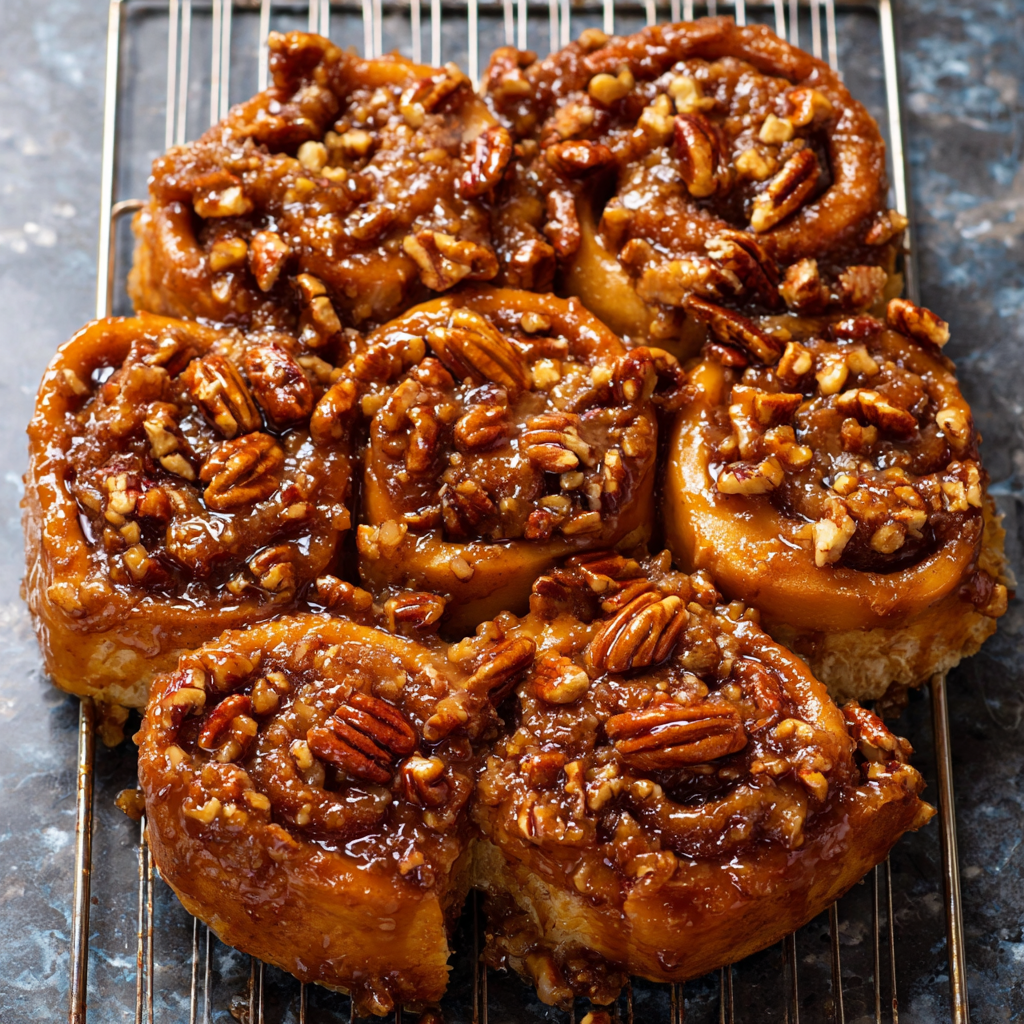
These giant pecan sticky buns are the definition of cozy homemade baking. Soft, fluffy cinnamon roll dough is layered with buttery cinnamon sugar, baked over a rich caramel pecan sauce, and flipped into the most gooey, sticky, irresistible breakfast treat imaginable.
Warm brown sugar, toasted pecans, buttery caramel, and swirls of cinnamon fill your kitchen with the most comforting aroma while these beauties bake. Perfect for chilly mornings, holiday brunches, weekend baking projects, or anytime you want a truly indulgent homemade treat.
And yes — they are HUGE. One sticky bun is practically a dessert and breakfast combined!
Why You’ll Love These Pecan Sticky Buns
Extra soft and fluffy dough
Rich homemade caramel pecan topping
Gooey cinnamon sugar swirls
Perfectly sticky and buttery
Great for holidays and brunch gatherings
Better than bakery-style sticky buns
Makes your kitchen smell incredible
Sticky Buns vs Cinnamon Rolls
While sticky buns and cinnamon rolls may look similar, there’s one major difference:
Sticky Buns
Sticky buns are baked over a buttery caramel pecan sauce. After baking, the pan is flipped upside down so the gooey caramel topping runs down over the rolls.
Cinnamon Rolls
Traditional cinnamon rolls are baked plain and topped with frosting after baking.
Sticky buns are richer, gooier, nuttier, and extra decadent thanks to that buttery caramel layer.
What Makes These Sticky Buns Special?
These buns are oversized, bakery-style sticky buns with thick spirals of cinnamon sugar and plenty of buttery pecan caramel in every bite.
The dough bakes up beautifully soft and pillowy, while the caramel sauce melts into the buns creating that signature sticky texture everyone loves.
Every bite is warm, gooey, buttery, sweet, and loaded with toasted pecan flavor.
Ingredients You’ll Need
For the Dough
1½ cups warm milk
2¼ teaspoons active dry yeast
½ teaspoon sugar
3½ cups all-purpose flour
1 teaspoon salt
¼ cup sugar
4 tablespoons softened butter
For the Filling
4 tablespoons melted butter
½ cup brown sugar
½ cup white sugar
2 teaspoons cinnamon
For the Caramel Pecan Topping
8 tablespoons butter
1 cup brown sugar
½ teaspoon vanilla
¼ teaspoon cinnamon
¼ cup heavy cream
Pinch of salt
1 cup chopped pecans
How to Make Pecan Sticky Buns
Step 1: Activate the Yeast
In a bowl, combine warm milk, yeast, and ½ teaspoon sugar.
Let sit for 5 minutes until frothy.
Step 2: Make the Dough
In a stand mixer bowl, combine:
Flour
Salt
Sugar
Pour in the yeast mixture and mix with a dough hook.
Add softened butter one tablespoon at a time.
Knead for about 5 minutes until the dough becomes soft and smooth.
Step 3: Let the Dough Rise
Shape the dough into a ball and place it back into the bowl.
Cover and let rise in a warm spot for about 30 minutes or until doubled in size.
Step 4: Prepare the Filling
Roll the dough into a 10×20-inch rectangle on a floured surface.
Spread melted butter over the dough.
Sprinkle evenly with:
Brown sugar
White sugar
Cinnamon
Roll tightly into a log.
Cut into 8 large rolls.
Step 5: Make the Caramel Sauce
In a saucepan over low heat, combine:
Butter
Brown sugar
Vanilla
Cinnamon
Heavy cream
Salt
Bring to a gentle simmer and whisk until smooth.
Step 6: Assemble the Sticky Buns
Grease a 9×12-inch baking dish.
Pour the caramel sauce into the bottom of the pan.
Sprinkle chopped pecans evenly over the sauce.
Place the sticky buns into the pan.
Step 7: Second Rise
Cover and let the buns rise again for about 30 minutes.
Step 8: Bake
Bake at 350°F for 25–30 minutes until golden brown and fully cooked.
Step 9: Flip and Serve
Let the buns rest for 15 minutes.
Carefully invert the pan onto a parchment-lined tray or serving platter.
The warm caramel sauce will flow beautifully over the buns.
Serve warm and enjoy!
Tips for the Best Sticky Buns
Don’t Add Too Much Flour
The dough should feel soft and slightly tacky, not dry.
Too much flour can make the buns dense and tough.
Use Warm Milk, Not Hot
Hot milk can kill the yeast. Aim for warm bathwater temperature.
Let the Dough Rise Fully
A full rise creates fluffy, tender buns.
Use Fresh Yeast
Fresh active yeast helps the dough rise properly and creates the best texture.
Flip Carefully
The caramel is extremely hot after baking, so use caution when flipping.
Delicious Variations
Maple Pecan Sticky Buns
Add maple syrup to the caramel sauce.
Apple Cinnamon Sticky Buns
Add diced cooked apples to the filling.
Bourbon Caramel Sticky Buns
Add a splash of bourbon to the caramel sauce.
Chocolate Pecan Rolls
Sprinkle mini chocolate chips into the filling.
What to Serve with Sticky Buns
These sticky buns pair perfectly with:
Hot coffee
Cappuccino
Chai tea
Cold milk
Fresh fruit
Scrambled eggs
Breakfast casserole
Storage Tips
Refrigerator
Store covered for up to 4 days.
Freezer
Freeze baked buns for up to 2 months.
Reheating
Warm in the microwave for 20–30 seconds or in a low oven until soft and gooey again.
Frequently Asked Questions
Can I make these overnight?
Yes! Assemble the buns and refrigerate overnight before the second rise.
Can I make smaller buns?
Absolutely. Cut into 12 smaller buns instead of 8 giant ones.
Can I use walnuts instead of pecans?
Yes, walnuts work beautifully.
Why are my sticky buns dry?
Usually from adding too much flour or overbaking.
Can I make these without a stand mixer?
Yes! You can knead the dough by hand.
Final Thoughts
These Big Fat Pecan Sticky Buns are everything a homemade breakfast pastry should be — soft, sticky, buttery, sweet, and overflowing with caramel pecan goodness.
They take a little time, but every minute is worth it once you pull those golden sticky buns from the oven and flip them into a gooey masterpiece.
Perfect for cozy weekends, holiday mornings, or anytime you want a bakery-style treat right at home.
When Tommy Fisher set out to build a section of border wall in South Texas during the first Trump administration, the project quickly became ensnared in controversy. Experts raised concerns about shoddy construction and signs of erosion.
Beyond that, Fisher’s company had received funding from a group called We Build the Wall, an influential conservative nonprofit that included President Donald Trump’s then-political strategist Steve Bannon as a board member. Some of its leaders eventually went to prison for their involvement in the venture.
“It was only done to make me look bad,” the post continued.
But none of this stopped Fisher’s company from getting subsequent border wall contracts, including from the state of Texas. And now the federal government has awarded his company over $9 billion to build even more border wall — including a $1.2 billion contract in the Big Bend region of Texas, where residents have continued to press for answers about the government’s plans in and around one of the country’s largest national parks.
And, as during Trump’s first term, Fisher’s work is stirring up controversy again. A New York-based construction company has sued the Trump administration after it awarded the bulk of new Texas border wall contracts to North Dakota-headquartered Fisher Sand & Gravel and another company.
Posillico Civil Inc.’s lawsuit, filed in the Court of Federal Claims in Washington, D.C., on May 13, offers one of the first public glimpses into the procurement process along the border in Texas. The suit claims that out of the 11 prequalified vendors for the wall projects, U.S. Customs and Border Protection awarded nearly $14 billion — about 73% of the value of the contracts — to just two: Fisher’s firm and Barnard Construction, based in Montana. The work also includes wall projects around El Paso, Laredo, Del Rio and the Rio Grande Valley.
The Trump administration has come under scrutiny for awarding no-bid contracts and for the lack of transparency around its accelerated border wall construction plans, moves designed to help the president achieve his key campaign promise of securing the border.
During his first term, Trump’s moves also faced criticism. A 2020 investigation by ProPublica and the Tribune found that the government was awarding contracts before acquiring titles to the land, leading to millions of dollars in costs related to delays. A review of federal spending data by the news organizations also revealed how the first Trump administration had made hundreds of contract modifications, increasing the cost of the border wall project by billions.
The administration has shown no signs of slowing down: The U.S. Department of Homeland Security secured $46.5 billion to build the border wall in 2025, thanks to the One Big Beautiful Bill Act.
Having prequalified contractors is not uncommon, as the system is structured to help the government move through projects quicker, but it is not meant to remove competition, said Charles Tiefer, a leading authority on federal contract law and former member of the Commission on Wartime Contracting in Iraq and Afghanistan.
DHS “is picking contractors for loyalty and from confidence that they will do its bidding, rather than, as every other administration has done, picking contractors for best value,” Tiefer said, referring to reports that then-Secretary of Homeland Security Kristi Noem awarded a $220 million ad campaign contract to a firm she had connections to. In response to ProPublica’s reporting, DHS said the department “has no involvement with the selection of subcontractors” and that it doesn’t control or weigh in on who contractors hire.
“They got huge blank checks, and they want to write them as fast as possible,” Tiefer said.
The White House declined to comment for this story. A CBP spokesperson said in a written statement that the bidding process has been fair. “Contracts awarded are based on the contractor’s qualifications to perform the work in a timely manner and at prices deemed fair and reasonable,” the spokesperson wrote, saying neither CBP nor DHS have an affiliation with We Build the Wall.
An attorney for Posillico declined to comment. The company has previously built 43 miles of federal wall in South Texas and also won a contract to construct sections of Gov. Greg Abbott’s state border project. The state project experienced many of the same construction delays and cost overruns as Trump’s border wall.
Posillico alleges in the lawsuit that it incurred “substantial bid preparation and proposal costs” drawing up plans for federal solicitations that were “not genuine competitive opportunities.”
While these are just allegations, Scott Amey, a contracting expert and general counsel at the watchdog group Project on Government Oversight, said border wall contracts have long been controversial and raised questions on what the government is getting for the cost, as well as the political connections of some of the contractors. Amey closely followed border wall procurement during the first Trump administration.
“There’s a cost, and ethics and contracting questions that all come up whenever you mention anything with the border wall,” Amey said.
Representatives for Fisher Sand & Gravel and Barnard did not respond to requests for comment. Barnard has filed as an intervenor in the case, meaning it isn’t a party in the suit but wants to participate.
Although the vast majority of the new funding is going to Fisher and Barnard, several other companies got smaller percentages of the contracts: Spencer Construction LLC; Granite Construction Co.; and Southwest Valley Constructors, which recently won another $1.7 billion contract for barrier construction in and around Big Bend National Park. Representatives for the other companies did not respond to a request for comment for this story.
Posillico’s lawsuit claims that the contracts issued to the other companies went beyond the original scope of wall construction work the federal government told bidders it was seeking.
In CPB’s Big Bend Sector project, for example, contractors were ultimately required to install cattle fencing and cattle guards — something Posillico’s lawsuit contends was not what the government originally asked of potential contractors. Had the government been clearer on the scope, the lawsuit argues, the company may have had a better chance of winning a contract.
As part of the new scope of work, winning contractors, including Fisher Sand & Gravel, will also have to work with the International Boundary and Water Commission, the federal agency that administers treaties around the Rio Grande and the physical border with Mexico.
Fisher has previously clashed with the commission. In 2019, the commission filed a lawsuit claiming Fisher had violated a binational water treaty between the U.S. and Mexico after the company constructed fencing in South Texas. The investigation by ProPublica and the Tribune found that a 3-mile stretch of border wall Fisher built on the banks of the Rio Grande was at risk of collapsing if not fixed. The company also built a segment of border wall in Sunland Park, New Mexico, without following proper procedures. Both projects involved We Build the Wall, the nonprofit.
In the end, four of the nonprofit’s top leaders, including Bannon, were arrested on fraud and other charges connected to the fundraising scheme. Three men, including an Air Force veteran, were convicted and sentenced to prison. Trump pardoned Bannon, who was awaiting trial.
Fisher and the government reached a settlement in 2022 in which Fisher Sand & Gravel agreed to conduct quarterly inspections, maintain an existing gate and keep a $3 million bond for 15 years or until the property was transferred to the government to cover expenses in case the structure failed.
Local residents protest new wall infrastructure in Presidio, Texas, in March.Hannah Gentiles
“The Rules Don’t Really Apply”
The Posillico lawsuit offers a rare peek behind the veil at the high-dollar world of border wall construction, an industry that has sprung up over the past 10 years in response to Trump’s recurring campaign promise to build a wall.
The procurement process has been especially obscure around border wall contracting, thanks to Noem waiving dozens of laws regulating financial transparency and competitiveness in government contracting for the entire southern border. That act marked the first time in American history these waivers were applied to all 1,954 miles of the U.S.-Mexico border.
In its lawsuit, Posillico made explicit that it did not contest the use of waivers to expedite construction of the wall.
For residents of border communities, the waivers have meant that DHS has released very little information detailing the massive infrastructure projects coming to their communities. This spring, the Center for Biological Diversity filed two lawsuits in federal court related to border wall construction in the Big Bend area, specifically over DHS’ failure to respond to a series of Freedom of Information Act requests for documents related to the project and challenging the agency’s authority to waive laws without Congress’ approval. The government has not filed answers to the complaints yet, with a deadline of June 1 for the FOIA complaint and early June in the congressional authority lawsuit.
In the Posillico lawsuit, DHS moved to seal documents in the case, including any depositions or affidavits; Judge David A. Tapp signed off on the motion.
In the absence of publicly posted requests for proposals and direct communication from Washington, residents in the Big Bend region have been relying on an online map posted by CBP that says it tracks contracts as they’re awarded. Lines on the map have shifted dramatically over the past few months, raising questions about what the government actually plans to build. The agency briefly took the map down altogether, around the same time that protests about the possibility of a physical wall in Big Bend National Park reached a fever pitch. When the map was restored to the website, it appeared to show a mix of “vehicle barriers” and “patrol roads” planned instead of steel walls within park boundaries.
Fisher Sand & Gravel is currently slated to build a wall-related project in Big Bend Ranch State Park, bordering the national park to the west, though it hasn’t publicly released any plans for what alternate border barriers might look like. Landowners in communities adjacent to the park are still gearing up to face eminent domain challenges from the federal government.
Barnard is working on a project outside the parks. Documents in Posillico’s lawsuit revealed that CBP has flagged sections of wall in Hudspeth, Jeff Davis and Presidio counties for “fast-track” construction by the company. To support that work, a pecan farm near the small ranching community of Lobo has started clearing a swath of land for a 500-person camp and petitioning the local water conservation district for approval to use agricultural well water for the project.
Amey, the contracting expert, said the Trump administration seems to want to make the exception the rule, considering controversial practices like Noem’s decision to award the huge border ad contract and the fact the government has waived so many contracting rules to accelerate the wall’s construction.
“It seems as if this administration, especially this time around, has decided that the rules don’t really apply,” he said.
How the world sees Donald Trump: surveys show other countries see US president as ‘unreliable’ and ‘dangerous’
Americans are increasingly turning against the war in Iran and the president that launched it. According to a survey conducted in April by US-based pollster, Pew International, 61% of people in the US disapprove of the war while only 37% approve. The US president’s overall approval rating, meanwhile, has slipped to 34%.
In many other countries, however, this disenchantment looms larger. Pew’s spring 2025 survey revealed 12 months ago a strong lack of confidence in Donald Trump across much of the world. The survey was conducted in 24 mostly European countries, but also countries in Asia, Africa, the Middle East and Latin America.
Respondents were asked a question about the confidence they had in Trump to do the right thing in world affairs.
Confidence in President Trump to do the right thing
Data from Pew Research/Graph by Paul Whiteley, Author provided (no reuse)
The country with the lowest levels of confidence was Mexico with Canada, Sweden and Germany not far behind. Interestingly, proximity to the United States appears to boost a lack of confidence in the president, with Canada and Mexico much less confident than other countries.
Respondents in the UK were more likely to be confident than those in other European countries such as France, Spain and Italy. But even then, only 37% of UK respondents were confident, compared with 63% who were not. The UK score is rather similar to Japan which has also been a longstanding ally of the US.
There were five countries in which the president enjoyed a positive net level of confidence: Hungary, Kenya, India, Israel and Nigeria. These are all classified as hybrid authoritarian regimes or flawed democracies by the Economist Intelligence Unit. It shows that citizens of weak democracies or authoritarian states quite like him.
Is Trump dangerous?
This lack of confidence in the president is only part of the story. The survey asked what respondents thought about various traits that could be associated with Trump as president. It asked if they thought he was he was “well qualified”, “strong”, “honest” or “diplomatic”. It also asked if he was “arrogant” or “dangerous”.
The second chart shows the percentage of respondents who thought that he was “dangerous”. It makes sober reading. More than 50% of the respondents in 21 of the countries thought this. It seems likely that the US and Israel’s attack on Iran, which took place after the survey was in the field, will have reinforced these perceptions. The war is stalled and the economic repercussions are likely to increase its unpopularity both in the US and around the world.
Perceptions that President Trump is ‘dangerous’
Data from Pew Research/Graph by Paul Whiteley, Author provided (no reuse)
The prospects for post-Trump America
The US can, of course, recover from the Trump era. Unlike Russia, where periods of democracy have been an aberration in its history, the US has been a democracy for 250 years. That said, it is currently classified as a “flawed democracy” in the Economist Intelligence Unit database.
But if, as seems likely, the Democrats outperform the Republicans in the midterm elections in November this year, they will regain control of either the House or the Senate, or both. This would be a severe blow to Trumpism.
A May Day march in Washington against the Trump administration’s policies.AP Photo/Jose Luis Magana
If Congress is controlled by the Democrats, they can veto any of Trump’s legislative proposals, hamstring his policies by withholding funding and at the same time initiate impeachment proceedings against him. Such actions will very likely make him a lame duck, leading to a loss of support for Republicans in the presidential elections in 2028.
Favourable and unfavourable views of the United States in 2025
Data from Pew Research/Graph by Paul Whiteley, Author provided (no reuse)
The survey also shows that America’s reputation as a reliable ally and supporter of democracy has been seriously damaged across the world in his two terms in the White House. The third chart shows the percentage of survey respondents who have a favourable or unfavourable view of the US.
It is striking that many of America’s traditional allies such as Australia, Canada, Germany and France now have a very unfavourable view of the US. This contrasts with the flawed democracies or hybrid authoritarian states who like him. Although, to be fair, attitudes to the US overall are much more favourable than attitudes to Trump.
How might the US regain the international respect it has clearly lost under Trump as president? In the realm of foreign policy, actions speak louder than words – and America’s Nato allies will need to see some kind of concrete assurance that Washington is prepared to resume the leadership and security roles it is apparently abandoning under the current administration.
Perhaps what it also needs is some kind of “truth and reconciliation commission”, along the lines of the one set up by Nelson Mandela following the collapse of apartheid in South Africa. Once Trump has left office, America needs to understand clearly what has happened so that it can avoid this in the future. It is a cliché – but nonetheless true – that people who fail to learn from history are doomed to repeat it.
JWST maps the weather on a hot gas giant 700 light-years away
WASP-94A b is a hot, tidally locked gas giant orbiting close to one of the stars in a binary system roughly 690 light-years away from Earth. In a new Science study, scientists led by Sagnick Mukherjee, an astrophysicist at Johns Hopkins University, used the James Webb Space Telescope to learn what the weather looks like out there.
Tidal locking means that you no longer have day- and night-side temperature differences sweeping across the planet. “We wanted to understand the atmospheres of such planets,” Mukherjee says. “Are they static or dynamic? Do they have winds? Do they have clouds?” His team found that, on WASP-94A b, it’s cloudy in the morning, but the skies are clear in the evening. The fact that we didn’t know this already means we might have gotten the chemistry of this and many other exoplanets surprisingly wrong.
Averaged atmospheres
WASP-94A b has a mass slightly below half of Jupiter but has a diameter that’s over 70 percent wider. “This means the planet has low density, and its atmosphere extends further out into space, which makes it easier to observe,” Mukherjee explains. When astronomers study atmospheres like this, they usually rely on transmission spectroscopy. By analyzing the spectrum of light filtering through the planet’s atmosphere as it crosses in front of its star, they can figure out its chemical composition.
The problem with this approach is that the light filtering through the entire circumference of the planet’s silhouette was averaged out, as though its atmosphere was one homogenous ball of gas. For tidally locked planets, this was a massive oversimplification.
On tidally locked worlds, there are massive temperature swings between day and night sides, which usually lead to differences in atmospheric density between the day side and the night side. These differences, combined with the Coriolis effect that stems from the planet’s slow rotation, cause a phenomenon called equatorial super-rotation. This is where winds on the equator blow eastward faster than the planet is spinning. Circulation models predicted this is exactly what’s happening on WASP-94B a.
The leading edge of the planet’s disk, called the morning limb, is the region where the local atmosphere is rotating out of the colder night side and into the hot day side. The trailing edge at the evening limb is where the heated daytime gases are crossing over into the dark side. To catch this process in motion, Mukherjee and his colleagues employed a technique called limb-resolved spectroscopy.
Slicing transits
Because it takes a little bit of time for the planet to fully cross the star’s edge during the beginning and end of the transit, the telescope sees the leading morning limb block the starlight slightly before the trailing evening limb does. Using JWST’s Near Infrared Imager and Slitless Spectrograph (NIRISS), the team measured the light curves as WASP-94A b transited and split the signal. This way, they managed to extract two separate chemical transmission spectra for the exoplanet: one for its morning, and one for its evening limb. And there was quite a difference between the two.
The morning limb’s spectrum was just a sloped line, rising at shorter wavelengths, which indicated high-altitude aerosols blocking the light from deeper in the atmosphere. “You would see a lot of dust and cloud particles at very high altitudes,” Mukherjee says. “Going deeper, the clouds likely clear up, and you would probably find water vapor and these kinds of gases.”
On the evening limb, the spectrum showed no substantial evidence of aerosols and revealed spikes of gaseous water vapor. “This would be a different view where you do not encounter many clouds through your journey, but what you see is just gas—water vapor mostly and other gases, maybe like carbon dioxide,” Mukherjee suggests.
By feeding the JWST data into computer models, the team could also predict what the weather engine on WASP-94 b looks like in motion.
Equatorial winds
The average temperature on WASP-94A b exceeds 1,500 Kelvin, and Mukherjee’s team confirmed the evening limb is around 450 Kelvin hotter than the morning limb—hot enough to evaporate potential aerosol materials like iron or magnesium silicate. This temperature difference dictates the weather dynamics on the planet.
On the permanent night side, gases in the atmosphere condense into droplets due to lower temperature, forming clouds. “These cloud particles are then dragged by the equatorial wind towards the morning side,” Mukherjee says. As the clouds are pushed into the heat of the day side, most of these droplets evaporate. By the time the winds reach the evening limb again, the clouds are almost completely gone, leaving the skies clear.
Based on this day-side/night-side aerosol distribution, the team determined WASP-94 b has actual clouds rather than hazes. The latter are basically photochemical smog created when intense radiation breaks the molecules down. Because hazes are produced by ultraviolet light, they should preferentially appear on the planet’s permanent day side. Global jet streams would then blow them into the evening limb, making the sunset hazy and the morning relatively clear—the exact reverse of what showed up in the data.
The team even managed to calculate how the atmosphere keeps the clouds aloft. The equatorial wind is apparently strong enough to push the heavy mineral droplets through the night side faster than gravity can pull them down.
Finally, the researchers ran an experiment where they took their precise JWST data and reanalyzed it without splitting it into two to resolve the limbs. “This had a huge effect on our understanding of the composition of this planet,” Mukherjee says. The results the researchers got when they averaged the atmosphere in a traditional model turned out a bit alarming for exoplanet science in general.
Biased composition
Because the thick morning clouds diluted the clear water vapor signals from the evening, the single-sphere model concluded that the planet’s metallicity—the abundance of elements heavier than hydrogen and helium—was suspiciously high. “With the limbs resolved, we’ve got an oxygen enrichment of this planet that was three to five times higher than our Sun,” Mukherjee explains. When the team averaged the spectrum, the oxygen enrichment came out about 100 times higher.
This bias in the composition estimates, he argues, probably affects other tidally locked exoplanets, including sub-Neptunes and super-Earths that are smaller than WASP-94A b. For now, though, we have not been able to resolve the morning and evening asymmetries in these smaller planets, even using the JWST. But the team thinks there is still a lot we can do before concluding we need an even bigger telescope.
“We need to think harder about how to mitigate this bias,” Mukherjee says. The answer, he suggests, might be figuring out how to disentangle morning and evening limbs in smaller planets based on the data we get from the instruments we have. “And even if we don’t have this kind of measurements, we can think about how to develop our theoretical models to mitigate this even if we have an averaged spectrum of the planet,” Mukherjee claims.
Sex and the City Star Resurfaces with ‘Cryptic Message’ After Vanishing for Years
Jason Lewis, the former Sex and the City heartthrob who once had fans swooning as Smith Jerrod, has finally resurfaced after more than three years away from the spotlight — and he returned with a mysterious message that immediately got people talking.
The 54-year-old actor popped back up on Instagram Wednesday with a beachside video, showing himself walking along the sand as he explained why he suddenly disappeared from public life.
“I went quiet,” Lewis said in the clip. “Not because I have nothing to say, but because I had something to do.”
For fans who have wondered where he has been, the message only added to the intrigue.
Lewis did not reveal exactly what he has been working on, but he hinted that it has consumed much of his life behind the scenes.
“The kind of creative work that doesn’t leave room for much else, and I made my peace with that,” he said. “It’s the kind of work that needs to find its people, though.”
The actor added that he is “still in it,” but far enough along that he felt ready to step back into public view.
In the caption, he kept things just as mysterious, writing simply: “After three years, it was time.”
Lewis was last seen in the public eye in 2022, when he competed on Season 31 of Dancing with the Stars. He was paired with professional dancer Peta Murgatroyd, but the pair’s ballroom run ended quickly when they became the first couple eliminated.
At the time, Lewis admitted the show was a big leap for him. He said his fiancée, actress Liz Godwin, helped convince him to finally take the offer after he had passed on it in the past.
“This year, when the offer came in, my fiancée asked me to be a little less pigheaded and at least take a look at a show,” he told People.
After watching an episode with her, Lewis said he was impressed by the production and the talent.
Still, his time on the show was not easy. After his elimination, he described the experience as “challenging” and “a little scary,” but said he was grateful to be part of it.
For longtime Sex and the City fans, Lewis will always be remembered as Smith Jerrod, the gorgeous young model who became Samantha Jones’ unlikely love interest.
He played the role opposite Kim Cattrall from 2003 to 2004 on the hit HBO series, then returned for the 2008 Sex and the City movie and the 2010 sequel.
But when the franchise came back as And Just Like That, Lewis was not included.
Before the sequel series premiered in 2021, Lewis said he had not been contacted about appearing.
“I would be the last to know!” he told the Daily Front Row at the time.
“As much as I appreciate the flattery, the conversation is about the girls,” he added.
His last acting role was in the NBC supernatural drama Midnight, Texas, which aired in 2018.
Now, after years of silence, Lewis appears to be teasing something new — but he is keeping fans guessing for now.
And judging by the cryptic tone of his comeback, the former Sex and the City star may be preparing for a very different next chapter.
AI euphoria getting reality check in South Korea, and vice versa
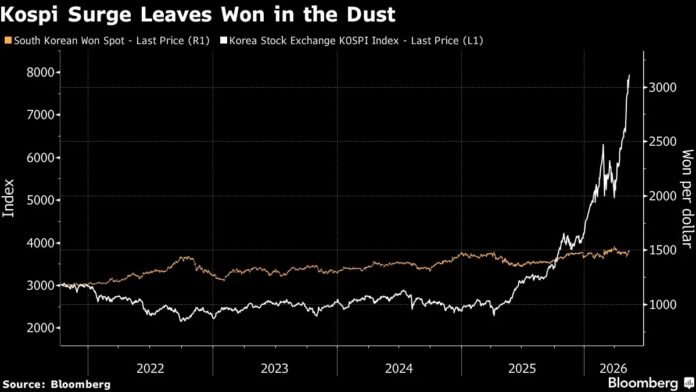
TOKYO — Few market visuals are more striking than the South Korean won and the Kospi index suddenly tearing off in opposite directions.
The won has slumped 4.5% this year, putting it among Asia’s weakest currencies. The Kospi, meanwhile, has exploded — up 85% since Jan. 1 and 200% over the past year. The frenzy propelling Seoul stocks to record after record is rooted in artificial‑intelligence mania. Tech giants SK Hynix, up 873% in twelve months, and Samsung Electronics, up 447%, are doing most of the heavy lifting.
The stock surge has given President Lee Jae‑Myung an almost sorcerous market aura. On the campaign trail before taking office in June 2025, he vowed to lift the Kospi to 5,000 – a target that implied doubling the index over his five‑year term. Instead, it blew past 8,000 in under a year (it’s currently at 7,815).
Yet the won’s slide is marring Lee’s market triumph. Since mid‑2025, the currency has drifted steadily lower even as stocks soared. Its drop is far milder than the Kospi’s surge, but the won is now hovering near levels last seen during the 2009 global financial crisis as the Iran war fallout ripples across Asia.
“The weakness in the won is an important data point as Korea doesn’t have any fiscal problems,” says Brad Setser, an economist at the Council on Foreign Relations. “It also doesn’t suffer from any shortage of foreign exchange – so creative policy makers should be able to engineer a stronger won.”
That’s easier said than done, of course. Setser says Korea’s giant National Pension System should pause its accumulation of foreign assets. Effectively, this means selling dollars for won. The US, meanwhile, should be willing to join the BOK in directly supporting the won. Bottom line, Setser says, it’s “time to be creative.”
The problem, notes economist Paul Cavey, founder of advisory East Asia Econ, is that “foreigners became huge sellers of domestic assets” in recent weeks. Net sales of Kospi shares by overseas investors so far this year topped US$62 billion. Part of the worry is that AI made it too easy for President Lee’s team – and that the market is too frothy for comfort.
Earlier this month, Citigroup analysts raised the specter of “irrational exuberance” dominating the Kospi. The reference here is to a phrase made famous by then-Federal Reserve Chairman Alan Greenspan in 1996.
“Although we believe it’s too early for a severe market correction or the end of the bull market due to tightening financial conditions caused by interest rate factors, the Kospi appears significantly more overbought compared to the US market,” Citi writes. “A prudent approach would be to take profits on half of the positions.”
A major worry is that Lee still hasn’t tackled the long‑standing “Korea discount,” which keeps local equities priced below global peers. It’s also why MSCI continues to withhold developed‑market status — an upgrade that would unleash a flood of foreign capital into won‑denominated assets.
MSCI has pressed Korea to scrap outdated rules, ease ownership limits, deepen capital markets, extend currency‑trading hours and boost transparency. Seoul has made some progress. Lawmakers reinstated short‑selling in March 2025 after a 17‑month ban. Authorities have expanded foreign‑exchange trading to 17 hours.
Yet MSCI holds that Korea still isn’t ready for global prime time. In June 2025, when it rejected Korea’s upgrade request again, MSCI said: “Despite these reforms, investors believe it remains critical to assess whether the implemented measures are sufficient, given that developed markets typically feature fully convertible currencies with active, unconstrained offshore and onshore forex markets.”
To be sure, Korea recently saw its weighting in MSCI Emerging Markets Index increase to 21.7% from 15.4%. This puts Korea in league with China’s 22% weighting.
Yet the Korean market is being challenged from both ends amid domestic rigidities and global headwinds.
Internationally, the surging US dollar is adding pressure, siphoning capital out of emerging markets and raising the risk of accelerated outflows from Korea. It also magnifies the country’s exposure to soaring energy costs. With Middle East turmoil keeping oil in the $100 a barrel range, the shock poses a direct threat to Asia’s fourth‑largest economy.
In March, Korea imposed nationwide fuel‑price caps for the first time in nearly three decades. Inflation accelerated anyway. Consumer prices rose 2.6% in April from a year earlier, the fastest pace in about two years and up from 2.2% in March. That leaves the Bank of Korea in a bind – and raises the odds that new governor Shin Hyun‑song will soon opt for a rate hike.
The BOK has held rates steady since May 2025, after delivering four 25-basis-point cuts in the previous seven months. The last time the BOK tightened was in January 2023. At the time, the central bank hiked rates to 3.5%, the highest since 2008. Though the BOK meets on May 28, it’s not expected to start hiking its 2.5% benchmark until the second half of 2026.
The longer the Strait of Hormuz stays closed, the more Korea’s 2026 outlook unravels — and the more vulnerable the AI‑driven economy becomes. As inflation pushes bond markets into turmoil, the risk grows that capital will retreat from AI, data centers, and cloud infrastructure.
Korea may become ground zero for a new clash between the “old economy” — surging commodity prices and other traditional pressures — and the “new economy” that AI is building in real time.
Earlier this month, BOK Deputy Governor Ryoo Sang-dai warned it may be “time to consider stopping rate cuts, and thinking about increases” as inflation heats up. Economist Kong Dong‑rak of Daishin Securities notes that, compared with the last policy meeting — when officials adopted a wait‑and‑see stance amid uncertainty over the war’s impact — recent BOK comments mark “a step forward” toward prioritizing inflation.
This isn’t to dismiss Korea’s potential. Betting against it hasn’t been a winning strategy in recent decades. Korea is, after all, an economy that knows how to take a punch.
After the 1997-98 Asian financial crisis, Korea was the first shattered economy to claw its way back. A decade later, it sidestepped the “Lehman shock” in ways hedge funds never anticipated. And in 2009, despite market speculation, Korea didn’t become the “next Iceland” at all.
Korea sailed through the Federal Reserve’s 2013 “taper tantrum,” which rattled emerging markets worldwide. Ditto for the 2017-2021 Trump‑era trade war. In 2020, Korea became a Covid‑19 exemplar with remarkably low infection rates. And by 2021, the BOK was the first top‑12 central bank to tighten policy.
More recently, President Lee steered Korea through the turbulence of the 2025 Trump 2.0 trade war with surprising resilience. And today, the Kospi is hitting all‑time highs despite US tariffs and the ongoing US-Israeli conflict in Iran.
The challenge is that Korea excels at economic defense but struggles to play offense. In the second half of 2026, it will need both skills.
Lee also must convince the world that Korea hasn’t lost its innovative edge. It once sat at the center of the tech universe when success meant flashy smartphones. Today, the bar is far higher. It’s about not just producing top‑tier AI chips but also inventing the next wave of game‑changing technologies that put Korea at the heart of global disruption.
And in an Asia‑wide start‑up arms race, strengthening Korea’s competitiveness may matter more than ever. Korea’s biggest structural problem is its sprawling family-owned conglomerates, or chaebols, which dominate the economy and crowd out the resources new startups need to thrive. In such top-down systems, real disruption usually only happens once a company reaches a significant size.
Last month, Lee urged Korea Inc. to move upmarket quickly. “With free trade weakening and geopolitical risks rising, the global trade order is at a turning point,” he said. “A manufacturing-dependent country like ours must pursue bold, transformative innovation – our future depends on it.”
Easier said than done. To stay ahead of the global pack Team Lee must incentivize Korea to raise its game in R&D, building ecosystems, and fostering a risk-taking culture that puts Korea at the center of shaping — not just riding — the AI wave.
Lee’s 351-day-old administration is clearly on a roll. On his watch, the Kospi has soared beyond virtually everyone’s wildest expectations. Fueled by AI, Korea’s market cap has since surpassed France, Germany and the UK. Yet, the weak won suggests Korea might not be as ready for global prime time as the bulls believe.
USS Nimitz Enters Caribbean as Trump Administration Increases Pressure on Cuba
The USS Nimitz aircraft carrier and its accompanying strike group have entered the Caribbean Sea as the administration of U.S. President Donald Trump intensifies pressure on Cuba, adding a military dimension to an already escalating diplomatic and legal campaign.
The deployment was announced by U.S. Southern Command, which described the carrier group as demonstrating strategic reach and military readiness in the region. Officials indicated the carrier is expected to remain in the Caribbean for at least several days.
According to U.S. officials, the deployment is currently intended as a show of force rather than preparation for a major military operation. The USS Nimitz is accompanied by escort vessels and its embarked air wing, reinforcing the U.S. presence in waters close to Cuba.
The move coincides with a broader effort by Washington to increase pressure on Havana. The U.S. Justice Department recently unsealed charges against former Cuban leader Raúl Castro linked to the 1996 downing of two civilian aircraft operated by the Miami-based Brothers to the Rescue group, an incident that killed four people.
The deployment has raised questions about whether Washington is signaling a tougher approach toward Cuba. However, Trump has indicated the military presence should not be viewed as an imminent escalation, while emphasizing continued pressure on Havana.
Cuban officials have criticized the measures and described recent U.S. actions as politically motivated. The latest developments come amid continued economic difficulties on the island and increasingly strained relations between Washington and Havana.