Residents, volunteers, and security instructors say the focus on training readiness for another attack is tied to whether the kibbutz can restore confidence and bring people home
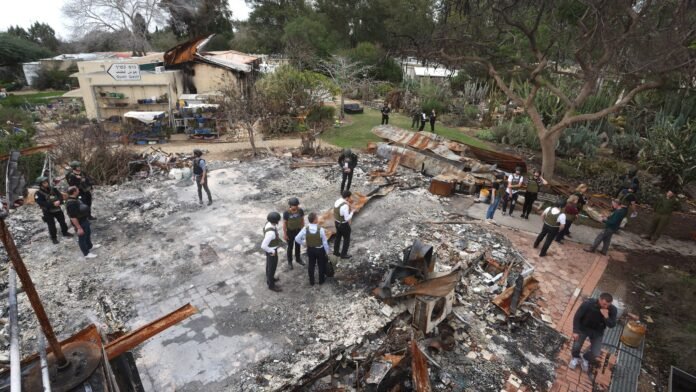
Inside Kibbutz Nir Oz, where the traces of October 7 remain visible across the kibbutz, local security teams gathered for a training exercise aimed at preparing residents for the first critical moments of a future emergency. In a community where the question of security is inseparable from the question of whether civilian life can be rebuilt, the session led by Magen 48 carried a significance beyond the drill itself. Nir Oz has become one of the clearest symbols of the October 7 tragedy, and efforts like this are now tied directly to whether residents believe they can return and live here safely again.
The community was the first line and the last line of defense
For Ehud Dribben, co-founder of Magen 48—an Israeli civilian-led initiative and NGO dedicated to training and equipping rapid response security teams in communities across Israel—the mission begins with a blunt lesson from the attacks. “Magen 48 was established to protect communities,” Dribben told The Media Line. “There is a need. The community was the first line and the last line of defense.”
Dribben said the events of October 7 showed that local defense teams must be able to operate before outside forces arrive. “The army is not able to be there all the time in the first few hours,” he said. “And if the community is not going to learn how to defend itself and be productive until the army comes, look where we are here, Nir Oz. That’s a big lesson. So, we have to provide them with the tools to be able to defend themselves until the army comes.”
Magen 48 presents its work as a direct response to the failures and gaps exposed that day. The organization trains civilian first-response teams inside Israeli communities, with an emphasis on coordination, local terrain, command structure, and decision-making under pressure. Dribben said the point is not simply to distribute equipment, but to teach residents how to function together as a unit when minutes matter.
We make them a fighting force
“Equipment is important,” he said. “But we emphasize the training. What do you do with equipment? The army gave them equipment. A lot of NGOs gave equipment. But no one really taught them what to do with the equipment and how to perform as a unit.” He said the gap exposed on October 7 was not only material but operational: communities needed to know what to do in each scenario, who was responsible for what, and where each person needed to be. “We make them a fighting force.”
The model is built in part on the experience of another kibbutz, where Dribben and his team carried out a training program prior to October 7. He said that training enabled the community to respond effectively during the attack and has since become a reference point for what structured local preparedness can mean under direct assault. “We did a training program for Kibbutz Erez, and they were able to defend themselves and save the kibbutz,” he said. “And that’s because they knew how to work together as a team and confront the enemy.”
Dribben said that kind of preparedness cannot be achieved through isolated exercises. “It needs to be a process, a professional program,” he said. “It could not be a training day here and there. If you want to make it happen, it’s got to be serious.” He said the long-term goal is not only tactical but social: to give residents enough confidence to return home and begin restoring trust in the IDF.
In Nir Oz, that connection between security and return is not theoretical. The kibbutz became one of the symbols of the October 7 massacre, and many residents have still not returned permanently. The training is being carried out with local teams and residents working alongside Magen 48 instructors, including Officer Y., a Nir Oz resident who serves as the kibbutz’s security coordinator.
“Nir Oz was my first home in Israel. It always will be,” Officer Y. told The Media Line. “At the end of the day, someone has to do this job, and we have a national assignment as far as I’m concerned, to help rebuild the kibbutz … And if I’m able to have the privilege to take upon myself the security of this place, then I’m more than honored to do so.”
Officer Y. said the volunteers taking part understand the burden they are carrying. “Every member of our team feels the vast weight on their shoulders of the responsibility that we have of rebuilding and securing this home,” he said, describing the training as a way to bring people from different backgrounds into one functioning security framework. “We’re able to take a group that is inorganic, as we say, of various backgrounds, of various professional levels when it comes to fighting and security, and to help make them the most professional soldiers that they can be,” he said.
In Nir Oz, the connection between security and return is not theoretical. While most of the Gaza border region has already moved back toward routine, Nir Oz remains in a different category. Official figures from the government’s Tekuma rehabilitation authority show that more than 92% of Gaza border residents have returned, and the region’s population has grown beyond its prewar level. But the most devastated communities, including Nir Oz, remain on a slower timetable, with rehabilitation and broader return still extending toward 2027.
For Ori, a Nir Oz resident who moved to the kibbutz last August as part of a rehabilitation group, joining the local security team is part of the broader effort to bring life back to the community. “We’re trying to build a community here and make a life back in Nir Oz after the horrible things, the massacre that happened on October 7,” he told The Media Line.
Ori said the link between community life and security is now unavoidable. “In order to build a community, we need to be able to protect ourselves, so part of the rehabilitation is making a rapid response team and being a part of it in order to defend Nir Oz from Gaza and other threats in the area,” he explained.
He was not part of the kibbutz security team on October 7. He said he joined after moving to Nir Oz, not because security is his profession, but because he sees it as necessary for rebuilding. “I’m an educator, I work in education, it’s not my training, it was my training in the military, and now we’re training together in order to build the rapid response team again.”
In Ori’s view, the return of families depends on whether residents believe there is a real security framework in place. He said strong local security teams, regular training, and trust among team members are all part of making people safe and helping them feel safe. “I think it’s pretty clear that in order for people to come back to Nir Oz, or build a community back in the Gaza area, we have to believe that we can be safe, and there could be security in living here,” Ori said.
For him, the goal is personal as much as communal. He said he wants to live in Nir Oz, raise his children there, and know that his family and friends are safe. He added that although he still hopes for peace in the future, the reality after October 7 is that residents feel they must be strong enough to defend themselves in order to live here now.
The difficulty of restoring that sense of safety is clear in the words of Shachar Butler, a Nir Oz resident who served as head of security in the kibbutz from 2016 until October 7, 2023. He described the attack as something that arrived without the usual warning signs residents had learned to recognize after years near Gaza. “My day started like everyone’s at 6:29. Alarms going through the air, and it seemed weird because usually you could smell when something is coming,” he told The Media Line. “You could smell when a conflict or when an escalation will come out. At this point, it was just out of the blue.”
Butler said he quickly realized the situation was not a regular escalation. He recalled hearing a gunshot, recognizing that it was not from an Israeli weapon, and understanding within minutes that gunmen were already at his house. “I heard a gunshot. I realized it’s not an Israeli weapon. And in a matter of minutes, there were already people in my house, basically surrounding my house. Around 30 of them.”
The numbers from Nir Oz remain among the most painful in Israel’s October 7 story. Butler described it as a small community of about 400 people and said that by the end of that day, 117 had either been murdered or kidnapped to Gaza. He added that the kibbutz is now counting 73 dead from the community, even without what he called the collateral damage among survivors whose health later declined, especially older residents.
Butler said only a small number of residents have returned so far. “Right now, not a lot. Maybe about 20 of them,” he said. “We have a project called Pioneer Neighborhood for people who want to come here and rebuild the place. So, they’re living here right now. Still no kids, no education systems … but this is all yet to come.”
For Butler, the central challenge is not simply bringing people back physically but rebuilding the link that was broken during the hours in which residents waited for help. “I think Nir Oz is notoriously known for being Ground Zero on the 7th of October. And the reason for that is that the army never showed up,” he said. “Until 2 o’clock in the afternoon, no army force entered Nir Oz. And when they did enter at 2 o’clock, there was nowhere for terrorists to fight anymore.”
These people were crying for help for hours and hours and hours, and nobody came to save them
He said those hours created a crisis of confidence that still shapes the kibbutz’s future. “These people were crying for help for hours and hours and hours, and nobody came to save them,” Butler said. “So, I think this will be our main goal and our main challenge, to create, to re-establish this link of trust between civilians and army, that when I call for help, someone will come and help me.”
That trust, Butler said, is essential if Nir Oz is to have a future. “Otherwise, we can throw away all the 60 years, 70 years of this place and go live in a safer place, in Tel Aviv or whatever,” he said. “And the people we lost here, those were the bread-and-butter people, that was the hard core of Zionism, coming to the border and building an amazing place. You can see with your eyes, the contrast between the greenery … and all the horrors that happened here.”
Butler sees the training as necessary, even if it arrives after the catastrophe that made its urgency undeniable. “It’s a bittersweet feeling because it’s a little too late,” he said. “But then again, we need people to do it. And I think the way Magen 48 is doing it, that’s how we were supposed to do it also before the 7th of October, sadly. But we can only do what we can do now. So here and now, it’s the best way to do it.”
For Dribben, the purpose of the work is not only to prepare for an attack, but to help residents regain enough confidence to return home. He said safety means having both the ability and the know-how to defend oneself and having a community that can react efficiently if something happens. In his view, that confidence can only be built through training, resilience, and communal strength.
The exercise in Nir Oz reflects the uncomfortable reality now facing communities across southern Israel: rebuilding homes is not enough if residents do not believe they can live in them safely. Magen 48’s training does not answer every question raised by October 7, nor does it erase the failures that residents still describe in raw terms. But for those moving through the kibbutz with weapons, radios, and instructors at their side, the work is a practical attempt to turn the worst day in their community’s history into a lesson in readiness for the future.