12.3 C
London
Thursday, May 21, 2026
Home Blog

NEC’s orbital transfer vehicle has cislunar combat potential

0
nec’s-orbital-transfer-vehicle-has-cislunar-combat-potential
NEC’s orbital transfer vehicle has cislunar combat potential

Japan’s NEC Corporation has launched a project to develop an Orbital Transfer Vehicle (OTV) – a spacecraft designed to transport satellites to their intended orbits after they have separated from the rockets that lift them into space.

Without an OTV, a satellite must use its own engines and fuel to reach its destination. With an OTV, even small satellites without powerful engines can be placed in distant orbits. And OTVs can transport multiple small satellites simultaneously, further increasing their efficiency.

NEC expects OTVs “to make important contributions to accelerating all aspects of space development. Not only will they promote the development of future space economies – such as the utilization of geostationary orbits and cislunar space – but by lowering the barriers to space utilization, they will also encourage the entry of new operators into the sector.”

The company has been selected to receive a grant for this project from the Japan Aerospace Exploration Agency (JAXA) under the heading “Technologies for Realizing Flexible Mobility in Space: (A) Development of Inter-Orbital Transportation Vehicles.”

NEC has spent decades developing and manufacturing spacecraft, including the geostationary communications satellite Kizuna, the lunar orbiter Kaguya and the deep-space probes Hayabusa and Hayabusa2.

Launched in 2003, Hayabusa returned to Earth in 2010 with the first samples from an asteroid (Itokawa), collected from the surface during a touch-and-go operation.

Hayabusa2, launched in 2014, twice landed on a larger asteroid (Ryuga), deployed three rovers, and blasted a hole in the rock to collect subsurface samples. It returned those samples to Earth in a capsule that landed in the Australian outback in 2020.

Based on this experience, NEC plans to conduct market feasibility studies, conceptual design and demonstrations for OTVs by the end of its current fiscal year, which ends in March 2027. Starting next year, the company plans to develop a prototype satellite for launch by 2032.

Soon after that, according to its press release, NEC aims to put the technology into practical use, ideally to “realize missions that deliver social benefits, and deepen research activities aimed at exploring new frontiers.”

The press release is fine as far as it goes, but OTVs go much farther.

As explained by Japan space and defense expert Paul Kallender, senior researcher at Keio University’s Shonan Fujisawa Campus (Keio SFC) west of Tokyo:

“In military space, OTV capability is a leading critical/strategic technology allowing militaries enhanced flexibility and greater range of options to disperse spacecraft into multiple orbits.”

“The most famous OTV vehicle,” Kallender adds, “is the US Space Force’s X-37B space plane. Arguably, the second most famous (or most infamous) OTV is the X-37B’s Chinese dark mirror-doppelganger Shenlong (Divine Dragon).

“NEC’s OTV project is publicly framed as civil space logistics to accelerate satellite deployment and on-orbit services across diverse orbits. However, its core capabilities – multi-orbit transfer, rendezvous and docking, and on-orbit servicing/refueling – are inherently dual-use, with clear relevance to responsive military logistics, satellite inspection, space situational awareness, and future cislunar security operations.”

Schematic diagram: NEC

Writing in the Japan: RMA (Revolution in Military Affairs) Substack, Kallender notes that “In low-Earth Orbits (LEO), OTVs enable: 

  • More and better-placed military Intelligence, Surveillance and Reconnaissance (ISR) satellites, or tactical satellites, or swarms of satellites in proliferated constellations; 
  • More and better-placed on-orbit spy satellites in different orbits to better spy on other satellites;
  • More and better-placed ASAT (attack) or sentinel/bodyguard maneuverable satellites in different orbits to, well, attack or defend against counterparts.

The last of these capabilities is a key enabler for Space Force’s push to develop maneuver warfare capabilities.”

Summing up, Kallender notes that NEC’s OTV is “a critical new enabler for Japan’s military space enterprise because it is being specifically designed for a much higher geostationary orbit and for entry into cislunar space.”

“Cislunar space is the entire area of space encompassing the Earth-Moon system. Cislunar space is, literally, the new high ground of military space.”

In its Mid-term Management Plan 2030, NEC identifies the “new security environment” as a major opportunity, stating that “As the global order transforms, Japan has the potential to emerge as a credible third option. Persistent geopolitical tensions and innovations in AI are driving not only defense market growth, but also a broadening of the security landscape.”

This includes:

  • The blurring of the line between peacetime and contingencies
  • The convergence of civilian and defense technologies and markets
  • The growing importance of digital infrastruture

Japan’s defense build-up plan is driving a 2.5 times increase in the nation’s defense-related market – a major opportunity for NEC. In addition to being a leading-edge satellite developer, the company is one of Japan’s top suppliers of information and communications systems and related software.

NEC plans to “steadily expand its business in priority areas such as cross-domain operational capabilities, command and control, pursuing global expansion through equipment transfers and expanded sales of dual-use products in line with government policy.”

One of the most important of those OTV “missions that deliver social benefits” is national defense.

Follow this writer on X: @ScottFo83517667

In Kibbutz Nir Oz, Security Training and Rebuilding After October 7 Go Hand in Hand

0
in-kibbutz-nir-oz,-security-training-and-rebuilding-after-october-7-go-hand-in-hand
In Kibbutz Nir Oz, Security Training and Rebuilding After October 7 Go Hand in Hand


Residents, volunteers, and security instructors say the focus on training readiness for another attack is tied to whether the kibbutz can restore confidence and bring people home

Inside Kibbutz Nir Oz, where the traces of October 7 remain visible across the kibbutz, local security teams gathered for a training exercise aimed at preparing residents for the first critical moments of a future emergency. In a community where the question of security is inseparable from the question of whether civilian life can be rebuilt, the session led by Magen 48 carried a significance beyond the drill itself. Nir Oz has become one of the clearest symbols of the October 7 tragedy, and efforts like this are now tied directly to whether residents believe they can return and live here safely again.

The community was the first line and the last line of defense

For Ehud Dribben, co-founder of Magen 48—an Israeli civilian-led initiative and NGO dedicated to training and equipping rapid response security teams in communities across Israel—the mission begins with a blunt lesson from the attacks. “Magen 48 was established to protect communities,” Dribben told The Media Line. “There is a need. The community was the first line and the last line of defense.”

Dribben said the events of October 7 showed that local defense teams must be able to operate before outside forces arrive. “The army is not able to be there all the time in the first few hours,” he said. “And if the community is not going to learn how to defend itself and be productive until the army comes, look where we are here, Nir Oz. That’s a big lesson. So, we have to provide them with the tools to be able to defend themselves until the army comes.”

Magen 48 presents its work as a direct response to the failures and gaps exposed that day. The organization trains civilian first-response teams inside Israeli communities, with an emphasis on coordination, local terrain, command structure, and decision-making under pressure. Dribben said the point is not simply to distribute equipment, but to teach residents how to function together as a unit when minutes matter.

We make them a fighting force

“Equipment is important,” he said. “But we emphasize the training. What do you do with equipment? The army gave them equipment. A lot of NGOs gave equipment. But no one really taught them what to do with the equipment and how to perform as a unit.” He said the gap exposed on October 7 was not only material but operational: communities needed to know what to do in each scenario, who was responsible for what, and where each person needed to be. “We make them a fighting force.”

The model is built in part on the experience of another kibbutz, where Dribben and his team carried out a training program prior to October 7. He said that training enabled the community to respond effectively during the attack and has since become a reference point for what structured local preparedness can mean under direct assault. “We did a training program for Kibbutz Erez, and they were able to defend themselves and save the kibbutz,” he said. “And that’s because they knew how to work together as a team and confront the enemy.”

Dribben said that kind of preparedness cannot be achieved through isolated exercises. “It needs to be a process, a professional program,” he said. “It could not be a training day here and there. If you want to make it happen, it’s got to be serious.” He said the long-term goal is not only tactical but social: to give residents enough confidence to return home and begin restoring trust in the IDF.

In Nir Oz, that connection between security and return is not theoretical. The kibbutz became one of the symbols of the October 7 massacre, and many residents have still not returned permanently. The training is being carried out with local teams and residents working alongside Magen 48 instructors, including Officer Y., a Nir Oz resident who serves as the kibbutz’s security coordinator.

“Nir Oz was my first home in Israel. It always will be,” Officer Y. told The Media Line. “At the end of the day, someone has to do this job, and we have a national assignment as far as I’m concerned, to help rebuild the kibbutz … And if I’m able to have the privilege to take upon myself the security of this place, then I’m more than honored to do so.”

Officer Y. said the volunteers taking part understand the burden they are carrying. “Every member of our team feels the vast weight on their shoulders of the responsibility that we have of rebuilding and securing this home,” he said, describing the training as a way to bring people from different backgrounds into one functioning security framework. “We’re able to take a group that is inorganic, as we say, of various backgrounds, of various professional levels when it comes to fighting and security, and to help make them the most professional soldiers that they can be,” he said.

In Nir Oz, the connection between security and return is not theoretical. While most of the Gaza border region has already moved back toward routine, Nir Oz remains in a different category. Official figures from the government’s Tekuma rehabilitation authority show that more than 92% of Gaza border residents have returned, and the region’s population has grown beyond its prewar level. But the most devastated communities, including Nir Oz, remain on a slower timetable, with rehabilitation and broader return still extending toward 2027.

For Ori, a Nir Oz resident who moved to the kibbutz last August as part of a rehabilitation group, joining the local security team is part of the broader effort to bring life back to the community. “We’re trying to build a community here and make a life back in Nir Oz after the horrible things, the massacre that happened on October 7,” he told The Media Line.

Ori said the link between community life and security is now unavoidable. “In order to build a community, we need to be able to protect ourselves, so part of the rehabilitation is making a rapid response team and being a part of it in order to defend Nir Oz from Gaza and other threats in the area,” he explained.

He was not part of the kibbutz security team on October 7. He said he joined after moving to Nir Oz, not because security is his profession, but because he sees it as necessary for rebuilding. “I’m an educator, I work in education, it’s not my training, it was my training in the military, and now we’re training together in order to build the rapid response team again.”

In Ori’s view, the return of families depends on whether residents believe there is a real security framework in place. He said strong local security teams, regular training, and trust among team members are all part of making people safe and helping them feel safe. “I think it’s pretty clear that in order for people to come back to Nir Oz, or build a community back in the Gaza area, we have to believe that we can be safe, and there could be security in living here,” Ori said.

For him, the goal is personal as much as communal. He said he wants to live in Nir Oz, raise his children there, and know that his family and friends are safe. He added that although he still hopes for peace in the future, the reality after October 7 is that residents feel they must be strong enough to defend themselves in order to live here now.

The difficulty of restoring that sense of safety is clear in the words of Shachar Butler, a Nir Oz resident who served as head of security in the kibbutz from 2016 until October 7, 2023. He described the attack as something that arrived without the usual warning signs residents had learned to recognize after years near Gaza. “My day started like everyone’s at 6:29. Alarms going through the air, and it seemed weird because usually you could smell when something is coming,” he told The Media Line. “You could smell when a conflict or when an escalation will come out. At this point, it was just out of the blue.”

Butler said he quickly realized the situation was not a regular escalation. He recalled hearing a gunshot, recognizing that it was not from an Israeli weapon, and understanding within minutes that gunmen were already at his house. “I heard a gunshot. I realized it’s not an Israeli weapon. And in a matter of minutes, there were already people in my house, basically surrounding my house. Around 30 of them.”

The numbers from Nir Oz remain among the most painful in Israel’s October 7 story. Butler described it as a small community of about 400 people and said that by the end of that day, 117 had either been murdered or kidnapped to Gaza. He added that the kibbutz is now counting 73 dead from the community, even without what he called the collateral damage among survivors whose health later declined, especially older residents.

Butler said only a small number of residents have returned so far. “Right now, not a lot. Maybe about 20 of them,” he said. “We have a project called Pioneer Neighborhood for people who want to come here and rebuild the place. So, they’re living here right now. Still no kids, no education systems … but this is all yet to come.”

For Butler, the central challenge is not simply bringing people back physically but rebuilding the link that was broken during the hours in which residents waited for help. “I think Nir Oz is notoriously known for being Ground Zero on the 7th of October. And the reason for that is that the army never showed up,” he said. “Until 2 o’clock in the afternoon, no army force entered Nir Oz. And when they did enter at 2 o’clock, there was nowhere for terrorists to fight anymore.”

These people were crying for help for hours and hours and hours, and nobody came to save them

He said those hours created a crisis of confidence that still shapes the kibbutz’s future. “These people were crying for help for hours and hours and hours, and nobody came to save them,” Butler said. “So, I think this will be our main goal and our main challenge, to create, to re-establish this link of trust between civilians and army, that when I call for help, someone will come and help me.”

That trust, Butler said, is essential if Nir Oz is to have a future. “Otherwise, we can throw away all the 60 years, 70 years of this place and go live in a safer place, in Tel Aviv or whatever,” he said. “And the people we lost here, those were the bread-and-butter people, that was the hard core of Zionism, coming to the border and building an amazing place. You can see with your eyes, the contrast between the greenery … and all the horrors that happened here.”

Butler sees the training as necessary, even if it arrives after the catastrophe that made its urgency undeniable. “It’s a bittersweet feeling because it’s a little too late,” he said. “But then again, we need people to do it. And I think the way Magen 48 is doing it, that’s how we were supposed to do it also before the 7th of October, sadly. But we can only do what we can do now. So here and now, it’s the best way to do it.”

For Dribben, the purpose of the work is not only to prepare for an attack, but to help residents regain enough confidence to return home. He said safety means having both the ability and the know-how to defend oneself and having a community that can react efficiently if something happens. In his view, that confidence can only be built through training, resilience, and communal strength.

The exercise in Nir Oz reflects the uncomfortable reality now facing communities across southern Israel: rebuilding homes is not enough if residents do not believe they can live in them safely. Magen 48’s training does not answer every question raised by October 7, nor does it erase the failures that residents still describe in raw terms. But for those moving through the kibbutz with weapons, radios, and instructors at their side, the work is a practical attempt to turn the worst day in their community’s history into a lesson in readiness for the future.

Vivian Cuts Energy Use By 28.8%, Securing EU Funding

0
vivian-cuts-energy-use-by-28.8%,-securing-eu-funding
Vivian Cuts Energy Use By 28.8%, Securing EU Funding


Pharmaceutical and medical devices company Vivian has reported a 28.8% reduction in energy consumption over the past year, significantly surpassing the 5% benchmark required to qualify for support under the EU-backed EENergy initiative, which helps small and medium-sized enterprises improve energy efficiency.

The achievement secured the group a €10,000 grant and positions Vivian among a relatively small number of European SMEs able to demonstrate tangible operational and financial benefits from sustainability-driven investment.

Launched in February of 2024, the European Union’s EENergy project aims to distribute €9 million in the form of 900 grants to SMEs throughout Europe to engage in activities, purchases or integrations.

Nicholas Incorvaja, recently appointed as the company’s finance manager and ESG lead, said the result underscored the growing link between environmental, social and governance practices and business performance.

“ESG is not simply a reporting exercise. By embedding sustainability into our operations, we are reducing environmental impact while also unlocking efficiencies and creating long-term value,” he said.

The reduction reflects a series of incremental changes rather than a single intervention.

What began as a set of practical initiatives including energy conservation, waste separation and digital transformation, developed into a more formalised ESG framework. When Vivian moved to its new premises in 2023, it invested in energy efficiency measures, including an upgraded photovoltaic system that generates about 120MWh annually, alongside broader digitalisation and operational improvements, reducing reliance on grid electricity and lowered emissions.

“What matters is not just achieving these results but sustaining them. The focus now is on continuous improvement, supported by better data and targeted investment.”

Vivian plans to reinvest its EENergy funding into further projects, including the expansion of its electric vehicle charging infrastructure and the rollout of an AI-driven ESG monitoring platform aimed at identifying additional efficiencies.

NASA’s Psyche spacecraft returns unfamiliar views of a familiar world

0
nasa’s-psyche-spacecraft-returns-unfamiliar-views-of-a-familiar-world
NASA’s Psyche spacecraft returns unfamiliar views of a familiar world

Not quite halfway through a six-year sojourn through the Solar System, a NASA spacecraft used a close encounter with Mars last week as a dress rehearsal for its arrival at the Solar System’s largest metal asteroid in 2029.

The Psyche mission launched more than two-and-a-half years ago, in October 2023, from Kennedy Space Center, Florida, to kick off a journey of some 2.2 billion miles (3.6 billion km) to reach its unexplored namesake, the asteroid Psyche. The robotic research mission got an initial lift from a powerful SpaceX Falcon Heavy rocket. It uses plasma engines to gradually build up the impulse needed to reach its destination in the asteroid belt, between the orbits of Mars and Jupiter.

A flyby of Mars last Friday gave the spacecraft its most significant boost since launch. Navigators at NASA’s Jet Propulsion Laboratory in California set up the spacecraft for a course taking it 2,864 miles (4,609 km) from the Martian surface, well above the planet’s tenuous atmosphere. Psyche used Martian gravity like a slingshot to gain enough speed to reshape its orbit around the Sun, putting the probe on a path to intercept its asteroid target.

Right on the money

“Although we were confident in our calculations and flight plan, monitoring the DSN’s (Deep Space Network’s) Doppler signal in real time during the flyby was still exciting,” said Don Han, Psyche’s navigation lead at JPL, in a statement. “We’ve confirmed that Mars gave the spacecraft a 1,000-mile-per-hour boost and shifted its orbital plane by about 1 degree relative to the Sun. We are now on course for arrival at the asteroid Psyche in summer 2029.”

The gravity assist was the main goal of the Mars flyby, but ground teams used the encounter to test the spacecraft’s three science instruments: a multispectral imager consisting of two cameras, a gamma-ray and neutron spectrometer, and a magnetometer. Similar sensors are flying on other spacecraft that are permanently studying Mars, so the real benefit of running the instruments during Psyche’s encounter was for scientists to use the flyby as a practice run for when it reaches the asteroid Psyche.

“As a bonus, it captured Mars images from a rare perspective,” NASA said in a press release.

The spacecraft approached Mars from a high phase angle, or from the side opposite the Sun, making the planet appear as a thin crescent as Psyche moved in for the encounter. The wispiness of the thin Martian atmosphere was on full display, with sunlight shining through diffuse clouds of dust suspended dozens of miles over the sharp edge of the planet’s rust-colored surface.

This is the first view of a nearly “full Mars” as seen by NASA’s Psyche spacecraft shortly after its closest approach to the planet on May 15, 2026. The view extends from the south polar cap northwards to the Valles Marineris canyon system and beyond.

This is the first view of a nearly “full Mars” as seen by NASA’s Psyche spacecraft shortly after its closest approach to the planet on May 15, 2026. The view extends from the south polar cap northwards to the Valles Marineris canyon system and beyond. Credit: NASA/JPL-Caltech/ASU

As Psyche zoomed past the red planet, its cameras captured a wide-angle overhead view of Mars’ southern polar ice cap. Jim Bell, who leads the Psyche imager instrument team at Arizona State University, said the spacecraft took thousands of images during the encounter. The observations will help scientists “calibrate and characterize” the performance of the cameras, Bell said.

Psyche’s magnetometer may have detected a signature of the solar wind interacting with Mars’ upper atmosphere or its remnant magnetic field, and its spectrometers were tuned to measure the chemical composition of the Martian surface underneath the spacecraft’s flight path.

Numerous other missions are exploring Mars full-time, so there’s little chance of any major discoveries lurking in Psyche’s flyby datasets. But scientists should be able to calibrate the mission’s instruments by comparing flyby observations with archival data from other Mars missions.

It is always interesting to gain new perspectives, even on something familiar. You can’t see a crescent Mars from Earth. But the Psyche mission’s real payoff will come in three years, when the probe pulls in close to asteroid Psyche, an object the size of Massachusetts that is rich in iron, nickel, and likely other metals that we know only as a fuzzy blob through telescopes. It is truly uncharted territory, but the Psyche spacecraft will have more than two years to survey the asteroid, far longer than the fleeting glimpse it got of Mars last week.

Reporter Carjacked at Gunpoint While Live on Air (Video)

0
reporter-carjacked-at-gunpoint-while-live-on-air-(video)
Reporter Carjacked at Gunpoint While Live on Air (Video)


A Mexican sports reporter’s live interview turned into a nightmare when a gunman yanked open his car door and carjacked him on camera.

Fernando Vargas, a journalist and communications director for Mexico’s National Professional Basketball League, was speaking live Tuesday on the Mexican sports program “Bla, bla, bla deportivo” when the shocking attack unfolded.

Vargas was sitting inside his parked car at a gas station in the Mexican state of Morelos, just south of Mexico City, when a man suddenly opened the driver’s side door and pointed a gun at him.

The broadcast captured the chilling moment the armed robber appeared to chamber a round before demanding Vargas hand over his belongings.

“The key, quick. Key, phones and wallets, quick,” the man said in Spanish.

Host Ed Martínez watched in stunned silence as the horrifying scene played out live for viewers.

Despite the terrifying ambush, Vargas somehow stayed calm. He gathered several items, including his phone, and stepped out of the vehicle as the robber continued barking orders.

It remains unclear whether the gunman realized the entire ordeal was being broadcast live.

Vargas could be seen exiting the car before the video feed went dark, though audio continued. At one point, the shaken journalist could be heard trying to de-escalate the situation.

“Calm down, calm down,” Vargas told the robber.

Thankfully, Vargas escaped the attack without physical injuries.

Martínez later updated viewers on Instagram, saying Vargas was safe but badly shaken.

“Thankfully, he’s safe, but very scared,” Martínez wrote. “If anyone recognizes the guy in the video, please help us and report him to the authorities. This happened in Morelos.”

The thief reportedly fled with Vargas’ car, wallet, phone and other personal belongings.

According to reports, no arrests had been made.

Trump-Xi summit didn’t change North Korea’s strategic reality

0
trump-xi-summit-didn’t-change-north-korea’s-strategic-reality
Trump-Xi summit didn’t change North Korea’s strategic reality

The Trump-Xi summit in Beijing may have projected calm at the leader level, but it should not be mistaken for strategic convergence. Whatever one makes of the new language of “constructive strategic stability,” the underlying reality is one of constrained rivalry, not cooperation. That distinction matters greatly when it comes to North Korea.

The Trump administration’s China policy increasingly resembles bounded strategic competition rather than unconstrained confrontation. This is not détente in the Cold War sense. It is a transactional effort to reduce the immediate risks of conflict while preserving long-term competition in military power, advanced technology and geopolitical influence. Both Washington and Beijing appear intent on buying time.

For Xi Jinping, such stability serves a clear purpose. It aligns with China’s broader strategy of economic resilience, technological advancement, and continued military modernization under the 15th Five-Year Plan. It also reinforces Beijing’s preferred global narrative: China as the responsible stabilizer, America as the disruptive military power.

Xi’s nominal endorsement of freedom of navigation through the Strait of Hormuz fits neatly into that story, but without any corresponding commitment to use China’s leverage with Iran to restore maritime security. Tehran seems to understand this dynamic well. Iran’s appointment of a hardline senior political figure as special envoy to Beijing suggests not confidence in Chinese crisis diplomacy, but recognition that China offers political cover, economic lifelines, and diplomatic legitimacy without meaningful pressure or conditions.

Ceremony, however, is not strategy. Summit atmospherics have a short shelf life when unaccompanied by concrete agreements.

Even if Washington and Beijing sustain a temporary trade truce or moderate tensions over technology and security issues, the structural competition remains intact. The administration’s actions elsewhere suggest as much. From efforts to limit China’s foothold in Panama and the Western Hemisphere to resource competition in Greenland, the broader contest continues unabated.

Indeed, weaponized interdependence has become the defining operating system of US-China relations. Semiconductors, rare earths, supply chains and AI infrastructure are no longer merely economic concerns. They are instruments of national power and strategic coercion.

Mutual dependence no longer reassures; it creates vulnerability. AI governance may be discussed diplomatically, but beneath the rhetoric both powers increasingly see artificial intelligence as a decisive source of military advantage and geopolitical leverage.

Nowhere is the strategic divide clearer than Taiwan.

If the summit demonstrated anything, it is that Beijing views Taiwan not as a secondary irritant, but as the central test of US-China relations and perhaps the clearest measure of whether America’s alliances still mean what they say. This is precisely why hopes for major US-China cooperation on North Korea remain unrealistic.

Taiwan and Korea have long been linked in the logic of US credibility and Asian balance-of-power politics. The issue dividing Washington and Beijing is not fundamentally trade or diplomatic rhetoric. It is the future distribution of power in Asia.

Strategic ambiguity has helped preserve peace for decades by deterring both Chinese aggression and unilateral Taiwanese moves toward formal independence. But recent signals have introduced uncertainty.

Trump’s criticisms of Taiwan, calls for greater burden-sharing and suggestions that arms sales could serve as negotiating leverage may be intended as tactical positioning, but allies hear something different: wavering commitment. Deterrence depends on not only capabilities but confidence. Tactical calm today could simply reflect Beijing’s decision to buy time while expanding its leverage for a future move.

That same logic applies to North Korea.

Leader-level de-escalation between Washington and Beijing does not translate into strategic alignment on the Korean Peninsula because their interests fundamentally diverge. Avoiding war may be a shared objective. Advancing each other’s strategic interests is not.

China will not deliver North Korea for Washington.

Beijing may prefer stability on the peninsula, but its deeper priority is limiting American strategic advantage. The era when denuclearization served as a common diplomatic slogan has faded. For Beijing, North Korea increasingly functions less as a proliferation challenge than as a geopolitical buffer and a potential source of leverage against the United States and its allies.

That does not mean diplomacy with Pyongyang is impossible. President Trump may well seek renewed summit diplomacy with Kim Jong Un. But expectations about China’s role should be disciplined. At most, Beijing may support tactical crisis management to prevent war or regime collapse. It is unlikely to meaningfully pressure Pyongyang in ways that strengthen US influence, weaken North Korea’s strategic utility or advance genuine denuclearization.

Nor would Kim return to diplomacy from weakness.

The Kim Jong Un of today is not the leader Trump met in 2018. He now operates with greater nuclear confidence, stronger constitutional legitimacy, Russian political and military backing and a clearer long-term dynastic vision.

North Korea seeks recognition as a permanent nuclear weapons state while simultaneously strengthening both its nuclear and conventional military capabilities, aided in part by Moscow’s wartime dependence on North Korean munitions and manpower.

The strategic environment has changed.

The emerging order in Asia is one not of reconciliation but of managed rivalry – stability without trust, deterrence without resolution and diplomacy without convergence. That is precisely why strengthening the US-ROK alliance and trilateral cooperation with Japan remain indispensable. Not because diplomacy has failed, but because diplomacy now unfolds in a far more dangerous strategic landscape.

Dr. Patrick M. Cronin is Asia-Pacific Security Chair at the Hudson Institute and Scholar and Residence at Carnegie Mellon University’s Carnegie Mellon Institute for Strategy and Technology (CMIST). 

Creamy Polish Dill Soup (Zupa Koperkowa)

0
creamy-polish-dill-soup-(zupa-koperkowa)
Creamy Polish Dill Soup (Zupa Koperkowa)

If you’re looking for a cozy, comforting soup that feels both hearty and fresh, this Polish Dill Soup is pure comfort in a bowl.

Known in Poland as Zupa Koperkowa, this creamy dill soup is made with tender potatoes, sweet carrots, green peas, fragrant fresh dill, and a silky broth finished with sour cream.

It’s light yet satisfying, simple yet deeply flavorful, and one of those nostalgic homemade recipes that instantly warms both the body and soul.

The fresh dill is truly the star of the dish, giving the soup its bright, herby flavor that makes it completely unique and incredibly comforting.


Why You’ll Love This Polish Dill Soup

Cozy & Comforting

Warm, creamy, and perfect for chilly days.

Fresh & Herby

Fresh dill gives the soup a vibrant, delicious flavor.

Easy One-Pot Recipe

Simple ingredients and minimal cleanup.

Hearty Yet Light

Potatoes and vegetables make it filling without being heavy.

Budget-Friendly

Made with affordable pantry staples.

Great for Meal Prep

It reheats beautifully and tastes even better the next day.


What Is Polish Dill Soup?

Zupa Koperkowa is a traditional Polish soup commonly made with:

  • Potatoes
  • Carrots
  • Broth
  • Fresh dill
  • Sour cream

There are many regional variations using:

  • Rice
  • Pasta
  • Barley
  • Meatballs
  • Boiled eggs

But the fresh dill remains the defining flavor of this beloved comfort food.


Ingredients You’ll Need

Fresh Dill

The most important ingredient — bright, fresh, and aromatic.

Potatoes

Create hearty texture and comforting flavor.

Carrots

Add sweetness and color.

Green Peas

Bring freshness and a pop of sweetness.

Onion & Garlic

Build savory depth.

Sour Cream

Creates the silky creamy finish.

Chicken Broth

Forms the flavorful soup base.

Scallions

Add extra freshness and onion flavor.

Herbs & Spices

Marjoram, nutmeg, turmeric, salt, pepper, and bay leaf create warmth and depth.


Why This Soup Is So Special

Unlike heavy cream soups, this dill soup feels both rich and refreshing at the same time.

The fresh dill completely transforms the broth, adding:

  • Bright herbal flavor
  • Fresh aroma
  • Signature Polish comfort-food character

The potatoes make it hearty while sour cream creates luxurious silky texture.

It’s simple food at its absolute best.


How to Make Polish Dill Soup

This soup is easy enough for a weeknight but tastes like it simmered all day.


Step 1: Prep the Ingredients

Dice:

  • Potatoes
  • Carrots
  • Onion
  • Scallions

Mince the garlic and chop the fresh dill.


Step 2: Sauté the Vegetables

In a large pot, melt butter over medium-low heat.

Cook:

  • Onion
  • Garlic
  • Carrots
  • Scallions

until softened and fragrant.


Step 3: Add Seasonings

Stir in:

  • Salt
  • Pepper
  • Marjoram
  • Turmeric
  • Nutmeg
  • Bay leaf

Cook briefly to release the flavors.


Step 4: Add Potatoes & Broth

Add:

  • Potatoes
  • Green peas
  • Chicken broth

Bring everything to a boil.

Reduce heat and simmer until the potatoes become tender.


Step 5: Stir in Sour Cream

Once the vegetables are cooked, stir in the sour cream gently until fully incorporated.

To prevent curdling, use room-temperature sour cream or temper it first with a little hot broth.


Step 6: Add Fresh Dill

Stir in most of the fresh dill and simmer uncovered for a few minutes.

Taste and adjust seasoning as needed.


Step 7: Serve Warm

Top each bowl with extra fresh dill and serve with:

  • Crusty bread
  • Baguette
  • Buttered toast

Tips for the Best Dill Soup

Use Fresh Dill

Fresh dill is absolutely essential for authentic flavor.

Temper the Sour Cream

This helps prevent the cream from splitting.

Don’t Overcook the Dill

Add it near the end to preserve its bright flavor.

Use Homemade Broth

Homemade broth creates even richer flavor.

Choose Waxy Potatoes

They hold their shape better in soup.


Delicious Variations

Add Pasta or Rice

Traditional versions sometimes include:

  • Egg noodles
  • Rice
  • Barley

Add Protein

Try:

  • Small meatballs
  • Shredded chicken
  • Boiled eggs

Make It Vegetarian

Swap chicken broth for vegetable broth.

Add More Vegetables

Try:

  • Celery root
  • Celery stalks
  • Leeks

What to Serve with Polish Dill Soup

This soup pairs beautifully with:

  • Rustic bread
  • Rye bread
  • Buttered baguette
  • Side salads
  • Roasted vegetables

It’s hearty enough to enjoy as a light dinner on its own too.


Storage & Leftovers

Refrigerator

Store in an airtight container for up to 3 days.

Freezer

Freeze for up to 3 months.

Thaw overnight in the refrigerator before reheating.


Reheating Tips

Warm gently over medium-low heat.

Avoid boiling after adding sour cream to keep the texture smooth and creamy.


Frequently Asked Questions

Can I use dried dill?

Fresh dill is highly recommended for authentic flavor.

Can I make it vegetarian?

Absolutely — use vegetable broth.

Can I freeze it?

Yes, though cream-based soups may separate slightly after thawing.

What potatoes work best?

Waxy potatoes hold their shape beautifully.

Can I make it ahead?

Definitely! The flavors deepen overnight.


Why Everyone Loves This Recipe

This Creamy Polish Dill Soup is:

  • Cozy
  • Creamy
  • Fresh
  • Herby
  • Comforting
  • Nostalgic

It’s one of those simple homemade soups that instantly feels warm and nourishing from the very first spoonful.

If you love comforting soups with fresh flavor and creamy texture, this recipe is a must-try.


More Cozy Soup Recipes You’ll Love

  • Chicken Orzo Soup
  • Creamy Tortellini Soup
  • Potato Soup
  • Spanish Potato Soup

Polish Dill Soup Recipe Card

Ingredients

  • 1 tablespoon butter
  • 1 brown onion, chopped
  • 2 garlic cloves, minced
  • 3 carrots, diced
  • 2 scallions, chopped
  • 1 teaspoon salt
  • 1 teaspoon black pepper
  • 1 teaspoon dried marjoram
  • ¼ teaspoon turmeric
  • ¼ teaspoon nutmeg
  • 1 bay leaf
  • 3 waxy potatoes, diced
  • ½ cup green peas
  • 4 cups chicken broth
  • 4 tablespoons sour cream
  • 4 tablespoons fresh dill, chopped

Instructions

  1. Sauté onion and garlic in butter.
  2. Add carrots and scallions.
  3. Stir in seasonings and bay leaf.
  4. Add potatoes, peas, and broth.
  5. Bring to a boil and simmer 15 minutes.
  6. Stir in sour cream.
  7. Add fresh dill and simmer briefly.
  8. Serve warm with extra dill.

Hormuz closure could trigger global food price crisis within a year, UN agency warns

0
hormuz-closure-could-trigger-global-food-price-crisis-within-a-year,-un-agency-warns
Hormuz closure could trigger global food price crisis within a year, UN agency warns

The closure of the Strait of Hormuz could trigger a severe global food price crisis within six to 12 months, the UN Food and Agriculture Organisation (FAO) warned on Wednesday, calling the disruption “the beginning of a systemic agrifood shock,” Anadolu reports.

The Rome-based agency said the disruption is no longer only a shipping or energy-market problem, warning that the shock is moving through global agrifood systems in stages.

“The shock is unfolding in stages: energy, fertiliser, seeds, lower yields, commodity price increases, then food inflation,” the FAO said in a podcast titled Policy Recommendations to Prevent a Global Food Crisis | Hormuz Crisis 2026, published Wednesday.

The FAO said the Strait of Hormuz has been effectively closed since Feb. 28 and remained shut as of May 18, disrupting global energy and fertiliser supplies that are critical for agricultural production.

The agency warned that the window for preventive action is closing rapidly, adding that decisions taken now by farmers and governments will determine whether the current disruption turns into a broader food price crisis in the coming months.

The FAO urged governments to expand alternative trade routes, avoid export restrictions, protect humanitarian food flows, and create buffers to absorb higher transport costs.

It also called on governments to avoid policies that could worsen food-fuel competition, including boosting biofuel demand during shortages, and said energy policy responses should not deepen food security risks.

The agency recommended expanding affordable emergency credit for farmers, agribusinesses and small firms across food value chains, with repayment schedules aligned to harvest periods and grace periods of at least six to nine months.

The Strait of Hormuz is one of the world’s most important energy chokepoints, and disruptions there have raised concerns over fuel, fertiliser, and transport costs feeding into global food prices.

The FAO’s Food Price Index has already risen for three consecutive months, with the agency linking pressure on food markets to higher energy and fertiliser costs.

Famously secret about its finances, SpaceX opens its books for the first time

0
famously-secret-about-its-finances,-spacex-opens-its-books-for-the-first-time
Famously secret about its finances, SpaceX opens its books for the first time

After nearly a quarter of a century operating as a private company, with its financial accounts a closely guarded secret, SpaceX on Wednesday afternoon released a detailed accounting of its business in a nearly 400-page S-1 filing with the US Securities and Exchange Commission.

SpaceX, founded in 2002 and still led by Elon Musk, submitted the filing in anticipation of an initial public offering of its stock as soon as June 12.

The document revealed no major surprises about the company’s space operations, but there was a trove of details about its sprawling operations, which now encompass launch, spaceflight, space-based Internet, and, thanks to its recent acquisition of Musk’s xAI, social media and AI.

The company reported revenues of $18.67 billion in 2025, up significantly from $14.02 billion the year before. However, after turning a small profit in 2024, the company lost $4.94 billion in 2025 largely due to spending on artificial intelligence development.

That’s a big market you’ve got there

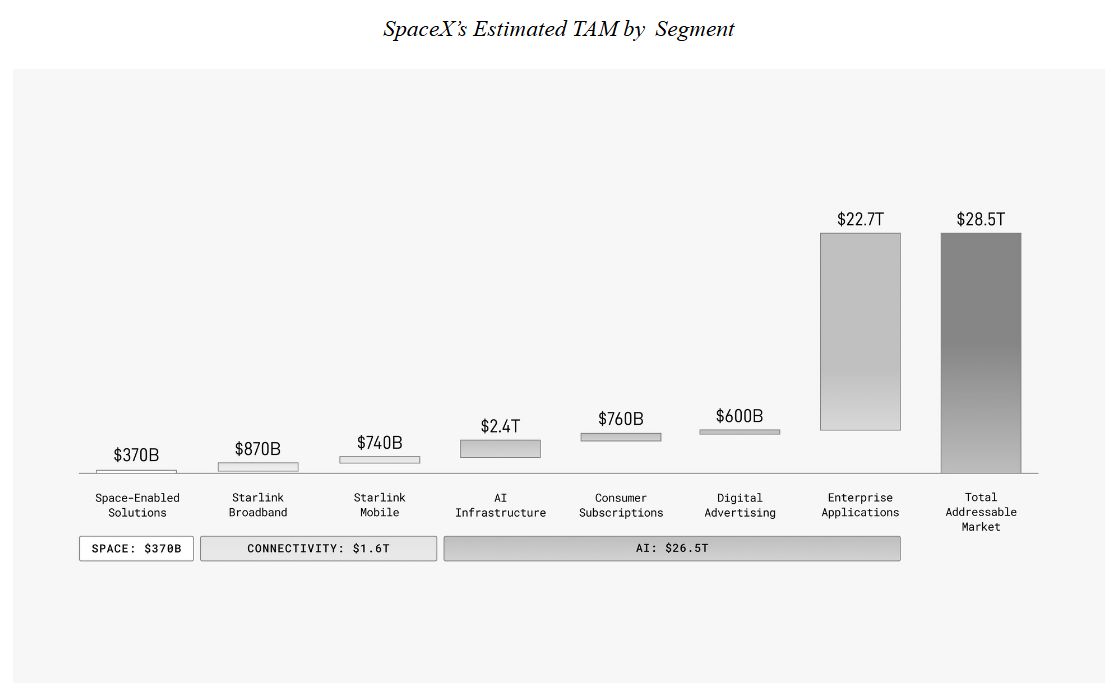
SpaceX projects a “total addressable market,” or TAM, of $28.5 trillion across its present and future offerings in space, data, and AI services. However, of this amount, only about $2 trillion is directly related to space or the company’s Starlink network. The remaining $26.5 trillion is believed to come from AI, largely from enterprise applications.

SpaceX estimate of total addressable market.

SpaceX estimate of total addressable market. Credit: SpaceX S-1 filing

“We believe we have identified the largest TAM in human history,” the company states on page 171 of the filing. “We believe our next trillion-dollar market is AI compute, which we contemplate will leverage our rockets and satellites for massive orbital deployment.”

The company said its estimates for this large market were based on a number of sources.

“Our AI market estimates are based in part on projections of global data center compute demand from third-party sources, including estimates published by RAND Corporation, together with internal assumptions regarding the portion of global compute capacity that may be utilized for AI workloads and other operational assumptions such as power usage, utilization rates and pricing,” the filing states.

Compensation details

The document includes some interesting details about the company’s leadership. After the IPO concludes and SpaceX becomes a public company, Musk will retain 85.1 percent of the “combined voting power” in leading SpaceX. He will serve as the company’s chief executive officer and chairman of the board of directors. It will be very difficult to remove him from this position.

Musk’s salary in 2025 was $54,080, a value tied to California’s minimum salary for exempt employees. Gwynne Shotwell, president and chief operating officer of the company, received a salary of $1.08 million in 2025, but including stock awards, her total compensation was valued at $85.8 million.

The S-1 filing notes that Musk has served as an advisor to President Trump and alludes to the possibility that changes in politics might materially affect the company’s future.

“The current political environment in the United States is highly polarized, and shifts in the composition of the US Congress or changes in the presidential administration can result in significant changes in government spending priorities, regulatory posture, and the allocation of contracts and resources across industries and programs,” the filing states. “Our relationships with US government agencies and the favorability of the regulatory and procurement environment in which we operate may be affected by which political party controls the presidency or one or both chambers of the US Congress.”

The space business

There is relatively little new information in this document about the company’s launch business. For example, there is no breakdown of the Falcon 9’s internal launch cost (believed to be about $15 million per launch) relative to the base public price of $74 million.

As for the larger Starship vehicle, the filing states that SpaceX aims to reduce the price per kilogram to orbit to at least $185. SpaceX intends to begin launching V3 Starlink satellites during the second half of this year on the super-heavy rocket, but this is predicated on a series of test flights that will resume as early as Thursday from Starbase in South Texas.

The filing also acknowledges the significant work that SpaceX has yet to complete with Starship to make it a fully reusable rocket capable of delivering large payloads to the Moon and Mars.

“These systems involve significant technological, engineering, and operational challenges, including the need to develop habitable transportation and surface environments, and perform complex in-orbit operations,” the document states. “Solving these challenges will require developing solutions that are novel or untested and will require substantial capital investment.”

The AI business

By staking its future on AI, SpaceX makes the case that it is the best-placed company to build a massive constellation of orbital data centers.

“We believe we are the only company with a commercially viable path to building orbital AI compute at scale,” the filing states. “This is underpinned by our unique ability to launch substantial mass into orbit cost efficiently through reusable rockets and manufacture secure, reliable, and high performance satellites at low cost and high volume. Our goal over time is to launch 100 gigawatts of compute to space each year.”

SpaceX said it expects to begin deploying its orbital AI compute satellites as early as 2028.

This company, founded with an initial goal of launching a small rocket known as the Falcon 1, has come a long way since its humble beginnings. It has become the world’s most accomplished launch company and annually puts about 80 percent of all mass into orbit. It operates more satellites than the rest of the world combined.

And yet, to reach its stratospheric valuation and addressable market, SpaceX must evolve from a space company into an AI company and continue growing rapidly. These are huge bets. It will be up to investors to decide in the coming months and years whether these are also good bets.

Truce holds a year after brief Indo-Pak war, conflict continues

0
truce-holds-a-year-after-brief-indo-pak-war,-conflict-continues
Truce holds a year after brief Indo-Pak war, conflict continues

A year has passed since conflict broke out between India and Pakistan, briefly raising fears of an all-out war between the two nuclear powers.

While violent conflict between the neighbors has been commonplace for the past 80 years, this latest round of fighting felt different.

Both sides used new weapons against one another, including cruise missiles, short-range ballistic missiles and drones. The level of mistrust and sharp rhetoric worsened considerably, significantly testing regional partnerships.

One year later, tensions remain high, with an underlying risk of further escalation.

What happened last year?

The war broke out last May following a terrorist attack that killed 26 civilians in the Pahalgam area of Indian Kashmir on April 22.

Within days, Indian police claimed the Pakistan-based militant group Lashkar-e-Taiba was behind the attack. Pakistan vehemently denied any involvement.

Then, on May 7, India launched Operation Sindoor against alleged terrorist strongholds in Pakistan, which prompted a Pakistani retaliatory attack, Operation Bunyan-un-Marsoos.

Dozens of people are believed to have been killed. As in any India-Pakistan conflict, the possibility of the use of nuclear weapons created further alarm.

The four-day conflict came to an end with a ceasefire on May 10. It was announced by the Trump administration, which claimed to have mediated the deal. This irritated India, but Pakistan nominated US President Donald Trump for the Nobel Peace Prize.

India nonetheless claimed victory, boasting of its ability to deliver precise attacks far inside Pakistani territory, exposing weaknesses in its rival’s air defenses. Pakistan, meanwhile, claimed to have shot down five Indian fighter jets (which India denies).

Political ramifications

In Pakistan, the Pakistani military returned to the political mainstream following the conflict. After leading Pakistan’s military response to India, the chief of army staff, Syed Asim Munir, was elevated to field marshal, and then to the post of the country’s first chief of defense forces.

Munir’s influence has only grown since. He has become very close to Trump and has been a key figure in the negotiations between the US and Iran to bring an end to their war.

Pakistani people rally in support of the Pakistani armed forces on the anniversary of the ceasefire with India. Photo: Akhtar Gulfam / EPA

In India, Operation Sindoor was seen as a win for the Modi government’s decisive foreign policy, and was a moment of rare political consensus in the country.

However, in Kashmir, the terror attack raised fresh questions about the government’s claims of normalcy in the region – and its push to boost tourism – following the controversial revocation of Kashmir’s statehood in 2019.

In the weeks that followed the attack, security operations in the Kashmir valley shut down several tourist sites. This led to a sharp decline in visitor numbers and severely affected local businesses. Security operations also targeted civilians, alarming human rights experts.

Perhaps the most significant impact of the conflict has been the difference in diplomatic engagements of both countries.

Shifting regional dynamics

The war highlighted Pakistan’s operational cooperation with both China and Turkey. The Pakistani military used Chinese-built fighter jets and missiles in its attacks, as well as Turkish-made drones. Its satellite-based intelligence was enabled by China, too.

After the war, Pakistan also signed a new deal with the Trump administration to develop Pakistan’s oil reserves, and a defense pact with Saudi Arabia, a staunch US ally.

India had pursued a decade-long push to isolate Pakistan diplomatically, which made Pakistan’s increasing bonhomie with the US and Gulf states particularly awkward.

Prime Minister Narendra Modi’s once-close relationship with Trump, meanwhile, began to deteriorate over US tariffs and India’s purchase of Russian oil.

Modi’s ill-timed visit to Israel and the visible lack of influence in the US-Iran war has also raised questions about India’s professed role as a regional leader. It has highlighted the limits to India’s strategy of balancing its strategic partnerships, especially during conflict.

India has tried to engage in proactive diplomacy, dispatching delegations of MPs and former diplomats to more than 30 countries over the past year. While India claims these visits were a success, they haven’t done much to convince the world that Pakistan was the aggressor in their conflict.

Where do things go from here?

One year on, the political rhetoric on both sides is as charged as ever.

Both India and Pakistan have signaled a resolve for further escalation in future conflicts.

Despite a sliver of hope for secret backchannel talks, India continues to give stern warnings to Pakistan over its alleged support to terrorist groups.

India has also reiterated that a major water-sharing treaty between the countries would remain suspended until Pakistan takes steps to end its support for terrorism – leaving a major concern over water security unresolved.

In response, Pakistan has made clear any attempt to target Pakistan again would “trigger consequences” that would not be “geographically confined or strategically or politically palatable for India”.

The shifting geopolitics and heightened rhetoric have narrowed the space for any prospects of meaningful dialogue between the two. As a result, the alarmingly low levels of trust will remain.

The ceasefire holds for now, but the conflict continues unabated.

Stuti Bhatnagar is a lecturer, Indo-Pacific studies, UNSW Sydney.

This article is republished from The Conversation under a Creative Commons license. Read the original article.

0FansLike
0FollowersFollow
0FollowersFollow
0SubscribersSubscribe
- Advertisement -
Google search engine

Recent Posts