11.1 C
London
Tuesday, May 19, 2026
Home Blog

Ebola strain spreading in Congo and Uganda has no approved vaccine

0
ebola-strain-spreading-in-congo-and-uganda-has-no-approved-vaccine
Ebola strain spreading in Congo and Uganda has no approved vaccine

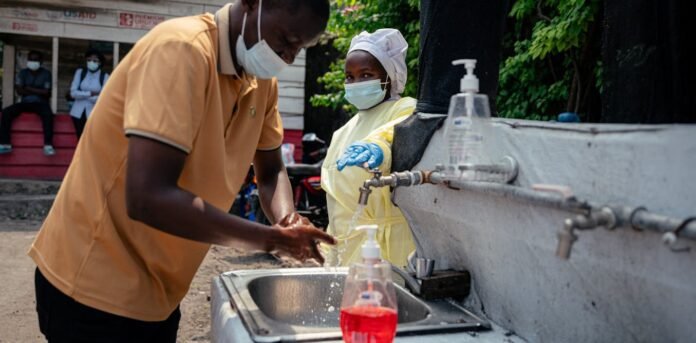
As a deadly outbreak of Ebola virus spreads in the Democratic Republic of Congo and Uganda, the U.S. Centers for Disease Control and Prevention said on May 17, 2026, that it is transferring “a small number of Americans” who were in Congo and who were exposed to the virus.

Some of these exposures are classified as high-risk, and among them is an American doctor who has been evacuated to Germany, health officials said.

On May 18, the U.S. also announced a ban on people who have recently traveled to Ebola-affected countries from entering the country.

The World Health Organization declared the outbreak to be an international health emergency on May 17. However, the CDC says the risk to the United States remains low.

As an infectious disease scientist who has studied multiple epidemics around the world, I agree that this reassurance is justified. But one key aspect of this outbreak is highly concerning: There is more than one Ebola virus, and this outbreak is caused by one for which the world has no vaccine.

On May 17, 2026, the World Health Organization declared the Ebola outbreak a “public health emergency of international concern.”

A familiar name, an unfamiliar virus

First identified in 1976, Ebola viruses have caused dozens of outbreaks across Africa.

The group of viruses that cause the disease, called orthoebolaviruses, consists of six known species, but three cause most large outbreaks: Zaire, Sudan and Bundibugyo. The tools the world developed over the past decade – the licensed vaccine Ervebo and monoclonal antibody treatments – were designed against the Zaire species, which is by far the most common.

The current outbreak, by contrast, is caused by the Bundibugyo virus, first identified in 2007 in Uganda. It is only the third documented Bundibugyo outbreak on record – and the largest.

There are no approved vaccines or therapeutics for the Bundibugyo virus. That’s because its genetic makeup differs significantly from other orthoebolaviruses. When the Bundibugyo virus was first described, scientists warned that this divergence would complicate efforts to design diagnostics and vaccines against it. An immune response to the Zaire species, elicited by a vaccine, is unlikely to protect against Bundibugyo.

An outbreak that grew in the dark

The most worrying feature about the current outbreak is not the virus itself but how large it already was when it was recognized.

It took the WHO until May 15 to identify the Bundibugyo strain as the cause of the outbreak. By May 16, the health organization had identified 246 suspected cases and 80 deaths in the DRC’s Ituri province. Recent Zaire outbreaks were often declared with only a handful of community deaths.

One reason for the delay is technical: The rapid field tests used for screening are calibrated for the Zaire species and often miss Bundibugyo. Early samples in this outbreak tested negative for Ebola; only genomic sequencing at a reference laboratory in Kinshasa identified the species. An outbreak that spreads invisibly is far harder to contain because contact tracing is always one step behind.

Geography compounds the danger – and explains why the WHO moved so fast after identifying the cause of the outbreak to declare it an emergency. Ituri has porous borders with Uganda and South Sudan as well as a highly mobile population. It is also in the grip of a humanitarian and security crisis due to prolonged armed conflict in eastern Congo.
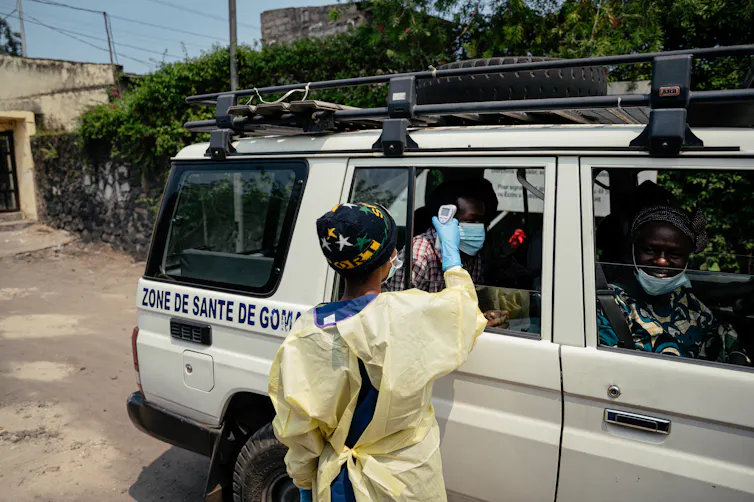
A person in protective gear checks the temperature of people in a white van.

A visitor has their temperature checked at a checkpoint before entering Kyeshero Hospital in Goma, Congo, on May 18, 2026. Jospin Mwisha/AFP via Getty Images

The outbreak’s hot spots include mining towns with constant worker turnover, and cases have already reached Kampala, Uganda’s capital city, where more than 1.5 million people are connected to the world by an international airport. That is the international community’s central fear: not the remote village, but the virus reaching dense, highly connected urban hubs from which it can travel along trade and air routes across borders.

An outbreak that stays rural can be contained; one that reaches the transit network – as seems to be the case now – becomes everyone’s problem.

How Ebola spreads – and why health workers’ risk is high

There is also a less intuitive route. After recovery, the virus can persist for months in sites such as the testes, eyes and central nervous system, which infectious disease experts call “immune-privileged” sites. This means they don’t tend to experience strong responses from the immune system when they are invaded by foreign substances.

For the Zaire species, this has produced documented cases of sexual transmission from male survivors whose blood had long since cleared the virus. This is why the WHO now advises male survivors to abstain from sex or use condoms until semen tests negative twice.

How far this applies to Bundibugyo is not yet established, but it is one more reason that a “contained” outbreak is rarely the end of the story.

A revealing detail of the current outbreak: Among the first identified cases were four health workers, who died within days. This points to transmission inside health facilities, a classic pattern when protective equipment and infection control fall short.

What this outbreak is really testing

With no specific vaccine or antiviral, the response depends entirely on classic public health measures: early detection, case isolation, contact tracing, safe burials, infection control and community engagement. These work, but they are labor-intensive and fragile in a conflict zone.

The encouraging news is that early supportive care – fluids and blood-pressure and oxygen management – saves lives even without a targeted drug. Experimental Bundibugyo vaccines have also shown promise in primates, though they are not yet proved in humans.

There is a final point that should resonate in the United States: Some epidemiologists have raised the question of whether cuts to global health programs contributed to the delay in this outbreak’s detection. Whatever the answer, the lesson is the same: With the existing Ebola vaccine, the world built a narrow defense against one species of a virus that comes in several.

The Americans now being flown out of Congo are a reminder that in an interconnected world, no outbreak is ever entirely someone else’s problem.
Australian Aboriginals cared for a dingo’s grave for decades

0
australian-aboriginals-cared-for-a-dingo’s-grave-for-decades
Australian Aboriginals cared for a dingo’s grave for decades

A thousand years ago, the ancestors of today’s Barkindji people carefully buried a dingo (or garli, in the Barkindji language) in a mound of shells.

Archaeologists recently studied the burial in what’s now New South Wales, Australia. They found that the Barkindji ancestors had buried the dingo with the same care and ceremony as any beloved human member of the community and looked after the grave for centuries. The burial reveals that dingoes were, as Australian Museum and University of Sydney archaeologist and study co-author Amy Way puts it, “deeply valued and loved” by ancient people in Australia.

The long-lost dingo

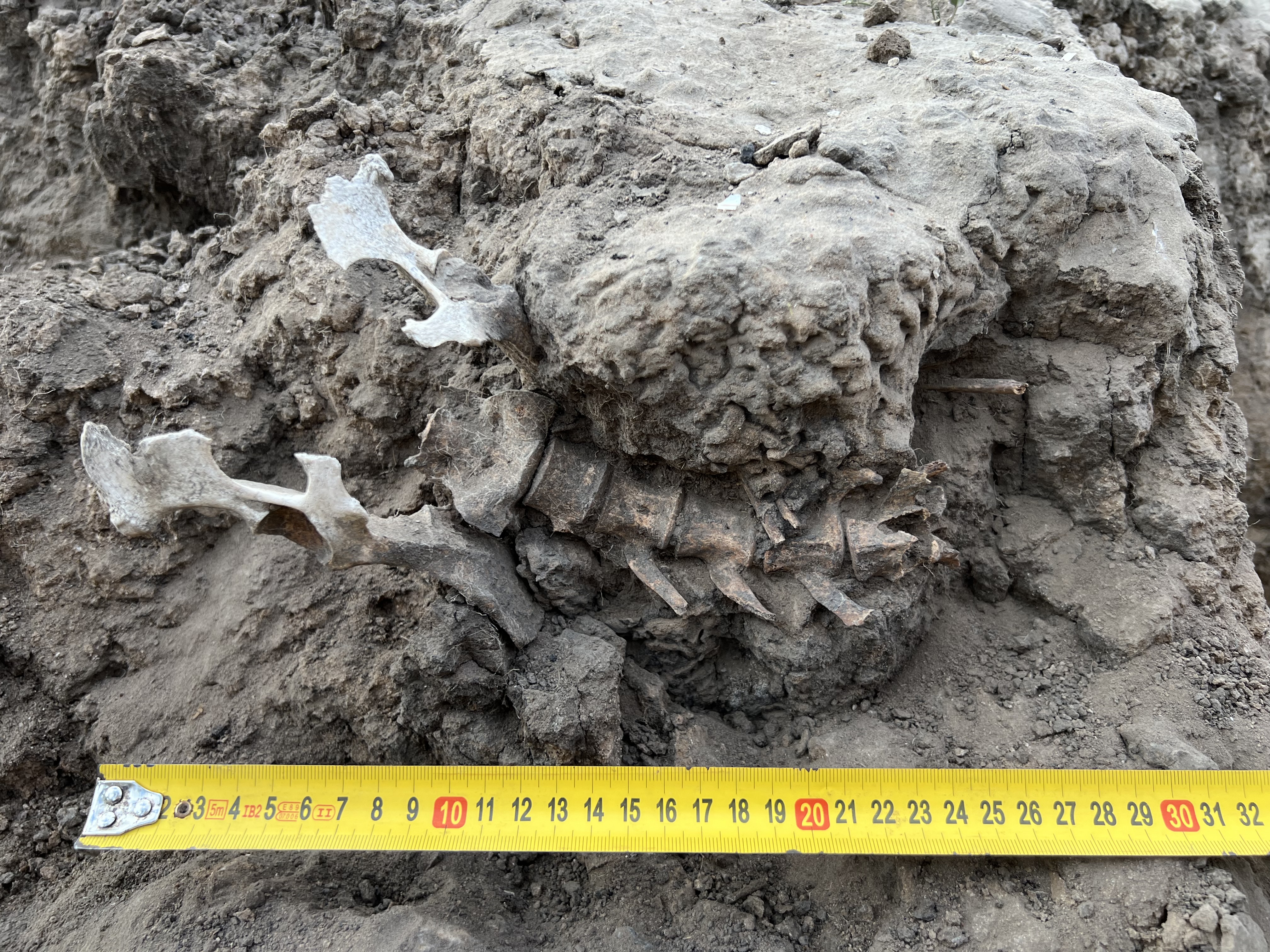
Five years ago, Barkindji Elder Uncle Badger Bates and National Parks and Wildlife Service archaeologist Dan Witter saw bones eroding out of a road cut in Kinchega National Park, an area along the Baaka, or Darling River, in New South Wales, Australia. Badger recognized the bones as a dingo, lying on its left side in what was once a carefully built mound of river mussel shells.

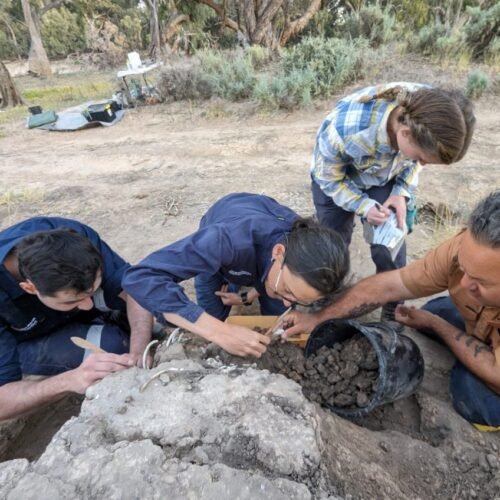
At the urging of the Menindee Aboriginal Elders Council, which worried that erosion would end up destroying the dingo bones and any information about the past they contained, a team of archaeologists, working alongside Barkindji elders, excavated and studied the skeleton. The bones turned out to belong to an elderly male dingo, with worn teeth and possible signs of arthritis. Broken and healed bones suggested that he’d lived a tough, active life but also been cared for by people.

And the layers of shells around him revealed that generations of Barkindji had tended his grave and ritually “fed” him by adding shells to the mound for centuries after his death. This is definitely not the first dingo burial ever found in Australia, but it’s farther north and west than any other example. It reveals a far more profound and lasting relationship between ancient people and dingoes than outside researchers, at least, had previously fully realized.

“This confirms these traditions were much more widespread than we once thought,” said University of Western Australia specialist Loukas Koungoulos, the lead author of the paper, in a press release.

photo of a dino skeleton partial buried in dry soil

The dingo’s bones revealed healed injuries and possible arthritis.

The dingo’s bones revealed healed injuries and possible arthritis. Credit: Amy Way

Hunting kangaroos and snoozing by the fire

The dingo’s bones tell their own story. Koungoulos says he was probably between 4 and 7 years old, which would be late middle age for a wild dingo today. Heavily worn teeth were the first hint of the dingo’s senior citizen status, but the ends of his leg bones also showed signs of bone decay, probably thanks to long-term inflammation: possibly something like arthritis.

And he was shorter than most wild dingoes, based on the length of his femurs. That’s not unusual—domesticated animals are often shorter than their wild relatives, and it doesn’t take many generations for that to show up—but it could say something interesting about exactly how close wild dingoes got to domestication in the centuries before European colonists wrecked everything.

At some point, the dingo had suffered a broken rib and lower leg. Koungoulos suggests the injuries look like the aftermath of a kangaroo kick and may have happened on a hunt. The injuries themselves aren’t too surprising; wild dingoes hunt kangaroos, and Aboriginal hunters worked with dingoes the same way people in other parts of the world have hunted with dogs for millennia. What’s more striking is that the two injuries were long-since healed. Somebody nursed this dingo back to health after his kangaroo encounter.

“What stands out about garli is that he was old and well-cared-for,” said Koungoulos. “The healed injuries, worn teeth, and careful burial tell us that this animal lived a long life alongside people, and that his death was marked intentionally and with respect.”

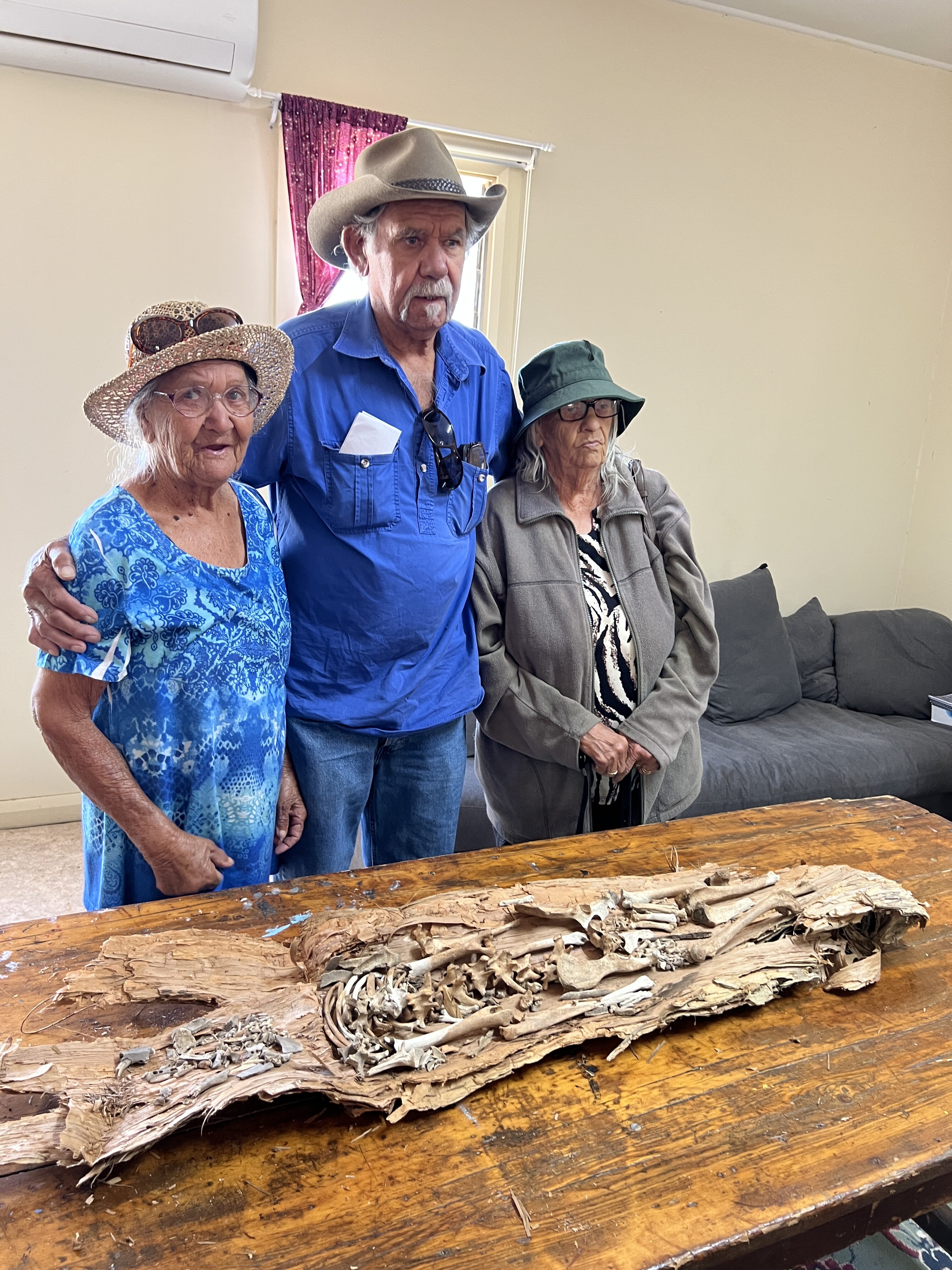
three elderly people stand behind a carefully arranged dingo skeleton lying on a table

Barkindji elders stand with the excavated dingo skeleton; in the center is Uncle Badger Bates, who first identified the bones as a dingo.

Barkindji elders stand with the excavated dingo skeleton; in the center is Uncle Badger Bates, who first identified the bones as a dingo. Credit: Amy Way

How dingoes became beloved community members

People have lived in this part of Australia for at least 40,000 years, and the oldest traces of humans on the continent date to 65,000 years ago. But dingoes are relative newcomers; the first dingoes arrived on Australia’s shores between 3,500 and 5,000 years ago: just a relative handful of domestic dogs that tagged along with seafarers from New Guinea, according to genetic studies. But that small starting population went wild, both literally and figuratively.

And, of course, they’re undeniably friend-shaped. It didn’t take Australia’s First Nations peoples long to bond with the dingoes, finding a place for them in their creation stories and in their communities.

“These creatures were the first non-humans who answered back, came when called, helped in the hunt, slept with people, and learned to understand some of the vocabulary of human languages,” wrote anthropologist Deborah Bird Rose in her book Wild Dog Dreaming: Love and Extinction. “People gave them names, fitted them into the wider kinship structure, and took care of dead dingoes in the same way they took care of dead people.”

The Baaka dingo is proof of just how deeply dingoes had worked their way into people’s hearts and lives by around a thousand years ago. Radiocarbon dating of the freshwater mussel shells reveals that the dingo’s burial mound was built between 916 and 963 years ago, around the same time the dingo died. But layers of shells kept being added over the centuries, in what Barkindji elders describe as a “feeding” ritual meant to honor the dead dingo as one of the community’s own ancestors.

“If garli were buried with the same care and respect we see for human ancestors, including mothers and elders, it tells us these animals were profoundly valued and loved,” said Way.

In many places, shell middens begin as refuse piles and eventually become parts of the foundations of buildings or settlements. But in Australia, middens “are sites built by the Old People,” write Way, Barkindji elder and artist Barb Quayle, and Barkindji custodian Dave Doyle in a 2023 article about their work. They’re built on purpose as burial sites for family members—both two- and four-legged. But this is the first time archaeologists have actually unearthed a midden with evidence that people added to it regularly for so many generations.

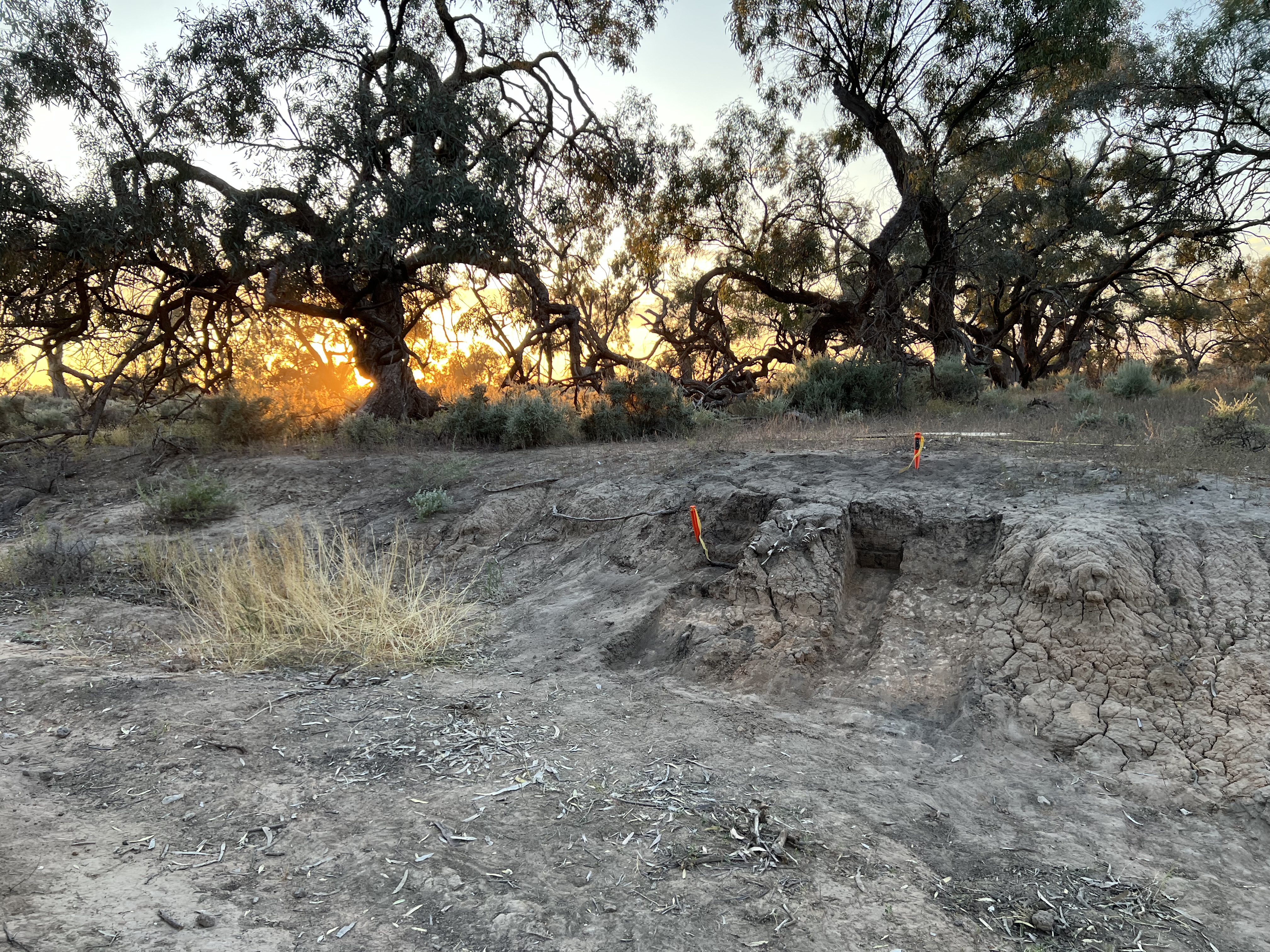
sun sets behind a scraggly treeline. In the foreground, bones erode out of a low embankement

The site looks lonely today, but this once would have been a carefully tended grave and an important site for Barkindji ancestors in the area.

The site looks lonely today, but this once would have been a carefully tended grave and an important site for Barkindji ancestors in the area. Credit: Amy Way

That’ll do, garli, that’ll do.

The Barkindji people have shown this small, elderly dingo the same care their ancestors did. Koungoulos and Doyle excavated the bones only after Quayle had performed a smoking ceremony over the grave, which involves passing smoke over the grave and the bones as a form of spiritual cleansing. Way and her colleagues have been working with Barkindji representatives for several years to learn more about the Barkindji people’s more than 40,000-year history in the region, combining traditional knowledge and priorities with modern scientific techniques.

And earlier this year, Barkindji Elders and archaeologists reburied the dingo on Barkindji land. In Australia, this kind of repatriation is called a return to Country.

“This research reinforces what Barkindji people have always known,” said Way. “These relationships with animals, ancestors, and Country were deep, deliberate, and ongoing.”

Australian Archaeology, 2026. DOI: 10.1080/03122417.2026.2650909. (About DOIs)


Correction: location of the Darling river was corrected.

Actor’s 75 Year Marriage Bombshell Has Fans Stunned

0
actor’s-75-year-marriage-bombshell-has-fans-stunned
Actor’s 75 Year Marriage Bombshell Has Fans Stunned


Boy Meets World legend William Daniels and his longtime wife Bonnie Bartlett are finally clearing the air about one of the most surprising chapters in their decades-long love story.

Daniels, 99, and Bartlett, 96, are preparing to celebrate their 75th wedding anniversary next month, a milestone most Hollywood couples never come close to reaching. But now, Bartlett is speaking out after past comments about the couple’s so-called “open marriage” sparked a frenzy.

The Emmy-winning actress told the Daily Mail that the headlines made the arrangement sound far more dramatic than it actually was.

“It’s funny, the press will pick up on something and make more of it than it was,” Bartlett said, explaining that she and Daniels never sat down and created any formal “rules” about their marriage.

According to Bartlett, the two simply lived through the ups and downs of a very long relationship, especially during the wild world of New York show business.

“There was never any discussion as to what we were going to do,” she said. “But in 75 years, the two of you together, you know, it would be abnormal if you weren’t attracted occasionally to other people.”

Bartlett admitted there were moments when both she and Daniels became involved with other people during their marriage.

“There have been times, yeah, both of us, on both sides,” she said.

The Little House on the Prairie actress also wrote about the painful subject in her 2023 memoir, Middle of the Rainbow, where she revealed the couple once had what she described as an “open marriage.”

But Bartlett made it clear the arrangement was not some glamorous Hollywood fantasy.

In fact, she previously said it was “very painful” and “didn’t work well.”

The actress confessed she had an affair around 1959, eight years after marrying Daniels. She described the man as a “slightly boring” actor, and said the relationship only lasted a few months.

Daniels also stepped outside the marriage in the 1970s with a producer, a betrayal that Bartlett said left her devastated.

That moment changed everything.

Bartlett said she eventually realized she “could no longer tolerate any kind of open marriage.”

Still, despite the heartbreak, the couple never fully broke apart. Instead, they somehow managed to survive decades of fame, temptation, grief, and career pressures that would have destroyed many marriages.

“Bill and I never sit down and make rules,” Bartlett said. “We never sit down and talk about these things. We just don’t. We just live our lives.”

She added that their careers sometimes pulled them in different directions for long periods of time.

“If he’s away for a year, he’s away for a year,” she said. “Our lives just went on, but we never got unhinged.”

Bartlett said their early years together unfolded during a much freer era, when attitudes about relationships and sex were changing rapidly.

“It was a time when people were doing that,” she explained. “It was at a time in New York when there was a lot of sex and a lot of people doing all kinds of things, you know, very free.”

But after all these years, the couple is still together, still smiling in photos, and still beloved by fans who know Daniels best as the wise and warm Mr. Feeny from Boy Meets World.

The two even played husband and wife on screen multiple times, including in Boy Meets World and St. Elsewhere.

Bartlett admitted she is surprised by just how long their marriage has lasted.

“You don’t plan for it. You really don’t plan for it,” she said. “I’m not at all romantic or anything like that. I’m a big believer in today, you know? And then all of a sudden it’s 75 years. It’s kind of amazing, I must say.”

Daniels, for his part, still sounds completely devoted to the woman he met all those years ago at Northwestern University.

“I wouldn’t be with anyone else in my life than this woman sitting next to me,” he said.

Their marriage has also endured deep personal tragedy. Ten years after tying the knot, the couple welcomed a son, William Jr., who died just 24 hours after his birth. They later adopted two sons.

After 75 years, Bartlett and Daniels’ love story may not be neat, simple, or picture-perfect. But it is one of the rare Hollywood marriages that lasted through scandal, sorrow, fame, and time itself.

Wall Street guru struck speechless by Trump insider stock trades

0
wall-street-guru-struck-speechless-by-trump-insider-stock-trades
Wall Street guru struck speechless by Trump insider stock trades

One of Wall Street’s most recognizable gurus, Jim Cramer, became notably tongue-tied on Monday after President Donald Trump’s recent stock-trading spree entered into a televised conversation with his colleagues on CNBC.

Disclosures published by the US Office of Government Ethics last week revealed that Trump in the first quarter of 2026 carried out over 3,700 stock transactions, including over 30 stock purchases that were each worth $1 million or more.

As noted by The Financial Times, Trump’s investments included transactions involving Tesla, Nvidia, Apple, Meta, Visa, Citi, Boeing, Qualcomm and GE Aerospace, whose executives all accompanied the president on his trip to China last week.

When CNBC co-host Carl Quintanilla brought up these trades during Monday’s edition of “Squawk on the Street,” Cramer spent ten straight seconds mumbling incoherently.

This promoted co-host David Faber to reassure viewers that “we’re not having technical difficulties here,” even as Cramer appeared to short circuit.

Journalist Ryan Grim said that Cramer’s reaction to mention of Trump’s trades was understandable given that some of the companies whose stocks he traded have been direct beneficiaries of the president’s illegal war with Iran and other policies.

“Cramer here is having what should be the normal reaction to Trump actively insider trading on his own decisions,” remarked Grim. “Just sputtering speechlessness.”

Journalist Judd Legum on Monday published an analysis of the Trump stock trades in which he identified multiple instances where the president purchased stocks of companies shortly before – or in some cases, on the exact same day – that he publicly singled them out for praise.

Specifically, Legum found that Trump bought tens of thousands of dollars’ worth of shares in biotech firm Thermo Fisher Scientific on the same day he took a tour of one of its manufacturing facilities, and hundreds of thousands of dollars’ worth of shares in Apple on the same day he delivered a speech calling it “a great company,” while saying then-CEO Tim Cook has “done a good job.”

Trump also bought up shares in Micron Technology and then described it as “one of the hottest companies” during an interview with Fox News just one day later.

And nine days after buying millions of dollars’ worth of shares in Dell, Trump delivered a speech in Georgia where he told his audience to “go out and buy a Dell computer.”

In analyzing the trades, Legum explained how Trump has destroyed any remaining guardrails preventing US presidents from using their office to personally enrich themsleves.

“If Trump wanted to legally remove himself from investment decisions he could do so by creating a qualified blind trust,” Legum wrote. “Instead, before returning to the White House, Trump transferred his assets in a trust that is managed by his sonDonald Trump Jr. There are no legal or practical barriers preventing Trump from being involved in the management of his assets.”

Representative Dan Goldman (D-NY) warned Trump that details of his assorted stock trades would eventually come to light.

“This smells like blatant and criminal insider trading,” Goldman wrote in a social media post. “Even worse, Trump is personally profiting off of his illegal deportation dragnet. Since we know congressional Republicans will pretend like they never saw this and won’t do a thing, anyone involved in these trades should preserve their records for my investigation in January 2027.”

… elsewhere in the world of grift

Also on Monday, 93 House Democrats launched a bid to block Trump’s $1.77 billion taxpayer-funded settlement with the Internal Revenue Service, through which the president could reward supporters, including people convicted of seditious and violent felonies during the January 6, 2021 Capitol insurrection.

The Democratic lawmakers joined an amicus brief filed in Trump v. IRS before Judge Kathleen Williams in the US District Court for the Southern District of Florida. Their action followed the Trump administration’s announcement of the creation of a so-called “Anti-Weaponization Fund” as part of an agreement to drop a $10 billion lawsuit against the IRS over a leak of the president’s tax returns.

Acting US Attorney General Todd Blanche described the fund as “a lawful process for victims of lawfare and weaponization” allegedly carried out by the US Department of Justice (DOJ) during the Biden administration “to be heard and seek redress.”

However, House Judiciary Committee Ranking Member Jamie Raskin (D-Md.) called the settlement “pure fraud and highway robbery,” noting that Trump oversees the agency that agreed to settle with him.

“No president can concoct a fake case for $10 billion in damages against the government so he can be plaintiff and defendant and then ‘settle’ his bogus case against himself as a judge,” Raskin said.

“This case is nothing but a racket designed to take $1.7 billion of taxpayer dollars out of the treasury and pour it into a huge slush fund for Trump at DOJ to hand out to his private militia of insurrectionists, rioters and white supremacists, including those who brutally beat police officers on January 6, 2021, and sycophant accomplices to his election-stealing schemes,” he added.

The Democratic lawmakers’ amicus filing seeks to block the settlement, which could use taxpayer funds to compensate pro-Trump figures like the nearly 1,600 Capitol insurrection defendants charged or convicted of crimes connected to the Capitol attack, including seditious conspiracy, assault on law enforcement officers with dangerous weapons, and other felonies.

“Trump suing the IRS was never about justice, it’s another self-enrichment scheme on the backs of hard-working taxpayers,” House Ways and Means Committee Ranking Member Richard Neal (D-Mass.) said Monday.

“Now, with the court poised to weigh in only days from now, Trump is scrambling to cut a backroom deal and solidify his position as the judge, jury, and executioner,” Neal added. “Reporting detailing Trump’s interest in a billion-dollar slush fund for the J6 criminals and permanent immunity from any further IRS scrutiny only deepens the stench of corruption.”

Matt Platkin and Norm Eisen, lawyers representing the Democrats, said Monday: “It’s against the law for the president to in effect sue himself – and then settle for a huge sum. The court has the power to put a stop to these shenanigans and should do so.”

Trump was accused of rewarding political violence when he granted blanket pardons to the January 6 insurrectionists on his first day back in the White HouseAccording to the watchdog group Citizens for Responsibility and Ethics in Washington, dozens of pardoned Capitol attackers have since been charged or convicted of serious crimes, including child sex crimes, rape, grand larceny, burglary, home invasion, gun violations, death threats against public officials and fatal DUI incidents.

The president and other MAGA figures have accused the Biden administration of “weaponizing” the DOJ against Trump and his supporters. Meanwhile, Trump has targeted political opponents; federal officials involved in investigating and prosecuting him for alleged election interference and mishandling classified documents; pro-Palestine activists; universities and corporations resisting his anti-diversity, equity, and inclusion crusade; journalists; civil society groups; and others.

Progressive advocacy groups and legal experts joined Democratic lawmakers in condemning Trump’s settlement.

“Donald Trump and his compromised Department of Justice have created a slush fund to make payouts to Trump supporters and cronies,” Public Citizen co-presidents Lisa Gilbert and Robert Weissman said in a statement. “This scheme amounts to the creation of a January 6 payment fund.”

Brett Edkins, managing director of policy and public affairs at Stand Up America, said that “while Americans struggle with rising costs fueled by his economic mismanagement and war with Iran, Donald Trump is teaching a masterclass in grift.”

“He’s negotiated with himself to create a $1.7 billion tax-dollar slush fund with no oversight, no transparency, and no accountability,” Edkins continued. “In simple terms, Trump is stealing $1.7 billion in taxpayer dollars to hand out to himself, his cronies, his donors, or anyone he deems sufficiently loyal—including supporters who were convicted by juries of assaulting police officers on January 6, 2021.”

“This is truly unprecedented corruption,” he added, “and American taxpayers will foot the bill.”

-Common Dreams

More Than 100,000 American Kids Have Had a Parent Detained in Immigration Sweeps, Report Estimates

0
more-than-100,000-american-kids-have-had-a-parent-detained-in-immigration-sweeps,-report-estimates
More Than 100,000 American Kids Have Had a Parent Detained in Immigration Sweeps, Report Estimates

Far more American children have likely been separated from their parents during immigration sweeps than previously understood, according to a report by the Washington, D.C.-based think tank Brookings.

The report published Monday estimates more than 100,000 U.S. citizen children have had a parent detained since President Donald Trump’s mass deportation campaign began last year. The analysis cites reporting from ProPublica on the detention of parents, which can often lead to family separations.

During Trump’s first administration, a policy of family separation at the U.S.-Mexico border ended after widespread outrage. Now, the breakup of families is happening amid sweeps by immigration agents across the country.

About 400,000 people have been detained by immigration agents since Trump returned to office, Brookings noted. But it’s nearly impossible to know how many family separations that has caused, since the administration does not track it.

Families are also now being split up in ways that are more dispersed, more hidden and harder to track.

Brookings created its estimate by using census information to approximate the number of children that detainees have. It estimated that roughly 200,000 children, including 145,000 American kids, have had a parent detained. The think tank notes that the actual number could be somewhat higher or lower.

ProPublica used a different, more conservative, approach that relied on government data obtained through a public information lawsuit by the University of Washington. We found that in just the first seven months of Trump’s second term, at least 11,000 American children had a parent detained. We also found that Trump has been deporting about four times as many mothers of American children per day as President Joe Biden did.

As we noted, our figures are almost certainly undercounts. For instance, the government data relies on detainees self-reporting whether they have children. In some cases, agents may not ask and parents may not share details about their families out of fear of what might happen to their children.

“There are a lot of families that are in the situation that are not being written down,” said Tara Watson, one of the authors of the Brookings report. It’s “important both for transparency and from a child health and wellbeing perspective to know what’s happening to the kids. How many of them are leaving the U.S.? How many of them are staying in the U.S. with close family? How many of them do we really not know what their situation is?”

ProPublica also followed multiple families through their sudden separations and found a wide variety of outcomes for the children.

Doris Flores, a mother from Honduras, was separated from her breastfeeding infant after Immigration and Customs Enforcement officers arrested her and her fiance at the same time. In the rush to find someone to care for the baby and Flores’ 8-year-old daughter, she called on their local pastor to take the children in.

In response to the Brookings findings, the Department of Homeland Security, which oversees ICE, sent an oft-repeated statement that the agency “does not separate families,” adding that parents are asked if they want to be removed with their children or instead to have them placed with a person the parent designates. DHS said this is consistent with the practices of past administrations.

However, guidelines for ICE officers encountering parents have changed. A document known as the Parental Interests Directive was given a new name under Trump — the Detained Parents Directive. Its preamble, which once instructed agents to handle immigrant parents in a way that was “humane,” has been stripped of the word.

Support Independent Journalism:

As a nonprofit newsroom, we rely on donations from individuals like you to fuel our work. Your support today will directly fund investigations that shine a light on urgent issues: corporations prioritizing profits over public safety, health insurers denying coverage to patients, unintended consequences of new laws and more.

One Mars spacecraft, two senators, and a cloud of questions

0
one-mars-spacecraft,-two-senators,-and-a-cloud-of-questions
One Mars spacecraft, two senators, and a cloud of questions

NASA released a much-anticipated contract solicitation for a Mars-orbiting spacecraft late last week, kicking off what is sure to be a hotly contested and potentially controversial procurement.

At issue is $700 million, already appropriated by Congress, to build a spacecraft, launch it to Mars, and once there to serve as a vehicle to relay communications between the red planet and Earth. But the stakes may be even bigger than this, including the possible resurrection of the recently canceled Mars Sample Return mission.

As part of the new solicitation, NASA says it will conduct the acquisition “as a full and open competition.” But will it? That’s the question that several people involved with this procurement process are asking. And it could turn messy, quickly.

What is not controversial is that NASA needs a new spacecraft capable of relaying communications from Mars to Earth. NASA’s best communications relay today is the Mars Reconnaissance Orbiter, which has now been there for 20 years. It’s a great spacecraft, but it’s getting long in the tooth.

The US Congress, more or less out of the blue, stepped up with $700 million in funding for a new Mars Telecommunications Orbiter in the “One Big Beautiful Bill” passed in 2025. Ars previously wrote about this legislation, which raised some eyebrows, as this is a large appropriation for a relatively straightforward spacecraft.

Competition is narrowed

Proposals to build the spacecraft, the name of which has been changed to Mars Telecommunications Network (MTN), are due by June 15. A contract is expected to be awarded by October 1, less than five months from now.

There was some curious wording in the legislation that funded the Mars orbiter. It specified the spacecraft must be selected from among US companies that “received funding from the Administration in fiscal year 2024 or 2025 for commercial design studies for Mars Sample Return; and proposed a separate, independently launched Mars telecommunication orbiter supporting an end-to-end Mars sample return mission.”

Similar language ended up in NASA’s procurement notice, which states that to be eligible to bid, a company needs to “demonstrate that the Offeror proposed a separately and independently launched Mars telecom orbiter to support an end-to-end Mars Sample Return mission.”

That seems like a curious requirement. Why must the bidder for a relatively straightforward orbiter around Mars have previously proposed an orbiter as part of an “end-to-end” mission to return samples from Mars? Was Congress seeking to be preferential for a particular company?

Some hints about what is happening

The One Big Beautiful Bill was signed into law on July 4, 2025. One month later, as part of its Q2 Investor Update, Rocket Lab included a slide about its plans to support human missions to Mars. In the corner of the slide, the company noted that $700 million had just been appropriated for a Mars orbiter (MTO).

“Rocket Lab was the only commercial provider to propose a MTO as part of an end-to-end Mars Sample Return mission to support human exploration and science missions to Mars,” the slide stated.

Slide from Rocket Lab Q2 2025 Investor Update.

Slide from Rocket Lab Q2 2025 Investor Update. Credit: Rocket Lab

Rocket Lab is one of several companies eligible to compete based on the requirement that bidders have received funding in 2024 or 2025 for a “commercial design study” for a Mars Sample Return mission. Other eligible bidders include: Blue Origin, L3Harris, Lockheed Martin, Northrop Grumman, SpaceX, Quantum Space, and Whittinghill Aerospace.

At an “Industry Day” event earlier this year, NASA officials indicated that the contract solicitation would be released by May 1. However, it was two weeks late. Weeks matter when NASA is seeking to have this spacecraft built and launched before the end of the next Mars launch window in late 2028.

Ars’ Stephen Clark recently asked Rocket Lab chief executive Peter Beck if he knew why this delay had occurred. He said he did not. Beck was also asked whether NASA was moving quickly enough given the schedule constraints.

“I think there’s plenty of fire lit under them already,” Beck said. “They understand the importance of the mission. So I think we just need to get it out there, and they need to get it awarded, and everybody needs to get to work.”

One source indicated to Ars that this delay was due in part to a letter sent by US Sen. Roger Wicker, R-Miss, earlier in May to NASA. According to this source, Wicker’s letter was interpreted as favorable toward Rocket Lab’s position in the competition.

Despite multiple efforts, Ars has been unable to obtain a copy of this letter. A NASA spokesperson, noting that the agency is now in a “blackout” period due to the contract solicitation’s release, declined to confirm the existence of Wicker’s letter or to release it.

Mars Sample Return

Why would Wicker be interested in a space company like Rocket Lab, which was founded in New Zealand and now has its headquarters in Long Beach, California?

The answer probably lies in the Stennis Space Center, a rocket engine test facility in southern Mississippi. Rocket Lab already tests its Archimedes rocket engine there and plans to test engines for its Mars orbiter there. Additionally, two sources indicated, the company would likely do more testing there if NASA’s Mars Sample Return (MSR) program were resurrected.

Do you remember Mars Sample Return? NASA’s plan to return Martian rocks and soil to Earth came under severe scrutiny three years ago when its projected price tag ballooned to $10 billion. This led to much debate, including NASA ultimately asking for cheaper “commercial” proposals from companies like Rocket Lab.

“We were a relatively loud voice on MSR, because we just saw a program and a capability that could be solved,” Beck said in his recent interview with Ars. “The cost estimates for MSR, and all the rest of it, was just nuts. I think anybody knows that I have a bit of a soft spot for planetary sciences. So with MSR, I just saw a whole bunch of Nobel Prizes sitting on the surface there, and it was just criminal not to bring them home. As part of that, we studied the whole architecture very, very, very closely, and it was clear to us that a Mars Telecommunication Orbiter would be an important part of that.”

Not dead yet

Ultimately, the Trump White House and the US Congress, as part of the budget process, canceled the Mars Sample Return mission in January.

Only, maybe it’s not dead yet.

In March, the US Senate Committee on Commerce, Science, and Transportation unanimously passed a new NASA Authorization Act that called for a reinstatement of Mars Sample Return. According to this legislation, NASA shall “establish within the Science Mission Directorate a new Mars Sample Return program for the purpose of returning scientifically curated samples from Mars to Earth.” This mission should cost no more than $8 billion, according to the bill.

Although this legislation has not passed the full US Congress, we can draw some clues from it. Sen. Ted Cruz, R-Texas, chairs the committee that authored the bill, and he likely supports a revival of Mars Sample Return because it would bring new facilities and prestige to Johnson Space Center in Texas. Rocket Lab, if it were to obtain the contract to build a Mars orbiter, would have a leg up in the contracting process to develop the rest of the sample return mission. Testing for these vehicles, including a Mars Ascent Vehicle, could happen in Mississippi.

On the fog of Beijing

0
on-the-fog-of-beijing
On the fog of Beijing

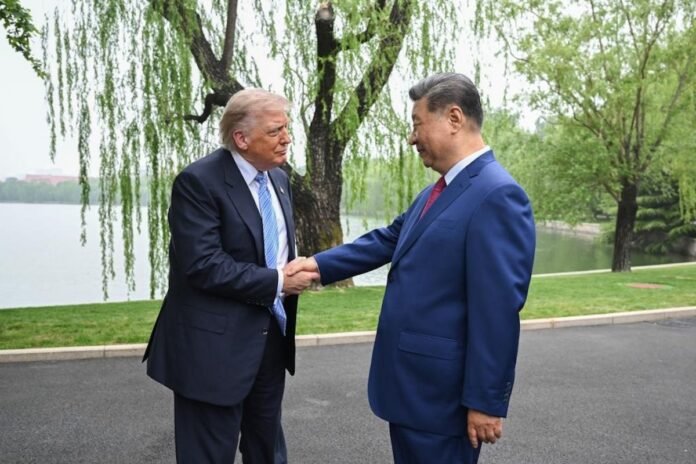
One of the difficulties in analysing summit meetings between leaders such as Xi Jinping and Donald Trump is that the events are a blend of public theatre and private discussion.

With previous presidents of China and the United States such summits represented the culmination of long negotiations between specialist senior officials, providing a predictable structure and predictable outcomes. But with power in both countries now concentrated in the hands of their respective leaders rather than in broader governing systems the summits have less structure and more theater, while the private discussions are more important and more secretive.

So it may take weeks, months or even years to gain anything like a clear understanding of what happened during the two-day summit held in Beijing between the leaders of the world’s two superpowers on May 14-15. Very little was announced publicly, even about long-running issues concerning trade and Chinese purchases of American products.

Under Presidents Bush, Obama or Biden, such silence would have meant that the structured, official negotiations had failed. But with Trump everything is personal and little is structured. We cannot judge whether the summit succeeded or failed until we see what happens next.

The only thing that is clear is that Trump and Xi intend to keep on meeting in this way, with a reciprocal summit now scheduled to take place at the White House on September 24. The question for Europe and for the rest of the world is whether to feel happy that the world’s two greatest military and economic powers are talking regularly rather than fighting – or to feel worried that they might do private deals that could harm the rest of us.

One answer to that question is likely to emerge not in Asia or America but in the Middle East. On the face of it, Iran and the United States have reached an impasse with Trump dismissing Iran’s peace proposals as “unacceptable,” with Iran refusing to renounce its uranium-enrichment and nuclear programs and with both sides still blocking the Strait of Hormuz.

But Iran’s foreign minister, Abbas Arraghchi, visited China just before the Trump-Xi summit, presumably to convey his government’s position and to hear China’s views. And Trump claimed after the summit that he and Xi “feel very similar” about ending the war, about Iran’s nuclear ambitions and about Hormuz. All of which suggests there is scope for the impasse to be broken.

The Chinese were more circumspect than Trump about what he and Xi said to each other about the Middle East. Nonetheless, both Trump and the true rulers of Iran, the Islamic Revolutionary Guard Corps, the elite military group who have taken control since Supreme Leader Ali Hossein Khamenei and others were assassinated by Israeli bombs, now have to decide what their next steps should be. It will be in those decisions that we may be able to detect an outcome from the Beijing summit.

One option, threatened by both sides, is to resume hostilities, both against each other and against the Arab states on the opposite side of the Persian Gulf from Iran. But that would hardly fit with what Trump claims to have discussed with Xi.

The other, likelier option, is a renewed exchange of peace proposals and the resumption of negotiations through the current Pakistani mediators. It would not be at all surprising if that next exchange had discreet Chinese fingerprints on it, especially concerning nuclear weapons and the handling of Iran’s remaining stockpile of nuclear materials.

Trump will not have asked Xi to intervene publicly in the negotiations, for he realises that Xi would refuse to do so. But he might well have asked him to help persuade Iran to reach a compromise over the nuclear issue that he, Trump, can then present publicly as a success.

For Trump, the compromise needs to appear as if it will ensure that Iran will never become an official nuclear-weapons state. A mere promise by the Iranian government would not be enough, especially while it retains uranium-enrichment capabilities and the highly enriched material thought to have been buried by Israeli and American bombs last year. But Chinese involvement in supervising that material might carry the necessary credibility.

Outsiders often worry, with good reason, that Trump might be persuaded to trade off weakened American support for Taiwan in return for this sort of Chinese assistance over Iran’s nuclear program. In Beijing, President Xi reserved his sharpest and clearest language for the Taiwan issue, warning America to tread carefully over the issue as otherwise conflict could break out.

To the relief of many pro-Taiwan Asian governments, notably Japan, Trump made no public comments on Taiwan in response, although he did refuse to say whether he had decided to approve a large sale of American weapons to Taiwan.

One of the biggest puzzles concerning this second Trump administration is that although President Trump has surrounded himself with people who in the past were counted as “China Hawks,” people who favored quite aggressive policies over trade and military postures in order to resist Chinese strategic advances, the president himself frequently sounds soft, and even friendly, toward China.

And in an administration where personal decision-making is far more important than the views of the governing system, this makes American China policy both unpredictable and worrying.

However, Taiwan may not be the biggest reason to worry about such personal dealmaking between the super-potentates. China does not appear in a hurry to try to take control over Taiwan. It also knows that any progress it might make with America under Trump is likely to endure only until the end of his term in January 2029 and might anyway be unreliable.

The bigger reason to worry is symbolized by the fact that President Xi’s next visitor in Beijing will be President Vladimir Putin of Russia, who is reported to be flying there as early as Wednesday, May 20.

In Beijing, Trump spoke very flatteringly of his host, praising Xi as “a great leader.” Meanwhile, throughout his second term Trump has helped Putin in his war against Ukraine, ending American weapons supplies to Ukraine and frequently seeking to bully Ukraine’s President Volodymyr Zelenskyy into giving up more territory to the Russian invaders.

Trump has loosened sanctions against Russian oil and even brokered a weekend ceasefire deal between Ukraine and Russia to make it easier for Putin to hold his Victory Day military parade on May 9 without fear of long-range Ukrainian attacks.

The real reason to worry is that Trump’s evident closeness to both Xi and Putin could lead him not to betray Taiwan in the long term but rather to betray Ukraine in the immediate future.

Thanks to European support and its own domestic production, Ukraine has regained some of the initiative against its invader. With Russia now looking in the weaker position despite its still-frequent missile attacks on civilians in Ukraine, Putin could be tempted to use China to push America to cut its support for Ukraine still further in exchange for help over the Iran war.

That, to cite Trump’s own book title, is “The Art of the Deal.”

A former long-time editor in chief of the Economist, Bill Emmott is the author of Deterrence, Diplomacy and the Risk of Conflict over Taiwan (2024). This article, republished with permission, is the English original of an article first published in Italian translation by La Stampa. It can also be found, along with many other articles, on Bill Emmott’s Global View.

Nationwide Strike Disrupts Trains and Public Transport Across Italy

0
nationwide-strike-disrupts-trains-and-public-transport-across-italy
Nationwide Strike Disrupts Trains and Public Transport Across Italy


A 24-hour general strike called by the USB trade union is disrupting transport and public services across Italy on Monday, affecting rail services, local transit systems, schools and health services.

Air transport was exempt from the action, but rail and public transport networks in several cities faced delays, cancellations and reduced services.

USB said the protest was linked to broader international and domestic issues, including opposition to war and military spending. The union said it had taken up an appeal launched by the Global Sumud Flotilla movement, arguing that current events required stronger public mobilization.

In a statement, the union said concerns included “the war, the genocide in Palestine, the arms race, the attack on international law and the shrinking of democratic spaces.”

Rail services were among the sectors expected to face significant disruption. A strike involving staff from the FS Group, Italy’s state railway network, began at 9 p.m. Sunday and was due to continue until 9 p.m. Monday.

Rail infrastructure operator RFI warned that service changes could occur before and after the official strike period. Rail operator Trenitalia urged passengers to check schedules before traveling and said updates would be available through its app, website and customer service channels.

Local public transport systems, including buses, trams and metro services, also faced disruptions, although legally mandated guaranteed service windows remained in place. These generally included operating periods between 6 a.m. and 9 a.m. and between 6 p.m. and 9 p.m.

In Rome, transit operator Atac said services would only be guaranteed during legally required time slots. Metro C was closed, while Metro A and Metro B continued operating with possible reductions in service. The company also warned that bus and surface transport services could face route reductions or complete suspensions.

The strike affected the entire Atac network in the capital, as well as transport services operated by several contracted companies and the city’s on-demand ClicBus service.

Milan also warned of possible disruptions and cancellations across its public transport network. Local operator ATM said guaranteed service periods were expected to run from the beginning of operations until 8:45 a.m. and from 3 p.m. until 6 p.m.

The strike also drew support from university workers. USB Università said it opposed increased military spending while public universities continued to face funding pressures.

The union said rising living costs, inflation and job insecurity were increasingly affecting researchers, students and university staff, while public research risked becoming more closely tied to military and industrial interests.

Spain summons Israeli envoy over Gaza flotilla interception, calls it ‘new violation of int’ law’

0

Spain on Monday summoned Israel’s chargé d’affaires and lodged what Foreign Minister Jose Manuel Albares described as a “formal and forceful protest” over Israel’s interception of a Gaza-bound flotilla, calling it “a new violation of international law,” Anadolu reports.

Speaking at a joint press conference with Egyptian Foreign Minister Badr Abdelaty in Madrid, Albares said Israeli forces had intercepted the Global Sumud Flotilla and that Spanish authorities were closely monitoring the situation, El Mundo reported.

“I do not have the exact number of Spaniards, but it would be around 45,” Albares said, adding that between “one and two dozen” Spanish nationals aboard the vessels may currently be detained by Israeli authorities.

Albares said Spain had already established contact with other governments whose citizens were also on board.

The minister called the interception “a new violation of international law,” and that he remains uncertain about how Israeli authorities will proceed with those detained but stressed that the action itself was an “unacceptable act and an illegal detention.”

He said Madrid was following developments “minute by minute” and described the flotilla as “peaceful.”

Earlier Monday, the Israeli army attacked the humanitarian flotilla in international waters and detained around 100 activists.

The flotilla, consisting of more than 50 boats, set sail Thursday from the Turkish Mediterranean district of Marmaris in a renewed attempt to break the Israeli blockade imposed on Gaza since 2007.

Organizers said the mission included 426 participants, among them 96 Turkish activists and participants from 39 other countries, including Germany, the US, Argentina, Australia, Bahrain, Brazil, Algeria, Indonesia, Morocco, France, South Africa, the UK, Ireland, Spain, Italy, Canada, Egypt, Pakistan, Tunisia, Oman, and New Zealand.

On April 29, Israeli forces also attacked the aid mission off the coast of the Greek island of Crete, and deported the activists on board.

ISIS Seeks a ‘New Phase of Fighting’ in Syria

0
isis-seeks-a-‘new-phase-of-fighting’-in-syria
ISIS Seeks a ‘New Phase of Fighting’ in Syria


Foreign fighters and sleeper cells remain a security concern as the group tries to revive its networks after years of territorial collapse

[DAMASCUS] Syria witnessed a notable escalation in the rhetoric of the Islamic State group (ISIS) over the past week after the organization released a new propaganda message urging its members and foreign fighters inside Syria to “continue fighting” against the Syrian state and refrain from surrendering or leaving the country.

The appeal, circulated through platforms linked to the group, comes at a sensitive moment for Syria as the government continues efforts to consolidate security control in eastern regions and the Syrian desert, where ISIS sleeper cells remain intermittently active. Analysts say the latest message reflects an attempt by the organization to exploit ongoing security tensions and reintroduce itself as a force still capable of confrontation after years of military collapse and territorial losses.

According to the statement attributed to ISIS, the group focused particularly on inciting foreign fighters, claiming that Syrian authorities “will gradually eliminate them” and calling on them to join what it described as a “new phase of fighting.” The message also urged attacks against the Syrian army and security forces, especially in Deir ez-Zur, Raqqa, and the Syrian desert, areas that have continued to figure in sporadic ISIS operations in recent months.

Analysts following Syrian affairs believe such rhetoric represents an effort by ISIS to reaffirm both its media and military presence as it seeks to reactivate dormant cells and regroup what remains of its fighters after years of heavy losses.

ISIS first emerged openly in Syria in 2013 after expanding from Iraq amid the chaos of the Syrian conflict and deteriorating security conditions. Initially operating under the name “Islamic State in Iraq and al-Sham,” the group later split from al-Qaida and became involved in violent confrontations with Syrian opposition factions.

Between 2014 and 2015, ISIS reached the peak of its power after seizing vast territories across Syria and Iraq, most notably the city of Raqqa, which it declared the “capital of the caliphate,” in addition to large parts of Deir ez-Zor, the Syrian desert, and border areas with Iraq. At the time, the organization relied on a vast network of local and foreign fighters, as well as financing through oil revenues, taxation, smuggling, and extensive media propaganda campaigns that enabled it to recruit thousands of fighters from around the world.

During its expansion phase, ISIS evolved into one of the most extreme and organized militant groups in the region, attracting thousands of foreign fighters from Arab, Asian, and European countries, as well as from the Caucasus and North Africa.

UN and Western estimates indicate that more than 40,000 foreign fighters joined ISIS in Syria and Iraq between 2013 and 2017. However, the group gradually began to decline following military campaigns launched against it by the US-led international coalition, alongside operations conducted by the Syrian army, Russian forces, and the Syrian Democratic Forces (SDF), resulting in the loss of its major strongholds and culminating in the fall of its final territorial enclave in Baghouz in 2019. Since then, the organization has shifted into a new phase based on clandestine operations and small mobile cells rather than direct territorial control.

Its attacks now rely primarily on ambushes, improvised explosive devices, assassinations, and rapid assaults targeting checkpoints and military forces, particularly across the vast Syrian desert stretching between Homs and Deir ez-Zor and in remote areas near the Iraqi border. According to a February 2025 report by the UN Security Council’s Analytical Support and Sanctions Monitoring Team, ISIS’s combined strength in Iraq and Syria was estimated at 1,500 to 3,000 fighters, most of them, including key leaders, in Syria. Those fighters are believed to operate in small cells supported by logistical networks, smugglers, and sympathizers who facilitate movement and supplies.

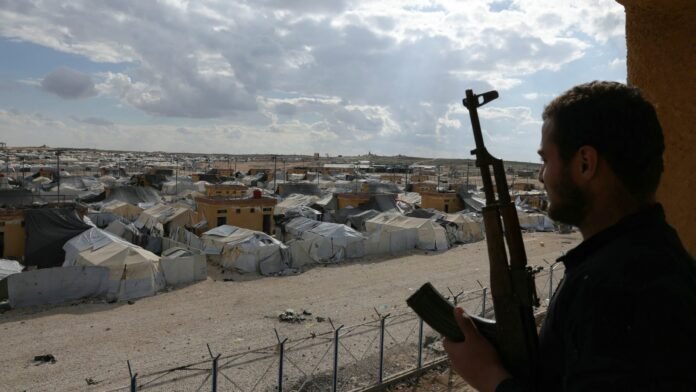
UN investigators and counterterrorism researchers say thousands of foreign nationals with alleged ISIS links remain in al-Hol, Roj, and SDF-run detention facilities in northeastern Syria. The unresolved status of foreign fighters has remained a major security concern, with UN monitors warning that jihadist networks in Syria continue to benefit from instability and weak state control in some areas.

Experts believe ISIS’s latest call directed at these fighters reflects fears within the organization of losing what remains of its most experienced cadres, while also attempting to remobilize them into a new project centered on guerrilla warfare and long-term attritional conflict.

[The latest message] reflects ISIS’s attempt to exploit any transitional phase or security shifts in order to reactivate its cells

In this context, Abdul Rahman Riyad, a Syrian affairs analyst who has written on security and political developments in Syria, told The Media Line that the latest message “reflects ISIS’s attempt to exploit any transitional phase or security shifts in order to reactivate its cells.” He added that the organization understands it has lost the ability to exercise broad territorial control and therefore now relies on propaganda, incitement, and a strategy of attrition through small mobile cells. He also noted that the group’s focus on foreign fighters reveals fears over the fragmentation of what remains of its human and military infrastructure.

[ISIS] is no longer capable of returning in the traditional form it appeared in during 2014, but it still poses a security threat due to the flexibility of its cells and their ability to move through desert regions

Retired Brig. Gen. Mustafa al-Sheikh, a security and strategic affairs expert, told The Media Line that ISIS “is no longer capable of returning in the traditional form it appeared in during 2014, but it still poses a security threat due to the flexibility of its cells and their ability to move through desert regions.” He explained that ISIS currently relies on rapid ambushes, limited nighttime attacks, and targeting military roads and supply lines, adding that “what we are witnessing today is a different version of the organization, one that depends more on guerrilla warfare and security exhaustion than on direct control of cities.”

[ISIS’s latest call carries] more propaganda and psychological dimensions than indications of a broad military comeback

Syrian academic and political researcher Dr. Mahmoud al-Hamza told The Media Line that ISIS’s latest call carries “more propaganda and psychological dimensions than indications of a broad military comeback.” He explained that the group is attempting to preserve its image among supporters after years of setbacks, which is why it focuses heavily on mobilizing rhetoric and portraying itself as an active force despite continued security pressure. He added that ISIS benefits from any security fragility or economic and social crises to rebuild its clandestine networks, especially in desert and border regions that remain difficult to fully secure.

On the other hand, Syrian authorities insist that the threat posed by the group remains under control. A security spokesperson for the Syrian Interior Ministry told The Media Line that security agencies “continue to monitor ISIS cell movements closely” and have managed in recent months to thwart several plots and arrest individuals linked to the organization.

The spokesperson, whose name is being withheld for security reasons, stated that the recent propaganda messages “reflect the weakness the organization is experiencing more than any real strength on the ground.” He added that security forces continue operations in the Syrian desert and eastern Syria and will not allow any terrorist threat to reemerge amid intensive security and intelligence coordination aimed at preventing the exploitation of any security vacuum.

Although ISIS no longer possesses the military and political capabilities that once enabled it to establish what it called a “caliphate,” recent developments indicate that the organization’s threat has not entirely disappeared and that it continues to seek opportunities to exploit instability and security gaps in order to reactivate its armed networks inside Syria. As Syrian forces and their allies continue pursuit operations, the issue of foreign fighters and the camps scattered across northeastern Syria remains one of the country’s most complicated files, amid growing fears that these environments could become fertile ground for the resurgence of extremism in the years ahead.

0FansLike
0FollowersFollow
0FollowersFollow
0SubscribersSubscribe
- Advertisement -
Google search engine

Recent Posts