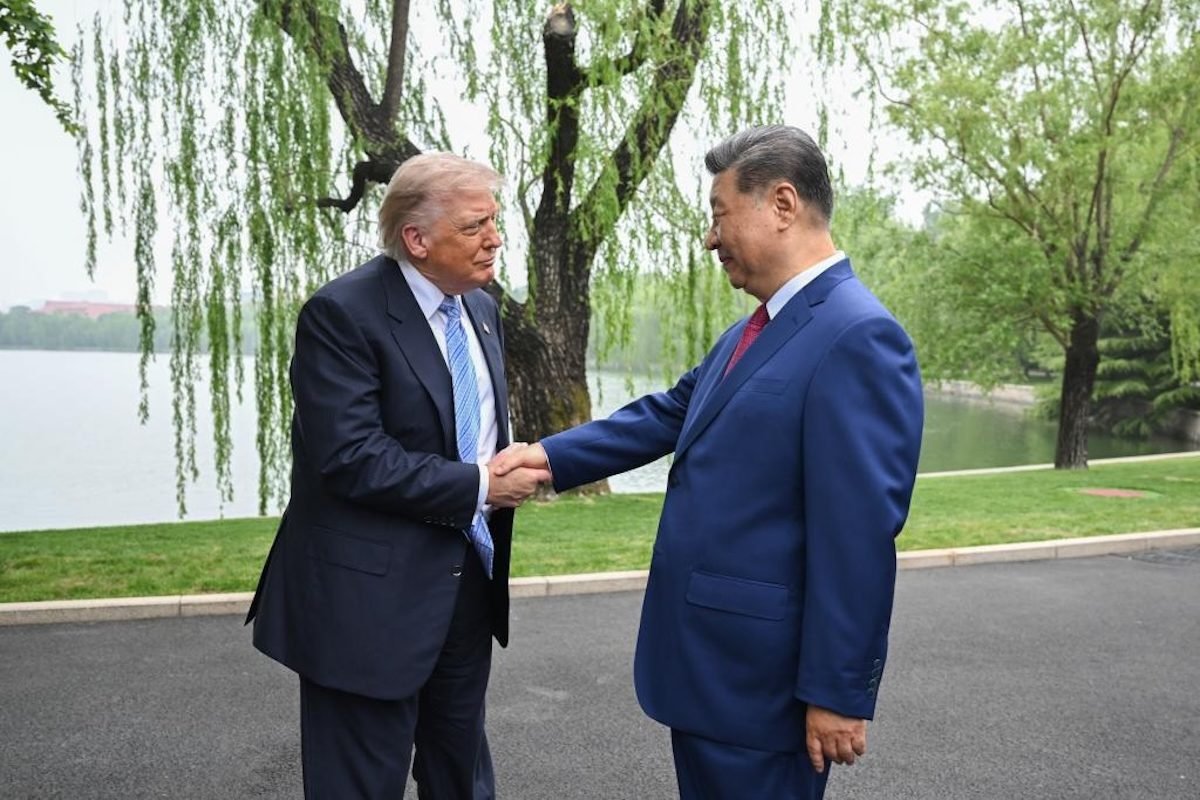
One of the difficulties in analysing summit meetings between leaders such as Xi Jinping and Donald Trump is that the events are a blend of public theatre and private discussion.
With previous presidents of China and the United States such summits represented the culmination of long negotiations between specialist senior officials, providing a predictable structure and predictable outcomes. But with power in both countries now concentrated in the hands of their respective leaders rather than in broader governing systems the summits have less structure and more theater, while the private discussions are more important and more secretive.
So it may take weeks, months or even years to gain anything like a clear understanding of what happened during the two-day summit held in Beijing between the leaders of the world’s two superpowers on May 14-15. Very little was announced publicly, even about long-running issues concerning trade and Chinese purchases of American products.
Under Presidents Bush, Obama or Biden, such silence would have meant that the structured, official negotiations had failed. But with Trump everything is personal and little is structured. We cannot judge whether the summit succeeded or failed until we see what happens next.
The only thing that is clear is that Trump and Xi intend to keep on meeting in this way, with a reciprocal summit now scheduled to take place at the White House on September 24. The question for Europe and for the rest of the world is whether to feel happy that the world’s two greatest military and economic powers are talking regularly rather than fighting – or to feel worried that they might do private deals that could harm the rest of us.
One answer to that question is likely to emerge not in Asia or America but in the Middle East. On the face of it, Iran and the United States have reached an impasse with Trump dismissing Iran’s peace proposals as “unacceptable,” with Iran refusing to renounce its uranium-enrichment and nuclear programs and with both sides still blocking the Strait of Hormuz.
But Iran’s foreign minister, Abbas Arraghchi, visited China just before the Trump-Xi summit, presumably to convey his government’s position and to hear China’s views. And Trump claimed after the summit that he and Xi “feel very similar” about ending the war, about Iran’s nuclear ambitions and about Hormuz. All of which suggests there is scope for the impasse to be broken.
The Chinese were more circumspect than Trump about what he and Xi said to each other about the Middle East. Nonetheless, both Trump and the true rulers of Iran, the Islamic Revolutionary Guard Corps, the elite military group who have taken control since Supreme Leader Ali Hossein Khamenei and others were assassinated by Israeli bombs, now have to decide what their next steps should be. It will be in those decisions that we may be able to detect an outcome from the Beijing summit.
One option, threatened by both sides, is to resume hostilities, both against each other and against the Arab states on the opposite side of the Persian Gulf from Iran. But that would hardly fit with what Trump claims to have discussed with Xi.
The other, likelier option, is a renewed exchange of peace proposals and the resumption of negotiations through the current Pakistani mediators. It would not be at all surprising if that next exchange had discreet Chinese fingerprints on it, especially concerning nuclear weapons and the handling of Iran’s remaining stockpile of nuclear materials.
Trump will not have asked Xi to intervene publicly in the negotiations, for he realises that Xi would refuse to do so. But he might well have asked him to help persuade Iran to reach a compromise over the nuclear issue that he, Trump, can then present publicly as a success.
For Trump, the compromise needs to appear as if it will ensure that Iran will never become an official nuclear-weapons state. A mere promise by the Iranian government would not be enough, especially while it retains uranium-enrichment capabilities and the highly enriched material thought to have been buried by Israeli and American bombs last year. But Chinese involvement in supervising that material might carry the necessary credibility.
Outsiders often worry, with good reason, that Trump might be persuaded to trade off weakened American support for Taiwan in return for this sort of Chinese assistance over Iran’s nuclear program. In Beijing, President Xi reserved his sharpest and clearest language for the Taiwan issue, warning America to tread carefully over the issue as otherwise conflict could break out.
To the relief of many pro-Taiwan Asian governments, notably Japan, Trump made no public comments on Taiwan in response, although he did refuse to say whether he had decided to approve a large sale of American weapons to Taiwan.
One of the biggest puzzles concerning this second Trump administration is that although President Trump has surrounded himself with people who in the past were counted as “China Hawks,” people who favored quite aggressive policies over trade and military postures in order to resist Chinese strategic advances, the president himself frequently sounds soft, and even friendly, toward China.
And in an administration where personal decision-making is far more important than the views of the governing system, this makes American China policy both unpredictable and worrying.
However, Taiwan may not be the biggest reason to worry about such personal dealmaking between the super-potentates. China does not appear in a hurry to try to take control over Taiwan. It also knows that any progress it might make with America under Trump is likely to endure only until the end of his term in January 2029 and might anyway be unreliable.
The bigger reason to worry is symbolized by the fact that President Xi’s next visitor in Beijing will be President Vladimir Putin of Russia, who is reported to be flying there as early as Wednesday, May 20.
In Beijing, Trump spoke very flatteringly of his host, praising Xi as “a great leader.” Meanwhile, throughout his second term Trump has helped Putin in his war against Ukraine, ending American weapons supplies to Ukraine and frequently seeking to bully Ukraine’s President Volodymyr Zelenskyy into giving up more territory to the Russian invaders.
Trump has loosened sanctions against Russian oil and even brokered a weekend ceasefire deal between Ukraine and Russia to make it easier for Putin to hold his Victory Day military parade on May 9 without fear of long-range Ukrainian attacks.
The real reason to worry is that Trump’s evident closeness to both Xi and Putin could lead him not to betray Taiwan in the long term but rather to betray Ukraine in the immediate future.
Thanks to European support and its own domestic production, Ukraine has regained some of the initiative against its invader. With Russia now looking in the weaker position despite its still-frequent missile attacks on civilians in Ukraine, Putin could be tempted to use China to push America to cut its support for Ukraine still further in exchange for help over the Iran war.
That, to cite Trump’s own book title, is “The Art of the Deal.”
A former long-time editor in chief of the Economist, Bill Emmott is the author of Deterrence, Diplomacy and the Risk of Conflict over Taiwan (2024). This article, republished with permission, is the English original of an article first published in Italian translation by La Stampa. It can also be found, along with many other articles, on Bill Emmott’s Global View.