For most of modern history, the household was a bundle. Under one roof, families pooled rent and meals, raised children, cared for parents, kept each other company and insured one another against bad luck. Nobody itemized it, and national accounts barely noticed.
Across East Asia, that arrangement is coming apart, and one line item after another has turned into something you pay for. The loneliness economy is the usual name for the result; the unbundling of the family household is the more accurate one.
In South Korea, single-person households are now 36% of the total, the largest category. Japan was at 38% in 2020 and is expected to reach 44% by 2050; Tokyo is already past half.
China’s 2020 census found 125 million people living alone, equal to one in four households. Fertility has fallen in step. South Korea’s rate is 0.80, Hong Kong’s is 0.84 and Taiwan’s births fell 20% in 2025 alone.
The money has followed. Discovery Reports, a Chinese research firm, puts spending by singles in China at more than US$1 trillion in 2025, up about 50% in two years. The “silver economy” serving the elderly is expected to reach 30 trillion yuan, about $4 trillion, by 2035. Pop Mart, the toymaker behind Labubu, reported $5.4 billion in revenue last year, up 185%.
Two readings of these figures are common, and I think both miss the point. One is demographic doom: fewer people, smaller markets, decline. The other is the retailer’s view: never mind the birth rate, the consumer is still spending. The first ignores a market that plainly exists; the second overlooks where much of the money comes from.
A large part of the solo economy’s growth is a transfer rather than new activity. When a family cooks dinner, GDP records nothing. When one person orders a single-serving meal, streams a drama instead of talking to a spouse and hires a sightseeing companion for the weekend, the same functions show up as transactions. Output rises partly because the boundary of what gets counted has moved.
For anyone using Asian consumption data as a demand signal, this matters. Some of what looks like discretionary spending is a premium the solo consumer cannot avoid: one rent, one refrigerator, one electricity bill and nobody to share them.
The premium is physical as well. A study of EU households found that people living alone have the highest carbon footprint of any household type, roughly 9.2 tonnes a year each, about twice that of someone in a household of five or more. That is a European study, but the arithmetic travels, and it sits uneasily beside climate plans written in national rather than per-capita terms.
The solo economy, then, is three things at once: a real market, a statistical artifact and a loss of efficiency. Most policy arguments insist it is only one of them.
Markets are good at unbundling meals, entertainment and paid company. They are bad at unbundling the two things families did best: insurance against catastrophe and the last mile of care.
You can buy a single-serving hotpot. You cannot buy someone who notices that you did not wake up. Hence the check-in app bluntly named “Are You Dead?” that topped China’s paid app charts in January: miss two daily check-ins, and it alerts an emergency contact. It is a paid substitute for a job that, until recently, needed no product.
Governments have been improvising too. Japan created a minister for loneliness in 2021. Seoul has budgeted 451 billion won, about $326 million, over five years for counseling, a hotline and other measures against isolation and “lonely deaths.”
The World Health Organization’s Commission on Social Connection links loneliness to about 871,000 deaths a year, roughly 100 an hour, and estimates that one person in six is affected.
Living alone and being isolated are different things, and policy tends to blur them. Nearly half of South Koreans who live alone say they feel lonely at least sometimes, which means about half do not, and plenty of people in crowded homes feel nothing else.
A government that reads household size as isolation will spend in the wrong places. Brands worked this out first; the region’s marketing sells independence, not consolation.
The care gap is sharpest in hospitals. Serious illness assumes a next of kin: someone to consent for a patient who cannot sign a discharge, answer the phone at three in the morning.
Patients who arrive without a spouse, children or a sibling within reach turn surrogate decision-making, guardianship and discharge planning from ethics-seminar material into a limit on how quickly a hospital can free a bed.
Japan expects 10.8 million people over 65 to be living alone by 2050, one household in five, and its demographers warn that the number with no relatives at all is rising. Care systems are being built around a relative who, for a growing share of patients, will not exist.
The fixes are unglamorous: statutory non-kin surrogates, default care networks, long-term-care entitlements that follow the person rather than the family. They are also far cheaper than the emergency room.
The region’s most consequential export, though, may turn out to be neither the karaoke booth nor the check-in app but the rulebook for synthetic companionship.
China’s new rules for “anthropomorphic” AI services took effect on July 15. They prohibit virtual romantic relationships for minors, require a guardian’s consent for users under 14, oblige providers to intervene when a user signals self-harm and treat emotional over-dependence as a risk to be managed.
The United States is arriving at similar rules from the opposite direction, one legislature at a time. New York’s disclosure and crisis-referral law took effect last November and California’s in January; Oregon and Washington follow next January.
By June, 78 bills were in play across 27 states. In the European Union, the AI Act’s transparency obligations, among them the duty to tell people when they are talking to a machine, have applied since August 2.
Three legal traditions have therefore, within about a year of one another, begun treating engineered intimacy as a regulated product. Whoever builds companionship at scale for a population of one will also set the working standards for duty of care, disclosure, crisis escalation and data use in emotionally dependent relationships with machines.
For now, the most detailed of those standards are China’s.
Three things would help. First, measure care capacity, meaning who would notice an emergency, rather than counting household size. Second, treat check-in and companion apps as safety infrastructure and judge them by their links to emergency and clinical services, not by engagement.
Third, bring the law of chosen family up to date; surrogate decision-making, hospital next of kin, tenancy succession and caregiving leave still assume a spouse or child that a third of households will not have.
Ellen Xie, a comedy producer in Shanghai, has said that she and her single friends imagine forming “temporary families” as they grow old, and that some company will surely want to make money from it. She is right about the second part. Whether the law will recognize the first is the open question.
None of this makes Asia a cautionary tale. It makes the region the pilot site, with the rest of the world a few years behind but still in the same queue.
Y. Tony Yang is an Endowed Professor at the George Washington University in Washington, D.C.
Norway Moves To Criminalize Israeli Settlement Trade With 3-Year Prison Terms
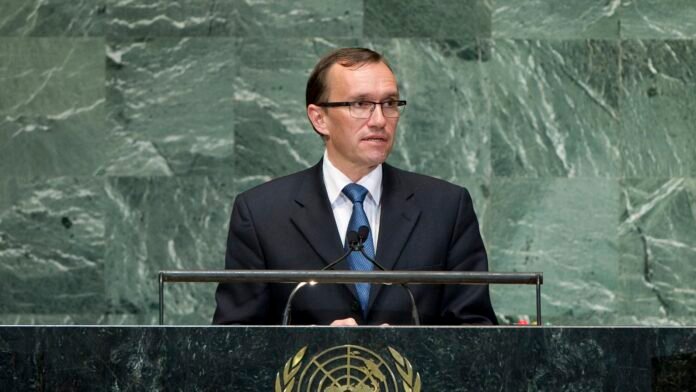
Norway is considering legislation that would criminalize trade with businesses operating in Israeli settlements in the West Bank and East Jerusalem, with intentional violations carrying penalties of up to three years in prison.
Foreign Minister Espen Barth Eide said he expects Norway’s parliament, the Stortinget, to vote on and approve the proposal. A public consultation on the legislation is scheduled to end September 19, 2026.
The measure would prohibit Norwegian individuals and companies from importing or exporting goods produced in Israeli settlements, including wine and agricultural products. It would also cover real estate transactions and infrastructure and construction services connected to the areas.
Intentional violations could result in fines or imprisonment for up to three years, while negligent violations would carry a maximum six-month sentence. The legislation would apply to both Norwegian citizens and companies.
The proposal would also waive the usual “double criminality” requirement, allowing Norwegian citizens to face prosecution at home for settlement-related transactions even when the activity is legal under Israeli law.
Eide defended the proposed restrictions in an interview with Norwegian state broadcaster NRK.
“The arguments [in support of the bill] have only become stronger because the situation in the West Bank has become even worse. In addition, so many other countries are now doing the same thing the government has already proposed through this bill,” he said.
Norway also joined Canada, Denmark, Finland, France, Iceland, Ireland, Poland, Portugal, Spain and Sweden in a joint statement expressing intentions to take or support similar measures shortly after a British announcement.
Eide also accused Israel of using allegations of antisemitism to discourage criticism.
“Israel has become far too accustomed to being able to intimidate Western countries by saying they were antisemites if they criticized Israel for abuses and violations of international law. Now the [protective cover] that Israel has in many ways enjoyed is gone,” Eide said.
Israel’s Embassy in Norway condemned the initiative, describing the “proposal to criminalize trade” as the “latest example of the Norwegian foreign minister’s obsessive anti-Israel activism on the global stage.”
Norway’s direct economic activity with Israeli settlements is relatively limited. The proposal follows Norway’s formal recognition of Palestinian statehood and similar efforts by other Western countries to restrict settlement commerce.
Prehistoric builders transported Devil’s Arrows 11 miles
Stonehenge is the most famous example of megalithic architecture across Britain and Ireland, but there are plenty of others, including Calanais, Newgrange, and Avebury, as well as the Devil’s Arrows. The latter is Britain’s tallest standing stone alignment, yet little is known about the provenance of its stones. Scientists have confirmed that the stones came from a site 18 kilometers (11 miles) away, transported by humans rather than glacial movement, according to a paper published in the Proceedings of the Royal Society A: Mathematical, Physical and Engineering Sciences.
“Sites in southern England and Scotland receive considerable attention but monuments like the Devil’s Arrows have remained comparatively understudied despite their significance,” said co-author Jim Leary of the University of York. “We have now proved that Neolithic communities moved several 25-ton stones across Yorkshire, transforming a familiar site into an epic quest to create a sacred landscape.”
Stonehenge has been the focus of recent chemical analyses identifying where all the stones that make up the structure came from, revealing that many originated in quarries a significant distance away. For instance, a 2019 study concluded that the 42 bluestones that make up the inner ring came all the way from western Wales. The outer layer of sarsen stones hails from much closer to home: Marlborough Downs, an area of round, grassy hills 25 to 30 km (17 miles) north of Stonehenge, which has the largest concentration of sarsen in the UK.
In 2024, Anthony Clarke, who co-authored this latest study, and his team discovered that the Stonehenge Altar Stone originated from the Orkney region in the very northeast corner of Scotland, rather than Wales. Next, they tackled the long-standing debate over how the stones got to that location in the first place. One theory holds that glaciers moved the bluestones at least part of the way from Wales to Salisbury Plain in southern England, while others contend that humans moved them—although precisely how that was done has yet to be conclusively determined.
Earlier this year, Curtin’s team produced the strongest scientific evidence to date that it was humans, not glaciers, that transported the stones. They analyzed hundreds of zircon crystals collected from rivers close to the historic monument, looking for evidence of Pleistocene-era sediment. If the stones had “sailed” to the plain from farther north, there would be a distinct mineral signature in that sediment as the transported rocks eroded over time. They didn’t find that signature, making it far more likely that humans transported the stone.
The devil went down to Boroughbridge
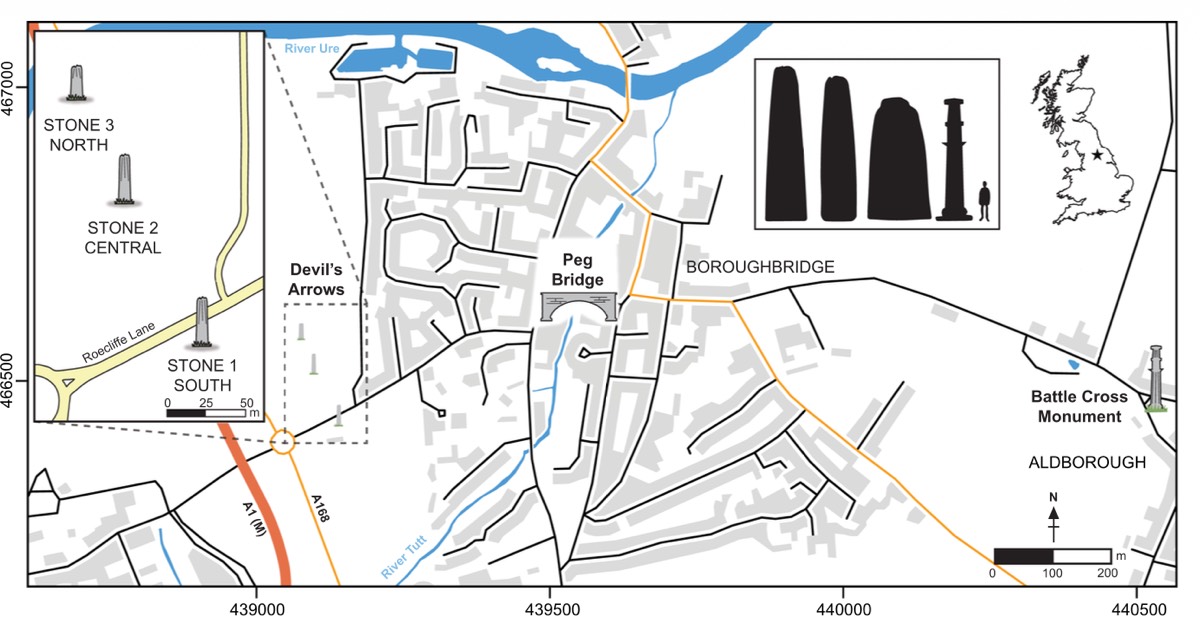
Now Curtin et al. have turned their attention to the Devil’s Arrows, three aligned stones located in the lowlands, just outside Boroughbridge in North Yorkshire. Local legend holds that the Devil formed the arrangement by standing on How Hill and hurling giant stone arrows while shouting “Borobrigg keep out o’ way, for Aldborough town I will ding down!” But the arrows didn’t quite reach their target and landed where the stones stand today. The tallest of the stones stands 6.85 meters (22.5 feet). The stones are part of a broader Neolithic complex, and it’s believed their arrangement is meant to align with the southernmost summer moonrise.
Location and appearance of the Devil’s Arrows on the western outskirts of Boroughbridge, Yorkshire. The insets show the alignment and spacing of the three surviving stones, along with scaled profiles of the Devil’s Arrows and the Battle Cross monument.
Credit: A. Clarke et al., 2026
Location and appearance of the Devil’s Arrows on the western outskirts of Boroughbridge, Yorkshire. The insets show the alignment and spacing of the three surviving stones, along with scaled profiles of the Devil’s Arrows and the Battle Cross monument. Credit: A. Clarke et al., 2026
A 2025 geophysical survey found two distinct patches of magnetic disturbance thought to be an indication of former positions of stones that have been removed. There is also evidence, in the form of possible stone sockets, that the line of stones had once continued north and may have served as way markers along the Great North Route.
Among historical records, there is a 16th century account of a fourth standing stone to the north-northwest of the surviving Devil’s Arrows that had toppled over by the dawn of the 17th century. There is a 1687 report of locals breaking up a stone and using the remnants to build the nearby Peg Bridge, transporting the upper segment to nearby Aldborough Manor. And 19th century antiquarian J.R. Walbran suggested that a repurposed monolith had become the Battle Cross Monument that once stood in Boroughbridge’s market square before being relocated to Aldborough in 1852.
Clarke et al. took samples from all three Devil’s Arrows stones, as well as from the Battle Cross monument and Peg Bridge, using small sections of adhesive tape applied to inconspicuous areas of the stones free of lichens or mosses. Grain samples stuck to the tape and were later removed by dissolving the tape glue with mineral turpentine. They removed coarse magnetic materials and light minerals like quartz and feldspars, and imaged what remained in the samples using field emission scanning electron microscopy. They also performed an isotopic analysis of zircon and apatite minerals to get an age “fingerprint” in order to match the stones to their likely source.
The Devil’s Arrows are made of a coarse-grained sandstone. Plumpton Rocks, which is closer to the Devil’s Arrows, had previously been identified as the probable source of the stones. Based on their analysis, Clarke and his team concluded that the most likely source is actually Brimham Rocks, meaning the stones were transported by prehistoric builders significantly farther than originally thought. Regional ice-flow reconstructions ruled out a possible glacial transport mechanism for the stones.
“Our research shows these stones weren’t simply taken from the nearest available source—they were deliberately chosen from a challenging landscape 18 kilometers away,” said Clarke. “Moving them would have required incredible planning, coordination, and engineering skill. This tells us prehistoric people placed real importance on the landscape itself. It wasn’t just about convenience—the location the stones came from likely held meaning for them.”
Their results also confirmed that the Battle Cross monument is composed of one of the missing Devil’s Arrows stones.
“Reuse does not erase meaning,” the authors concluded. “Rather, it adds further episodes to the stone’s biography. A monolith may begin as bedrock, become a selected and transported prehistoric object, acquire significance within a megalithic setting, and later be reimagined as building stone, bridge fabric, a crossing marker, or part of a Christianized or civic landscape. Each phase modifies the interpretive frame. The object is not a static remnant of a single past, but a material witness to repeated acts of human engagement.”
Proceedings of the Royal Society A Mathematical, Physical and Engineering Sciences, 2026. DOI: 10.1098/rspa.2026.0504 (About DOIs).
Columbia Gives Big Money to Pro-Israel Groups — But Not to Pro-Palestine Ones
As Columbia University ramped up its crackdown on pro-Palestine protesters over the past three years, the Ivy League institution was paying hundreds of thousands of dollars to pro-Israel groups, according to a review of tax filings. Recipients of the cash included the American Israel Public Affairs Committee’s charity arm, the Israel on Campus Coalition, and others.
Though the university gave in smaller amounts to pro-Israel groups before the October 7, 2023, attack by Hamas and other Palestinian militant groups, the spending ramped up in that fiscal year as the genocide in Gaza unfolded and Columbia led the way in a national campus protest movement against it.
“Pro-Israel and anti-Palestinian politics are the official policy of this institution.”
In contrast to its pro-Israel giving, according to an analysis of documents which track some of the money given by tax-exempt nonprofits, the school gave little or no such funds to pro-Palestine, Arab, or Muslim groups over the same period.
“It confirms our worst suspicions since fall of 2023 that pro-Israel and anti-Palestinian politics are the official policy of this institution,” Joseph Howley, an associate professor of classics at Columbia and a Jewish member of the university’s faculty, told The Intercept. “You could have surmised that from the institution’s actions and speech, but it appears to also be revealed in its resource allocation.”
A Columbia spokesperson said the grants went through a university-administered donor-advised fund, an arrangement where a nonprofit organization pools tax-deductible donations and lets the donors request to make specific distributions to other charities.
“These grants did not come from Columbia’s operating funds and were payments distributed from a donor-advised fund established at Columbia in accordance with IRS rules,” the Columbia spokesperson said.
“It’s just so opaque,” Mark De Fusco, an expert on financial transactions in higher educational institutions and former researcher at the Pullias Center for Higher Education, told The Intercept. “So, you can essentially make donations and not be identified.”
“Deeply Invested in the Genocide”
In the fiscal year ending in June 2024, Columbia paid $100,000 to the Israel on Campus Coalition and another $75,000 to AIPAC affiliate American Israel Education Foundation.
In the same period, the Columbia administration summarily suspended the pro-Palestine student groups Jewish Voice for Peace and Students for Justice in Palestine, quashed the encampments in solidarity with Gaza, and called on the New York City Police Department to arrest pro-Palestine protesters on campus on two separate occasions.
The protesters had been demanding that Columbia disclose its financial ties to Israel and pro-Israel organizations and divest from them.
“The whole reason why we were protesting in the first place is because we knew that they were deeply invested in the genocide in Gaza,” said Maryam Alwan, a Palestinian American activist who participated in the campus protests in solidarity with Gaza before graduating from Columbia in 2025. “These findings confirm what we’ve been saying all along.”
While grants to American universities and medical research centers dominate past tax filings by Columbia, the pro-Israel organizations stand out as a rare few that prioritize relations with a specific foreign country. In 2024, over 170 of the 440 payments in this category were toward higher education and over 120 went to healthcare initiatives.
The payments by Columbia to the pro-Israel organizations were listed by the university as being for “program services,” though the term is not publicly defined by the university.
The Pro-Israel Beneficiaries
In fiscal year ending in June 2025, Columbia paid $7,200 to the Anti-Defamation League for “program services.” In the same period, the ADL welcomed the arrest of a lead Columbia protest negotiator Mahmoud Khalil by federal immigration officials. (None of the pro-Israel organizations that received Columbia cash responded to requests for comment.)
Details about any services offered by the ADL to Columbia in that period were not mentioned or publicized by the university. In July 2025, Columbia announced it was partnering with the ADL to conduct “programming and training” on antisemitism. A month before the announcement of the partnership, ADL chief Jonathan Greenblatt compared pro-Palestinian student protesters to Islamist terrorists.
“Columbia should be investing in its students, not bankrolling organizations that intimidate them,” Khalil told The Intercept. “This is what happens when a university is controlled by ideologues on its Board of Trustees whose commitment to Israel appears to matter more than their fiduciary duty, academic freedom, or the students they are supposed to serve.”
The pro-Israel organizations that received payments from Columbia stand out from the rest of the university’s beneficiaries in its filings. While a small number of ethnic community organizations such as the Dominican Women’s Development Center and the Caribbean Women’s Health Association are listed as having received funding from the school in its disclosures, these groups largely operate in the diaspora and are not advocating for U.S. relations with a foreign nation.
The choice to fund organizations that specifically advocate for Israel struck several students, alumni, and faculty members with whom The Intercept discussed the findings as odd.
“At this point, Columbia cares about one thing and one thing only, which is the money of its donors and the ideological interests that those donors espouse,” said Aharon Dardik, an Israeli student who graduated from Columbia earlier this year and who had previously been court-martialed for refusing to serve in the Israeli military.
One of the beneficiary organizations receiving money from Columbia, the American Israel Education Foundation, describes itself on its website as “the charitable organization affiliated with AIPAC, America’s pro-Israel lobby.” The group is best known for funding trips for members of Congress to visit Israel. Over the past decade, Columbia has paid AIPAC’s charity arm $250,000, with a $75,000 payment in the fiscal year ending in June 2023 and a $100,000 payment in the one ending in June 2017.
Another beneficiary organization, the Israel on Campus Coalition, says its role is to put pro-Israel campus activism under one umbrella and work toward a future “where the anti-Israel movement is marginalized.” The group offered a fellowship at Columbia; the school’s website lists one student as having received the fellowship from 2022 to 2024.
“There’s no institutional neutrality.”
Columbia also paid $450,000 to the United Jewish Appeal Federation of New York in the fiscal year ending in June 2024. UJA says on its website that, since October 7, 2023, the organization spent hundreds of millions of dollars in Israel, including tens of millions to support Israeli soldiers and their families.
A review of these financial contributions, adding up to hundreds of thousands of dollars in the past three years, have brought Columbia’s process for donating to beneficiary organizations into sharp focus.
“People talking about institutional neutrality; there’s no institutional neutrality,” said a Columbia student who did not wish to be identified due to concerns over retaliation. “Columbia has always been very pro-Israel, and this just goes to show that that’s where their real commitments are.”
Trump says Iran wants deal with US ‘quickly and badly’
US President Donald Trump said Monday that Iran wants to reach an agreement with Washington “quickly and badly,” while saying he would decide whether the US engages with Tehran, Anadolu reports.
“The failing Nation of Iran wants to make a deal, quickly and badly,” Trump wrote on his social media platform Truth Social.
“I will determine whether or not the U.S.A. will choose to engage — The concept of which we are open to,” he added.
READ: Trump forecasts end to Iran war around November US midterm elections
The US and Israel launched attacks on Iran in February, prompting Tehran to retaliate against Israel and US military targets across the region.
Washington and Tehran reached the Islamabad understanding in June with Pakistani and Qatari mediation, but its implementation later stalled amid disagreements over the Strait of Hormuz.
The US resumed military attacks on Iran in August, with Tehran responding by striking US military assets in several Arab countries aligned with Washington.
READ: US ready to supply nuclear fuel to Iran if nuclear issue resolved, Energy Secretary says
Pumpkin Pecan Crisp pairs smooth spiced pumpkin with a buttery brown butter, oat, and pecan topping baked until golden.
Pumpkin Pecan Crisp pairs a softly spiced pumpkin custard with a buttery oat-and-pecan topping full of golden, craggy crumbs. It has the cozy appeal of pumpkin pie, only there is no crust to roll, chill, or carefully shape.
The filling stays smooth and rich thanks to pumpkin puree, evaporated milk, brown sugar, vanilla, and warm fall spices. Meanwhile, browned butter gives the pecan crisp topping a deeper toasted flavor without making the dessert complicated. Giving the pumpkin layer a short head start in the oven also helps keep those buttery crumbs right where they belong—on top.
Serve it slightly warm for a softer, spoonable dessert, or let it cool longer for neater portions. A little whipped cream or vanilla ice cream is wonderful alongside, although those toasted pecan clusters give it plenty of personality all on their own.
Pumpkin Pecan Crisp pairs smooth spiced pumpkin with a buttery brown butter, oat, and pecan topping baked until golden.
Recipe Yield: 8 servings
INGREDIENTS
Pumpkin filling: 1 (15 oz) can pure pumpkin puree 2 large eggs 1/2 cup packed dark brown sugar 1/4 cup granulated sugar 1 tsp pure vanilla extract 1 1/4 tsp ground cinnamon 1/2 tsp ground ginger 1/4 tsp ground nutmeg 1/8 tsp ground allspice 1/2 tsp fine sea salt 1 cup evaporated milk
Brown butter pecan crisp topping: 10 tbsp unsalted butter 3/4 cup all-purpose flour 3/4 cup old-fashioned rolled oats 1/2 cup packed light brown sugar 3/4 cup roughly chopped pecans 1/2 tsp ground cinnamon 1/4 tsp fine sea salt
INSTRUCTIONS
1. Prepare the oven and dish: Preheat oven to 350°F. Lightly grease a 9-inch square baking dish.
2. Mix the pumpkin filling: Whisk pumpkin, eggs, brown sugar, granulated sugar, vanilla, cinnamon, ginger, nutmeg, allspice, and salt until smooth. Then whisk in evaporated milk until evenly combined.
3. Start baking the filling: Pour the pumpkin mixture into the prepared dish. Bake for 12–15 minutes, until the outer edge is just beginning to set.
4. Brown the butter: Meanwhile, melt butter in a small saucepan over medium heat. Cook for 4–6 minutes, swirling often, until golden with fragrant brown bits. Remove from heat and let cool briefly while keeping it warm and liquid.
5. Make the pecan topping: Combine flour, oats, brown sugar, pecans, cinnamon, and salt. Pour in the warm browned butter and stir gently until moist, irregular crumbs and clusters form.
6. Add the topping and finish baking: Carefully scatter the topping evenly over the partially baked pumpkin. Bake for another 32–38 minutes, until the topping is golden and the edges are set. The center should have only a slight wobble and reach 165–170°F in the pumpkin layer.
7. Cool and serve: Let the crisp cool for at least 30 minutes so the pumpkin layer can finish setting. Serve slightly warm or at room temperature.
Helpful Tips to Perfect This Recipe
Choose pure pumpkin: Use 100% pumpkin puree rather than pumpkin pie filling. The prepared filling already contains sugar and spices that would change the flavor and sweetness.
Stop the brown butter at amber: Once the milk solids turn golden brown and smell nutty, remove the saucepan from the heat. They continue darkening briefly after cooking.
Keep the topping craggy: Stir just until moist clusters form instead of working the mixture into a smooth paste. Those irregular pieces bake into a better crisp topping.
Trust the slight wobble: The center should not look liquid, although it does not need to feel completely firm. The pumpkin custard continues setting while the crisp rests.
Reheat uncovered: Refrigerate leftovers covered for up to 4 days. Warm portions uncovered at 325°F until heated through to bring back more of the pecan topping’s crispness.
Rate This Recipe
Tried this recipe? Your rating helps others and means so much.
Houthi rebels’ control of Red Sea oil chokepoint exposes deep divisions in Brics
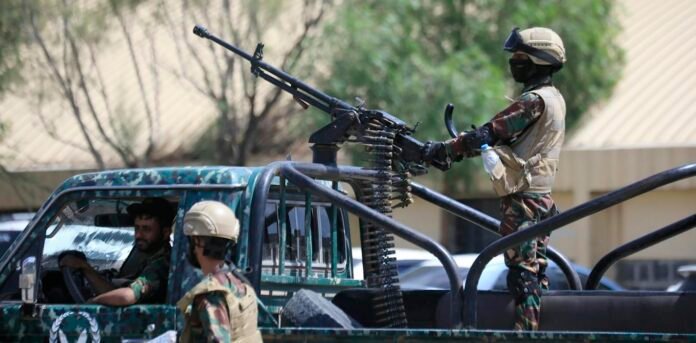
Houthi rebel forces have seized the Yemeni port of Mokha as well as Mayyun Island overlooking the Bab el-Mandab strait. This gives Iran’s most powerful remaining proxy force in the Middle East nearly complete control of Yemen’s entire Red Sea coast.
Directly or indirectly, Tehran now has a chokehold on around 12% of global trade that passes through that waterway. It is also maintaining its pressure on the Strait of Hormuz, which has already led to a cut of flows there from about 9 million barrels of oil a day to between 3.7 and 6.4 million.
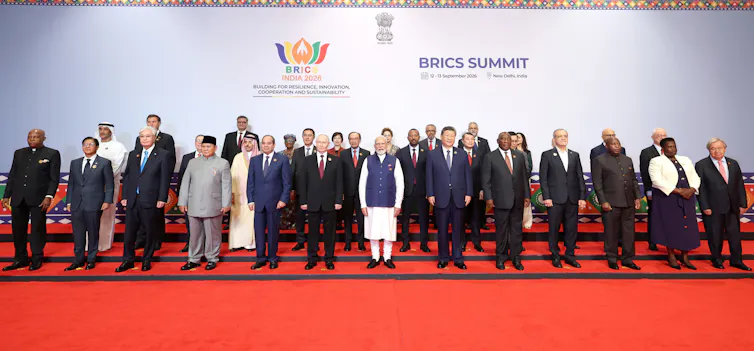
The day after the Houthis took control of the Bab al-Mandab Strait, Brics leaders assembled in New Delhi, for their 18th annual summit. Brics is the group of “emerging economies” which formed around Brazil, Russia, India, China, and South Africa in 2006, to counter western influence in global institutions. It has since added six permanent members: Egypt, Ethiopia, Iran, Saudi Arabia, UAE and Indonesia. A further ten countries, Belarus, Bolivia, Kazakhstan, Cuba, Malaysia, Nigeria, Thailand, Uganda, Uzbekistan and Vietnam joined as “partner countries” in 2025.
According to its own figures, Brics represents 49.5% of the global population, 40% of global GDP and 26% of global trade. But the conflict in the Middle East is exposing deep divisions in the bloc. This is clear from a reading of the New Delhi declaration, which has no mention of the Red Sea, Bab el-Mandab, Yemen or the Houthis. It contains no reference to shipping, to maritime security, or to freedom of navigation.
But Houthi control of Bab el-Mandab leaves Saudi Arabia exposed. Its east-west pipeline across the kingdom, built to bypass Hormuz, terminates on the Red Sea coast the Houthis now overlook. It had been running at full capacity, before being shut down after strikes from Iranian proxies in Iraq and the Houthis’ subsequent seizure of Yemen’s Red Sea coastline.
The latest Houthi advances are not going to improve the outlook on maritime traffic that insurers have already treated as high-risk for months. The resulting increased costs are likely to continue to deter traffic through the Red Sea.
The UAE suspended all trade and financial transactions with Iran in late August. This move came after Iran allegedly attacked a ship owned by the Abu Dhabi National Oil Company in the Strait of Hormuz and launched two ballistic missiles into UAE territorial waters there.
All this came on top of UAE claims in May that Iran had fired 3,000 missiles and drones at it in the first two months of the US war against Iran alone.
China and India, the world’s largest oil importers, need the Strait of Hormuz open to keep global oil and gas prices low. Both also depend on it as a trade route that the Northern Sea Route through the Arctic is unlikely to replace soon.
By contrast, Russia, whose own exports travel by other routes, is the one Brics member whose economic outlook improves as these Iranian-controlled chokepoints tighten. This is not an accident. In testimony to US lawmakers this month, Russia and China were both singled out as supporters of the Houthis alongside Iran.
Russian personnel in Sana’a, Yemen’s capital, have supplied technical and targeting support for attacks on Red Sea shipping. Most weapons smuggling to the Houthis is now apparently routed through Chinese companies – and a satellite firm tied to China’s military has been accused of providing intelligence used against commercial vessels.
For China, supporting the Houthis may be a way to get assurances for the safety of its own ships transiting the Red Sea. For Russia, it’s mostly about being able to use the Strait to increase its profits from oil sales to India and China, the two countries that now account for 80% of all Russian oil exports.
Deep divisions
These divisions – and the obvious inability to speak with one voice on the situation in the Middle East – are eroding Brics’ claim that it speaks for the global south against an order that has ignored it and is unwilling to reform.
Brics family photo: 21 countries who agree on almost nothing.EPA/India Ministry of External Affairs
Ironically, what drives the erosion of credibility is the rapid and diverse expansion of Brics’ membership – something it takes pains to celebrate. What this did was to import a slew of unresolved conflicts faster than it could handle them.
Key members and partners of the bloc are at serious loggerheads. Iran is effectively in a state of war with the UAE and Saudi Arabia. Saudi Arabia and the UAE have been at odds for years over Yemen, Sudan, and Somalia. India and China, meanwhile, are at on-again, off-again conflict over border disputes along the line of control in Kashmir which intersects with their broader geopolitical competition for influence in Asia and beyond.
Each enlargement of Brics has lowered the ceiling on what the bloc can agree on and say publicly. Saying nothing at all – beyond expressing “deep concern over the continued escalation of tensions in Middle East/West Asia” and calling for “exercising maximum restraint, as well as avoiding actions that could further aggravate the situation” – may be the only survival mode for the bloc.
But a group whose sole remaining source of unanimity is opposition to the US and its allies and that cannot describe a crisis in which its own members stand on opposite sides is hardly likely to become a pole of a multipolar order.
Whether Bab al-Mandab and Hormuz reopen will be settled in Tehran, in Washington, and in the marine insurance market in London. It will not be settled by the 11 governments that spent last weekend calling for maximum restraint.
Don Jr.’s wedding secretly bankrolled by oligarch close to Putin
This article originally published by Pulitzer Prize-winning investigative newsroom ProPublica is republished with permission.
On May 24, Donald Trump Jr. was celebrating in the Bahamas, as scantily clad dancers in stilettos and sailor caps performed for him and his guests. It was the last night of his wedding, a lavish, three-day party held across a pair of ultra-exclusive private islands. A five-tier funfetti cake had been airlifted in from Florida, and helicopters and seaplanes descended on the islands before guests settled into their oceanfront villas. That night on the beach, Trump Jr. lifted his bride into the air while fireworks launched from a barge over the sea.
“It was everything we dreamed of and more,” his wife later wrote on Instagram.
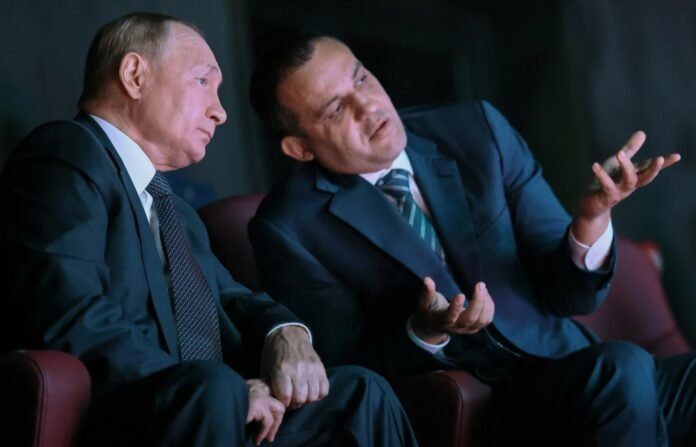
That dream was heavily funded by a secret benefactor: Umar Kremlev, a Russian oligarch close to President Vladimir Putin.
Kremlev footed the bill for hundreds of thousands of dollars of wedding expenses, according to records reviewed by ProPublica and interviews with three people familiar with the event. The oligarch paid to rent out one of the private islands, where a reception was held and where guests slept. He also covered other big-ticket items, like the fireworks show, and his team helped plan the event.
Kremlev is the head of the International Boxing Association, a scandal-plagued sports group that has beenfinanced by the Russian state-owned energy giant Gazprom. The wedding payments came from an IBA-affiliated entity in Dubai that the boxing association uses for financial transactions.
The guest list numbered around 50. It included Trump Jr.’s brother-in-law Jared Kushner, Eric Trump — and Kremlev, an imposing man with a shaved head who speaks limited English. The oligarch was part of a large group whose presence puzzled other attendees. They sometimes stood off by themselves, speaking Russian.
“It was really small, like, just really close friends,” Trump Jr. later said on his podcast. “Tried to keep it really tight. And it was just awesome.”
Kremlev’s previously unreported relationship with Trump Jr. represents an extraordinary development: a member of Putin’s circle financially supporting the president’s son and gaining intimate access to the Trump family. For a decade, Putin’s government, regarded as a chief adversary of the US, has been accused of efforts to influence American elections. Attempts by Russia to make inroads with the Trumps before the 2016 election exploded into controversy that dogged much of the president’s first term.
National security experts expressed alarm at Trump Jr. accepting the oligarch’s largesse, saying it raised an urgent question: What motivated Kremlev to spend a fortune cultivating the connection?
“If I’m paying for your wedding, at some point, you’re going to owe me something,” said Frank Montoya Jr., a retired career FBI official who held senior counterintelligence roles. Oligarchs like Kremlev often act in coordination with the Russian government. While it’s unclear if that happened here, Trump Jr. put himself in a precarious position, Montoya said. “This should be unthinkable for the son of the president. End of story.”
Holden Triplett, who served as Trump’s counterintelligence director on the National Security Council during his first term, said Russian intelligence frequently seeks to build ties with US government officials and their family members. “Money is a tried-and-true method to gain access,” said Triplett, who also worked for the FBI in Moscow.
In the days leading up to Trump Jr.’s wedding, Kremlev was in China as part of the delegation accompanying Putin, according to Chinese state media. The month before, Putin had bestowed him with a state honor, the Order of Friendship. The Ukrainian government has imposed sanctions on Kremlev personally, citing his closeness to Putin and Russian security services.
The Ukrainian government has imposed sanctions on Kremlev personally, citing his closeness to Putin and Russian security services.
It’s not clear why Kremlev helped pay for Trump Jr.’s wedding. The men appear to have met only recently. Public reporting suggests Trump Jr. could have afforded it himself, with Forbes recently estimating his net worth at roughly $300 million.
In response to detailed questions, a spokesperson for Trump Jr. did not dispute the wedding payments from Kremlev. “Umar is a personal friend of Don,” he said. The spokesman said that Kremlev is “not someone he has a business relationship with” and that the men met through a mutual friend in the hunting world and bonded over their love of boxing and the outdoors.
A spokesperson for Trump Jr.’s brother Eric said of Kremlev: “Eric has absolutely no clue who this person is, nor has never heard his name.”
In a statement, Kremlev’s press office said, “Mr. Kremlev and Mr. Trump Jr have a friendly relationship” and they first met “a couple of years ago.”
The press office described Kremlev as a businessman and philanthropist, adding, “Mr. Kremlev has never discussed political matters with any of his American friends and acquaintances,” including Trump Jr. They said the boxing organization itself did not incur expenses for the wedding but they did not comment on the payments from the Dubai entity. The press office also said that when Putin and Kremlev were in China recently, Kremlev was not part of Putin’s “official delegation.”
Kushner, who has been helping lead the US government’s negotiations with Russia over Ukraine, did not respond to requests for comment. The White House and the Russian government did not respond either.
The revelations come as Trump Jr. has emerged as a political power center in his own right. Beloved by the MAGA base, he reportedly played an active role in vetting White House cabinet picks for Trump’s second term and was dubbed his father’s “most essential political adviser” by The Wall Street Journal. “I certainly don’t think I’d be sitting here as the VP nominee without Don’s help,” Vice President JD Vance told the outlet in late 2024.
This account is based on records and interviews with dozens of current and former IBA officials and contractors, wedding attendees and other people in Trump Jr.’s and Kremlev’s circles.
Trump Jr. exchanged vows with socialite Bettina Anderson on a private island that was featured in “Pirates of the Caribbean” and the 2006 James Bond movie “Casino Royale.” They had their first dance on a second private island nearby that can rent for around $100,000 a night, paid for by Kremlev. The company that put on the fireworks display charges around $70,000 for such shows. (Kremlev did not attend the ceremony itself, which was held on the first day and had just 18 guests, Trump Jr.’s spokesperson said.)
The atmosphere was Monte Carlo meets frat party — helicopters in and out, a beachside DJ set, beer pong tournaments. One day, the men went spearfishing. Artisans at the London fashion house Safiyaa spent 150 hours embroidering Anderson’s bespoke silk reception outfit. The president’s son had undergone treatment to better define his jawline for the occasion.
Don Jr. wedding party. Photo: Little Pipe Cay / Lux Hospitality Bahamas; Laura Gordon Photography
Some longtime friends of Trump Jr. told associates they were disappointed not to be invited, though a few of his closest business partners — executives at the Trump family crypto company, World Liberty Financial, and the venture capital firm 1789 Capital — did make the cut. President Trump himself skipped it. (“He’d like me to go, but it’s going to be just a small, little private affair,” the president told reporters beforehand. “I said, you know, this is not good timing for me.”) But many of the guests were immediate family of the bride and groom.
That made the large contingent of Russians all the more conspicuous. “What are they doing here?” one person recalled thinking. At least one of the Russian guests had been with Kremlev on his China trip: Alexander Lagutin, a businessperson who has served in senior roles at a Russian defense contractor and a state-backed energy company. Kremlev’s right hand at the IBA, Elena Sobol, attended the wedding too.
Since the wedding, the Trumps have released scores of photosand videos of the festivities. While they show many of the guests, the Russians have been absent from all of them. (The top of Kremlev’s head is visible in the back of one group photo posted on Instagram by a friend of the bride.) After the party was over, on his “Triggered” podcast, Trump Jr. emphasized the event’s privacy: “The people that were there — if you’re on that list, you weren’t talking.”
In 2009, Umar Kremlev did not yet exist.
He was in his late 20s, with a criminal record for extortion and battery, still going by his birth name, Umar Lutfulloyev, according to the Russian independent news outlet Proekt. But he was about to rapidly ascend in Russia to a position of wealth and influence, with the help of a powerful friend. (“Mr. Kremlev has a completely clean legal record,” his press office said.)
In 2010, he changed his name to Kremlev. He soon joined a Russian government-backed biker gang called the Night Wolves, eventually taking a leadership role, according to news reports. That is what first brought him close to Alexei Rubezhnoi, who now leads Putin’s presidential security service, Proekt reported. In 2017, Kremlev took over the Russian Boxing Federation, after Rubezhnoi personally intervened to put him at the helm.
In 2020, Kremlev became president of the IBA. The association was something akin to FIFA but for boxing and had long overseen the sport in the Olympics. But it had been beset by corruption allegations and was on the brink of insolvency. Kremlev brought money to the table from Gazprom, the state-owned company that operates as an arm of Putin’s government. Gazprom publicly became the IBA’s financial backer, filling its coffers with tens of millions of dollars.
Former high-level IBA officials said that Kremlev had a clear political agenda. “Umar is guided by Putin. It was using the sport for soft political power,” a former IBA board member told ProPublica. “It’s geopolitics. That it’s boxing is just happenstance.” Kremlev, 43, is also heavily involved in an organization called Healthy Fatherland, run by his 23-year-old wife’s twin sister. The group — which promotes healthy eating and youth sports — is under Ukrainian sanctions for its alleged role in a program of abducting Ukrainian children from occupied territories and relocating them under the guise of “rehabilitation.” (Healthy Fatherland did not respond to a request for comment.)
Kremlev’s cozy relationship with the government has made him rich. Putin used the levers of the state to make Kremlev a dominant player in the Russian sports betting industry, according to Proekt, and one of his companies was chosen to operate the national lottery. After Putin nationalized Russia’s largest car dealership company in 2023, Kremlev became the owner of that too.
Putin used the levers of the state to make Kremlev a dominant player in the Russian sports betting industry.
He now flaunts that wealth through his boisterous public persona. In one video Kremlev posted on social media, he surprises a young mother by giving her a free car. In another, he criticizes his young female aide’s outfit as not feminine enough and makes her change. He shadowboxes with ostriches and brings in celebrities like Rick Ross and Naomi Campbell for IBA events; he praises Stalin and rides private jets.
Following the Russian invasion of Ukraine in 2022, the U.S. began to indict Russian oligarchs and seize yachts and other assets. Kremlev repeatedly told associates he was worried about being targeted by a US government probe, according to a person close to IBA leadership. “He was very afraid of American sanctions,” the person added. (Kremlev does not appear on public US sanction lists.)
With the business environment in Europe growing more hostile to Russia, Kremlev moved much of the IBA’s operations from Switzerland to the United Arab Emirates. A new Dubai entity, IB Challenger, would later pay wedding expenses for Trump Jr. The current sources of the IBA’s funds are murky, and, in recent years, top executives have given conflicting accounts of the status of its relationship with Gazprom. (Kremlev’s press office told ProPublica the IBA’s sponsorship contract with Gazprom “expired long ago.”) People close to the organization said they understood that its money still comes from Russia.
In 2023, the International Olympic Committee stripped Kremlev’s IBA of its role organizing Olympic boxing. It has cited a host of governance issues and the group’s refusal to “transparently explain the sources of its financing or to explain its full financial dependency, at the time, on a single state-owned company.”
In 2023, the International Olympic Committee stripped Kremlev’s IBA of its role organizing Olympic boxing. It has cited a host of governance issues and the group’s refusal to “transparently explain the sources of its financing or to explain its full financial dependency, at the time, on a single state-owned company.”
It was a major setback that deprived the IBA of a key source of its international influence. Kremlev has raged against the Olympic committee ever since and has said that his IBA predecessor, who he blames for the problems, “must be shot.”
Kremlev saw a potential ally in President Trump. After Trump’s second inauguration, in January 2025, Kremlev sent an open letter to the president asking him to look into the Olympic committee’s actions in advance of the 2028 Los Angeles Games. “We look forward with great optimism to the possibility of working together to make the Olympic movement great again,” he wrote.
In September 2025, the IBA brought in Trump Jr. for a panel discussion in Istanbul about boxing. With his then-girlfriend, Anderson, sitting offstage, he criticized transgender women competing in women’s sports and reminisced about watching Saturday night fights as a child. Trump Jr. shared the stage with Kremlev, the boxer Manny Pacquiao and Muhammad Ali’s daughter Rasheda. (Trump Jr.’s spokesperson said he was not paid for the appearance and was already in Turkey for an unrelated event.)
Kremlev hosted Trump Jr. at an event in Istanbul in September 2025. Photo: International Boxing Association
The president’s son had reason to be attuned to the sensitivity of cozying up with a Putin associate, especially while his father navigates the Russia-Ukraine war. Trump Jr.’s June 2016 meeting with a Russian attorney in Trump Tower became a major focus of the Robert Mueller investigation.
The Trump Tower meeting was arranged after an email offering Trump Jr. damaging information about Hillary Clinton as “part of Russia and its government’s support for Mr. Trump.” Trump Jr. famously responded, “If it’s what you say I love it especially later in the summer.” Trump Jr. later dismissed the matter as a “witch hunt,” and the Mueller report concluded that there was not enough evidence to convict him of a crime.
Recently, Kremlev has been working to expand into the US market. In July, his group hosted a bare-knuckle boxing event in Miami, a chance to showcase a particularly bloody form of the sport in which contenders fight without gloves. But the debut was overshadowed when manosphere influencer Andrew Tate, whom the IBA had brought in to host, was arrested by US marshals outside the arena. (Tate is facing rape and sex trafficking charges in the United Kingdom, which he has denied.)
Much about Kremlev’s relationship with Trump Jr., and where it is headed, remains unknown. In a press release after the Istanbul panel, the IBA hinted there was more to come.
“President Kremlev and Donald Trump Jr made it clear – this alliance will not remain symbolic,” the press release read. “More joint initiatives will follow.”
F1 in Madrid: Like Monaco but twice as long and none of the glamour
It’s been quite the couple of weeks for Formula 1. First, its annual visit to one of the oldest tracks on the calendar, the Italian temple of speed that is Monza, just outside Milan. Apologies for no Ars report, but your correspondent was on the ground, on vacation, learning the hard way that attempts to call the circuit “accessible by public transport” can still involve walking several miles. The place was packed with Tifosi—the hardcore Italian superfans—dressed in red, who had their hopes dashed almost immediately as Charles Leclerc first ruined his teammate’s race, then his own, all within the first two laps.
Salvation came in the form of the first Italian title contender in my lifetime, Mercedes’ Kimi Antonelli. Opting to take a new engine and other power unit components meant Antonelli would start the race from 19th. But the kid is in fine form right now, and Monza’s long straights and slow corners make for several good overtaking spots. I declared to my race companions that morning that “he’s going to podium, easily,” but if anything, I was too cautious. By the time Leclerc’s heavy crash at Parabolica had stopped the race, Antonelli was already up to 12th.
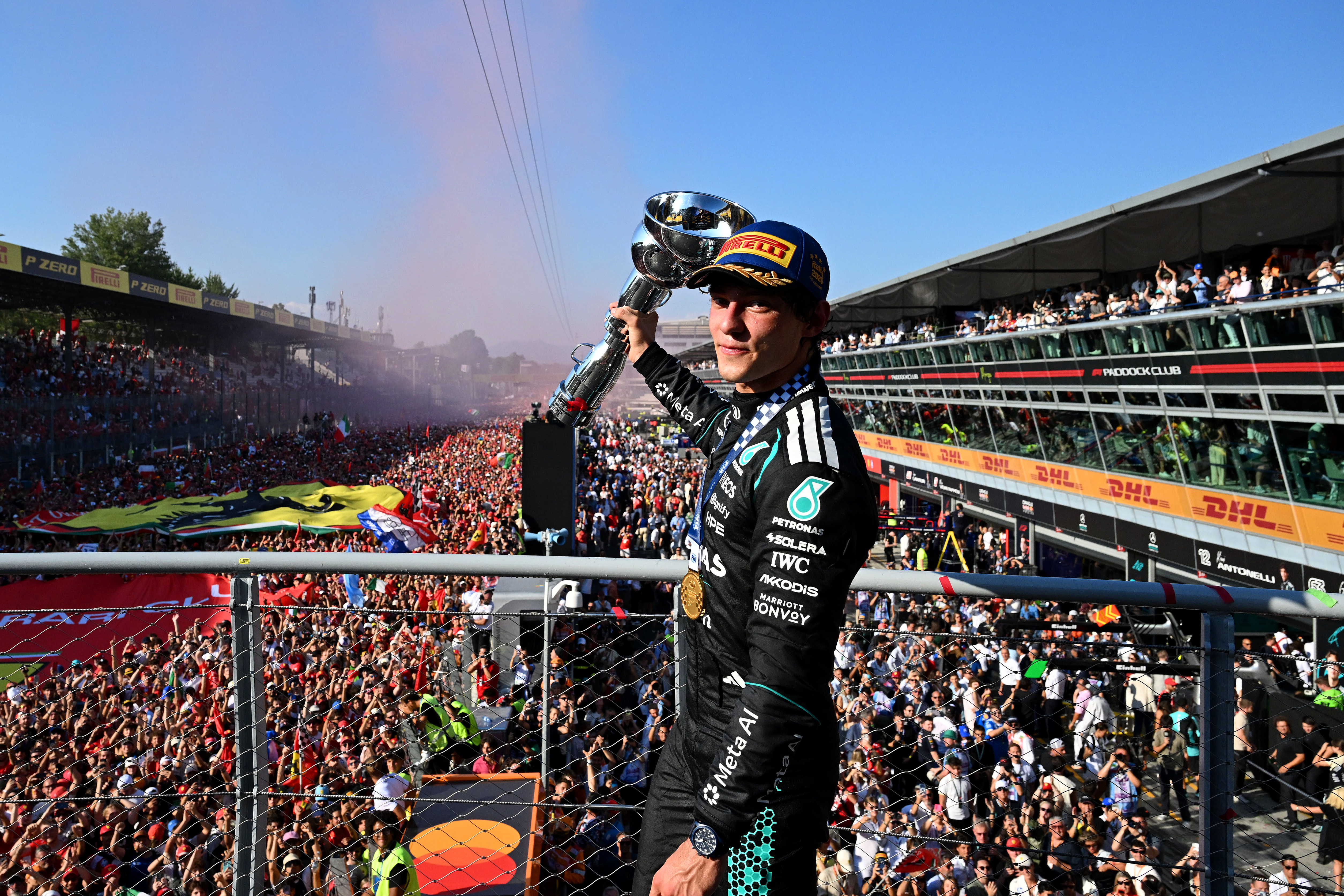
From the second standing start, on fresh medium tires and still needing a second pitstop, he made short work of the rest of the grid, including his teammate George Russell, who spent much of the race in the lead, on a theoretically faster one-stop strategy. Even a mistake from Antonelli that saw him make an excursion through a gravel trap as he tried to pass Russell couldn’t stop his charge, and he became the first Italian to win the Italian Grand Prix in 60 years—fairy tale stuff, surely.
Kimi Antonelli just gave the Tifosi a new name to cheer.
Credit: Mark Sutton – Formula 1/Formula 1 via Getty Images)
Kimi Antonelli just gave the Tifosi a new name to cheer. Credit: Mark Sutton – Formula 1/Formula 1 via Getty Images)
The contrast with this past weekend could not be starker.
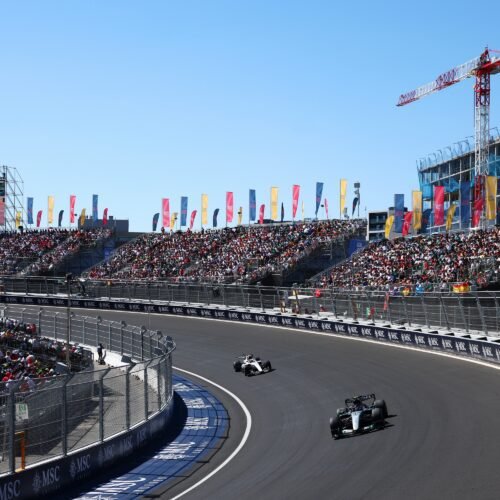
The sport traveled from Italy to Spain to race on the new Madring, a temporary circuit built around a sprawling exhibition center near the Spanish capital’s airport. The 3.3 mile (5.4 km) circuit had a troubled gestation, with construction setbacks caused by heavy rain, among other issues. Like some other new street circuits, a highway passes over the course, constraining the track design somewhat, and its most notable feature is a long banked corner meant to generate IndyCar-like passing. At least, that was the idea.
Indeed, had the F1 race followed on from the examples set by the F2 and F3 support races, the race report you’re reading now would describe all manner of chaos with plenty of overtaking, a few heavy crashes, and more than one red flag. But F1 drivers are all a lot more experienced than those in the junior series. They’re not prone to crashing and know when to pick their battles. And there were no battles to be fought on the Madring.
This is as exciting as the Spanish Grand Prix got.
Credit: Mark Thompson/Getty Images
This is as exciting as the Spanish Grand Prix got. Credit: Mark Thompson/Getty Images
The win should have gone to McLaren’s Lando Norris. He was fastest in qualifying on a day when the driver made more of a difference than the car, and he was the fastest driver during the race, leading from the start. But on lap 14, a virtual safety car was declared after Lance Stroll retired his Aston Martin. Under a VSC, the cars circulate at reduced speed, and making your pitstop under a VSC can therefore allow you to do so without losing nearly as much time to your rivals. Which is exactly what Antonelli and Max Verstappen did, Antonelli even slowing his pace by a second or two after being warned the scenario was likely.
Norris had no such luck; the VSC was declared just after the point at which he could have responded and entered the pits. Worse, it ended shortly before Norris reached the pit entry on his next lap. Bewilderingly, the McLaren still pitted anyway, rather than remaining on track to continue building a gap for a later green-flag stop. Making matters worse, a problem with one of the wheels meant Norris was stationary for more than seven seconds—easily three times the length of a competitive stop in 2026. Norris rejoined the race in fifth with plenty of work to do. It became fourth when Russell stopped for tires, then third after Leclerc made his stop late in the race, but the reigning driver’s champion could progress no further.
“You only have to look at the layout, and it’s quite clear that it’s going to be a poor track for racing,” said Haas’ Oliver Bearman. McLaren’s Oscar Piastri concurred: “I think the only track more difficult to overtake on is Monaco, so it’s not ideal,” said the McLaren driver.
Lewis Hamilton was an early retirement with brake failure. Any title hopes for Ferrari should be forgotten now.
Clive Mason/Getty Images
Lewis Hamilton was an early retirement with brake failure. Any title hopes for Ferrari should be forgotten now. Clive Mason/Getty Images
With another win, it seems Antonelli’s coronation as champion is more and more certain.
Mark Sutton – Formula 1/Formula 1 via Getty Images
With another win, it seems Antonelli’s coronation as champion is more and more certain. Mark Sutton – Formula 1/Formula 1 via Getty Images
Lewis Hamilton was an early retirement with brake failure. Any title hopes for Ferrari should be forgotten now. Clive Mason/Getty Images
With another win, it seems Antonelli’s coronation as champion is more and more certain. Mark Sutton – Formula 1/Formula 1 via Getty Images
“Around here, if you just drive a little bit in the middle, then you can’t pass,” explained Red Bull’s Max Verstappen, who indeed held off Norris for second place after stopping like Antonelli under the VSC. Antonelli’s win makes his total eight, and he now has an 81-point lead over his teammate Russell.
The good news, considering there’s another nine years left of the Madring deal, is that there are already changes planned to the track for next year. Turns 5-6, 13, and 20 are all going to be looked at to create better overtaking opportunities, like wide entries to corners after heavy brake zones. The Madring’s series of corners that require trail braking might be a good challenge for a time trial, but they don’t make for good TV.
And it seems that unhappy drivers are the best way to get the FIA to do something. On the eve of the Madrid race, we learned that FIA President Mohammed Bin Sulayem wants to give Aston Martin more development resources after a conversation with Aston Martin’s lead driver, Fernando Alonso, overriding the existing process meant to do just that.
Can anyone get special treatment if the FIA president likes them? Seems we may find out.
Credit: Clive Mason/Getty Images
Can anyone get special treatment if the FIA president likes them? Seems we may find out. Credit: Clive Mason/Getty Images
“I said, Fernando, I understand that it’s not acceptable that you are coming to your own country and then now, after two times the world champion, and you are [in] the last [place]. We did something earlier, in May, legally, for the team towards the engine to go and improve. And then I said to him, I’m not going to tell you what we are going to do, please tell me what you want, because you are the driver, come and tell me what do you want us to do to improve these results? Suddenly, you see everything change. And then I get a call, and then I had a meeting yesterday. We are here also to support,” Bin Sulayem said.
The European Commission will propose an EU KIDS Act on Thursday to set a minimum age for accessing social media throughout the bloc.
The proposal will come with an EU-wide minimum age and requirements for online products to be safe by design, according to parts of preparatory documents seen by POLITICO.
Commission spokesperson Olof Gil confirmed an the act is coming on Thursday at a Monday press conference.
The new proposal comes after intense pressure by government leaders like France’s Emmanuel Macron to put minors’ safety on social media platforms at the top of the political agenda. The French government is pushing ahead with a national law to restrict kids’ access to platforms like TikTok and Instagram.
The EU’s new proposal will apply to social media, video-sharing platforms, online games and AI chatbots and AI companions, but it will excluding educational tools and will also come with some tools for parents and guardians, the documents said.
The proposal will come with a new enforcement architecture similar to those of the Digital Services Act and the Artificial Intelligence Act, including supervisory fees to be paid by companies, the documents said. These landmark laws centralize enforcement of the highest-risk companies and services to the European Commission.
The text is still subject to change before it is announced and will have to be negotiated with EU governments and lawmakers.