12.8 C
London
Saturday, May 16, 2026
Home Blog

OpenAI feels “burned” by Apple’s crappy ChatGPT integration, insiders say

0
openai-feels-“burned”-by-apple’s-crappy-chatgpt-integration,-insiders-say
OpenAI feels “burned” by Apple’s crappy ChatGPT integration, insiders say

OpenAI is reportedly exploring legal options after Apple’s ChatGPT integration into its products didn’t live up to the AI firm’s expectations.

When the deal was announced, Apple likened features linking Siri to ChatGPT to its now-infamous deal embedding Google search in the Safari browser, insiders granted anonymity to discuss the “strained” partnership told Bloomberg. And the promise of that excited OpenAI, which expected the deal “could generate billions of dollars per year in subscriptions,” an OpenAI executive granted anonymity to discuss the partnership told Bloomberg.

Instead, OpenAI suspects Apple intentionally failed to promote the integration and fears that the deal may have damaged the ChatGPT brand, sources said.

Specifically, OpenAI hates how Apple designed the integration, sources said. Particularly bad was the choice forcing Apple users summoning Siri to also “specifically invoke the word ‘ChatGPT’ when speaking or typing a command,” sources said. That makes it harder for users to access the features, OpenAI apparently feels. And Apple’s other choices, like using small windows providing limited information when responding with ChatGPT outputs, seems to ensure that users can easily ignore the features, sources said.

As the OpenAI executive explained, Apple didn’t fully explain how the integration would work when the deal came together, so OpenAI took a “leap of faith” it now appears to regret.

“When we heard about this opportunity, it sounded amazing: being able to acquire a giant number of customers and have distribution in such a big mobile ecosystem,” the executive said, attempting to explain why OpenAI was willing to enter the arrangement blind. Since then, efforts to renegotiate the deal have “stalled,” Reuters reported. And, supposedly due to feeling “burned,” OpenAI has declined to enter other partnerships to work on Apple’s AI models, Bloomberg reported.

According to the insiders, OpenAI is so disappointed in Apple’s work that the AI firm is now “actively working with an outside legal firm on a range of options that could be formally executed in the near future.”

“We have done everything from a product perspective,” the OpenAI executive summed up OpenAI’s frustrations to Bloomberg. “They have not, and worse, they haven’t even made an honest effort.”

Supposedly, OpenAI is still hoping to resolve its issues with Apple outside of court, if possible. But one option that OpenAI may pursue could be accusing Apple of a breach of contract. Going that route wouldn’t necessarily require filing a lawsuit right away, sources suggested.

Apple and OpenAI did not respond to Ars’ request to comment.

Musk may expose how deal was done

Most likely, OpenAI will delay approaching Apple until after its court battle with Elon Musk concludes, Bloomberg reported. A decision in that litigation is potentially coming next week.

OpenAI also faces a court battle with Musk over its Apple deal. However, it may be inconvenient for Musk that tensions between OpenAI and Apple have grown since he filed a lawsuit last August. Musk alleged that the deal integrating ChatGPT into Apple products violated antitrust and unfair competition laws, supposedly propping up OpenAI to dominate the chatbot market and Apple the smartphone market.

So far, Musk’s lawsuit has survived motions to dismiss, though the judge has yet to comment on its merits. That leaves Apple and OpenAI potentially stuck defending the deal at a trial scheduled for October, even if it falls apart.

However, the partnership’s end may make it harder for Musk to uphold his claims of a conspiracy in his lawsuit.

Due to Musk’s fury that his chatbot Grok has never been featured as a “Must Have” app in Apple’s App Store, the lawsuit alleged that Apple and OpenAI struck a deal as part of a giant conspiracy to lock out rivals developing chatbots that Musk claimed Apple fears could make smartphones obsolete. As Musk’s theory goes, Apple was so afraid of Musk’s plan to turn X into an “everything app” that it partnered with OpenAI to supercharge ChatGPT as a market leader and constrain X’s innovation.

Increasingly problematic for Musk, the looming fallout between OpenAI and Apple suggests their allegiance is not that deep. Bloomberg’s sources suggested that Apple was happy to partner with OpenAI as its own AI projects failed to launch but over time became less inclined to boost ChatGPT after learning about OpenAI’s plans to make its own device that could rival the iPhone. Reuters suggested that Apple was so “rankled” by OpenAI teaming up with its former star designer Jony Ive that it lost motivation to help supercharge ChatGPT as OpenAI expected.

For Musk, it may become impossible to argue that OpenAI and Apple are colluding to keep Apple at the top of the smartphone market when OpenAI is working on its own device. And his arguments about ChatGPT’s supposed “exclusivity” are also falling apart, as Apple is now testing Siri integrations with Anthropic’s Claude and Google Gemini.

OpenAI’s executive insisted to Bloomberg that OpenAI’s potential legal action has nothing to do with Apple expanding its AI partners, emphasizing that the deal was never intended to be exclusive.

With tensions high, Apple and OpenAI would probably prefer to keep details about how the deal came together secret. However, although Musk’s lawsuit may be losing steam, it has recently succeeded in forcing Apple and OpenAI to be more transparent about the deal.

This week, magistrate judge Hal Ray Jr. denied Musk’s request to see Tim Cook’s internal messages discussing the deal but ordered Apple to share documents by mid-June from Senior Vice President of Software Engineering Craig Federighi.

Federighi “made high-level, strategic decisions about the Apple-OpenAI Agreement,” the judge noted, and “may have unique relevant evidence not already produced relating to Apple’s integration of OpenAI into Apple Intelligence.” Apple will also have to provide any “documents that refer to potential exclusivity clauses of the artificial intelligence provider for Apple products,” as Musk tries to keep his antitrust fight alive.

It’s possible that OpenAI and Apple will make up before Musk’s lawsuit heads to trial this fall. In June, Apple is expected to unveil a revamped Siri that could better promote ChatGPT in ways that resolve at least some of OpenAI’s concerns, Bloomberg reported.

OpenAI maintains that Musk is distorting antitrust law as part of a “harassment campaign” attacking OpenAI to slow down its work, so that Musk’s xAI can catch up. Apple argued that a Musk win would devastate the tech industry by setting an alarming precedent that any deal with a supplier violates antitrust law if other proposals are rejected. Perhaps most damning for Musk’s case, both OpenAI and Apple have urged the court to agree that Musk cannot show harm since none of his firms make smartphones.
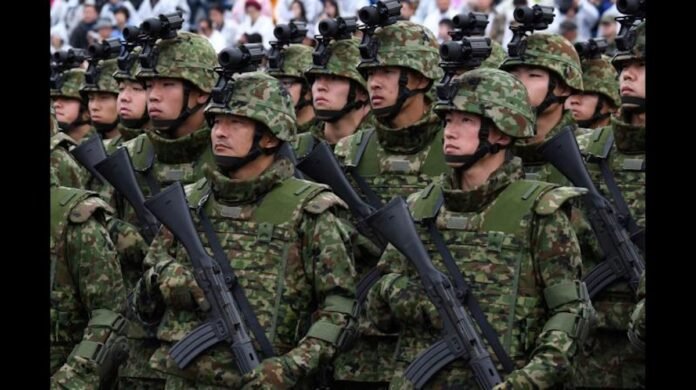
Rearming Japan: ambition, constraints and limits

0
rearming-japan:-ambition,-constraints-and-limits
Rearming Japan: ambition, constraints and limits

Originally published by Pacific Forum, this article is republished with permission.

In barely half a year, Prime Minister Sanae Takaichi has pushed Japan’s defense policy into unfamiliar territory. The FY2026 main defense budget has reached 9.04 trillion yen (approximately US$58 billion), with total security-related spending at roughly 10.6 trillion yen, at about 1.9% of GDP.

The 2% threshold, long treated as sensitive, has effectively been reached ahead of schedule. At the April 2026 LDP convention, she signaled that constitutional revision is imminent, with a proposal targeted for 2027.

This is more than higher spending. It is a compressed phase of military normalization under pressure. The driver is a China-Taiwan trilemma: Japan must deter China, prepare for instability around Taiwan and hedge against uncertainty in US commitments, all without provoking escalation or exhausting its own capacity.

While a stronger military posture can enhance deterrence and reassure the United States, rapid acceleration still creates inherent trade-offs, and prioritizing one objective can weaken another in practice.

The pressing question is whether Japan can transform this accelerated buildup into enduring military capability before structural limits impose constraints.

Acceleration beyond predecessors

Japan’s trajectory did not begin with Takaichi. Under long-serving Prime Minister Shinzo Abe, the outer boundaries of postwar security policy were stretched, most notably through the 2015 legislation that reinterpreted Article 9 to permit limited collective self-defense.

Fumio Kishida, prime minister from 2021-2024, consolidated that trajectory, committing Japan to reach 2% of GDP in defense spending by FY2027 while revising core strategic documents.

Takaichi has forced execution under time pressure. Her February 2026 supermajority mandate allowed her to compress what had been a gradual process. Speed has reduced political resistance, but it has also limited the time available for institutions to absorb change.

The March 2026 reorganization of the Self-Defense Forces reflects this shift. A centralized Fleet Surface Force concentrates naval command, while a new Amphibious and Mine Warfare Group sharpens the focus on island defense. The Air Self-Defense Force has expanded into an Air and Space Self-Defense Force.

Procurement has accelerated, including Tomahawk acquisition and upgrades to indigenous systems. Restrictions on arms exports have been eased, signaling a more active role in defense industrial cooperation.

The emphasis has moved beyond preparing for contingencies and toward shaping them. That transition brings initiative, but also greater exposure to miscalculation and institutional strain.

The China-Taiwan trilemma as the central driver

The strategic logic behind this acceleration is rooted in geography and timing. China’s military modernization continues at scale, accompanied by persistent gray-zone activity around the Senkaku Islands. At the same time, a Taiwan contingency, whether through blockade or direct force, has become a planning scenario rather than a remote possibility.

Japan sits uncomfortably close to this potential flashpoint. The Nansei Islands (also called the Ryukyus) extend toward Taiwan, with some points only about 110 kilometers (68 miles) away.

Critical sea lanes passing through the Miyako Strait and the Bashi Channel carry the vast majority of Japan’s energy imports. Disruption in these corridors would register immediately as an economic shock.

Prime Minister Sanae Takaichi speaks with the press Friday about her phone call with US President Donald Trump as he flew home from his summit with Chinese leadaer Xi Jinping. Photo: Prime Minister’s Office of Japan

Tokyo increasingly treats Taiwan as strategically aligned but operationally constrained.

Political gridlock and readiness gaps raise doubts about its ability to sustain a prolonged defense.Japan cannot assume time or US availability will be on its side, particularly under an administration that frames alliances in more transactional terms.

These pressures cannot be reconciled cleanly. Strengthening deterrence risks escalation. Preparing for a Taiwan contingency demands resources that strain sustainability. Hedging against US uncertainty requires autonomy that can complicate coordination. The result is a managed tension rather than a balanced strategy.

Geographic focus and operational shift

Japan’s response is most visible along its southwestern arc. The islands of Yonaguni, Ishigaki, and Miyako are being fortified with missile deployments, surveillance systems and logistical infrastructure designed to support sustained operations. 

Forward arming and refueling points extend air coverage. Unmanned systems improve surveillance while reducing risk to personnel. Electronic warfare capabilities aim to disrupt adversary targeting.

Island chain strategy. Map: ResearchGate

This “southwestern wall” is a distributed network designed to complicate movement through the First Island Chain and raise operational costs. The emphasis lies on denial – slowing and constraining an adversary rather than defeating it outright.

From Beijing’s perspective, such a network complicates rapid coercive options but does not eliminate them. Saturation tactics or blockade strategies could still impose severe pressure, especially if Japan struggles to sustain operations. Denial depends as much on endurance as on initial positioning.

The core constraints: Human resources, demographics, and doctrinal legacy

The ambition of Japan’s defense buildup faces structural limits that are harder to overcome than budget ceilings.

The most immediate is manpower. As of the end of FY2024, the Self-Defense Forces stood at 89.1% of authorized strength, with recruitment shortfalls persisting despite expanded eligibility and retention measures. This gap already affects readiness.

A denial strategy built on dispersed, high-tempo operations across the southwestern islands is manpower-intensive. It requires rotation, redundancy and the ability to absorb attrition. Japan is weakest where its strategy demands the most.

Demographic trends reinforce this constraint. The pool of recruitment-age citizens continues to shrink, as it is projected to decline by another 30% or so by the mid-2040s, while competition from the civilian labor market remains strong. Expanding the force will be difficult regardless of budget growth.

Doctrine presents a different challenge. The long-standing emphasis on an exclusively defense-oriented policy under Article 9 has become increasingly detached from operational practice. Counterstrike capabilities and force restructuring point toward a more flexible doctrine. Takaichi’s push for constitutional revision seeks to reconcile this gap, but the process remains politically sensitive.

Even where funding exists, conversion into capability is uneven. Roughly 1 trillion yen in defense allocations go unspent annually due to procurement delays, industrial bottlenecks, and currency effects. The constraint is no longer willingness to spend, but the ability to sustain capability over time. These pressures concentrate risk in long-duration operations, where initial gains are hardest to maintain.

Historical echoes as cautionary restraint

Japan’s postwar identity continues to shape both domestic debate and external perception. The legacy of World War II and the normative weight of pacifism remain embedded in political culture. They no longer function as an outright barrier, but they define the boundaries of acceptable policy.

Public protests in April 2026, including a large demonstration outside the Diet and coordinated actions nationwide, reflect persistent unease. Coalition dynamics reinforce the need for caution. Younger voters appear more open to a stronger defense posture, but this openness does not translate into unconditional support.

Externally, China continues to frame Japan’s military developments through historical narratives, while other regional actors watch more quietly. Tokyo’s challenge is to signal restraint externally while expanding capability internally. Perception remains integral to deterrence.

Forward outlook: 2026–2035 inflection points

The upcoming revisions to Japan’s National Security Strategy will shape the next decade. Technology will play a larger role, particularly in unmanned systems and AI-enabled support, offering partial relief from manpower constraints. Partnerships will deepen, including with the Philippines and Australia.

Several trajectories stand out. Prolonged gray-zone pressure in the East China Sea would test operational endurance, exposing weaknesses in personnel and logistics. 

Economic coercion by China, combined with fiscal constraints, could slow expansion. A successful constitutional revision could strengthen legal clarity and alliance coordination, while testing domestic cohesion.

Each path stresses a different dimension of Japan’s strategy – operational endurance, fiscal sustainability or political legitimacy. None can be managed through spending alone.

Realism must match resolve

Takaichi has supplied what Japanese defense policy long lacked: urgency backed by resources. The challenge has shifted. It is no longer about overcoming political hesitation or breaking fiscal taboos.

Japan’s rearmament now depends on whether the state can sustain what it has chosen to begin. The constraints it faces are enduring, not transitional. How they are managed will determine whether this acceleration produces lasting military capacity or a force that expands quickly but struggles to endure when it is tested most.

Tang Meng Kit (mktang87@gmail.com) is a Singaporean freelance analyst and commentator. He graduated from the S. Rajaratnam School of International Studies (RSIS), NTU, Singapore in 2025. By profession, Meng Kit works as an aerospace engineer. He has keen interest in geopolitics and cross-straits affairs.

The UK may soon have another female prime minister

0
the-uk-may-soon-have-another-female-prime-minister
The UK may soon have another female prime minister


Angela Rayner has been cleared of wrongdoing in a tax investigation, removing a potential hurdle to any bid to become the next leader of the ruling Labour Party.

The former deputy prime minister told the Guardian newspaper and ITV News that the U.K. tax authority HMRC concluded she “didn’t try to avoid paying tax” or “wasn’t careless in the way in which I conducted myself” following an investigation into unpaid property tax, which was launched last fall.

It comes at a crucial time, with Keir Starmer’s leadership under threat. Health Secretary Wes Streeting is widely expected to launch a leadership challenge against the prime minister as soon as Thursday.

Rayner is seen as a standard bearer of the soft left of the Labour Party, and is popular with grassroots members. She was the party’s elected deputy leader from 2020 until she resigned over the tax investigation last fall.

Allies of the ex-Cabinet minister have made clear Rayner would be prepared to stand in a leadership contest if required.

When asked by ITV about her ambitions, she declined to rule out a tilt at the top job, saying: “I want us to pull together. I’ve said we have to do better and we all have to pay our part in that, and I will play my part in delivering on that.”

Source: Politico

Nakba is not a memory; it is a system still in motion

0
nakba-is-not-a-memory;-it-is-a-system-still-in-motion
Nakba is not a memory; it is a system still in motion

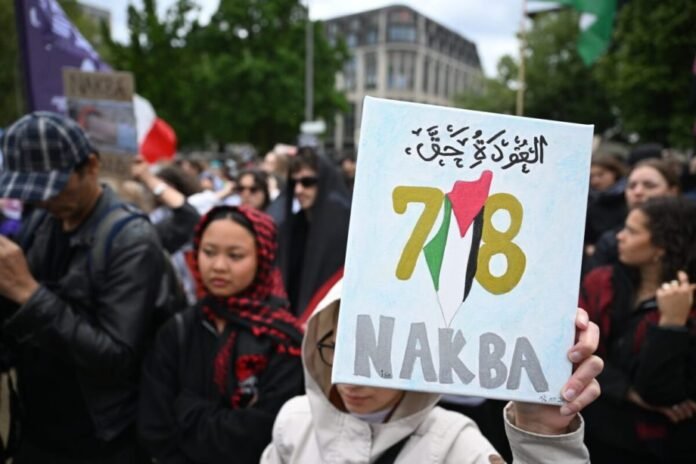
Every year on 15 May, Palestinians mark the Nakba — the catastrophe of 1948. Yet to describe the Nakba as history is to misunderstand its enduring architecture. It was never a single event sealed in black-and-white photographs of frightened families clutching iron keys to homes they would never see again. It was, and remains, a political system: one of removal, replacement, legal erasure, and economic dispossession. The tragedy is not only that the world watched it begin, but that much of the world continues to watch it unfold in real time.

In 1947, Palestinians privately owned roughly 94 per cent of the land in Mandate Palestine, while Jewish settlers held around 5–6 per cent, according to British surveys. Yet the UN Partition Plan allocated 55 per cent of the territory to a Jewish state, despite Jews comprising only around one-third of the population. By 1949, after war and expulsion, Israel controlled 78 per cent of historic Palestine. Around 750,000 Palestinians — roughly 80 per cent of the Arab population within what became Israel — were expelled or fled. More than 500 villages and 11 Arab towns were depopulated or destroyed.

This was not merely the fog of war. It was state formation through demographic engineering.

The legal mechanisms that followed were as consequential as the military campaign itself. Israel’s 1950 Absentees’ Property Law transformed displacement into permanent dispossession.

A farmer forced to flee a village became, by law, an ‘absentee’ and therefore lost rights to land, home, orchards, bank accounts, and even inheritance. Many who never left the country but were displaced internally became the cruelly named “present absentees”. Their absence was bureaucratic fiction; their dispossession was entirely real.

This matters because the Nakba did not end in 1948. It adapted.

The occupied West Bank today bears the unmistakable grammar of that same project. In early 2026, Israel approved the restart of land registration in Area C of the West Bank for the first time since 1967. On paper, it sounds administrative. In practice, it is a potentially transformative annexation. Any land lacking formal registration risks being declared ‘state land’. Given incomplete Jordanian-era surveys and decades of restricted Palestinian access to legal registration, human rights groups warn this could dispossess Palestinians of up to half the West Bank.

Israeli Finance Minister Bezalel Smotrich was unusually candid, calling it part of a “settlement revolution to control all our lands”. Sometimes the language of policy is stripped bare enough to expose the ideology beneath it.

At the same time, settlement expansion has accelerated at an extraordinary speed. Peace Now reported that 2025 saw 54 new settlements or outposts approved — the highest number on record — alongside nearly 28,000 housing approvals for settlers. Roads are built to connect hilltops to Tel Aviv, while Palestinian villages remain under demolition orders.

The world still calls this a ‘peace process’. Palestinians experience it as a slow-motion disappearance.

Then there is Gaza, where the Nakba has become not only legal and political, but geological. United Nations satellite analysis estimates that roughly 80 per cent of Gaza’s buildings have been damaged or destroyed. More than 61 million tonnes of rubble now cover the strip. Around 86 per cent of farmland has been rendered unusable. This is not simply urban devastation; it is civilisational erasure. Libraries, olive groves, universities, bakeries, graveyards — the physical memory of a people is being pulverised.

For global policymakers, Gaza should force an uncomfortable reckoning. Reconstruction is not merely an aid challenge. It is a sovereignty question. Who rebuilds? Who returns? Who decides where a home once stood?

The moral failure of the current moment is amplified by the strategic recklessness of Washington.

The United States continues to frame unconditional support for Israel as a strategic necessity, even as that posture corrodes its own legitimacy across the Global South and increasingly among Western allies.

International law cannot survive as a selective instrument.

When Russia violates sovereignty, the language is clear. When Israel expands settlements deemed illegal by the International Court of Justice, ambiguity returns. When civilians are buried beneath apartment blocks in Gaza, diplomatic vocabulary suddenly becomes hesitant. This inconsistency is not merely hypocrisy; it is geopolitical self-harm.

Trust, once lost, is expensive to rebuild. Even traditional partners are shifting. Europe is fractured. Türkiye has called the West Bank registration plan unlawful annexation. Across Latin America, public anger is sharper. A 2026 global perception survey ranked Israel as the least favourably viewed country in the world, a dramatic collapse driven by Gaza and settlement expansion. This is not a public relations issue. It is the foreign policy consequence of sustained impunity.

The Global North and the Global South alike should pay close attention, because the Palestinian story is not an isolated tragedy—it is a mirror held up to the modern international order itself.

From the plantations of the Caribbean to the reservations of North America, from the mines of the Congo to the partition lines of India, from Algeria to South Africa, history has repeatedly shown how empires were built not only by conquest, but by the careful legalisation of theft.

Land was taken, names were changed, maps were redrawn, and entire peoples were told that their dispossession was either necessary or invisible. The Nakba belongs to this wider human archive of erasure. It speaks the same language of colonial logic: remove the native, rename the land, and turn memory into a problem of administration. The Global North cannot pretend distance from this history, because many of its modern institutions were financed by it. The Global South cannot ignore it, because many of its own borders and wounds were shaped by the same hand. Palestine is not an exception—it is a continuation.

History does not disappear because official narratives demand silence. It survives stubbornly in refugee camps and family keys, in broken olive trees and inherited deeds, in the trembling voice of a grandmother naming a village erased from the map but not from the bloodline. It survives in the same way memory survived among Indigenous peoples in the Americas, among Black South Africans under apartheid, among the displaced of Kashmir, Cyprus, and Sudan. Justice delayed does not become justice denied—it becomes intergenerational grief, passed like an heirloom from parent to child.

That is why Palestine unsettles the conscience of the world: it forces a confrontation with an old truth that power prefers to forget—that dispossession is never truly past while the displaced are still alive.

The question is no longer whether history will judge this silence, but whether the international community still possesses the moral courage to interrupt it.

There is no strategic stability in permanent humiliation. No regional architecture can endure while millions remain stateless, displaced, and governed by laws designed for their exclusion. Security built on denial is not security; it is deferred instability.

A genuine path forward requires more than ceasefire diplomacy. It demands political honesty. Settlement expansion must stop. Land seizures disguised as registration must be challenged. Gaza’s reconstruction must be tied to Palestinian political rights, not administered as an open-air dependency. Refugee return, restitution, or meaningful compensation must return to serious diplomatic discussion, not remain buried beneath the rubble of failed negotiations.

This is not radicalism. It is the minimum threshold of justice.

The Nakba is not an anniversary. It is an active structure shaping borders, economies, alliances, and the moral credibility of the international order itself. For strategists and policymakers, the lesson is stark: unresolved dispossession does not become history. It becomes the future. And history, when ignored, has a habit of returning — not quietly, but in ruins.

The views expressed in this article belong to the author and do not necessarily reflect the editorial policy of Middle East Monitor.

4 Wounded, One Critically, in Rosh Hanikra Drone Strike as Israel-Lebanon Talks Resume in Washington 

0
4-wounded,-one-critically, in-rosh-hanikra-drone-strike-as-israel-lebanon-talks-resume-in-washington 
4 Wounded, One Critically, in Rosh Hanikra Drone Strike as Israel-Lebanon Talks Resume in Washington 


Four Israeli civilians were wounded Thursday when an explosive drone struck a parking lot in the Rosh Hanikra area as a new round of US-mediated negotiations between Israel and Lebanon opened in Washington amid continued fighting in southern Lebanon. 

Galilee Medical Center in Nahariya said it was treating one person in critical condition and another in moderate condition following the drone strike. Two additional wounded civilians were brought to the hospital in good condition. The hospital said one of those patients had already been released, and the second was expected to be discharged soon. 

At the same time, Israeli and Lebanese representatives began a new round of talks at the State Department offices in Washington under US mediation. An Israeli official said negotiations had started a short time earlier and were expected to continue on Friday. 

The fighting along the northern front continued as the Israel Defense Forces reported additional Hezbollah attacks targeting Israeli forces operating in southern Lebanon. The IDF Spokesperson said Hezbollah launched surface-to-air missiles earlier Thursday at Israeli Air Force aircraft operating over southern Lebanon. The military said the launches failed. 

The IDF Spokesperson also said Israeli forces killed 20 Hezbollah operatives in southern Lebanon during the previous 24 hours and struck approximately 65 Hezbollah infrastructure sites through aerial and ground operations. 

Targets included weapons storage facilities, observation posts, command centers, and other infrastructure that it said had been used by Hezbollah operatives to advance terror plans. 


Review: Good Omens finale (mostly) sticks the landing

0
review:-good-omens-finale-(mostly)-sticks-the-landing
Review: Good Omens finale (mostly) sticks the landing

It’s been a three-year wait, but Prime Video finally released the series finale for Good Omens: a 90-minute single episode that sought to wrap everything up in a neat little bow. Verdict: Truncating the final season so drastically definitely hurts the first half of the series finale, which feels chaotic and rushed. But once that stupendous on-screen chemistry between co-stars David Tennant and Michael Sheen kicks back in, the old magic shines through, strong as ever, giving us a fitting end to this beloved comic saga.

(Spoilers below for all seasons.)

Here’s a brief recap, since it’s been a minute since the S2 finale. The series is based on the original 1990 novel by Neil Gaiman and the late Terry Pratchett. Good Omens is the story of an angel, Aziraphale (Sheen), and a demon, Crowley (Tennant), who gradually become friends over the millennia and team up to avert Armageddon. Season 2 found Aziraphale and Crowley getting back to normal, when the archangel Gabriel (Jon Hamm) turned up unexpectedly at the door of Aziraphale’s bookshop with no memory of who he was or how he got there. The duo had to evade the combined forces of Heaven and Hell to solve the mystery of what happened to Gabriel and why.

In the S2 finale, the pair discovered that Gabriel had defied Heaven and refused to support a second attempt to bring about Armageddon. He hid his own memories from himself to evade detection. Oh, and he and Beelzebub (Shelley Conn) had fallen in love. They ran off together, and the Metatron (Derek Jacobi) offered Aziraphale Gabriel’s old job. That’s when Crowley professed his own love for the angel and asked him to leave Heaven and Hell behind, too. Aziraphale wanted Crowley to join him in Heaven instead. So Crowley kissed him, and they parted. Once Aziraphale got to Heaven, he learned his task was to revive the stalled plans to bring about the Second Coming, i.e., the End Times.

Muriel is hot on the case of the missing Book of Life.

The archangels of heaven are unimpressed with Muriel’s efforts thus far.

The original plan for the third and final season called for six episodes, but production was delayed first by the 2023 writer’s strike and then by multiple allegations of sexual assault against Gaiman. (Gaiman has vehemently denied allegations of any nonconsensual sex or abuse, but admitted to being selfish and “careless with people’s hearts and feelings” in a January 2025 blog post.) The fallout led to Gaiman withdrawing from the project and Prime Video opting for a 90-minute finale rather than a full season. And here we are.

The Second Coming hits a snag

The finale picks up a few years after the S2 cliffhanger. Aziraphale is now Supreme Archangel, with plans for the Second Coming well underway—except he’s tweaked them to be a bit more upbeat, bringing peace on Earth and universal happiness rather than the rampant death and destruction of Armageddon. This doesn’t go down well with some of his fellow angels, who prefer the original plan. A heartbroken Crowley, meanwhile, is spending his time drinking heavily and passing out in a Soho alley, having lost his sense of purpose when Aziraphale refused him.

The Second Coming rollout soon hits a snag. First, the Metatron mysteriously vanishes, removed completely from reality by someone who has stolen the Book of Life. In the ensuing panic, Jesus (Bilal Hasna) wanders off down to Earth and is befriended by a former street hustler named Harry the Fish (Mark Addy). The Archangel Michael (Doon Mackichan) and plucky assistant Muriel (Quelin Sepulveda) focus on solving the Metatron’s murder, while Aziraphale heads down to Earth to hunt for the missing Jesus, lest the demons of Hell find him first. He enlists a reluctant Crowley’s help.

Good Omens has always embraced the colorfully comic side quest; it’s part of what makes this such a rich fictional universe. But you need time to flesh it all out for those subplots to really work, and time is what the finale just doesn’t have. Hell and its demons, in particular, seem little more than an afterthought here; they’re not even particularly effective as comic relief. The beats just don’t quite land.

Aziraphale seeks Crowley’s help locating a missing Jesus.

Jesus re-creates the miracle of the loaves and fishes, this time with pizza.

That said, the sequence where Aziraphale helps Crowley (who can no longer perform miracles since quitting Hell) win back his classic Bentley from local gangster Brian Cameron (Sean Pertwee) is quite amusing: Aziraphale challenges Brian to a cryptic crossword contest, which the angel wins handily. That subplot also introduces the metaphor of three-card monte that runs throughout the episode.

And Jesus re-creating the miracle of the loaves and fishes in Soho’s streets with a magical pizza box that always replenishes is a nice touch. But there’s just no time to really delve into his burgeoning friendship with Harry (a great character we barely get to know) or his search for his purpose, because two more archangels have been murdered, and the end might really be near this time.

Ultimately, though, we’re really here for Aziraphale and Crowley—truly a love story for the ages—and Sheen and Tennant do not disappoint. We’ve watched this unlikely pair bond for millennia through flashbacks over all three seasons, so of course they’re going to team up one last time to save the entire universe from being erased, rocketing off into space in the Bentley with Queen’s “Don’t Stop Me Now” blaring.

The angel and the former demon even get to confront God Herself (Tanya Moodie) and propose their own version of a universe in which humans would have actual free will instead of playing God’s rigged game—even if that universe comes at a great cost to Aziraphale and Crowley.  I wish we’d gotten a full final season, but Good Omens sticks the landing with humor and heart. It’s a lovely way to bid farewell to these beloved characters.

All three seasons of Good Omens are now streaming on Prime Video.

Kardashian Pays $500K to Free Death Row Inmate

0
kardashian-pays-$500k-to-free-death-row-inmate
Kardashian Pays $500K to Free Death Row Inmate


Kim Kardashian is once again stepping into the middle of a shocking true crime case — and this time, it helped free a man who spent nearly three decades on death row.

The billionaire reality star reportedly paid the massive bond that allowed Richard Glossip to walk out of an Oklahoma prison after 29 years behind bars, according to TMZ.

Glossip had been convicted in the 1997 killing of Oklahoma City motel owner Barry Van Treese and endured a nightmare few can imagine. Over the years, he survived nine execution dates and even ate his “last meal” three separate times while waiting to die.

Now, after years of legal battles and growing questions surrounding his conviction, Glossip is finally out on bond.

Hollywood producer Scott Budnick, one of the loudest voices fighting for Glossip’s release, celebrated the dramatic moment online.

“After 29 years innocent on Oklahoma’s death row — Richard Glossip walked out as a free man this afternoon!” Budnick wrote on Instagram.

He also revealed Kardashian moved quickly to cover the staggering $500,000 bail.

“Well, he has to be released on bail, that was graciously paid for immediately by Kim Kardashian, who’s been fighting for Rich’s freedom for years,” he added.

The bombshell release comes one year after the U.S. Supreme Court threw out Glossip’s conviction and ordered a new trial, citing major concerns tied to the case.

Oklahoma Judge Natalie Mai officially granted Glossip’s release on Thursday, saying the court hopes a fresh trial “free of error” will finally bring closure to everyone involved.

The brutal murder at the center of the case dates back to 1997, when motel owner Barry Van Treese was beaten to death with a baseball bat.

Justin Sneed later admitted to carrying out the killing and agreed to testify against Glossip in exchange for a plea deal. Glossip has long maintained he had nothing to do with the murder and says he was wrongfully convicted based largely on Sneed’s testimony.

The case has sparked national outrage for years, with celebrities, activists and legal experts questioning whether Oklahoma nearly executed an innocent man.

Now, thanks in part to Kardashian’s high-profile involvement, Glossip is getting another chance to fight for his freedom outside prison walls.

Trump left China empty‑handed – but avoided something worse

0
trump-left-china-empty‑handed-–-but-avoided-something worse
Trump left China empty‑handed – but avoided something worse

When Britain sent its first formal diplomatic mission to China in 1793, one of the participants from London, Peter Auber, remarked that the group had been “received with the utmost politeness, treated with the utmost hospitality, watched with the utmost vigilance and dismissed with the utmost civility.”

The mission, which aimed to open trade and establish a permanent British embassy in Beijing, involved great pomp – but it led to no tangible return. Auber’s quote came back to me as I watched Donald Trump’s two-day state visit to China unfold.

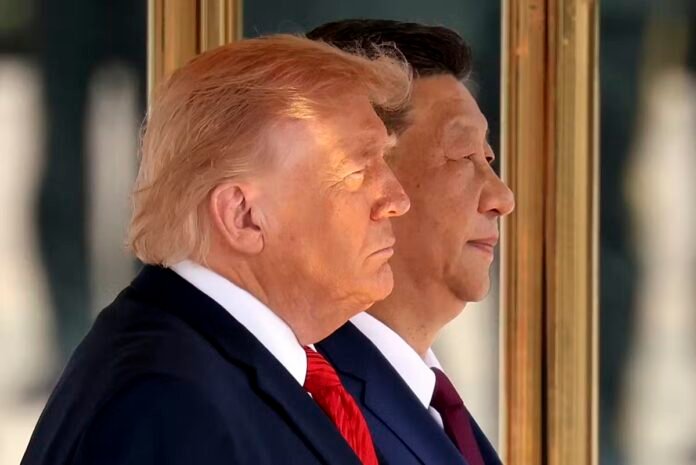
The Chinese president, Xi Jinping, opened the summit by greeting his American counterpart with warm words. The relationship between their two countries, he stated, was the “most consequential in the world.” Xi added that making America great again, a reference to Trump’s political slogan, was compatible with Chinese progress.

Trump was equally effusive in his praise of Xi. Writing on social media during his flight to Beijing, he stated that the Chinese president was “respected by all”. And when the two delegations sat down for direct talks, Trump told Xi: “You’re a great leader.”

But what did this visit actually achieve, beyond the diplomatic words and mutual flattery?

One of Trump’s perennial aims in his first and second spells in the White House has been to correct the trade imbalance between the two powers. Figures from 2025 show that while the US sold US$106 billion of goods to China, it bought products worth $308 billion from Chinese exporters – a trade deficit of around $200 billion.

On Trump’s previous visit to China in 2017, soya beans were the thing Beijing agreed to buy more of from the US. This time around, the sole big ticket item was aircraft.

On May 14, Trump announced that China had agreed to order 200 Boeing jets. Yet Boeing’s stock fell 4% immediately after the announcement, because the order was lower than many analysts had expected. Trump also said that China had, in principle, agreed to buy crude oil from the US.

However, in terms of something significant for the CEOs of major tech companies accompanying Trump to Beijing, including Tesla’s Elon Musk, Nvidia’s Jensen Huang and Apple’s Tim Cook, it seems there was no major breakthrough.

China’s strategy of developing its own technology and capacity in this area is well-known, with the government’s recent 15th five-year plan setting out its commitment to innovation, and to its own indigenous companies.

Great-power cooperation

A more significant outcome from the visit came in the less tangible space of geopolitical management and great-power cooperation. At the summit, Xi said clearly that the world relies on China and the US being able to engage with each other pragmatically, even if they don’t see eye to eye.

Comments made on Taiwan, in particular, were seen as underlining the red lines for each side. Xi repeated his demand for American non-interference, a coded warning about US arms sales to the island, which Beijing regards as a breakaway province. Trump later told reporters he had not yet decided whether a major US sale of weapons to Taiwan could move forward.

But in their talks with Chinese officials, the US delegation appear to have stuck largely to policy lines in place since the 1970s – that this issue has to be sorted out peacefully, with agreement from both Taiwan and China.

In view of the other turbulence in the world at the moment, sticking as far as possible to the status quo on this issue, while unexciting, can be described as a positive.

A map of Taiwan, off the coast of China.
China regards Taiwan as a breakaway province. Peter Hermes Furian / Shutterstock

Regarding that turbulence, Trump said Xi had offered to help the US in the Iran conflict – but how this might work out in practice is another matter. China is unlikely to want to play a heavy mediation role, because of the potential to be sucked into the perpetual problems the region seems to present to anyone getting more involved there.

What China wants is a long-term truce that means both Tehran and Washington can claim to have emerged from the Iran war as the winner – despite there being no final decisive outcome. China definitely does not want the conflict to continue indefinitely, given its disruptive economic impact – hence the offer of some kind of help.

History will probably judge Trump’s visit as one more landmark along the road to a world in which China has greater prominence, but still accords the US respect and acceptance of its current economic and military primacy. Trump may have left empty-handed – but in diplomacy, nothing happening is sometimes a good thing.

That the two leaders got on, did not clash and agreed to continue the conversation might not seem a great outcome. But in this turbulent world, it still counts as a plus.

Kerry Brown is professor of Chinese politics; director, Lau China Institute, King’s College London

This article is republished from The Conversation under a Creative Commons license. Read the original article.

The US is betting on AI to catch insider trading in prediction markets

0
the-us-is-betting-on-ai-to-catch-insider-trading-in-prediction-markets
The US is betting on AI to catch insider trading in prediction markets

For most of the past year, it looked like prediction markets had kicked off a new golden age of fraud. On Polymarket, traders raked in fortunes from suspiciously timed bets on geopolitical events like the raid on Venezuela and the Iran War. It wasn’t clear whether the US government would bother pursuing some of the most flagrant bad actors, since Polymarket’s crypto-based platform was technically offshore and not regulated or licensed within the country.

Now, however, the Commodity Futures Trading Commission, which oversees prediction markets, wants you to know that it’s watching very, very closely. The agency is searching for suspicious behavior from traders within the United States who have been sneaking onto offshore markets, including Polymarket’s crypto platform—which is blocked stateside—by using virtual private networks. “We’re going to find them, and we’re going to bring actions,” agency chairman Michael Selig told WIRED this week, speaking from the CFTC’s headquarters in Washington, DC.

Selig says the agency, which is especially lean right now, is staffing up. Like so many other AI-pilled workplaces, the CFTC is also leaning into automation to handle the growing workload, including tools that analyze trading patterns and flag potential manipulation. “You’ve got so much data,” Selig says. “When we feed it into AI, we get really great information. It can help us understand things, like where we might want to investigate, or when we might need to send a subpoena to a trader.”

In addition to proprietary surveillance systems developed in-house, the agency’s arsenal includes third-party blockchain tracing tools like Chainalysis for crypto platforms, and market abuse detection software including Nasdaq Smarts for centralized markets. (Beyond Nasdaq Smarts, the agency did not specify which AI tools it uses and declined to share more specific examples.)

Prominent prediction market companies have recently started touting all the work they’re doing to catch sketchy bettors. US-based exchange Kalshi, Polymarket’s primary competitor, eagerly announced that it has suspended and penalized customers flagged for insider trading and market manipulation.

In April, after significant backlash over suspected insider trading, Polymarket announced its own partnership with Chainalysis. It was part of a broader push to crack down on market manipulation. While the company’s CEO, Shayne Coplan, had talked in the past about why insider trading could be good for prediction markets, Polymarket changed its approach this spring, updating its market integrity rules and announcing a partnership with Palantir for its US-based sports markets (the Chainalysis deal focuses on the offshore platform). The company did not respond to WIRED’s request for comments for this story.

According to Chainalysis spokesperson Maddie Kenney, the company analyzes the same data for both clients. “The value Chainalysis adds for our customers, including Polymarket and the CFTC, is organizing the data and enriching it with the attributions and insights we’ve accumulated over years in the space,” she says. Certainly sounds like a good deal for Chainalysis!

The CFTC’s assurances that it is hunting insiders comes at a moment of intense scrutiny on prediction markets. In March, Connecticut senator Chris Murphy toldWIRED that he suspected White House staffers were engaged in insider trading on war-related contracts. At the beginning of April, seven members of Congress asked the CFTC to investigate overseas markets offering war-themed events contracts. In a letter, the lawmakers argued that the commission had the authority and responsibility to curb insider trading, especially on “morally obscene” trades on military action. Selig recently told Congress that the company is pursuing “hundreds, if not thousands” of insider trading tips.

Investigations are not limited to federally regulated exchanges. “We’re surveilling the markets on a global basis,” he tells WIRED.

Selig says that the agency will exert extraterritorial jurisdiction—its legal ability to enforce its laws beyond traditional boundaries—when it finds suspicious activity on offshore platforms like Polymarket, though he says it’s a case-by-case approach. “We use it in extreme circumstances,” he says, with an eye towards whether charges have a strong chance of sticking in court. “In any extraterritorial litigation, there’s going to be challenges to our authority, and that could also impair our ability to bring cases in the future.” According to Selig, the 2010 Dodd-Frank Act allows the CFTC more leeway to pursue this kind of enforcement action, by giving it more authority over foreign swap activities that impact the US. When appropriate, the agency works with regulators from other countries, too. “For cases where we’re not sure we’ll win, or it’s less in our wheelhouse and more of a foreign matter, we would relay it to a foreign regulator,” he says. “We’re constantly referring cases.” (The agency declined to specify which cases it had referred.)

So far, exactly one man has been charged with insider trading in the United States. On April 23, federal agents arrested a US Army special forces soldier for trades he made on Polymarket last year tied to the capture of former Venezuelan leader Nicolas Maduro. After the arrest, Polymarket claimed that it had flagged the trade to the government.

Selig is insistent that the CFTC is only just getting started. The agency will identify wrongdoers, he says—no matter “how large or how small.”

This story originally appeared on wired.com.

What’s really driving Europe’s pro-Russian supporters?

0
what’s-really-driving-europe’s-pro-russian-supporters?
What’s really driving Europe’s pro-Russian supporters?

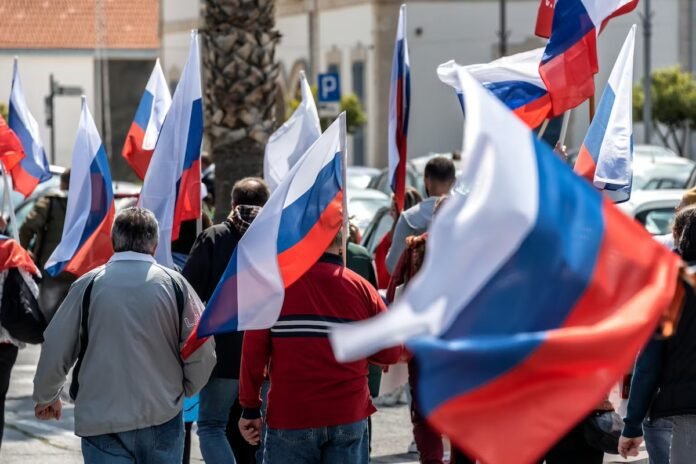
A new study across 18 European countries indicates more pro-Kremlin sentiment toward the Russia-Ukraine war is not rare. People gather (pictured) at a protest march in support of Russia in Larnaca (Cyprus) in 2022. Photo: kirill_makarov / Shutterstock via The Conversation

Russia’s full-scale invasion of Ukraine in February 2022 sparked the most significant military conflict in Europe’s post-Second World War history.

While European public opinion is overwhelmingly pro-Ukrainian, significant segments of Europe’s population hold ambivalent or even outright pro-Russian positions. As public support is key to providing military and financial assistance to Ukraine, we wanted to understand why some Europeans are sympathetic to the aggressor.

Our study considers that pro-Kremlin positions could come from four main sources:

  • Economic interests
  • Ideology
  • Partisan alignment
  • Disinformation

We analyzed data from two academic surveys from late 2023, spanning nearly 30,000 respondents and 18 European countries.

The surveys asked respondents whom they considered responsible for the war and whom they wanted to win. In practice, answers to those two questions are strongly correlated, and vary substantially across countries.

For example, support for a Russian victory is virtually absent in Poland, but approaches 20% in Slovakia.

Partisan alignment and disinformation

Our statistical analyses indicate that the strongest predictor of Europeans’ position on the war in Ukraine is the proximity of respondents’ preferred political party to the Kremlin.

The closer a party’s ties, as assessed by academic experts from the CHES project, the more likely its supporters are to favor Russia over Ukraine.

While the data does not allow us to fully determine the underlying mechanism, the results suggest that partisan alignment is the most likely explanation. Those who support Russia do not care too much about the war, but they align with their preferred party’s rhetoric.

The second-strongest correlate of Kremlin-aligned narratives is exposure to and vulnerability to disinformation. Pro-Russian views are over-represented among those who consume alternative channels for political news and believe in conspiracy theories.

For example, those who mainly consume political news from social media and messaging applications and subscribe to the view that the Covid-19 pandemic was orchestrated by national governments are 40% less likely to wish for Ukraine’s victory compared to those who consume traditional media and do not believe in conspiracy theories.

The third, though weaker, source of pro-Russian attitudes is ideology: cultural conservatism and authoritarianism. Respondents who favor strong leaders and question minority rights are more likely to sympathize with the Kremlin. By contrast, economic interests exert little to no effect.

Despite fears among analysts that rising energy costs in the aftermath of the invasion could sway public opinion against Ukraine, those who report having suffered during the energy crisis are not more likely to support the Kremlin.

Moderating public discourse, combating disinformation

Our results highlight the importance of top-down processes, whereby pro-Russian attitudes primarily reflect signals shared by pro-Kremlin politicians and disinformation spread by alternative sources of political news.

Much of the surprising support for the aggressor does not seem to stem from some ideological affinity or economic interests, but from the information and interpretation that circulates within political systems.

Countering Russia’s influence thus requires assertive moderation of public discourse and robust efforts to combat disinformation. These imperatives contrast with governments’ attitudes in many EU member states.

For example, the current Andrej Babis’s cabinet in the Czech Republic has renounced any anti-disinformation measures. In Slovakia, Prime Minister Robert Fico has echoed pro-Russian narratives himself.

These examples highlight a central challenge: efforts to counter disinformation are ultimately constrained by domestic political incentives.

Where political elites amplify or tolerate pro-Kremlin narratives, public attitudes are likely to follow. Strengthening resilience to disinformation ultimately depends on political leadership that is committed to defending the integrity of the information environment.

This article is published on behalf of all the authors of the original study: Filip Kostelka, Martín Alberdi, Max Bradley, Toine Fiselier, Alexandra Jabbour, Nahla Mansour, Eleonora Minaeva, Silvia Porciuleanu, and Diana Rafailova.

Filip Kostelka is professor and chair in political and social shange, European University Institute

This article is republished from The Conversation under a Creative Commons license. Read the original article.

0FansLike
0FollowersFollow
0FollowersFollow
0SubscribersSubscribe
- Advertisement -
Google search engine

Recent Posts