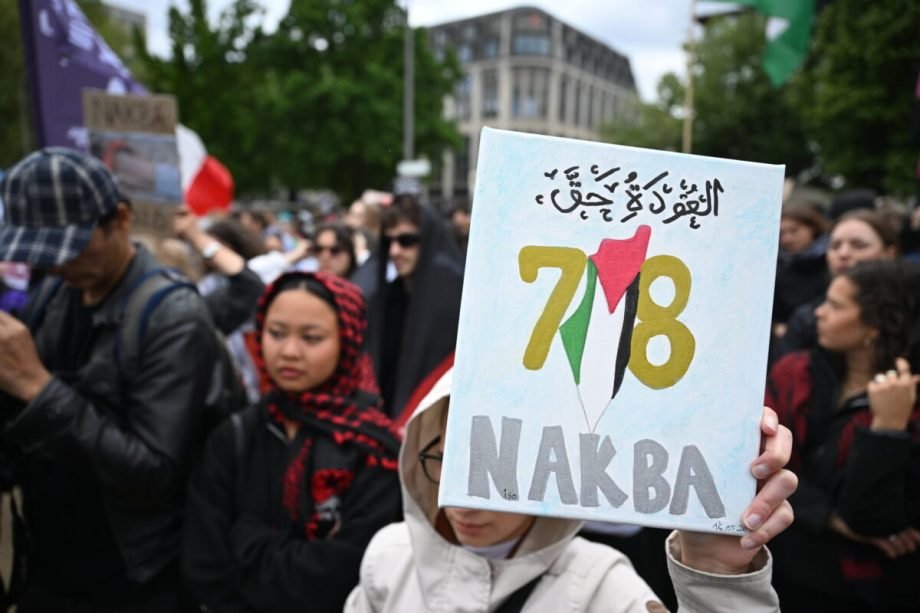
Every year on 15 May, Palestinians mark the Nakba — the catastrophe of 1948. Yet to describe the Nakba as history is to misunderstand its enduring architecture. It was never a single event sealed in black-and-white photographs of frightened families clutching iron keys to homes they would never see again. It was, and remains, a political system: one of removal, replacement, legal erasure, and economic dispossession. The tragedy is not only that the world watched it begin, but that much of the world continues to watch it unfold in real time.
In 1947, Palestinians privately owned roughly 94 per cent of the land in Mandate Palestine, while Jewish settlers held around 5–6 per cent, according to British surveys. Yet the UN Partition Plan allocated 55 per cent of the territory to a Jewish state, despite Jews comprising only around one-third of the population. By 1949, after war and expulsion, Israel controlled 78 per cent of historic Palestine. Around 750,000 Palestinians — roughly 80 per cent of the Arab population within what became Israel — were expelled or fled. More than 500 villages and 11 Arab towns were depopulated or destroyed.
This was not merely the fog of war. It was state formation through demographic engineering.
The legal mechanisms that followed were as consequential as the military campaign itself. Israel’s 1950 Absentees’ Property Law transformed displacement into permanent dispossession.
A farmer forced to flee a village became, by law, an ‘absentee’ and therefore lost rights to land, home, orchards, bank accounts, and even inheritance. Many who never left the country but were displaced internally became the cruelly named “present absentees”. Their absence was bureaucratic fiction; their dispossession was entirely real.
This matters because the Nakba did not end in 1948. It adapted.
The occupied West Bank today bears the unmistakable grammar of that same project. In early 2026, Israel approved the restart of land registration in Area C of the West Bank for the first time since 1967. On paper, it sounds administrative. In practice, it is a potentially transformative annexation. Any land lacking formal registration risks being declared ‘state land’. Given incomplete Jordanian-era surveys and decades of restricted Palestinian access to legal registration, human rights groups warn this could dispossess Palestinians of up to half the West Bank.
Israeli Finance Minister Bezalel Smotrich was unusually candid, calling it part of a “settlement revolution to control all our lands”. Sometimes the language of policy is stripped bare enough to expose the ideology beneath it.
At the same time, settlement expansion has accelerated at an extraordinary speed. Peace Now reported that 2025 saw 54 new settlements or outposts approved — the highest number on record — alongside nearly 28,000 housing approvals for settlers. Roads are built to connect hilltops to Tel Aviv, while Palestinian villages remain under demolition orders.
The world still calls this a ‘peace process’. Palestinians experience it as a slow-motion disappearance.
Then there is Gaza, where the Nakba has become not only legal and political, but geological. United Nations satellite analysis estimates that roughly 80 per cent of Gaza’s buildings have been damaged or destroyed. More than 61 million tonnes of rubble now cover the strip. Around 86 per cent of farmland has been rendered unusable. This is not simply urban devastation; it is civilisational erasure. Libraries, olive groves, universities, bakeries, graveyards — the physical memory of a people is being pulverised.
For global policymakers, Gaza should force an uncomfortable reckoning. Reconstruction is not merely an aid challenge. It is a sovereignty question. Who rebuilds? Who returns? Who decides where a home once stood?
The moral failure of the current moment is amplified by the strategic recklessness of Washington.
The United States continues to frame unconditional support for Israel as a strategic necessity, even as that posture corrodes its own legitimacy across the Global South and increasingly among Western allies.
International law cannot survive as a selective instrument.
When Russia violates sovereignty, the language is clear. When Israel expands settlements deemed illegal by the International Court of Justice, ambiguity returns. When civilians are buried beneath apartment blocks in Gaza, diplomatic vocabulary suddenly becomes hesitant. This inconsistency is not merely hypocrisy; it is geopolitical self-harm.
Trust, once lost, is expensive to rebuild. Even traditional partners are shifting. Europe is fractured. Türkiye has called the West Bank registration plan unlawful annexation. Across Latin America, public anger is sharper. A 2026 global perception survey ranked Israel as the least favourably viewed country in the world, a dramatic collapse driven by Gaza and settlement expansion. This is not a public relations issue. It is the foreign policy consequence of sustained impunity.
The Global North and the Global South alike should pay close attention, because the Palestinian story is not an isolated tragedy—it is a mirror held up to the modern international order itself.
From the plantations of the Caribbean to the reservations of North America, from the mines of the Congo to the partition lines of India, from Algeria to South Africa, history has repeatedly shown how empires were built not only by conquest, but by the careful legalisation of theft.
Land was taken, names were changed, maps were redrawn, and entire peoples were told that their dispossession was either necessary or invisible. The Nakba belongs to this wider human archive of erasure. It speaks the same language of colonial logic: remove the native, rename the land, and turn memory into a problem of administration. The Global North cannot pretend distance from this history, because many of its modern institutions were financed by it. The Global South cannot ignore it, because many of its own borders and wounds were shaped by the same hand. Palestine is not an exception—it is a continuation.
History does not disappear because official narratives demand silence. It survives stubbornly in refugee camps and family keys, in broken olive trees and inherited deeds, in the trembling voice of a grandmother naming a village erased from the map but not from the bloodline. It survives in the same way memory survived among Indigenous peoples in the Americas, among Black South Africans under apartheid, among the displaced of Kashmir, Cyprus, and Sudan. Justice delayed does not become justice denied—it becomes intergenerational grief, passed like an heirloom from parent to child.
That is why Palestine unsettles the conscience of the world: it forces a confrontation with an old truth that power prefers to forget—that dispossession is never truly past while the displaced are still alive.
The question is no longer whether history will judge this silence, but whether the international community still possesses the moral courage to interrupt it.
There is no strategic stability in permanent humiliation. No regional architecture can endure while millions remain stateless, displaced, and governed by laws designed for their exclusion. Security built on denial is not security; it is deferred instability.
A genuine path forward requires more than ceasefire diplomacy. It demands political honesty. Settlement expansion must stop. Land seizures disguised as registration must be challenged. Gaza’s reconstruction must be tied to Palestinian political rights, not administered as an open-air dependency. Refugee return, restitution, or meaningful compensation must return to serious diplomatic discussion, not remain buried beneath the rubble of failed negotiations.
This is not radicalism. It is the minimum threshold of justice.
The Nakba is not an anniversary. It is an active structure shaping borders, economies, alliances, and the moral credibility of the international order itself. For strategists and policymakers, the lesson is stark: unresolved dispossession does not become history. It becomes the future. And history, when ignored, has a habit of returning — not quietly, but in ruins.
The views expressed in this article belong to the author and do not necessarily reflect the editorial policy of Middle East Monitor.