6.4 C
London
Saturday, May 16, 2026
Home Blog

Ready or not, AI government is already here

0
ready-or-not,-ai-government-is-already-here
Ready or not, AI government is already here

In April, the General Services Administration announced plans to automate 1 million work hours annually after cutting nearly 40% of its staff since October 2024, with similar reductions being seen across the government workforce.

While the Elon Musk-led Department of Government Efficiency (DOGE) may have receded as a formal initiative, it has been hiring staff members who have been working across several agencies and accelerating further government automation.

Washington first adopted large-scale automation during World War II to manage massive military datasets, before its expansion into the postwar administrative state. Unlike previous waves, however, AI-driven automation is reducing jobs across both government and private industry without creating comparable replacement roles.

These systems are already shaping core government functions tied to state authority and legitimacy, including the use of military force. Reports on the Pentagon’s Maven Smart System, deployed in the 2026 Iran conflict, offer a glimpse into how far the use of such technologies has advanced.

Launched in 2017, Maven is a network of contractor-built systems led by Palantir Technologies, with involvement from companies like Microsoft and Amazon. It integrates satellite imagery, drone feeds, radar and infrared sensors, and signals intelligence, along with dozens of other data sources. Computer vision algorithms, which have been trained on vast image datasets, classify the “battlefield objects” with an “AI Asset Tasking Recommender” suggesting strike options.

Two decades ago, this task took thousands of personnel to complete, but it can now be done by a handful of operators in seconds. Targeting output increased from fewer than 100 before Maven to more than 5,000 per day during the Iran war, said a National Geospatial-Intelligence Agency official to Wired.

Earlier versions of Maven have been used in Afghanistan, Ukraine, Iraq, Syria, Yemen, and during the seizureof Nicolas Maduro in Venezuela, and the technology has continued to evolve during the Iran conflict. While not fully autonomous, it is another step toward true agentic AI warfare, where AI systems move beyond assisting human decisions through automation toward identifying and carrying out tasks with minimal human input.

The Pentagon has sought $54 billion as part of its 2027 budget to move toward an “autonomous and remotely operated systems across air, land, and above and below the sea, including the ‘Drone Dominance program.’”

It is the latest signal of Washington’s intention to reduce human involvement in war, as troop numbers continue their decades-long decline, reducing by 64% between 1968 and 2025. Azerbaijan’s use of loitering drones in Armenia in 2020 and Israel’s use of AI-assisted warfare in Gaza show how easily countries can adapt to these systems. Russian and Chinese efforts to increase their autonomous systems capacity are already competing or outpacing those of Washington.

Reducing human deliberation in warfare compresses legal review in international humanitarian law, which rests on the 1949 Geneva Conventions and the 1977 Additional Protocol I.

“[T]he opacity of modern AI makes it… harder to trace who is responsible for errors, and thus secure justice for victims. These gaps undermine both deterrence and enforcement, revealing how the Geneva Conventions and the Rome Statute fall short when applied to systems that make targeting decisions on their own,” stated the Lieber Institute.

Principles of distinction, proportionality, and precaution are now heavily strained by new AI weapons, with enthusiasm for additional regulation waning as governments globally accept reduced human control to gain an edge on the global stage.

All-of-government approach

The shift toward AI systems also carries serious domestic implications. Core state functions such as law enforcement, legal processes, and administrative decision-making, alongside public services like transport and municipal management, are now characterized by large-scale automation with creeping autonomy.

Supporters say such systems could reduce human error and political bias, while delivering faster, more consistent decisions and ensuring better governance and infrastructure. Lawmakers also need to keep pace with the private sector, which has embraced automated and autonomous systems to improve efficiency and competitiveness.

Albania’s Diella, for example, is a virtual “‘minister’ in charge of tackling corruption” in Albanian Prime Minister Edi Rama’s new cabinet, according to Al Jazeera. Her inaugural address to parliament in 2025 drew international attention. Running on OpenAI models and Microsoft’s cloud infrastructure, she is being seen as a sign of “progress.”

While domestic support is mixed, it has given AI governance a public face that encourages normalization. “Right now, Diella is just a chatbot, not an autonomous system. Artificial intelligence could support government decisions if properly trained and monitored, but the real issue is transparency: We don’t know what data it relies on or who is responsible for maintaining it,” Besmir Semanaj, who has 17 years of experience in information technology, told Deutsche Welle.

Since the 1990s, law enforcement agencies across the U.S. and around the world have meanwhile evolved their use of discriminative/predictive AI. By monitoring personal data like travel, finances, and communications, individual and regional risk scores are generated to direct police resources. In 2025, the British government admitted to developing a “homicide prediction project,” using data to flag people considered capable of murder, while companies like Palantir and Babel Street sell systems with similar capacities.

Increasing automation is expanding practical autonomy among AI systems. Police robots, from Singapore’s patrol bots to Miami’s autonomous security vehicles, are equipped with facial and vehicle recognition technology and can monitor public areas and alert police in real time.

Automated AI is also prominent in the legal system, directly impacting human liberty. In the US, bail and sentencing rely on partial algorithmic risk tools, like Arnold Ventures’ Public Safety Assessment tool, which uses nine objective factors to predict whether defendants may miss court or commit new crimes. AI tools such as COMPAS, PRIME, and HARMLESS perform similar functions.

The Michigan Joint Task Force on Jail and Pretrial Incarceration’s review of statewide arrest and court data, along with other documents, however, raised concerns “about the accuracy of Arnold Ventures’ assertion and demonstrates the potential harms of using past criminal history as a risk assessment input.”

AI judicial reasoning is also used in divorce settlements. Australia’s Split Up software, developed in the 1990s, later inspired tools like Amica, a government-backed platform that uses financial inputs and case precedents to suggest a split of assets.

Brazil’s Victor Program helps the Supreme Federal Court rapidly classify cases. It analyzes “compliance with the constitutional requirements of admissibility, and [accelerates] analysis of cases that reach the Supreme Court by using document analysis and natural-language processing tools,” according to the Oxford Institute of Technology and Justice.

China goes further, with its “smart courts” integrating AI extensively into document drafting, evidence sorting, and case review. Automated analyses of case files are given to judges alongside similar past rulings and recommended outcomes to standardize decisions, reducing the role of human discretion. Meanwhile, countries such as Canada and the UK have implemented rules allowing AI in judicial administration, but not formal judicial decision-making.

Automation in government is often easier to deploy in cities and smaller states, and Estonia stands out as one of the most automated countries in the world. Estonia has also begun extending automation into the judiciary, including AI-assisted judges for small claims disputes. The e-Estonia platform delivers state benefits, such as parental support, often without citizens applying for it.

As Estonian Prime Minister Kristen Michal described it, these AI systems “are predictive, personalized, and proactive.”

Understanding the risks

AI-driven governance is closely tied to several initiatives like Smart Cities, 15-minute cities, and various forms of social credit systems, where public infrastructure, services, surveillance, and administration are integrated through automated management.

In 2025, Palantir CEO Alex Karp and the head of corporate affairs and legal counsel to the office of the CEO, Nicholas W. Zamiska, endorsed closer integration between Silicon Valley and the state in their book, “The Technological Republic.”

While the administrative state may continue shrinking its workforce, the automated and potentially autonomous interface replacing it will make the government structure far larger and more intrusive.

Handing off public authority to private firms providing the underlying technology, alongside decisions being made by opaque algorithmic processes instead of identifiable officials, has also made populations uneasy. A 2025 Cornell Brooks Public Policy article reveals mixed support in the US for the use of AI in government overall, and lower acceptance when used in high-stakes decisions.

The same tools being developed to manage society can also be turned against it by other actors. In 2025, Anthropic stated that a likely Chinese state-sponsored actor used its Claude agentic AI to attempt infiltration into 30 targets worldwide, including tech companies, government agencies, chemical manufacturing companies, and financial institutions, succeeding in several cases. The company described it as the “first documented case of a large-scale cyberattack executed without substantial human intervention.”

Administrative failures caused by automation have also created serious problems for years. In the Netherlands, a self-learning system used by the Dutch Tax and Customs Administration wrongfully penalized thousands of families, many from marginalized communities, driving some into financial ruin and even loss of child custody.

In 2016, Arkansas automated Medicaid care assessments through a third-party contractor, abruptly cutting support for vulnerable recipients and triggering federal court challenges. The Department of Homeland Security has also repeatedly misidentified individuals through automated screening systems, preventing some from traveling. In Colorado in 2020, an automatic license plate reader falsely flagged a car as stolen, leading police to hold an innocent mother and her children at gunpoint.

Whatever rules are built into automated systems can also standardize decisions in ways that strip context. Research from a Technical University of Munich project on algorithmic governance notes that the “heuristic judgments” or “rules of thumb” reduce complex decisions into simpler standard calculations. As reliance on “algorithmic truth” grows, human judgment and deeper reasoning risk being sidelined by streamlined decisions that appear fairer.

Automation similarly expands the potential for more powerful censorship models and political manipulation. Embracing automated and autonomous governance also means surrendering part of the human role in self-government. Collective governance, grounded in public debate and access to accountable officials, will give way to structures that are harder to question or fully understand.

Regulation for new governance

Regulation is struggling to keep pace across the board, although the EU’s General Data Protection Regulation (GDPR) and the Digital Services Act and Digital Markets Act provide some coverage. Organizations like the Open Government Partnership are also advocating for international regulations on AI and automation.

Additional regulation appears less formidable in other countries. The Transparent Automated Governance (TAG) Act has established regulations for US federal agencies, but Washington’s response has mostly been market-oriented, with state and local governments acting more aggressively to establish AI regulation. China has similarly prioritized experimentation over comprehensive checks and balances.

Integration with Big Tech has also proven contentious, particularly in military applications. Anthropic’s concerns over the use of the Claude AI model in Maven-related operations in Venezuela led US officials to label it a “supply-chain risk,” prompting lawsuits from the firm. Google previously withdrew from its own Maven contract during the first Trump administration in 2018 after employee protests, although cooperation continued secretly.

Governments are therefore compelled to build these capabilities internally. A 2019 Stanford Report titled “Government by Algorithm” noted that more than half of algorithm applications were built in-house by agencies, “suggesting there is substantial creative appetite within agencies.”

But keeping pace with the private sector will be challenging. An Emory Law Journal paper warned that “mounting evidence suggests that agencies are turning to systems in which they hold no expertise, and that foreclose discretion, individuation, and reason-giving almost entirely.”

There is little reason to believe that AI-driven governance will slow down. Having transformed much of the private sector, the American Academy of Arts and Sciences suggests that it will soon move beyond the digitization of front-end governance and into “back-end decision-making” still largely handled by human officials.

Considering this, the public will need to adopt its own tools to navigate increasingly AI-driven governance, and automated systems have proven capable of challenging government bureaucracy and private-sector administration alike. The popular DoNotPay AI chatbot, for example, has helped overturn hundreds of thousands of parking tickets in the U.S. and UK by automating legal appeals.

As governments become more impersonal and machine-driven, adapting to that may require seeing automation as something the public can use to navigate and, at times, protect itself, rather than simply submit to.

John P. Ruehl is an Australian-American journalist living in Washington, D.C., and a world affairs correspondent for the Independent Media Institute. He is a contributor to several foreign affairs publications, and his book, “Budget Superpower: How Russia Challenges the West With an Economy Smaller Than Texas’“, was published in December 2022. Follow him on X @john_ruehl.

This article was produced by Economy for All, a project of the Independent Media Institute.

How Yemenis’ Pockets Became a Lifeline for Financing Cross-Border Wars

0
how-yemenis’-pockets-became-a-lifeline-for-financing-cross-border-wars
How Yemenis’ Pockets Became a Lifeline for Financing Cross-Border Wars


When many middle-class families are struggling to buy basic food, the telecommunications sector has become a major financial channel for funding the Houthis’ war effort

Saeed, 42, a government employee in Sanaa, has gone years without receiving a regular salary. Each morning, he checks his mobile phone—not for a job offer or salary deposit, but to see what remains of his meager balance. His screen rarely brings good news. Instead, it shows a familiar message from his telecommunications provider: “To support the Missile and Drone Force with 100 rials, send to 180.”

Across areas controlled by the Houthis, millions of Yemenis are facing what critics describe as a carefully organized system of digital collections. At a time when many middle-class families are struggling to buy basic food, the telecommunications sector has become a major financial channel for funding the “war effort.”

At first glance, the requested 100 rials may seem insignificant. Multiplied across millions of subscribers, it becomes a substantial revenue stream that helps finance military manufacturing and battlefield operations. For Saeed, 100 rials could buy an extra loaf of bread for his family. In the Houthis’ political and military calculations, it is presented as a “popular contribution” toward missiles and drones used on battlefronts and in regional escalation.

What is described as a “voluntary donation” appears to go further. It reflects a systematic policy for managing resources in areas under Houthi control, redirecting money from economically exhausted Yemenis toward military spending and widening the gap between humanitarian needs and defense expenditures.

The issue extends beyond the text messages on Saeed’s phone. Behind the 100-rial donation request linked to code “180,” and similar numbers, lies a daily struggle for survival.

I feel like my phone is no longer a communication tool—it has become a mandatory piggy bank for the Houthis

“When I receive a message asking me to support the ‘missile force,’ I feel like my phone is no longer a communication tool—it has become a mandatory piggy bank for the Houthis,” Saeed said bitterly. “They do not ask whether I can afford food for my children. Instead, they force me into a war I have nothing to do with. How can I donate to missile production when I cannot even buy a sack of flour?”

According to a United Nations Panel of Experts report, S/2023/833, these collections are not random but part of what the report describes as a “resource extraction system” that generates hundreds of millions of dollars annually outside financial oversight or a transparent state budget. 

The report explains how revenue from this vital sector is redirected toward military manufacturing, effectively turning ordinary phone subscribers into unwilling contributors to military operations extending beyond Yemen’s borders into the Red Sea and elsewhere.

Abdulwasea, a technical engineer working for a mobile telecommunications company, described how this “money printer” operates within the sector: “We are not running marketing campaigns—we are implementing technical military orders.”

As soon as a military operation against targets in Saudi Arabia or Israel is announced, we receive instructions to send the messages. These codes are linked to a direct deduction system.

“As soon as a military operation against targets in Saudi Arabia or Israel is announced, we receive instructions to send the messages. These codes are linked to a direct deduction system, and the money is transferred at the end of each day to designated accounts.”

This mechanism targets millions of subscribers with relatively small sums—about 100 rials each—which can generate billions in available liquidity within hours. According to the engineer, the rapid cash flow helps finance drone programs and missile development by exploiting full control over telecommunications infrastructure and turning technology designed to connect people into a tool for financing prolonged wars of attrition.

Conditions on the streets mirror what is happening to mobile phone balances.

Inside his retail shop on one of Sanaa’s busy streets, Abdulwahid watches not only his customers but also the changes imposed on his business with each new occasion introduced by the Houthis.

“My shop has shifted from being a source of income into a channel for funneling money to supervisors,” Abdulwahid said. “We do not pay zakat and taxes just once—we pay them repeatedly, under labels such as ‘supporting the frontlines’ or ‘Martyr’s Week.’ Even cleaning fees, municipal charges, and business licensing costs have multiplied several times over, without any improvement in services.”

My shop has shifted from being a source of income into a channel for funneling money to supervisors

These practices are not isolated actions by individual actors, but part of a systematic strategy aimed at stripping the private sector and reshaping the economy in favor of the war authority. A report by the Sana’a Center for Strategic Studies says the Houthis collected nearly $1.8 billion annually in taxes and levies from areas under their control.

This parallel system does not stop at present-day taxation; it also pursues companies and banks retroactively, demanding financial records dating back to their year of establishment to collect taxes allegedly unpaid for decades, with the revenues directed toward financing the “war effort” rather than paying public sector salaries.

The reports also indicate that these practices have weakened the regular commercial sector in favor of a new class of “war profiteers” linked to the Houthis, who benefit from the system to expand their influence. While independent small business owners such as Abdulwahid face two difficult options: submitting to the collection system or risking bankruptcy and withdrawal from the market.

A field survey conducted for this report included a random sample of 50 participants, including telecommunications users and wholesale and retail traders in markets across the capital.

The findings reflected the depth of the crisis. About 98% of participants—48 people—said the ongoing collections directly contributed to rising prices for essential goods and the deterioration of purchasing power, arguing that war effort levies consume money that would otherwise be spent on food and medicine for their families.

Fear also shaped the responses. Two participants refused to speak or express any opinion, worried that the survey team could be affiliated with the Houthis and tasked with monitoring dissenting voices. Their refusal reflected widespread mistrust and fear of retaliation.

Ultimately, Saeed’s struggle to secure bread and Abdulwahid’s fear of losing his business converge at the same point.

After more than a decade of war that devastated Yemen and turned the “public sector salary” into a distant memory from a more stable era, Yemenis now find themselves trapped in a new cycle of collections that extends beyond financing domestic frontlines to supporting wider regional conflicts.

Yemen, once a country seeking a political solution to its crisis, has increasingly become, critics say, a testing ground for a “trench economy”—a financial system that feeds on crises and exploits religious and nationalist sentiment to justify the extraction of citizens’ savings.

While missiles launched across the region send political and military messages, the clearest message for people like Saeed and Abdulwahid appears on a phone screen or a payment receipt: Even the struggle for daily bread has become fuel for wars that ordinary Yemenis neither chose nor expect to gain from and may lead to more poverty.


Russian parliament approves law allowing Putin to invade other countries

0
russian-parliament-approves-law-allowing-putin-to-invade-other-countries
Russian parliament approves law allowing Putin to invade other countries


Russia’s lawmakers have passed a law formally authorising the Kremlin to deploy troops abroad to “protect Russian citizens,” giving Russian President Vladimir Putin the authority in practice to invade foreign countries.

According to the State Duma documents, the “bill was drafted to protect the rights of Russian citizens in the event of their arrest, detention, criminal or other prosecution pursuant to decisions of foreign courts vested with criminal jurisdiction by other foreign states without Russia’s participation.”

Vyacheslav Volodin, chair of the Russian State Duma, said that “Western ‘justice’ has turned into a repressive machine for dealing with those who disagree with the decisions imposed by European officials.”

“In these circumstances, it is important to do everything to ensure that our citizens abroad are protected.”

Putin used a false argument of “protecting Russian-speaking population and Russian citizens” for both his invasion of eastern Ukraine and the unilateral annexation of Crimea in 2014, and Moscow’s all-out war against Ukraine in early 2022.

Andrey Kartapolov, head of the State Duma Defence Committee, claimed that the proposed legislation would “counter the campaign of rampant russophobia that continues abroad.”

The new bill adds fuel to European officials’ warnings that Russia poses a direct military threat to its neighbours.

Moscow’s continued missile and drone assaults on Ukraine have already seen Russian weapons breach NATO territory, driving European states to ramp up their defence capabilities in response.

Ukraine’s President Volodymyr Zelenskyy suggested in April that Russia’s online crackdown and all the restrictive measures banning popular messengers may be a prelude to a mobilisation of conscripts and a new offensive, either against Ukraine or the Baltic countries.

Moscow itself issued numerous threats to the Baltics since the beginning of its full-scale invasion of Ukraine.

Earlier this week, the Swedish government said it would push forward with a plan to form a new spy agency targeting overseas threats, part of a wider rethink prompted by Russia’s war in Ukraine.

Source: Euronews

UN marks Nakba anniversary amid warnings over Gaza crisis

0
un-marks-nakba-anniversary-amid-warnings-over-gaza-crisis
UN marks Nakba anniversary amid warnings over Gaza crisis

The UN commemorated the anniversary of the Nakba on Friday, with senior officials warning that the suffering and displacement experienced by Palestinians since 1948 continue amid the Gaza conflict, Anadolu reports.

The event, convened by the UN Committee on the Exercise of the Inalienable Rights of the Palestinian People, was held at UN headquarters to highlight the enduring impact of the Nakba — the mass displacement and dispossession of Palestinians during the creation of Israel in 1948.

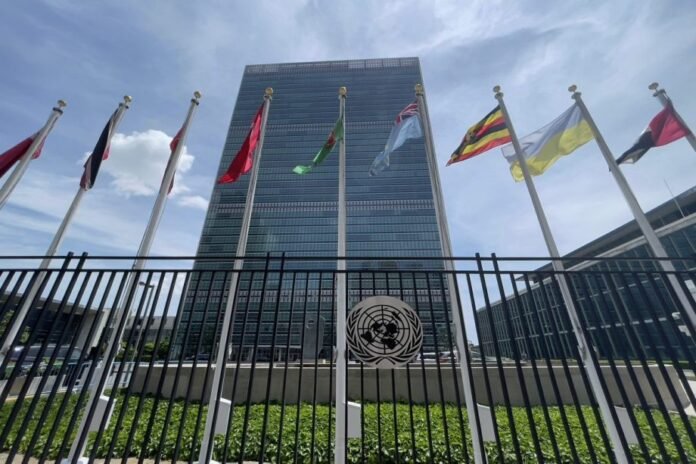
Addressing the gathering, President of the UN General Assembly Annalena Baerbock described the Nakba as a lasting historical “pain” that continues across generations.

“They were removed from their homes, their houses destroyed, their lives and livelihoods upended. In a moment, entire people scattered,” she said.

“It is a pain that endures across generations and thousands of kilometers. It is a pain for which only meaningful justice can provide relief.”

Baerbock said the issue remains deeply relevant because the suffering of Palestinians has not ended.

She also stressed the continuing responsibility of the UN to pursue a just solution to the Israeli-Palestinian conflict.

READ: Javier Bardem says Nakba ‘never ended,’ calls Gaza ‘genocide’ in UN message

“One of the first tasks of the United Nations was to find a just solution to conflicts and crises across the world, including the question of Palestine,” Baerbock said. “For 78 long years, this institution, alongside numerous other peace processes, has worked to address the Israeli-Palestinian conflict.”

She urged member states not to lose focus on the humanitarian crisis in Gaza, which she described as “catastrophic” despite the announcement of a ceasefire last October.

“A ceasefire, which does not mean peace, but more killing, even of children, is not peace and is no ceasefire,” she said. “It’s a continuation of fire.”

Khaled Khiari, the UN assistant secretary-general for the Middle East, Europe, the Americas, Asia and the Pacific, also warned that conditions in Gaza remain dire. “The situation in Gaza today is a catastrophe of grave proportions,” Khiari told participants.

He added that the ceasefire remains fragile and civilians continue to suffer.

READ: Palestinian group says Israel has arrested more than 23,000 in West Bank since Gaza war began

US hantavirus case was false positive; outbreak cases drop from 11 to 10

0
us-hantavirus-case-was-false-positive;-outbreak-cases-drop-from-11-to-10
US hantavirus case was false positive; outbreak cases drop from 11 to 10

In a press briefing Friday, officials for the World Health Organization announced that the case count of the hantavirus outbreak on the cruise ship MV Hondius in the South Atlantic has shrunk from 11 cases to 10 after a previously reported US case was found to be a false positive.

That US case was originally reported by US health officials as “mildly positive,” and the WHO had considered it “inconclusive,” but still counted in the outbreak as a case in the agency’s May 13 outbreak report and in a briefing on May 14.

The inconclusive case was in Dr. Stephen Kornfeld, an American doctor aboard the ship who helped respond to the outbreak after the ship’s doctor became ill. In an interview with CNN earlier this week, Kornfeld explained that he and others on board had taken nasal swabs early in May, before evacuation, and those swabs were sent for PCR testing in the Netherlands. Two labs in the Netherlands processed Kornfeld’s swabs; one lab reported a negative result, and the other reported a faint positive.

Generally, a faint positive result on a PCR test could suggest low levels of virus at the start or end of an infection, or it could simply suggest contamination.

Adding to the complexity of the potential case, Kornfeld said that he had developed a minor illness in early April while on the ship, just a few days after the first hantavirus case fell ill in the outbreak—a Dutch man who died on board from his infection.

In an interview with ABC News Friday, Kornfeld reported that his repeat testing was negative and so was his serology testing looking for antibodies against hantavirus—which he would have developed if his illness in April was actually an unusually mild hantavirus infection. Overall, the testing shows that he is not currently infected and has not had a previous infection. As such, he has been transferred from the biocontainment unit to the quarantine unit at the Nebraska Medical Center, where US passengers from the Hondius are being monitored.

“I physically feel great—I have felt great for many, many days,” Kornfeld told ABC. “Emotionally, I feel wonderful. It’s nice to be negative for hantavirus.”

Evacuation complete

Overall, there have been 10 cases: Seven cases who became ill on the ship, one case that disembarked the ship on April 24, before the outbreak was identified, and fell ill in Switzerland. The remaining two cases—one from France, the other from Spain—were identified as the ship was evacuated and passengers were being repatriated. The number of deaths has not changed since May 2, with three total: a Dutch couple and a German woman.

Also in the WHO press conference, Director-General Tedros Adhanom Ghebreyesus said that the operation in the Canary Islands to safely evacuate the ship is complete. The operation involved transferring the ship’s 120-plus passengers to their home countries or to quarantine in host countries en route to their final destinations.

“Because of the long incubation period of up to six weeks, more cases may be reported in coming days as passengers return to their countries, where they are being quarantined and tested in specialized facilities or at home,” Tedros warned. “This does not mean the outbreak is expanding; it shows that the control measures are working, that laboratory testing is ongoing, and that people are being cared for with support from their governments.”

The US is monitoring 41 people who may have been exposed. That includes 18 passengers (including Kornfeld) who were evacuated from the Hondius, passengers who had disembarked the ship on April 24, and people who shared a flight with a Dutch woman (the wife of the first case) who also fell ill from the infection and died in South Africa, on her way home.

Barron Trump’s Secret Family Drama Exposed After Birthday Snub

0
barron-trump’s-secret-family-drama-exposed-after-birthday-snub
Barron Trump’s Secret Family Drama Exposed After Birthday Snub


Barron Trump has spent years staying out of the spotlight while the rest of his famous family dominates headlines — but now, new details about the ultra-private first son’s personal relationships are finally coming to light.

And according to Melania Trump herself, there was one family member who meant absolutely everything to him.

In a rare emotional interview, the First Lady opened up about Barron’s “magical” bond with her late mother, Amalija Knavs, revealing the quiet family moments that shaped the 20-year-old behind closed doors.

“My mother was the epitome of love and warmth,” Melania shared. “Every story she read to Barron sparked his imagination, and every game they played strengthened their bond.”

The normally guarded mom painted a picture of a young Barron spending countless hours cuddling with his grandmother, playing games, laughing together, and learning about his Slovenian roots.

According to Melania, Amalija made sure Barron never forgot where he came from.

“She made sure that Barron felt a strong connection to his Slovenian roots,” Melania explained, adding that traditional meals, stories from her childhood, and family traditions helped keep that connection alive inside the Trump household.

The emotional revelations come as fresh rumors swirl about Barron’s reportedly distant relationship with some of his older siblings.

Sources recently claimed Barron’s 20th birthday celebration in March was shockingly small — and allegedly missing several major members of the Trump family.

According to insiders, Donald Trump Jr., Ivanka Trump, and Eric Trump were all left off the guest list entirely, while Tiffany Trump was reportedly the only sibling invited to the celebration.

And sources say that wasn’t an accident.

“Melania is in charge, and she wanted this to be about Barron,” one insider claimed. “Not about Donald Trump and not about the other children.”

The source added that Barron “didn’t grow up with them in the same way” and claimed “there isn’t a real bond there.”

The reports have only fueled more intrigue surrounding the youngest Trump, who has largely avoided public life despite constant fascination from fans and critics alike.

Barron is currently attending college and is said to want nothing to do with the nonstop political circus surrounding his famous father.

And according to insiders, Melania is fiercely protective of that privacy.

After Eric Trump previously shared details about a conversation Barron allegedly had with Joe Biden during inauguration events, sources claimed Melania was furious behind the scenes.

“Melania does not want Barron discussed. Ever,” an insider said. “She protects that boy like a lioness.”

The source added: “He’s in college. He wants a quiet life. Headlines and memes are the last thing she wants for him.”

Still, despite his efforts to stay under the radar, Barron continues to spark massive public curiosity — especially as Americans wonder whether the youngest Trump could someday step into the political spotlight himself.

How low will Indonesia’s falling rupiah go?

0
how-low-will-indonesia’s-falling-rupiah-go?
How low will Indonesia’s falling rupiah go?

Indonesia’s psychological and economic guardrails officially cracked in mid-May when the rupiah plunged to 17,513 against the US dollar, the weakest level in the currency’s history.

The decline has become a warning signal of the country’s macroeconomic framework, which is now trapped in what increasingly resembles a perfect storm.

The currency’s roughly 5% year-to-date depreciation confirms that the stabilization tools long touted by policymakers are beginning to lose their effectiveness amid intensifying global volatility.

This deterioration did not emerge in a vacuum. Since the start of 2026, the rupiah has already shown significant fragility, with capital outflows reaching US$1.6 billion in the first three weeks of January alone.

The trend has accelerated as geopolitical tensions escalated and dramatically reshaped global risk perceptions. Financial markets have increasingly shifted into safe-haven mode, driving up the US Dollar Index (DXY).

Yet the public narrative surrounding the rupiah’s fall often advances dangerously simplistic explanations. Monetary authorities appear increasingly trapped in what critics describe as an “ostrich policy”, downplaying worsening market realities in order to preserve the rhetoric of macroeconomic stability.

In reality, the rupiah’s decline reflects the convergence of severe external shocks and unresolved domestic vulnerabilities. Preventing the currency from sliding further below 17,500 rupiah has now become the most critical credibility test for both Bank Indonesia and the Prabowo Subianto-led government.

The rupiah’s failure to stage a meaningful rebound points to a deeper erosion of investor confidence. Although Indonesia posted a relatively strong first-quarter economic growth print of 5.61% year-on-year, markets are apparently viewing the figure skeptically.

Indonesia’s economic growth is widely perceived as shallow, driven largely by social spending and seasonal consumption rather than productive, capital-intensive investment. As a result, the economy lacks a sufficiently strong anchor to withstand mounting foreign exchange speculation.

Net-importer trap

The dominant external pressure now stems from the war in Iran and related blockades of the Strait of Hormuz. The waterway serves as one of the world’s most critical energy arteries, and disruptions there have removed up to 100 million barrels of crude supply from global markets each week.

For Indonesia, the consequences are highly asymmetric and deeply damaging. As a net oil importer, the country faces an immediate surge in energy import costs as Brent crude prices hover around $110 per barrel.

Rising domestic demand for US dollars to finance fuel imports has placed an additional burden on a currency already weakened by broad-based dollar strength.

At the same time, the US Federal Reserve remains committed to a higher-for-longer interest rate stance, holding rates steady at 3.75%. The situation has been exacerbated by the rise in US 10-year Treasury yields to 4.47%, narrowing the interest-rate differential between Indonesian assets and US financial instruments.

Global investors thus no longer see emerging markets as attractive yield destinations, but increasingly as risks to avoid. The resulting capital outflows have become systemic and are difficult to contain through temporary spot-market interventions alone.

From a technical standpoint, the pressure on the rupiah reflects the standard dilemma faced by small, open economies. Under normal conditions, central banks calibrate interest rates based on inflation dynamics and the gap between actual and potential economic growth.

But in the current environment, exchange-rate stability has become the dominant variable shaping monetary policy decisions. Despite inflation remaining relatively contained at 2.42%, the rupiah’s deviation from its perceived fundamental value has reached extreme levels that, in theory, would require a much more aggressive interest-rate response.

Bank Indonesia’s reluctance to raise rates significantly above 4.75% highlights its core dilemma: defend the currency or preserve growth in a consumption-dependent economy.

By holding rates steady, authorities have effectively widened the yield gap with global and dollar-denominated assets. For currency speculators, this has become a signal to continue selling the rupiah, as real returns on domestic assets are increasingly viewed as uncompetitive.

Meanwhile, Indonesia’s capital market transparency has come under heightened global scrutiny. MSCI’s May 2026 index review, which saw the deletion of 18 Indonesian equities from the index, far more than authorities anticipated, has emerged as another negative catalyst.

Concerns over high shareholding concentration in major Indonesian listed firms, particularly companies with limited free float such as BREN and DSSA, have fueled fears of rating downgrades or reduced index weighting.

Foreign investors have responded with heavy selling ahead of a potential MSCI rebalancing, reducing dollar inflows into the equity market and intensifying pressure on the foreign exchange market.

Bank Indonesia’s limited ammunition

Criticism of Bank Indonesia’s inability to prevent the rupiah from breaching 17,500 rupiah must also be viewed through the lens of the “Impossible Trinity,” also known as the monetary trilemma.

No central bank can simultaneously maintain a stable exchange rate, preserve independent monetary policy, and allow completely free capital mobility. As global financial integration deepens, Indonesia’s monetary authorities have become trapped in a classic “fear of floating” problem,  an excessive reliance on foreign-exchange intervention that often arrives too late to match the speed of market movements.

At the same time, Indonesia’s foreign exchange reserves are eroding at a concerning pace. In April 2026, reserves fell to $146.2 billion from $148.2 billion the previous month.

The decline marked the fourth consecutive monthly drop, driven by debt repayments and the mounting costs of currency intervention. Although reserves still cover roughly 5.8 months of imports, the downward trajectory signals to markets that the central bank’s long-term intervention capacity may be approaching its limit.

Bank Indonesia has deployed seven stabilization measures, including interventions through Bank Indonesia Rupiah Securities (SRBI) and the non-deliverable forward (NDF) market. But these efforts have proven insufficient against the global dollar rally.

A deeper problem lies in Indonesia’s structural imbalance between exports and imports. While the trade balance remains in surplus, the margin has continued to narrow, with import growth of 7.18% far outpacing export growth of just 0.90%.

Foreign-exchange supply from the real sector remains thin, even as corporations face peak demand for dollars to pay dividends and service foreign debt during the middle of the year.

Institutional uncertainty has also contributed to the market malaise. The establishment of state fund Daya Anagata Nusantara Investment Management Agency, known as Danantara, alongside perceived political meddling at the central bank, not least the appointment of Prabowo’s nephew as a deputy governor, has raised questions about the integrity of economic policy.

Markets are highly sensitive to any perception that central bank independence may weaken. Concerns over stock market transparency and the sustainability of expansive state spending without credible new revenue sources have added to investor governance concerns.

Together, these factors help explain why the rupiah has become one of ASEAN’s worst-performing currencies, at times underperforming even regional peers such as the Malaysian ringgit and Thai baht.

Gaming out the rupiah’s bottom

So how low could the rupiah potentially go? Scenario-based analysis suggests that the 17,500 rupiah level may mark just the beginning of a consolidation phase. Under a baseline scenario in which Middle East tensions persist without major escalation, the rupiah is likely to fluctuate between 17,550 and 17,700 per US dollar.

However, if the Strait of Hormuz were to face a prolonged closure and oil prices surged beyond $120 per barrel, the rupiah could weaken to 18,000-18,300 rupiah, the same scenario analysis projects.

The implications of such a depreciation would extend far beyond currency markets. In the real economy, manufacturers are already facing severe margin compression due to rising import costs and higher global energy prices.

The threat of mass layoffs is emerging as corporations pursue aggressive efficiency measures to maintain margins and survive. Imported inflation is also starting to raise consumer prices, particularly in sectors such as pharmaceuticals and electronics. That trend threatens to erode household purchasing power and consumer confidence.

Even so, comparisons with the 1997-98 Asian financial crisis are misleading. Indonesia’s banking sector today is significantly healthier, with stronger capitalization and tighter regulatory oversight than in the mid and late 1990s.

The greater danger now is not sudden collapse, but a prolonged economic deterioration fueled by chronic uncertainty and swelling fiscal burdens as the government struggles to subsidize energy costs and service increasingly expensive external debt.

Ultimately, stabilizing the rupiah will require far more than monetary intervention alone. Markets need to see credible fiscal discipline and assurances that state spending remains productive and transparent.

Structural reforms aimed at reducing Indonesia’s dependence on imported energy, particularly through accelerated energy diversification, need to be expedited to diminish reliance on Middle Eastern oil and gas.

Without extraordinary policy measures and meaningful improvements in market transparency, the rupiah will remain highly vulnerable for the foreseeable future. The currency’s breach of 17,500 per dollar should galvanize rapid, comprehensive reform.

In the end, the most dangerous crisis is not merely currency depreciation, but the collapse of confidence itself, and restoring that confidence will require concrete action, not increasingly fragile rhetoric about stability.

Ronny P Sasmita is senior international affairs analyst at the Indonesia Strategic and Economic Action Institution, a Jakarta-based think tank

Cheesy Beef & Sausage Sliders – Easy, Melty & Crowd-Pleasing

0
cheesy-beef-&-sausage-sliders-–-easy,-melty-&-crowd-pleasing
Cheesy Beef & Sausage Sliders – Easy, Melty & Crowd-Pleasing

You are here: Home / All RECIPES / Cheesy Beef & Sausage Sliders – Easy, Melty & Crowd-Pleasing

If you’re looking for a quick, hearty, and ultra-satisfying recipe, these Cheesy Beef & Sausage Sliders are exactly what you need. Packed with savory ground meat and melted cheese, these sliders are simple to make and perfect for feeding a crowd.

Whether you serve them as a main dish for dinner or as a party appetizer, they’re guaranteed to disappear fast. Think of them as a rich, cheesy twist on classic burgers—easy, comforting, and full of flavor.


Why You’ll Love This Recipe

  • Super quick – Ready in about 15 minutes
  • Minimal ingredients – Simple pantry staples
  • Perfect for parties – Great for gatherings and game days
  • Rich & cheesy – Melted cheese makes every bite irresistible
  • Versatile – Serve as sliders, sandwiches, or even over fries

Ingredients

  • 1 lb ground beef
  • 1 lb pork sausage
  • 1 lb (16 oz) Velveeta cheese, cubed
  • 1 teaspoon Worcestershire sauce
  • 1 teaspoon black pepper
  • 1/2 teaspoon onion powder
  • 24 slider buns

Instructions

1. Cook the Meat
In a large skillet over medium-high heat, cook the ground beef and sausage until fully browned and cooked through.

2. Drain Excess Fat
Carefully drain the grease to prevent the mixture from becoming too heavy.

3. Add Cheese & Seasoning
Add cubed Velveeta cheese, Worcestershire sauce, black pepper, and onion powder to the skillet.

4. Melt & Combine
Reduce heat to medium and stir until the cheese is fully melted and the mixture is creamy and well combined.

5. Assemble Sliders
Spoon the hot cheesy meat mixture onto slider buns.

6. Serve
Serve warm and enjoy!


Tips for Best Results

  • Drain the meat well for a better texture
  • Cut cheese into small cubes for faster melting
  • Stir frequently to prevent sticking or burning
  • Serve immediately while hot and gooey

Variations

  • All beef option: Skip sausage and use only ground beef
  • Spicy version: Add jalapeños or hot sauce
  • Extra flavor: Mix in garlic powder or smoked paprika
  • Toppings: Add pickles, onions, or mustard for a burger-style twist

Serving Suggestions

These sliders pair perfectly with:

  • French fries
  • Potato wedges
  • Coleslaw
  • Chips or simple salads

Storage

  • Store leftovers in the fridge for up to 3 days
  • Reheat gently on the stove or microwave

Final Thoughts

These Cheesy Beef & Sausage Sliders are the definition of comfort food—simple, filling, and packed with flavor. Perfect for busy nights, parties, or whenever you need something quick and delicious, they’re sure to become a go-to favorite.

Anthropic’s $1.5B copyright settlement is getting messy as judge delays approval

0
anthropic’s-$1.5b-copyright-settlement-is-getting-messy-as-judge-delays-approval
Anthropic’s $1.5B copyright settlement is getting messy as judge delays approval

After several authors and class members raised objections to Anthropic’s $1.5 billion settlement over its widespread book piracy to train AI, a federal judge has delayed final approvals of the settlement.

On Thursday, US District Judge Araceli Martinez-Olguin declined to rubber-stamp what’s regarded as the largest copyright settlement in US history. Instead, she wanted to better understand why some class members were objecting and opting out of the settlement. So, she asked authors to address key concerns of objectors, who argued that lawyers’ compensation was way too high and payments to class members were a “pittance.”

Ars reviewed several objections to the settlement, as well as letters from objectors who claimed that the authors’ legal team was trying to unfairly shut them out from voicing concerns.

Calling out lawyers for requesting more than $320 million in legal fees when each author only expects a $3,000 payout, some objectors asked the court to delay approving the settlement until a more reasonable plaintiff compensation plan is constructed.

“Every dollar that Counsel takes from the Settlement fund is one that is not given to those actually harmed,” wrote Pierce Story, an objector and author of two works covered by the settlement.

To support his arguments against the eye-popping lawyer fees, Story estimated that the large payout could break down to lawyers receiving between roughly $10,000–$12,000 per hour, which he said included a generous estimate of hours for any future work. That’s excessive, Story suggested, citing a T-Mobile case where the 8th Circuit court observed that “no reasonable class member would willingly pay” a much lower requested fee award between $7,000–$9,500.

Story accused lawyers of breaking a promise to tie their compensation to member payouts. And he’s further frustrated that the compensation they’re seeking is tied to the full settlement fund, when many authors entitled to compensation have yet to register and “are unlikely to be compensated.”

An attorney for authors confirmed on Thursday that “authors and other copyright holders filed claims covering over 92% of the more than 480,000 works included in the settlement.” But objectors maintain that lawyers’ pay should reflect the total number of claimants, not the total amount in the settlement fund.

By urging the court to make “reasonable and fair adjustments” to lower attorney fees, Story is hoping to increase compensation to authors. Offering an example, he noted that “a still-generous Counsel payout of $70 million would yield a nearly 25 percent increase in individual Plaintiff awards, while Counsel would still receive the equivalent of their current top rates” for hours worked.

To Story, it also seemed like the attorneys could’ve gotten more compensation for authors, but instead of pursuing “creative options,” they “settled far too quickly to maximize” their own compensation.

“Were the attorneys as skilled, gritty, and brilliant as they profess, and were the Settlement the ‘home run’ Counsel claims it to be, Plaintiffs would receive more than this pittance,” Story said.

Ruben Lee, another class member objecting, agreed: “I believe the amount offered is paltry, and does not in any way reflect the full value of the unauthorized use of my work.”

Objectors may not win every fight, but they have seemingly persuaded the court to at least entertain their strongly worded pleas, including warnings that the settlement may not survive an appeal if the terms aren’t re-examined. Notably, their objections came shortly before a group of 25 class members opting out of the settlement filed a new lawsuit, showing that Anthropic is not done fighting these claims.

“For the Court to agree that counsel’s request of nearly a third of a billion dollars, while individual plaintiffs settle for a pittance of available compensation and no protections against future abuse is an aberration of civil justice and a slap in the face to all those who labored to publish their works,” Story said. “Such a decision would also further the too-often-observed stereotype that … class-action Plaintiffs are merely tools used to obtain Powerball-size payouts to attorneys.”

Judge William Alsup, who initially approved the settlement but has since retired, also questioned whether the lawyers’ fees were too high. Worried that the settlement was being “shoved down the throat of authors,” he recommended an independent investigation to ensure no improper attorneys’ fees would be granted, but according to Lea Bishop, a non-class member objector and professor of copyright law, the recommendation “was not squarely disclosed to incoming Judge Martinez-Olguin” in a status report submitted by authors’ lawyers. Additionally, class members weren’t notified of the investigation.

Authors must respond to objections raised by May 21, when Anthropic will also have to file a brief explaining “why late opt outs should not be honored,” the judge ordered.

Attempts to shut out some objectors

Objectors also feel strongly that the settlement should not be approved unless Anthropic agrees to restrict future uses of pirated works.

James R. Sills, who has two works included in the settlement, insisted that due to ambiguity over how each individual work was acquired, Anthropic must agree to destroy all copies of works, both digital and physical, before the settlement can proceed.

“Currently, Anthropic will not delete any scanned physical copies of works/books,” Sills wrote. “So, they currently can use these works. The key problem: I don’t know how Anthropic acquired/pirated my two works. No authors will know how their works were taken by Anthropic. So, no authors will know if their works will be destroyed or not. Therefore, all forms of all of the works must be destroyed and not utilized by Anthropic.”

For some objectors, the process of submitting concerns was apparently a challenge. Ruben noted that he “tried to file this objection via the Court’s ECF and PACER systems, but have found it impossible to do so.”

The authors’ legal team has attempted to exclude some objections from the record, according to letters submitted urging the court to recognize that they met the deadline to submit their filings.

In one letter, an author with one work included in the settlement, Robert C. Jacobson, told the judge that counsel had characterized his objection as improperly filed despite the court acknowledging “a delay in docketing certain objections received earlier this year.”

Like Sills, Johnson raised complaints about “the absence of any prospective relief or framework addressing ongoing commercial use of models trained on the class works,” as well as “the lack of transparency regarding how class members’ specific works were processed and used.”

Another class member, Victoria Pinder, complained that counsel tried to mark her objections as “invalid” by incorrectly claiming her objection “was not sent to the court.”

Pinder pointed out how messy communication between some class members and their lawyers has gotten. She noted that the lawyers had docketed her claims previously before attempting to claim they’d never been submitted.

“There is no basis to single Ms. Pinder out,” her submission said.

To Pinder, it seems like attorneys are taking little care when hearing concerns from class members. In her letter, she requested the court to correct a misspelling of her name in counsel’s filing attempting to invalidate her objection. It seems that the lawyers mashed together the two female objectors’ names, referring to her as “Lea Victoria Pinder” and referring to Bishop as “Lea Victoria Bishop.”

Bangladesh barrage bet holds no water for India’s diplomacy

0
bangladesh-barrage-bet-holds-no-water-for-india’s-diplomacy
Bangladesh barrage bet holds no water for India’s diplomacy

May 15 occupies a charged place in Bangladesh’s political memory. The date is observed as “Farakka Day”, commemorating the 1976 long march led by Maulana Abdul Hamid Khan Bhashani protesting India’s diversion of Ganges water through the Farakka Barrage. Nearly half a century later, the symbolism remains painfully current.

Bangladesh’s latest mega project — the US$2.8 billion Padma Barrage approved this week by the Executive Committee of the National Economic Council — is in many ways a delayed answer to the same unresolved question that animated Bhashani’s march: how can a downstream country survive when the tap upstream is controlled elsewhere?

The government has framed the barrage as an engineering solution to an ecological problem. Built at Pangsha in Rajbari district of Bangladesh, the structure is intended to retain monsoon water from the Padma River and redistribute it during the dry season, when vast parts of southwestern Bangladesh turn increasingly saline and water-starved.

Officials say the barrage will hold nearly 2,900 million cubic meters of water, revive at least five major river systems, improve irrigation across 28.8 lakh hectares of farmland, support fisheries and navigation, recharge groundwater and strengthen freshwater flows into the Sundarbans.

The project is colossal even by Bangladesh’s infrastructure standards. At more than $2.8 billion for its first phase alone — with eventual costs potentially crossing $4 billion — it instantly joins the ranks of the country’s most ambitious public works.

Yet the deeper significance of the barrage lies in geopolitics. It is a tacit admission that Dhaka no longer believes diplomacy alone can guarantee sufficient water from India.

That anxiety is sharpened by the calendar. The 1996 Ganges Water Sharing Treaty between Bangladesh and India expires in December 2026, only months away. Signed after years of acrimony, the treaty regulates dry-season water sharing at Farakka between January and May — precisely when Bangladesh suffers its harshest shortages.

The agreement was once hailed as a breakthrough in regional water diplomacy. Yet in Bangladesh, dissatisfaction with its outcomes has steadily grown.

Dhaka has long argued that actual flows reaching the Padma during lean months remain inadequate for agriculture, river transport and ecological balance. Bangladeshi hydrologists blame the Farakka Barrage, commissioned by India in the 1970s to divert water toward the Hooghly River and Kolkata port, for fundamentally reshaping the hydrology of southwest Bangladesh.

Rivers such as the Gorai, Madhumati and Ichamati have progressively silted up. Salinity intrusion has crept deeper inland. Navigability has deteriorated. Fisheries have weakened. The effects are not merely environmental but civilizational: riverine Bangladesh increasingly finds itself without rivers.

The Padma Barrage represents an attempt at strategic adaptation. If Bangladesh cannot fully secure guaranteed upstream water politically, it must maximize storage of whatever water does arrive during the monsoon. In effect, the state is trying to compensate domestically for uncertainty internationally.

But that logic collides with another hydrological reality…that barrages do not manufacture water. They only regulate what exists. That is why the debate surrounding the project has quickly become inseparable from the future of the Ganges treaty itself.

Water experts have warned that without predictable upstream flow after 2026, the barrage could struggle to meet its lofty promises. During severe dry seasons, Ganges flow entering Bangladesh has already dropped sharply because of upstream diversion and changing rainfall patterns linked to climate change.

Analysts have pointed to a basic engineering dilemma: retaining water in the Padma, one of the world’s most sediment-heavy rivers, will be extraordinarily difficult. Himalayan sediment loads constantly reshape the riverbed. Without sophisticated sediment management, critics fear silt accumulation could rapidly undermine both navigability and storage capacity.

Environmental groups such as Bangladesh Poribesh Andolon have questioned whether sufficient feasibility studies and consultations were conducted before approval. Bangladesh’s history with mega projects has made such skepticism politically potent.

Over the past decade, infrastructure spending under the previous Bangladesh Nationalist Party rival government and the Awami League alike has often been dogged by allegations of inflated costs, procurement irregularities and weak accountability.

That creates an awkward political contradiction for the current government led by Prime Minister Tarique Rahman. Before returning to power, BNP leaders repeatedly criticized mega projects associated with the Sheik Hasina era, arguing that Bangladesh should prioritize education and human development rather than prestige infrastructure financed through debt.

The Padma Barrage, therefore, marks a striking reversal. Officials insist the difference is existential necessity: this is not a vanity bridge or symbolic expressway but a survival project tied to food security, climate resilience and freshwater availability.

Still, even supporters privately acknowledge that the barrage’s ultimate viability depends less on engineering than diplomacy. A former diplomat who preferred to remain unnamed told this correspondent that the decision to proceed with the project is likely evidence of “declining confidence” that negotiations alone can secure Bangladesh’s water future.

The remark captures a growing unease in Dhaka about the broader trajectory of India-Bangladesh river relations. That unease extends beyond the Ganges.

The unresolved Teesta dispute looms heavily in the background. Bangladesh and India appeared close to a Teesta water-sharing agreement more than a decade ago, only for opposition from West Bengal’s state government to derail the deal. The issue became an enduring symbol in Bangladesh of how Indian domestic politics can obstruct bilateral diplomacy.

Now, political developments in West Bengal may once again reshape calculations. The recent electoral rise of the Bharatiya Janata Party in the state has revived speculation that New Delhi could eventually gain greater room to pursue a Teesta settlement without resistance from regional actors. Yet that prospect cuts both ways for Bangladesh.

While some policymakers see an opportunity for renewed negotiations, others fear that a stronger BJP footprint in eastern India may harden New Delhi’s strategic approach to transboundary rivers at a moment when climate pressures are intensifying across the basin.

Indeed, the entire regional context is becoming more volatile. Climate change is altering Himalayan snowmelt, disrupting monsoon patterns and increasing the unpredictability of river flows throughout South Asia. Water is no longer merely an environmental issue but a strategic one.

Bangladesh’s barrage project therefore reflects a broader geopolitical trend: downstream states increasingly seeking infrastructural self-protection against uncertain transboundary arrangements.

Yet the central paradox remains unresolved. Bangladesh can build barrages, dredge rivers and expand irrigation networks, but none of these measures can fully substitute for reliable upstream cooperation. The Ganges is an international river system, and no domestic engineering project can escape that fact.

That is why the approaching expiry of the 1996 treaty is so profoundly important. If Dhaka and New Delhi fail to negotiate a credible successor framework, the Padma Barrage risks becoming a monument to strategic anxiety rather than hydrological success.

Even if renewed, any future agreement will need to address realities that the original treaty only partially confronted: climate variability, ecological sustainability and sediment management, not simply volumetric sharing formulas.

For Bangladesh, Farakka Day thus has become a reminder that the country’s river crisis remains fundamentally unfinished. The Padma Barrage may prove an impressive feat of engineering. It may revive distributaries, reduce salinity and support agriculture.

But unless Bangladesh secures dependable transboundary water flows, the project will remain constrained by the same geopolitical vulnerability that Bhashani warned about back in 1976.

Faisal Mahmud is a Dhaka-based journalist

0FansLike
0FollowersFollow
0FollowersFollow
0SubscribersSubscribe
- Advertisement -
Google search engine

Recent Posts