6.3 C
London
Friday, May 15, 2026
Home Blog

Zero-day exploit completely defeats default Windows 11 BitLocker protections

0
zero-day-exploit-completely-defeats-default-windows-11-bitlocker-protections
Zero-day exploit completely defeats default Windows 11 BitLocker protections

A zero-day exploit circulating online allows people with physical access to a Windows 11 system to bypass default BitLocker protections and gain complete access to an encrypted drive within seconds.

The exploit, named YellowKey, was published earlier this week by a researcher who goes by the alias Nightmare-Eclipse. It reliably bypasses default Windows 11 deployments of BitLocker, the full-volume encryption protection Microsoft provides to make disk contents off-limits to anyone without the decryption key, which is stored in a secured piece of hardware known as a trusted platform module (TPM). BitLocker is a mandatory protection for many organizations, including those that contract with governments.

When one disk volume manipulates another

The core of the YellowKey exploit is a custom-made FsTx folder. Online documentation of this folder is hard to find. As explained later, the directory associated with the file fstx.dll appears to involve what Microsoft calls the transactional NTFS, which allows developers to have “transactional atomicity” for file operations in transactions with a single file, multiple files, or ones that span multiple sources.

The steps for carrying out the bypass are simple:

  1. Copy the custom FsTx folder from the Nightmare-Eclipse exploit page to an NTFS- or FAT-formatted USB drive
  2. Connect the USB drive to the BitLocker-protected device
  3. Boot up the device and immediately press and hold down the [Ctrl] key
  4. Enter Windows recovery

There are at least two ways to accomplish the third step. One way is to boot into Windows, hold down the [Shift] key, click on the power icon, and click restart. Another is to power on the device and restart it as soon as Windows starts booting.

In either case, a command (CMD.EXE) prompt appears. The prompt has full access to the entire drive contents, allowing an attacker to copy, modify, or delete them. In a normal Windows Recovery flow, the attacker would need to enter a BitLocker recovery key. Somehow, the YellowKey exploit bypasses this safeguard. Multiple researchers, including Kevin Beaumont and Will Dormann, have confirmed the exploit works as described here.

It’s unclear what in the custom FsTx folder causes the bypass. Dormann said that it appears to be related to Transactional NTFS, which itself uses command-log file system under the hood. Dormann further noted that by looking at the Windows fstx.dll, one will see code that explicitly looks for System Volume InformationFsTx in the FsTxFindSessions() function.”

The contents of this FsTx directory used in the YellowKey exploit reveal no strings related to RecoverySimulation.ini. It does, however, show the files and paths ??C:Windowswin.ini and
??X:WindowsSystem32winpeshl.ini, “where X:WindowsSystem32winpeshl.ini is what controls what WinRE [Windows Recovery] does when it fires up.”

Dormann, who is a senior principal vulnerability analyst at Tharros Labs, continued:

But what’s intriguing to me is: Why can the presence a System Volume InformationFsTx directory on one volume affect the contents of ANOTHER VOLUME when it’s replayed? 🤔

In a normal WinRE session, you have a X:WindowsSystem32 directory that has a winpeshl.ini file in it:

[LaunchApp]
AppPath=X:sourcesrecoveryrecenv.exe

However, with the YellowKey exploit, it looks like Transactional NTFS bits on a USB Drive are able to delete the winpeshl.ini file on ANOTHER DRIVE (X:). And we get a cmd.exe prompt, with bitlocker unlocked instead of the expected Windows Recovery environment. While the TPM-only Bitlocker bypass is indeed interesting, I think the buried lede here is that a System Volume InformationFsTx directory on one volume has the ability to modify the contents of another volume when it is replayed. To me, this in and of itself sounds like a vulnerability.

A Microsoft representative declined to answer questions sent by email about the reported vulnerability other than to say the company is investigating.

People should know that at the moment, BitLocker on Windows 11 isn’t providing the protection it’s supposed to. That means stolen or lost devices can still be accessed even when BitLocker is enabled.

This bypass works only in the Windows 11 default mode of BitLocker, which stores decryption keys in the TPM. This TPM-only configuration has long been considered insufficient by many security professionals, who instead advise that a PIN should be required before the key can be retrieved from the TPM. Beaumont advised people to enable a BIOS password lock to prevent YellowKey attacks. While using BIOS password locks is a good practice, it’s unclear how they provide any protection against this particular exploit.


Old-Fashioned Gingerbread Cake

0
old-fashioned-gingerbread-cake
Old-Fashioned Gingerbread Cake

You are here: Home / Desserts / Old-Fashioned Gingerbread Cake

Moist, warmly spiced, and rich with molasses—this classic gingerbread cake is the ultimate cozy holiday dessert.

When it comes to gingerbread, cookies often steal the spotlight—but this old-fashioned gingerbread cake might just be even better. Soft, moist, and filled with comforting spices, it delivers that signature ginger-molasses flavor with hints of brown sugar and cinnamon. Every bite feels warm and nostalgic—like Christmas in cake form.

Even better? It’s incredibly simple to make—no mixer required—yet the result is a beautifully rich cake with a tender crumb and slightly dense texture that pairs perfectly with a drizzle of butterscotch sauce.


💛 Why You’ll Love This Gingerbread Cake

  • Moist & Tender: Soft crumb with a slightly dense, comforting texture
  • Perfectly Spiced: Ginger, cinnamon, nutmeg, and cloves in perfect balance
  • Not Too Sweet: Rich flavor without being overpowering
  • Easy to Make: No electric mixer needed
  • Holiday Favorite: Fills your kitchen with the smell of Christmas

🌿 Key Ingredients

  • Molasses: The star flavor—rich, deep, and slightly caramel-like
  • Brown Sugar: Adds sweetness and enhances the molasses flavor
  • Warm Spices: Ginger, cinnamon, nutmeg, and cloves for that classic taste
  • Butter: Adds richness and moisture
  • Eggs & Vanilla: Bring structure and warmth
  • Hot Water: Helps blend the molasses smoothly into the batter

👩‍🍳 How to Make Gingerbread Cake

1. Preheat Oven

Set oven to 350°F (180°C) and grease a 9×13-inch pan.

2. Mix Dry Ingredients

In a large bowl, whisk together:
flour, ginger, cinnamon, nutmeg, cloves, baking soda, and salt.

3. Mix Wet Ingredients

In another bowl, whisk:
melted butter, brown sugar, molasses, and hot water until smooth.

4. Add Eggs & Vanilla

Whisk in eggs and vanilla (make sure mixture isn’t too hot).

5. Combine

Gently mix dry ingredients into wet until smooth.
(Batter will be thin—this is normal.)

6. Bake

Pour into pan and bake 30–35 minutes, until a toothpick comes out clean.


🍯 Butterscotch Sauce (Optional but Highly Recommended)

  1. Melt butter in a saucepan
  2. Add brown sugar and salt, stir until dissolved
  3. Bring to a gentle boil
  4. Whisk in cream until smooth
  5. Remove from heat and stir in vanilla

🍽️ Serving Suggestions

  • Serve warm with butterscotch sauce 🍯
  • Add a dollop of whipped cream
  • Sprinkle with powdered sugar
  • Pair with coffee or tea ☕
  • Or frost with cream cheese frosting for a richer dessert

❓ Tips & Notes

  • Use regular molasses (not blackstrap) for best flavor
  • Let cake cool slightly before serving for perfect texture
  • Batter will be thin—don’t worry, it bakes beautifully
  • Honey can be used instead of molasses for a milder taste

🧊 Storage

  • Room Temperature: Up to 3 days
  • Refrigerator: Up to 5 days
  • Butterscotch Sauce: Store in fridge up to 1 week

✨ Final Thoughts

This old-fashioned gingerbread cake is everything you want in a holiday dessert—simple, comforting, and full of warm spice. Whether served at a festive gathering or enjoyed with a quiet cup of tea, it’s a timeless recipe that brings cozy joy to every bite.

The misread storytelling behind Xi Jinping’s speeches

0
the-misread-storytelling-behind-xi-jinping’s-speeches
The misread storytelling behind Xi Jinping’s speeches

For many in the West, China still feels hard to fully understand. Public debate and media coverage too often focus on the “China threat.”

Critics highlight the flaws of China’s political system and limits on freedom, yet China has still managed to rise as a major power that can now compete with the United States. One reason for this gap in understanding is that the media often interprets China through a Western-centric perspective.

US President Donald Trump’s summit with Chinese leader Xi Jinping this week, for instance, will be analyzed in the West very differently from the way it will be seen in China. Xi’s language will be parsed and scrutinized for couched messages, veiled threats and hidden meanings.

But analysts may be missing some of the tools China uses to explain and justify its actions.

My co-authored new research offers a new way to look at China’s grand strategy: by analyzing the way the government uses storytelling. My research partners and I are part of a growing group of scholars looking at how geopolitics is becoming a contest of narratives – how states tell stories about themselves and each other.

To do this, we studied four major speeches by Xi from 2021–23. We read them as stories and dissected the narratives – as well as the characters and language – to better understand the meaning behind the words.

Why narrative in politics matters

The use of political narratives by leaders is not new.

In ancient Athens and Rome, politicians relied on strong public rhetoric to persuade people. Aristotle described three key elements of persuasion in rhetoric: logic (logos), emotional appeal (pathos), and the speaker’s credibility (ethos).

Modern theorists like Kenneth Burke argue rhetoric creates a sense of shared purpose between leaders and the public, but it can also create division between groups.

And communications scholar Michael Kent identifies 20 master “plots” that have been used by storytellers for thousands of years to craft effective narratives. These include: quest, adventure, pursuit, transformation, revenge, sacrifice, discovery and of course love.

My research partners and I used these plot devices to analyze Xi’s speeches to see how he communicates – and tells stories – about China’s strategies.

The plot devices in Xi’s speeches

We found several master plots that consistently shape China’s official stories:

Adventure

In the Chinese Communist Party’s 100th anniversary speech in 2021, Xi said:

To save the nation from peril, the Chinese people put up a courageous fight. As noble-minded patriots sought to pull the nation together.

This storyline frames China as a nation on a long journey towards strength and prosperity, marked by setbacks and breakthroughs. This is seen as a type of political adventure. This narrative also appeals to shared memories in China of hardship and endurance.

Youtube video

Xi Jinping’s speech to mark the 100th anniversary of Chinese Communist Party’s founding.

Quest

Xi’s speeches also described a quest – the nation’s striving towards a difficult goal, under the leadership of the Chinese Communist Party (CCP).

In Xi’s 20th Party Congress report in 2022, he said:

There has never been an instruction manual or ready-made solution for the Chinese people and the Chinese nation to turn to […] as they moved on toward the bright future of rejuvenation.

The message is intended to inspire unity, patriotism and pride among Chinese listeners.

Transformation

In his 14th National People’s Congress speech in 2023, Xi said:

The Chinese nation has achieved the great transformation from standing up and growing prosperous to becoming strong, and China’s national rejuvenation has become a historical inevitability.

Transformation stories describe not just change, but growth and renewal. This narrative presents China’s rise as a natural evolution built on decades of reform and sacrifice.

Youtube video

Jinping’s speech at the 14th National People’s Congress.

Rivalry

Rivalry stories tend to feature internal and external threats.

In two of the speeches we studied, Xi refers to efforts by foreign powers to “blackmail, contain, blockade, and exert maximum pressure on China,” and recalls a past when foreign bullying caused “great suffering”.

In the CCP’s 100th anniversary speech, Xi also said:

Anyone who would attempt to do so will find themselves on a collision course with a great wall of steel forged by over 1.4 billion Chinese people.

These storylines reinforce the idea that China must remain vigilant and united against outside pressure.

Love

Xi doesn’t refer to a romantic-type of love story in his speeches; rather, he speaks of the dedication and loyalty of the Communist Party’s supporters.

In the 100th anniversary speech, for instance, Xi said:

And I would like to express my heartfelt gratitude to people and friends from around the world who have shown friendship to the Chinese people and understanding and support for China’s endeavours in revolution, development and reform.

How audiences see these messages

The impact of this messaging is strong at home. It’s often reinforced through state media, cultural products and patriotic education to reach as wide an audience as possible.

The frequent contrast between past suffering and present strength encourages the public to see China as a peaceful but firm global actor.

For a foreign audience, this storytelling can help other countries interpret China’s actions and anticipate its responses.

For example, China’s narratives about past humiliation and the need to defend its sovereignty help explain its strong stance on Taiwan – and the Communist Party’s legitimacy on this issue in the eyes of the people.

But this does not mean a military conflict is inevitable. Any future military action over Taiwan would depend on a multitude of factors, including careful calculations of risk, China’s economic interdependence with the world, and the potentially catastrophic consequences for the region and its people.

This cannot be easily conveyed in storytelling, which is why we can’t rely on this device alone to explain China’s actions. But it does give us a window into leadership’s thinking – and in a political system like China’s, this is vital.

Mei Li is lecturer in strategic public relations, University of Sydney

The author would like to acknowledge her co-researchers on the project: Mitchell Hobbs of the University of Sydney (project lead), and Zhao Alexandre Huang and Lucile Desmoulins of Gustave Eiffel University, France.

This article is republished from The Conversation under a Creative Commons license. Read the original article.

Judge probes whether Musk settlement with Trump admin is tainted by corruption

0
judge-probes-whether-musk-settlement-with-trump-admin-is-tainted-by-corruption
Judge probes whether Musk settlement with Trump admin is tainted by corruption

A federal judge reportedly said she will not rubber-stamp a settlement between Elon Musk and the Securities and Exchange Commission, saying the deal raises red flags and needs scrutiny over whether Musk is getting special treatment from the Trump administration.

As we reported last week, the Trump administration agreed to let Musk pay a $1.5 million fine to settle a lawsuit that originally sought at least $150 million. In 2022, before buying Twitter outright, Musk purchased a 9 percent stake in the social network and failed to disclose it within 10 days as required under US law. The SEC lawsuit filed during the Biden administration said the late disclosure allowed Musk to keep buying shares at artificially low prices and underpay shareholders by at least $150 million.

Under the settlement with the SEC, a trust in Musk’s name would pay a $1.5 million civil penalty to the government and not admit that Musk committed any violation. The deal requires court approval, and Judge Sparkle Sooknanan expressed skepticism at a hearing yesterday in US District Court for the District of Columbia.

“I am not going to rubber-stamp this settlement, and I cannot rubber-stamp this settlement,” the judge said, Bloomberg reported. “Is Mr. Musk getting some kind of special treatment in this case?” Sooknanan was also quoted as saying.

Sooknanan said that dropping the demand for $150 million and imposing the settlement terms on a trust instead of Musk himself are both “red flags,” a Reuters report said. “Sooknanan also noted that SEC lawyers at a prior hearing to discuss the case had appeared surprised when lawyers for Musk revealed that they had been in settlement talks with the agency,” Reuters reported. Sooknanan called that fact another red flag.

Musk, SEC ordered to answer questions

After yesterday’s hearing, Sooknanan issued a short order telling attorneys for Musk and the SEC to submit a brief by June 1 “addressing the Court’s questions as stated on the record at today’s hearing.” Bloomberg’s report said Sooknanan told attorneys that the brief should explain “how the parties reached the deal, including why the proposed settlement involves a trust tied to Musk instead of the billionaire himself.”

SEC attorney Nicholas Grippo told the judge, “These are important, fair questions. Happy to answer them,” according to Bloomberg. The SEC historically operated with independence from the White House until Trump issued an executive order declaring that independent agencies must take orders from the president.

In a previous order last week, Sooknanan said that precedents require the court to consider whether “the settlement is fair, adequate, reasonable and appropriate under the particular facts,” “whether it resolves the claims in the complaint, and whether it was tainted by improper collusion or corruption.”

The SEC filed the lawsuit in January 2025 with only days remaining in the Biden presidency. In December 2024, SEC attorneys reportedly asked Musk to pay over $200 million to settle the allegations.

The disclosure rule that Musk was accused of violating is enforced under a “strict liability” standard, meaning that it doesn’t matter whether a rule violation was intentional or inadvertent. Musk unsuccessfully tried to get the lawsuit moved to a Texas court, and Sooknanan rejected his motion to dismiss the case in February 2026.

European Parliament reaches deal on support rules for adults needing assistance across EU

0
european-parliament-reaches-deal-on-support-rules-for-adults-needing-assistance-across-eu
European Parliament reaches deal on support rules for adults needing assistance across EU


The European Parliament and EU government negotiators have reached a provisional agreement on new rules aimed at improving support and legal protection for adults requiring assistance in cross-border cases within the European Union.

According to the agreed text, the legislation will apply to matters including medical care, place of residence, real estate, trade, and the management of property and assets. The rules will not apply to cross-border cases related to marriage, succession, social security or maintenance obligations.

The proposed regulation is intended to allow adults to organise their own protection and support in advance of a time when they may no longer be able to manage such matters themselves. The rules will determine which legal frameworks apply in cross-border situations while ensuring that a person’s choices are respected.

Under the agreement, measures taken in one EU country should not require a special procedure to be recognised in another member state. However, EU countries would still be able to refuse recognition if the adult concerned was not given what the text describes as a “genuine and effective hearing”.

Negotiators also agreed that EU countries should provide adults with appropriate support and access to relevant information, including through a practice guide on the application of the regulation and factsheets summarising national legislation.

The agreed text also introduces a European Certificate of Support and Representation, which adults in need of support would be able to request for use across the EU. The certificate could also be used to demonstrate that a designated person is authorised to represent or support the adult.

MEPs secured provisions stating that the certificate should be issued free of charge or for a fee not exceeding administrative costs and, where possible, in digital format.

To address privacy concerns, negotiators agreed to remove interconnected registers from the legislation while strengthening electronic communication between authorities and citizens.

Rapporteur Yana Toom said: “We are making life easier for adults that need protection or support in another country. With the new rules, the Parliament aimed for legal certainty and ensuring the highest respect for human rights, in particular the right to equal recognition before the law.”

The regulation will enter into force 20 days after publication in the Official Journal once it is formally approved by the European Parliament and the Council.

According to the background information accompanying the proposal, the regulation builds on rules established under the International Protection of Adults Convention adopted by the Hague Conference on Private International Law in 2000 and seeks to address gaps in judicial cooperation concerning the protection of adults across EU countries.

Antisemitism watchdog rips ‘blood libel’ smear vs New York Times

0
antisemitism-watchdog-rips-‘blood-libel’-smear-vs-new-york-times
Antisemitism watchdog rips ‘blood libel’ smear vs New York Times

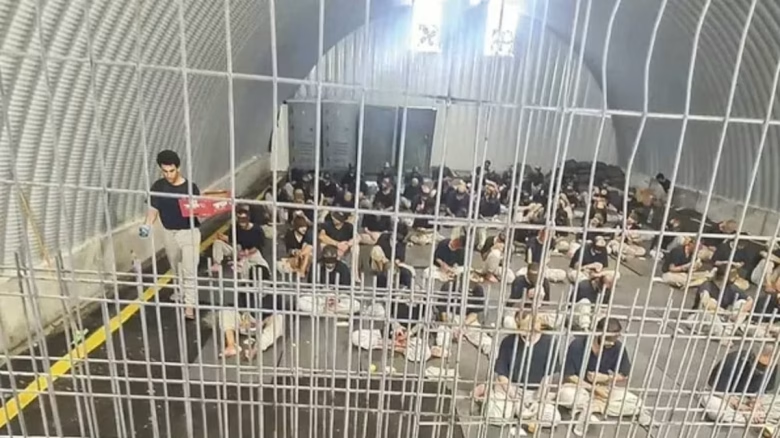
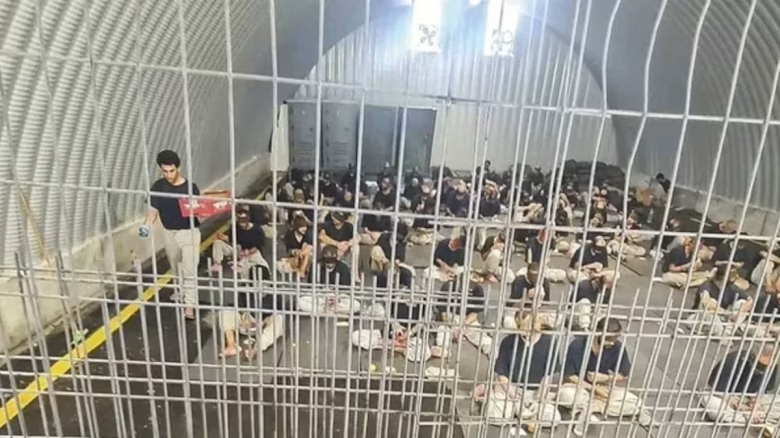
Palestinians held at the notorious Sde Teiman prison in the Negev Desert are seen shackled and blindfolded in this undated photo. Photo: whistleblower via Quds News Network

A Jewish-led organization dedicated to fighting antisemitism was among the groups and individuals who have condemned attacks on The New York Times and one of its most prominent columnists, who published accounts by alleged Palestinian victims of sexual abuse perpetrated by Israeli soldiers and settlers.

Nicholas Kristof’s May 11 column, “The Silence That Meets the Rape of Palestinians,” combines interviews with 14 former Palestinian detainees and information from reports published by United Nations experts and human rights groups to highlight documented rape and other systemic sexual abuse of Palestinians jailed by Israel Defense Forces (IDF) troops, as well as sexual assaults and other abuses allegedly committed by Israeli settler-colonists. The column features the controversial claim by one former prisoner that he was raped by a dog unleashed upon him by Israeli soldiers.

The Israeli Foreign Ministry responded to the column in a social media post alleging that the Times “chose to publish one of the worst blood libels ever to appear in the modern press.”

“In an unfathomable inversion of reality, and through an endless stream of baseless lies, propagandist Nicholas Kristof turns the victim into the accused,” the ministry said.

Responding to the ministry’s post, the Nexus Project – a group “made up of individuals deeply committed to the fight against antisemitism” – said on Bluesky: “To weaponize the term ‘blood libel’ to dismiss Kristof’s thorough reporting is dangerous. It’s insulting to the term’s violent history and hinders our community’s ability to call out actual blood libels when they occur.”

“Kristof’s article is a challenging and important read,” the group added. “It takes courage and care to expose sexual violence.”

On Tuesday, the Israeli Foreign Ministry accused the Times of serving “a Hamas-driven narrative,” claiming the newspaper “deliberately timed its piece to undermine today’s horrific Civil Commission report documenting Hamas’ preplanned, systematic sexual atrocities on October 7, [2023] and against hostages thereafter – attempting to create false equivalence and belittle documented crimes.”

The Times refuted a claim by the ministry that the newspaper “said it was not interested” in reporting on Hamas sexual violence on and after the October 7 attack. In fact, the Times updated its earlier reporting on Hamas sex crimes after Israeli investigator said critical details were “false.”

Critics of the column also cast aspersions upon the alleged Palestinian victims and rights groups that documented the sexual violence they suffered, linking them to Hamas. The Times and other US media have been accused of accepting Israeli claims at their word but treating Palestinian testimonies with skepticism or outright dismissal.

Numerous other pro-Israel accounts, including the American Jewish Committee and EndJewHatred, have either repeated the “blood libel” accusation against Kristof or amplified social media posts that did so.

Many – including the American Israel Public Affairs Committee – denied or questioned the veracity of Kristof, his sources and the Times.

This was the case despite the publication of numerous reports by United Nations experts, as well as Israeli and international human rights groups, of Israeli rape and sexual violence against Palestinian men, women, and children in both Gaza and the occupied West Bank.

Senior Israeli officials including Finance Minister Bezalel Smotrich and Security Minister Itamar Ben-Gvir have defended soldiers accused of gang-raping a Palestinian prisoner in an attack caught on camera at the notorious Sde Teiman prison. The IDF is investigating the deaths of dozens of Palestinians at Sde Teiman, including one man who died after allegedly being sodomized with an electric baton.

Right-wing Israeli politicians, pundits, and others publicly argued that IDF troops should have free rein to rape, torture, and murder Palestinians as revenge for the Hamas-led October 7, 2023 attack on Israel.

An August 2025 investigation by the Australian Broadcasting Corporation featured Palestinian boys kidnapped by Israeli occupation forces in Gaza who said they suffered or witnessed sexual torture committed by their jailers.

Last year, Israel blocked a request from UN sex crimes experts to probe alleged sexual violence perpetrated by Hamas fighters during the October 7, 2023, attack, reportedly to avoid attendant scrutiny of rapes and other abuses allegedly committed by Israeli forces against imprisoned Palestinians.

Other Israelis and their defenders expressed incredulity or proclaimed the impossibility of dogs being trained to rape people.

“My brain does not know how to process the fact that The New York Times – the paper I grew up worshiping and hoping to work for one day – published, on the front page, that Israelis are training dogs to rape Palestinian prisoners,” tech entrepreneur and anti-progressive commentator Michelle Tandler said Monday on X.

However, in addition to repeated Palestinian claims of such abuse, female Holocaust survivors have said they were assaulted by dogs specially trained by Nazi SS officer Klaus Barbie. Later, Ingrid Oderock, a Chilean raised in a Nazi colony in the South American country, became one of the most feared torturers during the dictatorship of Augusto Pinochet. Her specialty, as noted in the Academy Award-nominated animated short film Bestia, was training dogs to rape jailed female dissidents.

-Common Dreams

Brett Wilkins is a San Francisco-based journalist and author who contributes regularly to Common Dreams and Counterpunch. He is also a member of Collective 20, a new anti-war collective with Noam Chomsky, Medea Benjamin and others.

Israel begins illegal settlement construction atop historic Hebron municipality building in West Bank

0
israel-begins-illegal-settlement-construction-atop-historic-hebron-municipality-building-in-west-bank
Israel begins illegal settlement construction atop historic Hebron municipality building in West Bank

Israel began illegal settlement construction works atop the historic Hebron municipality building in the southern West Bank, municipal authorities said Thursday, Anadolu reports.

In a statement, the Hebron Municipality said Israeli authorities began to build on the roof of its old headquarters in the Ein Al-Askar area in the Old City.

It said the works aim to “impose a new status quo in violation of local and international laws,” describing the construction as part of “the ongoing settlement expansion policy targeting the city of Hebron, its holy sites and historic buildings.”

The municipality said the old municipal building has been closed for years under an Israeli military order and is considered one of the major historical and national landmarks in the Old City, which is listed as a UNESCO World Heritage site.

“Any alteration or assault on the building constitutes a clear violation of all international conventions and norms related to the protection of cultural and human heritage,” it warned.

The municipality called on local and international institutions, as well as rights and humanitarian organizations, to intervene immediately “to stop this assault and prevent attempts to impose a new reality targeting the historical and cultural identity of the Old City.”

It vowed to pursue the issue through all local and international legal channels to halt the violations and hold those responsible accountable.

Under the Hebron Protocol signed on Jan. 17, 1997, Hebron was divided into the H1 and H2 zones, with Israel retaining full control over the Old City and its surroundings, including the Ibrahimi Mosque area in H2.​​​​​​​

In 2017, Palestine succeeded in registering Hebron’s Old City and the Ibrahimi Mosque on the UNESCO World Heritage List and the List of World Heritage in Danger.

Texas Mural Honors Druze and Iranian Children Killed by Iran and Its Proxies

0
texas-mural-honors-druze-and-iranian-children-killed-by-iran-and-its-proxies
Texas Mural Honors Druze and Iranian Children Killed by Iran and Its Proxies


A large-scale mural honoring Druze and Iranian children killed by the Islamic regime of Iran and its regional proxies was unveiled Thursday in Webster, Texas, as Iranian-American artist Hooman Khalili sought to draw international attention to the victims ahead of the upcoming FIFA World Cup.

The installation, titled “WOMAN. LIFE. FREEDOM.,” was unveiled between 10:00 and 11:00 a.m. at 425 Henrietta in Webster, outside Houston.

Mural by Hooman Khalili featuring children murdered by the Iranian regime and Hezbollah. The mural was unveiled in Texas on May 14, 2026. (Courtesy)

The mural depicts children gathered on a soccer field and combines the stories of victims from Israel and Iran. At the center of the installation are the 12 Druze children killed on July 27, 2024, when a Hezbollah rocket struck a soccer field in Majdal Shams near Mount Hermon in northern Israel.

The artwork also honors Iranian children killed during unrest and crackdowns carried out by the Islamic regime since 2022, including Kian Pirfalak, Sarina Esmailzadeh, and Nika Shakarami.

Mural by Hooman Khalili featuring children murdered by the Iranian regime and Hezbollah.(Courtesy)

“This mural is ultimately about children,” Khalili said. “Different backgrounds, different countries, different languages—but the same stolen innocence. These children share a common enemy in the ideology and violence exported by the Islamic regime and its proxies.”

Khalili said the installation was timed to coincide with growing international attention on North America ahead of the FIFA World Cup, which will be hosted across the United States, Canada, and Mexico.

“The roots of this project are in Israel,” he said. “But my hope is that the tree blossoms in the United States. As the world gathers around soccer, I want the eyes of the world to also see the humanity of these children and the brutality that took their lives.”

The mural incorporates imagery associated with Druze and Persian identity, including references to Nabi Shu’ayb, also known as Jethro’s Tomb, Azadi Tower in Tehran, and the Lion and Sun emblem of Persia.

Artist Hooman Khalili meets with Naila Fakhr al-Din, the mother of Alma Fakhr al-Din, who was killed by a Hezbollah rocket in Majdal Shams. (Instagram)

Khalili recently traveled to Majdal Shams, where he met Naila Fakhr al-Din, the mother of Alma Fakhr al-Din, and Druze spiritual leader Sheikh Rafa Halabi. The installation also includes a tribute to Iranian footballer Zahra Azadpour, who was killed during unrest in Iran in January 2026.

Demi Moore’s Shockingly Thin Cannes Appearance Sparks Health Fears as Doctors Sound the Alarm

0
demi-moore’s-shockingly-thin-cannes-appearance-sparks-health-fears-as-doctors-sound-the-alarm
Demi Moore’s Shockingly Thin Cannes Appearance Sparks Health Fears as Doctors Sound the Alarm


Demi Moore’s ultra-thin appearance at the 2026 Cannes Film Festival is sparking serious concern, with health experts warning the Hollywood icon may be pushing her body to dangerous extremes.

The 63-year-old actress turned heads while serving on the prestigious Cannes jury — but instead of focusing on her glamorous red carpet looks, fans online couldn’t stop talking about how shockingly thin she appeared.

Now, medical experts are sounding the alarm over what they say could be the devastating physical toll of dramatic weight loss later in life.

One health expert claimed Moore appears to weigh somewhere between 95 and 105 pounds at 5-foot-5, describing her current frame as “significantly lighter than optimal” for a woman her age.

Experts say many people are mistaking Moore’s visible arm definition for fitness, when it could actually be a sign her body is running on empty.

“When the body is in a chronic caloric deficit, it becomes catabolic,” explained health coach and nutrition practitioner Tara Roscioli. “That means the body literally starts breaking down its own muscle for fuel.”

She added that what some fans are calling “toned” may actually be the result of extremely low body fat combined with intense exercise and restricted eating.

“That combination doesn’t create a strong body,” Roscioli warned. “It accelerates the breakdown of one.”

Plastic surgeon Dr. James Chao also raised concerns about Moore’s noticeably hollow facial features and frail frame.

“What worries many doctors isn’t just being skinny,” he explained. “It’s the sunken cheeks, visible collar bones, lack of soft tissue and minimal body fat at the age of 63.”

The doctor noted that dramatic weight loss can look even more severe as people age because the body naturally loses collagen, muscle mass and skin elasticity over time.

Hollywood’s growing obsession with rapid weight loss — fueled in part by Ozempic rumors surrounding celebrities — has only intensified the conversation.

While Moore has never confirmed using any weight loss drugs, speculation has swirled online for months.

Experts say medications like GLP-1 drugs can speed up fat loss, but if patients aren’t eating enough protein or strength training properly, the body can also lose critical muscle mass.

“The lower you go in weight after 60, the more it shows,” Dr. Chao explained. “You lose volume in the face, skin support decreases, and the body can begin looking frail very quickly.”

Moore has openly admitted she pushed her body to extremes during the height of her career.

In a 2024 interview, the Ghost actress revealed that after giving birth to daughter Scout Willis while filming 1993’s Indecent Proposal, she biked an astonishing 60 miles a day with a trainer.

Looking back, Moore admitted the pressure she placed on herself was “crazy” and “ridiculous.”

“I was really just punishing myself,” she later confessed in 2025, reflecting on her years of harsh dieting and intense workouts.

The actress said she now tries to have a more “relaxed” and “trusting” relationship with her body — but her latest Cannes appearance has many fans fearing the damage may already be showing.

Over a year later, AMD is bringing improved FSR 4 upscaling to its older GPUs

0
over-a-year-later,-amd-is-bringing-improved-fsr-4-upscaling-to-its-older-gpus
Over a year later, AMD is bringing improved FSR 4 upscaling to its older GPUs

When AMD announced version 4 of its FidelityFX Super Resolution (FSR) graphics upscaling technology early last year, it came with strings attached: The improved hardware-backed image quality would be available only on Radeon RX 9000-series GPUs based on the RDNA4 architecture, not on any older Radeon GPUs.

To date, AMD has released only a handful of 90-series graphics cards, including the RX 9070 XT, the RX 9070, the 8GB and 16GB versions of the RX 9060 XT, and an RX 9060 that’s only available to PC companies rather than end users. That list notably doesn’t include any integrated GPUs, such as those found in AMD-powered thin-and-light laptops or gaming handhelds like the Steam Deck and its imitators.

Over a year later, AMD Computing and Graphics SVP Jack Huynh has announced that a version of FSR 4 is finally coming to older GPUs. The rollout will begin in July with RDNA3- and 3.5-based GPUs, which include the Radeon RX 7000 series, as well as integrated GPUs like the Radeon 890M and Radeon 8060S.

In “early 2027,” support will also be extended to the RDNA2 architecture, which includes the Radeon RX 6000 series, integrated GPUs like the Radeon 680M, and the Steam Deck’s GPU. This would also open the door to supporting FSR 4 on the PlayStation 5 and Xbox Series X and S, all of which also use RDNA2-based GPUs.

Performance may take a hit

Getting hardware-backed FSR running on older Radeon GPUs meant making it work with the INT8 hardware in those chips, rather than the FP8 data format that RDNA4 supports.

Getting hardware-backed FSR running on older Radeon GPUs meant making it work with the INT8 hardware in those chips, rather than the FP8 data format that RDNA4 supports. Credit: AMD

Huynh’s short video presentation didn’t get into performance comparisons, but did mention that AMD had to work to get FSR 4’s superior hardware-backed upscaling working on its older graphics architectures. RDNA4 includes AI accelerators that support the FP8 data format in the hardware, and porting FSR 4 to older GPUs meant getting it running on the integer-based INT8 hardware in the RDNA3 and RDNA2-based GPUs.

This may mean that FSR 4.1 running on an RDNA3 or RDNA2-based GPU may come with a larger performance hit relative to RDNA4 cards, or that image quality may differ slightly. Modders have already worked to get FSR4 working on INT8-supporting GPUs, and the older GPUs reportedly see a 10 to 20 percent performance hit relative to FSR 3.1 running on the same hardware. AMD’s official implementation may or may not improve on these numbers.

Regardless, it’s nice to see AMD doing work to support owners of older GPUs, especially since it continues to sell many products that use the older RDNA3 and RDNA2 architectures. Some of the company’s recent driver releases have implied that the company was doing less work to support older graphics architectures; the FSR 4.1 announcement should put some of those fears to rest, even though it’s coming later than some owners of those older GPUs might have preferred.

Any games that support FSR 4 should be able to support FSR 4.1 running on Radeon 7000-series cards; users will presumably be able to install a driver update in July that enables the new feature. Games that support the older FSR 3.1 can also be forced to use FSR 4 in the Radeon graphics driver.

AMD’s FSR competes primarily with Nvidia’s Deep Learning Super Sampling (DLSS) upscaling technology, which tends to be more widely supported in games and deliver better results (partly because it has always been hardware-accelerated, something FSR only started doing in version 4). Part of the appeal of previous FSR versions is that they worked on pretty much any reasonably modern GPU hardware, including Intel’s integrated graphics and old GeForce GPUs that didn’t support DLSS. FSR 4.1 still won’t be as widely compatible as older versions were, even with the expanded hardware support.

0FansLike
0FollowersFollow
0FollowersFollow
0SubscribersSubscribe
- Advertisement -
Google search engine

Recent Posts