7.4 C
London
Friday, May 15, 2026
Home Blog

“It’s Overwhelming But It’s Amazing” — Richard Glossip Released From Jail After Three Decades

0
“it’s-overwhelming-but-it’s-amazing”-—-richard-glossip-released-from-jail-after-three-decades
“It’s Overwhelming But It’s Amazing” — Richard Glossip Released From Jail After Three Decades


Three decades after he was arrested for a capital crime he swore he didn’t commit — and more than a year after the U.S. Supreme Court overturned his conviction — former death row prisoner Richard Glossip was granted bond by an Oklahoma judge and released from jail.

In an order handed down on Thursday, Oklahoma County District Judge Natalie Mai set Glossip’s bond at $500,000. She ordered him to live with his wife, wear an electronic monitoring device, and abide by a curfew from 10 p.m. to 7 a.m., and forbade him from traveling outside the state.

Shortly after 5 p.m., Glossip, 63, walked out of the Oklahoma County Jail accompanied by his wife Lea and members of his legal team, who expressed gratitude to everyone who has supported him. “It’s overwhelming but it’s amazing at the same time,” Glossip said.

“We are extremely grateful that Judge Natalie Mai has granted Richard Glossip a bond,” Glossip’s longtime attorney Don Knight wrote in a statement. “In doing so, she rejected the State’s claim that there is a strong case for guilt. For the first time in 29 years of being incarcerated for a crime he did not commit, during which he faced 9 execution dates and ate 3 last meals, Mr. Glossip now has the chance to taste freedom while his defense team continues to pursue justice on his behalf.”

Mai’s decision comes more than a year after the U.S. Supreme Court overturned Glossip’s conviction and death sentence based on false testimony and prosecutorial misconduct. The momentous victory before the high court seemed certain to mark the end of Glossip’s decadeslong ordeal.

But in June 2025, Oklahoma Attorney General Gentner Drummond, who is running for governor, announced that he would retry Glossip for first-degree murder, opening a new chapter in the protracted legal saga. Glossip has remained in jail ever since.

His next court appearance is scheduled for June 23.

Glossip was twice convicted and sentenced to death for the murder of his boss, motel owner Barry Van Treese, who was brutally killed at the Best Budget Inn on the outskirts of Oklahoma City in January 1997. A 19-year-old handyman named Justin Sneed admitted to fatally beating Van Treese with a baseball bat but insisted that Glossip bullied him into doing it. Sneed’s account became the basis for the state’s case against Glossip — and for a plea deal that allowed Sneed to avoid the death penalty. Sneed is serving a life sentence.

Prosecutors told jurors at Glossip’s 1998 trial that he’d taken advantage of the younger, more vulnerable Sneed, offering him money to kill their boss so that Glossip could take over the motel. “Glossip encouraged, aided and abetted and sent Mr. Sneed off to do his dirty work,” they said.

But this story began falling apart not long after Glossip arrived on death row. A video of Sneed’s police interrogation cast serious doubt on the state’s version of events, revealing coercive questioning by Oklahoma City detectives who pressured Sneed into implicating Glossip. 

Glossip’s conviction was overturned twice. In 2001, the Oklahoma Court of Criminal Appeals ruled that Glossip’s lawyers had been ineffective for failing to present the interrogation video to jurors. But in 2004, a second jury convicted Glossip and resentenced him to death. More than 20 years later, in February 2025, the U.S. Supreme Court again vacated Glossip’s conviction, finding that Sneed had lied on the stand during Glossip’s retrial — and that prosecutors had failed to correct Sneed’s testimony. This misconduct, combined with “additional conduct by the prosecutor further undermines confidence in the verdict,” the justices wrote.

Glossip came close to execution numerous times, as Oklahoma authorities aggressively defended their conviction despite mounting evidence pointing to his innocence. Drummond, who came into office in 2023, broke with his predecessors and took unprecedented steps to block Glossip’s execution — only to announce months after Glossip’s Supreme Court victory that he would retry Glossip for first-degree murder. 

The state has since fought to keep Glossip locked up at the Oklahoma County Jail. At a bond hearing last summer, prosecutors insisted to Oklahoma County Judge Heather Coyle that Glossip is guilty and poses a danger to the community. Coyle ruled in their favor but later stepped down from the case after Glossip’s lawyers discovered that she was close friends with the lead prosecutor at Glossip’s second trial. Five more judges subsequently stepped down from the case due to their own ties to the Oklahoma County District Attorney’s Office.

Mai’s order granting bond came on the heels of a setback for Glossip’s legal team, who had hoped to resolve the case once and for all. In April, following a daylong hearing in Oklahoma City, Mai declined to enforce a previous agreement between Drummond and Knight that would have allowed Glossip to walk free. After hearing testimony on the matter from Knight and from the Oklahoma solicitor general, Mai sided with the state, ruling from the bench that “the matter should go on for trial.”

In a subsequent motion, Glossip’s lawyers argued that, while Mai may have concluded that the agreement was not enforceable for the purpose of resolving the case, it was still grounds to release Glossip from jail.

“Regardless of the parties’ differing views,” they wrote, “it remains significant that … the Attorney General believed that an appropriate resolution of this case should result in Mr. Glossip’s release from custody. The State’s chief law enforcement officer did not see Mr. Glossip as a dangerous individual who should remain incarcerated, or one against whom the State had proof beyond a reasonable doubt that he was guilty of murder.” 

In a reply brief, Jimmy Harmon, the chief of the criminal justice division of the AG’s office, wrote that in making her decision Mai should not consider anything Drummond has said about the case.

Mai apparently disagreed. In her order, Mai quoted a letter Drummond wrote to the parole board in 2023, expressing his view that the record didn’t support a first-degree murder conviction.

“The Court fully expects that the State will rigorously prosecute its case going forward and the defense will provide robust and effective presentation for Glossip,” Mai wrote. “The Court hopes that a new trial, free of error, will provide all interested parties, and the citizens of Oklahoma, the closure they deserve.”

“After everything we’ve been through together over the years, knowing that my husband is finally coming home is a feeling I can’t even begin to describe.”

At Glossip’s most recent bond hearing in February, Harmon alerted the judge that she should not expect anything new from the state at Glossip’s third trial. “The evidence presented will be essentially the same as was presented in the first two trials,” he said. 

This evidence, which was never strong to begin with, has been diminished and discredited in the decades since Glossip was first sent to death row. While Knight has spent more than a decade uncovering new evidence debunking the state’s case, the state is evidently prepared to once again rely on Sneed, whose credibility has been fatally undermined. “Besides Sneed, no other witness and no physical evidence established that Glossip orchestrated Van Treese’s murder,” Supreme Court Justice Sonia Sotomayor wrote last year. 

As Mai prepares to preside over a trial based on the same discredited evidence, Glossip, who is now 63, is set to rejoin the free world for the first time in nearly 30 years. “After everything we’ve been through together over the years, knowing that my husband is finally coming home is a feeling I can’t even begin to describe,” his wife Lea said.

Meanwhile, Glossip’s legal team is gearing up for trial “against a system that the United States Supreme Court has found to be guilty of serious misconduct by state prosecutors,” Knight said. “Mr. Glossip is deeply grateful to the many thousands of people who have expressed support for him over the years and now looks forward to the day when he is exonerated and truly free from this decades-long nightmare.”

Update: May 14, 2026, 7:08 p.m. ET

This article has been updated to include new details after Glossip’s release from jail.

How Trump plans to keep pushing his tariffs despite court losses

0
how-trump-plans-to-keep-pushing-his-tariffs-despite-court-losses
How Trump plans to keep pushing his tariffs despite court losses

President Donald Trump just can’t quit tariffs.

He suffered a major defeat when the Supreme Court ruled in February 2026 against the sweeping emergency tariffs he’d announced the previous year. Then, on May 7, a federal court knocked down the interim tariffs he’d announced after the high court’s decision.

Yet Trump appears undeterred and keeps finding a plan B – and then C and D.

“So, we always do it a different way,” the president told reporters after the May 7 decision. “We get one ruling, and we do it a different way.”

That different way, currently, is using an authority called Section 301. This option is likely to invite more litigation, but it may prove to be more powerful and durable than previous levies. To that end, the administration has opened two probes, paving the way for fresh tariffs later this year against China and other major trading partners.

Why does this matter? US trade policy may seem like a complicated mess of acronyms and legalese. But, as a trade economist who has been following the tariff wars, I believe Trump’s strategy of making aggressive global tariffs the centerpiece of his foreign economic policy is quite clear – even as his trade policy overall remains deeply unpopular.

And if he succeeds, the average levy may jump to the highs of the “Liberation Day” tariffs of April 2025, before some were scaled back in subsequent – if incomplete – deals with trading partners.

A tariff obsession

At first glance, Trump’s fixation with tariffs may seem surprising.

They have failed to stimulate US manufacturing and employment, while consumers and importers have absorbed the brunt of the price hikes. To Trump, though, what seems to matter is that the Supreme Court took away his tariff-making power when it ended his emergency tariffs. He now wants that power back.

Indeed, that power was the appeal of the Liberation Day tariffs, which let Trump set tariff rates at any level and for any length of time, with the flexibility to assign different tariffs to different countries. With such tools, he could threaten more punishing levies to enforce bilateral trade deals.

In addition, he saw the revenue that those tariffs brought in as a source of power and has resented the Supreme Court order that they be refunded to the US companies that paid them. Trump is even angry at any companies that have decided to collect the tariff refunds.

But Trump is especially furious at his Supreme Court appointees Amy Coney Barrett and Neil Gorsuch, whose votes swung the February decision. He continues to excoriate them. He declared he was “ashamed” of all the justices who voted to strike the tariffs, characterizing them as “fools” and “lapdogs” who didn’t have “the courage to do what’s right for our country.” Trump also said the court’s decision would inadvertently push him to “impose tariffs more powerful … rather than less.”

In short, Trump is moving from his Liberation Day tariffs to what I call “revenge tariffs” – in an attempt to show the high court that it cannot stop him.

Planning the next battle

Section 301 of the 1971 US Trade Act is designed to remedy foreign countries’ trade practices deemed discriminatory, unfair, unreasonable or burdensome to US commerce. It sets no limit on the tariff amount; lets the president discriminate among targeted countries; and generates tariff revenue without violating the Constitution’s taxation clause, a major element in the Supreme Court’s February decision.

Another potential advantage: Federal courts have typically given the president discretion in determining the purpose, scope and remedies chosen to implement Section 301.

The main reason why Trump didn’t use Section 301 last year for his Liberation Day tariffs – opting instead for another law, the International Economic Emergency Powers Act – was because he thought the latter would grant that kind of unlimited tariff authority but without any extra procedural requirements. To a certain point, that proved correct – until his Supreme Court loss.

As for next steps, the Trump administration has proposed two Section 301 investigations. One is against alleged “excess industrial capacity” among several countries – shorthand for overproduction through government intervention – and the other against alleged failures to enforce bans on trade using forced labor.

To Trump, the appeal is that these probes have a vast scope. And he has already indicated that he seeks to use any tariffs stemming from the probes as leverage: If a country that has inked a trade deal considers abandoning the agreement, for example, Trump has warned that he could threaten Section 301 tariffs later.

“Any Country that wants to ‘play games’ with the ridiculous supreme court decision, especially those that have ‘Ripped Off’ the U.S.A. for years, and even decades, will be met with a much higher Tariff, and worse, than that which they just recently agreed to. BUYER BEWARE!!!” Trump wrote on his social platform, Truth Social, in February.

Using Section 301, in short, would be akin to declaring that every US trading partner in some way damages the US and will be targeted with punitive tariffs. This action would be unprecedented – and likely face legal challenges. These would first go to the Court of International Trade, which also nixed the interim tariffs, and appeals would go to the US Court of Appeals for the Federal Circuit. The final instance of appeal would be the Supreme Court.

Fair and balanced?

International trade law has established mechanisms for trading partners to crack down on forced labor or address industrial capacity through policy changes or negotiations. In such a scenario, tariffs would provide the means, not the ends, to address these more substantive policy disputes.

So far, though, Trump seems to have another goal: correcting the “unfair trade imbalances” that he also cited for the Liberation Day tariffs. One government Section 301 petition claims that foreign excess capacity is letting countries rack up “persistent” trade surpluses. Another claims that trade in forced-labor goods harms the US trade balance by increasing US imports of underpriced products and decreasing US exports by forcing them to compete with cheap competition.

If these petitions succeed, Trump could then impose the Section 301 tariffs individually, country by country, as part of his global trade balancing goal. Trump also wants to seize back the revenue that his tariffs generated.

The catch is that Section 301 requires cases to be based on actionable practices, not trade balance outcomes. Moreover, the 2025 tariffs didn’t even accomplish any balancing: The US deficit in goods actually increased that year. So using Section 301 is just as unlikely to improve the US trade balance, which is determined by macroeconomic factors, not foreign excess capacity or imports of goods made with forced labor.

A question of deference

Will there be any guardrails on Trump’s plan to introduce the new tariffs in July 2026, as he has indicated? This will depend in part on whether courts in these cases continue the traditional deference granted dudring the pre-Trump era to the president.

Trump is counting on this, but it’s not a slam dunk. Many experts question whether overcapacity is a trade violation. And on the forced labor issue, the US National Trade Estimate Report added potential offenders besides China only in March 2026 – an announcement well timed in anticipation of the current Section 301 case. The forced labor case may in fact be intended to compel US trading partners to abandon supply chains that include Chinese goods.

But as it happens, the European Union and other countries are more effective than the US in prohibiting forced-labor imports and therefore shouldn’t be targeted. Trade experts also point out that the US itself produces forced-labor goods in private prisons and has often failed to stop forced-labor imports. It’s just as guilty as many other countries of not enforcing its ban on such trade, these legal scholars argue.

Still, courts have traditionally given latitude to the president on Section 301. It lets the White House pursue trade liberalization while respecting the norms of global trade rules that the US championed at the time.

Trump has, in contrast, made a practice of undermining those rules and can be expected to stretch Section 301 as far as possible. Indeed, his rhetoric seems to suggest that the Section 301 cases were chosen primarily to establish a permanent tariff regime by providing all-purpose bargaining leverage, not correcting damaging foreign trade practices.

For these reasons, it’s likely that Trump will face legal challenges – as well as a potential impact on his party at the midterm ballot box – as he tries to test the limits of US trade law.

Kent Jones is a professor emeritus of economics, Babson College.

This article is republished from The Conversation under a Creative Commons license. Read the original article.

Energy supplier abandons Lake Tahoe residents to serve data centers

0
energy-supplier-abandons-lake-tahoe-residents-to-serve-data-centers
Energy supplier abandons Lake Tahoe residents to serve data centers

The tourist and ski resort town of Lake Tahoe must scramble to find a new energy supplier by May 2027—the result of a Nevada utility company saying it needs the power capacity in part for new data centers. The resulting energy crisis impacts 49,000 California residents who live near Lake Tahoe, nestled in the Sierra Nevada mountains on the border between California and Nevada.

Lake Tahoe’s local electricity provider, California-based Liberty Utilities, has been obtaining 75 percent of its power from the Nevada-based company NV Energy. But the latter has said it will stop providing power to the Lake Tahoe region by May 2027, according to extensive reporting by Fortune.

Nevada’s fast-growing data center development is one of the main reasons given by NV Energy for ending its energy supply agreement with Liberty, according to a Liberty filing with California regulators. Fortune highlighted data from NV Energy’s own planning documents showing that a dozen data center projects in northern Nevada could drive 5,900 megawatts of new demand by 2033.

Such data center demand has also spurred NV Energy to sign contracts with tech companies to secure additional power-generation sources. Amazon recently agreed to support the Nevada utility company’s deployment of 700 megawatts of “low-carbon energy” for Reno data center operations, including 100 megawatts of geothermal energy, according to Data Center Dynamics.

However, NV Energy representatives pushed back on the idea that data centers are the main culprit behind the decision to stop supplying energy to the Lake Tahoe community, telling Fortune that it was part of a long-term transition predating the AI boom. After NV Energy initially sold its California assets to Liberty in 2009, it struck a series of temporary agreements to keep providing power to Lake Tahoe until Liberty could secure another energy supplier.

Now, for whatever reason, NV Energy has decided it cannot keep extending such agreements. That leaves Liberty scrambling to find a new energy supplier as it plans to offer a replacement contract for any bidders capable of meeting California’s renewable energy requirements.

Seeking solutions

The situation is further complicated by the fact that “no single regulator oversees the entire chain from power generation to customer bills,” according to Fortune. California residents of Lake Tahoe pay rates approved by California state regulators, but the Liberty grid that services them sits under NV Energy’s authority and is fully reliant on Nevada power transmission lines.

NV Energy is constructing a new $4.2 billion transmission line, called Greenlink West, that could help Liberty access a wider pool of energy suppliers. But as Fortune points out, the transmission project is scheduled to become operational by May 2027, which would be cutting it close for Liberty and Lake Tahoe’s needs.

Lake Tahoe’s woes may currently be an outlier, but many other US communities are grappling with energy supply issues and other associated costs of data center development—a Gallup poll from March 2026 found that seven in 10 Americans opposed AI data centers in their communities.

Public opposition to data centers has coalesced into “the most bipartisan issue since beer,” according to a Milwaukee-based comedian quoted in The New York Times. Nearly half of data center projects are facing delays and data center moratoriums, with industry executives citing issues such as labor shortages and power constraints as key factors.

Silicon Valley is well aware that its AI data center buildout has a popularity problem on top of the energy supply bottleneck and other construction complications. That may explain the turn to unusual schemes such as offering homeowners the chance to host mini data centers, along with more quixotic proposals such as launching orbital data centers into space and floating AI data centers in the middle of the ocean.

Microsoft eyeing startup deals for life after OpenAI

0
microsoft-eyeing-startup-deals-for-life-after-openai
Microsoft eyeing startup deals for life after OpenAI


Microsoft is shopping ​for artificial-intelligence startups as the software company prepares for a future independent of its once-vital partner OpenAI, five people familiar with the matter said.

The ‌potential acquisitions could help the company stock up on AI talent and deliver on its stated goal of building a cutting-edge AI model by next year, three of the people said.

This spring, Microsoft weighed acquiring code-generation startup Cursor, four people said. But Microsoft backed away due to internal concerns that such a deal would not pass regulatory scrutiny, given Microsoft’s ownership of GitHub Copilot, three of the people said.

Microsoft ​is in discussions with Inception, a small startup built by a Stanford University team focused on a different method of developing large language models, three people ​familiar with the matter said. Inception was founded in mid-2024. Microsoft’s venture fund M12 invested in Inception’s $50 million seed round in late ⁠2025.

The discussions are ongoing and may not result in a deal, these sources said.

Inception declined to comment.

HEATED MARKET

Microsoft is eyeing deals in an increasingly heated market. AI researchers ​can easily command tens of millions of dollars or more in compensation. Startup valuations are soaring as investors scramble for positions in promising AI technology.

Microsoft is also facing significant competition ​for deals from other tech giants, notably Elon Musk’s SpaceX, two people familiar with the matter said. SpaceX, which bought Musk’s AI research startup xAI in February, announced a deal with Cursor shortly after Microsoft walked away.

Cursor declined to comment.

SpaceX also courted Inception, three people said. Inception recently hired a bank to help negotiate a deal, a person familiar with the startup said, adding that Inception is looking ​for a price of over $1 billion.

SpaceX did not immediately respond to a request for comment.

10 TRILLION PARAMETERS

Catching up to OpenAI and other labs at the frontier is a tall ​order. Some of the most advanced AI labs are building models of around 10 trillion parameters, a measurement of their sophistication, researchers say. That is up from about 1 trillion parameters three ‌years ago.

Inception’s ⁠models produce text using a technique called diffusion, more commonly used to generate AI images and videos. While standard models generate one token at a time, diffusion generates and refines multiple tokens simultaneously. This method can significantly boost the model’s speed.

But diffusion can be unpredictable and it is unclear if it can be used to produce mammoth-sized models, AI researchers say.

Any deals would add to the work under way at Microsoft, including teams led by DeepMind co-founder Mustafa Suleyman, a person familiar with the strategy said.

Microsoft and OpenAI have ​been partners since 2019, when Microsoft invested $1 billion ​into the then-unknown research lab. OpenAI’s ⁠release of ChatGPT in late 2022 anointed Microsoft as an AI pioneer while also powering growth for Microsoft’s Azure cloud-computing business. Microsoft has given $11.8 billion of its promised $13 billion to OpenAI, Microsoft said in an April 29 securities filing,

Microsoft has spent more than $100 billion on ​its OpenAI investments and its costs of building infrastructure and hosting, Michael Wetter, who runs the company’s corporate development, testified in court ​on Wednesday.

The initial deal ⁠gave Microsoft exclusive access to OpenAI’s technology and gave OpenAI a guaranteed source of computing resources to pursue research. But tensions flared between OpenAI and Microsoft over the years as both sides chafed over the contract’s restrictions.

OpenAI found that its needs outstripped what Microsoft could supply. Microsoft was also contractually barred from building a foundation model that could compete with OpenAI’s offerings, ⁠two of the ​people said. The two companies have loosened their contract several times over the years.

An amended deal in ​late 2025 allowed Microsoft to build artificial general intelligence, a still-theoretical advanced form of AI that can do complex tasks better than a human. In late April, OpenAI and Microsoft struck a deal that gives OpenAI the ​freedom to build some products with Microsoft’s rivals, such as Amazon.

Source:  Reuters

US DOJ said dropping fraud charges after Adani hired Trump lawyer

0
us-doj-said-dropping-fraud-charges-after-adani-hired-trump-lawyer
US DOJ said dropping fraud charges after Adani hired Trump lawyer

Donald Trump and Gautam Adani. Image: India Today

The US Department of Justice is reportedly preparing to drop charges against Indian billionaire Gautam Adani shortly after he hired one of President Donald Trump’s personal lawyers to represent him.

The New York Times reported on Thursday that the DOJ – now headed by former Trump attorney Todd Blanche – is working on ending its case against Adani, who was indicted in November 2024 along with two colleagues for alleged conspiracies to commit securities and wire fraud, among other charges.

The Times noted that the DOJ’s reversal came after Adani hired a legal team headed by attorney Robert Giuffra Jr., who is currently leading efforts to overturn Trump’s 34 felony convictions for falsifying business records.

According to the Times, Giuffra’s work for Adani “culminated in a previously unreported meeting last month at the Justice Department’s headquarters in Washington” that included an offer that “if prosecutors dropped the charges, Mr. Adani would be willing to invest $10 billion in the American economy and create 15,000 jobs.”

Bloomberg reported on Thursday that the DOJ could announce it’s dropping charges against Adani “as soon as this week,” and added that the Securities and Exchange Commission “is also moving to settle a parallel civil fraud case it brought against Adani and others in November 2024.”

The DOJ alleged that Adani, whom Forbes estimates is worth at least $82 billion, “orchestrated an elaborate scheme to bribe Indian government officials to secure contracts worth billions of dollars,” and then subsequently lied about the scheme to secure funding from US investors.

Given Trump’s past pardons of white-collar criminals – including a cryptocurrency magnate who helped boost the value of the president’s personal meme coin – some observers were quick to label the DOJ’s move to drop charges against Adani an act of corruption.

University of Arkansas economist Jeremy Horpedahl commented that the Adani case shows that “the way to avoid fraud charges under the Trump administration is to hire Trump’s personal lawyer and engage in bribery.”

Manish Sharma, leader of the Indian Youth Congress, suggested in an X (Twitter) post that did not cite detailed evidence, that Indian Prime Minister Narendra Modi was also involved in the effort to get charges dropped for Adani, a longtime political ally.

“Perfect timing, just months after Modi signed that one-sided trade deal with Trump,” wrote Sharma. “Quid pro quo delivered: Compromised PM sells out Indian interests, Trump admin returns the favor to Modi’s favorite billionaire.”

Elie Mystal, justice correspondent for The Nation, criticized the New York Times for describing the quid pro quo proposed by Giuffra on behalf of his client as an “unusual offer.”

“’UNUSUAL OFFER??’ No, headline writers,” wrote Mystal, who then suggested a more accurate headline: “Charges Dropped Against Indian Billionaire Accused of Bribery, After Offering Trump A Bribe.”

-Common Dreams

Fired hacker twins forget to end Teams recording, capture own crimes

0
fired-hacker-twins-forget-to-end-teams-recording,-capture-own-crimes
Fired hacker twins forget to end Teams recording, capture own crimes

Perhaps you remember Muneeb and Sohaib Akhter, the 34-year-old twin brothers we profiled earlier this week. Although they had the tech chops to commit years of petty crimes (like stealing airline miles), what landed them in truly serious trouble was deleting 96 US government databases in the hour after both were fired last year by the same federal IT contractor, Opexus. (Opexus had just found out that both brothers had previously been in prison for cyberfraud.)

The pair come off less as cybercriminal masterminds than as galumphing galoots—that is to say, a pair of bumbling oafs who thought that asking AI how to cover their tracks was going to keep them out of federal prison.

One of the minor mysteries I encountered while writing the piece was that the government had a verbatim transcript of everything the brothers said to each other during their hour-long deletion spree. The two men lived together in Arlington, Virginia, so it made sense that they might be chatting in the same room rather than by text or instant message. But how the heck had the government gotten access to the audio? Supersecret software bugging? Crazy corporate spyware running on their company laptops? FBI agent in the bushes with a microphone?

I couldn’t figure it out, and the answer didn’t appear in any of the court documents I read. But a helpful source today pointed me to the answer. It is contained within a court filing that bears the unpropitious name, “UNITED STATES’ RESPONSE IN OPPOSITION TO DEFENDANT’S MOTION TO REVOKE THE DETENTION ORDER.”

This is the kind of title that practically begs you not to read its contents. Yet the file turns out to be fascinating. And it reveals that our galumphing galoots were supersecretly recorded by… themselves.

On accident.

Because they forgot to stop recording the Teams meeting in which they were fired.

You can’t make this stuff up, folks.

Here’s how prosecutors put it:

On February 18, 2025, two human resources (HR) employees of Company-1 [Opexus] scheduled a Microsoft Teams meeting with Sohaib and Muneeb. Sohaib recorded the meeting starting at 4:48pm Eastern Standard Time. The HR personnel left the meeting approximately 2 minutes and 40 seconds into the recording. Apparently unbeknownst to the defendants, the meeting continued recording the next hour of interactions between the brothers.

And what did the pair discuss? Fortunately, this obscure document gives us a much fuller picture. If you’ve ever wondered what it sounds like to be in the room while cybercriminals do their thing, it sounds something like this:

SOHAIB: “Still connected? Still on the VPN?”

SOHAIB: “Delete all their databases?”

MUNEEB: “Eh, they can recover them…backups, I’m pretty sure.”

SOHAIB: “Daily backups?”

MUNEEB: “Yup.”

SOHAIB: “What’s the plan [then]? We gonna take care of severance or are we gonna do something about…” “Should we retort to whatever they send us by saying we need $25,000 each? Hm?”

MUNEEB: “We are doing petty shit now.”

MUNEEB: “I’m going to wipe my computer clean.”

SOHAIB: “I can’t access the system but I still have the email address for their customers for eCase and FOIAXpress.”

MUNEEB and SOHAIB discuss being compensated by Company-1.

MUNEEB: “I’m not gonna threaten them shit, that’s like could be shown as some sort of . . .”

SOHAIB: “It depends on how you write it. Just say, ‘according to our previous agreement, this is the tally of the amount that I’ve been [paid], if you pay it up front, then I have no reason to communicate with customers.’”

MUNEEB: “I’m good.”

SOHAIB: “Whatcha working on man?”

MUNEEB: “Nothing important, man.”

SOHAIB: “Why won’t you tell me? I ain’t gonna snitch.”

MUNEEB: “Don’t need to. Don’t worry about it.”

MUNEEB: “People are logged out for the day, this is the perfect time.”

SOHAIB: “How do you still have access? When did you connect to their VPN?”

MUNEEB: “10 minutes before their stupid meeting.”

SOHAIB: “You might still have access to it until the end of the day. Until at least 6 hours.”

MUNEEB: “Don’t worry about it man. Don’t worry about it.”

SOHAIB: “I see you are cleaning out their database backups.”

MUNEEB: “Don’t worry about it. You don’t do nothing. Don’t try nothin’. They are looking at you, they are not looking at me.”

SOHAIB: “[G]oing to RDP into their systems and delete all their data.”

[inaudible]

SOHAIB: “The ramifications for that would be worse though.”

MUNEEB: “What are you talking about? I didn’t do nothing. They closed my access when they had that meeting.”

SOHAIB: “Alright, if you have good plausible deniability.”

SOHAIB and MUNEEB then have additional discussion about deleting backups and changing DNS information.

MUNEEB: “Eh, they can recover from yesterday. [The IT manager] will have some work to do.”

MUNEEB and SOHAIB discuss Company-1 customers, including Veteran’s Affairs OIG, Education Department OIG, DHS OIG, and customer data.

MUNEEB: “DHS was a big [customer].”

SOHAIB: “Just go into each of them and start the delete process. It will take its time. . . It will eventually delete all their files.”

MUNEEB: “Sabes, don’t say nothin’, OK, don’t worry about it.”

SOHAIB: “I ain’t sayin’ shit.”

SOHAIB: “You should have thought about it prior, man.”

MUNEEB: “What do you mean? Like had a kill script, what do you mean?”

SOHAIB: “Blackmailing them in for some money would’ve been…”

MUNEEB: “No, you do not do that. That’s proof of guilt, man.”

SOHAIB: “No but the thing was you always have your opinion, I could just communicate with their customers.”

MUNEEB: “Communicate with their customers is a different thing!”

SOHAIB: “So you’re saying these are two separate things?”

MUNEEB: “There ya go. Go say that man, go argue for that, then they’ll think you’re the one behind this shit.”

SOHAIB: “. . . They’re gonna probably raid this place.”

MUNEEB: “Eh, I’ll clean this shit up. I don’t got shit.”

SOHAIB: “We also gotta clean stuff up from the other house man.”

MUNEEB: “Get rid of that shit.”

SOHAIB: “Deleting their filesystems would be a harder fix.”

MUNEEB: “Mhhmm, especially if you clear it out.”

MUNEEB: “Everything that I did, I’m making sure it’s protected. That it’s clean.”

MUNEEB: “Don’t worry, we’ll go to Texas.”

Neither brother is currently in Texas; both are in federal prison. Sohaib was found guilty at trial last week, while Muneeb pleaded guilty in April 2026—but has been furiously trying to take back his plea ever since through a series of handwritten letters to the judge.

How severe has the economic impact of the Iran war been for the Gulf states?

0
how-severe-has-the-economic-impact-of-the-iran-war-been-for-the-gulf-states?
How severe has the economic impact of the Iran war been for the Gulf states?

The US and Israel’s war on Iran has cast a long shadow over the Gulf. It has placed many of the economies that make up the Gulf Cooperation Council (GCC) regional grouping – Bahrain, Kuwait, Oman, Qatar, the United Arab Emirates (UAE) and Saudi Arabia – under substantial strain.

Since the war began in February, the World Bank has downgraded its 2026 GDP growth forecast for the region from 4.4% to just 1.3%. Some thinktanks, including Oxford Economics, even predict that some GCC economies will enter recession in the second half of the year.

However, the effects of the war have differed across the region. While the Gulf states are often viewed as a unified economic bloc bound by a shared dependence on hydrocarbons, the conflict has revealed significant differences in their economic vulnerability and resilience.

Countries like Qatar and Kuwait have seen their oil and gas exports seriously disrupted by the effective closure of the Strait of Hormuz. But Saudi Arabia and the UAE, which have access to bypass infrastructure, have been partly able to circumvent this limitation.

Saudi Arabia has diverted 7 million barrels of crude per day through its east-west pipeline, allowing it to export oil from Yanbu on the Red Sea. The UAE, meanwhile, has utilised a pipeline from Habshan to Fujairah to export up to 1.8 million barrels of oil each day from the Gulf of Oman.

This infrastructure has enabled both countries to capitalise on soaring global oil prices. Saudi Aramco, Saudi Arabia’s state oil company, reported a 26% jump in profits in the first quarter of 2026.

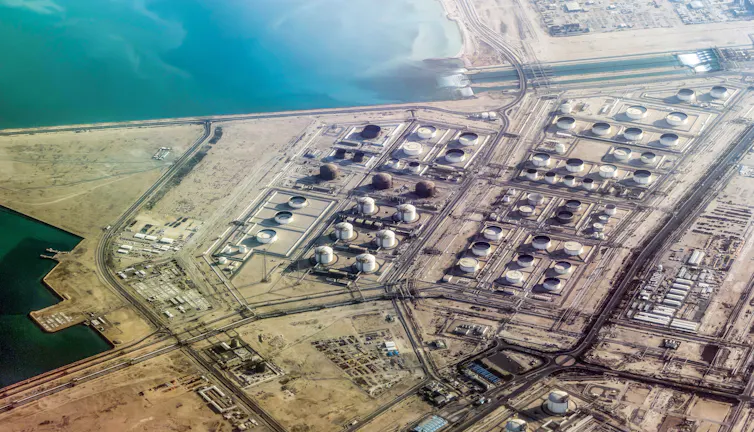
An aerial view of Qatar's Ras Laffan industrial complex.

Iranian attacks have caused significant damage to Qatar’s Ras Laffan industrial complex. Hannibal Hanschke / EPA

Disruption to energy exports is one part of the story. The war has also caused substantial physical damage to energy infrastructure across the region. Around 80 energy facilities, ranging from production plants to refineries and pipelines, have been targeted by Iranian missile and drone attacks so far.

It will take months – and in some cases years – to repair the damage (which stands at an estimated US$58 billion) once the war ends. Qatar’s liquified natural gas industry, in particular, has suffered serious damage. QatarEnergy, the state-owned energy company, says it will take up to five years to repair its Ras Laffan industrial hub alone.

Gulf diversification

The GCC states have adopted strategies to diversify their economies away from a dependency on hydrocarbons. Tourism and aviation are two central pillars of this, with GCC countries investing heavily in these sectors. The Gulf is now home to some of the busiest international airport hubs in the world.

But these industries, too, have been damaged by the war. Financial analysis firm, Moody’s, suggested recently that hotel occupancy in Dubai is set to plummet to 10% in the second quarter of 2026 from 80% before the war. Some Iranian attacks have targeted civilian areas, including hotels and residential buildings, prompting tourists to stay away.

The Iran war has also placed Gulf airlines such as Emirates, Etihad and Qatar Airways under increasing financial pressure. More than 30,000 flights to the Middle East were cancelled in the first month of the war and jet fuel prices – the biggest variable cost to airlines – are up 90% on the annual average.

The logistics sector is another area of Gulf diversification. It has grown rapidly since the early 2000s thanks to the region’s strategic position between east-west trade routes. The UAE’s Jebel Ali Port, for instance, is now one of the world’s largest container ports and the base of Dubai’s multinational logistics firm, DP World.

However, Jebel Ali has seen a 40% drop in vessels due to the war, with container carriers rerouting to alternatives such as Salalah in Oman and Colombo in Sri Lanka. And while DP World has opened emergency land corridors to ports outside the Gulf to keep cargo moving, these routes are costly and have limited capacity.

The UAE and Qatar also both serve as major air freight hubs, acting as bridges for cargo travelling between Asia and Europe. But this has been affected by the war too. Freight rates have increased following attacks on both Dubai and Doha that led to grounded flights and air space closures.

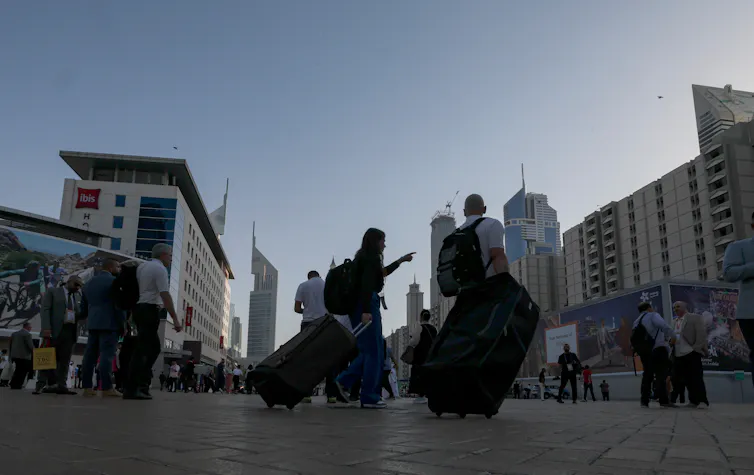
Tourists carrying their luggage through Dubai.

Tourists carrying their luggage through Dubai in April 2025. Ali Haider / EPA

In the long-term, the economic impact of the war on the Gulf economies will hinge on its duration and political outcome. But the risks are firmly tilted to the downside. The fiscal outlook for some GCC states is deteriorating, with several facing scenarios where government spending exceeds revenue. Public sector debt in some GCC states is rising too.

Moody’s has downgraded its outlook on Bahrain, which was already facing longstanding financial issues prior to the war, from “stable” to “negative”. This will make it harder for Bahrain to access much-needed capital and increase future borrowing costs.

GCC economies invest their surplus oil and gas revenues through sovereign wealth funds, which collectively manage between US$4 trillion and US$6 trillion in global assets. Governments are likely to draw on these funds to support domestic spending on reconstruction and bolstering their defences after the war.

This could undermine their future potential to fund large long-term diversification mega-projects such as Saudi Arabia’s Neom City. Plans for Neom, which was initially proposed as a linear city to home 9 million people, have already been scaled down in recent years due to issues including funding pressures.

The Gulf’s loss of “safe-haven” status due to the war, and the resulting reputational damage, cannot easily be reversed. Even after the conflict ends, higher risk premiums will persist for those doing business in the Gulf. Shipping disruptions could take months to unwind, and a prolonged closure of the Strait of Hormuz would be likely to trigger permanent rerouting.

If the conflict drags on, structural shifts in global supply chains may deepen, with lasting costs for the Gulf economies.

Trump-Xi summit puts US exports, Iran at center of reset bid

0
trump-xi-summit-puts-us-exports,-iran-at-center-of-reset-bid
Trump-Xi summit puts US exports, Iran at center of reset bid

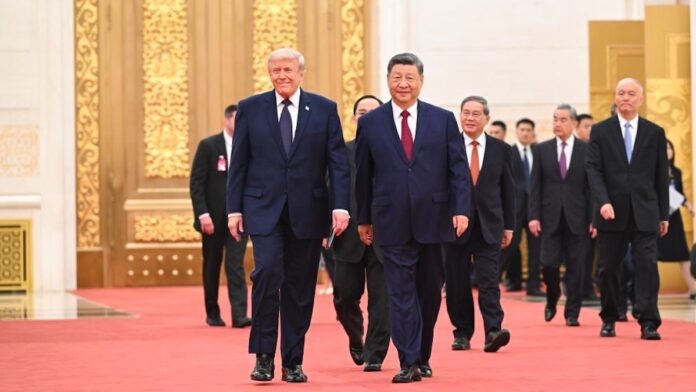
US President Donald Trump’s Beijing summit with Chinese President Xi Jinping has produced a package of Chinese commitments on US soybeans, energy and aircraft, giving both governments a basis to steady relations after years of trade and security tensions.

The two-hour-and-15-minute meeting between Trump and Xi has also laid the groundwork for Washington and Beijing to rebuild bilateral relations after years of escalating trade conflicts, export controls and geopolitical disputes. Trump invited Xi and his wife, Peng Liyuan, to visit the White House on September 24.

Trump told Fox News on Thursday that Xi has committed to helping the US on Iran and agreed to buy US soybeans, oil, liquefied natural gas (LNG) and other energy products. He said China would purchase 200 Boeing 737 jets.

A US official said Xi had opposed the militarization of the Strait of Hormuz and any effort to charge a toll for its use, while showing interest in buying more American oil to reduce China’s dependence on the strait in the future. 

“Both countries agreed that Iran can never have a nuclear weapon,” the official said.

US Treasury Secretary Scott Bessent said Washington has already secured a major soybean commitment from China, confirming that one of the main agricultural pledges from the previous Trump-Xi summit remained in place.

“And then soybeans, we have a very large purchase commitment from the Busan agreement for the next three years. So beans are really all taken care of,” he said in an interview with CNBC on Thursday.

At the previous Trump-Xi summit in South Korea last October, China agreed to purchase 25 million metric tons of US soybeans annually over the following three years.

Global geopolitical situations have changed since Washington captured Venezuelan leader Nicolas Maduro and his wife in January and began blocking ships from entering or leaving Iranian ports in April. Some Chinese pundits said the Middle East conflicts and global supply chain tensions have made Trump’s energy purchase request easier for Beijing to accept.

Reuters reported on Thursday that Chinese Customs appeared to have renewed licenses for hundreds of US beef exporters on Thursday, a move that would have restored market access for many plants whose permissions had expired over the past year. But then the Customs reverted the registration status of those exporters to “expired” on its website. It was unclear why Beijing made those moves.

Before the trip, observers have said Trump’s mission in China was straightforward. He wanted to help American farmers and manufacturers increase sales to China, giving Republican candidates a stronger economic message ahead of the mid-term elections in November.

Other US goals included pressing China to stop buying Iranian oil or supplying Tehran with drone parts and missile-related materials, and calling for the release of Hong Kong pro-democracy businessman Jimmy Lai.

Media reports said the two governments are expected to hold further talks to cut tariffs on about US$30 billion worth of imports not linked to national security concerns.

Meanwhile, Nvidia Chief Executive Jensen Huang’s last-minute hop onto Trump’s plane in Alaska to join the Beijing trip fueled market hopes that the two countries might have agreed on an arrangement allowing Chinese firms to import and deploy Nvidia’s H200 graphics processing units (GPUs).

Reuters reported on Thursday that the US Commerce Department has cleared about 10 Chinese firms to buy Nvidia’s H200 chips, including Alibaba, Tencent, TikTok parent ByteDance and JD.com. The US also approved Lenovo and Foxconn as distributors. Nvidia has not delivered any H200 chips to China, as Beijing has urged local firms to prioritize domestic chips over foreign processors.

Details about possible shipments of H200 to China were not immediately available.

China’s rejuvenation meets MAGA

For Beijing, Xi’s top priority at the meeting was to rebuild China-US relations and prevent heavy US tariffs from returning in early November 2026, after a one-year truce. Beijing also wants the Trump administration to stop arms sales to Taiwan and roll back tariffs and export controls on China.

At a banquet held in honor of Trump and his delegation, Xi said China-US relations concern the wellbeing of more than 1.7 billion people in both countries and affect the interests of more than eight billion people worldwide. He said both sides should rise to that historic responsibility and steer the giant ship of China-US relations steadily in the right direction.

Xi framed his own national rejuvenation agenda and Trump’s “Make America Great Again (MAGA)” slogan as compatible rather than conflicting goals.

“The people of China and the US are both great people. Achieving the great rejuvenation of the Chinese nation and making America great again can go hand in hand. We can help each other succeed and advance the well-being of the whole world,” Xi said in a toast.

In the US, MAGA is a Republican slogan closely tied to Trump. In China, Xi’s “great rejuvenation of the Chinese nation” refers to Beijing’s goal of making China wealthy, powerful and central to global affairs by 2049, while reversing what the Communist Party calls a century of national humiliation by Western powers. The concept is also tied to Beijing’s goal of reunification with Taiwan.

“If the Taiwan issue is handled properly, the bilateral relationship between China and the US will be overall stable,” Xi told Trump in the official meeting on Thursday. “Otherwise, the two countries will have clashes and even conflicts, putting the entire relationship in great jeopardy.” 

Safeguarding cross-strait peace and stability is the biggest common denominator between China and the US, he added, emphasizing that “Taiwan independence” and cross-Strait peace are as irreconcilable as fire and water. He urged the US side to exercise extra caution in handling the Taiwan question.

“I have agreed with President Trump on a new vision of building a constructive China-US relationship of strategic stability,” Xi said. “I look forward to working together with you to set the course and steer the giant ship of China-US relations, so as to make 2026 a historic, landmark year that opens up a new chapter in China-US relations.”

The new vision will provide strategic guidance for bilateral relations over the next three years and beyond, and should be welcomed by the people of both countries as well as the international community, he said.

“China-US economic ties are mutually beneficial and win-win in nature,” he said. “Where disagreements and frictions exist, equal-footed consultation is the only right choice.”

He said the two governments should implement the consensus reached by the leaders and make better use of communication channels in political, diplomatic and military-to-military fields. He added that the two sides should also expand exchanges and cooperation in trade, health, agriculture, tourism, people-to-people ties and law enforcement.

Thucydides Trap

During the official meeting with Trump, Xi expressed his wishes in three questions.

“Can China and the US overcome the Thucydides Trap and create a new paradigm of major-country relations? Can we meet global challenges together and provide greater stability for the world? Can we build a bright future together for our bilateral relations in the interest of the well-being of the two peoples and the future of humanity?” he said. “These are the questions vital to history, to the world and to the people.”

The Thucydides Trap is a term popularized by American political scientist Graham Allison to describe the risk of war when a rising power challenges an established power. In China-US relations, it refers to whether Beijing’s rise and Washington’s strategic dominance can be managed without military conflict.

“Some US commentators and policymakers had in recent years treated China-US rivalry as unavoidable, saying the two countries had already fallen into the Thucydides Trap and were bound to compete for supremacy,” said Cui Hongjian, a professor at the Academy of Regional and Global Governance at Beijing Foreign Studies University. “This pessimistic and negative sentiment not only affected China-US relations, but also affected the international community, raising the sense of insecurity and uncertainty.”

He said the latest Trump-Xi meeting, coming after their summit in Busan, showed both sides wanted to move the relationship away from pessimism and back toward controlled engagement.

“This has resolved a major psychological concern in the international community,” he said. “This interaction is expected to reverse that sense of losing control and put the two countries back on a track of reasonably and effectively managing their relationship.”

Read: Trump-Xi summit to weigh US energy sales amid Hormuz crisis

Follow Jeff Pao on X at @jeffpao3

Tourists Flee Disney’s Childhood Home in Horror

0
tourists-flee-disney’s-childhood-home-in-horror
Tourists Flee Disney’s Childhood Home in Horror


The house where Walt Disney once dreamed up a future filled with magic is now surrounded by scenes visitors say look more like a disaster zone.

Tourists traveling to Kansas City to see the legendary creator’s childhood home are being met with piles of garbage, discarded needles, abandoned vehicles and homeless encampments spreading through nearby alleys and streets.

What should feel like a nostalgic stop connected to the man behind Disneyland has instead become a disturbing wake-up call for shocked visitors.

Disney’s former home on Bellefontaine Avenue still looks picture-perfect from the outside. The historic property features a cozy front porch, rocking chairs and the kind of old-fashioned charm that feels pulled straight from a Disney movie.

But just around the corner, the fantasy reportedly falls apart fast.

Overflowing trash, debris and signs of drug activity have become impossible to ignore as the area surrounding the iconic home continues to deteriorate.

“It gives this place a bad name,” homeowner Roberta Young told Fox 4 Kansas City.

Young, who owns the property and gives tours to Disney fans from around the world, said the neighborhood has dramatically spiraled downhill in recent years.

“Even when I came up, it was not this bad,” she said.

The growing crisis comes as Kansas City prepares to host four World Cup games this summer, with thousands of tourists expected to pour into the city.

Young fears visitors will see the chaos surrounding Disney’s childhood home and leave horrified.

Kansas City reportedly has around 3,000 homeless people living on its streets, with local reports claiming the city now has one of the highest homeless populations per capita in the region.

The city has pledged millions of dollars to address the crisis, but officials admitted they cannot force people to leave encampments or accept treatment.

Meanwhile, neighbors say conditions continue getting worse.

Young said she wants city leaders to aggressively clean up the neighborhood and help addicts get off the streets before the international spotlight arrives for the World Cup.

“What I actually want and hope and pray that they get to do is to clean up the alley,” she said.

“At least 100 days in a rehab to clean these people up and maybe they can get their self together in order to get a job.”

The situation is especially heartbreaking considering the home’s place in American history.

Disney moved to Kansas City when he was nine years old and spent much of his childhood there before eventually launching the entertainment empire that would become one of the most recognizable brands on Earth.

He attended school nearby, studied art in the city and even created some of his earliest animated projects there before leaving for Hollywood in 1923.

Now, the once-magical neighborhood tied to the birth of Disney’s empire is becoming known for something far darker.

DOJ Escalates War on Trans Youth Healthcare With Criminal Subpoenas

0


In an escalation of its efforts to criminalize and eradicate trans healthcare, Donald Trump’s administration has sent its first known criminal subpoenas to hospitals that have provided gender-affirming care for young trans people. 

New York University Langone received a criminal grand jury subpoena last week from the US Attorney’s Office in the Northern District of Texas demanding information about teens who received care from the hospital’s now-shuttered trans youth health program, as well as information on the medical staff who provided that care. 

In accordance with a New York state shield law, the hospital posted a public notice to inform affected patients. The notice also said “several” other institutions had received similar subpoenas, which the hospital said demands “information pertaining to patients under the age of 18 who received gender affirming care” between 2020 and 2026.

Previous administrative subpoenas for confidential patient information have been reliably quashed in courts around the country as blatantly unconstitutional, illegal intrusions into patient privacy. So far, these have been related only to civil investigations. The Langone subpoena means that the federal government has now launched a criminal investigation into trans youth healthcare providers, and in Northern Texas, a judicial district prone to extreme, right-wing decisions. 

What we do know for certain is that resisting every government demand here is the only acceptable path forward. 

It appears that providers, not the trans patients or their guardians, are the target of the criminal investigation. Since federal grand juries are the black boxes of the criminal legal system, little information is available about the details of the case. It is not even publicly known what charges the prosecutors could be pursuing. The subpoena demands sweeping information including medical records relating to any patients under 18 who received gender-affirming treatments, including puberty blockers, hormone treatments, or any other “clinical services.” What we do know for certain is that resisting every government demand here is the only acceptable path forward. 

When it comes to healthcare providers, New York’s Shield Law is specifically in place as a protection from out-of-state prosecution. But the law has not yet been robustly tested against a federal case. 

“The hospital may try to fight the subpoena, in whole or in part, in court — but because the federal government is strategically pursuing the case in one of the most conservative courts in the country, Langone faces an uphill battle,” S. Baum wrote in the trans news and advocacy site Erin in the Morning. “This round of litigation could also put the efficacy of Shield Laws to the test.”

The Justice Department’s aim, whether or not the grand jury leads to prosecutions, is to further intimidate and harass healthcare providers and hospital administrators nationwide into preemptively ending services for trans young people. Many institutions, including NYU Langone, have already complied and stopped providing such care. Convening the grand jury is yet another direct and immediate attack on trans kids and adults, and a threat to bodily autonomy and medical confidentiality more broadly.

We also know by now that the Constitution or our country’s laws are no constraint on the Trump administration. Prosecutors and lawmakers will continue to throw everything they can against the wall until something sticks to establish a new political-legal reality — one usually achieved after a case winds its way up to a favorable federal judge, and eventually the far-right Supreme Court. 

Meanwhile, NYU Langone has shown itself to be an easy target. In response to threats from the federal government last year to withhold funding, the hospital ended its Transgender Youth Health Program. Despite the fact that a federal court in April ruled that the government cannot withhold funding over trans healthcare provision, more than 40 hospital systems have stopped providing necessary medical care to trans youth based on the Trump regime’s threats. 

The fact that Langone already bent to Trump’s demands by shuttering the program but is still facing a potential criminal probe only proves the folly of compliance. Should the hospital, or any other hospital system, supply federal prosecutors with patient’s or worker’s personal information, patients would be well within their rights to sue for HIPAA violations and potentially even civil rights violations given the discriminatory nature of the request. Patients and their families can also file a motion against the subpoena — a precedent that has been set when it comes to administrative subpoenas asking for trans patients’ information. 

“If you capitulate, you’ve actually opened yourself up to liability for selling out your constituents.”

Earlier this year, for example, the families of six trans teens who had received treatment at the Children’s Hospital Los Angeles filed a motion to quash an administrative subpoena on behalf of themselves and more than 3,000 other transgender youth patients and families whose identities and private medical information the subpoena demanded. A settlement was reached, in which the government withdrew the subpoena requests seeking patient-identifying information and instructed Children’s Hospital to redact all such information from any documents produced.

Meanwhile, a federal judge in the Northern District of Texas — from the same district where the criminal grand jury is empanelled — ruled earlier this month that Rhode Island Hospital in Providence must comply with a Justice Department administrative subpoena for trans youth patient information, including names, addresses, Social Security numbers, and medical records. In response, the Rhode Island Office of Child Advocate filed an emergency motion to quash the request. In a hearing over the motion in a Providence court, U.S. District Judge Mary McElroy slammed the Justice Department for conducting a “fishing expedition” by seeking medical records and patient information in a scrambling effort to criminalize healthcare provision; she also said the case was quite clearly “shopped” to Texas. 

For institutions and individuals, the stakes for resisting a criminal grand jury subpoena are higher. Individuals can be jailed and fined for the length of the grand jury in order to compel them to testify, and institutions can be slapped with hefty fines. But the consequences of giving in are graver still: Hospitals that capitulate to these demands could be subject to costly patient class action over privacy and rights violations. Institutions that hand over information are also aiding the potential criminal prosecution of medical care providers — an attack on the entire medical profession.

“If NYU Langone and other providers turn the confidential data of their patients over to the Trump-appointed U.S. Attorney for Northern Texas, everyone’s privacy, everyone’s healthcare, everyone’s civil rights are compromised,” Brad Lander, the former New York City comptroller and congressional candidate, wrote on Bluesky.

In March, a federal court ruled that a case brought by Columbia University students could proceed against the university. The lawsuit argues the university became a “third-party collaborator” in unconstitutional actions when it supplied the names and disciplinary records of students involved in Palestine solidarity organizing. The court determined Columbia could be found liable as a “state actor” for acting under government coercion to suppress student speech. Students and civil rights advocates sued the school for handing over student information in response to a congressional subpoena. While a civil, rather than a criminal, case, the finding should make institutions reflect on their readiness to comply with discriminatory and unconstitutional requests from this administration. 

“If the calculus before was that it’s better to comply with the federal government because it is either face saving or economically saving for these private institutions, now there’s the counterbalance: If you capitulate, you’ve actually opened yourself up to liability for selling out your constituents,” civil rights attorney and CUNY law professor Zal Shroff, who is representing plaintiffs in the case against Columbia, told me. 

Given that a federal grand jury subpoena is itself explicitly coercive, it’s unclear whether exactly the same legal claim could be made against NYU should it comply with the government’s demands. Shroff noted, “It may be that they are seeking to use the criminal process to avoid what has been found in the civil process,” but that nonetheless, “legal consequences work in multiple ways” when it comes to people’s ability to challenge private entities for their compliance with the administration’s harms. Continued complicity with Trump’s regime, however, has a known result. 

“NYU caved and ended care and they’re still being hit with a grand jury subpoena. It’s incredibly clear that no amount of preemptive compliance will stop this attack,” Harvard Law instructor Alejandra Caraballo wrote on Bluesky. “You either fight or you will be destroyed by this administration. Caving will not save you.” 

0FansLike
0FollowersFollow
0FollowersFollow
0SubscribersSubscribe
- Advertisement -
Google search engine

Recent Posts