22.9 C
London
Wednesday, June 17, 2026
Home Blog

The Slate Truck’s price may have leaked, starts at $24,950

0
the-slate-truck’s-price-may-have-leaked,-starts-at-$24,950
The Slate Truck’s price may have leaked, starts at $24,950

One of the most hotly anticipated electric vehicles makes its formal debut next week. It’s the Blank Slate, a refreshingly simple pickup truck EV designed by Slate Auto, which is trying to take some of the soaring cost out of a new car with a back-to-basics approach that means even electric windows are an optional extra. Of course, a crucial aspect of this pared-back approach is pricing.

Plenty of people are attracted to the idea of a truck with a compact footprint, no infotainment system or embedded modem, and the option to upconvert it later into an SUV or fastback. In the abstract, at least, people aren’t going to jump at the prospect of a truck with 150 miles (241 km) of range if it costs too much.

When Slate broke cover in 2025, it was targeting a price of around $20,000, assuming the $7,500 IRS clean vehicle tax credit would remain in effect, but it was abolished later that year.

Well, if a leak on the Slate website earlier is to be believed, the starting price for that standard range truck will be just $24,950. The price was live for several hours earlier today, and screenshots were posted to the Slate forums, along with some updated specifications. These include a slightly less powerful electric motor for the rear wheels—now 181 hp (135 kW) instead of 201 hp (150 kW), but a tow rating that’s been doubled to 2,000 lbs (907 kg).

That pricing and those specs are gone from the Slate website, but we’ll have official pricing and a first-ride impression on June 24.

Musk’s AI tool Grok was used to help fire 2,000 munitions at Iran

0
musk’s-ai-tool-grok-was-used-to-help-fire-2,000-munitions-at-iran
Musk’s AI tool Grok was used to help fire 2,000 munitions at Iran

Image: ADP Live / Wikimedia Commons

Pentagon official revealed in a court filing earlier this week that the US military used a version of Elon Musk’s artificial intelligence tool, Grok, to help carry out attacks on Iran.

Cameron Stanley, the Pentagon’s chief digital and AI officer, wrote in a sworn statement to a federal court in Mississippi that the US military “relies on derivatives of” Musk-run xAI’s “commercial offerings known as the Grok Gov Model.”

The model, which is used within the Pentagon’s Maven Smart System, “enabled US forces to deploy over 2,000 munitions to 2,000 distinct targets within 96 hours during Operation Epic Fury,” the Trump administration’s name for the war the president launched against Iran in late February.

Stanley’s statement came as part of a lawsuit that the NAACP brought against xAI earlier year, accusing Musk’s company of illegally operating dozens of polluting gas turbines for its Colossus 2 data center, which powers Grok.

Defending xAI, Stanley claimed in his statement that if Grok “cannot be deployed, refined, and upgraded” across the Pentagon “due to either limitations in energy supply or limited reserve compute capability, such as those requested by plaintiffs in this matter, the many tools deployed by military and civilian personnel alike which rely on Grok Gov Models would be severely impacted.”

The Defense Department acknowledged shortly after launching its assault on Iran that the US military was “leveraging a variety of advanced AI tools” to help “sift through vast amounts of data in seconds so our leaders can cut through the noise and make smarter decisions faster than the enemy can react.”

In a March 12 letter to Pentagon Secretary Pete Hegseth, a group of more than 120 House Democrats demanded details on “the role of artificial intelligence … in selecting targets, assessing intelligence and making legal determinations during Operation Epic Fury.”

The lawmakers specifically asked whether AI tools were used to identify an Iranian elementary school as a target. On the first day of the Iran war, the US military bombed a girls’ school in southern Iran, killing more than 150 people—mostly young children.

Stanley’s statement did not identify any of the “2,000 distinct targets” he said were attacked with the help of the Grok Gov Model.

-Common Dreams

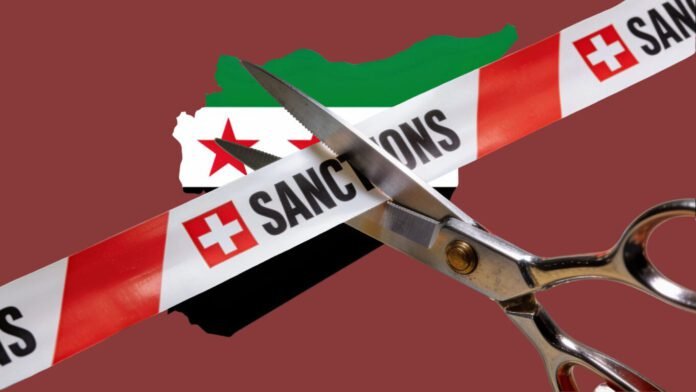
Switzerland Removes 7 Syrian Entities From Sanctions List

0
switzerland-removes-7-syrian-entities-from-sanctions-list
Switzerland Removes 7 Syrian Entities From Sanctions List


Switzerland removed seven Syrian state-linked entities from its sanctions list this week, aligning its measures with recent European Union action as Western governments continue easing restrictions on Damascus following the fall of Bashar Assad’s regime.

The Swiss State Secretariat for Economic Affairs said the Federal Department of Economic Affairs, Education, and Research amended Annex 7 of Switzerland’s Syria sanctions ordinance on June 15. The changes took effect at 11 p.m. on June 16. The amendment removed seven entries and modified listings for 18 individuals and four entities.

The delisted Syrian entities include the Ministry of Defense, Ministry of Interior, Air Force Intelligence Directorate, General Intelligence Directorate, Military Intelligence Directorate, Political Security Directorate, and Higher Institute for Applied Sciences and Technology.

The move follows the EU’s May decision to renew restrictive measures targeting individuals and entities tied to the former Assad regime until June 1, 2027, while removing seven Syrian entities from its blacklist. The EU said the delistings were intended to “support the strengthening of the EU’s engagement with Syria.”

The EU first imposed sanctions on Syria in 2011 after Assad’s government violently suppressed anti-government protests. After Assad’s fall in late 2024 and the formation of a transitional government, European governments began recalibrating their approach. The EU lifted most economic sanctions on Syria in May 2025 to support political transition, economic recovery, and reconstruction, while keeping targeted measures against figures linked to the former regime and sanctions imposed on security grounds.

The Syrian Future Movement welcomed the Swiss decision, calling it a positive step toward enabling state institutions to support security and development. The group said the move reflected a shift away from treating Syrian institutions as indistinguishable from the former regime.

The movement said the decision remains partial, noting that restrictions remain on individuals and entities, alongside asset freezes and bans on weapons and equipment used for repression. It called for a broader lifting of sanctions to support recovery, investment, the return of displaced people, and reconstruction.

Freed Belarusian journalist Andrzej Poczobut receives Sakharov Prize at European Parliament

0
freed-belarusian-journalist-andrzej-poczobut-receives-sakharov-prize-at-european-parliament
Freed Belarusian journalist Andrzej Poczobut receives Sakharov Prize at European Parliament


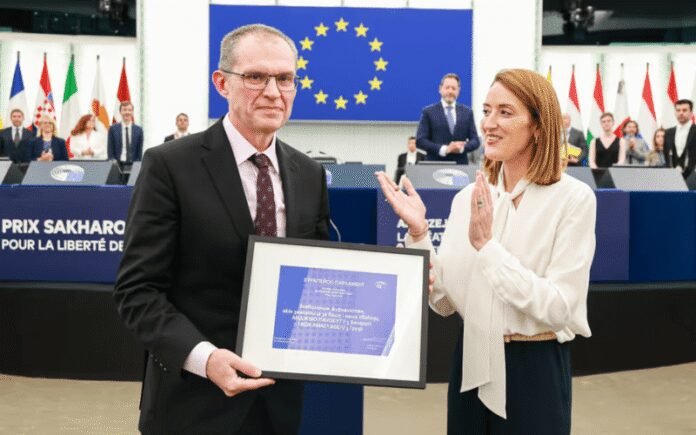
Belarusian journalist Andrzej Poczobut, who was imprisoned in 2021 before being released in April 2026, addressed the European Parliament in a formal sitting on Wednesday after receiving the 2025 Sakharov Prize for Freedom of Thought.

European Parliament President Roberta Metsola formally presented the prize to Poczobut, which had originally been awarded jointly to him and Georgian journalist Mzia Amaglobeli in December 2025 while both were still imprisoned in their respective countries.

Welcoming Poczobut, Metsola said the award recognised not only his courage but also “the values he refused to abandon despite years of unjust imprisonment”. She said his release offered hope while reinforcing Europe’s commitment to defending those persecuted for speaking the truth, defending democracy or exercising their fundamental freedoms.

Addressing MEPs, Poczobut thanked the European Parliament for its support, saying its voice had reached him while he was in prison.

“I learnt about being awarded the Sakharov Prize and about the European Parliament’s earlier statements whilst I was in prison,” he said, adding that Parliament’s concern for his fate had influenced the behaviour of prison guards.

Poczobut said repeated attacks on the Polish minority in Belarus formed part of what he described as “the anti-European crusade led by Alexander Lukashenka for decades.”

He also highlighted what he described as the absence of freedom of expression and press freedom in Belarus, the exclusion of critical international correspondents from the country and the monitoring of critical voices on social media by the authorities.

Referring to the 854 political prisoners still detained in Belarus, including 21 journalists, Poczobut also spoke about what he described as the global rise of authoritarianism and called for the immediate release of his fellow 2025 Sakharov Prize laureate, Mzia Amaglobeli, who remains imprisoned in Georgia.

Concluding his address, Poczobut described the situation in Belarus as “extremely dramatic” and said that long-term efforts to promote democracy and human rights, support grassroots initiatives in authoritarian states and strengthen independent media would ultimately help unite Europe and enable Belarus to become part of Europe in more than a geographical sense.

Poczobut, a representative of the Union of Poles in Belarus and a historian and journalist with more than 20 years of experience, was imprisoned for his work defending the Polish language and culture as well as for his journalism.

Named after Soviet physicist and political dissident Andrei Sakharov, the European Parliament’s Sakharov Prize for Freedom of Thought has been awarded annually since 1988 to individuals, groups and organisations recognised for their work in support of human rights, freedom of expression and democratic values. In 2020, the prize was awarded to the democratic opposition in Belarus.

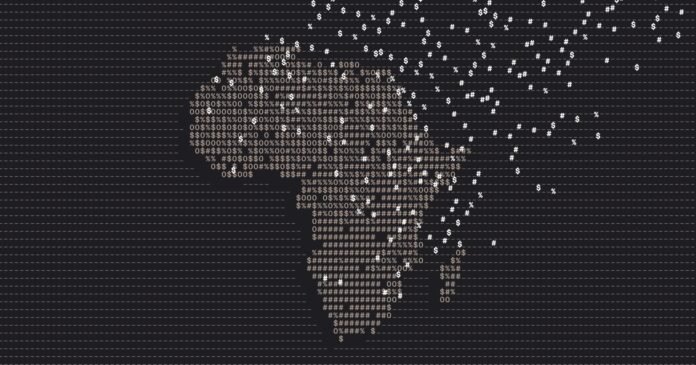
“Digital Colonialism”: U.S. Demands to Access Africans’ Data Raise Privacy, Sovereignty Concerns

0
“digital-colonialism”:-us.-demands-to-access-africans’-data-raise-privacy,-sovereignty-concerns
“Digital Colonialism”: U.S. Demands to Access Africans’ Data Raise Privacy, Sovereignty Concerns

Reporting Highlights

  • Strings Attached: U.S. officials are demanding access to the health data of millions of Africans as a condition of giving billions of dollars in lifesaving aid to African countries.
  • Privacy Concerns: Experts said the deals are vague and lack standard language to guard personal data from being exposed, misused or commercialized without people’s consent.   
  • America First: The U.S. said it needs access to the data to keep people safe and that it will be anonymized. The deals are part of a plan to use aid to make America “more prosperous.”

These highlights were written by the reporters and editors who worked on this story.

Frank Ssekamwa says the United States presented his country with an impossible choice. If it accepted the terms of a new health agreement, Uganda would have to give the U.S. access to the data of millions of his fellow citizens — a decision he worries would make their personal information more vulnerable to breaches and possible exploitation.

But if it refused, the East African nation would likely lose out on more than a billion dollars to address HIV, malaria, tuberculosis and other illnesses, even as its people face ongoing threats from Ebola and other deadly infectious diseases. 

So, on Dec. 10, it agreed.

“If you take the deal, you’re going to be exploited. If you don’t take it, you’re going to die,” said Ssekamwa, an attorney and digital rights expert in Uganda. “It’s the essence of digital colonialism.”

Across Africa, countries have faced similar dilemmas as the U.S. has held a series of closed-door negotiations in which lifesaving aid has been conditioned on access to citizens’ health data. The negotiations come in the wake of the dismantling of the U.S. Agency for International Development, which — in contrast with the new contracts — provided billions of dollars in aid with few strings attached. Officials in Zambia, Zimbabwe and Ghana have been so outraged by the demands that they rejected the initial deals. 

The demand to access health data is central to the Trump administration’s new America First Global Health Strategy, an openly transactional approach that seeks to leverage the desperate need for medical treatments abroad. Aid will now be given “in a way that directly benefits the American people and directly promotes our national interest,” Secretary of State Marco Rubio stated in September.

The State Department declined to publicly release global aid and data-sharing agreements it has signed with more than 30 countries as part of its new approach. But a ProPublica analysis of nine of the deals offers a window into the extensive U.S. demands for access to data — and the potential risks and vulnerabilities for the citizens of countries that have signed them. ProPublica also reviewed a data-sharing agreement struck with Uganda, which has not previously been reported; a data agreement with Kenya; six agreements over the sharing of pathogens that can cause pandemics that were made public by the State Department this week; generic templates of deals for sharing both data and pathogens that can cause pandemics; and an analysis of the documents the advocacy group Public Citizen shared exclusively with ProPublica. 

ProPublica also consulted more than a dozen experts in data privacy and global health, including several with direct knowledge of U.S. policy who said that the insistent demands for data access and other resources as a condition of aid are unprecedented. Without seeing the full suite of agreements, they could not identify all vulnerabilities. But they spotted some red flags: The terms of the deals are vague and lack language standard in most data-sharing agreements that adequately limits what data is collected and how it can be used. That increases the risk that individuals’ personal data could be exposed, misused or commercialized without their consent.  

In the Ugandan data deal, the U.S. will get direct, real-time access to nine of the nation’s health data systems for seven years, including the central repository that stores all of its health information, lab data, data collected by community health workers and, critically, its system for managing individuals’ electronic medical records. The agreement calls for the sharing of aggregated data with all personally identifiable information removed. It also says the data should be used for delivering and auditing healthcare services. 

But lawyers and digital privacy experts argue that the deal raises questions about who will have access to the massive cache of health data and whether it could be inappropriately accessed and exploited.

Some expressed concern that, because it is possible to reverse-engineer data that has been anonymized, people with HIV, tuberculosis and other diseases could have their records exposed.

Stephanie Psaki, who served as the U.S. coordinator for global health security under President Joe Biden, described the Trump administration’s approach as a “blunt instrument of ‘just give me the login to your data systems.’” 

“The U.S. would never agree to that,” she said, if the deal were offered in reverse.

In Uganda, the U.S. will provide up to $1.7 billion over five years for global health security and the treatment and prevention of deadly conditions such as malaria, tuberculosis, HIV and polio. In the past, the U.S. gave this aid without asking for direct benefits in return, saving an estimated 170,000 Ugandan lives per year

While a significant investment, it is less than the U.S. previously spent in Uganda and will decrease every year of the agreement. By 2030, the African nation will receive 45% less global health funding than when Trump retook office, according to an analysis by Vincent Lin of Partners in Health, which provides healthcare in poor countries. 

Several experts said there is broad support for some of the goals of the new plan for aid, including reducing African countries’ dependence on the U.S. for healthcare needs. But they worry the transactional nature of the approach could backfire by undermining trust or, in some cases, driving nations to reject deals altogether.

After withdrawing from the World Health Organization and losing access to its global network that tracks and combats disease outbreaks, the U.S. is attempting to obtain the information necessary to address potential pandemics through a patchwork of deals with individual countries. Each of the agreements ProPublica reviewed includes a section on responding to outbreaks. And some countries have signed separate pathogen-sharing agreements, which state that countries must “initiate sharing specimen(s) and related data” within five days of a U.S. request. The Trump administration is also planning unprecedented involvement of private companies to manage and process data.

The State Department told ProPublica that it needs access to the data to improve health outcomes in recipient countries and keep Americans safe. The new approach also requires countries to invest more in their own health systems in exchange for the aid, a promise many countries will likely struggle to fulfill. And, in some cases, including the deal with Uganda, it aims to boost local manufacturing through partnerships with American companies.

The State Department said it took multiple factors into account to ensure the required investments from other countries were “realistic and achievable.”

“The United States is investing billions of dollars in other countries’ health systems to fight infectious disease. In return, we expect governments to increase their own spending on health, so programs are sustainable and under genuine national ownership, not permanently financed by U.S. taxpayers. For the first time, both sides are putting skin in the game to ensure lasting impact,” a State Department spokesperson said in response to questions about the agreements.  

In response to follow-up questions from ProPublica, spokesperson Tommy Pigott said the agreements “share only the same kinds of aggregated, de-identified data that has been shared and used for years in the fight against HIV/AIDS, malaria, tuberculosis, and other diseases. All data sharing is consistent with each country’s laws and approvals. No personally identifiable information is being received or shared by the United States government.”

Uganda’s Ministry of Health, Ministry of Foreign Affairs, Personal Data Protection Office and embassy in Washington, D.C., did not respond to questions for this article. 

In the age of artificial intelligence, large health data sets have become so valuable they’ve been referred to as the new gold. The precise value of the health data of an entire nation is unclear, but it could be extremely valuable to AI-driven companies for training models. The industry of buying and selling such information troves is worth billions. And countries around the world have come to regard their citizens’ health records as national assets that deserve special protections and can confer economic and strategic advantages. 

Yet the agreements, which are part of a strategy the State Department openly states is intended to make America “more prosperous” and “promote American health innovations,” provide no guarantee that Africans subject to them will have a say in what happens with their data or receive a fair share of its benefits. “Once companies get this data, the value is being accrued. But there’s no way for the [African] population to know how companies will use it,” said Jane Munga of the Carnegie Endowment for International Peace, who has argued that the agreements may violate African privacy laws.

Africans have also expressed concern that they will not be able to access and benefit from medicines and vaccines developed from pathogen samples shared with the U.S. Five of the six specimen-sharing agreements reviewed by ProPublica state that, in the event that a medical product is developed primarily from a specimen from the country, the U.S. government “shall prioritize” a request from that government behind the needs of the U.S. Only one of the agreements, with Nigeria, commits the U.S. to facilitating “priority access” to — and the donation of — any medical products developed using the specimens.

The phenomenon of extracting information and samples from less-resourced populations and failing to credit and compensate them for their contributions to medical developments is well known enough to have several names, including “parachute science.” Just a few years ago, countries, including some in Africa, hosted COVID-19 vaccine trials, only to later struggle to access the shots they helped to develop.

Each agreement includes “benefit-sharing provisions,” the State Department said in response to questions. 


After the Trump administration dismantled USAID, the world’s largest provider of humanitarian assistance, it also drastically reduced funding for international health work done by the Centers for Disease Control and Prevention and severely scaled back the President’s Emergency Plan for AIDS Relief, which combats HIV globally. In addition to withdrawing from the WHO, the U.S. removed itself from international negotiations over a pandemic agreement intended to affirm countries’ sovereign rights to their biological resources and ensure equitable access to medical interventions.

Brad Smith, an entrepreneur who served in the first Trump administration, is now in charge of creating the system that would rise from the ashes. Before joining this administration, Smith founded three companies with business models that rest in part on using data to reduce healthcare costs, including CareBridge, a home care provider that sold for a reported $2.7 billion in 2024. During the presidential transition that year, Smith led the government efficiency panel that would become Elon Musk’s Department of Government Efficiency. After Trump took office, he presided over some $67 billion in sweeping cuts to the Department of Health and Human Services before being brought on as an adviser to the State Department. 

Although the humanitarian aid system had been largely dismantled, Congress required the executive branch to continue providing aid. So Smith and his team had to find new ways to get the funding to countries, ensure that it was being spent wisely and address potential pandemics — all without most of the international partners and staff the government had previously relied on to carry out this complex work. 

A Rhodes scholar known for his intense work ethic, Smith threw himself into the effort. State Department staff fielded calls from him at all hours of the night to explain budget items on spreadsheets. Through his personal lawyer, Smith referred questions to the State Department.

One of the greatest challenges lay in the handling of health data. In the past, PEPFAR, the HIV program, built its own systems to handle anonymized data, separate from government health records — a setup that Trump administration officials and others have criticized as inefficient.

The America First plan proposed standardizing data collection and processing within countries. The Ugandan data agreement requires the country to provide the U.S. — and its contractors — with logins “or other secure access mechanisms” to directly enter the country’s data systems. The new approach, U.S. officials say, will enable the U.S. to continue auditing programs and track outbreaks. 

The agreements ProPublica reviewed include statements about the U.S. government’s intent to ensure data security and say that the data is being accessed for the purposes of addressing diseases and auditing that work, but they leave open the possibility that sensitive information could be revealed, according to the data privacy experts ProPublica consulted. 

At particular risk are countries that don’t have national data privacy laws, such as Liberia, whose memorandum of understanding requires “interlinked and interoperable” data systems for “surveillance, laboratory, response, health, environment, agriculture.” That country’s main health agreement doesn’t require the U.S. to limit the amount of data it takes to the least needed, a standard clause in U.S. contracts, according to Abdoul Jalil Djiberou Mahamadou, a recent postdoctoral fellow focusing on bioethics at Stanford University. (Neither Liberia nor the State Department has released the supplemental data-sharing agreement.) “Once data is breached, it’s nearly impossible to get it back,” Mahamadou added.

The Liberian government did not respond to a request for comment.

The Ugandan data-sharing agreement says it will comply with the laws of both nations and permits the sharing of “sensitive personal data” if the consent of individuals whose data is shared is obtained, there is a compelling public health emergency of international concern and it is the only way information can be provided in a “timely and accurate format.”

Ssekamwa, the digital rights expert who also founded and runs the African Centre for Digital Justice, said there are important questions that haven’t been answered by the Ugandan government.

“Does the U.S. have appropriate data protections? Can the systems provide anonymized data? Are they really up to that standard?” said Ssekamwa. “If I’m someone who has had health issues, can you deny me a visa because of the health issues I’m having?”

Psaki, the former global health security coordinator, worried about the haste with which the changes to data access are happening. “Even in the best of circumstances, you can’t go from having parallel data systems that were established over 20-plus years to finding some way to integrate those data systems in six months.” 

Speed has been a hallmark of the America First global health effort. In September, just a month after Smith joined the State Department, it launched the strategy at an event co-sponsored by the U.S. Chamber of Commerce and five large pharmaceutical companies. By November, Smith was crisscrossing the African continent with a small team of negotiators, trying to persuade dignitaries to agree to deals. 

The State Department said the deals were “negotiated in a thoughtful and strategic way over many months.” 

On Dec. 4, Kenya became the first country to sign, during a triumphant celebration with Rubio and President William Ruto in Washington. Outcry over the agreement had already begun two days earlier, when a Kenyan activist named Nelson Amenya announced on the social platform X that he had seen a sample of the specimen-sharing agreement as well as a legal analysis that showed it would violate Kenyan law.

As a condition for receiving $1.6 billion in aid, the Kenyan government agreed to provide access to seven years’ worth of health records — two years longer than the U.S. would provide financial support. 

Although the Kenyan data-sharing agreement states that the U.S. will take “all reasonable measures to protect the confidentiality of information” and abide by American and Kenyan laws, Amenya worried that wouldn’t be enough. “Every HIV test, TB diagnosis, malaria case – accessible to US officials,” he wrote in the post, which now has one million views. “Your medical records, your children’s health data – all exposed.”

A few days later, a Kenyan senator named Okiya Omtatah sued members of the Kenyan government over the agreement, arguing that it poses a threat to citizens’ constitutional right to privacy by “allowing broad foreign access to sensitive data.” A Kenyan nonprofit also sued, and more than 50 groups weighed in on their side, describing the document as giving the U.S. “excessive access” to African data and raising the possibility of serious human rights violations. 

In court filings, the Kenyan government argued that it is obligated to achieve the “highest attainable standard of health” and that it is unable to do that on its own. After blocking the deal for months, in May, the Kenyan court temporarily allowed implementation of the agreement to proceed while it considers the case.

Since outrage bubbled up in Kenya, some other countries have negotiated shorter terms for sharing data and pandemic specimens, and have inserted additional protections, according to the Public Citizen analysis.

Still, groups across Africa have sounded alarms about dangers inherent in these provisions, including data breaches. Examples of such unauthorized access to personal data abound, including a recent case where the healthcare data of some 500,000 participants in the UK Biobank wound up listed for sale on the Chinese website Alibaba

Revealing whether someone has had an abortion, mental health condition, substance use treatment or sexually transmitted disease can be devastating anywhere. In Africa, research has shown it can lead to discrimination and violence. And even when personal information has been removed, individuals in “anonymized” data can be reidentified using AI and other tools

The Ugandan data-sharing agreement calls for the U.S. government to “promptly notify the Government of Uganda of any unauthorized access” in such cases and requires the parties to conduct a joint breach assessment and remediation plan afterward. But by that point, it may be too late, Ssekamwa fears. “Once the data gets out of Uganda, we are skeptical that the government of Uganda will actually have any power to control it,” he said.

The secrecy around both the negotiations and the agreements has raised further suspicions. The State Department has declined to share the agreements, telling ProPublica the agency will release them when negotiations with all partner governments are complete and describing its actions as “protecting sensitive negotiations—not ‘secrecy.’” In response to a public records request filed by ProPublica, the State Department said it planned to provide the documents in September 2027. The advocacy group Public Citizen recently filed suit against the federal government in an effort to obtain the documents. 

“Why are they hiding the agreement if they think the terms are OK?” asked Bernard Okpi, a Nigerian lawyer who sued his government in March, alleging that the deal violates the country’s constitutional right to privacy and promotes religious discrimination by prioritizing funding for Christian faith-based health facilities. That suit is pending, and the Nigerian government did not respond to questions from ProPublica.

The State Department said that the agreement with Nigeria “was negotiated in connection with reforms the Nigerian government has made to prioritize protecting Christian populations from violence.”

The Trump administration says that its new global health strategy is designed to save lives and keep the U.S. — and the world — safe from disease outbreaks. But ultimately its hard-driving and secretive negotiations may work against those goals.

While the administration aspired to strike agreements with 50 nations, including the three countries that walked away from negotiations in part over concerns about data sharing, it has fallen far short of that number. (In Zambia, officials also balked at U.S. demands for critical minerals.) The loss of aid in those countries is already proving to be devastating

Despite the Trump administration’s stated goal of putting “America first,” the U.S. may feel the consequences of those failed negotiations, too, as mistrust compounds the loss of long-standing systems that provided care and responded to disease outbreaks. 

“It’s in everyone’s interest to have a comprehensive approach to respond to an outbreak early,” said Psaki, who pointed to the quickly escalating number of Ebola cases in the Democratic Republic of Congo as evidence. While that country struck a healthcare deal with the U.S., five of the nine countries bordering it have not. “We need to get data and samples from all nine countries to collaborate effectively on that outbreak, and now we don’t have that.”

The State Department said the U.S. has responded swiftly to the outbreak and has provided over $270 million to the global fight against Ebola.

In Uganda, where people have also fallen sick and died from Ebola, Ssekamwa said that his country needs all the help that the healthcare deal can bring, including improved protection from outbreaks, but there needs to be more robust protection of people’s personal data.  

“We are happy to benefit from the technological advancement and the fruits of big data,” he said. Instead, he said, “the U.S. has left so many gaps within the agreement, which can be exploited in their favor.”


Why Albertans are seeking a referendum on separation from Canada

why-albertans-are-seeking-a-referendum-on-separation-from-canada
Why Albertans are seeking a referendum on separation from Canada

Albertans will head to the polls in October for what has been referred to as a “referendum on a referendum”. They will be asked to choose between two options: should Alberta remain a province of Canada, or should their province begin the legal process to hold a binding referendum on whether Alberta should separate from Canada?

This was announced on May 21 in a televised address by Alberta’s premier, Danielle Smith – a politician who, in the same breath, said she would personally vote to stay. The question on whether Alberta should remain or separate will appear alongside other questions on immigration policy and constitutional changes.

There is support in Alberta for a referendum. Around 700,000 Albertans signed petitions in 2025 and 2026 calling for a vote about either remaining in Canada or separating. That is a remarkable number in a province of just over 5 million people.

The groups behind the petitions say they gathered enough votes to trigger a province-wide referendum on independence. However, the petitions were struck down by an Alberta court in December 2025 and May 2026 for infringing indigenous treaty rights.

CTV News – Separatists appeal judicial decision striking down petition for referendum (19 May 2026)

Decades of grievances

Alberta sits on the fourth-largest proven oil reserves on the planet. And for decades, many people there have felt that the rest of Canada – particularly the federal government in Ottawa – has been drawing disproportionately on Alberta’s prosperity.

This anger traces back to 1980. That year, Canada’s then-prime minister, Pierre Trudeau, introduced the National Energy Program, capping domestic oil prices below world market rates and redirecting oil revenues to the federal government. The policy, which was repealed in 1985, devastated Alberta’s economy.

In the years that followed, Alberta’s unemployment rate more than tripled – from under 4% in 1980 to a peak of 12.4% by 1984. Tens of thousands of jobs disappeared as oil companies left the province, with estimates suggesting Alberta lost up to CA$100 billion (£54 billion) in revenue during the National Energy Program era.

Canada’s equalisation payment system, under which wealthier provinces indirectly subsidise poorer ones, has kept the wound open. Alberta consistently contributes far more to the federal treasury than it receives back in spending.

More recently, federal climate policies – including a carbon tax, emissions caps on the oil sector and what legislation critics have called the “no more pipelines bill” – have become focal points for the sense held by many Albertans that Ottawa is strangling their province’s economic lifeline.


Read more: As Alberta separatists court the U.S., prosperity is fuelling a sovereigntist turn


What the law provides

Under international law, all people have the right to self-determination – the right to shape their own political, economic and cultural future. But outside of colonial contexts, this right is almost always understood to mean self-government within an existing state, not the right to break away from it.

As legal scholars have argued, international law does not grant the component parts of sovereign states a right to secede unilaterally.

Although the International Court of Justice confirmed in its 2010 advisory opinion on Kosovo that there is no outright prohibition on declarations of independence, a legal right to secession outside the colonial context exists only in the most extreme circumstances.

This generally refers to contexts where people are actively oppressed or denied any meaningful say in their own governance. Alberta, a wealthy and democratic province with its own elected legislature, falls short of that threshold.

Under Canadian constitutional law, there is also no right to unilateral secession. The law does not expressly provide for or prohibit a province from leaving. But the Canadian Supreme Court’s landmark 1998 ruling – triggered by Quebec’s 1995 independence referendum in which the separatist side lost by less than one percentage point – settled the core question. The court held that Quebec could not declare independence on its own.

However, the court did not leave matters there. It went further, establishing what legal scholars have called a framework of “normative due process” for secession claims. If a clear majority votes yes on a clear question on secession, the federal government has a constitutional obligation to negotiate the province’s constitutional future in good faith. Democracy, the rule of law and the protection of minorities must all be respected – by both sides.

The Clarity Act of 2000, passed in response to Quebec’s 1995 independence referendum and the subsequent Supreme Court judgment, sets out those conditions: the question must be unambiguous and the majority must be clear. Under Section 2 of the Act, the House of Commons has the final say on what counts as a clear majority.

Canada’s prime minister, Mark Carney, has already signalled that a simple 50%+1 majority would not be enough for a province’s independence. And whether the Clarity Act is even triggered by the October vote is itself contested. Since the question does not directly ask whether Albertans want to secede, some argue the Act’s threshold requirements simply do not apply at this stage.

In any case, even a successful future referendum would only be the beginning. Any actual separation would require negotiated constitutional amendments – a complex, multi-party process involving the federal parliament and provincial legislatures – that would take years and could be blocked at multiple points.


Read more: What if Alberta really did vote to separate?


Alberta is not the only place in the world where questions of self-determination are live. Scotland, Catalonia and – following elections in May 2026 – Wales all have governments with pro-independence or pro-referendum positions.

Each faces its own version of the same tension: the democratic impulse to let people decide, and the legal and political reality that separating from a larger state is never as straightforward as a ballot paper makes it look.

Alberta’s October vote will not settle the question of independence. But it will tell the rest of Canada – and the world – just how seriously that question needs to be taken.

Ten months later, the $100 Google Home Speaker is finally available for preorder

0
ten-months-later,-the-$100-google-home-speaker-is-finally-available-for-preorder
Ten months later, the $100 Google Home Speaker is finally available for preorder

Good things take time, but not all things that take time are good. The jury is still out on the Google Home Speaker, but it certainly took a while to arrive. After announcing its new speaker last August, Google finally has a release date. The company’s first new smart home speaker in years will launch on June 25, and you can preorder it today for $99.99.

The generically named Google Home Speaker is Google’s first home audio device in almost six years. The last one was the Nest Audio, which debuted back in September 2020. The new device is small and round—an oblate spheroid, technically. It’s covered in a partially recycled fabric available in four colors: hazel, porcelain, jade, and berry (jade and berry are limited to the US). Google says the device produces “360-degree sound” for a uniform listening experience anywhere in a room.

Google is into lighting effects again.

Google is into lighting effects again. Credit: Google

Previous Google speakers included Assistant-style illuminated lights, but the Google Home Speaker features a light ring around the bottom that glows when the device is listening, “thinking,” or responding. This is becoming a trend with Google. The company will require a similar glowing lightbar embellishment on the upcoming Googlebook laptops. There are three far-field microphones distributed around the speaker that will pick up your speech, and there’s a mute switch when you don’t want it listening for the “OK Google” trigger.

Inside, the speaker has a quad-core A55-based processor clocked at 2GHz with a dedicated NPU. It runs local AI models for better sound isolation, allowing it to filter out background noise better than past smart speakers. Smart speakers have an annoying tendency to mishear, so the Google Home Speaker could be less frustrating in that way. If you don’t want to talk to the speaker, there are capacitive touch controls on the top to control media playback.

Meet the Google Home Speaker.

Interestingly, the new device may not be an upgrade on all fronts. The Nest Audio had a 75 mm woofer and a 19 mm tweeter, but the Google Home Speaker has only a single 58 mm full-range driver. Google tells Ars that the new speaker’s audio quality will fall between the Nest Audio and the smaller Nest Mini.

Despite the apparent drop in audio quality, the Google Home Speaker does have some utility beyond talking to Gemini. If you have a Google TV Streamer, up to two Home Speakers can pair with it for “Immersive” audio output. It also integrates with any other Nest speakers and displays on your local network.

The Berry color is one of the US exclusives.

The Berry color is one of the US exclusives. Credit: Google

Buying the Google Home Speaker also gets you six months of Google Home Premium. This adds various AI features to the Home app, which you may or may not want. It also enables Gemini Live on the speaker, allowing you to have a back-and-forth conversation with Google’s AI. Even if you want this feature, you may not need the new speaker, as Gemini is also available on Google’s other speakers. Your old speaker may not have the local processing and noise filtering capabilities of the new model, but Gemini lives in the cloud—the Google Home Speaker is just a new way to interact with it, and it can be yours for a hundred bucks.

Trump-Netanyahu war aims clash – can Iran peace deal survive?

0
trump-netanyahu-war-aims-clash-–-can-iran-peace-deal-survive?
Trump-Netanyahu war aims clash – can Iran peace deal survive?

The clock is ticking on the Iran peace deal. A memorandum of understanding between Iran and the US is due to be signed in Geneva on June 19, allowing for a 60-day ceasefire extension and the opening of the strategically vital waterway, the Strait of Hormuz. But key questions remain unresolved that could yet scupper the agreement.

For Washington and Tehran, the memorandum also includes Lebanon. Iran has made the signing of the deal contingent on an Israeli undertaking to withdraw from the territories it has occupied in southern Lebanon during the war. And the US president, Donald Trump, has demanded that the Israeli prime minister, Benjamin Netanyahu, behave “more responsibly in Lebanon”.

But Israel’s bombing of south Lebanon and Beirut continues and the Israeli military presence in Lebanon remains as Israel’s leaders remain adamant they will not withdraw. So where does Israel feature in this deal and how will it respond?

The terms of the deal remain confidential, and will only be revealed after the signing has taken place. But reports suggest that the US will be responsible for constraining Israeli military activity in Lebanon. Iran, meanwhile, appears to see the two states as one adversary in this war.

Over the past year, questions about the relationship between Trump and Netanyahu have regularly been asked, highlighting the divergent approaches to Iran and the broader security environment of the Middle East taken by the two states.

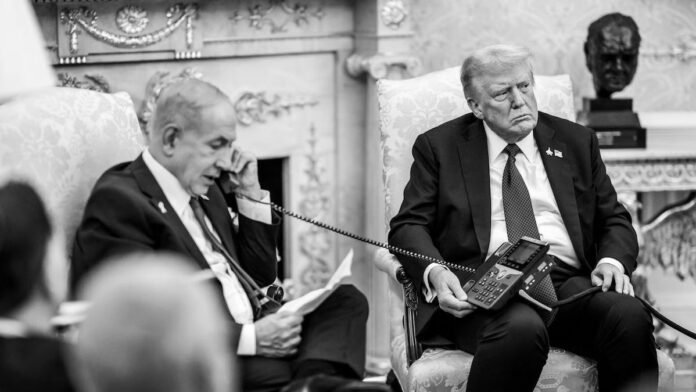
The Israeli strike on Hamas targets in the Qatari capital of Doha in the summer of 2025 provoked much anger, prompting the White House to release an image of Netanyahu on the phone with the emir of Qatar, Tamim bin Hamad Al Thani, while Donald Trump looked on, clearly unimpressed.

Leaked comments during the war with Iran have highlighted the extent of frustration felt by Trump towards Netanyahu. Speaking with Axios, a US media outlet, on June 14, Trump fumed: “Why did BB have to do a fucking attack? I was so pissed off. I let him know he has no fucking judgement. I let him know that.” Trump later warned Israel on Truth Social not to “blow it.”

Two weeks earlier, Trump and Netanyahu had an angry phone call about Israel’s threats to resume air strikes. In a conversation reported by Axios, Trump shouted: “What the fuck are you doing? You’re fucking crazy. You’d be in prison if it weren’t for me. I’m saving your ass. Everyone hates you now. Everybody hates Israel because of this”.

Divergent strategies

The tensions between the two men also reflect considerable strategic divisions emerging between Israel and the US. The two countries have long been close diplomatic partners, with shared strategic and ideological visions for the future of the Middle East. Support for Israel has been a cornerstone of domestic US politics alongside US foreign policy – prompting widespread reflection on the strategic merits of such an approach.

An article by John Mearsheimer and Stephen Walt, American political scientists, later turned into a book, engaged with the topic, questioning if the US-Israeli relationship was a consequence of “love or the lobby.” That was a clear reference to the pressure exerted on US politicians by the American Israel Public Affairs Committee – widely regarded as one of the most powerful lobbying groups in America with considerable influence on US policy.

Yet the strategic goals of the two states now appear to be in direct conflict. For the US, ensuring that the memorandum of understanding is signed and a final deal is reached with Iran is of paramount importance. For Israel, where public opinion is largely in favor of the war with Iran as well as conflict with Hezbollah, the memorandum signals capitulation and has provoked deep anger.

Many in Israel are calling on the government to reject the deal. One of Netanyahu’s coalition members, finance minister Itamar Ben-Gvir, declared that Israel must not accept the US ceasefire.

In an effort to distance Israel from the US, Ben-Gvir declared that “a sovereign state is not a contractor for any superpower. It is not bound by agreements that block its ability to protect its people.” Israel “must continue to demolish the houses in southern Lebanon,” he argued. “We must continue to be independent.”

Israel Katz, Israel’s defence minister, vowed that Israeli military will remain in southern Lebanon promising to retaliate if Iran hits Israel in support of Lebanon.

Netanyahu also expressed defiance. In a televised press conference on June 15, he declared that Israel “established deep security zones around the state of Israel. We did this in Gaza, in Lebanon and in Syria.” He added: “And I want to make it clear: we will remain in these security zones … to protect our country.”

This appears to be in direct contradiction of the terms of the memorandum of understanding and raises serious questions about the relationship between both Trump and Netanyahu and the US and Israel.

It appears that the relationship is now at a crossroads. Will Trump exert pressure on Netanyahu to stop the Israeli bombardment of Lebanon and to withdraw from the country, or will he turn a blind eye to Israeli military actions, risking the deal that he so desperately wants?

If the US president insists on an Israeli withdrawal, will Netanyahu comply? And what does this mean for either man’s electoral chances in the autumn, with Netanyahu facing a general election by October and Trump facing mid-term elections in early November?

With the two supposed allies each clearly at loggerheads over what their countries want – and, perhaps more importantly, what they themselves want – can the deal survive? And what does this mean for Israel’s relationship with the US? The clock is ticking.

Simon Mabon is a professor of international relations, Lancaster University.

This article is republished from The Conversation under a Creative Commons license. Read the original article.

Israeli Security Minister Ben-Gvir appoints relatives of slain Israelis as prison inspectors: Reports

0
israeli-security-minister-ben-gvir-appoints-relatives-of-slain-israelis-as-prison-inspectors:-reports
Israeli Security Minister Ben-Gvir appoints relatives of slain Israelis as prison inspectors: Reports

Israeli National Security Minister Itamar Ben-Gvir has decided to appoint relatives of slain Israelis as official prison inspectors in a move aimed at tightening detention conditions for Palestinian detainees, Israeli media reported Wednesday.

“The minister’s goal is to worsen the conditions of security prisoners,” people close to Ben-Gvir said, according to Israel’s Channel 12.

Israel uses the term “security prisoners” to refer to Palestinian detainees.

According to the broadcaster, Ben-Gvir decided to appoint the family members as official visitors and inspectors of Palestinian prisoners instead of qualified professionals.

“Minister Ben-Gvir reduced the number of inspectors to fewer than 20, and instead appointed bereaved families,” the channel said.

The inspectors are responsible for overseeing prisoners and monitoring their detention conditions and treatment inside Israeli prisons.

READ: Ben Gvir attacks Trump-Iran deal: Israel ‘not bound by US agreement’

The move drew criticism in Israel, with political sources describing it as “a crazy decision that violates the law and will harm international relations,” Channel 12 reported.

“With all due respect to the bereaved families, ultimately they are not an official or professional body,” the channel quoted former senior officials in the Israel Prison Service as saying.

The former officials warned that the move could trigger international criticism and escalate tensions inside and outside prisons.

Since taking office in late 2022, Ben-Gvir has moved to tighten detention conditions for Palestinian prisoners, including through policies that rights groups describe as food deprivation and medical neglect.

The Israeli rights group Physicians for Human Rights-Israel said Tuesday that Palestinian prisoner Imad Sarhan faced medical neglect and was not examined for more than two and a half years before his death on Saturday at Gilboa Prison.

According to the group, Sarhan suffered from several health conditions, including heart disease, diabetes, high blood pressure and obesity.

Sarhan’s death raised the number of Palestinian prisoners who have died in Israeli prisons since Oct. 7, 2023, to 104, according to the Israeli newspaper Haaretz.

Around 9,500 Palestinian prisoners, including women and children, are being held in Israeli prisons and face starvation, torture and medical neglect that have led to the deaths of dozens of detainees, according to Palestinian and Israeli rights reports.

READ: Extremist Israeli minister ‘stepped on prisoners’ heads’ during Ofer Prison raid, rights group says

Windows and Linux users: The deadline to update Secure Boot keys is near

0
windows-and-linux-users:-the-deadline-to-update-secure-boot-keys-is-near
Windows and Linux users: The deadline to update Secure Boot keys is near

The clock is ticking for Windows and Linux users to update cryptographic keys that protect their systems against firmware-based UEFI infections, a pernicious form of malware that loads before operating system and anti-malware protections start.

Beginning June 24, three certificates that cryptographically verify that each piece of firmware and software that loads during system boot will expire. The Microsoft-signed certificates are the linchpins of Secure Boot, a Microsoft-designed chain of trust. Secure Boot checks the digital signatures of all code that loads during system startup to ensure it originates from a trusted provider, such as the manufacturer of the motherboard the system runs on.

Secure Boot is designed to thwart bootkits, a form of malware that alters the systems responsible for loading firmware and software during the initial boot sequence. Because bootkits load before the OS and most other code, they can be difficult to detect. Once installed, they typically load malware onto the OS that steals credentials, backdoors the system, or performs other malicious actions. Even when the OS is disinfected, the bootkit can reinfect the system. Bootkits survive OS reinstallations as well.

A brief history of bootkits

The genesis of bootkits dates back to the early 1980s with the creation of several pieces of malware that targeted Apple II machines during the boot process. They spread in the wild through floppy disks that ostensibly contained pirated games.

Windows bootkits gained notice in the early 2000s as proofs of concept developed by researchers of offensive security. BootRoot, a bootkit demonstrated at the 2005 Black Hat security conference, is likely the first such instance. The malware infected the Network Driver Interface, which streamlined communications between network protocol drivers enabling service such as TCP/IP network adapter drivers. In the years following, similar PoCs included Vbootkit, the Stoned Bootkit, and Mebroot. There were many more.

In 2012, a new form of bootkit was demonstrated. Instead of targeting machines through the BIOS or master boot record, one such bootkit attacked Mac OS X systems by infecting the EFI, a package of firmware that started the boot process. A second very primitive bootkit targeted Windows 8 machines by infecting the​​ UEFI bootkit, the predecessor to the UEFI. Around 2013, a researcher demonstrated a more advanced UEFI bootkit for Windows named Dreamboat.

The first known case of a real-world attack targeting the UEFI came in 2018 with the discovery of malware dubbed LoJax. A repurposed version of legitimate anti-theft software known as LoJack, it was created by the Kremlin-backed hacking group tracked under names including Sednit, Fancy Bear, and APT 28. The malware was installed remotely using malware tools that can read and overwrite parts of the UEFI firmware’s flash memory.

In 2020, researchers unearthed the second known instance of real-world malware attacking the UEFI. Each time an infected device rebooted, its UEFI checked whether a malicious file was present in the Windows startup folder and, if not, installed it. Researchers from Kaspersky, the security provider that discovered the malware, named it “MosaicRegressor.” Researchers have yet to determine how the compromised UEFIs became infected. Since then, a handful of new UEFI bootkits have come to light. They are tracked under names including ESpecter, FinSpy, and MoonBounce.

Necessity is the mother of invention

In response to the threats, Microsoft worked with device makers to develop Secure Boot, an industry-wide standard that uses cryptographic signatures to ensure that each piece of software loaded during startup is trusted by a computer’s manufacturer. Secure Boot is designed to create a chain of trust that prevents attackers from replacing the intended bootup firmware with malicious firmware. If a single link in the startup chain isn’t recognized, Secure Boot will prevent the device from starting.

Then in 2023, researchers discovered LogoFail, a series of critical vulnerabilities found UEFIs booting up just about every Windows and Linux system in the world. An image-parsing bug in the software that presented hardware manufacturers’ logos during bootup allowed attackers to bypass Secure Boot and infect the UEFI with malicious firmware.

The discovery of LogoFail requires Microsoft to replace the existing cryptographic signatures underpinning Secure Boot with new ones. Three older signatures, which are dated 2011, are being removed. In their place are ones dated 2023. Microsoft is in the process of updating Windows 10 and Windows 11 machines. Linux distributors are also in the process of updating “shims,” a small, first-stage UEFI bootloader that acts as a trusted bridge between Secure Boot keys and the Linux bootloader.

Machines that fail to update the Secure Boot-related keys will continue to function, but they will no longer be protected against new UEFI threats. To be clear, they were already vulnerable to new UEFI threats that exploited the industry-wide LogoFail vulnerability. The key refresh is designed to mitigate that risk and prevent unrelated UEFI attacks that may arise in the future.

To check the status of the keys on Windows machines, users can open Windows Security settings > Device Security > Secure Boot. A green checkmark means the update has been completed. Most Windows machines automatically update the keys during regular monthly patch distributions, but older machines may require manual attention. Linux users should watch for the release of new shims. If at all possible, users should hold off on installing new motherboard firmware updates until after the new certificates are replaced.

0FansLike
0FollowersFollow
0FollowersFollow
0SubscribersSubscribe
- Advertisement -
Google search engine

Recent Posts