For months, US President Donald Trump has been fixated on Cuba. He’s issued threats and imposed additional sanctions on the island. The US military has conducted dozens of intelligence-gathering flights off the coast in recent weeks, suggesting a prelude to an invasion.
The Cuban government has indicated a readiness to negotiate with the Trump administration on some issues, such as migration, drug trafficking and investment openings for Cuban-Americans. But Cuba’s sovereignty is not negotiable.
After interviewing Cuban President Miguel Díaz-Canel last month, US journalist Kristen Welker seemed to catch on:
Nothing gets under [Cubans’] skin more than the notion that the United States can tell the Cuban government who should lead it or what it should be doing, how it should be governing, because that challenges the very idea of the sovereignty of the country.
This US obsession with controlling, influencing and coercing Cuba long predates Trump and even the Cold War. This is how President Theodore Roosevelt described the island in 1906:
I am so angry with that infernal little Cuban republic that I would like to wipe its people off the face of the earth. All we have wanted from them was that they would behave themselves and be prosperous and happy so that we would not have to interfere. And now, lo and behold, they have started an utterly unjustifiable and pointless revolution.
Understanding the current impasse between the two adversarial neighbors requires looking at this full arc of history. While the 1823 Monroe Doctrine sought to establish US predominance in the entire American continent, Cuba has always been a particular focus of Washington’s attention.
‘Americanization’ of the island
From the moment the 13 American colonies declared independence from Britain, Americans assumed Cuba would become part of the union. Successive US administrations sought to purchase, annex or otherwise control Cuba, claiming this was inevitable by virtue of the laws of gravity and geography. It was also seen as part of a self-proclaimed “civilizing mission.”
When the Cubans eventually defeated their Spanish colonial masters in 1898, the United States stepped in and occupied the island to thwart its independence.
At the time, at least one third of Cubans were former slaves or of mixed race. The US governor of Cuba, Leonard Wood, argued they were not ready for self-government.
Illustration shows Uncle Sam talking to a young boy labeled ‘Cuba’ on a beach, from a 1901 publication. Source: Library of Congress
Certainly, the US – especially the Southern former slave holders – didn’t want another Haiti in its neighbourhood. Haitian slaves had seized control of their island nation from the French in a violent rebellion in 1804, echoing the cries of the French revolution for liberty, fraternity and equality.
The US military occupation of Cuba ended in 1902 and Cuba formally declared independence – albeit with provisions. These allowed for future US intervention whenever Washington thought the Cuban people needed a guiding hand (which turned out to be fairly often).
In the decades that followed, US business interests deeply penetrated every sector of Cuba’s economy and had complete sway over Cuban governments.
On a cultural level, Cuba rapidly became “Americanized” through a new US-style education system. Travel to the island picked up, too. The popular Terry’s Guide to Cuba reassured US visitors in the 1920s they would feel right at home because “thousands” of Cubans “act, think, talk and look like Americans.”
Castro’s mission
All of this changed with the rise of Fidel Castro.
During the Cuban Revolution, Castro announced in April 1959 that the revolutionary government would be “Cubanizing Cuba.” This might seem “paradoxical,” he explained, but Cubans “undervalued” everything Cuban. They had become “imbued with a type of complex of self-doubt” in the face of the overwhelming US influence on the island’s culture, politics and economy.
US journalist Elizabeth Sutherland similarly observed at the time that Cubans suffered from a “cultural inferiority complex typical of colonized peoples.”
For North Americans, however, Castro’s blunt statement seemed at best to reflect ingratitude and, at worst, an insult. As the US broadcaster Walter Cronkite recalled:
The rise of Fidel Castro in Cuba was a terrible shock to the American people. This brought communism practically to our shores. Cuba was a resort land for Americans…. We considered it part of the United States.
At the heart of Cuba’s revolutionary project has been an assertion of Cuba’s sovereignty, independence and national identity. The drive has been to create a new, united and socially just Cuban nation, as envisioned by its great national hero and poet José Martí.
So, for Cubans it’s a matter of history. For North Americans, it’s a matter of self-image. They had “convinced themselves,” writes historian Louis A. Pérez, of the “beneficent purpose” from which the US “derived the moral authority to presume power over Cuba.”
When the Obama administration finally resumed relations with Cuba in 2014, it felt like a historic shift was taking place. The US might finally respect Cuban sovereignty and engage with Cuba on equal terms.
As President Barack Obama said at the time:
It does not serve America’s interests, or the Cuban people, to try to push Cuba toward collapse.… We can never erase the history between us, but we believe that you should be empowered to live with dignity and self-determination.
Trump has now reverted to Washington’s traditional neocolonialist view of Cuba, proclaiming he can do what he likes with the island. Perhaps it is time to try a new approach. As the spectacular debacle of the US-backed Bay of Pigs invasion showed 65 years ago, Cubans remain ready to defend their independence and their right to determine their own future.
Blue Origin may need external funding to hit ambitious launch targets
Blue Origin is weighing its first external fundraising as part of a push by Jeff Bezos’ rocket venture to hit ambitious launch targets and tap investor appetite boosted by SpaceX’s upcoming initial public offering.
Chief Executive Dave Limp told employees at a recent all-hands meeting that the company would require outside investment if it were to significantly increase its launch cadence, according to details of the meeting from two people who attended.
He said it would “take a lot of capital” to achieve the number of rocket launches Blue Origin has targeted—more money than would be available with “just one investor,” the people added.
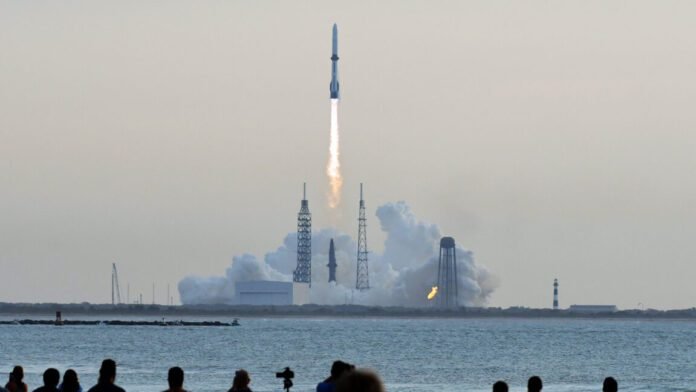
Blue Origin has set ambitious launch targets after reaching orbit with New Glenn, a 98-meter-tall heavy-lift rocket, for the first time in January 2025. It is competing with SpaceX for large commercial contracts and to develop a lunar lander for Nasa’s Artemis program.
Blue Origin is considering fundraising as SpaceX, which dominates the space launch market, gears up to list on the public market as early as June, with a valuation in excess of $1.75 trillion.
Limp told employees Blue Origin would have to demonstrate strong economics but that external funding was one option “on the table,” the people added.
Blue Origin declined to comment.
Limp was speaking to employees as he responded to questions on a new stock option plan. He said that similar to OpenAI and SpaceX, the group could use fundraising rounds to help staff exercise stock options. “We wrote this plan intentionally to allow for that,” he said.
He said the company needed to be “ready for external funding” and he was confident in strong interest from outside investors.
Bezos, who founded Blue Origin in 2000, is the company’s sole shareholder and its primary source of financial backing. He has largely used the sale of Amazon stock—he owns nearly 9 percent of the group, according to proxy filings—to fund the rocket maker.
Blue Origin is spending heavily as it scales operations including building an 800,000 sq ft manufacturing facility and a second launch pad in Florida. It is also investing in the testing and development of its reusable rocket booster and orbital upper stage.
The company is expected to spend roughly $4.8 billion this year, according to analysts at Capstone, a Washington-based consulting firm. It estimates the group has spent nearly $28 billion since its inception.
Josh Parker, an analyst at Capstone, said Blue Origin had faced significant cost increases in recent years as it developed New Glenn in a “brutal inflationary environment.” He said competition for talent with SpaceX had also forced up salaries.
Limp, a former Amazon executive who took charge of Blue Origin in late 2023, told employees that he did not expect Bezos would ever sell the business. He did not rule out a potential IPO in the future, the people added.
Blue Origin’s CEO in April said the group was planning between eight and 12 launches in total this year with New Glenn. A target of 14 launches had earlier been shared with employees internally.
He said the group had a longer-term goal of hitting 100 launches a year, with a significant portion of these expected to help build out its TeraWave satellite communications network for business customers.
EU Commission considers overhaul of regional policy department in spending shake-up
The European Commission is considering a major restructuring of one of its oldest departments as President Ursula von der Leyen seeks more direct control over EU spending.
The Directorate-General for Regional and Urban Policy, known as DG REGIO, oversees almost a third of EU spending through the bloc’s cohesion policy — roughly €600 billion of cash designed to help poorer regions.
But DG REGIO could become a casualty of the Commission’s broader effort to reorganize itself around new priorities, including competitiveness, defense and strategic investment, according to nine EU officials and diplomats familiar with the discussions. They were granted anonymity to discuss the confidential plans.
The debate reflects a wider shift in how Brussels manages money. While traditional cohesion funds have been managed jointly by EU governments and regions, during the pandemic the bloc moved to a more centralized model, with national recovery plans negotiated directly between capitals and the Commission.
That model showed the EU could move money faster when spending decisions were controlled more tightly from Brussels, the officials said, adding that the same logic is now shaping talks on the bloc’s next long-term budget.
Von der Leyen has pushed to steer more EU money toward defense and competitiveness. Under two restructuring scenarios now circulating in Brussels, she would gain tighter control over major spending programs, officials said.
One option is the creation of a new super-department, informally dubbed DG INVEST, that would oversee regional and social funds as well as the future competitiveness fund, four officials said.
Such a move would give von der Leyen a chance to reshape a major part of the Commission around her own priorities, one of the officials said: “If you build a structure from scratch, you shape it in your own image.”
A second option would stop short of scrapping DG REGIO outright, given its history and political weight. Instead, it could be merged with the Reform and Investment Task Force, known as SG REFORM, three officials said. SG REFORM manages the EU’s Covid recovery funds and already sits close to von der Leyen through the Secretariat-General.
But Ľubica Karvašová, vice chair of the European Parliament’s REGI Committee, said the ideas were “a failure to understand what cohesion policy is really about.”
Europe’s regions cannot be managed through an overly centralized investment model, Karvašová said. She also warned there would be political resistance if other Commission departments were strengthened at DG REGIO’s expense.
Inside DG REGIO, anxiety is spreading. One official described staff as “an egg in the fridge” — carrying an expiration date — adding that while many officials have already moved elsewhere in the Commission, there is no “panic exodus” yet.
The key moment for any overhaul is likely to be the Commission’s large-scale review, expected by the end of 2026 ahead of the next budget cycle in 2028, officials said.
The expected retirement next year of Director-General Themis Christophidou is also fueling speculation that DG REGIO could be killed off altogether, two Commission officials added.
[DAMASCUS] Damascus and Abu Dhabi on Monday, May 11, launched a comprehensive economic road map valued at more than $50 billion in what officials described as a major turning point in Syria’s recovery efforts and a new phase of Arab-led development in the Eastern Mediterranean.
The announcement came during the first Syrian-Emirati Investment Forum, hosted in Damascus, with the participation of a high-level Emirati delegation led by Minister of State for Foreign Trade Thani bin Ahmed Al Zeyoudi, alongside senior leaders from the UAE private sector, most notably Eagle Hills founder Mohamed Alabbar.
Opening the forum, Al Zeyoudi outlined the UAE’s broader strategic direction, emphasizing that the initiative aims to “advance bilateral relations across investment and trade sectors in a manner that serves the shared interests of both countries and their brotherly peoples.” He stressed before Syrian officials and investors that the UAE believes “economic integration and direct dialogue remain the optimal path toward sustainable growth.”
The development was met with strong official support from Damascus. Syrian Minister of Economy and Industry Dr. Mohammad Nidal al-Shaar described the forum as “a restoration of trust and natural communication between brothers.” In remarks that resonated strongly with attendees, he praised the Emirati development model, saying: “What we see in the UAE is the result of genuine effort and vision. We seek to benefit from an experience that turns the impossible into reality.”
The Syrian minister also said the government is committed to providing all necessary support and facilitation to ensure the success of Emirati projects, describing Syria today as “a major investment opportunity and a platform for launching toward the future.”
At the center of the discussions stood Alabbar, who drew significant attention after announcing Eagle Hills’ intention to launch massive urban and logistics projects worth $50 billion. Speaking directly to participants, Alabbar said the region is “undergoing a very major political transformation,” a shift that he said has given investors the confidence to commit large-scale investments matching Syria’s historical stature and the aspirations of its people.
The proposed investment vision includes the construction of integrated smart cities in Damascus and Latakia, providing more than 100,000 housing units, in addition to the redevelopment of strategic infrastructure, including the airports of Latakia, Qamishli, and Deir ez-Zor. The broader goal is to position Syria as a logistical hub linking the Arabian Gulf to the Mediterranean.
First Syrian-Emirati Investment Forum in Damascus, May 11, 2026. (Syrian Investment Authority)
The forum itself was not an isolated event, but rather the culmination of a gradual political track pursued by Abu Dhabi over several years. Observers point in particular to Syrian President Ahmed al-Sharaa’s visit to the UAE last April, which many viewed as the political green light for major Emirati companies to begin implementation.
The Syrian community in the UAE—estimated at around 250,000 people—is also emerging as a key bridge for transferring expertise and capital. Mahmoud al-Dharawi, deputy head of the Syrian Economic Forum for Development, stated that Syria has now become “a major investment opportunity” capable of attracting long-term strategic partners.
Despite challenges related to international financing mechanisms and the lingering effects of sanctions, the heavy Emirati presence in Damascus sends what analysts describe as a powerful signal: that economic realities may ultimately override political hesitation.
The success of this multibillion-dollar partnership would not merely mean rebuilding Syria’s physical infrastructure. It could also reshape the balance of power across the eastern part of the Arab world by presenting economics as the only sustainable guarantor of regional stability, and by demonstrating that development and joint economic interests may succeed where years of conflict failed.
As the forum concluded, it became increasingly clear that Damascus and Abu Dhabi are seeking to write a new chapter in the modern history of the region —one built on the premise that durable alliances are founded on economic integration and development, and that Syria may once again reclaim its traditional role as a commercial and investment crossroads in the Arab world.
Syrian-Emirati relations have passed through several pivotal stages. Since the era of Zayed bin Sultan Al Nahyan, the UAE has been a key supporter of development efforts in Syria, while Dubai and Sharjah became major hubs for Syrian business communities beginning in the 1990s.
Despite periods of diplomatic stagnation ushered in by the beginning of the Syrian Civil War in 2011, Abu Dhabi has maintained relatively friendly relations with Damascus before initiating a phase of what observers called “active engagement” in 2018. That trajectory accelerated dramatically after the devastating February 2023 earthquake, when Emirati humanitarian aid evolved into a political bridge that paved the way for Syria’s return—under former President Bashar Assad—to the Arab League.
Today, bilateral ambitions extend far beyond the real estate sector into strategic logistics cooperation. Discussions during the forum included opportunities to invest in and operate the airports of Latakia, Qamishli, and Deir ez-Zor, part of a broader effort to reconnect Syria with global trade networks.
With a large Syrian expatriate population in the UAE, representing, according to economic experts, roughly 68% of Syria’s educated workforce abroad, many analysts expect this partnership to create a “human bridge” capable of accelerating the return of Syrian expertise and capital.
Ultimately, supporters of the initiative argue that the project is about far more than reconstruction. They see it as an attempt to redesign the political and economic landscape of the Arab East through investment-led stability, offering a model in which development and regional cooperation replace conflict as the defining language of the future.
‘Survivor’ Host Endures Heartbreaking Family Tragedy
Heartbreak has hit the family of longtime Survivor host Jeff Probst after his brother, Scott Probst, died at the age of 58.
The tragic news was shared Monday in an emotional Instagram post by Scott’s brother, Brent Probst, who revealed the family is struggling with the sudden loss.
“Some sad news, our brother Scott is no longer with us,” Brent wrote. “He was a great brother, son and friend. I will miss him so much ❤️ I’m so sad he is gone.”
No cause of death has been publicly released.
As word spread online, former Survivor contestants quickly flooded the comments with messages of support for the famous TV family. Former contestant Janani K. Jha wrote, “I am so sorry to hear this. Sending you and your family so much love,” while fan favorite Adam Klein added, “I am so terribly sorry, Brent. Sending love to you and your whole family.”
While many fans know Jeff Probst as the face of the hit reality franchise Survivor, his brother Scott quietly built an impressive career of his own behind the scenes in both television and gaming.
Scott worked as a producer on several major video games, including Medal of Honor: European Assault and Command & Conquer 4: Tiberian Twilight. He also joined the Survivor family business for a time, working as a cameraman on 25 episodes of the long-running CBS competition series between 2011 and 2012. Years earlier, he also briefly worked as an art assistant connected to the show.
The devastating loss comes just two years after another heartbreaking death in the Probst family. In 2024, the brothers’ mother, Barb Probst, died from natural causes at 85 years old.
Now, fans of Survivor are rallying around Jeff Probst and his family as they mourn yet another painful loss behind the scenes of one of television’s most iconic reality shows.
Rivian adds a new onboard AI assistant to its latest software update
Rivian has quickly built a reputation as one of the auto industry’s leaders when it comes to vehicle software. Its clean-sheet approach to an electric vehicle’s electronic architecture earned it a $5 billion investment from Volkswagen Group, and its in-house infotainment system is beloved by owners despite no plans inside the company to support phone mirroring through Apple CarPlay or Android Auto.
In the absence of phone mirroring—and the way it lets you easily use Siri or Google Assistant hands-free while driving—Rivian has now added a new AI digital helper in its latest software update, compatible with both older Gen1 Rivians (model-year 2024 and older) as well as the more recent Gen2 models.
Rivian’s AI is deeply integrated into the car’s systems.
The Rivian Assistant rolled out in its latest software update, 2026.15, to all owners with a subscription or trial for Connect+, Rivian’s connectivity services. You activate it like most digital assistants, either with a button on the steering wheel, an icon on the infotainment display, or with a trigger phrase—in this case “Hey Rivian” or “OK, Rivian.”
Because the assistant runs within Rivian’s private cloud, it has a deep integration into the EV’s subsystems similar to BMW’s and Mercedes-Benz’s offerings, rather than the more pared-back abilities of the in-car AI assistant provided by Google to OEMs that use Android Automotive and Google Automotive Services. Rivian says that the AI can “control vehicle settings, climate control, navigation, media, messaging, and calling,” it can reference the owner’s manual, will reply to questions, search for information, and even explain in-car alerts and help you troubleshoot problems.
Rivian says you can also personalize the assistant via the Rivian mobile app, allowing it to connect to your calendar so it can access your schedule and to remember your preferences over time, including places you drive to regularly, like work or a school drop off, as well as things like music genres and favorite restaurants.
Interacting with Rivian’s AI.
I foresee that the reaction to Rivian’s assistant won’t be entirely positive, given the amount of antipathy some have toward LLM-based technologies. A few might even go as far as to declare they’ll never purchase a Rivian as a result, no doubt. But asking your car by voice to reschedule a meeting or find a spot to eat lunch seems a heck of a lot safer than someone using their smartphone when they should have their hands and eyes on the road.
Daredevil: Born Again S2 gives us a darker, grittier canvas
We loved the first season of Daredevil: Born Again, Marvel’s hotly anticipated revival of the popular series in the Netflix Defenders universe, and its sophomore outing did not disappoint. The show just wrapped its critically acclaimed second season, with a third already well underway—all part of MCU’s Phase Six master plan.
(Some spoilers below, but we’ll give you a heads up before any major S2 reveals.)
From its inception, Daredevil: Born Again was built around the conflict between Matt Murdock/Daredevil (Charlie Cox) and Wilson Fisk/Kingpin (Vincent D’Onofrio), with Fisk attempting to leave his criminal past behind as the newly elected mayor of New York, and Murdock determined to abandon his vigilante activities as Daredevil to focus full time on his law practice.
Those intentions prove to be relatively short-lived, as personal tragedy and political machinations eventually drove both men down their familiar old paths. The S1 finale saw Fisk pulling a major power move by declaring martial law in New York City and outlawing any masked vigilante heroes. The second season takes place six months later and deals with the inevitable fallout of that momentous decision. Murdock and his vigilante allies have been forced underground, while Fisk imposes multiple harsh authoritarian measures on the city to cement his power.
S1 proved Born Again to be an entertaining, character-driven series that felt very much a part of its Netflix predecessor while still having its own distinctive feel. Much of that was due to cinematographer Hillary Fyfe Spera, working in conjunction with the broader production team to bring Born Again’s distinctive aesthetic to vivid life. (You can read our 2025 interview with Fyfe Spera here.) Fyfe Spera and her team returned for S2, giving us a welcome continuity to the series’ overall design.
For the first season’s overall look, Fyfe Spera drew much of her inspiration from 1970s films like Taxi Driver, The French Connection, The Conversation, and Klute. For the second, she cites Michael Mann’s 1981 film Thief as a major inspiration. “It’s set in Chicago as opposed to New York, but the texture of that film, the grit of it, the use of darkness and contrast, was a really good reference for us,” Fyfe Spera told Ars. “Our goal was to take where the story left off [in S1] and evolve it, and that lent itself to getting a bit darker and grittier.”
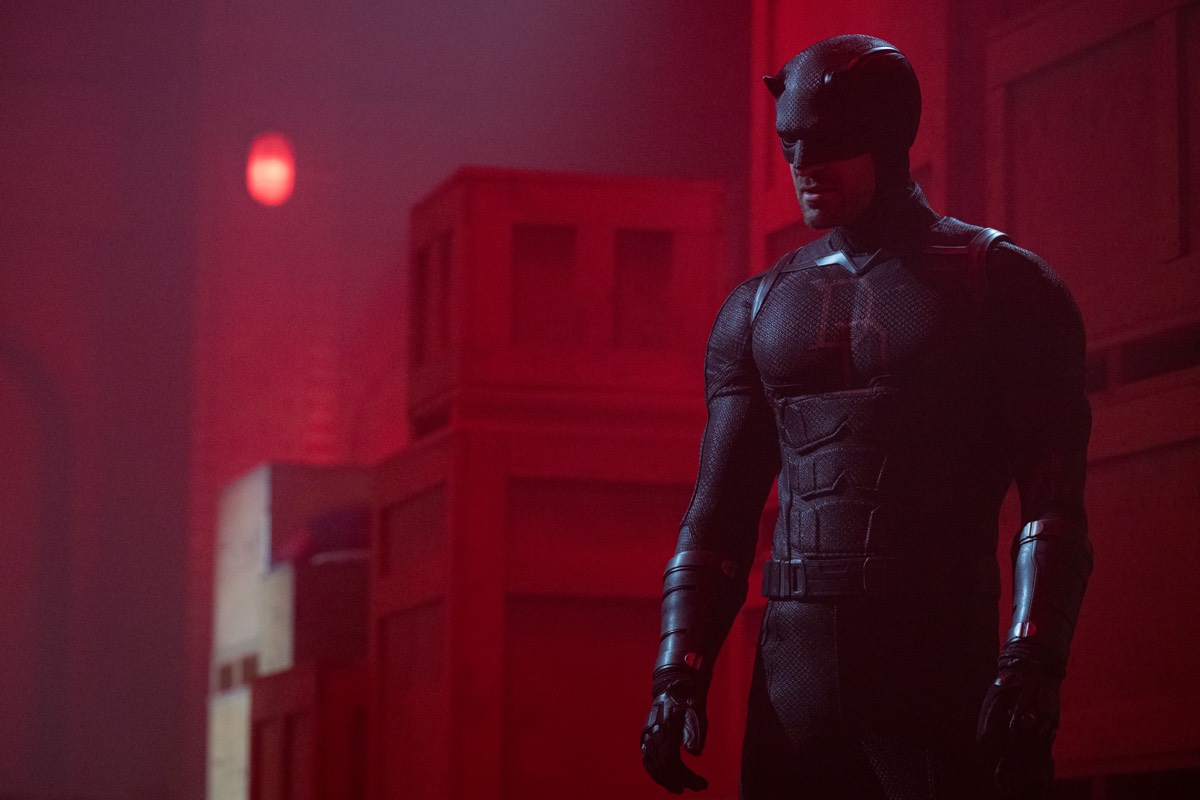
S2 also preserves the crucial central dynamic of Murdock and Fisk as two sides of the same coin, darkness and light. For the first season, Fyfe Spera translated that into two distinct camera languages. Last year, as Fisk trended back toward his Kingpin persona, she lit him with more white light, representing institutional oppression; Murdock, by contrast, was typically filmed in a warmer, red-lit environment. That visual vocabulary has been extended to the second season, augmented by a new black Daredevil suit with a red double D emblem on the chest—straight out of the 2010 Shadowland comic storyline.
Reds and whites
Matt’s vigilantes hide in the darkness, and are lit in warm red tones
Marvel/Disney+
Matt’s vigilantes hide in the darkness, and are lit in warm red tones Marvel/Disney+
Fisk represents institutional oppression as he hides in the light.
Marvel/Disney+
Fisk represents institutional oppression as he hides in the light. Marvel/Disney+
Matt’s vigilantes hide in the darkness, and are lit in warm red tones Marvel/Disney+
Fisk represents institutional oppression as he hides in the light. Marvel/Disney+
“There’s the vigilantes versus the institution of Fisk this season,” said Fyfe Spera. “[That theme] lent itself to opportunities to use darkness as a way to create those separate worlds in a really specific way. Fisk is hiding in the light, and the vigilantes are hiding in the darkness, but [in this case] light does not represent anything holy or just. So the vigilante world is warmer and more intimate, featuring the use of longer lenses, and the Fisk world feels more stark and white, with a more controlled dolly-mounted camera and very specific, centered frames.”
Fan speculation ran rampant about the apparent return of Matt’s old law partner, Foggy Nelson (Elden Henson), brutally gunned down at the start of the series’s pilot episode. Foggy is still dead, guys, sorry. But he does appear in pivotal flashback scenes as Matt is wrestling with his conscience, and those scenes were designed to evoke the original Netflix series, per Fyfe Spera.
“Not only did we go back to the spherical aspect ratio—as opposed to [Born Again’s] anamorphic screen—but we really wanted to lean into the greens and yellows with really saturated lighting,” she said. “It was fun to go back and call upon that DNA aspect of the show. We tried to stay true not just to the Netflix version but to the myth of Daredevil, of what both series have built up in terms of the story.”
The second season kicked off with a big set piece on a cargo ship in Red Hook’s free port. Fyfe Spera confessed to being a bit intimidated at first by the unique challenges of filming at that location, with no blue screen, despite living near the site and being familiar with the local waterways. “We’re going to do stunts on the deck, bring cameras there, a crane, and that entails [dealing with] tides, wind, currents, fog, cold—it’s a whole force of nature,” she said.
Staying true to the myth
Flashback scenes with Foggy were filmed in the original Netflix series aspect ratio.
Marvel/Disney+
Flashback scenes with Foggy were filmed in the original Netflix series aspect ratio. Marvel/Disney+
The lighting and camerawork force viewers “to see the result of the violence.”
Marvel/Disney+
The lighting and camerawork force viewers “to see the result of the violence.” Marvel/Disney+
Backlighting played a key role in several action sequences.
Marvel/Disney+
Backlighting played a key role in several action sequences. Marvel/Disney+
The lighting and camerawork force viewers “to see the result of the violence.” Marvel/Disney+
Backlighting played a key role in several action sequences. Marvel/Disney+
Her team collaborated with a Staten Island ship and tugboat company to pull off the very complicated logistics, starting with figuring out how to anchor the cargo ship in such a way that the boat wasn’t completely fixed. Lighting posed another challenge, since she wanted to include the kind of practical lighting one would use on the ship: sodium lights, LED sources, and so forth. The team also used drones for critical back lighting to get full 360 coverage, although the drones only had a 12-minute runtime, so this required careful coordination with the performers and manned camera crew. She adopted a similar interactive lighting approach for the scenes shot in the ship’s undersection, timed to the beats of the choreography.
“You have to be on your toes,” said Fyfe Spera. “We learned the choreography with the cameras and stunt performers, but we also had to learn it with the drone path, teach the drones where to fly consistently and hit the performance with a backlight throughout. If anything was off, the whole thing would fall apart. I’m so fortunate that we had the same team from S1, where we can finish each other’s sentences and everyone knows people’s abilities and how to push them. It’s a really collaborative process.”
Fyfe Spera credits stunt coordinator Phil Silvera and gaffer Charlie Grubbs with helping her capture the many action sequences and fast-paced fight choreography, such as Bullseye’s (Wilson Bethel) brutally efficient attack on Fisk’s anti-vigilante task force (AVTF) goons in a diner, or Fisk’s equally brutal beatdown of his opponent in a public boxing match.
“We want to show cause and effect, always,” she said. “There’s an A side and a B side but instead of cutting from A to B, we show [the transition] by panning with the camera or otherwise revealing it in some way. The violence is not sensationalized, where nothing comes of it. You are forced to see the result of the violence and you see the characters struggle with that. We were able to make the camera athletic enough to [capture] that. Showing it in a longer take makes it feel more authentic. It plays out so you can watch the whole arc of it.”
There were two sequences that Fyfe Spera is particularly fond of. The first is the episode 2 altercation in a bodega, which quickly escalates into an outright riot, culminating with Angela del Toro/White Tiger’s (Camila Rodriguez) Aunt Soledad (Ashley Marie Ortiz) being arrested by Fisk’s AVTF goons on a trumped-up charge. “It’s a scene that mirrors a lot of events that are unfortunately happening right now, so it meant a lot to me to get it right,” said Fyfe Spera. “We used a lot of practical lighting, like flashlights and headlights, to make the scene feel disorienting and hard to watch.”
WARNING: Major spoilers below.
Mirrored moments
Fisk’s wife, Vanessa, is his anchor; together they are a force to be reckoned with.
Marvel/Disney+
Fisk’s wife, Vanessa, is his anchor; together they are a force to be reckoned with. Marvel/Disney+
Matt Murdock and Karen Page’s relationship roughly mirrors that of Fisk and Vanessa.
Marvel/Disney+
Matt Murdock and Karen Page’s relationship roughly mirrors that of Fisk and Vanessa. Marvel/Disney+
Fisk’s wife, Vanessa, is his anchor; together they are a force to be reckoned with. Marvel/Disney+
Matt Murdock and Karen Page’s relationship roughly mirrors that of Fisk and Vanessa. Marvel/Disney+
Fyfe Spera’s second favorite sequence was the death of Fisk’s wife, Vanessa (Ayelet Zurer), in episode 5. The love story between Fisk and Vanessa has been a major linchpin of both the Netflix and Disney+ series. She humanized the monster and brought out his softer, art-loving side. Granted, Vanessa is ruthless in her own right, orchestrating Bullseye’s killing of Foggy in S1. That act created some tension between the two, but together, they are a force to be reckoned with.
The relationship between Matt and Karen Page (Deborah Ann Woll) this season is a mirror image of Fisk and Vanessa. Fyfe Spera described the pairings as “two power couples who need each other in desperate ways. It’s like those relationships during wartime that you know are probably doomed, ultimately, but they’re the only safe harbor.”
So when a shard of glass pierces Vanessa’s skull in the chaos that erupts when Bullseye tries to take out Fisk after the mayor’s brutal victory in the ring, and she collapses, the stakes are suddenly very high indeed for the mayor. Initially, it seems as if Vanessa will survive, but she finally succumbs to her injuries, and we watch Fisk’s tough, controlled facade crumble to pieces as she dies. It’s a powerful, heartbreaking scene, anchoring one of the single best episodes of television you’re likely to see this year.
“He’s completely broken down and all his defenses are gone,” said Fyfe Spera. “He can’t do anything to bring back the woman he loves. So our camera language changes. We used handheld cameras and longer lenses to make it feel really human and intimate—the last calm before the storm, because Vanessa is his anchor and he loses that. It was an emotional beat. You could have heard a pin drop on that set, everyone was keyed in on being there for the actors. And Vincent and Ayelet just nailed it.”
All episodes of Daredevil: Born Again S2 are now streaming on Disney+.
Europe is rearming itself without addressing the political consequences
Compounding the alarm triggered by Russia’s 2022 full-scale invasion of Ukraine, the erratic unpredictability of the second Trump administration has made the need for European security autonomy obvious. On a number of occasions over the past year, Donald Trump has loosely intimated that he might leave the Nato defence alliance.
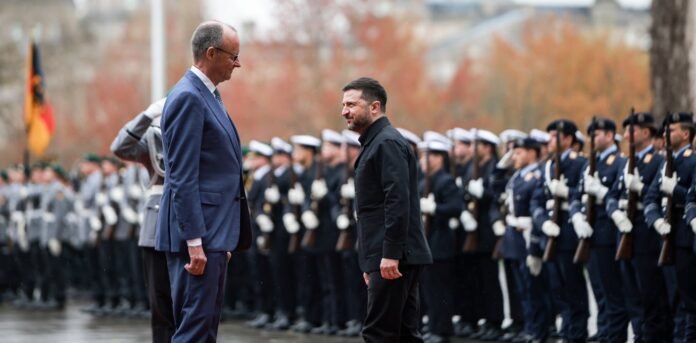
Washington’s recent move to withdraw 5,000 troops from Germany, plus unease over the US’s actions in Iran, have reinforced the imperative of European strategic independence. The US administration announced its planned withdrawal after the German chancellor, Friedrich Merz, criticised Trump’s Middle Eastern adventurism.
European rearmament is well underway. Governments still need to follow through on their promises to increase defence budgets to Nato’s new 5% of GDP target. But in 2025, European Nato members and Canada spent US$574 billion (£422 billion) on defence – an increase of nearly 20% on the previous year. This was the sharpest annual rise for 70 years.
The security debate should now move into a new phase in which European governments grasp the complex political implications of rearmament. These are gradually becoming apparent. Examples include a sharper trade-off between spending on defence and social programmes, and the prospect of Germany gaining military superiority as well as economic dominance.
There is also the danger of rightwing populist parties taking power with hugely increased military arsenals. Such parties are currently leading polls in France, Germany, the UK and several other countries, on agendas that sit uneasily with longstanding European security cooperation.
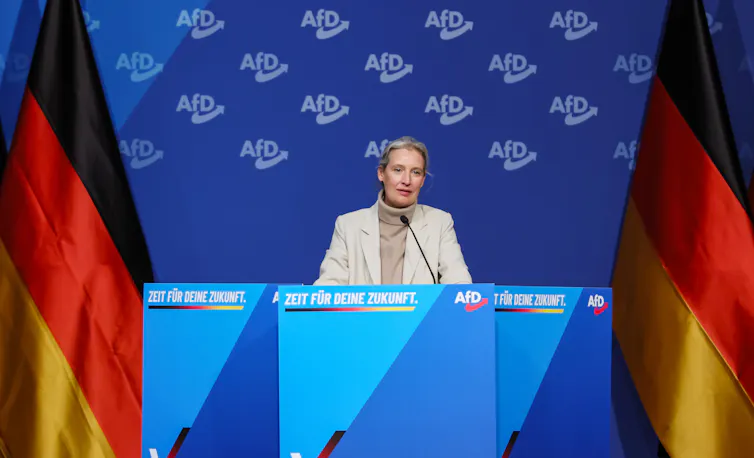
Alice Weidel, co-chairwoman of the Alternative für Deutschland (AfD) far-right populist party, speaks at an event in 2025.Ronald Wittek / EPA
European militarisation adds to the eye-watering military build-up globally, which is increasing the risk of major conflict. There is also the harmful environmental impact of rearmament, and the threat of over-militarisation crowding out Europe’s focus on non-military security – an approach rooted in social development and conflict prevention.
These challenges show that rearmament represents a foundational shift for the European order. Simply grafting this defence build-up on to unreformed EU and Nato structures is likely to create new imbalances.
The EU risks losing its value as a peace project if it morphs into a security union without a more balanced and comprehensive political settlement.
Addressing the consequences
Concerns are rising in several European countries about the need to embed and constrain future German military power within a more deeply integrated EU. Calls for a “European army” are resurfacing, most recently by the Spanish government – but still without political precision.
Defence spending is growing not just through national governments, but EU-level instruments that entail deeper collective security. Many European governments are pushing towards Nordic-style, whole-of-society security in which military and civilian resources mobilise in unison. The EU’s Preparedness Union Strategy, introduced in 2025, is aimed at this too.
Such considerations show that a securitised Europe must be underpinned by continent-wide political debate and channels of accountablity. As citizens are asked to mobilise around full-spectrum defence, they need a greater say in security policies. They need a voice in the trade-offs that higher defence spending will require, and how to manage issues such as Germany’s incipient military predominance.
However, the process of rearmament is currently being carried out in a way that reinforces the opaque, crisis-mode features of EU decision-making that have nourished illiberal populist parties. Europe will struggle to legitimise its security turn without rivitalising its collective political system in ways that provide stronger and more active societal input.
European powers are currently seeking to act more assertively in defence of their immediate geopolitical interests. They are doing so while not entirely jettisoning the liberal-order principles of rules-based cooperation and openness.
But they are struggling to inject this combination with clear, precise content. European governments have not, together, defined a common position on how far European rearmament should be used to project sharper-edged power externally, in addition to dissuading aggression against European territory.
European security deployments and conflict prevention elsewhere in the world have retrenched in recent years. The withdrawal of EU military forces from Africa’s Sahel region is perhaps the most notable example. It is unclear whether the current security turn aims to reverse this trend, or move further in the same direction.
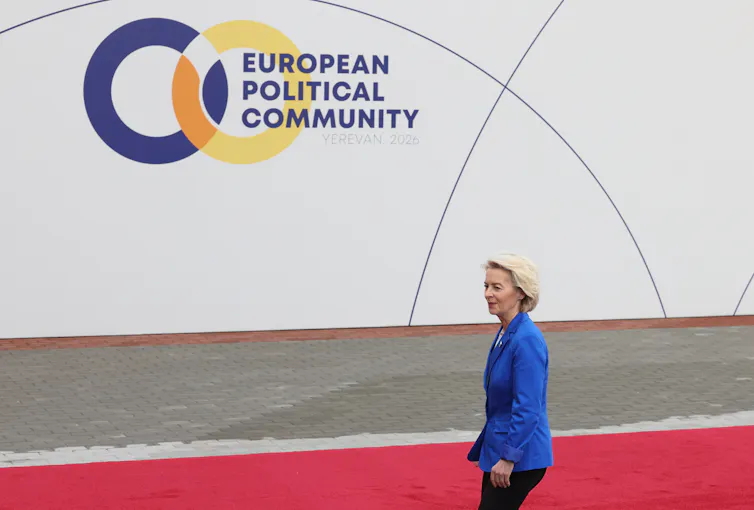
The president of the European Commission, Ursula von der Leyen, arrives in Yerevan, Armenia, for a meeting of the European Political Community on May 4.Hayk Baghdasaryan / EPA
Rearmament also raises questions about the organisational structure of the European order. Security dynamics are altering power balances and the relationship between different regional bodies. They are dragging the UK back into European affairs, for example, and prompting talk of new, flexible forms of alliance across the continent.
Upgrading European burden-sharing and coordination within Nato is overdue. But the alliance is unlikely to suffice as a structural, ordering principle for post-Trump security autonomy. Other formats will be needed to allow greater thematic and geographic adaptability.
Discussions took place on defence and security matters at the European Political Community summit in Armenia on May 4. It involved not only EU member states but the UK and other non-EU European powers. Recent European coalition efforts covering Ukrainian security and navigation in the Strait of Hormuz may herald a trend towards functional and shifting clusters of states.
Security debates do not neatly match the EU’s economic and regulatory space – and this invites reflection on innovative formats. Excluded from EU security plans, the British government especially needs to be ready with proactive ideas that contribute to structural reordering, well beyond negotiations of the current EU-UK reset.
As the EU finalises its new security strategy and the UK moves forward with implementing its strategic defence review, European governments need to address the political ramifications of rearmament. These present harder, more structural challenges than hiking defence budgets – but currently, governments are pushing them down the road.
Until these challenges are resolved, European rearmament will rest on shaky foundations, and generate many difficulties in its wake.
Trump has actually started to decouple US from China
Donald Trump is headed to China with a whole bunch of top US CEOs in tow to talk about trade. There is probably a post to be written here about how Trump is creating a new kind of “America, Inc” centered around his own person, using a combination of tariffs, export controls, federal government equity stakes and personal bullying.
But this is not that post. Instead, this is a post about decoupling. Trump was elected in 2016, and again in 2024, on promises to reduce American economic dependence on China. How well has he succeeded?
First, some background. In the mid-2010s, when Trump came to power, the US and China had a pretty well-understood economic relationship. America did R&D and designed products, then shipped the designs to China where they were manufactured — often using components from Japan/Korea/Taiwan, but sometimes using Chinese components. China would then ship the products back to America, where they were marketed and sold and serviced by the American companies.
Both countries chafed at this arrangement. Americans complained that the relocation of labor-intensive assembly to China put American factory workers out of a job (which was true) and worried that outsourcing assembly would eventually lead to the outsourcing of more valuable activities (which was probably true), while Chinese leaders were annoyed at being stuck in the low-value-added middle of the production chain. So both countries implemented policies to break up this arrangement and create a new trading system.
China used industrial policy to onshore high-value component manufacturing and create its own “national champion” brands, while U.S. Presidents Trump and Biden strove to reduce U.S. trade dependence on China.[¹] I wrote about this breakup in 2022:
Everyone agrees that China has succeeded in its half of the decoupling — far more Chinese-made goods are now made with Chinese components. The country has climbed up the value chain, and developed top brands like BYD, Huawei, Xiaomi, DJI, CATL, and so on.
Whether the US has succeeded in reducing its dependence on Chinese manufacturing, however, has been a subject of hot debate. On one hand, the percentage of America’s imports that it gets from China has plummeted:
That’s from a WSJ story in February of this year, entitled “The American and Chinese Economies Are Hurtling Toward a Messy Divorce”. A few more details:
Some businesses have moved production from China to the US to avoid tariffs, but the flow is still modest. Mexico and Southeast Asian nations are more common destinations for manufacturers leaving China…About 9% of Ohio manufacturers in a recent survey said they had reshored some production to the U.S. in 2025, up from 4% in 2021. About 60% of the reshoring in 2025 relocated from China[.]
It’s clear that tariffs have had an effect on the shifting of U.S. imports away from China. Even Trump’s far weaker tariffs in his first term showed results — America started buying tariffed goods from countries other than China, even as it kept buying non-tariffed goods from China:
Despite all the hullabaloo of “Liberation Day”, Trump’s tariffs on China — which built on previous tariffs on China by the Biden and first Trump administrations — dwarfed his tariffs on friendly countries:
Which kind of products is America no longer importing from China? Trump’s first-term tariffs mostly hit low-value products like furniture, shoes, and clothing (where China’s share was slowly declining anyway as its labor costs rose).
But more recent tariffs have hit China’s sales of electronics — PCs, phones, etc. Two years ago, most of America’s PCs were made in China; now, most of them are made in Vietnam.
It’s not just trade, either; on the investment side, too, decoupling has been very apparent. There were a whole bunch of stories in 2025 about U.S. businesses wanting to relocate their production out of China. These anecdotes represented a trend that was highly visible in the data — the collapse of foreign direct investment into the Chinese economy:
Why has investment shifted? Tariffs are one reason. Traditionally, a lot of what the US imported from China was made by American companies — for example, Apple manufacturing iPhones in Shenzhen and shipping them back to the US.
Tariffs make this a more expensive thing to do, so they provide an incentive for American companies — and any multinational companies that sell stuff to the US — to stop investing in Chinese factories.
A second reason is what I call the “China Cycle.” Multinationals have learned the painful lesson that when they put their factories in China, their technology will be appropriated by Chinese indigenous companies — often with the help of the Chinese government — and then later used to outcompete them in global markets.
Again and again, companies fell for the lure of the huge Chinese domestic market, only to lose their technological crown jewels to fierce Chinese competitors who rarely played fair. This has naturally chilled the desire to invest in China.
A third reason, of course, was the threat of war. As China grew more bellicose over Taiwan and the South China Sea, multinationals began to realize that having their factories in China, where they would be either blockaded or expropriated in the event of a conflict, posed a big risk.
So it’s possible to tell a pretty coherent story here. US companies had plenty of reasons to move out of China, but tariffs gave them a big extra push. And with the exodus of those companies, China’s exports to America plunged.
But in fact, there are lots of people who don’t believe the decoupling is real. One group — call it the “macro camp” — has argued that because US trade deficits and Chinese trade surpluses are still about the same size (or larger), there must be some sort of hidden conduit by which Chinese products are still reaching American shores, possibly by a circuitous route.
The macro camp included some strange ideological bedfellows — people like Brad Setser and Robin Brooks who were frustrated with tariffs’ inability to curb global imbalances and wanted to see sterner protectionist measures taken, and free-traders like The Economist and the Peterson Institute who seemed to think that if Trump & co. can be convinced that tariffs are futile, the free-trade consensus will reappear.
I had some ferocious battles[²] with some of these folks back in 2023:
My key argument was that you can’t just look at macro imbalances — China’s trade surplus with the whole world, and America’s trade deficit with the whole world — and conclude that Chinese goods must be making their way into America. It just doesn’t follow.
China could be finding alternative markets for its exports, while America found alternative sources for its imports, and these could roughly be the same countries. The macro imbalances would persist, but China and America would have decoupled.
That said, it’s also possible that the macro camp was right — China might be finding some way to get around tariffs. And sure, multinational companies are divesting from China, but that doesn’t mean China’s exports to America have to fall; China’s indigenous companies, like BYD and Huawei, are perfectly capable of selling their own products to America.
So before we conclude that decoupling is definitely real, we need to actually check the data in greater detail.
How might Chinese goods be sneaking into America? Decoupling skeptics often posited transshipment — basically, the idea that Chinese companies responded to tariffs by slapping a “Made in Vietnam” label on their products and sending them through Vietnamese ports on their way to American shores.
But while a little of this probably did happen, Gerard DiPippo estimates that transshipment is minor — at most 18% of China’s lost exports to America, and probably a lot less.
He got this estimate by looking at specific products — examining what China stopped selling to the US, and what it started selling to Vietnam, in the wake of tariffs. If products are being transshipped through Vietnam, the two numbers should line up.
But they usually don’t — the things China has started selling to Vietnam since Trump’s tariffs went into effect are, by and large, not the same products Vietnam has been selling more of to America. Transshipment can’t be the big story here.
A more convincing argument is mismeasurement. There is a gap between how much the US says it imports from China, and how much China says it exports to the US. As of 2024, the latter had fallen by much less than the former:
The biggest reason for this was probably the “de minimis” exemption, which let China ship small packages to America without paying tariffs. Chinese manufacturers took advantage of this rule by breaking down their shipments into a bunch of small packages:
But Trump closed the de minimis loophole by executive order in the summer of 2025. So that loophole can’t explain the continued collapse in China’s exports to the US over the last year.
There is one far more believable way that Chinese-made products might still be flooding into America: intermediate goods. Just as a “Made in China” iPhone was mostly made out of Japanese and Korean and Taiwanese parts back in 2011, a “Made in Vietnam” iPhone today will contain a lot of Chinese parts.
Since complicated components represent a lot more of the actual value of an electronics product than the actual final assembly, this means that it’s still mostly China selling stuff to America. Hsu, Peng, and Wu estimated in 2024 that this effect was substantial:
Utilizing transaction-level customs import-export data, we develop a novel measure to assess firm-product-level indirect dependence of U.S. importers on China via their suppliers in Vietnam and Mexico. Our findings indicate a substantial increase in indirect dependence on China post-Trade War…suggesting that despite efforts to reduce dependence on China, U.S. supply chains remain indirectly dependent on China via third-party nations.
Annoyingly, however, this data is only through 2022. In fact, we also have another data source on indirect trade — the OECD’s value-added trade numbers. But that’s also released very slowly; the most recent data set also only goes through 2022.
Looking at that data is still interesting, though. In fact, before the pandemic, America’s share of imports from China was falling on a value-added basis. The pandemic bumped it back up, but then it started to fall again in 2022:
The pandemic throws a wrench into the trend, making it hard to see if there’s been a recent drop that mirrors the recent drop in gross import flows. It’ll take some time to get that data. But in the meantime, it looks like Trump’s first-term tariffs really did reduce America’s import dependence on China a bit — and that decoupling might have resumed in 2022.[³]
Intermediate goods trade changes the basic story about decoupling. Tariffs and other factors broke the old arrangement between the U.S. and China, where American companies outsourced production to China and sold the products back to American customers. That old world is gone. In its place is a new relationship, in which Chinese companies sell parts and components to assemblers in other countries, who then sell the goods to America.
This is not a trivial change. On one hand, it shows how Chinese companies have moved up the value chain, becoming direct competitors to multinationals. On the other hand, final assembly of goods isn’t trivial or meaningless. It’s the least profitable part of the value chain, but it’s still important — after all, China industrialized in the 1990s and 2000s while doing mostly that sort of work.
So the fact that American tariffs are causing that assembly work to move out of China is significant. It doesn’t remove US dependence on Chinese manufacturing, but it reduces it. China itself started out doing assembly but later moved into component manufacturing; there are some signs Vietnam may be starting to do the same.
And if Vietnam can do it, so can India, Mexico, Indonesia and so on. China doesn’t have some magic secret sauce that makes it the only country that can make physical objects; other countries can learn, just like China did.
A non-Chinese supply chain won’t be built quickly or easily, and it hasn’t been happening as fast as the headline numbers suggest. But the US has made a promising start, and the tariffs on China were part of that.
A lot of Trump’s protectionist policy has been haphazard, misdirected, stupid, and downright corrupt, but this one — which was continued by Biden and the Democrats — was actually starting to yield some results. It would be a shame if Trump throws that all away on this trip in exchange for the promise of a few soybean purchases or whatever.
Notes
1. The US also started using export controls to limit China’s development in key strategic industries like semiconductors, and China eventually followed suit with its own export controls on rare earths.
2. OK, fine. I wrote some blog posts criticizing them, which they pretty much completely ignored. But in my mind, the battles were ferocious indeed.
3. One additional note of caution here: Even when the components are also made in Vietnam or Mexico, they may be made by Chinese-owned factories, meaning that some portion of what America pays to its Vietnamese and Mexican suppliers flows through to Chinese shareholders. Those profit flows won’t show up in any trade numbers at all.
This article was first published on Noah Smith’s Noahpinion Substack and is republished with kind permission. Become a Noahopinion subscriber here.
“Steadfastness 2” aid convoy gathers in Libya on route to Gaza
The “Steadfastness 2” land convoy, organised in support of the Gaza Strip, has deployed in Libya and is currently stationed in the Judaym Forest area west of Tripoli after entering Libyan territory two days ago.
According to the Algerian Popular Coordination for the Support of Palestine, all Algerian participants in the convoy have arrived at the designated assembly point after travelling through Tunisia.
In a statement, the coordination body said the Algerian convoy began its journey from multiple provinces across Algeria on 8th May before crossing Tunisia and reaching Libya.
The organisation expressed hope that the convoy would continue safely towards the Rafah Crossing in order to deliver humanitarian assistance to Palestinians in Gaza.
The organisers called on the governments involved to ensure the convoy’s security and diplomatic protection and appealed to the people of Libya and Egypt to facilitate its passage.
They also urged international human rights groups, journalists, unions and solidarity movements to monitor and support the mission.
The convoy includes doctors, engineers, academics, journalists, human rights activists and political figures. Organisers described the initiative as a humanitarian effort aimed at breaking the siege imposed on Gaza and delivering food and medical aid.