7.3 C
London
Wednesday, May 13, 2026
Home Blog

Soybeans on Beijing agenda but US farmers should temper optimism

0
soybeans-on-beijing-agenda-but-us-farmers-should-temper-optimism
Soybeans on Beijing agenda but US farmers should temper optimism

In 2017, President Donald J. Trump’s National Security Strategy declared China a competitor, an adversary and a “revisionist power” determined to supplant the United States in Asia.

In his 2025 National Security Strategy, the confrontational epithets were dropped, replaced by anodyne references. The document pledges to “rebalance” the US-China trade relationship and says deterring a conflict over Taiwan is a priority. But the tone of these pledges is neutral.

Even a section of the document that aims fire at China doesn’t use the words “China” or “Chinese.” The section vows to deny “non-hemispheric competitors” access to vital assets in the Western Hemisphere and “to make every effort to push out foreign companies that build infrastructure in the region.” Those “competitors” and “companies” are Chinese.

Could the Donald Trump who was once so tough on China have turned soft? His rhetoric is certainly softer. Applying the “look at what they do, not what they say” test also reveals softening. The administration is still pushing China on several fronts, but it has eased up on tariffs and allowed more sales of high-tech US semiconductors to China.

The chips sales worry China hawks like Matt Pottinger, who helped shape the first Trump administration’s tough approach to China as deputy national security advisor. In Congressional testimony in January, Pottinger criticized the sales, saying they would, among other things, “help China supercharge its military modernization.”

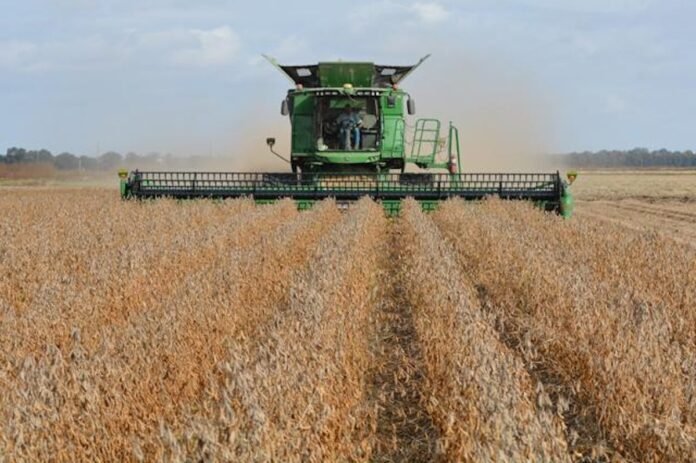
American farmers and ranchers suffered through the US-China trade wars in both Trump administrations. In last year’s trade war, China stopped buying American soybeans altogether for several months after Trump imposed 100% tariffs on Chinese imports.

A recent analysis by the Economist concluded that “agriculture was hit harder by retaliatory tariffs than any other American industry.”

The Chinese agreed last fall to resume purchases and the president agreed to slash the tariffs. This was more like a truce than a peace treaty, however. Neither side can feel confident that the other will continue to abide by the agreement.

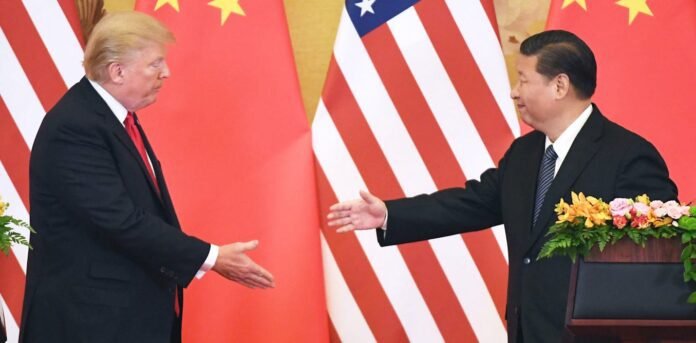
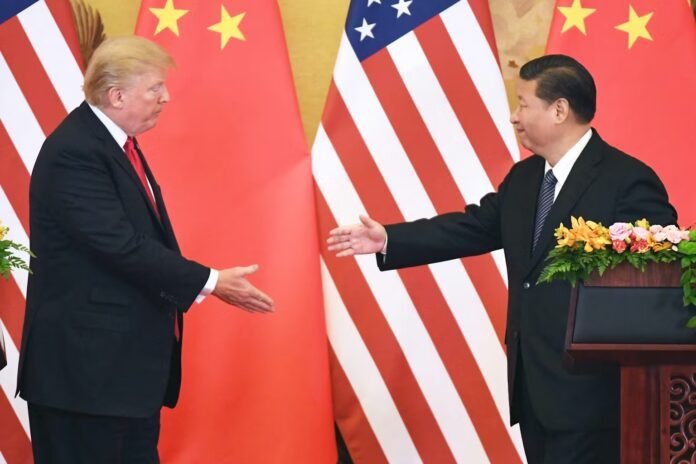
President Trump and President Xi Xinping are scheduled to meet in Beijing on May 14 and 15. Soybeans are on the agenda. It’s of course not the only issue the two leaders will discuss. The Chinese want their still-high tariffs further reduced and the Hormuz Strait opened, among other things. The US wish list includes rare-earths materials security and fentanyl-precursor control.

Still, Trump would love to come back with good news for US soybean growers. There’s a reasonable chance Xi will let him claim victory. The Chinese, he’ll crow, will keep buying US beans.

Make no mistake, though. Even if the summit is cordial and ends on a high note, there’s no guarantee of permanent peace. Each side has demonstrated it has the power to inflict pain on the other. Both have indicated a willingness to use that power to make a point.

With the summit just weeks away, China did that – twice. It ordered Meta, the US owner of Facebook, to unwind its $2 billion acquisition of the Chinese AI startup Manus.

And when the US Treasury sanctioned five small Chinese refiners for buying Iranian crude oil, China retaliated by saying the refineries could bring suit in Chinese courts against any bank, insurance company or other party complying with the US sanctions. It was the first time China had activated its anti-sanctions “blocking rules.”

The Wall Street Journal’s Lingling Wei, perhaps the best-sourced US journalist covering China, said she’s hearing from people around the leadership that Xi thinks he’s figured out how to “manage” Trump: “The U.S. president can be exhausted and outwaited, and calibrated escalation resets the bargaining floor instead of blowing up the relationship.”

Is Xi overplaying his hand? Though Trump wants this summit to go well, he doesn’t want to look like he can be “managed.” It wouldn’t be surprising if at some point after the summit he reminds Xi he can inflict pain, too.

It’s a truce, not a permanent end to hostilities. With luck, it will be a long truce. Trade, including soybean sales, will continue.

The Chinese, though, are preparing for the worst. They’re striving to end their reliance on US soybeans. They’re buying Brazilian beans and building infrastructure to help Brazil get product to market. They’re working to reduce soybean consumption by developing fermented feeds for their pigs.

US soybean farmers must prepare for the worst, too. They may still sell some of what they grow to China, but they need greatly increased sales to other markets, both foreign and domestic, in case the truce collapses.

Just as China wants to stop depending on them, they need to stop depending on China.

Former longtime Wall Street Journal Asia correspondent and editor Urban Lehner is editor emeritus of DTN/The Progressive Farmer. This article, originally published on May 11 by the latter news organization and now republished by Asia Times with permission, is © Copyright 2026 DTN, LLC. All rights reserved.  Follow Urban Lehner on X @urbanize.

Immigrants Detained in Chicago Military-Style Raid Seek Millions in Damages

0
immigrants-detained-in-chicago-military-style-raid-seek-millions-in-damages
Immigrants Detained in Chicago Military-Style Raid Seek Millions in Damages

On the night of the military-style raid at a Chicago apartment complex, a loud boom woke the Nigerian man who lived in Unit 215. Tolulope Akinsulie stood up from his bed and saw heavily armed federal agents rushing into his apartment. He then felt the jaws of a large dog biting into his right ankle, knocking him to the floor. Akinsulie screamed as the dog tore the flesh from his ankle, thighs, hip and wrist. 

Down the hall, agents took a Venezuelan mother and her 16-year-old son from their apartment at gunpoint to another unit. There, they saw agents hit a man with what looked like the butt of a  rifle and kick another who was lying on the floor. As he watched, her son began to hyperventilate.

“Here is another one,” agents said about a Mexican man who lived in Unit 502, before zip-tying his hands behind his back and marching him out of the building. Agents told the man he wasn’t welcome in the United States, took his city of Chicago identification card and ripped it up in front of him. 

While much has been documented about the Sept. 30 raid by the U.S. Department of Homeland Security, new accounts from 17 men, women and children detained that night paint a violent and terrifying portrait of how the federal agents conducted the operation.

Their descriptions form the basis of administrative claims filed on their behalf Tuesday against DHS and several other federal agencies that took part in the midnight raid in Chicago’s South Shore neighborhood.

The claims mark the tenants’ first step toward seeking accountability, their lawyers said, as well as millions of dollars in damages, for federal agents’ actions during the raid, a key moment in the Trump administration’s immigration crackdown in Chicago. The claims allege that agents didn’t have warrants before entering apartments.

“There was no reason to do me like that,” Akinsulie said in an interview with ProPublica. His body still bears the dark scars from the dog bites. The complaint, he said, is meant to send a message that officials are not above the law. “Everybody can get a check and balance,” he said. “People have to learn how to act right.”

The claims allege that federal agents caused physical injuries, emotional trauma, “brutal detention” and financial loss. Each of the claimants — 15 are immigrants, and two are U.S. citizens —  is seeking about $5 million, an amount the attorneys believe is comparable to similar court judgments in Chicago.

“There is no amount of damages that will compensate our clients for the trauma they experienced that night,” said Susana Sandoval Vargas, the Midwest regional counsel for the Mexican American Legal Defense and Educational Fund, a national Latino civil rights organization that is representing some of the tenants. “It is about holding the federal government accountable for their unlawful actions.”

A man’s leg with his pant leg rolled up. Above his ankle, there are scars.
“There was no reason to do me like that,” Tolulope Akinsulie said. His leg still bears the dark scars from where a dog bit him on the night of a federal raid on his apartment complex. Jamie Kelter Davis for ProPublica

A DHS spokesperson said Wednesday that the “operation was performed in full compliance of the law” and that tenants are not owed compensation. “DHS is taking appropriate and constitutional measures to uphold the rule of law and protect our officers and the public from dangerous criminal illegal aliens.”

The spokesperson did not respond to questions about Akinsulie’s injuries. But federal immigration agents have said they issued verbal warnings as they entered Akinsulie’s unit and believed he had been trying to hide and evade arrest, according to documents filed in an unrelated lawsuit. Akinsulie said he was in a deep sleep and did not hear any warnings or the dog barking.

Within DHS, the South Shore tenants’ claims also were submitted to U.S. Customs and Border Protection, U.S. Border Patrol and U.S. Immigration and Customs Enforcement. In addition, they were sent to the Bureau of Alcohol, Tobacco, Firearms and Explosives and the Federal Bureau of Investigation, neither of which responded to questions from ProPublica.

An 18th claim also was filed Tuesday on behalf of a tenant who was detained outside the building a week before the raid and lost property.

The Federal Tort Claims Act provides one of the only avenues for people who believe they were harmed by federal employees acting unlawfully and allows for compensation for emotional distress, property damage, injury or death. If the agency does not respond or settle a claim within six months, or if it denies a claim, individuals can then file a lawsuit. 

DHS would not say how many claims have been filed since last year. But already there have been dozens across the country: A pregnant woman in California said she went into premature labor after being detained and shackled. A Marine Corps veteran said he was tackled by federal agents while protesting in Oregon. A Chicago alderperson said agents swore at her, shoved her and handcuffed her after she questioned their presence in a hospital emergency room. The DHS spokesperson said the three individuals were obstructing or interfering with law enforcement.

In interviews, a half dozen attorneys said they expect to see more claims in the coming months. “Hopefully this case and others will be a check against the most aggressive and reckless forms of (immigration) enforcement,” said Mark Fleming, an attorney with the National Immigrant Justice Center, which worked on the case along with MALDEF, the Immigrants’ Rights Clinic at the University of Chicago and the MacArthur Justice Center.

During the South Shore raid, some 300 heavily armed agents stormed the dilapidated, five-story building; some descended from a Black Hawk helicopter. They hurled flash grenades, broke down apartment doors and zip-tied dozens of immigrants and U.S. citizens who lived in the building. The drama was captured by a television crew that accompanied agents.

The Trump administration repeatedly justified its actions by claiming it had intelligence that the Venezuelan gang Tren de Aragua had taken over the building, and that there were guns, drugs and explosives inside. ProPublica journalists, who over the past several months have interviewed 16 of the 37 immigrants detained that night, previously reported that there was little evidence to back the government’s claim. To this day, federal prosecutors have not filed criminal charges against anyone who was arrested.

The tort claims detail what families, including those with young children, allegedly experienced during the raid. A Venezuelan mother and father huddled together in their apartment with their four children, the youngest a 1-year-old U.S. citizen, who “screamed and cried in terror” while agents pointed guns at them. Agents marched them outside in their pajamas and separated the father. One of the boys, now 9, had a panic attack, according to the claim.

DHS officials previously insisted children were not zip-tied, but the account from the 16-year-old boy who hyperventilated at the sight of agents assaulting immigrants said he and his mom were zip-tied outside the building. DHS called that an “abject lie” and said no children were handcuffed or restrained. 

While the tenants were detained, the records allege, many of their possessions were stolen or lost: shoes, Playstations, smartphones, jewelry, mattresses, a backpack with $1,300 in cash and toys. Several reported losing their vehicles, too.

A large apartment building with a lawn and gate in front of it. There are two large trees framing the entrance of the building.
The South Shore apartment complex after the raid Jim Vondruska for ProPublica

The raid upended tenants’ lives. Many of the immigrants, mostly Venezuelan, have already been deported. Many U.S. citizens who lived in the building, including some on public housing assistance, were forced to relocate late last year after a judge ordered the building shuttered for safety issues and code violations.

José Miguel Jiménez López, 42, the Mexican man who lived on the fifth floor, worked as a welder in Chicago before the raid disrupted his life. Jiménez said he wasn’t a gang member or involved in criminal activity. So even when agents pointed guns at him, zip-tied his hands and told him to go back to his country, he thought they would let him go. They didn’t.

Over the next four months, he was shuttled to detention facilities in Indiana, Kentucky and Louisiana before being released at the Mexico border in February. He is now living in his childhood home in the state of Guanajuato. “I have friends and family who are still there, and they are afraid,” he said in an interview. “I wouldn’t like to see them go through what I had to go through.”

His claim details harsh conditions at the facilities, including insufficient food and water, constant air conditioning during winter and little time outside. Others described getting sick from the drinking water, a lack of adequate medical care and a constant worry that they would never see their loved ones again. The DHS spokesperson said the “safety and well-being of detainees are prioritized” and that detainees have access to medical care and nutritious meals.

In his claim, Jiménez alleged that “ICE officers treated him and other detainees as if they were sub-human and not entitled to basic dignity or respect.” He said he lost $3,000 worth of property, including a TV and a drill. 

Meanwhile, the Venezuelan woman and her 16-year-old son were transferred to the Dilley Immigration Processing Center in Texas. They spent three weeks there until they were released into the U.S. on electronic monitoring. The woman now has trouble sleeping, while her son sees a psychiatrist to process what happened that night. 

Akinsulie, 42, said he is grateful to be alive. A devout Christian, he finds peace reading the Bible and in prayer. But while he was in detention, he had so many nightmares that he needed to see a psychiatrist. He dreamed about dogs barking behind him. Chasing him. Talking to him.

“The one that really baffled me was when the German shepherd was chasing me. Then I was running,” Akinsulie said. “The German shepherd was about to bite me. That really scared me because I don’t want no more bites.”

The nightmares stopped after he was released in March; the government had conceded that he and others had likely been arrested unlawfully. Akinsulie, who said he has lived in Chicago since 2007, has no criminal history, according to the arrest report from the night he was detained. 

He is back in Chicago now, staying with a friend and doing odd jobs. He finds it difficult to stand for a long time, and sometimes pain shoots from his hip to his right foot. Once an avid soccer player, he said he can’t kick the ball or run like he used to. He worries that the injuries might be permanent, but he can’t afford to see a doctor.

FCC angers small carriers by helping AT&T and Starlink buy EchoStar spectrum

0
fcc-angers-small-carriers-by-helping-at&t-and-starlink-buy-echostar-spectrum
FCC angers small carriers by helping AT&T and Starlink buy EchoStar spectrum

The Federal Communications Commission yesterday approved EchoStar’s sales of spectrum licenses to AT&T and Starlink operator SpaceX. The deals are worth $40 billion in total.

The orders, issued by the agency’s Wireless Telecommunications Bureau and Space Bureau, aren’t surprising given that FCC Chairman Brendan Carr essentially forced EchoStar to sell the licenses. Last year, Carr threatened to revoke the licenses after SpaceX alleged that EchoStar subsidiary Dish Network “barely uses” the spectrum to provide mobile service to US consumers.

Dish had obtained a deadline extension for its network deployment obligations from the Biden-era FCC, and Carr objected to the agreement made with the previous administration. After Carr’s threat, the Charlie Ergen-led EchoStar struck deals to sell spectrum licenses to SpaceX for $17 billion and to AT&T for $23 billion.

AT&T is set to acquire 30 MHz of nationwide spectrum licenses in the 3.45 GHz band and 20 MHz in the 600 MHz band, giving it new options for both mid-band and low-band spectrum in its 5G and fixed wireless networks. SpaceX is buying 65 MHz of nationwide spectrum licenses in a few chunks between 1.695 GHz and 2.2 GHz, which it can use to boost the Starlink satellite mobile service that is available for T-Mobile phones.

The deals may still have a problem despite yesterday’s approvals. EchoStar objected to an FCC-imposed condition requiring it to fund an escrow account of $2.4 billion to compensate construction companies that were hired to build the Dish network.

Controversial approval and condition

EchoStar’s Boost Mobile subsidiary will continue to provide wireless service, but over the AT&T network rather than EchoStar’s own. Boost Mobile will also have access to Starlink’s mobile network through a deal with SpaceX. EchoStar, which has said it had to scale back its network-construction plans to resolve the FCC’s complaint, issued a statement yesterday suggesting it may fight the escrow requirement.

Separately, a group representing rural mobile carriers criticized the approvals, saying the FCC ignored competition concerns raised by small wireless operators. The spectrum sales “continue the troubling pattern of spectrum aggregation that disadvantages rural wireless providers, stifles competition in the wireless marketplace, and hinders the deployment of wireless services—particularly in the hardest-to-serve rural areas,” the Rural Wireless Association said.

While Starlink isn’t a wireless carrier, it is looking to dominate the emerging market for Direct-to-Device (D2D) systems that use low Earth orbit satellites to provide service on standard mobile phones. Meanwhile, AT&T’s purchase of EchoStar licenses continues the consolidation of spectrum with the three major carriers—AT&T, Verizon, and T-Mobile.

“In approving the EchoStar/AT&T deal, the FCC’s Wireless Telecommunications Bureau erroneously asserts that the likelihood of competitive harm is low, dismissing concrete harms identified by rural wireless carriers, including reduced access to spectrum needed to expand service in rural markets and diminished competitive opportunities for rural and regional wireless providers,” the Rural Wireless Association said.

Although the Rural Wireless Association objected to the approvals, it said there is still a chance for small carriers to get some spectrum licenses from EchoStar in future deals.

FCC chair says it’s all “thanks to President Trump”

While the approvals came from FCC staff, Carr announced the decisions in a press release. He also gave credit to his boss in the White House.

“Thanks to President Trump, America is leading the world again in next-gen technology,” Carr said in his official statement on the approvals. “As a result of President Trump’s work, Americans are now going to see faster Internet speeds, stronger competition, and innovative new offerings, including high-speed connections right to your smartphone from space—providing ubiquitous connectivity when these new systems are complete.”

AT&T previously received special authority to deploy EchoStar’s 3.45 GHz spectrum while the sale is pending. AT&T said yesterday that it has deployed the mid‑band spectrum to boost network capacity, and will deploy the low-band frequencies after closing the purchase. AT&T has said it expects to complete the deal in mid-2026.

EchoStar’s deal with SpaceX will be completed in two stages, with the licenses being transferred first to a trust held for the benefit of SpaceX and later from that trust to SpaceX. The companies say the two-step process is necessary to obtain regulatory approvals outside the US. The final step is expected to be completed by November 30, 2027, but could happen earlier.

EchoStar opposes “unprecedented” escrow condition

EchoStar said it is “evaluating next steps” in regard to the escrow condition. That kind of statement can indicate a company is considering legal action.

“The FCC has continuously applauded EchoStar’s spectrum sales to AT&T and SpaceX as pro-competitive transactions that serve the public interest, and we appreciate that the FCC approved them today,” EchoStar said. “However, these approvals come with an unprecedented involuntary escrow condition. We are analyzing this requirement and evaluating next steps.”

The FCC said the docket drew comments “alleg[ing] that EchoStar has told various tower companies, fiber backhaul providers, and construction firms that it will not fulfill its contracts nor pay the monies it owes them for constructing that radio network.” The companies asked the FCC to impose an escrow requirement so they can be paid from the proceeds of the spectrum sales.

“EchoStar disputes claims that have been raised by those companies,” and “responds that it has reached settlements with hundreds of vendors and made hundreds of millions of dollars of payments,” the FCC said. “It argues that any escrow condition is illegal and unmanageable.”

Despite acknowledging those objections, the agency ordered EchoStar to put $2.4 billion in an escrow account, which would be withdrawn based on the outcome of legal disputes with vendors. The FCC acknowledged that the agency itself played a “unique role in the underlying series of events,” creating “a precedentially novel fact pattern and cognizable public-interest harms specific to this transaction that we find necessary to resolve here.”

“With the attached condition, the FCC continues to allow the relevant parties and, if necessary, courts or other bodies, to adjudicate or settle these issues,” the FCC said.

Trump-XI summit: US president says he will discuss arms sales to Taiwan – breaking decades of US policy

0
trump-xi-summit:-us-president-says-he-will-discuss-arms-sales-to-taiwan-–-breaking-decades-of-us-policy
Trump-XI summit: US president says he will discuss arms sales to Taiwan – breaking decades of US policy

Donald Trump and Xi Jinping are likely to discuss many issues as they meet this week in Beijing. But alongside trade, technology and the war in Iran, one topic of conversation will stand out – the future of Taiwan.

Taiwan has long been a sensitive issue in Sino-American relations. Beijing regards the island as a breakaway province which must be reunited with the mainland. The United States has long opposed such a step. Yet in recent months, Trump has fuelled speculation that he may be ready to change key aspects of US policy on the issue, potentially granting Beijing long-sought concessions.

Trump’s apparent readiness to make these moves means that Taiwan is one of the issues on which we might see the most significant policy developments at the summit. And that could happen simply through the famously voluble president uttering just a few simple words.

The president’s policy towards Taiwan has been inconsistent and seemingly more malleable than that of previous administrations. Advocates for Taiwan point out that his administration recently approved the largest ever US arms sale to the island. But at the same time, he has sowed doubts about the strength of his support for Taiwan’s independence.

US policy towards Taiwan has traditionally been based on two principles. The first is “strategic ambiguity”, which means that the US declines to explicitly state whether it would actively use its military to defend Taiwan from attack by China. This policy is supposed to deter China while also discouraging Taiwan from formally declaring its independence from Beijing.

The second principle is the “one China policy”. According to this policy, the US recognises Beijing as the legitimate government of China, while opposing any violent solution to its dispute with Taiwan. It also retains robust informal links to the Taiwanese government in Taipei.

Observers are concerned that Trump may water down these principles during his summit with Xi. For instance, he might state that the US not only “does not support” Taiwanese independence but actively “opposes” it. Or he might double down on previous comments he has made indicating that whether or not Xi invades Taiwan is “up to him”.

Trump has also explicitly stated that he will discuss future US arms sales to Taiwan with Xi during this week’s summit. This violates one of the so-called Six Assurances that the US has upheld towards Taiwan since the 1980s, and which were endorsed by the US Congress in 2016.

Even securing a discussion of arms sales would be a victory for Xi, who would welcome an opportunity to chip away at the Six Assurances. Presumably he would then try to weaken the US commitment to the other five, which include a US commitment not to change its position on Taiwan’s sovereignty.

More concretely, if Xi succeeds in making US arms sales to Taiwan a legitimate topic of negotiation in Sino-American relations, then he could head them off in the future by offering the US concessions in other areas. For instance, if Trump or a future president asks Beijing for its help settling a conflict like that in Iran, Beijing might demand an end to US arms sales to Taiwan as the price.

High stakes

Given Trump’s reputation as a formidable China hawk, his attitude towards Taiwan may seem surprising. But it’s actually part of a longstanding pattern.

In relations with China, Trump has arguably always prioritised economic issues, while appearing less concerned about the security of America’s regional allies. He has also raised doubts about whether Taiwan is even defensible. In his first term, he reportedly told aides that: “Taiwan is like two feet from China. We are 8,000 miles away. If they invade, there isn’t a fucking thing we can do about it”.

Journalists surround a television set which is showing US president DOnald Trump arriving in Beijing.

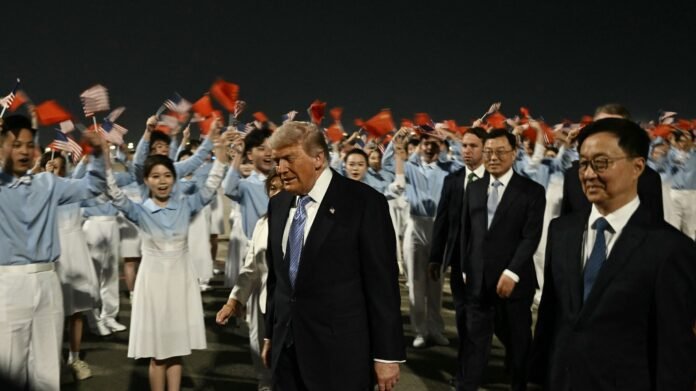
Huge anticipation: journalists watch the US president arrive in Air Force One for his Beijing summit with President XI, May 13. Samuel Corum/Sipa USA) Credit: Sipa US/Alamy Live News

Trump is also both highly transactional and less focused on abstract principles of foreign policy than most previous presidents. He views America’s support of allies such as Taiwan as a gift that it gives them, one that is often not worth the cost. If he can achieve a concrete victory for himself today by trading away support for Taiwan tomorrow, he may well be willing to do so.

All of these developments matter because they make a violent conflict between China and Taiwan, potentially ultimately involving the US, more likely. If Trump makes concessions to Xi, it will be the latest signal that US support for Taiwan is wavering. That made be read in Beijing as permission to violently change the status quo. Even though such an act might belatedly then be met with force from Washington in response, it is made more likely by Trump’s stance today.

Even worse for Trump, the summit comes at a time when American power and the wisdom of its long-term strategy are being visibly called into question in the Middle East. The US is bogged down in an intractable conflict and has severely damaged its deterrent capacity in the Indo-Pacific by burning through advanced munitions at a high rate. Trump’s personal unpopularity is also rising at home amid the war and its economic fallout.

This weakened position makes it even more likely that Trump will want to strike a deal with Xi to help end the war in Iran or ease trade tensions to help the economy at home. Taiwan may be the price of that – and, ultimately, peace.

Baloch insurgency: Suicide bombs and uptick in violence threaten Pakistan, regional security

0
baloch-insurgency:-suicide-bombs-and-uptick-in-violence-threaten-pakistan,-regional-security
Baloch insurgency: Suicide bombs and uptick in violence threaten Pakistan, regional security

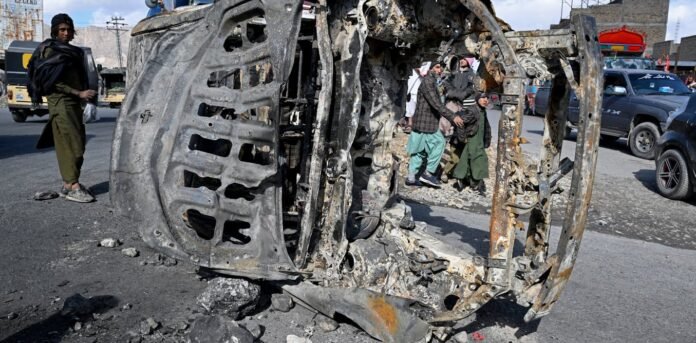
In the space of 10 days in late April 2026, insurgents in Pakistan purportedly carried out 27 attacks in the country’s southwest province of Balochistan, killing at least 42 military personal. Then, on May 11, authorities announced that a suicide bombing plot on the capital, Islamabad, had been foiled. Authorities arrested a girl over the incident – a nod to militants’ increasing use of young Baloch women to carry out attacks.

These incidents represent the latest flaring up of a long-running insurgency in Pakistan’s largest province and home to around 15 million people.

For a rundown of what you need to know about the Baloch insurgency and groups involved, The Conversation turned to Amira Jadoon and Saif Tahir, experts on militant and terrorist organizations currently researching such groups’ operational activities and strategic messaging in Afghanistan and Pakistan.

What is the Baloch insurgency about?

Pakistan’s southwestern province of Balochistan has long been the site of resistance and armed movements involving Baloch, an ethnic group of an estimated 8 million to 10 million people that straddles parts of Pakistan and Iran.

Their insurgency is rooted in both contemporary and historical grievances. Its origins trace back to the contested annexation of the princely state of Kalat in 1948, months after the partition of British India into India and Pakistan, and the resulting confrontations between Baloch tribal leaders and the newly formed Pakistani state.

While the insurgency long remained a low-level struggle framed around Baloch marginalization and economic exploitation, it turned violent in the early 2000s with the rise of militant factions, including the Balochistan Liberation Army, or BLA, in 2000 and the Balochistan Liberation Front, or BLF, which was revived in 2004 under current leader Allah Nazar Baloch decades after its 1964 founding. The insurgents’ goals vary, from greater autonomy and control over the province’s natural resources to full independence.

Baloch militants generally cast their emergence as a nationalist rebuttal to the Pakistani government’s long-standing narrative, which states that the unrest is driven by a handful of tribal chiefs resisting development rather than a broad-based movement.

In practice, the contemporary insurgency has expanded well beyond its tribal base, and Baloch militant groups have invested heavily in strategic communications that directly challenge the Pakistani state’s framing.

Today, Baloch militants’ propaganda targets the local educated youth, including women. They play on existing grievances over enforced disappearances, state repression and resource extraction. Balochistan is home to significant deposits of copper, gold, natural gas and coal, including at the Reko Diq mine, one of the world’s largest undeveloped copper and gold reserves. Yet the province remains Pakistan’s poorest.

Baloch militants’ efforts are designed to broaden the insurgency’s appeal, adding an urban, middle-class layer to what was once a primarily tribal revolt that casts itself as a struggle to defend the Baloch “motherland” and achieve national liberation.

The Baloch insurgency has emerged as one of Pakistan’s most consequential internal security challenges. In 2025, the BLA claimed 521 attacks and 1,060 security-force fatalities, though independent monitoring records substantially fewer attacks, at around 254 events, in Balochistan over the same period.

Two Baloch militants’ operations bookend the recent escalation. In March 2025, BLA fighters hijacked the Jaffar Express – a heavily used passenger train connecting Quetta, the capital of Balochistan, to Peshawar in northwestern Pakistan – holding more than 350 passengers in a 30-hour siege. In April 2026, the group announced a new naval wing, the Hammal Maritime Defence Force, following its first maritime attack on a Pakistan coast guard vessel near Jiwani, in Gwadar district.

These tactical innovations have been reinforced by deliberate efforts at broadening the support base for Baloch separatism. The 2018 formation of Baloch Raji Ajohi Sangar, an alliance of Baloch militant groups, and the 2020 entry of the non-Baloch Sindhudesh Revolutionary Army, a Sindhi separatist group based in neighboring Sindh that has extended Baloch militants’ operational reach into Karachi, signal an expanding ethno-regional coalition aimed at broadening the geographic and ideological scope of the insurgency.

Why the uptick in violence now?

Four converging factors explain the recent escalation.

First, the Pakistani state’s crackdown on peaceful political space in recent months has accelerated social discontent. Following the March 2025 Jaffar Express attack, prominent Baloch rights defender Mahrang Baloch was arrested under anti-terrorist laws, while three protesters were shot dead at a peaceful sit-in in Quetta.

As nonviolent avenues close, aggrieved civilians become more receptive to Baloch militants’ recruitment narratives.

Second, Baloch militants have acquired U.S. weapons left behind in Afghanistan during the 2021 withdrawal, including M4 and M16 rifles fitted with thermal optics. Recent reports have linked the arms used in the Jaffar Express attack directly to abandoned U.S. stockpiles in Afghanistan.

Third, militant operational collusion has deepened between the Balochistan Liberation Army and the Tehrik-i-Taliban Pakistan, the latter ranked by the Institute for Economics and Peace as the world’s fastest-growing insurgent group in 2024.

Despite the groups’ divergent ideologies, the cooperation appears to have produced clear tactical convergence, including town takeovers, the use of suicide bombings, and sniper and ambush tactics.

Finally, Baloch groups have excelled in the effective use of social media to influence and recruit educated young people, including women.

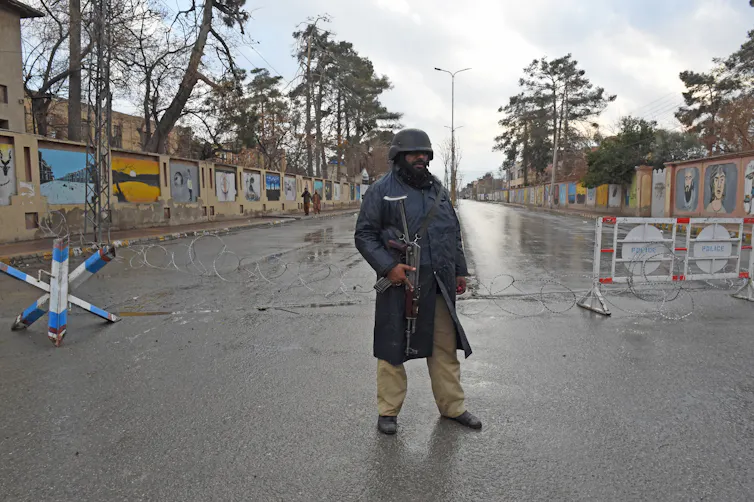
A man in a gun stands in the middle of a street.

A policeman stands guard near the blast site in Quetta after an attack by Baloch separatists on Jan. 31, 2026. Adnan Ahmed/AFP via Getty Images

The BLA’s elite Majeed Brigade has formalized a women’s wing, and the use of female suicide bombers has now spread across multiple Baloch factions. At least five known cases have been reported since 2022.

The deployment of women is strategic: Female operatives present a softer public face and yield both reputational and tactical benefits, evading security profiling, expanding target reach and amplifying media impact.

Has the insurgency been affected by the Iran war?

Tehran’s destabilization creates new tactical space for insurgents. Ethnic Baloch communities straddle the Pakistan-Iran border, and the BLA already maintains a presence in Iran’s Sistan and Baluchestan province.

The “Greater Balochistan” narrative promoted by Baloch nationalists, which envisions the reintegration of Baloch lands across both states, is gaining traction on the Iranian side. Moreover, weaker border enforcement gives militants greater freedom to move, recruit and coordinate.

Cross-border trade flows have dropped sharply since the war in Iran began, but the disruption is more likely to expand than to shrink Balochistan’s illicit economy over time. As state enforcement weakens on both sides of the border, the cross-border fuel and narcotics smuggling networks that Baloch militants tax and target are likely to expand further.

The cross-border problem had already escalated to interstate confrontation. In January 2024, Iran and Pakistan exchanged tit-for-tat strikes on Baloch militant groups operating across their shared border.

Counterterrorism coordination between the two countries remains modest, and attacks have continued, including the killing by militants of Pakistani migrants inside Iran as recently as April 2025.

With Iran’s stability weakening, these dynamics are likely to deepen, potentially raising tensions between Islamabad and Tehran over separatists in the future.

How are Pakistan-US relations affected?

The Baloch insurgency is now also an increasingly important focus of a warming U.S.-Pakistani relationship.

In August 2025, the U.S. State Department designated the BLA and its Majeed Brigade as foreign terrorist organizations – a move Islamabad had long pressed for.

Months later, the U.S. Export-Import Bank approved US$1.3 billion for the Reko Diq copper-gold project in Balochistan, its single largest critical minerals investment to date.

The current insurgency directly contests Pakistan’s capacity to deliver security in Balochistan. The Reko Diq mine lies in the same district where Zareena Rafiq, a BLF-affiliated female suicide bomber, struck a base of Pakistan’s federal paramilitary force on Nov. 30, 2025.

Further, in April 2026, a BLF commander declared that the group would target all foreign companies operating in Balochistan, regardless of country of origin.

Yet the present alignment between the U.S. and Pakistan is transactional: Its durability depends on Pakistan delivering on counterterrorism, mediation with Iran and mineral access.

Meanwhile, absent a counterinsurgency approach that addresses the underlying political and social drivers of the Baloch insurgency – including state repression, political marginalization and resource grievance – the broader U.S.-Pakistan reset is unlikely to deliver the stability its investments require.

Trump’s Shocking Revenge Plot Against Rod Stewart Revealed

0
trump’s-shocking-revenge-plot-against-rod-stewart-revealed
Trump’s Shocking Revenge Plot Against Rod Stewart Revealed


Rod Stewart just took another very public swipe at Donald Trump — and this time he did it right in front of King Charles.

The 81-year-old rock legend reignited his long-running feud with the president during a star-studded royal reception in London, where insiders say his comments left Trump absolutely raging behind the scenes.

Stewart attended a celebration marking the 50th anniversary of The King’s Trust at London’s Royal Albert Hall on May 11, where he greeted King Charles and Queen Camilla alongside his former Faces bandmate Ronnie Wood.

But according to witnesses, the conversation quickly turned political.

While praising Charles for the way he handled Trump during the monarch’s recent trip to America, Stewart reportedly mocked the president in front of guests and cameras.

“May I say, well done in the Americas. You were superb, absolutely superb… put that little ratbag in his place,” Stewart reportedly told the King.

Guests were said to have burst into laughter as Wood grinned nearby.

Stewart allegedly kept going, saying Trump completely missed the subtle digs aimed at him during the royal visit.

“Exactly, that’s it — it went right over his head,” the singer joked.

Turning to Queen Camilla, Stewart reportedly doubled down, praising Charles for being “so brave” and “so proud” during the trip.

But while the room may have laughed, sources close to Trump claim the president was anything but amused.

According to insiders, Trump was furious after hearing about the exchange — especially because it happened in front of the British monarch.

“Donald thinks Rod Stewart has become another celebrity trying to stay relevant by attacking him,” one source claimed. “He thinks it’s pathetic and beneath someone who used to entertain millions of Americans.”

Another insider alleged Trump was particularly irritated by what he viewed as the monarchy getting dragged into political shots against him.

“Trump believes the monarchy should stay neutral,” the source said. “He was fuming when he heard about it.”

Now, according to sources familiar with discussions happening around Trump allies, some supporters are allegedly talking about ways to quietly make life difficult for the legendary rocker.

And one topic that has reportedly resurfaced? Stewart’s wild drug-fueled past.

A political insider claimed people in Trump’s orbit have been revisiting Stewart’s long history of cocaine use and partying during the height of his fame in the 1970s and 1980s.

“There’s chatter that if things escalate further, Trump could push for scrutiny over whether Stewart should even be allowed to tour or enter the U.S.,” the source alleged.

The insider added: “They think there are ways to make life difficult without doing anything publicly dramatic. It would be a super-sneaky revenge.”

Stewart has never hidden his past struggles.

In interviews over the years — and in his 2012 memoir Rod: The Autobiography — the singer openly admitted to heavy cocaine use during his rock-star heyday.

He insisted he was never addicted and described himself as more of a “social user,” but some of the stories raised eyebrows for years.

Stewart even claimed he and Ronnie Wood once used cocaine anally to avoid damaging their noses and vocal cords.

The singer also revealed he struggled with steroid addiction in the late 1980s and early 1990s, saying the substances eventually caused internal bleeding and hallucinations.

Still, Stewart has credited his lifelong obsession with soccer for keeping him from spiraling completely out of control.

“I always needed to stay match fit,” he once joked.

The latest blow-up is just another chapter in Stewart’s increasingly bitter war of words with Trump.

Earlier this year, the singer blasted the president over remarks involving British troops who served in Afghanistan.

In an emotional Instagram video posted in January, Stewart called Trump a “draft dodger” and defended fallen British soldiers.

“We lost over 400 of our guys,” Stewart said at the time. “Think of their parents. Think about it. And Trump calls them almost like cowards. It’s unbearable.”

Now the feud appears far from over — and insiders claim both sides are digging in for an even uglier showdown.

Break with US policy: Trump to discuss Taiwan arms sales with Xi

0
break-with-us policy:-trump-to-discuss-taiwan-arms-sales-with-xi
Break with US policy: Trump to discuss Taiwan arms sales with Xi

File photo: Newscom / Alamy Live News

Donald Trump and Xi Jinping are likely to discuss many issues as they meet this week in Beijing. But alongside trade, technology and the war in Iran, one topic of conversation will stand out – the future of Taiwan.

Taiwan has long been a sensitive issue in Sino-American relations. Beijing regards the island as a breakaway province which must be reunited with the mainland. The United States has long opposed such a step. Yet in recent months, Trump has fueled speculation that he may be ready to change key aspects of US policy on the issue, potentially granting Beijing long-sought concessions.

Trump’s possible readiness to make these moves means that Taiwan is one of the issues on which we might see the most significant policy developments at the summit. And that could happen simply through the famously voluble president uttering just a few simple words.

The president’s policy towards Taiwan has been inconsistent and seemingly more malleable than that of previous administrations. Advocates for Taiwan point out that his administration recently approved the largest ever US arms sale to the island. But at the same time, he has sowed doubts about the strength of his support for Taiwan’s independence.

US policy towards Taiwan has traditionally been based on two principles. The first is “strategic ambiguity,” which means that the US declines to explicitly state whether it would actively use its military to defend Taiwan from attack by China. This policy is supposed to deter China while also discouraging Taiwan from formally declaring its independence from Beijing.

The second principle is the “one China policy.” According to this policy, the US recognizes Beijing as the legitimate government of China, while opposing any violent solution to its dispute with Taiwan. It also retains robust informal links to the Taiwanese government in Taipei.

Observers are concerned that Trump may water down these principles during his summit with Xi. For instance, he might state that the US not only “does not support” Taiwanese independence but actively “opposes” it. Or he might double down on previous comments he has made indicating that whether or not Xi invades Taiwan is “up to him”.

Trump has also explicitly stated that he will discuss future US arms sales to Taiwan with Xi during this week’s summit. This violates one of the so-called Six Assurances that the US has upheld towards Taiwan since the 1980s, and which were endorsed by the US Congress in 2016.

Even securing a discussion of arms sales would be a victory for Xi, who would welcome an opportunity to chip away at the Six Assurances. Presumably he would then try to weaken the US commitment to the other five, which include a US commitment not to change its position on Taiwan’s sovereignty.

More concretely, if Xi succeeds in making US arms sales to Taiwan a legitimate topic of negotiation in Sino-American relations, then he could head them off in the future by offering the US concessions in other areas. For instance, if Trump or a future president asks Beijing for its help settling a conflict like that in Iran, Beijing might demand an end to US arms sales to Taiwan as the price.

High stakes

Given Trump’s reputation as a formidable China hawk, his attitude towards Taiwan may seem surprising. But it’s actually part of a longstanding pattern.

In relations with China, Trump arguably has always prioritized economic issues, while appearing less concerned about the security of America’s regional allies. He has also raised doubts about whether Taiwan is even defensible. In his first term, he reportedly told aides that “Taiwan is like two feet from China. We are 8,000 miles away. If they invade, there isn’t a fucking thing we can do about it.”

Trump is also both highly transactional and less focused on abstract principles of foreign policy than most previous presidents. He views America’s support of allies such as Taiwan as a gift that it gives them, one that is often not worth the cost. If he can achieve a concrete victory for himself today by trading away support for Taiwan tomorrow, he may well be willing to do so.

All of these developments matter because they make a violent conflict between China and Taiwan, potentially ultimately involving the US, more likely. If Trump makes concessions to Xi, it will be the latest signal that US support for Taiwan is wavering. That may be read in Beijing as permission to change the status quo violently. Even though such an act might belatedly then be met with force from Washington in response, it is made more likely by Trump’s stance today.

Even worse for Trump, the summit comes at a time when American power and the wisdom of its long-term strategy are being visibly called into question in the Middle East. The US is bogged down in an intractable conflict and has severely damaged its deterrent capacity in the Indo-Pacific by burning through advanced munitions at a high rate. Trump’s personal unpopularity is also rising at home amid the war and its economic fallout.

This weakened position makes it even more likely that Trump will want to strike a deal with Xi to help end the war in Iran or ease trade tensions to help the economy at home. Taiwan may be the price of that – and, ultimately, peace.

Andrew Gawthorpe is a lecturer in history and international studies, Leiden University.

This article is republished from The Conversation under a Creative Commons license. Read the original article.

Trump-Xi Beijing Summit Tests Leverage on Trade, Taiwan, Iran

0
trump-xi-beijing-summit-tests-leverage-on-trade,-taiwan,-iran
Trump-Xi Beijing Summit Tests Leverage on Trade, Taiwan, Iran


Temporary deals on tariffs, rare earths, and diplomatic language may give both leaders short-term wins while leaving deeper conflicts untouched

US President Donald Trump arrived in Beijing on Wednesday for a state visit and scheduled talks with Chinese President Xi Jinping, with trade, rare earths, Taiwan, artificial intelligence, and the Iran war expected to dominate the agenda. The visit may produce visible deliverables, but the larger test is whether either side can gain leverage while leaving the deepest disputes unresolved.

The two leaders are expected to hold bilateral talks on Thursday, with the summit focused on stabilizing economic relations, possible Chinese purchases of US agricultural goods and aircraft, rare earths, advanced chips, and the wider impact of the Iran war.

The visit follows the Busan summit in October 2025, where President Trump and Xi agreed to pause the sharpest phase of their trade war. The Guardian and The Washington Post reported that tariffs on Chinese goods reached as high as 145% during the escalation before the October truce. That truce reduced immediate pressure but did not settle the underlying disputes over technology controls, supply chains, market access, or strategic influence.

Taken together, the issues on the table point to a summit built around tactical bargains rather than strategic settlement: limited trade relief, managed language on Iran, guarded signals on Taiwan, and attempts by both governments to preserve leverage for the next round.

A foreign policy analyst who works on US-China strategic competition and spoke with The Media Line on condition of anonymity framed the summit as a likely continuation of Busan rather than a break from it.

What we can realistically expect from this meeting is basically a second round of Busan

“What we can realistically expect from this meeting is basically a second round of Busan,” the analyst said. “Both sides will walk out with some deliverables, a tariff extension, a rare earth license, maybe a good photo, and call it a historic result.”

That is not stabilization of the relationship, it is calendar management

“That is not stabilization of the relationship, it is calendar management,” the analyst added.

Beijing, the analyst said, is treating the talks as part of a phased negotiation, with commitments kept reversible and timed against the US political calendar. The closer Washington gets to the 2026 midterm elections, the analyst argued, the more valuable a visible diplomatic win becomes for President Trump.

Dr. Elizabeth Freund Larus, a Taiwan Fellow with the Republic of China Ministry of Foreign Affairs and an adjunct senior fellow at the Pacific Forum, said she did not expect a “big climactic summit” or breakthrough. Presidential visits, she told The Media Line, usually formalize work done earlier by lower-level officials.

For Larus, the summit should be understood through the practical interests of both governments. China wants tariff relief and market stability, while President Trump wants Chinese purchases of American goods and proof that his pressure campaign has delivered. Substantively, she said, the result is more likely to extend the same unresolved bargaining pattern.

“I honestly see it as more of the same rather than a breakthrough,” Larus said.

Guy Burton, author of China and Middle East Conflicts and visiting fellow at Lancaster University, also said the Beijing talks should not be mistaken for a decisive turning point in the relationship. High-level summits, he told The Media Line, are often treated as historic moments, but the main forces shaping US-China relations are structural, long-term, and already in motion.

Burton identified Taiwan, trade, rare earths, and Iran as central issues, but argued that the wider challenge for Washington lies in the ambiguity of its own strategic messaging. He said “the current US position often appears internally inconsistent,” making it difficult for both allies and adversaries to determine Washington’s priorities.

That inconsistency is especially visible on Iran. The war has moved from being a Middle Eastern crisis into a global pressure point affecting energy markets, sanctions enforcement, maritime security, and China’s relationship with both Tehran and Washington. Iran is expected to feature prominently in the Beijing talks, with US officials pressing China to use its influence with Tehran as the conflict strains regional diplomacy and global energy flows.

For Burton, the question is not only whether Beijing can influence Tehran, but whether Washington’s own Iran policy is clear enough to persuade China that cooperation would serve a defined objective. He said US policy has moved among several stated aims, including preventing nuclear escalation, weakening Iran’s regional influence, and broader regime-change signals, creating uncertainty for allies and adversaries.

Burton said President Trump’s statements matter because he remains the American president, but Washington’s frequent shifts make US signaling harder to interpret.

Iran is one of the clearest examples of how the summit’s formal agenda and its strategic subtext overlap. China has economic interests in continued energy access from Iran, while Washington wants Beijing to help restrain Tehran or at least avoid undercutting sanctions pressure. Reuters reported that Treasury Secretary Scott Bessent said China buys 90% of Iran’s energy, while oil-tracking data cited in public reporting has also pointed to China’s continuing role as a major buyer of Iranian crude.

The foreign policy analyst said Beijing is likely to present itself as a useful interlocutor on Iran while avoiding sanctions enforcement that would harm its access to discounted Iranian oil. In that reading, China’s contribution would be diplomatic language and process rather than concrete pressure on Tehran.

“What is going to happen is China offers diplomatic language and process, not actual enforcement,” the analyst said. “And the final communiqué will make that legible as cooperation.”

Beyond Iran, the conflict has given Beijing a fresh military reference point as it weighs US capabilities, Taiwan contingencies, sanctions pressure, and energy security. Dennis Wilder, former senior director for East Asia in the George W. Bush administration and professor of the practice at Georgetown University, framed the Iran conflict as a demonstration of American military reach and operational capacity.

“The conflict in Iran presents a complicated picture for China,” Wilder told The Media Line. “Militarily, Xi must now realize that Trump is not reluctant to employ the US military’s formidable offensive power for distant force projection when he deems it in the best interest of the United States.”

Wilder said the Iran war would be studied closely by the People’s Liberation Army because it showcased US and Israeli use of artificial intelligence, cyber capabilities, space-based sensors, drones, satellites, and integrated battlefield data. He argued that the Chinese military is still far from matching those capabilities in real combat conditions.

“The People’s Liberation Army (PLA) is far from having the kind of informationalized joint force warfare capabilities—using artificial intelligence, cyber, space-based sensors, etc.—exhibited by the US and Israeli militaries,” Wilder said.

For Beijing, Iran is both an opportunity and a constraint. China has benefited from discounted Iranian oil, but its economic relationships with Gulf states are far more valuable than its ties with Tehran. Wilder said this has limited China’s willingness to openly support Iran during the conflict.

“The wars in Iran and Gaza have demonstrated the limits of China’s influence in the Middle East,” Wilder said. “Pakistan, not China, is the mediator in the Iran conflict, and China had no role in mediating the resolution of the conflict in Gaza.”

Beijing’s caution, Wilder said, reflects its larger commercial stake in the Gulf. China’s trade with the Gulf Cooperation Council reached roughly $300 billion last year, compared with an estimated $10 billion to $40 billion in trade with Iran. Chinese firms have also been expanding their presence in Saudi Arabia under the “comprehensive strategic partnership” agreement signed with Riyadh in 2023.

Taiwan remains the most sensitive strategic issue between the two powers, even if it does not formally appear as part of the economic negotiation. Beijing considers Taiwan part of its territory and has not ruled out the use of force, while Taiwan rejects Beijing’s claim and says only its people can decide its future.

China’s Foreign Ministry said after a November 2025 Trump-Xi call that Xi told President Trump: “Taiwan’s return to China is an integral part of the post-war international order.”

For Burton, Taiwan is precisely where US ambiguity becomes most consequential. He said one of Beijing’s likely red lines will be preventing any formal strengthening of US commitments toward Taiwanese sovereignty or security guarantees beyond Washington’s traditional framework of strategic ambiguity.

“Chinese leaders will be especially attentive to whether Trump might casually concede rhetorical ground, improvise unexpectedly or alter longstanding diplomatic formulations in ways that create instability,” Burton said.

Larus, speaking from Taipei, said concern over China remains present but should not be confused with panic. She argued that the threat environment has changed, but life in Taiwan continues without the sense of imminent crisis often suggested in Western media coverage.

“The people in Taiwan have been facing this threat from China for a very long time. It’s just that China was not able to make good on it until recently,” Larus said.

She added that people in Taiwan still question US commitments, especially in academic and government circles, and some are watching closely to see whether President Trump says anything in Beijing about Taiwan independence or Washington’s position on the island’s future.

Larus also argued that Xi may have reasons to avoid military action for now, especially given Taiwan’s internal political divisions, China’s own military uncertainties, and the high risks of war.

“Xi Jinping knows he doesn’t have to strike Taiwan. He doesn’t have to. Taiwan’s not going anywhere. It’s an island. It can’t go anywhere. Its population is declining. People aren’t having kids here,” Larus said.

She said China may see less risk in political pressure and influence operations than in invasion. Larus warned that Beijing remains skilled at cognitive warfare, social media influence, media penetration, and cultivating sources inside Taiwan’s military.

“China is very good, very, very good at cognitive warfare,” Larus said.

The foreign policy analyst said Taiwan is unlikely to appear in any trade text but will still affect the atmosphere of the talks. Chinese cooperation on trade or Iran, the analyst argued, is likely to become harder when US arms sales to Taiwan or technology export controls accelerate.

“It will not appear that way in any agreement text, but it will show up in the timing of concessions,” the analyst added.

Trade, tariffs, and critical minerals form the most visible area for potential deliverables. China dominates several parts of the rare earth and critical mineral supply chain, giving Beijing leverage over industries ranging from electric vehicles and consumer electronics to defense production. The International Energy Agency’s 2025 Global Critical Minerals Outlook warned that China is the dominant refiner for 19 of the 20 strategic minerals analyzed, with an average market share of around 70%.

Those vulnerabilities became visible in 2025, when Chinese exports of rare earth magnets reportedly plunged 74% year over year in May after export licensing restrictions, according to a Wall Street Journal analysis cited by Automotive World. Ford was among the manufacturers affected by rare earth magnet supply constraints, with Ford-focused industry reporting that some plants were temporarily shut down over the shortage.

For Burton and the foreign policy analyst, rare earths are a powerful source of leverage but not a weapon Beijing can use without cost. Burton said China wants to preserve stability and predictability, while the analyst said aggressive use of export controls could permanently accelerate allied diversification, as happened with Japan after 2010.

“That is why China uses the threat intermittently rather than going for a full cutoff,” the analyst said. “Some new US magnet production capacity is expected to start coming online in summer 2026, which would marginally reduce exposure, but real self-sufficiency is still years away.”

Beyond rare earths, trade remains central to the summit. President Trump’s tariff policy has been one of the most visible features of his China strategy, but its stated objectives have varied between industrial protection, revenue generation, and retaliation against unfair trade practices. Both sides are expected to discuss a possible extension of the October truce, potential tariff relief, and Chinese purchases of US goods, including agricultural products and aircraft.

Burton said President Trump’s tariff policy has mixed several objectives—protecting industry, raising revenue, and punishing unfair trade practices—that do not always point in the same direction. He added that legal challenges over presidential tariff authority could narrow the administration’s room to maneuver compared with what appeared possible a year ago.

Wilder, meanwhile, placed the summit in a broader military and strategic context. For China, the Iran war is a warning about US capabilities, but also a lesson about vulnerabilities in energy supply chains. The closure or disruption of the Strait of Hormuz reinforces long-standing Chinese fears about the Strait of Malacca, through which a large share of China’s Middle Eastern oil imports travel. China depends heavily on Middle Eastern energy flows, and any disruption in Hormuz carries direct energy-security stakes for Beijing.

A closure of the Strait of Hormuz, Wilder said, would remind China of the fragility of oil supply chains and deepen long-standing concerns about the United States’ ability to disrupt Chinese oil imports from the Middle East during a Taiwan contingency by blockading the Strait of Malacca.

He added that China is likely to look for alternative energy sources, a shift that could benefit US liquefied natural gas exporters if Beijing seeks to diversify away from vulnerable maritime chokepoints.

For Larus, China’s longer-term strategic movement may be most visible not only around Taiwan but also in the South China Sea and Central Asia. She said Beijing is building naval reach while expanding land routes to reduce exposure to US-controlled maritime chokepoints.

The summit’s importance may lie less in its formal conclusions than in the balance of leverage each side accumulates while leaving major disputes unresolved. For Beijing, time can be an asset if negotiations are managed through temporary extensions and controlled concessions. For Washington, the challenge is to convert pressure into enforceable outcomes without giving China symbolic wins on Taiwan, sanctions, technology, or supply chains.

Burton said the wider global order is already undergoing a structural shift, with deeper changes taking place through trade measures, military positioning, technological competition, and erosion in the wider international order. Still, the final test of the Beijing talks may be narrower and more immediate: Which side leaves with more leverage for the next round?

The foreign policy analyst framed the issue as a question of strategic clarity.

At the end of the day, this meeting is not about resolving the specific disputes. It is about who accumulates position while the disputes stay open.

“At the end of the day, this meeting is not about resolving the specific disputes. It is about who accumulates position while the disputes stay open,” the analyst said.

“The Americans arrive in Beijing with a transactional agenda, wanting to close line items, and the Chinese arrive knowing exactly what they are willing to concede and what they are not,” the analyst added. “That asymmetry in strategic clarity is the most important variable in the room, and it will not appear in any press release.”
The physics of how Olympic weightlifters exploit barbell’s “whip”

0
the-physics-of-how-olympic-weightlifters-exploit-barbell’s-“whip”
The physics of how Olympic weightlifters exploit barbell’s “whip”

Olympic weightlifting consists of three basic movements performed on a barbell: the snatch, the clean, and the jerk (with the latter two executed in combination). At such an elite level, athletes seek to exploit every possible advantage, including how a barbell bends and recoils in response to loaded weight and applied force—a property known as flexural bending in physics and dubbed the “whip” by Olympic athletes. Scientists are learning more about the underlying mechanisms of the whip, according to a presentation at this week’s meeting of the Acoustical Society of America in Philadelphia.

Joshua Langlois, a graduate student at Pennsylvania State University, competes in Strongman competitions as a hobby. He also has friends who compete at the national level in Olympic weight-lifting events. “They told me how they use the whip,” Langlois said during a media briefing. “When they dip down, they can feel when the bar flexes back up and use that to accelerate the movement upward to increase the amount they can lift.”

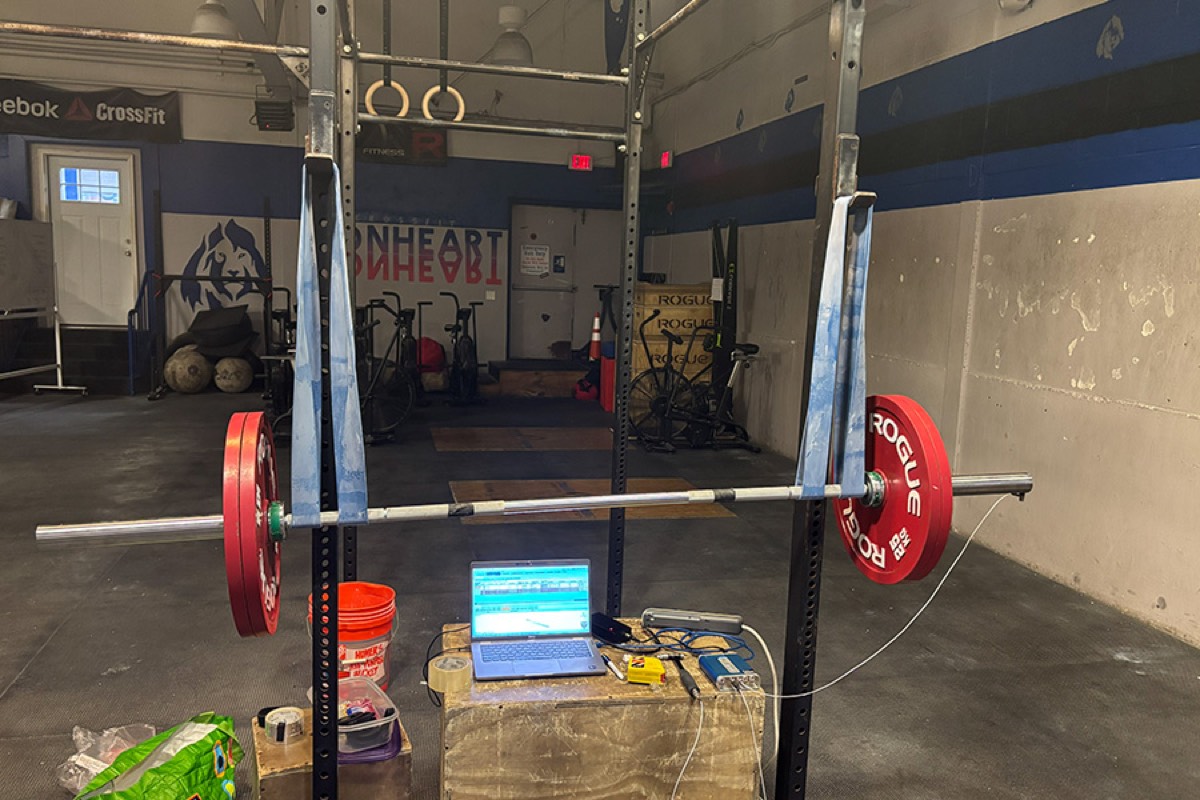
Langlois decided to conduct a modal analysis, i.e., how an object moves or vibrates, to quantify the whip and better understand the mechanics, as well as what makes for a good barbell at the elite level. He suspended four 20-kg men’s barbells (women use 15-kg barbells)—with 50 kg loaded on each end—from elastic resistance bands so that the bar was essentially floating in space. Then he attached accelerometers at each end of the bar where the vibrational mode patterns occur. Next he tapped set locations across the bar with a small hammer, measuring the acceleration at the end points, which enabled him to map out how the bars moved in response. He compared the vibrations of different barbells, as well as a single barbell loaded with different weights.

Sleeves or no sleeves?

Langlois found that the standard motion of a bar floating freely in space has a higher frequency without sleeves—i.e., the outer, thicker area of the bar that holds the weights and can rotate independently of the central shaft—than with sleeves. This was an expected result, per Langlois, since adding mass to the ends of a bar will typically decrease the rate of oscillation and also shift the nodes (the points where the bar is stationary).

The surprise came when he looked more closely at the higher bending (flexural) modes: in that case, the frequency increased at higher loads. “The bar becomes more fixed so the actual wavelength of the bar is less,” Langlois explained. “With a set wave speed, wavelength is inversely proportional to the rate of oscillation, so we get a higher frequency. This is something we did not foresee happening. So the barbell is likely to matter.”

The experimental setup used to determine the vibrations of barbells used in Olympic weightlifting.

The experimental setup used to determine the vibrations of barbells used in Olympic weightlifting.

The experimental setup used to determine the vibrations of barbells used in Olympic weightlifting. Credit: Joshua Langlois

Granted, it’s a small effect, in the range of a single percent, per Langlois. “But for elite sports, a single percent makes all the difference,” he said. “I am not an expert Olympic weightlifter. I have a hard time timing the whip, it’s hard for me to feel it exactly. There’s a similar thing with golfers. The best golfers in the world can actually feel how the golf club bends as they swing, and they can use that to change how the balls hit. So I don’t expect casual lifters to be able to use this very well. It’s just for the very elite level.”

Precisely which features make for the best barbell is still a puzzle. Olympic barbells have the same weight, diameter, and length, but other aspects can differ from brand to brand, such as the materials used. Most are made of some sort of steel, with stainless and chrome coated being the most common, and the respective mechanical properties can make a small difference to a given bar’s whip, according to Langlois. Specifically, the stiffness of the bar (the Young’s modulus) can vary quite a bit. “We don’t have a good feel for this because no barbell manufacturers will tell you exactly how they make the bar,” he said. “It’s all proprietary.”

There can also be variation in the coupling mechanism between the shaft (where you hold onto the bar) and the sleeve (where you load the plates), which can affect how much the bar bends. Sleeves can be bearing (with moving bearings inside for faster rotation), bushing (a solid piece with no moving parts), a hybrid of the two, or just bare steel. Barbell manufacturers typically recommend bushing sleeves for slower, heavy lifts and bearing sleeves for faster Olympic lifting. “The coupling mechanism varies between bushings, bearings, or bare steel,” said Langlois. “Bearings seem to have the best coupling, and that’s what most expensive barbells use.”

So what’s next? “We know that the bar matters,” said Langlois. “We know that it changes shape, changes frequency, with load. So now we’re going to take data with real Olympic weightlifters [men and women] so we can see exactly how they use the whip and how the bar matters for them.”

Britain to strengthen ties with the EU in new legislation

0
britain-to-strengthen-ties-with-the-eu-in-new-legislation
Britain to strengthen ties with the EU in new legislation


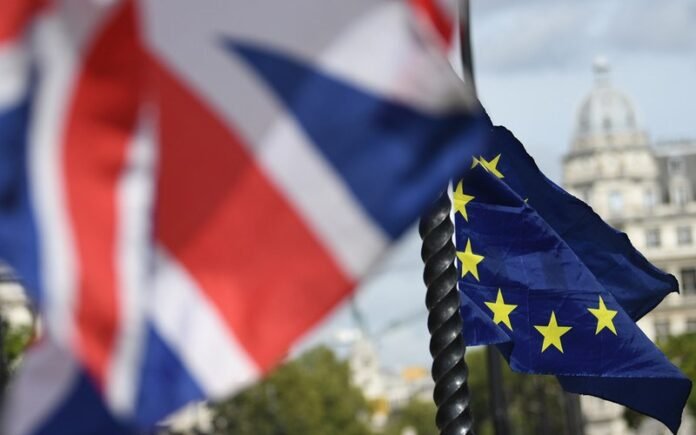
Britain will introduce legislation to strengthen its ties with the European Union, as Prime Minister Keir Starmer prioritises mending economic relations ​with the bloc as he tries to stay in power following growing ‌calls for him to quit.

Outlining the government’s legislative programme in a speech surrounded by pomp, King Charles said would introduce a bill to strengthen ties with the EU. The European ​Partnership Bill will be used to implement agreements with the EU “now and ​in the future,” the government said.

Starmer has been under pressure from some ⁠lawmakers to quit after his Labour Party suffered big losses in Scottish, Welsh and ​local English elections last week, but he has dug in and said that rebuilding ​the relationship with Europe is central to his plan for the country.

Starmer has sought closer ties with the EU while trying to avoid relitigating the Brexit debates ahead of Britain’s departure from ​the bloc in 2020.

While his government has said Britain needs to align with ​EU regulations by default in some industries to spur economic growth, Starmer retains a commitment to ‌red ⁠lines that Britain will not return to the EU’s single market or customs union, and will not restore freedom of movement with the bloc.

A year ago Britain and the EU reached a framework to agree new deals on food and ​drink, emissions trading ​and electricity, the ⁠details of which are still being negotiated.

The government said the proposed bill would “ensure agreements with the EU can be implemented ​now and in the future.”

It added that Britain’s parliament would ​have a ⁠say before EU law was applied in the UK and that any new treaties that might be applied under the bill would also be subject to parliamentary ⁠approval.

Starmer said ​in a written introduction to the King’s Speech ​that removing barriers to growth meant “setting a new direction for Britain at the next EU summit, ​putting Britain at the heart of Europe.”

Source:  Reuters

0FansLike
0FollowersFollow
0FollowersFollow
0SubscribersSubscribe
- Advertisement -
Google search engine

Recent Posts