US visas shouldn’t turn migrants into pawns against China
The latest warning from Washington that China could face visa restrictions over deportation cooperation points to a broader pattern: migration policy is increasingly being pulled into the orbit of geopolitical rivalry.
While US officials frame the issue as a matter of compliance — urging Beijing to accept nationals ordered removed — the use of visa pressure signals something more strategic.
Once migration becomes leverage between major powers, it rarely produces better coordination. Such approaches can introduce additional friction, making cooperation more difficult at a time when bilateral trust is already under strain.
Visas as leverage
The latest US warning over deportation cooperation shows how quickly migration can become a diplomatic pressure point.
Under Section 243(d) of the Immigration and Nationality Act, Washington has the option of tightening visas against countries it considers unwilling to take back their nationals.
But the existence of a legal tool does not answer the deeper question: does using migration enforcement as geopolitical pressure make the system safer, or does it deepen the logic of confrontation?
The danger is that a human issue is being securitized. International migration institutions and human rights bodies have long argued that migrants’ rights should be protected by law, not used as instruments of state pressure.
The Office of the UN High Commissioner for Human Rights has stressed that migrants’ rights are protected under existing legal frameworks and that rights are not opposed to security; rather, they reinforce the rule of law when properly applied.
That principle matters here because visa threats and sanctions blur the line between lawful immigration management and political punishment.
Migration inside rivalry
It is more than a technical immigration dispute. The issue falls within a broader US-China relationship shaped by mistrust, tariffs, export controls and a growing strategic split.
In that climate, even ordinary consular or deportation questions can be recast as tests of national resolve. Once that happens, migration stops being a policy area and becomes another theater of pressure, where each side signals toughness instead of solving practical problems.
The antiwar argument is straightforward: security language often expands the space for confrontation while shrinking the space for compromise. Scholars of migration securitization have shown that when states frame mobility mainly as a security threat, the result can be militarized borders, reduced rights protection, and policy spillover far beyond the original issue.
In this case, visa sanctions may satisfy a domestic political audience, but they risk turning consular coordination into a proxy battlefield in a great-power dispute.
There is a cost to this approach. If Washington wants Beijing’s cooperation on repatriations, it needs predictable consular channels and clear documentation procedures — not public ultimatums.
When Washington turns to public pressure, it risks closing off those pathways. Beijing, like most governments, tends to push back when cooperation is sought through public pressure.
That dynamic can slow down repatriation efforts and complicate identity verification. Over time, this approach risks feeding a cycle in which using migration as leverage only makes resolution harder to achieve.
A better approach
A more practical course would separate migration management from strategic rivalry. The US and China can compete on trade and security while still cooperating on deportations, identity checks and travel documents.
That is not a concession but a matter of keeping routine functions insulated from politics. A rights-based approach does not dilute enforcement; it helps sustain it without escalating tensions.
US credibility on migration depends on consistent enforcement, not measures that draw foreign nationals into a broader dispute. China, for its part, has room to ease tensions by approaching repatriations more consistently and without knock-on effects for ordinary travelers. Otherwise, a technical problem risks turning into yet another arena for rivalry.
If Washington wants credibility on migration, it needs to enforce immigration rules without turning foreign nationals into bargaining chips. Visa restrictions should be used sparingly, and only where they are clearly tied to law and to a proportionate policy goal.
Beijing has its own reason to avoid escalation. If it does not cooperate on lawful repatriation procedures, the fallout could widen beyond deportations and affect ordinary travelers, students and businesspeople.
That is not an abstract risk: Reuters reported this week that the Trump administration is prepared to consider visa sanctions on China if repatriation cooperation does not improve.
There is also a practical lesson here. Immigration enforcement depends on documentation, identity verification and regular consular contact, not just pressure from Washington.
When those channels weaken, removals become slower and more politicized, and the issue stops looking technical altogether.
Good migration governance
In practical terms, people in Asia are likely to feel this in their day‑to‑day plans. A visa dispute between Washington and Beijing can throw off study plans, holiday trips or business schedules that depend on smooth cross‑border travel.
Once migration is cast as a measure of political strength, it becomes easier for other states in the region to treat it as a security issue too, and harder to keep space for cooperation that puts people’s rights at the center.
A more sustainable course would ring‑fence migration from strategic rivalry. Washington should reserve visa restrictions for clearly defined legal violations and avoid using foreign nationals as bargaining chips.
Beijing should engage more consistently on repatriations and documentation, not to concede to US pressure, but to keep migration governance out of the line of fire.
If both sides can insulate this area from zero‑sum politics, they will not only protect migrants’ rights but also strengthen the stability that students, workers and firms across Asia now depend on.
The sports world is in shock after former Memphis Grizzlies forward Brandon Clarke died suddenly on Monday at just 29 years old.
Clarke’s death was confirmed by the Grizzlies, though the exact cause has not been revealed.
“We are heartbroken by the tragic loss of Brandon Clarke,” the team wrote in a statement posted to X. “Brandon was an outstanding teammate and an even better person whose impact on the organization and the greater Memphis community will not be forgotten.”
The team also shared condolences with Clarke’s family and loved ones as fans flooded social media with messages of grief and disbelief over the young athlete’s sudden death.
Clarke’s agency, Priority Sports, released a separate statement asking for privacy as his family mourns and begins making funeral arrangements.
The tragic news comes just weeks after Clarke found himself making headlines for a very different reason.
Back in April, the 6-foot-8 NBA forward was reportedly involved in a high-speed chase with law enforcement that ended with multiple charges. Authorities accused Clarke of trafficking Kratom, a controversial substance that has sparked heated debate across the country. He was also charged with possession of a controlled substance, fleeing police at excessive speeds, and improper passing.
The incident stunned many fans, especially given Clarke’s reputation as one of the league’s quieter and more respected players.
Clarke first entered the NBA in 2019 after being selected 21st overall in the draft by the Oklahoma City Thunder. But before he could even suit up, he was traded to Memphis, where he quickly became a fan favorite thanks to his hustle, athleticism, and high-energy play.
Over seven seasons with the Grizzlies, Clarke carved out a reputation as a reliable role player and explosive presence off the bench.
But injuries derailed the later part of his career. Clarke appeared in only two games this past season after battling serious knee and calf injuries that kept him sidelined for most of the year.
Now, fans are left mourning a player many believed still had years ahead of him both on and off the court.
Social media quickly filled with tributes Monday night, with devastated fans remembering Clarke not just for his basketball talent, but for his personality and presence in the Memphis community.
Twin brothers wipe 96 gov’t databases minutes after being fired
In the US, fired and laid-off workers often have their digital credentials deactivated before they learn about the loss of their jobs; indeed, the inability to log in to a corporate system may be the first an employee knows of the situation.
Though not a generous or humane approach to staff reduction, it does follow from the simple fact that a fired employee with access to company systems is a security risk.
Just ask the Akhter twin brothers, accused of wiping out 96 databases hosting US government information in the minutes after both were fired last year from their shared employer.
DROP DATABASE
Muneeb and Sohaib Akhter, now both 34, had been in trouble before. Back in 2015, the brothers pled guilty in Virginia to a scheme involving wire fraud and computers. Muneeb was sentenced to three years in prison, while Sohaib got two.
After their stints in jail, the brothers worked their way back into the tech world. In 2023, Muneeb got a job with a Washington, DC, firm that sold software and services to 45 federal clients; Sohaib got a job at the same company a year later.
On Feb. 1, 2025, Muneeb Akhter asked Sohaib Akhter for the plaintext password of an individual who submitted a complaint to the Equal Employment Opportunity Commission’s Public Portal, which was maintained by the Akhters’ employer. Sohaib Akhter conducted a database query on the EEOC database and then provided the password to Muneeb Akhter. That password was subsequently used to access that individual’s email account without authorization.
This was not a one-off. Muneeb had been assembling usernames and passwords—5,400 of them taken from his own company’s network data. He then built custom Python scripts to try these logins against common websites; for instance, his “marriott_checker.py” application tested the logins against Marriott’s hotel chains. Muneeb managed to log in successfully hundreds of times, including to DocuSign and airline accounts. Sometimes, if victims had airline miles stored, Muneeb would book travel for himself.
The brothers’ employer appears to have learned about their criminal past at some point in February. On February 18, 2025, the brothers—who lived together in Virginia—were both called into a Microsoft Teams meeting and summarily fired.
The call took place at the end of the day, wrapping up at 4:50 pm. Five minutes later, Sohaib was already trying to access his (now former) employer’s network—but found that his VPN access and Windows account were terminated.
Muneeb’s account had been overlooked, however, and he immediately embarked on a campaign of destruction.
At 4:56 pm, Muneeb accessed a US government database that his company maintained. He “issued commands to prevent other users from connecting or making changes to the database, and then issued a command to delete the database,” the government said.
At 4:58 pm, he wiped out a DHS database using the command “DROP DATABASE dhsproddb.”
At 4:59 pm, he asked an AI tool, “How do i clear system logs from SQL servers after deleting databases?” He later asked, “How do you clear all event and application logs from Microsoft windows server 2012?”
In the space of a single hour, Muneeb deleted around 96 databases with US government information. He downloaded 1,805 files belonging to the EEOC and stashed them on a USB drive, then grabbed federal tax information for at least 450 people.
Smart ideas
While this was going on, the brothers held a running conversation. (The government is not clear about whether this took place over text, instant message, or in person.)
“I see you cleaning out their database backups,” Sohaib said as he watched Muneeb’s work. As the database casualty list grew, Sohaib said, “Alright—if you have good plausible deniability.”
Muneeb didn’t appear to consider his actions a big deal. “Eh, they can recover from yesterday,” he said, referring to daily database backups.
“Yeah, they could,” Sohaib agreed.
Muneeb noted that an employee they knew would “have some work to do” when the destruction was revealed.
Sohaib fed Muneeb more suggestions.
“Delete their filesystem as well?” he said.
“Smart idea,” said Muneeb.
Sohaib then wondered if they had been too hasty. Perhaps, he said, “You shoulda had a kill script. Like, blackmailing them for some money would have been—”
“No, you do not do that, that’s proof of guilt, man,” Muneeb said.
“No, but the thing was, you always have your opinion,” Sohaib complained, and the two then bickered about whether they might try to blackmail their company’s customers instead.
As the data destruction went on, Sohaib said, “They’re gonna probably raid this place.”
“I’ll clean this shit up,” Muneeb said.
After wiping out the databases and event logs, the brothers reinstalled the operating systems on their corporate laptops with the help of an unnamed co-conspirator.
God guide my words
Sohaib was right; the feds did raid them. It just took three weeks.
On March 12, 2025, a search warrant was executed at Sohaib’s home in Alexandria. Agents grabbed plenty of tech gear but also turned up seven firearms and 370 rounds of .30 caliber ammunition. Given his former crimes, Sohaib should have had none of this.
The brothers remained free for another nine months as the investigation proceeded, but both were eventually arrested on December 3 and indicted for a host of crimes (you can read the indictment here).
Muneeb signed a plea deal on April 15, 2026, admitting to the major allegations in the indictment.
Sohaib took his case to trial. He lost. On May 7, 2026, a jury found him guilty of conspiracy to commit computer fraud, password trafficking, and possession of a firearm by a prohibited person. He will be sentenced in September.
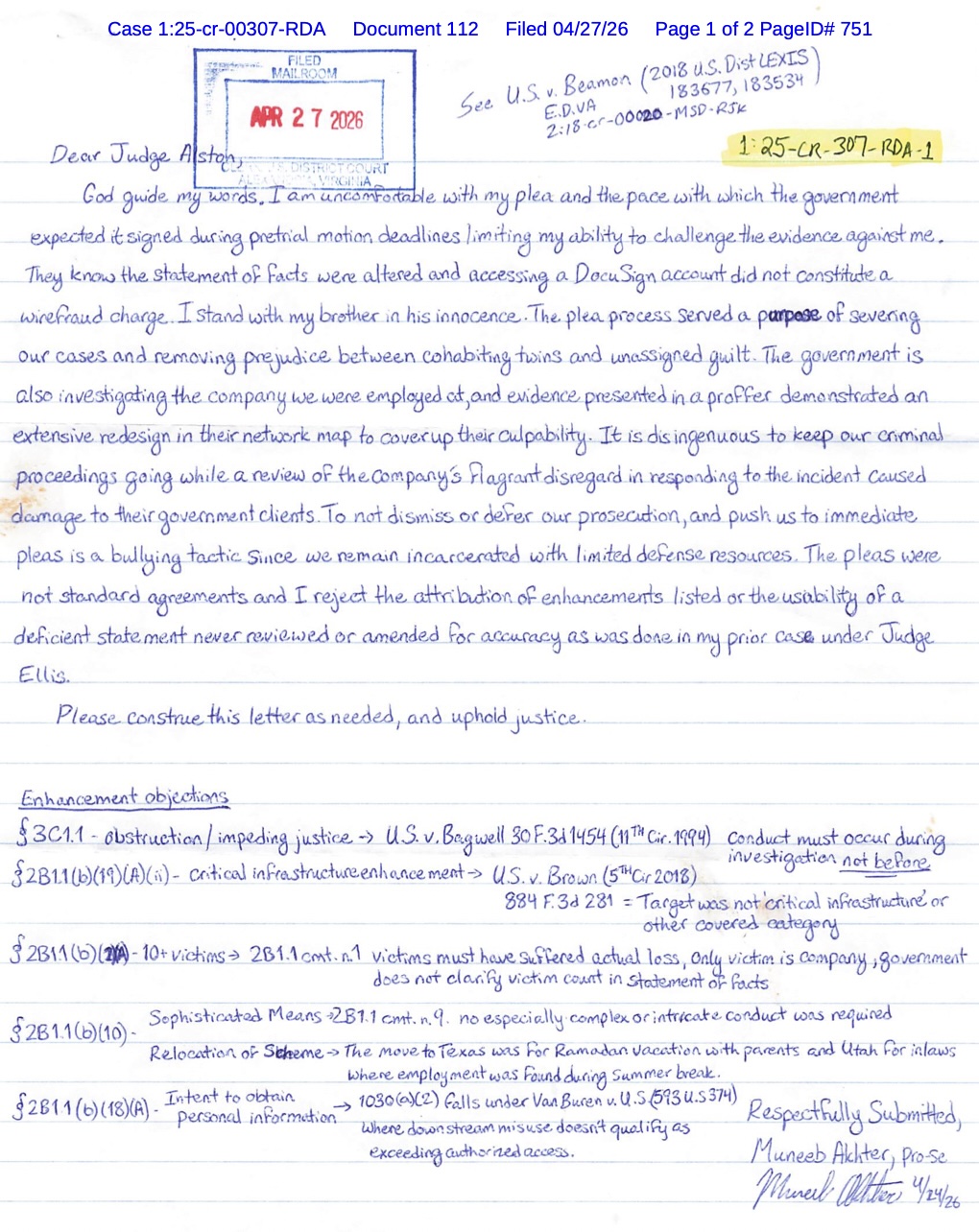
The cases would seem to be basically over, except that Muneeb has begun filing handwritten petitions from jail, arguing that his lawyer has been ineffective. More recently, the filings have taken aim at his signed guilty plea.
One of Muneeb’s letters from prison.
One of Muneeb’s letters from prison.
“God guide my words,” he wrote in a one-paragraph letter to the judge on April 27. “I am uncomfortable with my plea and the pace with which the government expected it signed during pretrial motion deadlines limiting my ability to challenge the evidence against me… I stand with my brother in his innocence.” (As mentioned above, Sohaib was found guilty several days later.)
Another brief handwritten letter, filed on May 5, claims that Muneeb is innocent of count 10, “since accessing DocuSign account does not grant anything of value nor did he obtain or intend to obtain anything of value from it.” It says nothing about deleting the 96 databases.
A third letter, also filed on May 5, asks for permission to proceed pro se—that is, with Muneeb functioning as his own lawyer. This is generally the “kiss of death” for federal cases. Still, like many intelligent-but-overconfident defendants with plenty of time on their hands, Muneeb wants to give it a shot. It may well turn out to be one more of his “smart ideas.”
How Keir Starmer could be replaced as UK prime minister
U.K. Prime Minister Keir Starmer is facing a battle for his job after his Labour Party suffered a calamitous set of results in local elections last week that if repeated at a general election would see it comprehensively ejected from power.
Despite winning a landslide election victory in July 2024, Labour’s popularity has sunk and Starmer is getting much of the blame.
The reasons why are varied, including a series of policy missteps, a perceived lack of vision, a struggling British economy and questions over his judgment — especially his appointment of Peter Mandelson as U.K. ambassador to Washington despite the envoy’s ties to the convicted sex offender Jeffrey Epstein.
How to get on track
The next U.K. national election doesn’t have to be held until 2029, but British politics allows parties to change leader midterm without the need for a general election.
Many within Labour think the only way to get the government back on track and to see off the threats from the right and the left is for Starmer to go — and as soon as possible.
“We have to change and we have to do it quickly,” Labour lawmaker Catherine West said. “We have to lay out a timetable and we have to turn this ship around.”
Changing leaders is easier said than done. Labour, unlike the main opposition Conservative Party, doesn’t have a history of ousting its leaders. There are a number of ways in which Starmer could go, with some more straightforward than others.
The easiest way
The simplest option is that Starmer announces his intention to resign, triggering an election for the Labour leadership. A resignation could possibly come if a Cabinet delegation tells Starmer that he has lost too much support within the party, or if members of his government quit in protest.
If Starmer decides to resign, the Cabinet and Labour’s governing body would likely pick an interim leader to be prime minister, probably someone not running to be Labour leader. Deputy Prime Minister David Lammy could fit the bill.
Under Labour’s rules, candidates must have the support of a fifth of the party’s House of Commons lawmakers — a number that currently stands at 81.
Those meeting that threshold would then have to receive the support of 5% of local constituency parties, or at least three party affiliates — groups such as trade unions and cooperative societies.
Eligible members of the party and affiliates would then vote for the leader using an electoral system that ranks the candidates. The winner is the first candidate to secure more than 50% of the vote.
King Charles III would then invite the winner to become prime minister and form a government.
The not so easy way
Starmer insisted that he won’t quit, saying that would “plunge the country into chaos.”
If Starmer doesn’t resign, he could face a challenge from one or more Labour lawmakers.
The first to move was West, who said Saturday that she would try to run for party leader, if the Cabinet didn’t remove Starmer by Monday. West acknowledged that she had nowhere near the support of 81 colleagues needed to force a contest, and her move appeared to be an attempt to force more high-profile contenders to make a move.
Unlike the Conservative Party, which has a history of getting rid of leaders such as Margaret Thatcher in 1990 and Boris Johnson in 2022, Labour doesn’t have that muscle memory. No Labour prime minister has ever been dislodged, though Tony Blair announced his plan to resign in 2007 after a series of low-level resignations.
Challengers would have to meet the eligibility thresholds above, but Starmer would automatically be on the ballot.
The potential candidates
Those considered to harbor leadership ambitions include Health Secretary Wes Streeting, former deputy prime minister Angela Rayner, who had to resign last year after acknowledging that she didn’t pay enough tax on a house purchase. An investigation into that is ongoing.
Andy Burnham, the popular mayor of Greater Manchester, is widely perceived as one of the strongest candidates. But he’s not eligible to stand at present, because he’s not in Parliament. Earlier this year, Labour officials blocked him from running in a special parliamentary election.
However, if Starmer indicates that he’s intending to stand down — for example, at Labour’s annual conference in September — a way could be found for Burnham to return to the House of Commons. A Labour lawmaker in a relatively safe seat could quit, opening up another chance for Burnham. Winning that special election is another matter, if the latest local election results are any guide.
How climate change could help hantavirus find more hosts
The cruise ship departed Ushuaia, Argentina, in April with plans to ferry 147 passengers and crew members to some of the most remote places on earth, including Antarctica. But the ship, named the MV Hondius, had its voyage cut short by a rare virus that has killed three and infected several others.
Hantaviruses are an ancient family of rodent-borne pathogens that likely caused disease in humans long before they first appeared in medical records in the 1950s. The viruses infect people via rodent waste — often through the inhalation of dust containing trace amounts of the excreta. Andes hantavirus, the strain that gripped the MV Hondius on its polar cruise, is one of a few hantaviruses known to cause hantavirus pulmonary syndrome, a rare but often deadly illness.
The Andes strain is also the only known hantavirus that can be transmitted human-to-human — a characteristic turning a rare rodent-borne infection into a multinational emergency, just a few years after the world was caught flat-footed by the COVID-19 pandemic.
The good news is that the Andes hantavirus, while uniquely deadly, is likely nowhere nearly as transmissible as COVID-19. Nevertheless, the outbreak is illuminating the complexity of responding to infectious disease outbreaks as international cooperation on public health issues has become fractured and contentious — all while global pandemics are only becoming more likely overall. A month before the first patients onboard the MV Hondius became symptomatic, Argentina officially completed the process of withdrawing from the World Health Organization, joining the U.S. in leaving a global health alliance that exists in large part to coordinate responses to these very kinds of cross-border disease outbreaks.
The emergency also points to another growing challenge for global public health: Climate change is altering the rainfall, vegetation, and habitat conditions that influence rodent populations — changes that experts say boost the odds that the pathogens these animals carry will spill over into human populations.
While the hantavirus’s one-to-six-week incubation period means the outbreak could have originated in any of the passengers’ home countries, a possible culprit is the ship’s stop for a birding expedition near Ushuaia, which is home to a landfill that attracts rodents looking for food. Argentina’s health authorities have already documented a sharp rise in hantavirus this season: 101 infections have been recorded since June 2025, about twice as many as there were in the same period a year earlier.
The country’s health ministry hasn’t yet determined what’s behind the surge, but research suggests that climate change may play a role. Argentina and neighboring countries in South America endured years of severe drought between 2021 and 2024, including Argentina’s worst dry spell in more than 60 years in 2023, followed by extreme rainfall last year. Weather extremes exacerbated by global warming change how rodents behave, according to Kirk Douglas, a senior scientist who studies hantaviruses and climate change at the University of the West Indies, Cave Hill, in Barbados.
Prolonged drought sends rats and mice into populated areas in search of food, which can put people at higher risk of contracting the virus. Sudden rainfall following drought causes trees and shrubs to produce a windfall of nuts and seeds, which tend to benefit rodents and boost their numbers — all the while increasing the risk of transmission from animal to human.
That doesn’t mean there’s a one-to-one relationship between global temperature rise and rodent-driven risk, however, and climate change is hardly the only force at play. A complex web of natural and human-made landscape changes can increase or decrease contact between humans and rodents. Increased temperatures and humidity, for example, don’t seem to influence the disease ecology of hantavirus in the same way that drought and precipitation do.
“Hantavirus is sensitive to the changes climate change will bring,” Douglas emphasized. “It’s all dependent on what the prevailing climate impact is.”
That complexity makes hantavirus risk difficult to predict — and easy to overlook. In the United States, hantavirus has been rare since federal surveillance began in 1993. There were fewer than 1,000 total confirmed cases up to 2023, the latest year that data is available. About 35 percent of those cases, almost all of which occurred west of the Mississippi River, resulted in death.
As in South America, the dynamics of hantavirus in the U.S. may be shifting. The places most at risk, federal scientists reported in a study published last year, are dry landscapes where homes are spread out, many kinds of rodents live nearby, and communities may have fewer resources to prevent or respond to disease — conditions that describe broad swaths of the American West.
Fearful, diminished and isolated: what this year’s Victory Day parade in Moscow tells us about Russia’s war against Ukraine
The military parade through Moscow’s Red Square on May 9, “Victory Day”, is the pinnacle of Russia’s annual celebrations marking the end of the second world war. Televised live and watched by millions, including invited foreign dignitaries, the Victory Day parade is all about showcasing Russia’s status and pride.
The first Victory Day parade was held in 1945 amid the triumph and relief at the defeat of Nazi Germany. A second was held in 1965 – but only two more were staged by the Soviet Union, in 1985 and 1990.
Under the leadership of Vladimir Putin, however, the parade has become a huge demonstration of Russia’s military prowess and might. And, since the start of Russia’s mass invasion of Ukraine in February 2022, the parade has also provided a snapshot of the progress of the conflict, including the country’s wartime mood and the extent of its international support.
But this year’s Victory Day parade showed the world a Russia that is fearful, diminished and isolated. There were no military vehicles or equipment on display. Instead, the products of Russia’s military industry were only visible to the crowds in video images displayed on big screens. Concerned that Ukraine might attack Moscow during the parade, Russian officials made the decision to protect valuable weapons needed for the war by withdrawing them from the event entirely.
The Russians had good reasons for their anxieties. Ukraine has developed the capability to strike targets deep inside Russian territory. Just a few days before the parade, two of Moscow’s airports were temporarily closed in response to hundreds of drones reportedly attacking in multiple regions of Russia, including near the capital.
This is not the first time that Russian officials have scaled down a Victory Day parade out of concern about Ukrainian attacks. In 2023 the situation was similar, with drone strikes in Russia leading up to the holiday amid widespread expectation of an imminent major Ukrainian counteroffensive. But even then, the number of military vehicles in Red Square not eliminated entirely. And the following year the parade featured launchers for intercontinental ballistic missiles to emphasise that Russia was willing and able to use any means necessary – including nuclear weapons – to impose its will on Ukraine. In 2025 the parade featured nearly 200 military vehicles.
Now, in the fifth year of the war, the Russian leadership is clearly concerned about their ability to protect their capital city from the Ukrainians, despite surrounding Moscow with elaborate air defences – including some equipment hastily relocated from combat zones.
It was not only the absence of military equipment that made this Victory Day parade underwhelming. One of the features of the event that helps to elevate it beyond a national holiday is the presence of international distinguished guests in the audience. This year, only a handful of national leaders were in attendance, three of whom represent former Soviet states and close allies of Russia: Belarus, Kazakhstan and Uzbekistan.
The contrast with last year’s parade was stark. In 2025 – to celebrate the 80th anniversary of the end of the second world war – Putin hosted leaders from nearly 30 countries, most notably China’s president Xi Jinping, who was given the place of honour next to Putin. Chinese soldiers marched in the parade, providing a further symbol of the cooperation between the two countries and the support that Moscow could rely on from Beijing.
This year Russia’s president was surrounded not by powerful world leaders but by elderly war veterans placed around him in the viewing stand. In this company, Putin looked like just another old man, dreaming of glory days long behind him.
Ageing comrades: Vladimir Putin speaks with second world war veteran Svet Turunov.EPA/Pavel Bednyakov/pool
The sharp reduction in the number – and status – of foreign leaders that the Russians were able to attract to Moscow this year reflects changes in the international political climate that are not in Russia’s favour. In 2025, the Slovakian prime minister, Robert Fico, attended the parade – an indication of rifts within the European Union over the war and support for Ukraine.
In 2026 Fico was again in Moscow – but didn’t attend the parade. Last year Venezuelan President Nicholas Maduro sat in the viewing stands – this year he sits in a US jail having been removed from power in an American raid.
War-weariness in Russia
Putin’s Victory Day speech this year was another indication of a change in Russia’s fortunes, striking a far less confident tone than in previous years. In 2023, the Russian president compensated for that year’s scaled-back parade with defiant rhetoric, claiming Russia was under threat of attack from the west and styling the conflict as “the people’s war”. In 2024, Putin responded to a suggestion from French president, Emmanuel Macron, that western troops might be deployed to Ukraine with thinly veiled threats that Russia might use nuclear weapons to reassert its dominance.
This year Putin was far more subdued. Although he denounced the west and claimed that victory would belong to Russia, these statements had a tired, ritualistic feel. His emphasis on Russia’s ability to endure anything and respond to any challenge hinted at the current state of the war.
But this war is far from over. Russia still has a large military, a well-resourced defence industry and is increasingly drawing in foreign soldiers to fight on its side – North Koreans marched alongside Russian troops in the parade.
But while Russia may not be on the verge of defeat, the way that it celebrated its most important holiday of the year suggests a new war-weariness. It’s a big contrast with the confidence exuded by Ukraine’s president, Volodymyr Zelensky. His tongue-in-cheek decree giving Putin permission to hold the parade suggests a turning point in the two countries’ morale – at the very least.
Hegseth Asks for More Money as Iran War Costs Skyrocket
Despite a ceasefire that has been in effect for more than a month, the cost of the U.S. war with Iran keeps spiking higher, a senior Pentagon official said on Tuesday.
Two weeks ago, the Pentagon claimed the war had cost $25 billion, a figure that analysts said was likely a gross undercount. In testimony before the House Appropriations defense subcommittee, the Department of War’s comptroller, Jay Hurst, said the cost of the war has risen “closer” to $29 billion because of the “repair and replacement of equipment” and “general operational costs” of keeping troops in the Middle East.
Experts also expressed skepticism at this revised count.
“The costs of this war are still growing, and the Pentagon is still not being straight with taxpayers or lawmakers about the numbers. If the numbers being thrown around in committee hearings were complete, why would the Pentagon continue withholding a comprehensive, itemized cost assessment from Congress?” said Gabe Murphy, a policy analyst at Taxpayers for Common Sense, a nonpartisan budget watchdog advocating for an end to wasteful spending. “Taxpayers deserve answers, and lawmakers need them in order to craft a responsible budget.”
“If they can’t defend the nation with a trillion dollars, they’re doing it wrong.”
Hurst, War Secretary Pete Hegseth, and Gen. Dan Caine, chair of the Joint Chiefs of Staff are on Capitol Hill to discuss the Pentagon’s $1.5 trillion budget request for 2027 before House and Senate appropriations subcommittees on Tuesday. Hegseth said the massive sum — the largest request in history — “reflects the urgency of the moment” and would address both the “deferment of long-standing problems as well as position our forces for the current and future fight.”
Murphy called the dramatic 45 percent increase a negotiating tactic. “They’re seeking $350 billion through reconciliation and $1.15 trillion in the base budget, but they know reconciliation is a long shot. It’s all about trying to make a $1.15 trillion Pentagon budget seem reasonable in comparison,” said Murphy. “But there’s nothing reasonable about it. It’s a roughly $150 billion increase over last year.”
Americans, Murphy said, deserve an explanation for the runaway military budget. “If they can’t defend the nation with a trillion dollars, they’re doing it wrong.”
President Donald Trump said Monday that the ceasefire with Iran — which went into effect on April 8 — is “on life support” after Iran’s response to the latest U.S. peace proposal. Reuters, citing Iranian state media, reported that Iran’s proposal included war reparations from the United States, lifting sanctions on Tehran, and recognition of its sovereignty over the Strait of Hormuz. Trump rejected Iran’s reply as “totally unacceptable” and called it a “piece of garbage.”
Hegseth said the Pentagon was prepared to reignite hostilities with Iran. “We have a plan to escalate, if necessary; we have a plan to retrograde if necessary. We have a plan to shift assets,” the secretary testified, declining to say more in the public hearing.
An analysis by The Intercept found that Trump has embroiled the U.S. in more than 20 military interventions, armed conflicts, and wars during his five-plus years in the White House. The expenses of this wide-ranging war on the world are rising across the globe.
The Intercept was, for example, the first outlet to reveal that the U.S. military’s intervention in Venezuela and attacks on boats in the Caribbean and the Eastern Pacific — Operations Absolute Resolve and Operation Southern Spear, respectively — have already cost taxpayers at least $4.7 billion, according to an exceptionally cautious estimate from Brown University’s Costs of War Project.
The ultimate price tag of Americas wars in Latin America will further balloon in the decades ahead, saddling future Americans with soaring costs, according to the report. “War is financed by debt, adding interest costs to the public budget,” wrote authors Hanna Homestead, a research analyst with the National Priorities Project, and Jennifer Kavanagh, the director of military analysis at Defense Priorities, a nonpartisan research group. “Furthermore, the federal government undertakes an obligation to pay veterans benefits for decades into the future.”
Recently, Linda Bilmes, a former assistant secretary and chief financial officer of the U.S. Department of Commerce and currently a public policy professor at the Harvard Kennedy School, told The Intercept that the already-excessive expense of the Iran war would likely be pushed into the trillions of dollars by such long-term costs like veterans benefits and interest on the debt to pay for the war.
He Was Fired for Sexually Harassing Students. California Allowed Him to Keep Teaching Anyway.
Reporting Highlights
Massages in Class: A California teacher was deemed “unfit to teach” after students reported him for touching them in ways that made them uncomfortable, including massaging their shoulders.
License to Teach: Jason Agan is one of 67 teachers whose credentials were not revoked by California after their schools determined they had committed sexual harassment or misconduct.
A Red Flag: The only visible sign that a teacher has been disciplined is a red flag icon next to their name on the state website of credentialed educators. It does not specify why.
These highlights were written by the reporters and editors who worked on this story.
Jason Agan was impossible to miss at Angelo Rodriguez High School. The San Francisco Bay Area teacher was loud and gregarious, a fixture on campus since the Fairfield school opened in 2001. He ran the student government and called himself the man behind the curtain, organizing pep rallies and prom. He taught AP calculus, so advanced math students ended up in his classroom, jostling for his approval and letters of recommendation. Some considered him a mentor who inspired a love of math — and even a second father.
But for years students also whispered about Agan’s behavior, according to interviews with 14 Rodriguez High graduates, most of whom he had taught. He touched some of them in public in ways that made them uncomfortable, they said, including hugging students and massaging their shoulders. And he seemed fixated on enforcing the dress code, calling out girls whose shorts were too short.
Nearly two decades into Agan’s tenure, and on the heels of the #MeToo movement, students had enough. At least 11 students and one parent submitted written complaints about his behavior to school administrators in 2018, drawing at least two warnings to stop, a KQED and ProPublica investigation found. By January 2019, the Fairfield-Suisun Unified School District had taken steps to fire him, suspending him without pay.
Agan pushed back, and nearly a year later an independent panel convened by the state to hear his case deemed him “unfit to teach.” The panel’s decision meant that the popular educator was officially out of the job where he had spent his entire teaching career.
But the panel’s review only addressed his employment at this one school district, and its finding was not shared publicly. It would be up to the state’s teacher licensing agency to determine whether additional discipline would be imposed, including whether Agan could keep teaching in California public schools.
Over the next three years, Agan was hired at a second school and then a third. During that period, the state issued a one-week suspension of his teaching license for his behavior at his first school. Then, Agan faced another accusation of unwanted touching — this time, by an eighth grader at his second school, according to school records. The state’s teaching credentialing agency did not inform the other schools or the parents of students in Agan’s classes of the full extent of what went on at Rodriguez High.
Math teacher Jason Agan, in the 2017-18 Rodriguez High School yearbook, said his goal was to “make RHS a place where all students can feel comfortable and safe.” The school district fired him in 2019 for sexually harassing students.Beth LaBerge/KQED
Agan, now 47, did not respond to multiple requests for an interview, and someone at his address hung up when a reporter rang his apartment buzzer and identified herself. Nor did he respond to questions sent via email or certified mail to his home about students’ accusations and his job history. He previously denied any sexual motivation in touching students, telling the independent panel that he was simply offering students support and encouragement — not massaging them, according to records obtained by the news outlets.
A broad look at California’s Commission on Teacher Credentialing by KQED and ProPublica shows a pattern of delays and inaction, combined with a lack of transparency, that have allowed educators to continue teaching after school districts reported them to the state for sexual harassment or other misconduct of a sexual nature. Agan’s case is one of at least 67 in which the state has not revoked the professional licenses of educators after school districts determined they had sexually harassed students or committed other types of sexual misconduct, according to a review of available records from 2019 through 2025 obtained by the news outlets. At least 14 of those educators were rehired by other schools, and of those, at least 12, including Agan, still work in education, according to a review of school websites and employment records provided by schools.
Anita Fitzhugh, a spokesperson for the Commission on Teacher Credentialing, said the state automatically revokes teachers’ credentials when they are convicted of sexual criminal offenses, but not necessarily when a district determines they have committed sexual misconduct. She said the state Legislature — not the licensing agency — determines the type of misconduct that results in automatic revocation.
The agency appoints a committee to assess noncriminal cases of misconduct, she said. Agan has not been accused of a crime.
“The Commission’s authority balances protecting students as well as the legal rights of educators who have been accused but not convicted of specific crimes,” Fitzhugh said in a written statement.
“If our job as teachers is to keep children safe, we have to be held accountable for things we do that could harm them.”
Alicia DeRollo, former commissioner on California’s teacher licensing agency
The agency’s disciplinary process is unique among licensing bodies in California in how much is kept secret, Fitzhugh said. The fact that a teacher has been disciplined is noted on a state website of credentialed educators, but the database does not explain why.
In contrast, the licensing bodies governing dozens of other professions in California, including doctors, nurses, police officers and lawyers, make the reasons that disciplinary actions were imposed easily accessible on their websites. And at least 12 states, including Oregon, Washington and Florida, do the same for teachers.
“If our job as teachers is to keep children safe, we have to be held accountable for things we do that could harm them,” said Alicia DeRollo, a longtime teacher who served as one of 19 commissioners on California’s teacher licensing agency from 2011 to 2020.
Amid this gap in oversight, Agan found two new jobs and remains in the classroom.
Student Complaints Start Piling Up
For 17 years, Agan taught at Rodriguez High, a sprawling open-air campus nestled alongside rolling hills where cows graze. The school serves the racially diverse commuter town of Fairfield, halfway between San Francisco and Sacramento.
The entrance to Rodriguez High School in Fairfield, CaliforniaBeth LaBerge/KQED
Then in 2018, several sophomores in his accelerated math class reported him to school administrators.
One girl alleged that he took her phone out of her back pocket while she was sitting down taking a test and that he would massage girls’ shoulders in class, according to school records. Assistant principal Gary Hiner cautioned Agan to be careful, sharing that students had told him they were uncomfortable when the teacher walked around class and touched them, according to a summary Hiner wrote about the spoken warning.
In March 2018, a father emailed another administrator after Agan wore a shirt to school that used the Pi symbol to spell out “Pimp.” The father wrote that a teacher should not be wearing a shirt making light of someone who “sexually exploits people for profit.”
This time, assistant principal Allison Klein emailed Agan, reminding him that school was not the place for “physically touching students, inappropriate innuendo, or jokes in poor taste.”
But the next school year, more students complained, records show. In October 2018, a student told her school counselor and then Hiner that Agan had come up behind her and started massaging her neck beneath her long hair. The student said she felt violated and froze, unsure of what to do, records show. She talked to her peers about Agan to see if others had similar experiences, and told Hiner those classmates said he also made inappropriate comments and touched students in his leadership class.
The student was so distraught she asked to transfer out of the math class and had a panic attack two days later in the school psychologist’s office, school records show. Neither Hiner nor Klein agreed to be interviewed.
Within weeks, at least nine more students submitted written complaints, alleging that Agan had massaged their shoulders and singled out female students for what they wore.
“This was a case of someone overstepping boundaries, and we’re not afraid to call this person out,” said Julia Steed, who was a 15-year-oldsophomore when she wrote to school administrators alleging that Agan “had tendencies to touch students,” including palming her head during class. “We were like, ‘Oh no, we’re not dealing with this.’”
Julia Steed, a Rodriguez High graduate, had complained to school administrators about Agan touching students.Beth LaBerge/KQED
Steed, now 23, told KQED and ProPublica that she and her classmates were emboldened by the #MeToo movement to speak out as teenagers across the country were gaining more awareness of boundaries and consent. By the end of 2018, the Fairfield-Suisun school board approved the superintendent’s recommendation to fire Agan.
Agan objected and demanded a hearing, something tenured California public school teachers facing termination are entitled to. His case would be evaluated by an independent panel, which would decide whether to uphold the district’s recommendation.
School districts rarely fire tenured teachers because losing a case is expensive and the teacher can wind up back in the job. Instead, many districts negotiate settlements that allow teachers to resign.
But in Agan’s case, Kris Corey, the Fairfield-Suisun superintendent at the time, said she and the school board believed they had a strong case for termination.
“The board said, ‘We don’t care how much this costs. We are going to a hearing,’” Corey said. “It’s the principle of the matter. This is not OK.”
For eight days in the Fairfield-Suisun district office beginning in July 2019, the three-member panel, including a teacher selected by Agan, heard testimony from students, teachers and administrators.
“This was a case of someone overstepping boundaries, and we’re not afraid to call this person out.”
Julia Steed, Rodriguez High graduate
Seven students, three administrators, a former guidance counselor and a parent spoke against Agan. Six of the students told the panel that Agan made them uncomfortable by touching them or commenting on their clothing, including calling one girl “short shorts.” Four of them, including Steed, said they did not feel comfortable going to Agan for extra help with math because they did not want to be alone with him. Several also said they refrained from speaking in class to avoid attracting his attention.
Four former students, three teachers and a staff member spoke on Agan’s behalf. The former students described Agan as a supportive mentor and caring teacher and said they felt at home in his classroom. All four students said he squeezed, rubbed or touched their shoulders, but that his actions did not make them uncomfortable.
One of those students told KQED and ProPublica that her opinion about the teacher’s behavior has changed in recent years. She said she had considered his physical contact normal while in high school. But her perspective shifted as she got older, she said.
“I went to college and talked to people and realized it wasn’t normal,” said the former student, now in her 20s. “Looking back at it, I would have jumped to the other side, to be quite honest.”
During the hearing, Agan testified that he would have stopped touching students’ shoulders if he had been clearly warned, according to a summary included in the panel’s decision. He said he became comfortable with his leadership students, and his actions carried over to math students even though he wasn’t as close with them. He denied massaging students’ shoulders and said students misinterpreted “squeezes or shakes” as massages. He said he did not intend to make students feel uncomfortable and regretted that some students did not feel safe in his class.
One of the administrators, former director of human resources Mike Minahen, told the panel that the details students shared with him during his investigation “weighed heavy” on him. He said it was unusual for high school students to “break the code” and come forward to make a complaint about a teacher, “especially a leadership teacher who has influence over student activities throughout the entire school.” Minahen, who has retired, declined to comment.
In November 2019, the panel unanimously decided Agan should lose his job. Even the teacher chosen by Agan agreed.
“The likelihood of recurrence is high,” the panel wrote in its decision. “Over time he has shown that he cannot or will not exercise good judgment.”
One of the panelists told KQED and ProPublica that she voted to terminate Agan’s employment in part because his alleged behavior continued even after administrators issued warnings.
“His actions were making students, particularly young women, want to not take advanced math classes. They didn’t want to be touched,” said the panelist, who spoke on the condition of anonymity so as not to jeopardize her job in education. “All that directly impacts their access to good colleges because he was a calculus teacher.”
In December 2019, school district officials sent documentation of Agan’s firing, along with details of their investigation, to the Commission on Teacher Credentialing, California’s educator licensing agency, as state law requires for public school teachers who resign or are fired for misconduct. The educator licensing agency would decide whether Agan would be disciplined further, such as receiving a public warning, facing a suspension or losing his license to teach in a California public school.
The disciplinary process typically takes one year, according to the agency.
It would take the state licensing board nearly 500 days to decide what to do in Agan’s case.
How Agan Returned to the Classroom
As the state considered the matter, Agan applied for a job at a Sacramento middle school about an hour away from Rodriguez High in May 2020. It was a time of heightened teacher shortages, especially in subjects like math, during the COVID-19 pandemic.
Agan provided stellar letters of recommendation from former teaching colleagues in his application, which school representatives provided to KQED and ProPublica in response to a public records request.
“Math is a difficult subject for many and my actions were meant as a means of encouragement.”
Jason Agan in a job application
Any school searching Agan’s name on California’s credentialing database would have seen a clean record and valid credentials indicating he was legally fit to teach. That’s because while the state licensing agency knew Agan had been fired for what the district described as sexually harassing students, California law prevented the agency from disclosing information about the case. Nowhere in the online public records did it say that Agan remained under investigation by the agency — let alone any details of his employment record.
In his application for the middle school job, Agan acknowledged that he had been fired after being “accused of inappropriately touching students on the shoulders during class.” He wrote that he disagreed with the dismissal and explained that he would often place his hands on students’ shoulders while helping them.
“Math is a difficult subject for many and my actions were meant as a means of encouragement; a way to say, ‘It’s ok that you’re having trouble, keep trying,’” Agan wrote, adding that he recognized his actions “made some students feel uncomfortable.”
Agan started teaching at Ephraim Williams College Prep Middle School that fall. The 175-person school is part of the Fortune network of charter schools. Administrators at Ephraim Williams at the time of Agan’s hiring did not respond to questions about how the school vetted him.
Ephraim Williams College Prep Middle School, a charter school in SacramentoBeth LaBerge/KQED
Former Fortune human resources consultant Rick Rubino, who helped the middle school recruit, interview and hire candidates at the time Agan was applying, said the school was not aware that Agan’s former employer concluded that he had sexually harassed multiple students. “Do you think any reasonable school district or principal would hire that person?” Rubino said. “No. So clearly, Fortune School did not get that information.”
Rubino said he “would guarantee that somebody at Fortune called the principal at the school where Jason Agan was teaching in Fairfield and got a good report.” He said he does not remember making that call himself.
The former principal at Rodriguez High did not respond to questions about a reference check. But a Fortune School spokesperson, Tiffany Moffatt, said school officials follow “all state guidelines and regulations and conduct thorough vetting, making decisions based on the information available to us.”
It wasn’t until near the end of Agan’s first school year at Ephraim Williams that the state licensing agency issued its decision regarding his actions at his first school. In May 2021, the state suspended Agan’s license for seven days; two of those days fell on a weekend. The sanction — along with a red flag icon — appeared in the state’s public database of credentialed educators. This would be the only visible clue schools would have of anything amiss in Agan’s work history.
Corey, the former superintendent of Fairfield-Suisun Unified, told KQED and ProPublica that she was “flabbergasted” that he had only been suspended for seven days.
“It was a real mismatch of what happened,” Corey said. “What a disservice it was to those girls.”
Steed, one of Agan’s accusers, said students had done the right thing and shared their concerns about Agan with their school, only for adults at the state level to give him the opportunity to teach elsewhere.
“What’s even the point of going through this whole process?” she said.
A Middle School Student Details Unwanted Touching
In September 2021, a month after Fortune students returned to in-person learning, an eighth grader at Agan’s second school complained about his conduct.
The student told her doctor during a routine physical that Agan had touched her lower back, according to a summary of the complaint.
The girl’s mother told KQED and ProPublica that she reported the incident to the principal, who connected mother and daughter with Rubino, Fortune’s human resources consultant. The mother told Rubino that Agan was giving her daughter a disproportionate amount of attention.
The girl, who is now 17, spoke to KQED and ProPublica on the condition that only her middle name, Sherelle, be used because she is a minor. Leslie, the student’s mother, is also being identified by her middle name to protect her daughter’s identity.
Sherelle, left, and her mother, Leslie, at their homeBeth LaBerge/KQED
In that same meeting, Sherelle told Rubino that Agan removed his hand from her lower back after she asked him to stop, and he returned to the front of the classroom. But he came back moments later and placed his hand on her shoulder, according to a letter of warning Rubino wrote to Agan after interviewing the girl.
“I felt disrespected. I felt uncomfortable. I felt mad,” Sherelle told the news outlets about the incident. “I felt like even speaking up didn’t matter.”
In his letter, Rubino directed Agan to stop touching students and “dial back” his praise for the girl. Rubino also cautioned that failure to comply could result in further disciplinary action, up to suspension or termination.
Agan denied the allegations in a written response to Rubino obtained by KQED and ProPublica. “I would like to be on record that I dispute it being listed as a ‘fact’ that I touched [the student] on the lower back,” Agan wrote. “I have been extremely diligent in avoiding personal contact with scholars due to my previous experience.”
Leslie had texted Rubino expressing concern about how Agan was vetted for the jobafter she said she saw online posts by students at his former school alleging that he had touched them inappropriately.
“Actually, I was the one who investigated the matter in the Fairfield Suisun School District when Mr. Agan was a candidate,” Rubino texted back that same day in messages reviewed by KQED and ProPublica. “I also checked social media and Google to see if I could find any information about the incident in Fairfield, but I did not find anything.”
Rubino did not answer subsequent questions about the details of his investigation or how much he knew about Agan’s conduct at the teacher’s previous school.
After the state licensing agency recommends educators be disciplined, California law allows it to release its findings, which include a summary of the case, to current supervisors and prospective employers who request it within five years. Fortune appears never to have asked for such findings, according to the logs of these requests between 2020 and 2024 provided by the agency to KQED and ProPublica. A Fortune spokesperson did not say why the charter school did not ask for the information.
“The whole education system would rather protect him.”
Leslie, the mother of a student who complained about Agan’s conduct
Leslie said her daughter’s experience at Ephraim Williams only worsened after she reported Agan. Math has always been Sherelle’s favorite subject. But as the school year went on, her grades in Agan’s class plummeted. She needed help but said Agan ignored her.
With just weeks left in the school year, Leslie pulled her daughter out of Ephraim Williams to finish eighth grade at another school.
She only learned about Agan’s disciplinary history when KQED and ProPublica contacted her in January. “The whole education system would rather protect him,” Leslie said. “You let him loose on all these kids.”
Fitzhugh, spokesperson for the teacher licensing agency, said the commission is “committed to keeping all students and schools safe” but is bound by the law in how it disciplines teachers. “The Commission stands ready to implement any additional public protections that the Legislature authorizes,” she said.
Starting the following year, in 2022, records show that Fortune offered Agan a role supporting new teachers rather than assigning him his own classroom. Fortune administrators did not respond to questions about why he was offered the position, which he declined because he had received another job offer in the Bay Area.
“Thank you for the last two years,” Agan wrote, resigning from the school. “It has meant more to me than you could ever know.”
By August 2022, Agan would begin teaching at Clifford School, which serves students in pre-K through eighth grade in Redwood City. He received tenure in 2024.
Clifford School, a public school for children in prekindergarten through eighth grade in Redwood City, CaliforniaBeth LaBerge/KQED
Wendy Kelly, deputy superintendent at the Redwood City School District, declined to answer questions about Agan’s hiring or say whether the school district was aware he had been accused of misconduct at two previous schools. She told KQED and ProPublica that the district, when hiring, typically calls candidates’ immediate supervisors and checks the database of licensed educators.
She said school districts rely on decisions by the Commission on Teacher Credentialing to “put the best people in the classroom.”
“I was pleased to see that the suspension was only seven days,” Kelly said of Agan’s discipline. “I have to trust that when the CTC reinstates the teacher that the issue has been either resolved, learned from, there’s been consequences in place, which is why they’re employable to the next organization.”
How We Reported This Story
KQED and ProPublica obtained detailed teacher disciplinary records from school districts after filing public records requests with the 300 largest districts in California. We asked for records of sexual misconduct complaints from 2019 through 2025, including any reports to the Commission on Teacher Credentialing. More than 150 districts provided records. If the district determined that an educator had committed misconduct that it characterized as sexual, including sexual harassment by unwanted touching, sending sexual electronic messages and making sexual remarks, we checked the state licensing database to see whether the state had revoked the teacher’s license or imposed other discipline.
eBay rejects GameStop’s $56B offer: “Your proposal is neither credible nor attractive”
eBay’s board of directors today rejected GameStop’s $55.5 billion offer to buy the company.
“We have concluded that your proposal is neither credible nor attractive,” eBay Chairman Paul Pressler wrote in a letter to GameStop CEO Ryan Cohen. Pressler said the board and its independent advisors thoroughly reviewed GameStop’s unsolicited bid and found numerous problems.
“We have taken into account such factors as 1) eBay’s standalone prospects, 2) the uncertainty regarding your financing proposal, 3) the impact of your proposal on eBay’s long-term growth and profitability, 4) the leverage, operational risks, and leadership structure of a combined entity, 5) the resulting implications of these factors on valuation, and 6) GameStop’s governance and executive incentives,” Pressler said.
GameStop made the surprising offer last week. eBay’s rejection “could lead to a hostile bid” because Cohen has “said he was willing to take the offer directly to eBay shareholders, possibly by calling a special meeting,” Reuters wrote.
Cohen struggled in an awkward CNBC interview to explain how GameStop would pay for the bigger company. eBay’s market capitalization is over four times larger than GameStop’s.
GameStop said it was on track to secure up to $20 billion in debt and offered to buy eBay for $125 per share, half in cash and half in GameStop stock. But as CNBC hosts pointed out, the numbers provided by GameStop didn’t add up to enough to cover the full $55.5 billion.
The rejection letter’s mention of “GameStop’s governance and executive incentives” seems to refer to Cohen’s performance-based stock option award. Cohen receives no salary or other guaranteed pay but could make $35 billion if GameStop hits a $100 billion market capitalization and $10 billion in cumulative earnings. GameStop’s current market capitalization is about $10.2 billion.
We contacted GameStop and will update this article if it provides a response.
Cohen not “passionate about GameStop”
Cohen said in an interview with Business Insider that he would prefer to be the CEO of eBay than the CEO of GameStop. “I did not want to be the CEO of GameStop. I want to be the CEO of eBay,” he said. “I’m passionate about eBay. I believe in eBay’s business. I wasn’t passionate about GameStop. That’s the difference.”
Cohen claimed that eBay could become more successful by dramatically cutting sales and marketing costs, and by using GameStop’s 1,600 US stores as “a national network for authentication, intake, fulfillment, and live commerce.” But eBay’s board told Cohen that the company can succeed with its current plan.
“eBay is a strong, resilient business that has delivered meaningful results over the past several years,” the board’s letter to Cohen said. “We have sharpened our strategic focus, strengthened execution, enhanced our marketplace and seller experience, and consistently returned capital to shareholders. With its differentiated global marketplace and a clear strategy, eBay’s board is confident that the company, under its current management team, is well-positioned to continue to drive sustainable growth, execute with discipline, and deliver long-term value for our shareholders.”
Cohen has been selling various personal items on eBay in a humorous attempt to raise money for the $55.5 billion offer. “I’m selling stuff on eBay to pay for eBay,” he wrote.
Cohen’s account was suspended last week, but eBay has since allowed him to resume the sales. “Cohen’s eBay account was initially flagged for suspicious activity by eBay’s internal artificial-intelligence tool, leading to an automatic ban, a person familiar with the matter told MarketWatch. But after further review, his account was reinstated and he is now able to buy and sell again,” MarketWatch wrote.
A set of GameStop store signs being sold by Cohen has been bid up to nearly $15,000. A Halo 2 Master Chief statue is fetching almost as much, and a Ken Griffey Jr. rookie card has a high bid of over $11,000. With a day left on Cohen’s auctions, there is hope that final prices will be even higher. It’s not $55.5 billion, but it’s a start.
Gingerbread Cake – Soft, Spiced & Perfect for the Holidays
You are here: Home/Desserts/ Gingerbread Cake – Soft, Spiced & Perfect for the Holidays
Nothing says cozy holiday baking quite like a warm slice of Gingerbread Cake. With its soft, moist texture and rich blend of spices, this classic dessert is a true seasonal favorite. Made with molasses, brown sugar, ginger, cinnamon, and warm spices, every bite is filled with comforting, festive flavor.
Whether you’re serving it at a holiday gathering or enjoying it with a cup of tea on a chilly evening, this gingerbread cake is guaranteed to bring warmth and joy to your table.
Why You’ll Love This Gingerbread Cake
Soft, moist, and tender crumb
Rich flavor from molasses and spices
Easy to prepare in under an hour
Perfect for holidays and winter gatherings
Delicious with whipped cream and fresh fruit
Ingredients You’ll Need
For the Cake:
2 ½ cups all-purpose flour
1 tsp baking soda
½ tsp baking powder
1 ½ tsp ground ginger
1 ½ tsp ground cinnamon
¼ tsp ground allspice
¼ tsp ground cloves
½ tsp salt
½ cup unsalted butter (softened)
¾ cup light brown sugar
1 large egg (room temperature)
1 cup molasses
1 tsp vanilla extract
1 cup hot water
Optional Topping:
Whipped cream
Fresh banana slices
How to Make Gingerbread Cake
Step 1: Prepare the Oven
Preheat your oven to 350°F (175°C) and grease a 9×13-inch baking pan.
Step 2: Mix Dry Ingredients
In a bowl, whisk together flour, baking soda, baking powder, spices, and salt. Set aside.
Step 3: Cream Butter & Sugar
In a large bowl, beat butter and brown sugar until light and creamy. Add the egg, molasses, and vanilla, and mix until smooth.
Step 4: Combine
Gradually add the dry ingredients to the wet mixture. Mix gently, then pour in the hot water and whisk until smooth.
Step 5: Bake
Pour the batter into the prepared pan and bake for 25–30 minutes.
Step 6: Cool & Serve
Let the cake cool before slicing. Serve with whipped cream and banana slices if desired.
How to Know When It’s Done
Insert a toothpick in the center—it should come out clean
The edges will slightly pull away from the pan
Make-Ahead Tips
You can bake this cake one day in advance. Let it cool completely, then cover tightly. Add toppings just before serving for the best texture and freshness.
Storage Tips
Store at room temperature (covered) for up to 2 days
Refrigerate for up to 1 week
Keep toppings separate until serving
Freezing Instructions
Let the cake cool completely
Wrap tightly in plastic wrap or foil
Freeze for up to 2 months
Thaw at room temperature before serving
Final Thoughts
This Gingerbread Cake is everything you want in a holiday dessert—warm, spiced, soft, and comforting. It’s simple to make, full of nostalgic flavor, and perfect for sharing with family and friends.