7.3 C
London
Thursday, May 14, 2026
Home Blog

Hormuz blockade and the fracturing of Asia’s growth narrative

0
hormuz-blockade-and-the-fracturing-of-asia’s-growth-narrative
Hormuz blockade and the fracturing of Asia’s growth narrative

The closure of the Strait of Hormuz on March 4, 2026, was not merely a localized military maneuver; it was the moment the “Asian Century” hit a wall of physical reality.

With Brent Crude surging past US$120 per barrel and liquefied natural gas (LNG) spot prices in Asia jumping by over 140%, the conflict has metastasized into a systemic shock for the Asia-Pacific.

For policymakers in Tokyo, Seoul, and New Delhi, this is no longer a distant geopolitical drama, but a domestic emergency of the highest order. The regional economy, which relies on the Middle East for over 70% of its oil and 60% of its LNG, is facing its most severe test since the 1970s.

This matters this week because the “just-in-time” energy arrivals that fuel the factories of the Pearl River Delta and Vietnam’s industrial corridors have effectively ceased, leaving markets to price in a permanent state of scarcity.

The dominant narrative suggests that Asia is a collateral victim of a Middle Eastern power struggle, yet this is a profound misreading of the structural triage currently underway. In reality, the 2026 Iran war has exposed the “vulnerability of distance” that underpins the region’s economic model.

Asia’s rise was built on the assumption of frictionless maritime trade and stable energy flows, but that assumption is now dead. What we are witnessing is not a temporary disruption but the forced restructuring of the global energy and labor order, with the Asia-Pacific as the involuntary theater of consequences.

While Washington focuses on the tactical dimensions of naval escorts, the strategic reality is that Asia is being forced to subsidize a war it did not start through a massive, undeclared tax on its middle class and industrial base.

The first conceptual pillar of this crisis is the supply-price pincer that is crushing Asian manufacturing. Unlike Western economies, which have diversified their energy baskets over the last decade, the Asia-Pacific remains tethered to the Persian Gulf.

The International Energy Agency has characterized this as the largest supply disruption in history, with a reduction of roughly 10 million barrels per day. The numerical reality is staggering. China, India, Japan, and South Korea account for 75% of Middle Eastern oil exports.

When Iran hit Qatar’s Ras Laffan complex, it did not just damage infrastructure; it effectively erased 17% of Qatar’s LNG capacity. For the agrarian backbones of South and Southeast Asia, this translates directly to food insecurity, as fertilizer prices are projected to increase by 31% this year.

Higher energy costs are driving inflation toward 6% across the region, forcing central banks to keep interest rates high and stifling the very credit needed to transition to alternative energy sources.

This reveals a harsh truth: Asia’s strategic autonomy is a mirage if its “energy umbilical cord” remains under the shadow of Iranian missiles. Beyond the balance sheets of refineries, the war is dismantling a decades-old social contract: the export of Asian labor to the Gulf.

For countries like Pakistan, Sri Lanka, Bangladesh and the Philippines, the Gulf was a vent for surplus labor and a reliable source of hard currency. The war has irreversibly shaken the image of the Gulf as a safe destination for the millions of expatriates who keep the regional economy afloat.

As GCC states divert capital from infrastructure to defense, the wartime boom is at risk of becoming a fiscal black hole. The World Bank notes that growth in the GCC has been downgraded by 3.1 percentage points. This creates a crisis of “insider-outsider” proportions.

From the ground-level perspective in South Asia, the concern is not just about falling remittances, which have dropped by an estimated 22% in the last quarter, but about the potential for mass repatriation.

If millions of workers return to home markets that are already struggling with high inflation and energy shortages, the result will not be a labor surplus, but a social explosion. The global order is being reshaped not by high-level diplomacy, but by the desperate return of a worker who can no longer afford to live in a war zone.

The final pillar of this transformation is the collapse of the logistics model that once defined the Asia-Pacific’s competitive edge. The maritime blockade has forced air cargo to reroute, adding three hours to Asia-Europe flight paths and increasing fuel costs exponentially.

Major carriers have introduced “Emergency Conflict Surcharges” of up to $4,000 per container, while air cargo capacity on the Asia-Europe corridor has dropped by 26%. Furthermore, war-risk insurance premiums have made the Strait of Hormuz virtually uninsurable for commercial vessels.

This logistics crisis changes how we think about the global order by signaling the end of the efficiency-first era. We are moving into a resilience-first world where the proximity of supply chains matters more than their cost.

For the inhabitants of the region, this means that even basic household items – from smartphones to cooking oil – are becoming luxury goods. The common inhabitant is being hit by a triple-weighted shock: more expensive food, more expensive energy, and a more expensive way to move those goods to market.

This systemic failure can be viewed through five distinct numerical aspects of regional degradation. First, the 11.5% jump in consumer prices for every 1% decline in oil production.

Second, the 20% drop in regional foreign direct investment as capital flees to safer, non-maritime jurisdictions. Third, the 40% increase in regional defense spending as Asian nations realize they can no longer outsource their energy security to a thinning US naval presence.

Fourth, the 15% contraction in the purchasing power of the middle class in emerging Asian economies. Fifth, the 50% increase in shipping times for electronics and high-tech components, effectively stalling the regional tech cycle. These figures highlight that the Iran war is not an external shock – it is a fundamental reconfiguration of Asian life.

The next few weeks will determine whether Asia remains an economic powerhouse or regresses into a series of fractured, energy-starved states. The warning for policymakers in Singapore, Hong Kong and Tokyo is clear: the era of separating geopolitics from growth is over.

Asia must now choose between three strategic paths: passive vulnerability, aggressive diversification into nuclear and renewable grids or a newfound diplomatic interventionism. If the Asia-Pacific does not lead the effort to stabilize its energy supply lines, the “Asian Century” will be remembered as a brief, fossil-fueled interlude before the return of regional fragmentation.

The transition from a consumer of security to a guarantor of security is no longer an option; it is a prerequisite for survival. Without a regional consensus to secure the sea lanes of the Indian Ocean, the economic miracles of the last 30 years will be systematically dismantled by a war a thousand miles away.

Strategic analysts in the West often miss the subtle local insight that, for the average Asian citizen, the war is felt at the petrol pump and the grocery store long before it is felt in the corridors of power. In short, this is not a battle over ideology but a battle over the cost of living.

Dr. Imran Khalid is a senior fellow at Foreign Policy In Focus – USA
Why Trump’s call to pull 5,000 US troops from Germany will hurt America

0
why-trump’s-call-to-pull-5,000-us-troops-from-germany-will-hurt-america
Why Trump’s call to pull 5,000 US troops from Germany will hurt America

President Donald Trump announced on May 1, 2026, that the United States will withdraw 5,000 U.S. troops from Germany – personnel who had been deployed there as a response to Russia’s invasion of Ukraine.

Germany-U.S. tensions started after the U.S. invasion of Iran. German Chancellor Friedrich Merz refused to support Trump’s war and stated that Iran had humiliated Washington’s leadership by closing the Strait of Hormuz. Trump followed the initial U.S. troop withdrawal announcement with threats to pull more armed forces.

U.S. troops will depart Germany over the next six to 12 months, leaving about 31,000 troops in the country.

The Trump administration’s decision to withdraw personnel comes after weeks of mounting tensions between the U.S. and NATO members. The United Kingdom and Portugal have restricted Washington’s ability to use its bases in those countries for certain activities related to the Iran war.

Trump also threatened to withdraw U.S. troops from Spain and Italy over their opposition to the war and refusal to help the U.S.

“Why shouldn’t I?” Trump said on April 30, 2026, referring to possible U.S. troop withdrawal from the two European countries. “Italy has not been of any help. Spain has been horrible. Absolutely.”

These remarks suggest the Trump administration views U.S. troop withdrawal as punishment for noncompliant European allies. But the reality is more complicated. Although this proposed 5,000-troop reduction is less than 15% of current U.S. forces in Germany, its logic and consequences speak to broader issues of power projection.

As experts in international relations, foreign policy and security cooperation, we have studied the relationship between U.S. military deployments and their host countries for years. While U.S. deployments contribute to the security of the host state, having troops based in Europe and other countries provides the U.S. with significant flexibility for pursuing its own foreign policy goals.

US deployment levels

Europe has historically been one of the regions with the highest concentrations of U.S. military personnel deployed overseas.

Since the end of the Cold War, for example, Italy has hosted between 20,000 and 40,000 personnel, and Spain between 2,000 and 7,000 personnel. Germany has regularly hosted the largest deployments. At the end of the Cold War, the U.S. maintained approximately 227,000 military personnel in Germany. Though Europe remains a significant location for basing U.S. troops, this number fell dramatically in the 1990s, hovering between 50,000 and 75,000 for most years since then.

US power projection

Historians and policymakers often explained U.S. deployments to Europe as a means of deterring the Soviet Union during the Cold War.

Nobel laureate Thomas Schelling described the logic in 1966: Even a small deployment in West Berlin served as a trip wire, ensuring that Soviet incursions would trigger a much larger military response from the U.S. and its European allies.

But a closer look at U.S. foreign policy challenges this view. While U.S. troops stationed in Europe were meant to defend Europe, their utility has extended far beyond that.

U.S. military bases and deployments provide the U.S. with greater flexibility and opportunities to pursue its foreign policy goals. By forward positioning military personnel and assets, the U.S. can reduce response times during crises, as well as the costs of moving its military resources into strategic positions.

A military plane lands on a runway.

A U.S. military aircraft lands at Incirlik Air Base in Adana, Turkey, as part of the operations against ISIS on Aug. 10, 2015. Volkan Kasik/Anadolu Agency/Getty Images

Foreign deployments can convince countries not to attack countries that host them. During the Cold War, for example, the U.S. deployed nuclear weapons to Incirlik Air Base in Turkey, a NATO ally. Turkey’s close proximity to the Soviet Union increased the U.S.’s ability to challenge its superpower rival with these weapons.

These missiles were famously later withdrawn during the Cuban missile crisis in 1962, giving the U.S. something to bargain with in persuading the Soviets to remove their missiles from Cuba.

Larger military engagements, such as the Vietnam War or the wars in Iraq and Afghanistan, have typically relied on U.S. military facilities in allied states that are closer to the conflict. During the Vietnam War, U.S. bases in Germany, Japan and the Philippines were used as staging areas through which U.S. personnel and equipment moved on their way in or out of Southeast Asia.

U.S. facilities in Germany, such as Ramstein Air Base and Landstuhl Regional Medical Center, have been integral to combat operations, satellite control of drones and treating U.S. personnel wounded in combat. Landstuhl has admitted over 97,000 wounded soldiers since its founding in 1953 and has already treated service members injured during the ongoing Iran war.

Further, military equipment such as radar and interceptor missiles often have limited ranges. Deploying this equipment closer to rival countries can increase the chance of successfully intercepting and destroying incoming missiles.

Humanitarian benefits

Beyond warfare, U.S. humanitarian relief and disaster response operations often benefit from U.S. bases.

For instance, after a large earthquake struck Japan in 2011, U.S. personnel and facilities located in and around Japan enabled the rapid mobilization of relief operations.

A military transport plane takes off from a runway.

A U.S. Air Force C-17 Globemaster transport plane takes off from Ramstein Air Base in Germany on June 23, 2025. Boris Roessler/Picture Alliance via Getty Images

In 2004, a powerful earthquake in the Indian Ocean triggered large tsunamis, affecting millions of people in nearby countries. U.S. personnel stationed at Yokota Air Base near Tokyo provided relief and supplies to people throughout Southeast Asia and as far as eastern Africa.

Similarly, after an earthquake in Turkey in 2023, U.S. medical personnel relocated from Germany to Incirlik Air Base to help provide relief.

Beyond their humanitarian benefits, these missions can increase favorable views of the U.S. More positive public views of America may also make foreign governments more likely to support U.S. foreign policy goals.

Lower costs for the US

Host states often make direct and indirect contributions to the costs of hosting and sustaining U.S. personnel. These can range from direct financial transfers to construction, tax reductions and subsidies. Japan and South Korea increased the amount they pay to host U.S. troops after Trump demanded they do so in 2019.

U.S. equipment – from tanks and trucks to planes and ships – also often relies on a host country’s infrastructure to operate and move within the host country. Germany, for example, paid over US$1 billion for construction costs and the stationing of U.S. troops in Germany during the 2010s.

Not all countries that host U.S. troops invest as much in their infrastructure as Germany does, and having those troops elsewhere could prove far more costly than having them in Germany.

The assault on a French nun and the forgotten story of Palestinian Christians

0
the-assault-on-a-french-nun-and-the-forgotten-story-of-palestinian-christians
The assault on a French nun and the forgotten story of Palestinian Christians

The video is horrifying, though it is the kind of horror now synonymous with the behavior of Israel, its military, its armed settlers, and society that has been conditioned to see the ‘other’ as subhuman.

Yet, this was not the typical viral video that emerges almost daily from occupied Palestine. The victim, this time, was not a Palestinian. She was an elderly French nun.  

On May 1, footage surfaced from Jerusalem showing a 36-year-old Israeli man running behind a French nun—a researcher at the French School of Biblical and Archaeological Research—and shoving her violently to the ground. 

In a chilling display of cruelty, the assailant did not simply hit and run. He walked away a few paces, then returned to the fallen woman to kick her repeatedly and mercilessly as she lay helpless.  

What was most astonishing was the sense of normalcy that followed. The assailant remained on the scene, conversing with another man who appeared entirely unperturbed by what should have been a devastating event in any other context. 

The video briefly imposed itself on the mainstream media scene, garnering perfunctory condemnations. Many explained the event as part of the larger landscape of Israeli violence, highlighting the ongoing genocide in Gaza as the most obvious example of this unchecked aggression.

But even the context of general violence does not fully explain why a French nun was targeted. She is not dark-skinned, she is European, she is Christian, and she holds no historical or territorial claims that would typically trigger the ‘security’ paranoia of the Zionist state. 

READ: Latin Patriarchate of Jerusalem files complaint over Israeli occupiers’ encroachments on church-owned lands in West Bank

Still, the incident was anything but ‘isolated,’ despite the rush by Israeli officials to label it a ‘shameful’ exception. To the contrary, the nun was attacked specifically because she is Christian. 

This raises the question: why? 

To answer this, we must acknowledge how Palestinian Christians have been systematically written out of the history of their own land.  

Palestinian Christians are not merely present in the land; they are among the most historically rooted communities in Palestine. They are anything but ‘foreigners’ or ‘bystanders’ caught in a supposed religious conflict between Jews and Muslims. 

In fact, the Christian Arab presence in Palestine predates the Islamic era by centuries. They are the descendants of historic tribes who shaped the region’s identity long before the advent of modern political labels.  

The marginalization of Palestinian Christians is a relatively new phenomenon, deeply linked to Western colonialism. For centuries, European powers used the pretense of ‘protecting’ Christian communities to justify their own imperial interventions. 

Consequently, this framed the native Christian not as a sovereign Arab with agency, but as a ward of the West—a narrative that effectively stripped them of their indigenous status and alienated them from their own national fabric in the eyes of the world.

Zionism added a lethal layer to this erasure. It has often projected itself as a ‘protector’ of Christians to avoid raising the ire of its Western backers. 

In reality, Palestinian Christians have been subjected to the same policies of ethnic cleansing, racism, and military occupation as their Muslim brothers and sisters. How else can we explain the catastrophic dwindling of the Christian population? 

Before the 1948 Nakba, Palestinian Christians made up roughly 12% of the population. Today, that number has plummeted to a mere 1%. During the Nakba alone, tens of thousands were expelled from their homes in West Jerusalem, Haifa, and Jaffa, their properties looted and their communities dismantled.  

A quick look at the map of Jerusalem and Bethlehem today tells the story of an ongoing erasure. Jerusalem is being systematically emptied of its native population, both Christian and Muslim. Christian properties and houses of worship are restricted, and the ‘Little Town’ of Bethlehem has been swallowed by a ring of illegal settlements and an 8-meter-high Apartheid Wall that has transformed the birthplace of Christ into an open-air prison. 

Yet, despite this, we rarely hear about the struggle for survival of Palestinian Christians. Instead, the world occasionally glimpses ‘incidents’—like the common habit of Jewish extremists spitting on foreign pilgrims and clergy in Jerusalem. This behavior has become so normalized that Israeli ministers, such as Itamar Ben-Gvir, have previously defended the act as an “ancient custom” that should not be criminalized.  

The reason the Palestinian Christian story is rarely told is that it fails to factor neatly into the convenient narratives used by Western governments. They are keen on presenting the ‘conflict’ as a Jewish state fighting for its identity against a monolithic ‘Islamic’ threat. Israel is heavily invested in this same ‘Clash of Civilizations’ trope, positioning itself as the vanguard of “Western civilization” against Arab extremism.

READ: Israeli army demolishes Christian monastery, nuns’ school in southern Lebanon

But some Palestinians—Muslim and Christian alike—are, to a lesser degree, also guilty of falling into this trap. The former often frame the Palestinian resistance as an exclusively Muslim struggle; meanwhile, some Christians participate in the very discourse that led to their marginalization in the first place. 

The Gaza genocide, however, has proven this logic not only erroneous but unsustainable. Throughout the slaughter, Israel has destroyed over 800 mosques, but it has not spared the Christian sanctuaries. 

On October 19, 2023, an Israeli airstrike targeted a building within the compound of the Church of Saint Porphyrius—one of the oldest churches in the world. 

In that massacre, 18 Palestinian Christians were killed, their blood mixing with the dust of a sanctuary that had stood for 1,600 years. It was a devastating reminder that the Israeli missile does not distinguish between a mosque and a church, nor between the blood of a Muslim and a Christian. 

The story of the French nun is worth every bit of the attention it received, as is the targeting of pilgrims. But as the headlines move on, we must remember that Palestinian Christians endure a suffering that is collective and rooted in the very soil of Palestine. They are now an endangered community, and Israel is the culprit. Without them, Palestine is not the same. 

The Palestinian homeland is only whole when it is the cradle of religious coexistence, and Palestinian Christians sit at the very heart of that history, dating back two millennia. Their survival is not a ‘minority issue’—it is the survival of Palestine itself.  

OPINION: Subjects of empire: Breaking the cycle of Arab dependency on US elections

The views expressed in this article belong to the author and do not necessarily reflect the editorial policy of Middle East Monitor.

Solar drone with jumbo jet wingspan broke a flight record—then it crashed

0
solar-drone-with-jumbo-jet-wingspan-broke-a-flight-record—then-it-crashed
Solar drone with jumbo jet wingspan broke a flight record—then it crashed

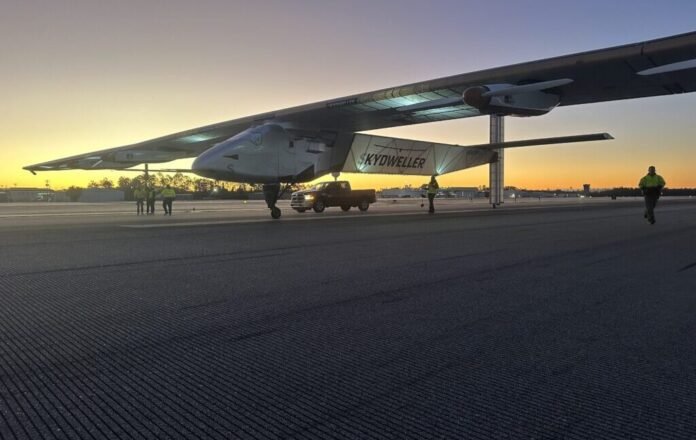
A solar-powered drone has been lost at sea after a record-breaking flight lasting eight days between late April and early May. The crash also marks the untimely demise of the pioneering aircraft Solar Impulse 2, which previously performed the world’s first solar-powered crossings of the Atlantic and Pacific oceans before becoming an uncrewed test platform for US military missions.

The carbon-fiber aircraft could perform such feats of aeronautical endurance while running solely on renewable energy and batteries because of a 236-foot (72-meter) wingspan—comparable to a Boeing 747 jumbo jet’s wings—covered with more than 17,000 solar cells. The company Skydweller Aero purchased and modified the original Solar Impulse 2 aircraft to become a test platform for “perpetual uncrewed flight” with the capability of carrying up to 800 pounds (363 kilograms) of payload.

Skydweller Aero was conducting test flights for maritime patrol mission scenarios with the US military, and the company also holds contracts with the Navy and Air Force. So the Skydweller drone was operating in that capacity when it took off on its final flight in the early morning hours of April 26.

In the Navy

After departing from Stennis International Airport in Mississippi, the Skydweller drone flew to join the US Navy’s annual Fleet Experimentation (FLEX) exercises near Florida’s Key West, according to a Skydweller Aero blog post. The Navy’s press release describes the FLEX 2026 event as testing AI and drone technologies for maritime patrols “in the fight against transnational organized crime.”

As part of the event, the drone used radar along with visual and thermal imaging to observe targets on the water during four days of continuous flight, according to Skydweller Aero. It also acted as a flying communications hub for Navy aircraft and warships while supporting AIS transponder-based tracking of ships in the area.

The Navy also highlighted the demonstration of a “sophisticated kill chain” which incorporated commercial drones with crewed US military helicopters and the Freedom-variant littoral combat ship USS Wichita. Together, such assets “successfully found, fixed, tracked, and targeted a captured drug boat” in a scenario leading up to “kinetic engagements destroying several captured drug boats,” according to the Navy’s press release.

It is unclear what role the Skydweller drone may have played in the exercise’s drug boat scenario. Ars has reached out to the US Navy for comment.

But the naval exercise comes as US Southern Command (SOUTHCOM) has conducted dozens of “lethal kinetic strikes” against alleged drug boats operating in the Caribbean and Pacific since September 2025. The lethal strikes have killed approximately 194 people to date, according to the nonprofit think tank InSight Crime—and legal and human rights experts have said the strikes violate both domestic and international law.

Following the formal end of the Navy exercise on April 30, the Skydweller drone spent several more days demonstrating “extended operational and airspace flexibility within the SOUTHCOM area of responsibility” by flying between Cuba and Mexico’s Yucatan Peninsula, according to Skydweller Aero’s blog post. The drone eventually positioned itself south of Cuba and north of the Cayman Islands while waiting out a period of bad weather.

Final destination

By the night of May 3, the drone was encountering severe weather conditions that included “extreme vertical air mass variability exceeding 10 times typical climb and descent rates,” Skydweller Aero wrote. The company emphasized that all aircraft systems were nominal throughout the flight—but a lack of energy reserves to deal with the extreme weather eventually brought down the drone.

The Skydweller drone was last visible on the flight-tracking service Flight Radar 24 north of Cancun, Mexico, in the early morning hours of May 4. The company described the drone as eventually performing a “controlled water ditching” around 6:30 am Eastern Time, but the aircraft “subsequently sank due to its non-buoyant composite structure.”

By the time it went under, the Skydweller drone had performed a record-breaking, solar-powered flight of eight days and 14 minutes—longer than any previous flights as either a drone or crewed aircraft. The company Skydweller Aero commemorated it as an “operational prototype” that had “validated the practical military utility of a persistent, medium-altitude solar aircraft” despite the loss at sea.

Skydweller drone flights in July 2025.

The aircraft’s earlier accomplishments will almost certainly endure in the public imagination. Solar Impulse 2 became the first solar-powered aircraft to circle the globe after completing a series of flights between 2015 and 2016. Along the way, it set a world record for the longest flight in a solar-powered plane when André Borschberg piloted the aircraft for 117 hours and 52 minutes—almost five days—during a 5,545-mile (8,924-kilometer) journey between Nagoya, Japan, and Hawaii.

Now, the crash of the Skydweller drone means that the Swiss Museum of Transport in Lucerne won’t get to display the historic aircraft per an original agreement with Skydweller Aero, according to SWI Swissinfo. That represents a blow for aviation enthusiasts unless future salvage operations can be carried out.

The pioneering design may nonetheless inspire future solar-powered aircraft for either civilian or military use. Skydweller Aero told Ars that it has no other prototypes immediately ready to replace the lost drone—but the company’s blog post described “planned upgrades using existing technology” that could enable future solar-powered drones to better withstand extreme weather conditions. Meanwhile, the Pentagon has proposed investing at least $54 billion into drone warfare systems.

Probe says sunken Russian cargo ship off Spain was transporting nuclear reactors to North Korea

0
probe-says-sunken-russian-cargo-ship-off-spain-was-transporting-nuclear-reactors-to-north-korea
Probe says sunken Russian cargo ship off Spain was transporting nuclear reactors to North Korea


Spanish investigators have discovered that the Russian cargo ship that sank in the Mediterranean in 2024 — originally believed to be part of a weapons retrieval mission to Syria — was secretly carrying nuclear reactor components bound for North Korea.

A Russian cargo ship that sank in the Mediterranean Sea between Spain and Algeria in December 2024 following explosions in its engine room was carrying components for two submarine nuclear reactors likely destined for North Korea, an investigation has revealed.

The Ursa Major sank on 23 December with 16 crew members on board. Fourteen were rescued and brought to Spain, while two crew members — second engineer Nikitin and engineer Yakovlev — remain missing and are presumed dead.

Spanish investigators now believe the vessel may have been deliberately sunk by a Western military using a rare supercavitating torpedo to prevent Russia from delivering advanced nuclear technology to North Korea, according to details of the Spanish probe obtained by CNN.

The Russian Foreign Ministry initially said the vessel sank after an “explosion in the engine room” but provided no explanation for the blast.

However, the ship’s Russian captain later told investigators that items declared on the ship’s manifest as “non-dangerous merchandise” — two large hatch covers — were actually components for two nuclear reactors similar to those used in submarines.

The captain also revealed that he thought the ship would eventually be diverted to the North Korean port of Rason to deliver the reactors, according to a source familiar with the investigation. He did not further discuss the cargo due to fears for his safety.

The vessel, previously known as Sparta III, was constructed in 2009. While its official manifest stated it was travelling from St Petersburg to Vladivostok carrying two large cranes, 129 empty containers and hatch covers, investigators have questioned why Moscow would send such cargo by sea around the world rather than using the country’s extensive rail network.

The investigation suggests the cranes were on board to assist with the delivery of the sensitive nuclear cargo upon arrival in North Korea.

Some details of the Spanish investigation into the incident were initially published by the Murcian local newspaper La Verdad in December 2024.
Suspicious circumstances and Russian interference

The ship was operated by Oboronlogistika, a company owned by the Russian Ministry of Defence. Just two months before the sinking, Oboronlogistika announced its ships had been licensed to carry nuclear material.

The vessel had been under US and UK sanctions since Russia’s full-scale invasion of Ukraine in 2022, due to its owner’s role in supplying cargo to the Kremlin’s military.

The sinking occurred just two months after North Korean leader Kim Jong-un sent some 10,000 troops to support Russia’s full-scale invasion of Ukraine — an exchange that investigators believe may have prompted the Kremlin to transfer nuclear technology to Pyongyang in return.

Russia and North Korea also have a deal in place since late 2024 pledging mutual military aid.

A nuclear-powered submarine was one item on a wish list of sophisticated weaponry that Kim announced during a political conference in 2021. Other weapons included solid-fuelled intercontinental ballistic missiles, hypersonic weapons, spy satellites and multi-warhead missiles.

North Korea released photographs in December 2025 of Kim’s visit showing what appeared to be a largely completed nuclear-powered submarine hull, coated with what was likely anti-corrosion paint, under construction in an assembly hall.

Pyongyang has indicated it plans to arm the submarine with nuclear weapons, calling it a “strategic guided missile submarine” or a “strategic nuclear attack submarine”.

While questions persisted about whether North Korea, a heavily sanctioned country, could obtain resources and technology to build nuclear-powered submarines, experts initially believed it was more likely Pyongyang designed its own reactor with Moscow’s expertise, rather than acquiring a decommissioned Russian one.

In the months following the sinking, significant military activity has been detected around the wreck site, which lies at a depth of approximately 2,500 meters.

One week after the incident, Russian spy vessel Yantar — later detected near UK waters in early 2025, prompting stern warnings from the British government — spent five days positioned over the Ursa Major wreckage.

Meanwhile, US nuclear “sniffer” aircraft have flown over the sunken ship twice in the past year, according to public flight data.

Spanish authorities have stated that recovery of the ship’s data recorder was impossible without incurring major costs and risks. Experts have questioned why this would be the case if no radioactive material were involved.
Russian claims and Syria connection

Russia’s state-linked operator Oboronlogistika claimed the ship was “embarking on another voyage to the Far East carrying significant project cargo as part of state tasks aimed at developing port infrastructure and the Northern Sea Route.”

However, Ukrainian military intelligence (HUR) had previously reported that the Ursa Major was actually headed to Syria to assist with evacuating Russian military equipment from the country’s bases at Tartus and Khmeimim, following the fall of Bashar al-Assad’s regime.

The Ursa Major had been used for years as part of Russia’s “Syrian Express” — a supply route transporting military equipment and weapons to Russian forces in Syria.

A UK sanctions listing states that ships belonging to Oboronlogistika have been used to transport missiles from Syria to the Black Sea.

The Spanish probe concluded that indications the ship would go to Syria were likely a distraction from the trip’s true purpose.

Following pressure from opposition lawmakers, the Spanish government issued only a brief statement in February on the investigation,confirming the captain’s testimony about the components for two nuclear reactors similar to those used in submarines.

South Korean intelligence reported in September 2025 that Moscow had already handed Pyongyang one nuclear reactor, and multiple South Korean government officials told domestic media that the Kremlin was suspected of sending two to three nuclear submarine propulsion modules to North Korea in the first half of 2025.

Via Euronews

Soybeans on Beijing agenda but US farmers should temper optimism

0
soybeans-on-beijing-agenda-but-us-farmers-should-temper-optimism
Soybeans on Beijing agenda but US farmers should temper optimism

In 2017, President Donald J. Trump’s National Security Strategy declared China a competitor, an adversary and a “revisionist power” determined to supplant the United States in Asia.

In his 2025 National Security Strategy, the confrontational epithets were dropped, replaced by anodyne references. The document pledges to “rebalance” the US-China trade relationship and says deterring a conflict over Taiwan is a priority. But the tone of these pledges is neutral.

Even a section of the document that aims fire at China doesn’t use the words “China” or “Chinese.” The section vows to deny “non-hemispheric competitors” access to vital assets in the Western Hemisphere and “to make every effort to push out foreign companies that build infrastructure in the region.” Those “competitors” and “companies” are Chinese.

Could the Donald Trump who was once so tough on China have turned soft? His rhetoric is certainly softer. Applying the “look at what they do, not what they say” test also reveals softening. The administration is still pushing China on several fronts, but it has eased up on tariffs and allowed more sales of high-tech US semiconductors to China.

The chips sales worry China hawks like Matt Pottinger, who helped shape the first Trump administration’s tough approach to China as deputy national security advisor. In Congressional testimony in January, Pottinger criticized the sales, saying they would, among other things, “help China supercharge its military modernization.”

American farmers and ranchers suffered through the US-China trade wars in both Trump administrations. In last year’s trade war, China stopped buying American soybeans altogether for several months after Trump imposed 100% tariffs on Chinese imports.

A recent analysis by the Economist concluded that “agriculture was hit harder by retaliatory tariffs than any other American industry.”

The Chinese agreed last fall to resume purchases and the president agreed to slash the tariffs. This was more like a truce than a peace treaty, however. Neither side can feel confident that the other will continue to abide by the agreement.

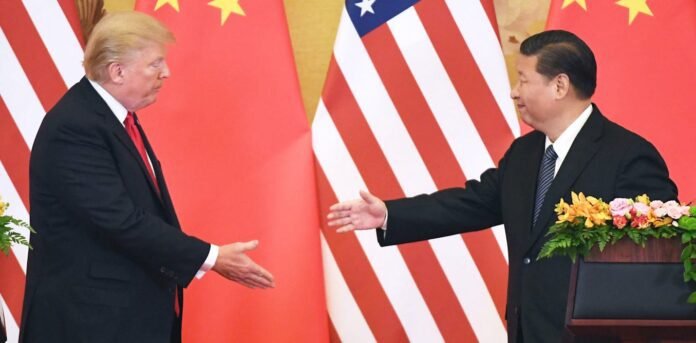
President Trump and President Xi Xinping are scheduled to meet in Beijing on May 14 and 15. Soybeans are on the agenda. It’s of course not the only issue the two leaders will discuss. The Chinese want their still-high tariffs further reduced and the Hormuz Strait opened, among other things. The US wish list includes rare-earths materials security and fentanyl-precursor control.

Still, Trump would love to come back with good news for US soybean growers. There’s a reasonable chance Xi will let him claim victory. The Chinese, he’ll crow, will keep buying US beans.

Make no mistake, though. Even if the summit is cordial and ends on a high note, there’s no guarantee of permanent peace. Each side has demonstrated it has the power to inflict pain on the other. Both have indicated a willingness to use that power to make a point.

With the summit just weeks away, China did that – twice. It ordered Meta, the US owner of Facebook, to unwind its $2 billion acquisition of the Chinese AI startup Manus.

And when the US Treasury sanctioned five small Chinese refiners for buying Iranian crude oil, China retaliated by saying the refineries could bring suit in Chinese courts against any bank, insurance company or other party complying with the US sanctions. It was the first time China had activated its anti-sanctions “blocking rules.”

The Wall Street Journal’s Lingling Wei, perhaps the best-sourced US journalist covering China, said she’s hearing from people around the leadership that Xi thinks he’s figured out how to “manage” Trump: “The U.S. president can be exhausted and outwaited, and calibrated escalation resets the bargaining floor instead of blowing up the relationship.”

Is Xi overplaying his hand? Though Trump wants this summit to go well, he doesn’t want to look like he can be “managed.” It wouldn’t be surprising if at some point after the summit he reminds Xi he can inflict pain, too.

It’s a truce, not a permanent end to hostilities. With luck, it will be a long truce. Trade, including soybean sales, will continue.

The Chinese, though, are preparing for the worst. They’re striving to end their reliance on US soybeans. They’re buying Brazilian beans and building infrastructure to help Brazil get product to market. They’re working to reduce soybean consumption by developing fermented feeds for their pigs.

US soybean farmers must prepare for the worst, too. They may still sell some of what they grow to China, but they need greatly increased sales to other markets, both foreign and domestic, in case the truce collapses.

Just as China wants to stop depending on them, they need to stop depending on China.

Former longtime Wall Street Journal Asia correspondent and editor Urban Lehner is editor emeritus of DTN/The Progressive Farmer. This article, originally published on May 11 by the latter news organization and now republished by Asia Times with permission, is © Copyright 2026 DTN, LLC. All rights reserved.  Follow Urban Lehner on X @urbanize.

Immigrants Detained in Chicago Military-Style Raid Seek Millions in Damages

0
immigrants-detained-in-chicago-military-style-raid-seek-millions-in-damages
Immigrants Detained in Chicago Military-Style Raid Seek Millions in Damages

On the night of the military-style raid at a Chicago apartment complex, a loud boom woke the Nigerian man who lived in Unit 215. Tolulope Akinsulie stood up from his bed and saw heavily armed federal agents rushing into his apartment. He then felt the jaws of a large dog biting into his right ankle, knocking him to the floor. Akinsulie screamed as the dog tore the flesh from his ankle, thighs, hip and wrist. 

Down the hall, agents took a Venezuelan mother and her 16-year-old son from their apartment at gunpoint to another unit. There, they saw agents hit a man with what looked like the butt of a  rifle and kick another who was lying on the floor. As he watched, her son began to hyperventilate.

“Here is another one,” agents said about a Mexican man who lived in Unit 502, before zip-tying his hands behind his back and marching him out of the building. Agents told the man he wasn’t welcome in the United States, took his city of Chicago identification card and ripped it up in front of him. 

While much has been documented about the Sept. 30 raid by the U.S. Department of Homeland Security, new accounts from 17 men, women and children detained that night paint a violent and terrifying portrait of how the federal agents conducted the operation.

Their descriptions form the basis of administrative claims filed on their behalf Tuesday against DHS and several other federal agencies that took part in the midnight raid in Chicago’s South Shore neighborhood.

The claims mark the tenants’ first step toward seeking accountability, their lawyers said, as well as millions of dollars in damages, for federal agents’ actions during the raid, a key moment in the Trump administration’s immigration crackdown in Chicago. The claims allege that agents didn’t have warrants before entering apartments.

“There was no reason to do me like that,” Akinsulie said in an interview with ProPublica. His body still bears the dark scars from the dog bites. The complaint, he said, is meant to send a message that officials are not above the law. “Everybody can get a check and balance,” he said. “People have to learn how to act right.”

The claims allege that federal agents caused physical injuries, emotional trauma, “brutal detention” and financial loss. Each of the claimants — 15 are immigrants, and two are U.S. citizens —  is seeking about $5 million, an amount the attorneys believe is comparable to similar court judgments in Chicago.

“There is no amount of damages that will compensate our clients for the trauma they experienced that night,” said Susana Sandoval Vargas, the Midwest regional counsel for the Mexican American Legal Defense and Educational Fund, a national Latino civil rights organization that is representing some of the tenants. “It is about holding the federal government accountable for their unlawful actions.”

A man’s leg with his pant leg rolled up. Above his ankle, there are scars.
“There was no reason to do me like that,” Tolulope Akinsulie said. His leg still bears the dark scars from where a dog bit him on the night of a federal raid on his apartment complex. Jamie Kelter Davis for ProPublica

A DHS spokesperson said Wednesday that the “operation was performed in full compliance of the law” and that tenants are not owed compensation. “DHS is taking appropriate and constitutional measures to uphold the rule of law and protect our officers and the public from dangerous criminal illegal aliens.”

The spokesperson did not respond to questions about Akinsulie’s injuries. But federal immigration agents have said they issued verbal warnings as they entered Akinsulie’s unit and believed he had been trying to hide and evade arrest, according to documents filed in an unrelated lawsuit. Akinsulie said he was in a deep sleep and did not hear any warnings or the dog barking.

Within DHS, the South Shore tenants’ claims also were submitted to U.S. Customs and Border Protection, U.S. Border Patrol and U.S. Immigration and Customs Enforcement. In addition, they were sent to the Bureau of Alcohol, Tobacco, Firearms and Explosives and the Federal Bureau of Investigation, neither of which responded to questions from ProPublica.

An 18th claim also was filed Tuesday on behalf of a tenant who was detained outside the building a week before the raid and lost property.

The Federal Tort Claims Act provides one of the only avenues for people who believe they were harmed by federal employees acting unlawfully and allows for compensation for emotional distress, property damage, injury or death. If the agency does not respond or settle a claim within six months, or if it denies a claim, individuals can then file a lawsuit. 

DHS would not say how many claims have been filed since last year. But already there have been dozens across the country: A pregnant woman in California said she went into premature labor after being detained and shackled. A Marine Corps veteran said he was tackled by federal agents while protesting in Oregon. A Chicago alderperson said agents swore at her, shoved her and handcuffed her after she questioned their presence in a hospital emergency room. The DHS spokesperson said the three individuals were obstructing or interfering with law enforcement.

In interviews, a half dozen attorneys said they expect to see more claims in the coming months. “Hopefully this case and others will be a check against the most aggressive and reckless forms of (immigration) enforcement,” said Mark Fleming, an attorney with the National Immigrant Justice Center, which worked on the case along with MALDEF, the Immigrants’ Rights Clinic at the University of Chicago and the MacArthur Justice Center.

During the South Shore raid, some 300 heavily armed agents stormed the dilapidated, five-story building; some descended from a Black Hawk helicopter. They hurled flash grenades, broke down apartment doors and zip-tied dozens of immigrants and U.S. citizens who lived in the building. The drama was captured by a television crew that accompanied agents.

The Trump administration repeatedly justified its actions by claiming it had intelligence that the Venezuelan gang Tren de Aragua had taken over the building, and that there were guns, drugs and explosives inside. ProPublica journalists, who over the past several months have interviewed 16 of the 37 immigrants detained that night, previously reported that there was little evidence to back the government’s claim. To this day, federal prosecutors have not filed criminal charges against anyone who was arrested.

The tort claims detail what families, including those with young children, allegedly experienced during the raid. A Venezuelan mother and father huddled together in their apartment with their four children, the youngest a 1-year-old U.S. citizen, who “screamed and cried in terror” while agents pointed guns at them. Agents marched them outside in their pajamas and separated the father. One of the boys, now 9, had a panic attack, according to the claim.

DHS officials previously insisted children were not zip-tied, but the account from the 16-year-old boy who hyperventilated at the sight of agents assaulting immigrants said he and his mom were zip-tied outside the building. DHS called that an “abject lie” and said no children were handcuffed or restrained. 

While the tenants were detained, the records allege, many of their possessions were stolen or lost: shoes, Playstations, smartphones, jewelry, mattresses, a backpack with $1,300 in cash and toys. Several reported losing their vehicles, too.

A large apartment building with a lawn and gate in front of it. There are two large trees framing the entrance of the building.
The South Shore apartment complex after the raid Jim Vondruska for ProPublica

The raid upended tenants’ lives. Many of the immigrants, mostly Venezuelan, have already been deported. Many U.S. citizens who lived in the building, including some on public housing assistance, were forced to relocate late last year after a judge ordered the building shuttered for safety issues and code violations.

José Miguel Jiménez López, 42, the Mexican man who lived on the fifth floor, worked as a welder in Chicago before the raid disrupted his life. Jiménez said he wasn’t a gang member or involved in criminal activity. So even when agents pointed guns at him, zip-tied his hands and told him to go back to his country, he thought they would let him go. They didn’t.

Over the next four months, he was shuttled to detention facilities in Indiana, Kentucky and Louisiana before being released at the Mexico border in February. He is now living in his childhood home in the state of Guanajuato. “I have friends and family who are still there, and they are afraid,” he said in an interview. “I wouldn’t like to see them go through what I had to go through.”

His claim details harsh conditions at the facilities, including insufficient food and water, constant air conditioning during winter and little time outside. Others described getting sick from the drinking water, a lack of adequate medical care and a constant worry that they would never see their loved ones again. The DHS spokesperson said the “safety and well-being of detainees are prioritized” and that detainees have access to medical care and nutritious meals.

In his claim, Jiménez alleged that “ICE officers treated him and other detainees as if they were sub-human and not entitled to basic dignity or respect.” He said he lost $3,000 worth of property, including a TV and a drill. 

Meanwhile, the Venezuelan woman and her 16-year-old son were transferred to the Dilley Immigration Processing Center in Texas. They spent three weeks there until they were released into the U.S. on electronic monitoring. The woman now has trouble sleeping, while her son sees a psychiatrist to process what happened that night. 

Akinsulie, 42, said he is grateful to be alive. A devout Christian, he finds peace reading the Bible and in prayer. But while he was in detention, he had so many nightmares that he needed to see a psychiatrist. He dreamed about dogs barking behind him. Chasing him. Talking to him.

“The one that really baffled me was when the German shepherd was chasing me. Then I was running,” Akinsulie said. “The German shepherd was about to bite me. That really scared me because I don’t want no more bites.”

The nightmares stopped after he was released in March; the government had conceded that he and others had likely been arrested unlawfully. Akinsulie, who said he has lived in Chicago since 2007, has no criminal history, according to the arrest report from the night he was detained. 

He is back in Chicago now, staying with a friend and doing odd jobs. He finds it difficult to stand for a long time, and sometimes pain shoots from his hip to his right foot. Once an avid soccer player, he said he can’t kick the ball or run like he used to. He worries that the injuries might be permanent, but he can’t afford to see a doctor.

FCC angers small carriers by helping AT&T and Starlink buy EchoStar spectrum

0
fcc-angers-small-carriers-by-helping-at&t-and-starlink-buy-echostar-spectrum
FCC angers small carriers by helping AT&T and Starlink buy EchoStar spectrum

The Federal Communications Commission yesterday approved EchoStar’s sales of spectrum licenses to AT&T and Starlink operator SpaceX. The deals are worth $40 billion in total.

The orders, issued by the agency’s Wireless Telecommunications Bureau and Space Bureau, aren’t surprising given that FCC Chairman Brendan Carr essentially forced EchoStar to sell the licenses. Last year, Carr threatened to revoke the licenses after SpaceX alleged that EchoStar subsidiary Dish Network “barely uses” the spectrum to provide mobile service to US consumers.

Dish had obtained a deadline extension for its network deployment obligations from the Biden-era FCC, and Carr objected to the agreement made with the previous administration. After Carr’s threat, the Charlie Ergen-led EchoStar struck deals to sell spectrum licenses to SpaceX for $17 billion and to AT&T for $23 billion.

AT&T is set to acquire 30 MHz of nationwide spectrum licenses in the 3.45 GHz band and 20 MHz in the 600 MHz band, giving it new options for both mid-band and low-band spectrum in its 5G and fixed wireless networks. SpaceX is buying 65 MHz of nationwide spectrum licenses in a few chunks between 1.695 GHz and 2.2 GHz, which it can use to boost the Starlink satellite mobile service that is available for T-Mobile phones.

The deals may still have a problem despite yesterday’s approvals. EchoStar objected to an FCC-imposed condition requiring it to fund an escrow account of $2.4 billion to compensate construction companies that were hired to build the Dish network.

Controversial approval and condition

EchoStar’s Boost Mobile subsidiary will continue to provide wireless service, but over the AT&T network rather than EchoStar’s own. Boost Mobile will also have access to Starlink’s mobile network through a deal with SpaceX. EchoStar, which has said it had to scale back its network-construction plans to resolve the FCC’s complaint, issued a statement yesterday suggesting it may fight the escrow requirement.

Separately, a group representing rural mobile carriers criticized the approvals, saying the FCC ignored competition concerns raised by small wireless operators. The spectrum sales “continue the troubling pattern of spectrum aggregation that disadvantages rural wireless providers, stifles competition in the wireless marketplace, and hinders the deployment of wireless services—particularly in the hardest-to-serve rural areas,” the Rural Wireless Association said.

While Starlink isn’t a wireless carrier, it is looking to dominate the emerging market for Direct-to-Device (D2D) systems that use low Earth orbit satellites to provide service on standard mobile phones. Meanwhile, AT&T’s purchase of EchoStar licenses continues the consolidation of spectrum with the three major carriers—AT&T, Verizon, and T-Mobile.

“In approving the EchoStar/AT&T deal, the FCC’s Wireless Telecommunications Bureau erroneously asserts that the likelihood of competitive harm is low, dismissing concrete harms identified by rural wireless carriers, including reduced access to spectrum needed to expand service in rural markets and diminished competitive opportunities for rural and regional wireless providers,” the Rural Wireless Association said.

Although the Rural Wireless Association objected to the approvals, it said there is still a chance for small carriers to get some spectrum licenses from EchoStar in future deals.

FCC chair says it’s all “thanks to President Trump”

While the approvals came from FCC staff, Carr announced the decisions in a press release. He also gave credit to his boss in the White House.

“Thanks to President Trump, America is leading the world again in next-gen technology,” Carr said in his official statement on the approvals. “As a result of President Trump’s work, Americans are now going to see faster Internet speeds, stronger competition, and innovative new offerings, including high-speed connections right to your smartphone from space—providing ubiquitous connectivity when these new systems are complete.”

AT&T previously received special authority to deploy EchoStar’s 3.45 GHz spectrum while the sale is pending. AT&T said yesterday that it has deployed the mid‑band spectrum to boost network capacity, and will deploy the low-band frequencies after closing the purchase. AT&T has said it expects to complete the deal in mid-2026.

EchoStar’s deal with SpaceX will be completed in two stages, with the licenses being transferred first to a trust held for the benefit of SpaceX and later from that trust to SpaceX. The companies say the two-step process is necessary to obtain regulatory approvals outside the US. The final step is expected to be completed by November 30, 2027, but could happen earlier.

EchoStar opposes “unprecedented” escrow condition

EchoStar said it is “evaluating next steps” in regard to the escrow condition. That kind of statement can indicate a company is considering legal action.

“The FCC has continuously applauded EchoStar’s spectrum sales to AT&T and SpaceX as pro-competitive transactions that serve the public interest, and we appreciate that the FCC approved them today,” EchoStar said. “However, these approvals come with an unprecedented involuntary escrow condition. We are analyzing this requirement and evaluating next steps.”

The FCC said the docket drew comments “alleg[ing] that EchoStar has told various tower companies, fiber backhaul providers, and construction firms that it will not fulfill its contracts nor pay the monies it owes them for constructing that radio network.” The companies asked the FCC to impose an escrow requirement so they can be paid from the proceeds of the spectrum sales.

“EchoStar disputes claims that have been raised by those companies,” and “responds that it has reached settlements with hundreds of vendors and made hundreds of millions of dollars of payments,” the FCC said. “It argues that any escrow condition is illegal and unmanageable.”

Despite acknowledging those objections, the agency ordered EchoStar to put $2.4 billion in an escrow account, which would be withdrawn based on the outcome of legal disputes with vendors. The FCC acknowledged that the agency itself played a “unique role in the underlying series of events,” creating “a precedentially novel fact pattern and cognizable public-interest harms specific to this transaction that we find necessary to resolve here.”

“With the attached condition, the FCC continues to allow the relevant parties and, if necessary, courts or other bodies, to adjudicate or settle these issues,” the FCC said.

Trump-XI summit: US president says he will discuss arms sales to Taiwan – breaking decades of US policy

0
trump-xi-summit:-us-president-says-he-will-discuss-arms-sales-to-taiwan-–-breaking-decades-of-us-policy
Trump-XI summit: US president says he will discuss arms sales to Taiwan – breaking decades of US policy

Donald Trump and Xi Jinping are likely to discuss many issues as they meet this week in Beijing. But alongside trade, technology and the war in Iran, one topic of conversation will stand out – the future of Taiwan.

Taiwan has long been a sensitive issue in Sino-American relations. Beijing regards the island as a breakaway province which must be reunited with the mainland. The United States has long opposed such a step. Yet in recent months, Trump has fuelled speculation that he may be ready to change key aspects of US policy on the issue, potentially granting Beijing long-sought concessions.

Trump’s apparent readiness to make these moves means that Taiwan is one of the issues on which we might see the most significant policy developments at the summit. And that could happen simply through the famously voluble president uttering just a few simple words.

The president’s policy towards Taiwan has been inconsistent and seemingly more malleable than that of previous administrations. Advocates for Taiwan point out that his administration recently approved the largest ever US arms sale to the island. But at the same time, he has sowed doubts about the strength of his support for Taiwan’s independence.

US policy towards Taiwan has traditionally been based on two principles. The first is “strategic ambiguity”, which means that the US declines to explicitly state whether it would actively use its military to defend Taiwan from attack by China. This policy is supposed to deter China while also discouraging Taiwan from formally declaring its independence from Beijing.

The second principle is the “one China policy”. According to this policy, the US recognises Beijing as the legitimate government of China, while opposing any violent solution to its dispute with Taiwan. It also retains robust informal links to the Taiwanese government in Taipei.

Observers are concerned that Trump may water down these principles during his summit with Xi. For instance, he might state that the US not only “does not support” Taiwanese independence but actively “opposes” it. Or he might double down on previous comments he has made indicating that whether or not Xi invades Taiwan is “up to him”.

Trump has also explicitly stated that he will discuss future US arms sales to Taiwan with Xi during this week’s summit. This violates one of the so-called Six Assurances that the US has upheld towards Taiwan since the 1980s, and which were endorsed by the US Congress in 2016.

Even securing a discussion of arms sales would be a victory for Xi, who would welcome an opportunity to chip away at the Six Assurances. Presumably he would then try to weaken the US commitment to the other five, which include a US commitment not to change its position on Taiwan’s sovereignty.

More concretely, if Xi succeeds in making US arms sales to Taiwan a legitimate topic of negotiation in Sino-American relations, then he could head them off in the future by offering the US concessions in other areas. For instance, if Trump or a future president asks Beijing for its help settling a conflict like that in Iran, Beijing might demand an end to US arms sales to Taiwan as the price.

High stakes

Given Trump’s reputation as a formidable China hawk, his attitude towards Taiwan may seem surprising. But it’s actually part of a longstanding pattern.

In relations with China, Trump has arguably always prioritised economic issues, while appearing less concerned about the security of America’s regional allies. He has also raised doubts about whether Taiwan is even defensible. In his first term, he reportedly told aides that: “Taiwan is like two feet from China. We are 8,000 miles away. If they invade, there isn’t a fucking thing we can do about it”.

Journalists surround a television set which is showing US president DOnald Trump arriving in Beijing.

Huge anticipation: journalists watch the US president arrive in Air Force One for his Beijing summit with President XI, May 13. Samuel Corum/Sipa USA) Credit: Sipa US/Alamy Live News

Trump is also both highly transactional and less focused on abstract principles of foreign policy than most previous presidents. He views America’s support of allies such as Taiwan as a gift that it gives them, one that is often not worth the cost. If he can achieve a concrete victory for himself today by trading away support for Taiwan tomorrow, he may well be willing to do so.

All of these developments matter because they make a violent conflict between China and Taiwan, potentially ultimately involving the US, more likely. If Trump makes concessions to Xi, it will be the latest signal that US support for Taiwan is wavering. That made be read in Beijing as permission to violently change the status quo. Even though such an act might belatedly then be met with force from Washington in response, it is made more likely by Trump’s stance today.

Even worse for Trump, the summit comes at a time when American power and the wisdom of its long-term strategy are being visibly called into question in the Middle East. The US is bogged down in an intractable conflict and has severely damaged its deterrent capacity in the Indo-Pacific by burning through advanced munitions at a high rate. Trump’s personal unpopularity is also rising at home amid the war and its economic fallout.

This weakened position makes it even more likely that Trump will want to strike a deal with Xi to help end the war in Iran or ease trade tensions to help the economy at home. Taiwan may be the price of that – and, ultimately, peace.

Baloch insurgency: Suicide bombs and uptick in violence threaten Pakistan, regional security

0
baloch-insurgency:-suicide-bombs-and-uptick-in-violence-threaten-pakistan,-regional-security
Baloch insurgency: Suicide bombs and uptick in violence threaten Pakistan, regional security

In the space of 10 days in late April 2026, insurgents in Pakistan purportedly carried out 27 attacks in the country’s southwest province of Balochistan, killing at least 42 military personal. Then, on May 11, authorities announced that a suicide bombing plot on the capital, Islamabad, had been foiled. Authorities arrested a girl over the incident – a nod to militants’ increasing use of young Baloch women to carry out attacks.

These incidents represent the latest flaring up of a long-running insurgency in Pakistan’s largest province and home to around 15 million people.

For a rundown of what you need to know about the Baloch insurgency and groups involved, The Conversation turned to Amira Jadoon and Saif Tahir, experts on militant and terrorist organizations currently researching such groups’ operational activities and strategic messaging in Afghanistan and Pakistan.

What is the Baloch insurgency about?

Pakistan’s southwestern province of Balochistan has long been the site of resistance and armed movements involving Baloch, an ethnic group of an estimated 8 million to 10 million people that straddles parts of Pakistan and Iran.

Their insurgency is rooted in both contemporary and historical grievances. Its origins trace back to the contested annexation of the princely state of Kalat in 1948, months after the partition of British India into India and Pakistan, and the resulting confrontations between Baloch tribal leaders and the newly formed Pakistani state.

While the insurgency long remained a low-level struggle framed around Baloch marginalization and economic exploitation, it turned violent in the early 2000s with the rise of militant factions, including the Balochistan Liberation Army, or BLA, in 2000 and the Balochistan Liberation Front, or BLF, which was revived in 2004 under current leader Allah Nazar Baloch decades after its 1964 founding. The insurgents’ goals vary, from greater autonomy and control over the province’s natural resources to full independence.

Baloch militants generally cast their emergence as a nationalist rebuttal to the Pakistani government’s long-standing narrative, which states that the unrest is driven by a handful of tribal chiefs resisting development rather than a broad-based movement.

In practice, the contemporary insurgency has expanded well beyond its tribal base, and Baloch militant groups have invested heavily in strategic communications that directly challenge the Pakistani state’s framing.

Today, Baloch militants’ propaganda targets the local educated youth, including women. They play on existing grievances over enforced disappearances, state repression and resource extraction. Balochistan is home to significant deposits of copper, gold, natural gas and coal, including at the Reko Diq mine, one of the world’s largest undeveloped copper and gold reserves. Yet the province remains Pakistan’s poorest.

Baloch militants’ efforts are designed to broaden the insurgency’s appeal, adding an urban, middle-class layer to what was once a primarily tribal revolt that casts itself as a struggle to defend the Baloch “motherland” and achieve national liberation.

The Baloch insurgency has emerged as one of Pakistan’s most consequential internal security challenges. In 2025, the BLA claimed 521 attacks and 1,060 security-force fatalities, though independent monitoring records substantially fewer attacks, at around 254 events, in Balochistan over the same period.

Two Baloch militants’ operations bookend the recent escalation. In March 2025, BLA fighters hijacked the Jaffar Express – a heavily used passenger train connecting Quetta, the capital of Balochistan, to Peshawar in northwestern Pakistan – holding more than 350 passengers in a 30-hour siege. In April 2026, the group announced a new naval wing, the Hammal Maritime Defence Force, following its first maritime attack on a Pakistan coast guard vessel near Jiwani, in Gwadar district.

These tactical innovations have been reinforced by deliberate efforts at broadening the support base for Baloch separatism. The 2018 formation of Baloch Raji Ajohi Sangar, an alliance of Baloch militant groups, and the 2020 entry of the non-Baloch Sindhudesh Revolutionary Army, a Sindhi separatist group based in neighboring Sindh that has extended Baloch militants’ operational reach into Karachi, signal an expanding ethno-regional coalition aimed at broadening the geographic and ideological scope of the insurgency.

Why the uptick in violence now?

Four converging factors explain the recent escalation.

First, the Pakistani state’s crackdown on peaceful political space in recent months has accelerated social discontent. Following the March 2025 Jaffar Express attack, prominent Baloch rights defender Mahrang Baloch was arrested under anti-terrorist laws, while three protesters were shot dead at a peaceful sit-in in Quetta.

As nonviolent avenues close, aggrieved civilians become more receptive to Baloch militants’ recruitment narratives.

Second, Baloch militants have acquired U.S. weapons left behind in Afghanistan during the 2021 withdrawal, including M4 and M16 rifles fitted with thermal optics. Recent reports have linked the arms used in the Jaffar Express attack directly to abandoned U.S. stockpiles in Afghanistan.

Third, militant operational collusion has deepened between the Balochistan Liberation Army and the Tehrik-i-Taliban Pakistan, the latter ranked by the Institute for Economics and Peace as the world’s fastest-growing insurgent group in 2024.

Despite the groups’ divergent ideologies, the cooperation appears to have produced clear tactical convergence, including town takeovers, the use of suicide bombings, and sniper and ambush tactics.

Finally, Baloch groups have excelled in the effective use of social media to influence and recruit educated young people, including women.

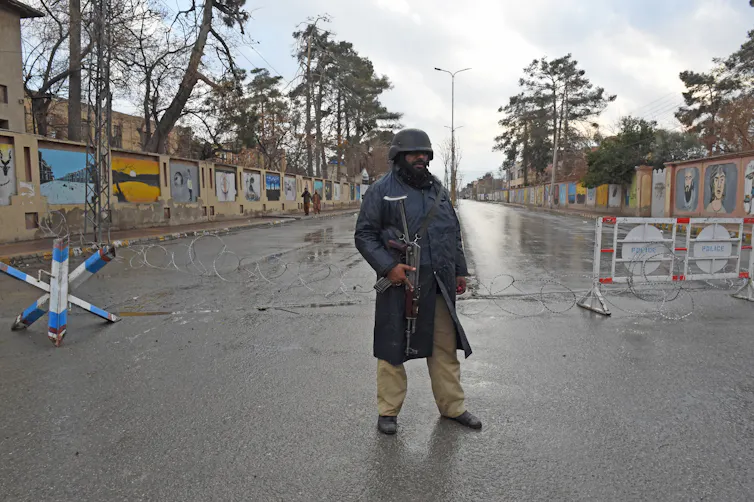
A man in a gun stands in the middle of a street.

A policeman stands guard near the blast site in Quetta after an attack by Baloch separatists on Jan. 31, 2026. Adnan Ahmed/AFP via Getty Images

The BLA’s elite Majeed Brigade has formalized a women’s wing, and the use of female suicide bombers has now spread across multiple Baloch factions. At least five known cases have been reported since 2022.

The deployment of women is strategic: Female operatives present a softer public face and yield both reputational and tactical benefits, evading security profiling, expanding target reach and amplifying media impact.

Has the insurgency been affected by the Iran war?

Tehran’s destabilization creates new tactical space for insurgents. Ethnic Baloch communities straddle the Pakistan-Iran border, and the BLA already maintains a presence in Iran’s Sistan and Baluchestan province.

The “Greater Balochistan” narrative promoted by Baloch nationalists, which envisions the reintegration of Baloch lands across both states, is gaining traction on the Iranian side. Moreover, weaker border enforcement gives militants greater freedom to move, recruit and coordinate.

Cross-border trade flows have dropped sharply since the war in Iran began, but the disruption is more likely to expand than to shrink Balochistan’s illicit economy over time. As state enforcement weakens on both sides of the border, the cross-border fuel and narcotics smuggling networks that Baloch militants tax and target are likely to expand further.

The cross-border problem had already escalated to interstate confrontation. In January 2024, Iran and Pakistan exchanged tit-for-tat strikes on Baloch militant groups operating across their shared border.

Counterterrorism coordination between the two countries remains modest, and attacks have continued, including the killing by militants of Pakistani migrants inside Iran as recently as April 2025.

With Iran’s stability weakening, these dynamics are likely to deepen, potentially raising tensions between Islamabad and Tehran over separatists in the future.

How are Pakistan-US relations affected?

The Baloch insurgency is now also an increasingly important focus of a warming U.S.-Pakistani relationship.

In August 2025, the U.S. State Department designated the BLA and its Majeed Brigade as foreign terrorist organizations – a move Islamabad had long pressed for.

Months later, the U.S. Export-Import Bank approved US$1.3 billion for the Reko Diq copper-gold project in Balochistan, its single largest critical minerals investment to date.

The current insurgency directly contests Pakistan’s capacity to deliver security in Balochistan. The Reko Diq mine lies in the same district where Zareena Rafiq, a BLF-affiliated female suicide bomber, struck a base of Pakistan’s federal paramilitary force on Nov. 30, 2025.

Further, in April 2026, a BLF commander declared that the group would target all foreign companies operating in Balochistan, regardless of country of origin.

Yet the present alignment between the U.S. and Pakistan is transactional: Its durability depends on Pakistan delivering on counterterrorism, mediation with Iran and mineral access.

Meanwhile, absent a counterinsurgency approach that addresses the underlying political and social drivers of the Baloch insurgency – including state repression, political marginalization and resource grievance – the broader U.S.-Pakistan reset is unlikely to deliver the stability its investments require.

0FansLike
0FollowersFollow
0FollowersFollow
0SubscribersSubscribe
- Advertisement -
Google search engine

Recent Posts