
13 C
London
Friday, May 8, 2026
Home Blog

Hasan Piker Is the Democrats’ New Man on the Trail, Whether They Like It or Not

0
hasan-piker-is-the-democrats’-new-man-on-the-trail,-whether-they-like-it-or-not
Hasan Piker Is the Democrats’ New Man on the Trail, Whether They Like It or Not


Devin Thomas O’Shea is the author ofThe Veiled Prophet: Secret Societies, White Supremacy, and the Struggle for St. Louis,” publishing with Haymarket Books in June 2026.

In a letter to Twitch and Amazon, New York Democratic Rep. Richie Torres once slammed Hasan Piker, the popular political streamer, for his “depravity” and called him “the poster child for the post-October 7th outbreak of antisemitism.” While mainstream Democrats and their allies have for months weighed the “problem” of Piker for the party, his star has only continued to rise. Insurgent candidates on the left are now making him their go-to surrogate, with Piker as a new kind of kingmaker, one they hope can shepherd his mass of online supporters behind them.

Piker recently touched down in Missouri to lend his star power to Cori Bush, who is looking to reclaim her position in the House after serving as the first Black woman to represent the state’s 1st Congressional District from 2021 to 2025. During her first term in office, Bush authored a bill calling for an “immediate deescalation and cease-fire in Israel and occupied Palestine.” In what was widely read as retribution, Bush was primaried by a Democratic opponent, Wesley Bell, who ended his own Senate campaign against Republican Josh Hawley for the run; Bell defeated Bush with the help of an unprecedented nearly $9 million in spending from the super PAC for the American Israel Public Affairs Committee, or AIPAC.

Now Bush is back, and like Piker, is unbowed: During the rally, she wore a T-shirt with her campaign slogan “FIGHT BACK” in big, bold letters. 

“I love seeing you all,” Bush told the May Day crowd. “I just don’t love why I keep seeing you all.”

Bush, who rose to prominence as an activist with the Black Lives Matter movement, quickly gained a reputation in office for bucking establishment Democrats — even outpacing other members of “the Squad” — and being outspoken in her criticism of party leadership.

On his wildly popular Twitch stream, Piker has argued that “80 percent of the Democratic Party now agrees with the principles that Cori Bush was defending at a time when it was inopportune for her to do so.” Piker’s visit to St. Louis coincided with weeks of national media scrutiny condemning the popular streamer’s views as antisemitic, culminating in Reps. Mike Lawler, R-N.Y., and Josh Gottheimer, D-N.J., pushing a bipartisan bill to explicitly denounce Piker.

But for the left, the criticism rings more like an endorsement, and Piker has hit the campaign trail for a number of progressive Democrats including Abdul El-Sayed, who’s running for the Senate in Michigan; Dr. Adam Hamawy, who’s running for a New Jersey House seat; and Rep. Ilhan Omar, who’s up for reelection in Minnesota. 

On stage with Bush, Piker described Bell as an “AIPAC stooge,” and urged St. Louisans to rally around the Bush campaign. “Republicans are monsters who traffic in hatred,” said Piker. “But we’re no longer going to vote for do-nothing Democrats, either.” He told the crowd about a St. Louis woman at the airport who was shocked to see him, visiting the city. “There’s this attitude in places like Missouri where city slickers like myself, the bicoastal elite, don’t come to places like St. Louis. Like, she genuinely was shocked,” Piker said on a stream re-cap.

At the rally, Piker described St. Louis as part of a growing coalition of the discontented. “I’ve seen a lot of places like St. Louis. Places that have been left behind by wealthy corporations that pollute your waters and steal your productive output … but today we say, ‘No more!’”

In a statement to The Intercept, a spokesperson for Bell pointed to common criticisms from mainstream figures over Piker’s past online comments. “If Cori Bush spent as much time meeting with her constituents as she does associating with people who condone sexual assault and blame America for September 11th, she may have fared better in her last election,” said Bell campaign spokesperson Jordan Blase.

“Republicans are monsters who traffic in hatred. But we’re no longer going to vote for do-nothing Democrats, either.”

Before Piker and Bush, historian Ángel Flores Fontánez took the stage as an organizer with the Party for Socialism and Liberation, anchoring the day in proud St. Louis labor history. One of the first American general strikes took place in the city in July 1877, when railroad workers across the United States objected to immiseration imposed by Gilded Age robber barons.

In 1877, railroad workers across the United States shut down rail line capital from New York to Pennsylvania, Pennsylvania to Ohio, all the way out west to Missouri. In St. Louis, the strike escalated, evolving into a general action which drew river levee roustabouts, coopers, newsboys, foundry workers, and refinery laborers into a weeklong action. 

The strike was a multiracial coalition, and the strike’s executive committee briefly ran St. Louis as one of the first commune governments before it was violently suppressed.

Fontánez recalled the city’s legacy of socialists, which dates back to the abolitionist German ’48ers, and the Funsten Nut Strike of May 1933. As University of Missouri history professor Keona Ervin notes in “Gateway to Equality: Black Women and the Struggle for Economic Justice in St. Louis,” the Funsten strike was one of the first successful strike actions of the era, with the Communist Party USA using the strike as a moment to “mark the urban Midwest as a new hotbed for radical labor politics spearheaded by black working women.”

In the aftermath of the 2014 Black Lives Matter movement, which began in the St. Louis suburb of Ferguson, many hoped to see St. Louis once again become a beacon of progressivism. But Missouri poses a cadre of challenges: The 1st District is a gerrymandered product of a red state that used to be purple. Missouri was a bellwether for a century, but as polarization intensified in the early 2000s, Missouri Republicans successfully drew maps that neutralized the state’s urban progressive centers.

Most Missourians live in the blue islands of St. Louis, Kansas City, and Springfield, which also make up 80 percent of the state’s annual GDP. Previously, the state elected Democratic governors, senators, and controlled a handful of congressional seats. But now the 1st District is one of the few remaining positions not controlled by Republicans.

Decades of state and federal Republican rule have been disastrous for the Greater St. Louis area, plunging the city into a pattern of capital flight and population loss. The city is still reeling from the May 2025 tornado which ripped through the city and hit historically Black neighborhoods in North St. Louis the hardest.

From the Federal Emergency Management Agency to the St. Louis mayor’s office, many residents feel the recovery has been botched and worry that the North Side will not be rebuilt. Last month, protesters confronted Mayor Cara Spencer over the sluggish cleanup effort, where houses have been left half-destroyed and their residents sleeping in tents. 

“When we’re going to our electeds, we’re saying fully fund the North Side,” Bush told the crowd. “If you can’t stand up to Donald Trump and his administration — at the city level, the state level, or the federal level — then you’re no representative for us. If you can’t stand up to Donald Trump and his allies, then how are you supposed to stand up for us?”

St. Louisans are calling on their elected officials to fight for more disaster relief, and also against attacks by the state legislature. At the direct request of President Donald Trump, Missouri Gov. Mike Kehoe, a former car dealership owner turned Republican politician, is attempting to further gerrymander the voting map for Kansas City. 

Kehoe also wants to abolish Missouri’s income tax, which critics say will send the state into a budget tailspin not unlike Sam Brownback’s failed tax-cutting policy, the “Kansas Experiment.”

The governor also caused an uproar by legally invading St. Louis in 2025, taking over state control of the city’s police department. In doing so, Kehoe defied a 2012 statewide vote which granted local control of the police to the St. Louis mayor. Missouri is the only state in the U.S. where the governor controls the police of the major cities, including the police budget.

Many St. Louisans are vehemently opposed to the police takeover and disgruntled with the status quo, but Missouri’s 1st District includes several neighborhoods in St. Louis County that went heavily for Bell in 2024. G Gamache, a union organizer with Starbucks Workers United who attended May Day rally, told The Intercept that Bush is still the fighter St. Louis needs.

“When you see her in person, you see how much she hasn’t changed who she is. … She’s still 10 toes down on things like Medicare for All, affordable housing, and ending the genocide of Palestinians by Israel. A wide majority of Democratic voters, and even many Republican voters, even in Missouri, support all these things,” he said.

Back in August 2025, Bush’s opponent, Wesley Bell, held his first and only in-person town hall, which was disrupted by protesters. Local activists challenged the congressman on his support of Israel, his refusal to call Gaza a genocide, and his trip to Tel Aviv, which was sponsored by the American Israel Education Foundation.

During the town hall, a man providing security for Bell was caught on video attempting to forcefully physically remove the protesters. 

Between Missouri Republicans and Bell, the 2.8 million St. Louisans living in the greater metropolitan area are generally represented by pro-Israel politicians. According to the Pew Research Center, most U.S. voters have soured on Israel, which is now engaged in an invasion of Lebanon, continued violence in the West Bank, the further annihilation of Gaza, and now an ongoing conflict with Iran, which has shut down the Strait of Hormuz, a critical shipping lane. As of April 2026, 60 percent of U.S. adults have an unfavorable view of Israel, up from 53 percent last year, and the trend seems to be accelerating.

Bell has tried to square this circle by recognizing the Armenian genocide, voting against Trump’s Big Beautiful Bill, and denouncing Kehoe’s attempts to redraw Missouri’s congressional maps. Since the initial almost $9 million, AIPAC has continued supporting Bell, directing donors through its PAC’s portal to fund his campaign.

Blase, the Bell spokesperson, told The Intercept that “Congressman Bell remains focused on standing up to Trump and fighting for the people of Missouri’s first Congressional District.”

While Bush called for a ceasefire early on, her criticisms of Israel don’t quite explain why AIPAC would spend so much on a Missouri congressional campaign.

A more complete answer may lie in Missouri as a node in the country’s military–industrial complex. St. Louis is home to several Boeing facilities, with the Seattle-headquartered aerospace company selling a range of weapons to the Israeli military, including F-35 and F-15IA fighter jets, missiles, and smart bombs.

In 2020, pro-Palestine student groups in St. Louis protested the St. Charles Boeing facility over a $2.2 billion contract to manufacture small-diameter bombs sold to foreign nations, including Israel, and in 2024, the Washington University Student Union Senate passed a resolution to divest from Boeing.

In one of its corporate PR products, a 2025 Boeing video highlighted St. Louis as “Fighterland U.S.A.,” nicknamed for its importance in military jet manufacturing across the Lambert International Airport and Scott Air Force Base complexes. In February 2026, the company announced the return of its Defense, Space & Security headquarters to St. Louis. Missouri’s Whiteman Air Force Base in Knob Noster, near Kansas City, made headlines in June 2025 as playing a key role in launching strikes against Iran.

St. Louis is also home to a number of companies on pro-Palestine boycott lists. The North American headquarters of Israeli Chemical Limited Group — which manufactures fertilizers, metals, and chemical products including white phosphorus — is in Creve Coeur, Missouri. As Human Rights Watch reported, Israel used white phosphorus in populated areas of Gaza and Lebanon in October and November 2023.

Bush told The Intercept that Missouri voters are agitated enough to show up and oust Bell, pointing to polling that shows the race to be neck and neck. But Bush is positioning herself as a fighter for people who have long felt left behind by the Democratic Party.

“If you hurt my people, I can’t sit back and do nothing. … If we wait on the feckless people in some of these seats to do it, it’ll never happen,” she promised.
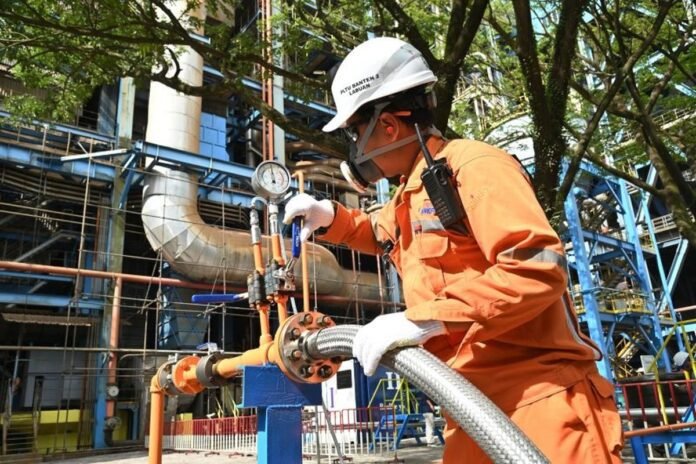

Japan’s ammonia push risks locking Indonesia into coal

0
japan’s-ammonia-push-risks-locking-indonesia-into-coal
Japan’s ammonia push risks locking Indonesia into coal

In the uneasy politics of energy transition, few ideas are as seductive — or as risky — as compromise. Ammonia co-firing, now being advanced through Japan’s Asia Zero Emission Community (AZEC) at Indonesia’s Suralaya and Paiton coal plants, is one such compromise.

It promises emissions reductions without shutting down coal plants. It offers continuity dressed as progress. But without a clear sunset clause, it risks becoming something else entirely: a long-term detour that delays the very transition it claims to advance.

Indonesia is not wrong to experiment. Coal still supplies more than half of its electricity, making rapid phaseout politically and economically difficult. Technologies that allow partial decarbonization — even incremental — can help bridge that gap.

Early trials, such as the ammonia co-firing test at the Labuan plant conducted with Japan’s IHI Corporation, show that blending ammonia into coal systems is technically feasible, even if only at very low levels so far.

This growing collaboration is not accidental. Japan has been actively promoting ammonia co-firing across Asia through AZEC, a regional framework designed to align decarbonization with industrial cooperation.

At Suralaya, feasibility studies supported by Japan’s Ministry of Economy, Trade and Industry and companies like Mitsubishi Heavy Industries are exploring ammonia use in existing coal infrastructure. At Paiton, similar studies and partnerships have been initiated under AZEC-linked agreements.

Yet this is precisely why caution is warranted. The technology’s promise has outpaced its proof. So far, ammonia co-firing remains confined to pilots. Indonesia’s flagship test used just a 3% ammonia blend — a level that reduces emissions only marginally.

Globally, most demonstrations have struggled to achieve more than about 20% substitution, leaving coal as the dominant fuel. Even in Japan, where the technology is most advanced, targets remain modest and experimental.

At those levels, the climate benefits are limited. And scaling up introduces new complications. Retrofitting boilers, managing combustion stability and building ammonia supply chains all add complexity and cost. This is not a simple fuel switch but a systemic transformation — one that remains largely unproven at commercial scale.

Cost is perhaps the biggest obstacle. Ammonia — especially low-carbon “green” ammonia — is expensive to produce and transport. Analysts warn that ammonia co-firing is significantly more costly than renewable energy alternatives, which are already cheaper and rapidly scaling across Southeast Asia.

The emissions story is also less clean than advertised. Most ammonia today is still produced from fossil fuels. Without a fully decarbonized supply chain, lifecycle emissions remain substantial. At low blending ratios, the overall reduction can be marginal — a small gain at high cost.

This is the central danger: that ammonia co-firing, framed as a bridge, becomes a crutch.

The political economy of energy systems makes this outcome likely. Retrofitting coal plants creates incentives to keep them running longer rather than retiring them sooner.

Investments justified as “transition” can end up locking in infrastructure for decades. Critics warn that Japan’s promotion of ammonia co-firing in Southeast Asia risks prolonging coal use and delaying the deployment of cheaper, cleaner alternatives.

In Indonesia, that risk is amplified by scale. Plants like Suralaya and Paiton are among the largest in the region. Extending their lifespans — even partially — has long-term consequences for emissions, investment flows and energy planning.

There is also a geopolitical dimension that cannot be ignored. Japan’s push for ammonia co-firing is not purely environmental; it is also industrial policy. By exporting technology and building regional fuel supply chains, Japan positions itself at the center of a new energy ecosystem.

That alignment of interests can be mutually beneficial — but only if host countries remain clear-eyed about their own priorities. Indonesia’s priority should be simple: the fastest, cheapest and most durable path to decarbonization.

The answer is not to reject ammonia co-firing outright. Pilot projects can provide valuable data, test infrastructure and build technical expertise. They may even play a niche role in specific sectors over time.

But they must be treated for what they are: experiments, not endpoints. That requires discipline — and deadlines.

Any Japan-backed AZEC ammonia co-firing pilot at Suralaya or Paiton should come with a binding sunset clause: a clear, enforceable timeline for either scaling to near-zero emissions or shutting down. Not an open-ended commitment, but a defined window — five to seven years — tied to measurable benchmarks.

Those benchmarks should be rigorous. Has ammonia supply become genuinely low-carbon at scale? Has co-firing reached high substitution levels without prohibitive cost increases? Does it compete economically with renewables plus storage? If the answer remains no, the pilot should end.

Such a clause would serve two essential purposes. First, it would prevent the sunk-cost trap. Governments often continue investing in marginal technologies simply because they have already spent heavily on them. A sunset clause forces reassessment and preserves flexibility.

Second, it would align incentives with Indonesia’s long-term transition. The country aims to reach net-zero emissions by 2060, and that goal will depend far more on scaling renewables than on extending coal. A clear endpoint ensures that interim solutions do not crowd out that future.

The alternative is drift — a slow extension of coal’s lifespan under the banner of innovation. Indonesia stands at a familiar crossroads: balancing growth, energy security and climate responsibility. There are no perfect solutions, but there are clearer and less clear paths.

Ammonia co-firing, as currently envisioned under AZEC, falls into the latter category: an expensive, uncertain and potentially counterproductive bridge. It may have a role as a tightly bounded pilot. But without limits, it risks becoming a liability.

If Japan and Indonesia are serious about the carbon transition, they should be equally serious about endings. Because a bridge without a clear destination — and a deadline — is not a bridge at all. It is a road that leads nowhere.

Bhima Yudhistira Adhinegara is executive director of the Jakarta-based Center of Economic and Law Studies (CELIOS) independent research institute. Muhammad Zulfikar Rakhmat is director of the institute’s China-Indonesia desk.

Escalation risks rise as political centers weaken

0
escalation-risks-rise-as-political-centers-weaken
Escalation risks rise as political centers weaken

Subscribe now with a one-month trial for only $1, then enjoy the first year at an exclusive rate of just $99.

Berlin faces a new test as the AfD moves closer to power
Diego Faßnacht reports that Germany’s September election in Saxony-Anhalt is emerging as a national stress test for Chancellor Friedrich Merz, with the AfD nearing a potential governing breakthrough amid collapsing confidence in Berlin’s political center.

Japan stepping up defense ties with Turkey and Indonesia
Scott Foster reports that Japan is rapidly expanding defense partnerships with Turkey and Indonesia, pursuing drone cooperation, naval exports and deeper regional security ties as Tokyo accelerates its postwar military normalization under Prime Minister Sanae Takaichi.

Victory Day ceasefire exposes widening Russia-Ukraine tensions
James Davis reports that the fragile Victory Day ceasefire highlighted deepening Russia-Ukraine tensions, with escalating drone attacks, mutual threats of retaliation and growing fears that miscalculation could widen the conflict beyond Ukraine’s borders.

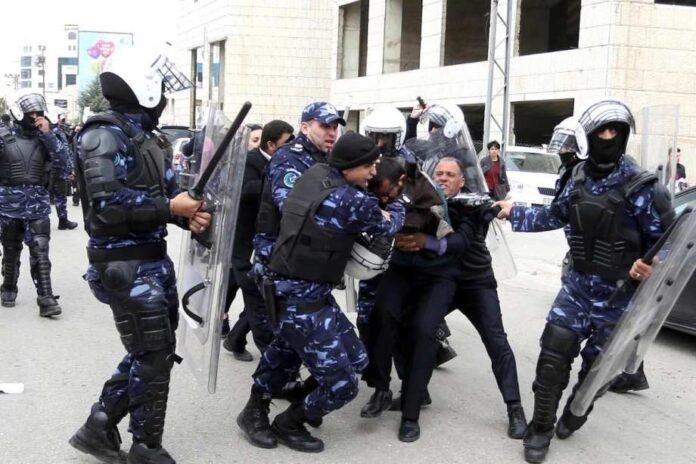
Families’ committee accuses Palestinian Authority forces of torture in al-Junaid prison

0
families’-committee-accuses-palestinian-authority-forces-of-torture-in-al-junaid-prison
Families’ committee accuses Palestinian Authority forces of torture in al-Junaid prison

A committee representing families of detainees in the occupied West Bank has accused Palestinian Authority security forces of carrying out systematic torture and abuse against political prisoners held in al-Junaid Prison.

The Committee of Families of Political Prisoners said it was deeply concerned over what it described as escalating violations against detainees, accusing Palestinian Authority security agencies of pursuing a policy of political arrests and repression targeting activists and resistance supporters.

In a statement issued on Thursday, the committee said torture practices had reached “shocking levels”, citing the case of detainee Suleiman al-Shami, whose family alleged he was subjected to severe abuse that resulted in burns to his feet while in custody.

The committee described the alleged abuses as a “fully-fledged crime” and said they reflected a broader pattern of repression rather than isolated incidents.

The accusations come amid increasing debate within Palestinian society over the role of Palestinian Authority security forces, particularly regarding arrests of political activists and resistance figures across West Bank cities.

Palestinian factions and political groups have linked these practices to ongoing security coordination between the Palestinian Authority and Israel.

READ: 90 Palestinian women held in Israeli prisons, rights group says

Iconic Singer in Coma After Emergency Surgery

0
iconic-singer-in-coma-after-emergency-surgery
Iconic Singer in Coma After Emergency Surgery


Fans around the world are rallying behind legendary singer Bonnie Tyler after shocking reports claimed the 74-year-old music icon has been placed in an induced coma following emergency bowel surgery in Portugal.

According to local Portuguese media, the “Total Eclipse of the Heart” star was rushed to a hospital in Faro late last month after suffering a perforated intestine, a serious medical condition that can quickly become life-threatening if left untreated.

Tyler reportedly underwent emergency surgery shortly after arriving at the hospital on April 30.

While the Welsh singer was initially said to be in stable condition following the operation, alarming new reports on Thursday claimed her health had suddenly taken a turn for the worse.

Portuguese newspaper Correio da Manhã reported that Tyler is now unconscious and breathing with the assistance of a ventilator inside an intensive care unit.

The outlet claimed the singer had originally been recovering in an intermediate care ward before doctors transferred her to intensive care after her condition deteriorated in recent hours.

“Bonnie Tyler is in an induced coma after several days at Faro hospital following intestinal surgery,” the newspaper reported.

“According to what we have learned, the singer is unconscious and connected to a breathing ventilator in the intensive care unit.”

The report also stated that doctors treating the Grammy-nominated star have allegedly admitted they are unable to predict how her condition may evolve over the next several hours, raising fears about the seriousness of the situation.

Neither Tyler nor her representatives have publicly addressed the reports as of Thursday.

The singer became one of the biggest voices of the 1980s thanks to massive hits like Total Eclipse of the Heart and Holding Out for a Hero, both of which helped cement her as a global music sensation with her unmistakable raspy vocals.

Over the decades, Tyler built a devoted fan base around the world and continued touring well into her 70s.

Oil prices jump on renewed US-Iran hostilities

0
oil-prices-jump-on-renewed-us-iran-hostilities
Oil prices jump on renewed US-Iran hostilities


Oil prices rose about 1% on Friday ​after renewed fighting broke out between the U.S. and Iran, threatening a shaky ceasefire and dashing hopes ‌for progress on a reopening of the Strait of Hormuz, a key transit route for oil and liquefied natural gas.

Brent crude futures were up $1.20, or 1.2%, at $101.26 a barrel as of 0356 GMT. West Texas Intermediate (WTI) U.S. crude futures rose by 85 cents, or ​0.9%, to $95.66 a barrel. The benchmarks were up more than 3% at market open.

The gains snapped three days ​of decline on reports this week that the U.S. and Iran were close to agreeing ⁠to a peace deal that would end the fighting but put off larger issues around Iran’s nuclear programme. For ​the week, both contracts are still set to fall about 6%.

“The market is on the cusp of a complete breakdown. ​Price formation is no longer anchored in a pragmatic reading of the war’s trajectory or the physical realities in the Strait of Hormuz,” said Vandana Hari, founder of oil market analysis provider Vanda Insights.

Friday’s jump in prices followed Iran’s accusations that the U.S. violated the ​month-long ceasefire between them, while the U.S. said its strikes were retaliatory after Iran fired on U.S. Navy vessels transiting ​the Strait of Hormuz on Thursday.

Iran’s military said the U.S. had targeted an Iranian oil tanker and another ship and civilian areas ‌in ⁠the strait and on the mainland.

Despite the renewed combat, U.S. President Donald Trump told reporters later on Thursday the ceasefire was still in effect.

“The U.S. administration continues to oversell the prospects of a thaw, and an optimism-biased market buys into it. Curiously, each time, the rebound is gradual and incomplete, making the head fakes at least somewhat effective,” Vanda Insights’ ​Hari said.

The exchange of fire ​happened as Washington awaited Iran’s ⁠response to the latest peace proposal, which did not address a number of contentious issues including the U.S. demand to reopen the Strait of Hormuz, a conduit for one-fifth ​of the world’s oil and LNG supply before the war began on February 28.

“On ​the supply front, ⁠the picture remains tight,” IG analyst Tony Sycamore said in a note.

Separately, the U.S. Commodity Futures Trading Commission is investigating oil price trades totalling $7 billion ahead of key Iran war-related announcements by President Trump, Reuters reported on Thursday.

Most of the trades involved ⁠short positions, ​or bets on prices falling, placed on the Intercontinental Exchange (ICE) and Chicago ​Mercantile Exchange (CME) before Trump statements announcing attack delays, the ceasefire or other changes to Iran policy that led to a decline in oil markets.

Source:  Reuters

What Iran’s absence from the Venice Biennale reveals about art and politics

0
what-iran’s-absence-from-the-venice-biennale-reveals-about-art-and-politics
What Iran’s absence from the Venice Biennale reveals about art and politics

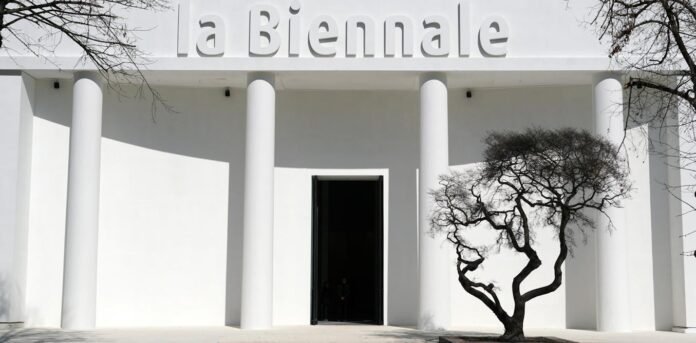
Just days before the opening of the 2026 Venice Biennale, organisers announced that Iran would no longer participate.

A short statement posted to the Venice Biennale website on May 4 said: “With regard to the National Participations in the 61st International Art Exhibition…it has been announced that the Islamic Republic of Iran will not participate.” No explanation was given. I believe that silence is itself revealing.

Iran’s withdrawal is less a sudden decision than the result of converging geopolitical and economic pressures that are reshaping both the global art world and Iran’s place within it.

At the most immediate level, the withdrawal reflects the material realities of crisis. With internet access restricted, international flights suspended and communication networks severely disrupted, even the basic logistics of participation – coordinating, shipping and installing artworks – probably became nearly impossible for Iran.

These conditions have been compounded by intensifying economic pressures, including the sharp devaluation of the Iranian rial, which has made international cultural engagement increasingly difficult to sustain.

An explanation of the Venice Biennale.

Such constraints point to a fundamental condition of contemporary art: global exhibitions rely on infrastructures of mobility and communication that are easily destabilised by conflict and sanctions.

The timing is also significant. The decision comes amid renewed military tensions and escalating political rhetoric surrounding Iran’s position in the global order. In such moments, when political discourse edges toward existential threat, the stakes of cultural visibility are heightened. At the same time, sustaining cultural presence becomes more difficult.


Read more: Middle East conflict looks increasingly like a war nobody can win


More revealing still was the lack of any announced artist, curatorial framework or exhibition concept for Iran’s pavilion, even days before the Biennale’s opening.

Iran’s presence at the Venice Biennale has historically been organised through state institutions, with oversight exercised by the ministry of culture and Islamic guidance since the Iranian revolution (1978-79). As with many national pavilions, this model positions art as a form of cultural diplomacy. But in Iran’s case, it has often produced a disconnect between official representation and contemporary artistic practice.

This gap is significant. The Venice Biennale, often described as the “Olympics of the art world”, remains structured around national pavilions, with each country responsible for presenting its cultural identity on a global stage. Yet, as critics have long argued, it has never been a neutral platform, but a space where art and geopolitics intersect.

More broadly, biennials are deeply embedded in political and institutional contexts, rather than existing outside them. Within this framework, they are often understood as sites of cultural soft power, where nations project influence through artistic production.

National representation in crisis

Iran’s withdrawal must also be understood in relation to the wider turmoil surrounding the 2026 biennale itself. This year’s edition has been marked by extraordinary controversy, including disputes over the involvement of Russia and Israel, calls for boycotts and the resignation of the entire international jury just days before the opening.

These events expose the fragility of the biennale’s longstanding claim to neutrality. Rather than existing outside politics, it has become a site where geopolitical tensions are actively staged and contested.

To exhibit at the biennale is never neutral: it means entering a highly visible arena shaped by competing narratives of legitimacy and power. For the Islamic Republic, this raises a deeper tension. The biennale’s national pavilion model requires countries to present a coherent cultural identity through contemporary art. Yet Iran’s artistic landscape is anything but singular. It is shaped by internal contradictions between state and independent practices, censorship and experimentation and local production and diasporic circulation.

The entire jury resigned just days before the opening.

These tensions are difficult to reconcile within a state-managed exhibition framework. The very premise of the pavilion – art as national representation – sits uneasily with a system in which artistic expression is subject to ideological and institutional control.

At the same time, the Biennale embodies forms of global circulation, cultural competition and visibility tied to international art markets that do not always align with the cultural and political ethos of the Islamic Republic. Representation therefore involves negotiating how a nation appears, to whom, and on whose terms.

The current moment makes this tension even more acute. As political rhetoric escalates and the possibility of large-scale destruction is invoked in global discourse, cultural visibility becomes more urgent. Art offers one of the few spaces through which narratives beyond conflict and diplomacy can emerge. Yet for Iranian artists, cultural presence is becoming more fragmented, shaped by diasporic networks, constrained by national borders and limited by economic and infrastructural pressures.

Iranian artists, particularly those working through independent and diasporic networks, have for decades operated beyond the frameworks of state representation, with their work circulating internationally through alternative artistic circuits. Iran’s missing pavilion, then, does not signal the disappearance of Iranian art. Rather, it reveals the precarious conditions through which that art circulates.

Iran’s absence from the Venice Biennale also highlights the limits of the national pavilion model. The system has frequently been criticised for reducing complex artistic practices to simplified national identities, even as contemporary art now operates through transnational networks that exceed the boundaries of the nation-state.

In Venice this year, the missing pavilion reflects an art world shaped as much by political crisis as by artistic production. Iranian art is not absent from the global stage. Yet the conditions under which it circulates and remains visible have become increasingly fragile.

Why the world needs a China Shock 2.0

0
why-the-world-needs-a-china-shock-2.0
Why the world needs a China Shock 2.0

The global economic discourse in this spring of 2026 is dominated by a single, apprehensive phrase: China Shock 2.0. From the halls of the European Commission to the campaign trails in the United States, the narrative is remarkably consistent.

It suggests that a second wave of Chinese industrial exports – this time focused on high-tech sectors such as electric vehicles, lithium-ion batteries, and renewable energy infrastructure – poses an existential threat to the West’s industrial heartlands.

However, a dispassionate look at the global landscape suggests that this shock is not a crisis of competition, but a fundamental recalibration of global efficiency that the world cannot afford to reject.

At the heart of the current friction lies a fundamental question for Western policymakers: is the primary concern the loss of specific manufacturing jobs, or the broader economic stability of the middle class?

For decades, the political consensus in the West has tilted toward the former, attempting to shield legacy industries through increasingly high trade barriers. Yet, it is becoming clear that protecting a narrow industrial base at the expense of global price stability is a losing bargain.

To understand the stakes, one must consider the counterfactual: what would the global economy look like without China’s green energy products? As of today, China has solidified its position as the indispensable provider of the tools required for the energy transition.

It currently controls roughly 70% of the world’s battery supply chain and a vast majority of the capacity for green hydrogen electrolyzers. The 15th Five-Year Plan, which transitioned this year toward absolute carbon control, has further accelerated this output.

If Western nations successfully wall off these products through triple-digit tariffs, the cost of the green transition will skyrocket. For the average citizen in London or Chicago, the de-risking of supply chains translates directly into a protectionism tax on their next car or home solar installation.

In a world where the deadline for carbon neutrality is non-negotiable, slowing the adoption of affordable green tech for the sake of industrial nostalgia is not just bad economics; it is a climate failure.

Further, the impact of this industrial surge provides a critical, if often unacknowledged, benefit to the global middle class. We are witnessing a China Shock in an entirely different sense: the democratization of high-quality goods.

For the past two years, persistent inflation has been the primary driver of global political instability. Here, Chinese exports act as a vital deflationary buffer. Data from the first quarter of 2026 shows that in dozens of emerging markets, industries with the highest penetration of Chinese imports have experienced the most significant cooling of producer prices.

This is the hidden virtue of the current trade dynamic. When a Chinese firm produces a technologically advanced electric vehicle at half the price of a Western equivalent, it is not merely exporting overcapacity. It is expanding the global middle class.

In Southeast Asia, Latin America and Africa, the availability of affordable, reliable tech is allowing millions to leapfrog older, dirtier technologies. This influx of value provides a floor for living standards during a period of global monetary tightening. For the global consumer, the China Shock is essentially a massive productivity dividend.

Despite these tangible benefits, the international narrative remains clouded by several persistent misunderstandings that frequently appear in foreign media reports. The first is the claim that China’s success is built on copy and imitation. This view is a relic of the previous decade. By 2026, China has clearly moved into a phase of indigenous innovation.

The competitive edge of Chinese firms today comes from engineering scale – the ability to take a nascent technology and refine it through rapid, massive production cycles that Western firms find difficult to replicate. From solid-state battery breakthroughs to AI-integrated manufacturing, the innovation is iterative and increasingly original.

A second misconception is that this export surge is a cynical byproduct of currency manipulation or a depreciated RMB. The trade data from April 2026 tells a far more complex story.

While the renminbi has fluctuated against a strong US dollar, China’s trade surplus has stabilized because its demand for high-end semiconductors and AI-related hardware has reached record levels. The surge in exports is driven by structural comparative advantage and manufacturing depth, not by exchange rate gimmicks.

There is also the recurring argument regarding overcapacity. Critics such as Janet Yellen suggest that China is producing more than its domestic market can consume, thereby dumping the excess on world markets.

Yet, this ignores the basic logic of global trade. No one accused the US of overcapacity when it dominated the global software and aircraft markets, nor Germany when it exported the vast majority of its high-end automobiles. In a globalized world, a nation’s manufacturing capacity is naturally sized for the global market. China is simply applying this logic to the industries of the future.

The world currently finds itself in a paradox. Global leaders express a desire for a rapid green transition, a curb on inflation, and a more inclusive global economy. Yet, there is a deep-seated suspicion of the very country most capable of delivering the scale and efficiency needed to achieve these goals.

This suspicion often stems from a failure to distinguish between the interests of specific industrial lobbies and the interests of the broader public. While the loss of manufacturing jobs in certain sectors is a political challenge that requires domestic solutions – such as improved safety nets and worker retraining – it should not dictate a global trade policy that makes the basic tools of the 21st century more expensive for everyone else.

If the current trend of fragmentation and friend-shoring continues, the result will be a productivity-poor world where the average citizen pays more for less. True economic leadership in 2026 should not be measured by the height of a nation’s trade barriers but by its ability to integrate into the most efficient production networks.

The China Shock 2.0 is not a threat to be contained, but an opportunity for global optimization. To reject it is to reject the most viable path toward a sustainable, affordable and technologically advanced future for all.

Education Minister Kisch Threatens Funding Cuts for Israeli Universities Promoting Political Agendas 

0
education-minister-kisch-threatens-funding-cuts-for-israeli-universities-promoting-political-agendas 
Education Minister Kisch Threatens Funding Cuts for Israeli Universities Promoting Political Agendas 


Israeli Education Minister Yoav Kisch called on university presidents to commit to keeping political activity off campuses and warned that institutions refusing to comply could face legislation imposing financial sanctions. 

In a statement released Wednesday, Kisch demanded that university leaders agree to “three clear principles,” including refraining from expressing political positions, ensuring uninterrupted institutional operations, and “clarifying that there is no place for strikes motivated by political reasons.” 

The proposal also calls on universities to prevent political disruptions, shutdowns, and strikes on campus grounds. 

According to the Education Ministry, “the move is intended to prevent division, preserve the proper functioning of the institutions, and allow all faculty members and students to study, teach, research, and express opinions freely and responsibly.” 

Kisch said universities should not serve as political platforms and warned that the government could move forward with legislation targeting institutions that reject the proposal. 

“We are putting an end to the politicization of university presidents,” Kisch said. “If they wish to promote a political agenda, they are welcome to resign from their positions and run in elections.” 

“Academic institutions that enter the political arena — we will advance legislation that will deny them funding,” he added. 

The minister’s position has reportedly received support from lawmakers including Avichay Buaron. 

The Association of Heads of Research Universities rejected the proposal and accused Kisch of using academia for political purposes. 

“We will not allow the Education Minister to drag academia into his political survival battles,” the group said. 

“It is deeply regrettable that at a time when higher education is fighting international boycotts, the minister chooses to weaken it from within in order to scrounge for votes in the primaries,” the association added. 

The group also said it was “very surprised by the minister’s remarks,” stating that Kisch “never approached us and no discussions were held with him on the matter.” 

“To remove any doubt, the heads of higher education have never agreed to any harm to the independence of institutions of higher education,” the statement said. 


Google’s Gemma 4 AI models get 3x speed boost by predicting future tokens

0
google’s-gemma-4-ai-models-get-3x-speed-boost-by-predicting-future-tokens
Google’s Gemma 4 AI models get 3x speed boost by predicting future tokens

Google launched its Gemma 4 open models this spring, promising a new level of power and performance for local AI. Google’s take on edge AI could be getting even faster already with the release of Multi-Token Prediction (MTP) drafters for Gemma. Google says these experimental models leverage a form of speculative decoding to take a guess at future tokens, which can speed up generation compared to the way models generate tokens on their own.

The latest Gemma models are built on the same underlying technology that powers Google’s frontier Gemini AI, but they’re tuned to run locally. Gemini is optimized to run on Google’s custom TPU chips, which operate in enormous clusters with super-fast interconnects and memory. A single high-power AI accelerator can run the largest Gemma 4 model at full precision, and quantizing will let it run on a consumer GPU.

Gemma allows users to tinker with AI on their hardware rather than sharing all their data with a cloud AI system from Google or someone else. Google also changed the license for Gemma 4 to Apache 2.0, which is much more permissive than the custom Gemma license Google employed for previous releases. However, there are inherent limitations in the hardware most people have to run local AI models. That’s where MTP comes in.

LLMs like Gemma (or Gemini) generate tokens autoregressively—that is, they produce one token at a time based on the previous token. Each one takes just as much computing work as the last one, regardless of whether the token is just a filler word in an output or a key piece of information in a complex logical problem.

The problem with rolling your own AI is that your system memory probably isn’t very fast compared to the high bandwidth memory (HBM) used in enterprise hardware. As a result, the processor spends a lot of time moving parameters from VRAM to compute units for each token, and compute cycles are going unused during this process.

Gemma 4 26B on a NVIDIA RTX PRO 6000. Standard Inference (left) vs. MTP Drafter (right) in tokens per second. Same output quality, half the wait time.

MTP uses that time to bypass the heavy model and generate speculative tokens with the lightweight drafter. While the draft models are smaller (just 74 million parameters in Gemma 4 E2B), they’re also optimized in several ways to speed up speculative token generation. For example, the drafter shares the key value cache (essentially the LLM’s active memory) so it doesn’t need to recalculate context the main model has already worked out. The E2B and E4B drafters also use a sparse decoding technique to narrow down clusters of likely tokens.

The draft tokens are not necessarily good predictions, of course. They are verified by the target model (Gemma in this case) in parallel. If the model agrees, the entire sequence is accepted in one forward pass. Along with this process, the larger model also generates an additional token normally. So the system can produce tokens from the draft sequence and a newly generated token in parallel in the time it used to take to generate a single new token. If you want more detail, Google has strangely opted to post a rundown of the process on X.

Faster local inference right now

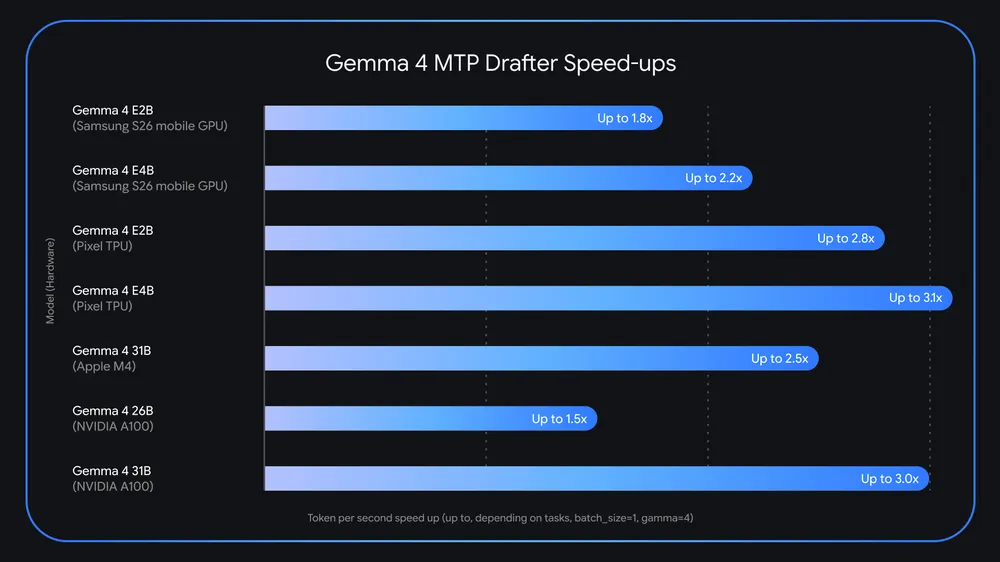
Google has released new versions of Gemma 4 models with MTP that you can try today. Google says the MTP drafter can make Gemma models up to three times faster, but the actual gain varies based on the hardware you use. In Google’s testing, the smaller E2B and E4B Gemma models on Pixel phones can run 2.8x and 3.1 times faster, respectively. The much larger Gemma 4 31B on Apple’s M4 silicon gets a 2.5x speed boost with MTP.

Tokens-per-second speed increases for various hardware configs.

Tokens-per-second speed increases for various hardware configs. Credit: Google

The company suggests users will find it easier to run the 26B MoE and 31B Dense models on consumer hardware, and mobile devices will enjoy improved battery life when running E2B and E4B models. Because the core Gemma model verifies all the draft tokens, MTP should also result in “zero quality degradation.” That’s not to say every output will be perfect, but the errors common in generative AI systems shouldn’t get any worse with MTP.

You can try speculative decoding in Gemma without too much additional work. The drafters are available under the same Apache 2.0 license as the core Gemma models. The faster transformers are available via MLX, VLLM, SGLang, and Ollama frameworks.

0FansLike
0FollowersFollow
0FollowersFollow
0SubscribersSubscribe
- Advertisement -
Google search engine

Recent Posts