In the uneasy politics of energy transition, few ideas are as seductive — or as risky — as compromise. Ammonia co-firing, now being advanced through Japan’s Asia Zero Emission Community (AZEC) at Indonesia’s Suralaya and Paiton coal plants, is one such compromise.
It promises emissions reductions without shutting down coal plants. It offers continuity dressed as progress. But without a clear sunset clause, it risks becoming something else entirely: a long-term detour that delays the very transition it claims to advance.
Indonesia is not wrong to experiment. Coal still supplies more than half of its electricity, making rapid phaseout politically and economically difficult. Technologies that allow partial decarbonization — even incremental — can help bridge that gap.
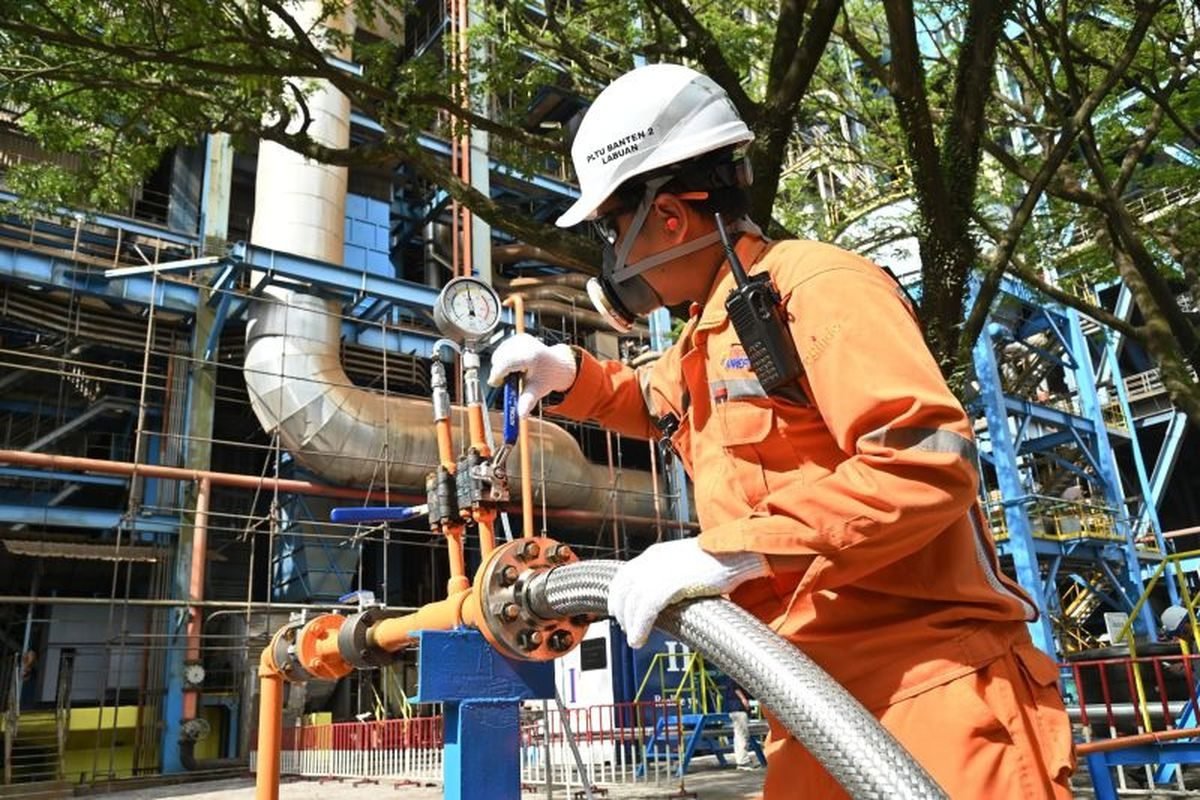
Early trials, such as the ammonia co-firing test at the Labuan plant conducted with Japan’s IHI Corporation, show that blending ammonia into coal systems is technically feasible, even if only at very low levels so far.
This growing collaboration is not accidental. Japan has been actively promoting ammonia co-firing across Asia through AZEC, a regional framework designed to align decarbonization with industrial cooperation.
At Suralaya, feasibility studies supported by Japan’s Ministry of Economy, Trade and Industry and companies like Mitsubishi Heavy Industries are exploring ammonia use in existing coal infrastructure. At Paiton, similar studies and partnerships have been initiated under AZEC-linked agreements.
Yet this is precisely why caution is warranted. The technology’s promise has outpaced its proof. So far, ammonia co-firing remains confined to pilots. Indonesia’s flagship test used just a 3% ammonia blend — a level that reduces emissions only marginally.
Globally, most demonstrations have struggled to achieve more than about 20% substitution, leaving coal as the dominant fuel. Even in Japan, where the technology is most advanced, targets remain modest and experimental.
At those levels, the climate benefits are limited. And scaling up introduces new complications. Retrofitting boilers, managing combustion stability and building ammonia supply chains all add complexity and cost. This is not a simple fuel switch but a systemic transformation — one that remains largely unproven at commercial scale.
Cost is perhaps the biggest obstacle. Ammonia — especially low-carbon “green” ammonia — is expensive to produce and transport. Analysts warn that ammonia co-firing is significantly more costly than renewable energy alternatives, which are already cheaper and rapidly scaling across Southeast Asia.
The emissions story is also less clean than advertised. Most ammonia today is still produced from fossil fuels. Without a fully decarbonized supply chain, lifecycle emissions remain substantial. At low blending ratios, the overall reduction can be marginal — a small gain at high cost.
This is the central danger: that ammonia co-firing, framed as a bridge, becomes a crutch.
The political economy of energy systems makes this outcome likely. Retrofitting coal plants creates incentives to keep them running longer rather than retiring them sooner.
Investments justified as “transition” can end up locking in infrastructure for decades. Critics warn that Japan’s promotion of ammonia co-firing in Southeast Asia risks prolonging coal use and delaying the deployment of cheaper, cleaner alternatives.
In Indonesia, that risk is amplified by scale. Plants like Suralaya and Paiton are among the largest in the region. Extending their lifespans — even partially — has long-term consequences for emissions, investment flows and energy planning.
There is also a geopolitical dimension that cannot be ignored. Japan’s push for ammonia co-firing is not purely environmental; it is also industrial policy. By exporting technology and building regional fuel supply chains, Japan positions itself at the center of a new energy ecosystem.
That alignment of interests can be mutually beneficial — but only if host countries remain clear-eyed about their own priorities. Indonesia’s priority should be simple: the fastest, cheapest and most durable path to decarbonization.
The answer is not to reject ammonia co-firing outright. Pilot projects can provide valuable data, test infrastructure and build technical expertise. They may even play a niche role in specific sectors over time.
But they must be treated for what they are: experiments, not endpoints. That requires discipline — and deadlines.
Any Japan-backed AZEC ammonia co-firing pilot at Suralaya or Paiton should come with a binding sunset clause: a clear, enforceable timeline for either scaling to near-zero emissions or shutting down. Not an open-ended commitment, but a defined window — five to seven years — tied to measurable benchmarks.
Those benchmarks should be rigorous. Has ammonia supply become genuinely low-carbon at scale? Has co-firing reached high substitution levels without prohibitive cost increases? Does it compete economically with renewables plus storage? If the answer remains no, the pilot should end.
Such a clause would serve two essential purposes. First, it would prevent the sunk-cost trap. Governments often continue investing in marginal technologies simply because they have already spent heavily on them. A sunset clause forces reassessment and preserves flexibility.
Second, it would align incentives with Indonesia’s long-term transition. The country aims to reach net-zero emissions by 2060, and that goal will depend far more on scaling renewables than on extending coal. A clear endpoint ensures that interim solutions do not crowd out that future.
The alternative is drift — a slow extension of coal’s lifespan under the banner of innovation. Indonesia stands at a familiar crossroads: balancing growth, energy security and climate responsibility. There are no perfect solutions, but there are clearer and less clear paths.
Ammonia co-firing, as currently envisioned under AZEC, falls into the latter category: an expensive, uncertain and potentially counterproductive bridge. It may have a role as a tightly bounded pilot. But without limits, it risks becoming a liability.
If Japan and Indonesia are serious about the carbon transition, they should be equally serious about endings. Because a bridge without a clear destination — and a deadline — is not a bridge at all. It is a road that leads nowhere.
Bhima Yudhistira Adhinegara is executive director of the Jakarta-based Center of Economic and Law Studies (CELIOS) independent research institute. Muhammad Zulfikar Rakhmat is director of the institute’s China-Indonesia desk.