18 C
London
Friday, May 8, 2026
Home Blog

Trump claiming Iran war ‘win’ – here’s the reality

0
trump-claiming-iran-war-‘win’-–-here’s-the-reality
Trump claiming Iran war ‘win’ – here’s the reality

Two months into the war in Iran, the reasons the US gave for launching this conflict – and Washington’s minimum criteria for claiming success – now appear unintelligible. So much so that US officials are now arguing the war had actually ended in America’s favor almost a month ago, when the ceasefire came into effect.

It is hard to think of a more damning indictment of Donald Trump’s catastrophic war in Iran than the spectacle of his secretary of state, Marco Rubio, telling reporters on May 5 that the main goal now was to get the Strait of Hormuz “back to the way it was: anyone can use it, no mines in the water, nobody paying tolls.”

This, he argued, was an entirely separate defensive and humanitarian operation and would only become a war if US ships came under fire – which they in fact did that same day. Rubio ignored the obvious contradiction that the humanitarian operation had been necessitated by the very war he was simultaneously presenting as already won.

Things took an even more absurd turn later that day. Trump announced he was suspending “Project Freedom”, his plan for the US Navy to escort tankers out of the strait, after just one day. The US president cited “great progress” toward an agreement with Iran. As has happened several times now, global stock markets rallied before falling back again.

Marco Rubio speaks about the Iran war in the White House Press Briefing Room in Washington on May 5. Photo: Jim Lo Scalzo / EPA via The Conversation

While few doubt Trump is desperate to put this disastrous war behind him, particularly before heading to Beijing on May 14, he massively oversold the impression of a breakthrough. The Iranians were merely considering a 14-point proposal for 30 days of negotiations aimed at finding a durable end to the war.

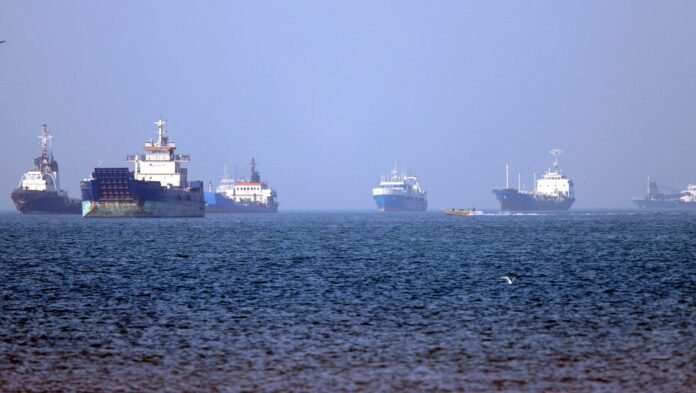
The more convincing reason Trump abandoned Project Freedom is that it was already clear it would not solve the crisis. Most owners of the 1,500 ships currently stranded behind the strait were unwilling to risk passage even with a naval escort. Iran’s response, attacking shipping and launching missiles at the United Arab Emirates, also threatened the ceasefire itself.

Washington’s problem is that the Iranians will probably insist talks can only begin, and the Strait of Hormuz reopen, if Trump agrees to end the economic blockade of Iranian maritime trade. The US blockade is inflicting serious damage on the Iranian economy.

Apart from anything else, Iranian officials see ending the blockade as logical reciprocity. But they also understand time is running out before the closure of the strait causes lasting structural damage to the global economy – if it has not already. This gives them enhanced leverage at the moment.

Yet even if negotiations begin, the same problem that prevented a deal before the war remains. Trump lacks the detailed and institutionalized policy apparatus of his predecessor, Barack Obama, whose 2015 nuclear agreement with Iran the current US president so desperately wants to outdo.

Obama’s deal took 20 months of intense wrangling to complete. Trump has neither the patience, technical expertise or direct diplomatic connections to achieve the same.

Added to this are new conditions created by the war itself. The fragmentation of Iran’s decision-making process and the empowerment of elites with an even higher tolerance for military and economic pressure have introduced uncertainty into the equation.

And Iran has now realized the increased leverage it has through its ability to close a critical artery of the global economy.

Colossal failure

The answer on the nuclear issue may lie in a fudge. Iran could well agree to a moratorium on uranium enrichment while not yet agreeing to ship out or dilute its enriched uranium – though without ruling that out in order to prolong negotiations.

If slightly more moderate heads in Tehran prevail – and that remains a very big if – it would be an obvious concession to make. Iran’s geographic advantages and ballistic missile capabilities have established a credible deterrent against future attack.

The question is whether anything short of total surrender on the nuclear issue is acceptable to Trump, and whether he is willing to resist inevitable Israeli opposition to blurring this red line. If not, he has already threatened to resume bombing at a “much higher intensity” than before.

Yet there are serious doubts about whether he has the stomach for this. And even if he does, it is difficult to see how any amount of US and Israeli bombing can force the Iranian regime to surrender.

Donald Trump is looking for a way out of the war in Iran. Photo: Shawn Thew / EPA via The Conversation

Trump’s shifting aims for the war and desperate scramble for an exit underscore that this entire enterprise has been a colossal strategic failure. It will define his legacy, reshape the Middle East and impose further misery on the Iranian people – the very opposite of what he has repeatedly said he wants to do.

The war has has shattered confidence among US regional allies that Washington can protect them. It has also alienated traditional US allies who were blamed and then punished for failing to solve a problem they neither created nor could resolve.

The US and Israeli attacks have further entrenched a brutal regime that will now be even harder to negotiate with, while completely marginalizing moderate voices inside Iran.

If negotiations can prevail, the successes the US president and his advisers trumpet – the destruction of parts of Iran’s military-industrial capacity and navy – are real. Though in the former case probably only temporary and in the latter, demonstrably not critical for maintaining freedom of navigation.

The only positive is that Trump’s brief experiment with military adventurism, an aberration even within his own muddled political trajectory, may now be ending.

Christian Emery is associate professor in international politics, UCL

This article is republished from The Conversation under a Creative Commons license. Read the original article.

The Unfinished Iran War: Are There Any Winners?

0
the-unfinished-iran-war:-are-there-any-winners?
The Unfinished Iran War: Are There Any Winners?


Reports of explosions, US self-defense strikes, and renewed clashes near the Strait of Hormuz show how unresolved maritime leverage, Gulf vulnerability, and political deadlock could push the conflict into another round

New reports of explosions late Thursday and early Friday near Iran’s Bandar Abbas, Qeshm Island, and other parts of Hormozgan province put new pressure on a fragile US-Iran diplomatic track that had yet to produce even a temporary settlement.

As of May 8, 2026, Washington and Tehran were reportedly still working toward a short-term memorandum rather than a full peace agreement, mediated by Pakistan, with Iran still reviewing the latest proposal. The framework under discussion would aim to halt the fighting, stabilize shipping through the Strait of Hormuz, and open a 30-day negotiation window, while leaving unresolved core disputes over Iran’s nuclear program, ballistic missile arsenal, proxy networks, and expanded control over maritime passage.

What has emerged instead is a landscape of partial gains, exposed vulnerabilities, and shifting alignments. The United States demonstrated military reach but lost political confidence among allies and voters. Iran suffered serious blows but preserved the regime and key coercive tools. Israel restored parts of its deterrence but failed to translate battlefield achievements into a political endgame. Gulf states moved further apart, with the UAE and Saudi Arabia increasingly pursuing different models of power. Pakistan gained diplomatic relevance, while Qatar’s mediation role became less exclusive. China and Russia absorbed pressure but also gained diplomatic and strategic space in a more fractured international order.

Gulf states sit at the core of the war’s main contradiction. They rely on US protection, but their ports, airspace, energy infrastructure, and commercial corridors become exposed whenever Washington escalates against Tehran.

According to Iranian state and semiofficial media, explosion-like sounds were heard late Thursday and early Friday near Bandar Abbas, Qeshm Island, and other parts of Hormozgan province. Reuters reported that Iran’s Fars news agency said the origin and precise location of the sounds near Bandar Abbas were not immediately known. US Central Command later said US forces had intercepted Iranian missile, drone, and small-boat attacks on three US Navy destroyers transiting the Strait of Hormuz and carried out self-defense strikes on Iranian military facilities, including missile and drone launch sites, command-and-control locations, and intelligence, surveillance, and reconnaissance nodes.

Iran accused the United States of violating the ceasefire by targeting Iranian vessels and coastal areas, while Iranian state media said Iranian forces exchanged fire with “enemy units” on Qeshm Island. CENTCOM said no US assets were struck. Iranian claims that US vessels suffered significant damage were not independently confirmed. Reports suggesting Emirati involvement in strikes inside Iran also remained unconfirmed.

The renewed reports around Hormuz matter because they expose the central weakness of the emerging diplomatic track: It seeks to pause fighting without resolving Iran’s maritime leverage, Washington’s dependence on force, Israel’s lack of a political endgame, or the Gulf states’ vulnerability to retaliation.

Those reports do not confirm a full return to the first phase of direct strikes and maritime confrontation. But they show that the conflict has already produced new armed exchanges before any political settlement has been consolidated.

US: Military Reach Without Political Control

Washington’s strongest card remains its capacity to shape the battlefield and global energy flows. The US and Israel eliminated key Iranian regime and military figures, while US airstrikes destroyed significant portions of Iran’s nuclear and ballistic missile production infrastructure. The crisis also forced China and other importers to reassess their energy exposure. But the broader American strategy produced uncertain results. Iran’s regime survived, its missile capabilities were damaged but not eliminated, and the fate of its enriched uranium stockpile remained unresolved. Its regional posture was weakened but not broken. Instead of producing a decisive diplomatic surrender, the war pushed Washington back into negotiations under pressure from Gulf allies, energy markets, and disrupted shipping.

President Donald Trump’s handling of the conflict also came under growing domestic pressure. A Reuters/Ipsos poll published April 28 found President Trump’s approval at 34%, the lowest level of his current term, while only 34% of Americans approved of the US conflict with Iran. A Fox News Poll released five days earlier showed a somewhat higher level of support for the military campaign, at 45%, but still found a 55% majority opposed to US action in Iran. An NPR/PBS News/Marist Poll published May 6, based on interviews conducted April 27–30, found that 81% of Americans said current gas prices were placing either a major or minor strain on their household budgets, while 63% said President Trump deserved a great deal or a good amount of blame for the increase. The domestic backlash mattered because Iran did not need to defeat the United States militarily to affect Washington’s calculations. By threatening shipping through the Strait of Hormuz and adding pressure to global energy markets, Tehran could raise the political and economic cost of the war for the United States, Europe, and Gulf states.

Project Freedom, the US-led operation to escort commercial shipping and reopen the Strait of Hormuz, became the clearest operational test of Washington’s position. Saudi Arabia and Kuwait reportedly halted or restricted American use of bases and airspace in their countries after the operation began. The restrictions were later eased, but the episode showed that Washington could no longer assume automatic Gulf alignment in a military escalation with Iran.

New reports of explosions near Bandar Abbas, Qeshm Island, and other sites in Hormozgan province, Iranian claims of clashes with US naval forces, and confirmed US self-defense strikes on Iranian military facilities sharpened that perception. The UAE said three people were wounded after its air defenses engaged two Iranian ballistic missiles and three drones, though it was not immediately clear whether all were successfully intercepted. Commercial vessels belonging to third countries were also targeted or endangered. Reports circulated of attacks affecting US naval assets, although US Central Command denied some of those claims.

Even without accepting every contested report, the strategic damage was clear: A US-led operation designed to reopen one of the world’s most important waterways had become another sign of how difficult it was for Washington to guarantee Gulf security without widening the war.

This is not peace at all, but crisis management under pressure

Cyril Widdershoven, senior adviser at Blue Water Strategy and a geopolitical energy analyst, told The Media Line that the current US-Iran framework falls well short of a settlement. “In my eyes, not at all. It should be seen only as a pause mechanism. The reported framework would end hostilities, open a short negotiating window, ease restrictions on the Strait of Hormuz, address sanctions, and begin nuclear talks. Reality shows that this is not peace at all, but crisis management under pressure. All critical issues remain unresolved, including missile programs, proxy networks, IRGC [Islamic Revolutionary Guard Corps] influence, and regional competition. If these issues are not addressed and resolved, the agreement will serve only as a tactical reset rather than a strategic solution. The likelihood of a relapse into confrontation remains high.”

Washington showed it could strike Iran, but it did not prevent Iran from imposing costs on Gulf infrastructure, shipping, energy markets, and allied territory. Widdershoven described the deal as both necessary and damaging for perceptions of US power. “For the Gulf, the current deal is all three. It is a compromise because nobody can afford permanent Hormuz paralysis. A necessity because the oil, LNG [liquefied natural gas], shipping, and insurance markets are cracking and will continue to do so. A failure because Iran may receive economic oxygen while core strategic capabilities remain intact. Washington now could be only buying time, as it stabilizes markets and avoids escalation. For most Gulf countries, the current US deal will make it seem as if there is no longer a basis to trust US deterrence and security.”

At the level of NATO, the war amplified disagreements that had already emerged during the Ukraine conflict over military burden-sharing, strategic priorities, and energy vulnerability. Several European governments remained reluctant to become directly involved in a broader maritime confrontation in the Gulf, fearing another energy shock at a time when Europe was already dealing with economic stagnation, industrial pressure, and unresolved dependence on external suppliers. Roughly one-fifth of global petroleum consumption and a significant share of LNG exports transit through the Strait of Hormuz. Insurance premiums for shipping crossing the Gulf surged during the peak of the escalation, while energy traders and European policymakers discussed contingency plans in case of prolonged disruption.

Rajat Ganguly, editor-in-chief of the Journal of Asian Security and International Affairs and a political analyst, told The Media Line that the war forms part of a broader weakening of Western cohesion. Offering a sharply critical view of US policy that remains contested in the European security debate, Ganguly linked the war to the fallout from Ukraine and the Nord Stream sabotage, for which no conclusive public finding has established US responsibility. “America used the Ukraine war to go after another peer competitor of America, which was Germany. Germany has been destroyed by the Ukraine war. Biden destroyed one of the Nord Stream pipelines, which used to bring very cheap Russian gas to Germany. It created energy security for Germany and through Germany to central Europe.”

Ganguly argued that the Iran conflict deepened existing doubts about Washington’s alliance management. “Trump is probably going to destroy NATO. And then, as he said, the Greenland issue is not over yet. He might decide to confiscate Greenland. So that would be another thing that he can do.”

For the United States, the war produced mixed results: greater pressure on Iran and China, but also deeper uncertainty among allies, voters, and Gulf partners.

The Gulf: Protection Without Immunity

Gulf states rely on US protection, but that protection does not make them immune to retaliation. Their ports, airspace, energy infrastructure, and commercial corridors become exposed whenever Washington escalates against Tehran. Iranian attacks toward the Emirates appeared to resume after the latest reported escalation, reinforcing the vulnerability that has run through the entire conflict.

The Gulf did not act as a single bloc

Widdershoven said the crisis exposed a basic Gulf dilemma. “The Gulf did not act as a single bloc. Some countries wanted a hard deterrence against Iran, while others feared escalation. Several Gulf states were much more concerned about the threat to trade, LNG credibility, ports, aviation, and investment confidence. The crisis exposed the old Gulf contradiction: everyone wants US protection, but nobody wants their economy turned into a battlefield.”

The most visible rupture is between Saudi Arabia and the UAE. Reports that the UAE would leave the Organization of the Petroleum Exporting Countries (OPEC) effective May 1, 2026, weakened confidence in the broader OPEC+ alliance and deepened existing tensions with Saudi Arabia. But the split was not only about oil quotas. It reflected two competing models of Gulf power.

Widdershoven said the Saudi-UAE split now reflects competing models of Gulf power. “The split is no longer only about oil quotas but, in reality, about two different state models. The Kingdom wants strategic centrality, price stability, and regional leadership. Abu Dhabi wants optionality, route control, access to technology, and freedom from cartel discipline. The UAE’s departure from OPEC has turned a quiet rivalry into a structural divergence.”

He added, “The divergence is already evident across several domains, including ports, logistics, defense partnerships, and capital allocation. Saudi Arabia is still looking at internal capacity, while the UAE externalizes power through networks. The risk is that competition will increasingly spill into overlapping geographies such as the Red Sea and Horn of Africa.”

That divergence was already visible in Sudan, Yemen, port politics, Red Sea strategy, and relations with Israel. Saudi Arabia still seeks regional centrality and leadership, but the UAE is building optionality: alternative corridors, Fujairah bypass capacity, non-OPEC flexibility, logistics networks, maritime infrastructure, Israeli defense technology, and deeper links across the Indian Ocean.

The UAE is the relative strategic winner because it has used the crisis to validate its long-standing bet on alternative corridors, Fujairah, ports, logistics, Israel-tech links, and non-OPEC flexibility

Widdershoven said the UAE appears to have gained more than most regional actors, though the outcome remains messy. “At present, there are no clean winners. The UAE is the relative strategic winner because it has used the crisis to validate its long-standing bet on alternative corridors, Fujairah, ports, logistics, Israel-tech links, and non-OPEC flexibility. Iran is the tactical winner if it gains sanctions relief without dismantling core capabilities. Saudi Arabia is the uncomfortable loser: still central, but less able to command Gulf discipline. Qatar loses some diplomatic shine. Global markets remain exposed.”

Closer UAE security cooperation with Israel fits this model, Widdershoven said. “The UAE is not simply reacting to war. It is building a post-Hormuz architecture that includes Israeli security technology, Indian Ocean trade depth, Fujairah bypass capacity, Red Sea/Horn links, and energy-logistics diversification. It is pragmatic, being too systematic to be temporary.”

He continues, “All cooperation in place, cybersecurity, surveillance, missile defense, and maritime domain awareness point to institutionalization. Even if political optics fluctuate, the underlying infrastructure and intelligence links are likely to persist. It is no longer an ideology-based axis but one centered on technology and trade resilience.”

Saudi Arabia, by contrast, appears more cautious. Riyadh pressured Washington over Project Freedom and resisted becoming a platform for escalation that could expose its territory, oil infrastructure, Red Sea routes, and Vision 2030 projects to Iranian or Houthi retaliation. This does not mean Saudi Arabia has moved toward Iran strategically. It means Riyadh wants deterrence without becoming the battlefield.

Kuwait’s restrictions on US access similarly showed that smaller Gulf states are recalibrating. They want US protection, but not unlimited exposure to Iranian retaliation. For the Gulf, the outcome is protection without immunity.

Iran: Damaged, Not Defeated

Tehran appears to have lost commanders, infrastructure, and economic stability, but it retained the assets that mattered most for coercion: missiles, maritime leverage, domestic control, and diplomatic delay.

The war damaged parts of the regime’s leadership and military infrastructure while exposing vulnerabilities inside the Islamic Republic. The closure and disruption of the Strait of Hormuz damaged Iran’s own economy as well as global shipping, insurance, and energy markets. The crisis also accelerated domestic repression, with rights groups describing continued executions, severe pressure on detainees and families, and internet restrictions that limited the ability of citizens and journalists to document events inside the country.

At the same time, Tehran preserved major sources of leverage. It kept the regime in place. It retained significant missile capabilities despite strikes. Its enriched uranium stockpile remained unresolved. It maintained parts of its proxy architecture, even if weakened. It imposed costs on US allies in the Gulf. And it turned the Strait of Hormuz from a strategic chokepoint into a bargaining instrument and revenue mechanism.

Iran’s creation of a Persian Gulf Strait Authority to vet and tax vessels seeking passage through Hormuz marked a significant change. Before the war, Tehran could threaten the Strait; during the crisis, it began institutionalizing control over maritime passage. This gave Iran both economic and diplomatic leverage. Even if the new system remains legally contested and operationally fragile, it showed that Iran used the crisis to claim a form of authority it did not previously exercise openly.

Ganguly argued that even heavy bombing could not resolve the question of Iran’s enriched uranium stockpile. “America and Israel underestimated that these 450 kilos of enriched uranium are so well hidden and so protected that even if you drop the biggest conventional bombs, the bunker busters, they would not be able to destroy that stockpile of uranium. Iran would retain it. The only way you could destroy it would be through a ground invasion. You would have to occupy the country and then try to get your hands on the material and destroy it.”

He said US planners misunderstood the nature of the Iranian state. “America has no clue that Iran is a civilizational state. We are talking about Persian civilization, which goes back thousands of years. These people have endured a lot of hardship throughout their history. They are very proud people. They do not simply give up and surrender because bombs are falling on their heads.”

The planning appeared to rely on a chain of assumptions that did not hold, Ganguly said. “On what basis did the US make this calculation that if they went and dropped bombs, the uranium stockpile would be destroyed, the regime would collapse, the people would rise up in revolt, and they would put Reza Pahlavi in power and be able to control Iran? And Russia and China would not intervene on Iran’s side? And the IRGC would just give up without fighting back? These are all American miscalculations.”

Instead, Iran appears to have moved into a less centralized wartime structure, which Ganguly said had been anticipated in Tehran’s contingency planning. “There was always this perception in Iran that an attack like this would come. So, I think nobody was surprised that Ayatollah Khamenei, before he died, prepared a detailed plan of how Iran would react if its leaders were to be killed. And the IRGC was scattered into 31 or 32 autonomous commands all over the country. The mosaic model, as it is called, happened.”

Internal resilience did not mean Iran emerged unscathed. Its economy suffered from the closure of Hormuz, and its own energy and export infrastructure faced pressure. But Tehran played its strongest cards effectively: the Strait, missiles, regional escalation, domestic coercion, and diplomatic delay. It also managed to frame itself in parts of the global media space as a state resisting US-Israeli aggression, even while tightening control at home.

That coercive apparatus is central to understanding the regime’s survival. The absence of large-scale anti-regime uprisings did not necessarily reflect legitimacy; it also reflected fear, exhaustion, executions, and an information environment shaped by internet shutdowns and security pressure. Rights groups cited in the reporting said executions had continued during the crisis, and the war environment gave the regime more room to suppress dissent away from international scrutiny.

Support from China, Russia, and North Korea is another contested but important part of the picture. Ganguly said Washington had expected Moscow and Beijing to protest diplomatically but avoid deeper involvement. “The other big miscalculation, if you ask me, was the reaction of Russia and China. I think America probably thought that Russia and China would protest diplomatically. They would condemn this, but they would not physically intervene in a strategic way. But we know now that they have. Russia has provided Iran with military hardware; so have the Chinese. And Iran has even got quite a lot of North Korean drones and other stuff made by North Korea. So North Korea, China, and Russia did provide military hardware to Iran.”

For Iran, the outcome is severe damage without strategic surrender.

China: Energy Risk and US Volatility

Beijing has been facing real pressure from disruptions to Iranian and Venezuelan oil flows, especially where transactions bypass the dollar. The United States used the war and related sanctions to attack one of Beijing’s strategic vulnerabilities: energy security. China buys large volumes of discounted oil from Iran, Venezuela, and Russia, and some of those flows are structured outside traditional dollar-centered mechanisms. Disrupting them gives Washington a bargaining chip ahead of President Trump’s planned meeting with Xi Jinping next week.

Ganguly frames this as part of the deeper contest between American hegemony and Chinese power. “One thing they have talked about is this paranoia, almost this fixation, that the US is locked in a hegemonic competition with China,” he said. “China’s Belt and Road Initiative, started under President Xi in 2013, has led China to become a major player in Latin America, in Venezuela, in the Middle East, and elsewhere.”

He said Iran and Venezuela fit into that broader strategic picture because of their energy ties to Beijing. “Take Iran as an example: 90% of Iranian oil goes to China. The same story applies to Venezuela. Probably 80-90% of Venezuelan oil was bought by the Chinese,” Ganguly said. “So by attacking Venezuela and Iran, I think America’s game plan is to disrupt this oil supply to China, which would undoubtedly create economic pressure for China.”

But Beijing also gained diplomatically. While Washington projected military power and coercive rhetoric, China increasingly projected itself as a stable and predictable actor focused on continuity of trade, long-term infrastructure, and controlled diplomacy. This contrast became especially visible in Europe and parts of the Gulf, where policymakers worried about the volatility of President Trump’s rhetoric, the possibility of sudden escalation, and uncertainty surrounding American commitments.

Ganguly said the conflict also reflected deeper anxiety in Washington over changes in the global financial order, including the growing role of BRICS. The grouping originally included Brazil, Russia, India, China, and South Africa and has since expanded. “The development of BRICS and the serious discussion taking place within BRICS about abandoning the American dollar as the currency of international trade has deeply unnerved the United States. The idea is that countries would no longer use the American dollar for trade, but instead use the Chinese yuan or other local currencies. Within BRICS, there are also countries supporting the creation of a common BRICS currency.”

For China, the war brought energy pressure but also a diplomatic opportunity.

Russia: Energy Relief and a Weaker NATO

Moscow also benefited from the crisis in indirect but important ways. First, the war revived the attractiveness of discounted Russian energy. As Hormuz became unstable and Gulf energy flows more uncertain, buyers in Asia and elsewhere had stronger incentives to look again at Russian barrels, despite sanctions. Moscow did not need to defeat sanctions entirely; it needed the crisis to make its energy exports harder to ignore.

Pressure also increased on Europe. After cutting much of its dependence on Russian energy following the Ukraine war, Western Europe now faced renewed concerns over high prices and disrupted oil and LNG supplies tied to the Hormuz crisis. That did not mean Europe was returning fully to Russian energy, but it strengthened Moscow’s argument that Western sanctions had left Europe more vulnerable.

Ganguly said Russia’s position has been strengthened by expectations that failed to materialize. “If you think about the massive sanctions imposed on Russia, everybody expected Russia to collapse. That did not happen. In some ways, Russia surviving the sanctions can be seen as a victory. We kept hearing during the Ukraine conflict that the Russian military was demoralized and close to collapse. That did not happen.”

The possibility of transferring Iranian enriched uranium to Russia remains contested and would require separate verification before being stated as fact. If Moscow becomes part of any future mechanism for storing, supervising, or transferring Iranian enriched uranium, Russia would move from being a spoiler or outside supporter to becoming a central node in nuclear diplomacy. That would give Moscow leverage not only over Tehran but also over Washington, Europe, and Israel.

That pressure also brought Russia and China closer strategically. Both powers benefited from observing US and Israeli military operations, missile defense performance, Gulf vulnerabilities, and the behavior of American allies under pressure. Even if Moscow and Beijing do not form a formal alliance, the conflict reinforced a shared interest in weakening US dominance and accelerating alternatives to Western-controlled financial, military, and diplomatic systems.

A weakened NATO is also strategically useful for Russia. If President Trump’s rhetoric, European hesitation, and transatlantic disputes continue to erode alliance cohesion, Moscow gains a less unified Western front. The same applies to energy vulnerability: The more Europe fears supply shocks and US unpredictability, the more Russia can present itself as an unavoidable strategic factor.

For Russia, the war offered higher energy relevance, closer ties with Iran, and a less cohesive Western front.

South Asia: Pakistan Rises, India Balances

Islamabad is one of the clearest diplomatic beneficiaries of the crisis. Its role as mediator in the current US-Iran track gave Islamabad a level of diplomatic relevance it had not enjoyed in years. For Washington, Pakistan offered access, military credibility, proximity to Iran, and relationships with both Saudi Arabia and elements of the wider Muslim world. For Tehran, Pakistan was less politically branded than Qatar and less directly associated with Israeli or Gulf pressure. For Saudi Arabia, Pakistan remained a familiar security partner with Islamic legitimacy and military weight.

Widdershoven said Pakistan became more useful because of the kind of leverage required in wartime diplomacy. “Diplomatic influence is currently focused on the transactional. Qatar is still relevant, but Pakistan has offered something different: military credibility, proximity to Iran, links to Washington, relations with Saudi Arabia, and a less politically branded mediation channel. In a high-volatility environment, the Pakistani option became much more acceptable. Pakistan’s involvement is a sign of a shift toward mediators who can combine diplomacy with implicit security leverage. In a wartime scenario, this is preferred.”

Pakistan’s rise also affects India. New Delhi maintained its balancing posture throughout the crisis, preserving ties with Washington, Moscow, Israel, Iran, and the Gulf. Some Indian-linked shipping reportedly received selective passage or more flexible treatment during the Hormuz disruption, reflecting India’s tactical diplomacy and its importance to multiple sides. But Pakistan’s emergence as the central mediator was uncomfortable for India, given the historic rivalry between the two nuclear-armed neighbors.

Ganguly said India’s balancing strategy gives it room to maneuver but also carries risks. “India is the classic fence sitter. It is not committing fully to one side or the other. Some might say this allows India to benefit from multiple relationships. India can be friends with Israel, buy Iranian oil, do business with the United States, and also buy cheap oil from Russia. But this strategy also has limits. There will come a point when India will not be able to continue doing this indefinitely.”

Ganguly offered a speculative political reading of Pakistan’s sudden prominence, interpreting it partly through President Trump’s frustration with Indian Prime Minister Narendra Modi. “Trump is not being able to get his way with Modi. And therefore, he is trying to teach Modi a lesson by saying, if you are going to play hardball with me, I will promote the Pakistanis.”

The India-Pakistan angle goes beyond mediation. It shows how the Iran war has widened the diplomatic field beyond the traditional Gulf and US-Israel-Iran triangle. Pakistan gained relevance by being useful in a specific wartime context. India retained flexibility but saw its rival gain diplomatic visibility.

Israel: Battlefield Gains Without a Day-After Plan

Militarily, Israel gained. Politically, it remains stuck. Its deterrence improved after operations in Lebanon and Iran. The shekel strengthened against the dollar on hopes of a US-Iran ceasefire deal. Israel also reportedly deepened defense cooperation with the UAE, including reported transfers of laser, surveillance, and air defense-related technologies to help intercept Iranian missiles and drones.

Yet Israel remains diplomatically isolated in key arenas. Gaza, Lebanon, and Tehran are all still open chapters. Hamas remains the dominant force in Gaza. Hezbollah has been severely degraded but not eliminated. Iran has been hit but not strategically neutralized. Israel’s military achievements have not translated into a clear political framework for the day after.

Michael Milshtein, head of the Palestinian Forum at the Dayan Center in Tel Aviv, told The Media Line that Israel’s military achievements have not delivered the outcome promised by the government.

There is no total victory or total defeat of the enemies—not Hezbollah, not Iran, not the Palestinians, not Hamas

“If you ask the prime minister or the government about this question, the answer will be ‘total victory’ and that ‘we are very close to total victory,’” Milshtein said. “But let us admit that almost three years after this ongoing war started, the three prominent arenas of this war remain open, and there is no total victory or total defeat of the enemies—not Hezbollah, not Iran, not the Palestinians, not Hamas.”

He said many Israelis recognize the gap between Israel’s military accomplishments and its broader strategic position.

“We are standing in front of an open front with no defeat of the enemies,” he said. “I think a broad part of the Israeli public understands that there have been dramatic military achievements and really impressive moves, but they also understand that there is no total victory.”

According to Milshtein, Israel has not converted battlefield gains into a coherent postwar plan. “It is not enough only to achieve military victories. You also need to translate these achievements into strategy. Unfortunately, we became stuck in a situation where we could not really do that, mainly because of the leadership’s insistence on not speaking about the day after or about strategy.”

Polling showed that the same tension was visible inside Israeli society. The Israel Democracy Institute found broad Jewish Israeli support for the campaign against Iran, including 93% support for Operation Roaring Lion in early March and continued majority support for pressing the war into late April. But other surveys pointed to growing doubts about the government’s ability to turn military pressure into a decisive result. A March survey by Reichman University’s Institute for Liberty and Responsibility found that while 65% of Israelis still supported the decision to go to war, only 37% expressed high confidence in the current leadership’s ability to manage the campaign, and respondents rated the IDF far higher than Netanyahu or the government. The polling captured the political tension Milshtein described: many Israelis backed confrontation with Iran, but confidence in the government’s broader management of the war was more fragile.

Milshtein said Israeli expectations of regional alignment do not match Arab political realities. He argued that Israel’s belief in a common anti-Iranian front with Sunni Arab states does not erase the centrality of the Palestinian issue in Arab diplomacy.

That issue remains central to Saudi calculations, he warned. “There is one very prominent condition of the Arab world regarding negotiations with the Palestinians. Until there are negotiations with the Palestinians, I do not see the Saudis mainly promoting normalization with Israel. Unfortunately, we still believe in this misconception that we can promote relations with the Arab world even if there are no negotiations with the Palestinians.”

Israel has also become dangerously dependent on President Trump personally, Milshtein said. “Israel, like a gambler, decided to rely totally on Trump—not only on the American administration, but on Trump personally. The other problem is that many ideological figures leading this government, mainly from the religious Zionist camp, do not really think there is any importance to external, diplomatic, or international relations.”

For Israel, the outcome is battlefield success without strategic closure.

Qatar and Turkey: Smaller Openings in a Fragmented Order

Doha remains important on issues such as Gaza and the Taliban, but the Iran war reduced the exclusivity of Qatar’s mediation role. Pakistan’s rise as a mediator showed that in high-risk wartime diplomacy, neutrality alone may not be enough.

Widdershoven said Qatar’s role has narrowed in the new wartime environment. “Doha has clearly lost its monopoly on mediation. For issues such as Gaza and the Taliban, Qatar remains important. However, in the Gulf-Iran war environment, Pakistan is much more useful. Qatar’s perceived neutrality has now become its weakness. Geopolitical tensions have hardened, and neutrality alone may no longer suffice.”

Turkey has remained more ambiguous. Ankara criticized Israeli military operations and attempted to position itself diplomatically between NATO, the Gulf, and the broader Muslim world, while also benefiting from the fragmentation of the regional order. Widdershoven said Ankara is also positioned to benefit. “Turkey will exploit diplomatic and defense openings.”

Qatar remains useful where communication channels matter. Pakistan became useful where wartime diplomacy required proximity, military credibility, and Saudi ties. Turkey is trying to preserve room for maneuver across multiple blocs.

The Next Round: Why the Pause May Not Hold

Current diplomacy leaves two possibilities open: a temporary deal that reduces immediate pressure, or a relapse into confrontation if core issues remain unresolved. Iran has not yet formally accepted all US terms, while President Trump has publicly signaled optimism. The reported framework may halt fighting, ease restrictions on Hormuz, and reopen nuclear talks, but it does not resolve the structural drivers of the conflict.

Fresh reports of explosions near Bandar Abbas, Qeshm Island, and other sites in Hormozgan province, confirmed US self-defense strikes on Iranian military facilities, renewed Iranian claims of naval clashes near the Strait, and the UAE’s report of another Iranian missile and drone attack suggest that the relapse scenario may already be taking shape before the diplomatic track has produced a durable result.

Even if a temporary agreement is reached in the coming days, the consequences of the war are already reshaping not only the region but the international system itself. The UAE is redesigning trade and energy routes beyond Hormuz. Saudi Arabia is recalibrating its dependence on Washington while facing strategic competition from Abu Dhabi. Europe is reassessing its energy vulnerabilities and its dependence on American security guarantees. China is accelerating efforts to position itself as a stable and predictable alternative pole of power. Russia has regained influence through energy diplomacy and geopolitical positioning. Iran has institutionalized influence over maritime routes while surviving militarily and politically. Israel is adapting to the reality of a prolonged multifront confrontation rather than a decisive closure.

This is not a peace settlement. It is a pressure valve.

Widdershoven said the emerging order is unlikely to resemble the old one. “This is not a peace settlement. It is a pressure valve. Nothing fundamental has changed on the ground yet. The Gulf is not returning to the old order. It is entering a fragmented system in which route control, storage, security technology, and diplomatic optionality are becoming the decisive variables.”

Ganguly said any renewed fighting could broaden quickly. “Once the fighting resumes, there are always two lines of escalation. One is the horizontal escalation, meaning targets that had not been hit before will now be targeted, including desalination plants. Then comes the vertical escalation risk, where more and more lethal weapons begin to appear because the lesser weapons have failed to achieve the objective.”

The diplomacy now being discussed may still reduce the immediate pressure. But the Strait of Hormuz was never only a battlefield; it was the test of whether force could create a political settlement. So far, it has shown the opposite.
Engineers at NASA’s Jet Propulsion Lab make a breakthrough in rotor technology

0
engineers-at-nasa’s-jet-propulsion-lab-make-a-breakthrough-in-rotor-technology
Engineers at NASA’s Jet Propulsion Lab make a breakthrough in rotor technology

A little more than three years since NASA’s Ingenuity helicopter ended its pioneering mission at Mars, engineers at the Jet Propulsion Laboratory in California are designing next-generation Martian rotorcraft to carry heavier payloads longer distances through the planet’s low-density atmosphere.

Ingenuity was a resounding success, becoming the first airborne platform to explore another world. The dual-bladed helicopter made 72 flights, overachieving NASA’s original goal of five flights over 30 days, after delivery to Mars by the Perseverance rover. By the time the mission ended with a crash-landing in January 2024, Ingenuity had shown scientists a new way to explore other worlds, using air to travel longer distances and reach locations inaccessible to ground vehicles.

NASA plans to send three more helicopters to Mars on the SkyFall mission, which could launch as soon as late 2028. SkyFall is set to ride to the red planet aboard a nuclear-powered spacecraft named Space Reactor-1, or SR-1, one of the tech demo initiatives announced earlier this year by NASA Administrator Jared Isaacman.

Ingenuity‘s main body was not much larger than a tissue box, with a mass of just 4 pounds (1.8 kilograms) and counter-rotating rotors that spanned about 4 feet (1.2 meters). The SkyFall helicopters will be larger and heavier, and they will use a novel maneuver to land themselves on the Martian surface after entering the atmosphere cocooned inside a heat shield. This will require innovations in the helicopter’s design.

Breaking a barrier

Engineers at JPL and a private company named AeroVironment, the same partners that developed Ingenuity, recently made a breakthrough in the lab to nudge the SkyFall mission closer to reality. The tests involved the new, larger rotor blades that will convey the next-gen helicopters through the rarefied Martian atmosphere, just 1 percent the density of air at sea level on Earth.

Because of this thin atmosphere, helicopters flying on Mars must spin their rotors faster than on Earth to generate lift, and heavier vehicles need more lift than lighter ones. The rotors on the SkyFall helicopters will also be larger than those on Ingenuity, which spun its blades at 2,700 rpm, already 10 times faster than passenger helicopters on Earth. But engineers were careful to design Ingenuity not to spin its carbon-fiber rotors faster than the speed of sound out of concern that exceeding Mach 1 (roughly 540 mph on Mars) might cause the blades to shatter.

“If Chuck Yeager were here, he’d tell you things can get squirrely around Mach 1,” said Jaakko Karras, the rotor test lead at JPL, in a NASA press release. “With that in mind, we planned Ingenuity’s flights to keep the rotor blade tips at Mach 0.7 with no wind so that if we encountered a Martian headwind while in flight, the rotor tips wouldn’t go supersonic. But we want more performance from our next-gen Mars aircraft. We needed to know that our rotors could go faster safely.”

Recent testing at JPL pushed rotors past the speed of sound without damaging them, NASA announced Thursday. The rotor tips reached a top speed of Mach 1.08 in a test chamber simulating Mars’ atmosphere. Engineers didn’t know for sure what would happen to the rotors, so they lined part of the chamber with sheet metal to shield it from damage if the blades broke apart during the supersonic experiment, according to NASA.

“From a control room a few yards away from the chamber, the team watched displays showing data and a view inside the chamber as the rpm climbed as high as 3,750,” NASA said. “At that rate, the tips were traveling at Mach 0.98. Then the engineers activated a fan inside the chamber that pelted the rotors with headwinds. After each run, they increased in wind velocity for the next run.”

Engineer Jaakko Karras inspects a next-generation Mars helicopter rotor blade prior to testing it at supersonic speeds in the 25-foot Space Simulator at NASA’s Jet Propulsion Laboratory in November 2025.

Engineer Jaakko Karras inspects a next-generation Mars helicopter rotor blade prior to testing it at supersonic speeds in the 25-foot Space Simulator at NASA’s Jet Propulsion Laboratory in November 2025. Credit: NASA/JPL-Caltech

The first series of tests used a three-bladed rotor design that could be flown on missions after SkyFall. A second test campaign used the actual two-bladed design that will fly on SkyFall. These blades are slightly longer, so they reached the same supersonic speed at a lower rpm. The faster spin resulted in a 30 percent boost in lift capability.

The team pushed rotor tip speeds to Mach 1.08, boosting the Mars vehicle’s lift capability by 30 percent. This breakthrough allows future missions to support heavier scientific payloads, including advanced sensors and larger batteries for extended flight.

“We thought we’d be lucky to hit Mach 1.05, and we reached Mach 1.08 on our last runs. We’re still digging into the data, and there may be even more thrust on the table. These next-gen helicopters are going to be amazing,” said Shannah Withrow-Maser, an aerodynamicist from NASA’s Ames Research Center.

At the same time that engineers are preparing to send more helicopters to Mars, NASA is working on a more massive rotorcraft named Dragonfly destined for Saturn’s moon Titan. Dragonfly will weigh nearly a ton, but flying on more distant Titan poses fewer challenges than on Mars because its atmosphere is thicker than Earth’s.

The only payloads on the Ingenuity helicopter were two cameras: a black-and-white imager for navigation and a higher-resolution color camera. Its longest flight in 2022 covered less than a half-mile and lasted 161 seconds. The aircraft had to land and recharge its batteries using solar arrays, and it used the nearby Perseverance rover as a base station to communicate with ground teams on Earth.

The SkyFall mission won’t have a rover nearby. The helicopters will have to communicate with mission controllers through orbiting relay satellites or a direct-to-Earth link. Future rotorcraft will use larger batteries to enable longer flights. Scientists would like to mount more sophisticated instruments on Mars helicopters to search for things like ice in the Martian soil. All of this will require heavier vehicles.

Breaking the sound barrier without breaking hardware moves us a step closer to fully exploiting this new mode of planetary exploration.

Amid Hantavirus Panic, the Ivermectin Super Fans Are Back

0
amid-hantavirus-panic,-the-ivermectin-super-fans-are-back
Amid Hantavirus Panic, the Ivermectin Super Fans Are Back


Within days of reports of a rare Andes hantavirus outbreak, political figures and prominent Covid-era ivermectin advocates once again began promoting the drug as a potential treatment — even as infectious disease experts say there is no clinical evidence supporting its use against hantaviruses.

Former congresswoman Marjorie Taylor Greene posted on X on Wednesday suggesting vitamin D, zinc, and ivermectin could prevent the rodent-borne disease. Ivermectin, an antiparasitic medication, surged in popularity during the Covid-19 pandemic as vaccine skepticism rose. In another post, Greene shared a 2024 article about mRNA hantavirus vaccine research while claiming pharmaceutical companies “manipulate the virus (bioweapon)” and “make the vaccine (poison).”

Other high-profile ivermectin advocates also circulated claims online, including physician and activist Mary Talley Bowden, whose post about ivermectin and hantavirus was viewed millions of times on X, and commentator Josh Walkos, known online as “Champagne Joshi,” who shared posts questioning hantavirus vaccine development.

“There is zero evidence indicating that ivermectin would be a treatment for any hantavirus.”

Primarily found in South America, the Andes hantavirus can cause severe respiratory illness and, unlike most hantaviruses, has demonstrated limited ability for person-to-person transmission in previous outbreaks. Health authorities are now investigating a recent cluster linked to international travelers aboard an expedition cruise ship traveling between Argentina, Antarctica, and South Africa, with several cases identified beyond the vessel.

The strain can be deadly, with mortality rates in some outbreaks estimated at as high as 50 percent. But experts say it typically requires close contact to spread, making it significantly less transmissible than Covid-19.

The resurgence of ivermectin claims comes as some Republican-led states continue efforts to expand access to the drug years after it became a flashpoint during the Covid-19 pandemic. On Wednesday, the South Carolina House passed legislation that would allow ivermectin to be sold without a prescription.

“There is no meaningful clinical evidence for ivermectin against hantavirus, full stop,” said Dr. Amesh Adalja, a senior scholar at the Johns Hopkins Center for Health Security whose work focuses on emerging infectious disease, pandemic preparedness, and biosecurity.

Adalja said the only antiviral formally evaluated in clinical trials for hantavirus is ribavirin, and even those results showed limited benefit.

Vincent Racaniello, a professor of microbiology and immunology at Columbia University, said the Andes virus remains the only hantavirus known to spread person to person.

“There is zero evidence indicating that ivermectin would be a treatment for any hantavirus,” Racaniello said.

While ivermectin is approved to treat certain parasitic infections in humans, including river blindness and intestinal strongyloidiasis, the FDA warns that improper use or high doses can cause serious side effects, including seizures and neurological complications.

Racaniello warned that unsupported medical claims circulating on social media can create public confusion during disease outbreaks.

Health communication experts say distrust that emerged during the Covid-19 pandemic continues to shape how some Americans respond to new disease outbreaks. Evolving public health recommendations during the pandemic, including former National Institute of Allergy and Infectious Diseases Director Anthony Fauci’s acknowledgment that the widely used 6-foot social distancing rule was not firmly grounded in data, contributed to enduring skepticism toward public health institutions.

Even as his administration rushed vaccine development, President Donald Trump publicly promoted unproven Covid-19 treatments including hydroxychloroquine, further politicizing debates around experimental therapies and public health guidance.

The president has so far offered scant remarks on the outbreak. Asked about the virus on Thursday, he told reporters “it should be fine.”

“People’s experience with Covid-19 permanently changed how many view public health guidance,” said Rebecca Fish, a health communications professor at the University of North Carolina Hussman School of Journalism and Media who previously worked in senior health policy and pharmaceutical industry roles. “There is now a much higher level of skepticism toward institutions like the CDC and official public health messaging.”

The Department of Health and Human Services and Centers for Disease Control and Prevention did not respond to questions from The Intercept about whether federal health agencies have evaluated ivermectin for Andes hantavirus or plan to address unsupported treatment claims circulating online.

Robert F. Kennedy Jr., who has publicly defended the off-label use of ivermectin and criticized clinically informed public health policies for Covid-19, now oversees HHS and the CDC. Last year, CBS News reported that layoffs tied to Kennedy’s restructuring of federal health agencies eliminated all full-time employees in the CDC’s Vessel Sanitation Program, which investigates outbreaks aboard cruise ships. Amid the news of the hantavirus outbreak, the administration confirmed to STAT that the cuts had been reversed. The chief of the Vessel Sanitation Program, however, announced his retirement on Wednesday.

“When someone feels ridiculed for asking a reasonable question, they don’t defer to authority, they route around it.”

People in a health crisis often look for reassurance and a sense of control, not just facts, Fish said, adding that unsupported treatment claims can spread quickly online when distrust in institutions is already high.

“When someone feels ridiculed for asking a reasonable question, they don’t defer to authority, they route around it,” she said. “The question is not whether that vacuum will be filled, but by whom and with what.”

Fish said public health officials and journalists should distinguish carefully between what is false, what remains unproven, and what is still unknown as evidence develops.

But experts said distrust in public institutions does not eliminate the need for clinical evidence when evaluating medical treatments.

“Clinical claims require real evidence that goes beyond anecdotal evidence,” Adalja, the Johns Hopkins scholar, said.

Racaniello, the microbiologist, warned that unsupported medical claims circulating on social media can still carry real public health risks.

“The problem arises when people inject their opinions on social media when they have no expertise in the matter,” Racaniello said. “Ivermectin at high doses can be damaging, so encouraging its use in this outbreak is irresponsible.”

Trump Exempted Some of the Nation’s Biggest Polluters From Air Quality Rules. All It Took Was an Email.

0
trump-exempted-some-of-the-nation’s-biggest-polluters-from-air-quality-rules-all-it-took-was-an-email.
Trump Exempted Some of the Nation’s Biggest Polluters From Air Quality Rules. All It Took Was an Email.

Reporting Highlights

  • Taken for Granted: The Trump administration has granted more than 180 polluting facilities nationwide a two-year pause on compliance with Clean Air Act rules.
  • Deregulating by Email: The administration set up an email address through the Environmental Protection Agency where companies simply had to send an email to make their request.
  • Silenced Science: The EPA’s air quality experts played no meaningful role in determining whether a facility should be handed an exemption to the rules, according to the agency.

These highlights were written by the reporters and editors who worked on this story.

In March 2025, President Donald Trump’s administration made a tantalizing offer to coal-fired power plants, chemical manufacturing facilities and other factories: Their operations could be exempted from key provisions under the Clean Air Act, the bedrock environmental law estimated to have prevented thousands of premature deaths. All they had to do was ask.

No rigorous application was needed. An email, which they had until the end of the month to send, would suffice.

Within two weeks, executives across major industries began flooding an inbox set up to receive and funnel requests from the Environmental Protection Agency to the White House. They asked that their facilities be excused from expensive Clean Air Act requirements, relief that would save their companies money but pollute the air breathed by millions of Americans.

At least 3,000 pages of emails were sent to and from this inbox in the weeks that followed. ProPublica obtained them via public records requests, giving the most complete look to date at a key aspect of what Trump’s EPA calls the “biggest deregulatory action in U.S. history.”

Richard Shaffer, asset manager at Scrubgrass Reclamation Company, emailed asking for an exemption covering a western Pennsylvania power plant that burns coal waste. A significant portion of the electricity it generates is used to mine bitcoin. Keeping the cost of environmental compliance low was important “for the security of the United States,” Shaffer wrote.

A response came 11 days later in a presidential proclamation. Approved.

A Citgo Petroleum Corporation lawyer, Ann Al-Bahish, sought exemptions for petroleum refineries in Illinois, Louisiana and Texas, which had all been hit with Clean Air Act violations in recent years. The rule at issue, the agency had previously concluded, would “provide critical health protections to hundreds of thousands of people living near chemical plants.” (The company agreed to install new pollution controls to resolve some of its violations.)

Kevin Wagner, vice president of the medical sterilizer company Sterigenics, messaged asking that nine facilities emitting the carcinogenic gas ethylene oxide, including near Salt Lake City, Los Angeles, Charlotte and Atlanta, be exempted. More than 45,000 people, most of them not white, live within a mile of these facilities, according to federal data.

Both companies got their response in July proclamations. Approved and approved.

The companies did not respond to ProPublica’s requests for comment.

A letter from Scrubgrass Reclamation Company addressed to the EPA, requesting a regulatory exemption for its power plant, cites national security and grid reliability. A paragraph requesting financial relief and continued operation is highlighted in yellow.
In requesting an exemption to a Clean Air Act rule, Richard Shaffer, with Scrubgrass Reclamation Company, told the EPA that his company’s power plant, which uses much of its electricity to mine bitcoin, is key to national security. Obtained and highlighted by ProPublica

In granting these requests, the White House didn’t seek input from EPA scientists. The administration cited authority under the Clean Air Act that had never before been used.

More approvals followed. All told, more than 180 facilities in 38 states and Puerto Rico have, by Trump’s unilateral decision, been given a two-year reprieve from following the latest Clean Air Act rules. About 250,000 people live within a mile of these facilities, according to EPA and U.S. Census Bureau data collected by the Environmental Defense Fund.

A majority are coal power plants and medical sterilizers. And more than 70 had faced formal enforcement action in the past five years by the EPA for violations such as emitting contaminants above regulatory limits and failing to properly track facilities’ pollution.

Few requests appear to have been denied. The administration hasn’t made public its decisions on requests from three classes of plants that it said it would consider exempting: manufacturers of rubber tires, iron and steel, and lime, which is used in products ranging from metals to concrete. About 55 facilities are covered by those rules, although Republicans in Congress have already repealed the rubber tire updated rule.

In response to ProPublica’s questions, an EPA spokesperson said in a statement: “EPA played no role in the determinations set out in the statute and specifically vested in the President. Any requests sent to the EPA’s electronic mailbox were forwarded to the White House.”

In defending the exemptions, the administration cited two standards in the Clean Air Act that a president must invoke to exercise such powers: The industry must be integral to national security, and the technology needed to meet the EPA requirements must be unavailable. Sticking with Biden-era requirements could shut down businesses, Trump argued.

“The President has provided regulatory relief from certain burdensome Clean Air Act requirements due to national security concerns that critical industries would no longer be able to operate under such stringent standards,” White House spokesperson Taylor Rogers said in a statement. “Exemptions were issued due to crushing Biden-era regulations that required large swaths of our industrial base to adopt technologies that don’t exist outside the imagination of Biden’s EPA bureaucrats.”

Numerous policy experts told ProPublica that they do not believe the White House’s justifications for the use of the exemptions.

“It’s being absolutely abused now, and it couldn’t be more obvious,” said one EPA staffer who asked not to be named because they currently work for the agency.

Indeed, multiple utilities have publicly said that they were already implementing pollution controls to comply with the more stringent rules, undercutting the administration’s claim that the technologies necessary to do so don’t exist.

Watch the Gray TV Report

Community groups and environmental nonprofits have sued the administration five times to halt the exemptions. A coalition of 12 organizations labeled the action an “illegal scheme.” (Four of the cases have been consolidated and are ongoing. In a motion to dismiss them, the administration argued that the groups did not have legal standing to sue and reiterated its stance that the law gives the president the authority to grant such exemptions.)

“The cancer risk presented by these facilities is huge,” said Sarah Buckley, a senior attorney with the Natural Resources Defense Council, adding that years of scientific study and public input informed the rules. “With a stroke of a pen, President Trump thinks he can just brush all that away.”

A young boy rides a BMX bike on a road past a large mural depicting mining with the phrase, “If it can’t be grown, it must be mined,” painted on the side of a white building on a sunny day.
A mural in Miami, Arizona, proclaims the importance of the copper industry to the state’s economy. Roberto “Bear” Guerra for ProPublica

“He Disregards the Checks-and-Balances System”

Freeport-McMoRan’s massive copper mining and smelting operation sits on the hills above the towns of Miami, Claypool and Globe in eastern Arizona. A Clean Air Act rule that was updated in 2024 regulates the smelter’s emissions and, by extension, the air breathed by the 10,000 people who live in these towns.

Nearly two and a half years of fine-tuning passed between publication of a draft rule and the final product. Some of it was spent gathering input from residents, public health groups, Native American governments and companies — feedback the agency addressed in subsequent rewrites. Years of air monitoring data also informed the process. Implementing the updated rule would “reduce emissions of toxic metals, primarily lead and arsenic, by nearly 50 percent” at the country’s several copper smelters, the EPA concluded.

Trump undid that work when he signed a proclamation in October pausing implementation and approving Freeport’s request that its Arizona copper smelter be given a pass on “all the deadlines promulgated under” the rule.

On a sunny morning a few weeks after Freeport received the exemption, white smoke poured from its smelter above a Baptist church and residential neighborhood. The plant’s low rumble reverberated across the surrounding desert, unusually green from a recent rain.

Trina Bunger has lived her life next to this smelter. Decades ago, the air was so polluted that her children wore handkerchiefs over their mouths when they went to school. So many of the family’s cattle fell ill that she no longer believed the sicknesses were a coincidence.

Years ago, on particularly bad days, when the air around the smelter was hazy, “it would choke you out. It was like walking in a cloud,” Bunger said. “If you read the obituaries, ‘Died of cancer. Died of cancer,’” she said of her neighbors. “Well, that’s our destination, so I better get done what I’m gonna get done.”

An older woman with red hair and large earrings, wearing a leopard print button-up shirt, black pants and tennis shoes, stands next to tall desert plants in the yard of a house.
Trina Bunger remembers the time before updated air quality regulations required stricter pollution controls. In those days, pollution in Globe, Arizona, would get so bad that it “would choke you out.” Roberto “Bear” Guerra for ProPublica

But she’s seen air quality steadily improve as regulations tightened, following advances in emissions control technology. Freeport spent $250 million on improvements completed in 2017 to better control sulfur dioxide emissions.

“It’s better than in the ’70s and ’80s and ’90s,” Bunger said.

Trump paused the requirement that Freeport follow the latest rule, including by installing additional pollution control equipment.

William Cobb and Todd Weaver, Freeport’s vice president and senior counsel, respectively, emailed the EPA in March 2025 to request a reprieve from the Clean Air Act. They argued that complying with the rule governing copper smelters would cost hundreds of millions of dollars, while bringing minimal emissions reductions.

“Significant investments have been made over the smelter’s long history to manage sulfur dioxide, lead and other regulated emissions in accordance with applicable standards, contributing to sustained improvements in local air quality,” Linda Hayes, Freeport’s spokesperson, said in a statement. The company has increased monitoring around the smelter and asked for the additional time to work with the EPA on evaluating “flaws” in the updated rule, she said.

For this conservative county, where more than two-thirds of voters went for Trump, the smelter is an economic blessing. Freeport’s broader copper operation here employs nearly 950 people, according to the company. A brightly painted mural down the road from the smelter reads: “If it can’t be grown, it must be mined.”

Eduardo Sanchez lauds the company’s economic impact and is hesitant to criticize the smelter. But, he said, Trump has no right to unilaterally decide when laws do and do not apply.

“In order to help the rich get richer, he’s deregulating everything,” Sanchez said. “He’s a tyrant. He disregards the checks-and-balances system. He overreaches through executive dictates.”

Smoke stacks rise from a smelter, sitting on a hill above a small gray house near a red stop sign and a white for-sale sign.
Freeport-McMoRan’s copper smelter sits on a bluff above three Arizona towns that are home to about 10,000 people. Roberto “Bear” Guerra for ProPublica
An older man wearing a white baseball hat, blue button-down shirt and khaki pants stands in the doorway to a house with a white door and yellow siding.
Eduardo Sanchez, a retiree who moved to Globe to be closer to his family, believes President Donald Trump is rolling back air quality regulations to further enrich executives. Roberto “Bear” Guerra for ProPublica

An Error-Ridden Process

While Trump’s exemptions will affect millions of Americans like those in Miami, Claypool and Globe, the process for granting them has been sloppy.

Because presidents have never previously used this authority to circumvent the Clean Air Act, industries were left guessing how to make the request, experts said.

“Hello, I am a gas company looking for an exemption. How do I start?” one businessman wrote in an email to the EPA.

Others appeared to mock the administration’s regulatory rollback, with one email calling for a coal power plant to be built on a 300-foot-wide mangrove island just offshore of the president’s Mar-a-Lago Club in Palm Beach, Florida. “It will produce power so strongly that jobs and power will be the best that people have ever seen,” the email stated.

The American Chemistry Council and American Fuel & Petrochemical Manufacturers, two trade groups representing chemical manufacturers, sent a letter requesting a blanket exemption for their roughly 640 member companies. “Without immediate intervention, such as a Presidential exemption,” the groups wrote, referencing the section of law Trump was using to hit pause on Clean Air Act rules, “companies will evaluate whether to shut down units or offshore their operations to prevent the application of an imprudent and unlawful rule.”

It emerged later that the administration had decided that companies must submit requests on their own behalf.

Rank-and-file agency staff also had little understanding of how the process would run, according to hundreds of pages of internal EPA communications obtained by the Environmental Defense Fund. Instead, a political appointee who had previously worked for a utility and a petrochemicals trade group played a key role in creating the inbox where companies sent their requests for exemptions, the records showed.

“There’s certainly no input from experts in EPA,” the EPA employee told ProPublica.

An email sent to the EPA, proposing exemptions for a planned coal-fired power plant on Palmsicle Island, Florida. A highlighted section details the goal to convert an unutilized island into a power plant.
An email sent to the EPA, with the subject line “Request for EPA Air Exception.” The body contains highlighted sentences: “I am a gas company looking for an exemption. How do I start?”
Most of the emails in the EPA’s inbox set up to receive Clean Air Act exemption requests came from large companies, but others appeared to mock the administration or expressed confusion over the process. Obtained and highlighted by ProPublica

The administration gave notice of approved exemptions by publishing presidential proclamations listing the factories’ locations on the White House’s website. “It is in the national security interests of the United States to issue this Exemption,” Trump wrote when exempting Freeport’s smelter. 

These proclamations at times added to the confusion. In a July proclamation, Trump appears to have granted an exemption to a plant south of Baton Rouge, although he listed it as being located in Alabama, not Louisiana, and to another in Alabama that may not exist at all.

Spelling mistakes and formatting errors throughout the proclamations have made identifying exempted plants a guessing game. The name of an Arkansas coal plant receiving an exemption was misspelled, for instance, as was the name of the company Phillips 66, which was granted exemptions at its oil refineries in Illinois and Texas.

Phillips 66 declined to comment.

In April, Sens. Sheldon Whitehouse and Adam Schiff, both Democrats, introduced a bill to amend the process by requiring the president to obtain Congress’ consent before granting pauses to Clean Air Act compliance. The exemptions, Whitehouse said in a statement, show a willingness to “abuse every loophole available to pollute for free, damn the health consequences for Americans.”

Thin plumes of smoke rise from three slender, tall smoke stacks, behind a residential neighborhood with large manicured grass yards surrounded by forests.
Ameren Corp.’s Labadie Energy Center, a coal power plant on the banks of the Missouri River, rises behind the new Lake Labadie Estates subdivision in Labadie, Missouri. Robert Cohen for ProPublica

A Sweeping Deregulatory Agenda

Trump’s exemptions give companies an extra two years to comply with updates to nine sets of regulations written under the law’s authority that mandate lower emissions or better monitoring around facilities in specific industries. The rules were slated to take effect this year and next.

This pause is part of a much larger strategy to unwind the Clean Air Act, buying time for the administration to deconstruct large portions of the legislative framework regulating the nation’s air quality — weakening regulations on everything from ethylene oxide emissions to plastics pyrolysis plants. And while the law largely governs toxins, the rollback has also undermined action on climate change, including repealing the legal theory used to classify greenhouse gas emissions like carbon dioxide as regulated pollutants.

The White House has focused these efforts most intently on one industry: coal. Trump has so far granted 71 coal power plants — more than any other category — two-year exemptions to the Clean Air Act rule governing them, called the Mercury and Air Toxics Standards. Then, in February, the administration formalized the rollback of the Mercury and Air Toxics Standards, in effect making the exemptions permanent.

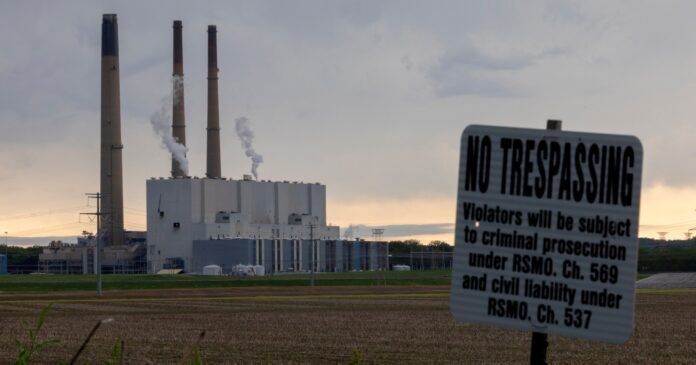
Among the beneficiaries of these moves is Ameren Corp.’s Labadie Energy Center west of St. Louis. The coal-fired power station is massive — 2.4 gigawatts, enough to power roughly 2 million homes — as are its emissions. It’s one of the nation’s largest sources of sulfur dioxide, which forms haze and harms the respiratory system, and the second-largest source of carbon dioxide, according to EPA data. But due to its age, the plant isn’t equipped with most modern pollution controls and can be linked to more than 300 premature deaths per year, according to a recent Sierra Club and Clean Air Task Force analysis of EPA data.

Patricia Schuba’s family has lived in Franklin County, Missouri, for five generations. From her home, she can see the plant and, emanating from it, “black clouds on an otherwise normal day.” Schuba keeps a mental list of the friends and family members who suffer from cancer, respiratory issues and other diseases and wonders if these health problems are linked to the emissions.

“I’m hopeful that the American public will wake up and elect people who actually put the American public first. And if we can do that, we can unwind some of this and clean up these sites,” said Schuba, who has served as the president of the Labadie Environmental Organization, a nonprofit community group, for about 15 years.

A woman wearing black frame glasses, a yellow rain jacket over a black shirt and black jeans poses for a portrait with her hands in her pocket, in front of a house with white siding and an American flag.
Patricia Schuba can see the Labadie coal-fired power station and its emissions from her home in Franklin County, Missouri. Robert Cohen for ProPublica

Sunil Bector, an attorney with the Sierra Club, said that heavily polluting facilities will reap overlapping benefits from the assault on the Clean Air Act. Research by his organization suggests that the Labadie power station stands to gain from every major action rolling back coal plant regulations.

“Ameren may expect that these rules are going away,” Bector said, “which means the levers that would force Ameren to internalize the cost of pollution are going away, which means the people who breathe air in St. Louis are internalizing the cost of pollution through their lungs.”

Craig Giesmann, the company’s director of environmental services, said in a statement, “Ameren Missouri’s Labadie Energy Center provides electricity to our customers in a cost-effective manner, operates in compliance with all applicable environmental regulations designed to protect public health and is supported by decades of investment in emissions controls.” Additionally, Giesmann said, the power plant is “critical infrastructure.”

The law requires the president to tie such exemptions to national security, and Trump has declared a national energy emergency over fears that emerging industries, like artificial intelligence, will not have access to the massive amounts of electricity they need. Data center proposals have come to Franklin County, and the county recently voted to recommend one despite the opposition of hundreds of locals. As the Trump administration speaks of an artificial intelligence arms race, Schuba fears Labadie will remain open for years to power data centers.

“There are real human consequences,” Schuba said, “lives that we sacrifice for whatever we think our future should be.”

A woman with braided hair, wearing a black shirt, with a serious expression; a soft-focus green foreground element partially obscures the right side of the frame.
A medical CPAP machine mask and tubing rest on top of white bed linens.
Tonga Nolan grew up in a region of Louisiana nicknamed “Cancer Alley,” close to various chemical plants, including Formosa Plastics’ facility. She said that many neighbors in her predominantly Black community have cancer, and she moved away after suffering from the illness as well. Annie Flanagan for ProPublica

“Death Started to Come”

Amid the rush to give out passes to the Clean Air Act, communities already saddled with air pollution find themselves affected once more.

An 85-mile stretch of Louisiana, running southeast from Baton Rouge, hosts such a concentration of heavy industry that it long ago garnered the nickname “Cancer Alley.” Studies have shown elevated cancer rates in the region, home to tens of thousands of people, and local chemical plants received passes on Clean Air Act rules. Louisiana hosts 20 of the facilities Trump has exempted. (Texas and Pennsylvania, two other states with histories of heavy industry, rank first and third, respectively, for the number of exempted facilities.)

Tonga Nolan grew up in a predominantly Black neighborhood on the north side of Baton Rouge and remembers it fondly as a tight-knit community. She also remembers when “death started to come.” Years later, she can recite the names of more than a dozen neighbors and family members who lived within a few blocks and died of cancer.

Nolan also had cancer. Wondering about a link between emissions from nearby facilities and her own health woes, Nolan moved away after undergoing a hysterectomy, she said. She is now in remission.

Chemical plants mark the western edge of the neighborhood, including a Formosa Plastics facility, which produces the plastic commonly called PVC.

The plant, owned by a Taiwanese chemicals company worth about $300 billion, has a history of violations. In 2003, the company accidentally released 8,000 pounds of carcinogenic vinyl chloride into Baton Rouge, according to the U.S. Chemical Safety and Hazard Investigation Board. And EPA data shows that its pattern of reported infractions has continued in recent years. (A company spokesperson told ProPublica in a statement that “significant improvements have been implemented” relating to “process safety, monitoring, and operational controls” since the 2003 incident.)

A street view looking down a road in a neighborhood, with houses on the left and an industrial facility with smokestacks emitting white clouds of smoke on the right, all under a bright blue sky with scattered clouds.
A white cloud of emissions rises from the Formosa Plastics facility near homes in Baton Rouge, Louisiana. Annie Flanagan for ProPublica

Formosa Plastics’ Baton Rouge plant applied for an exemption to a Clean Air Act rule. Jay Su and Tamara Lasater Wacker, executive vice president and corporate environmental director of Formosa Plastics, respectively, wrote to the EPA in March 2025 to make their case for it. They said that the company needed more time to design and install technology to comply with the rule and that the plastic synthesized at the plant was important to national security because it’s used in products such as blood bags.

“Due to the complexities and challenges that the rule currently presents, we request that the President grant a 2-year compliance date exemption for related emission limits and standards, performance testing, monitoring, recordkeeping and reporting requirements,” Su wrote.

The rule would have mandated better monitoring at the fence lines of Formosa Plastics and other plants. Such facilities can leak toxic gases from pipelines, valves and tanks, and they often vastly underestimate local emissions. But monitoring for leaks has proved effective in other industries; fence-line emissions of benzene, a carcinogen, fell 30% at petroleum refineries after implementation of a similar monitoring program, according to the EPA.

The administration granted Formosa Plastics’ request in July.

“We take our environmental responsibilities seriously and remain committed to safe, compliant, and transparent operations,” Formosa Plastics’ spokesperson said.

Exacerbating historical disparities, about 54% of people who live close to the facilities Trump exempted are not white, according to the federal data the Environmental Defense Fund collected. By comparison, only about 43% of the country is not white.

Polluting facilities “seem to be in the backyards of a lot of African American families,” Nolan said, adding that it’s hard to cope with the reality that many family members and neighbors are lost forever.

“You are hurting,” she said. “It’s like a hole that can never be filled.”

No promised US manufacturing boom as Trump tariffs ruled illegal

0
no-promised-us-manufacturing-boom-as-trump-tariffs-ruled-illegal
No promised US manufacturing boom as Trump tariffs ruled illegal

President Donald Trump signs an Executive Order on the Administration’s tariff plans at a “Make America Wealthy Again” event, Wednesday, April 2, 2025, in the White House Rose Garden. Photo: White House / Daniel Torok / Wikimedia Commons

A panel of federal judges ruled Thursday that US President Donald Trump’s sweeping 10% tariffs on most imports are unlawful, another major legal blow to the centerpiece of the Republican president’s economic agenda – which has failed to produce the manufacturing boom he repeatedly promised on the campaign trail.

The Court of International Trade (CIT) found in a 2-to-1 ruling that Trump violated the law when he unilaterally enacted the 10% import taxes following a February decision by the US Supreme Court, which struck down tariffs the president imposed using emergency powers. But the CIT’s ruling, which the Trump administration is expected to appeal, only barred collection of the tariffs from some of the plaintiffs in the case – including a pair of businesses and Washington state – an thus limited the ruling’s immediate impact.

Representative John Larson (D-Conn.), a member of the House Trade Subcommittee, applauded the new ruling in a statement, saying that “Trump must comply with the law by ending his illegal tax on the American people and getting families and small businesses the refunds they are owed.”

“The Supreme Court already rebuked the president’s costly tariffs, but Donald Trump sees our Constitution as a mere suggestion to follow, and not the law of the land,” said Larson. “As families are squeezed by sky-high grocery bills and gas prices, his latest round of tariffs is only pouring salt in the wound. The average household has already had nearly $2,000 stolen from them by this administration, and they should not have to pay a penny more.”

The decision came as a new analysis of trade and manufacturing data from the first quarter of 2026 found that the president’s “actions on trade have not delivered on his promises to quickly balance trade and revitalize US manufacturing.” Since Trump’s return to the White House last year, US manufacturing employment has declined by 82,000 jobs, according to the Rethink Trade program at the American Economic Liberties Project.

Additionally, the nation’s trade deficit was higher during the first three months of this year compared to the same period in 2024, Rethink Trade found.

“The first-quarter 2026 data show President Trump’s promises to prioritize speedily cutting the trade deficit and create more American manufacturing jobs are getting undermined by his chaotic and often mistargeted use of tariffs and squandering of leverage to demand other countries gut their Big Tech anti-monopoly and other policies instead of mercantilist abuses fueling the trade deficit,” said Lori Wallach, Rethink Trade’s director.

-Common Dreams

How climate change makes your allergies worse

0
how-climate-change-makes-your-allergies-worse
How climate change makes your allergies worse

It’s not in your head.

Climate change is contributing to longer and more severe pollen seasons across the Northern Hemisphere. Dr. Neelima Tummala, an ear, nose, and throat doctor at NYU Langone Health, said her patients tell her every year that their allergies are the worst they’ve ever been—and they might be right.

About a quarter of US adults and 1 in 5 children have seasonal allergies. For those millions of Americans, spring weather brings sniffles, itchy eyes, asthma exacerbation, and other miseries, with effects ranging from mild symptoms to serious medical emergencies.

Now, rising temperatures and carbon dioxide pollution are contributing to worsened pollen seasons across the country. Climate-change-driven heat waves, air pollution, and natural disasters can exacerbate allergy symptoms, too.

Although experts say it’s too early to fully tell how the 2026 pollen season will compare to past years, the trend over recent decades is clear, and evidence so far points to another tough year for the allergy-prone.

According to the USA National Phenology Network—a group focused on data and research concerning the seasonal patterns of plants and animals—spring bloom arrived early across much of the country.

AccuWeather meteorologists say this year’s trends fit into the overall pattern of an extending allergy season due to climate change.

They predict high tree pollen levels in the Ohio River Valley and parts of the Pacific Northwest this spring and say the Northern Plains and the Great Lakes could see early spikes in grass pollen in June and July, due to a combination of high rainfall and warmer weather. The Rockies can expect an intense weed pollen season, while New England and parts of the Gulf South might see lower than usual tree pollen levels, due to a cooler spring and less rain, they said.

Climate change and pollen

As global warming brings shorter winters and earlier thaws, trees start flowering—and therefore producing pollen—earlier in the spring.

A 2021 study found that human-caused climate change is worsening North American pollen seasons. And Climate Central found that between 1970 and 2025, the “freeze-free growing season” lengthened in the lion’s share of 198 US cities the group analyzed, with an average increase of 21 days. The Northwest and Southwest saw the largest average increases.

High levels of carbon dioxide also boost pollen production directly, and could amp it up as much as 200 percent by the end of the century, according to a 2022 study published in Nature Communications.

Pollen counts are rising globally, but they are particularly well studied across North America and northern Europe, said Moshe Ben-Shoshan, a pediatric allergist at the Montreal Children’s Hospital.

Some of Ben-Shoshan’s patients are experiencing stronger symptoms than they have in the past, and they can’t control them with treatments like antihistamines or nasal sprays that used to work.

“It’s the same symptoms, just more intense,” he said.

As climate change delays the first winter frosts across much of North America, summer ragweed also keeps flowering longer, extending the latter part of pollen season into the fall, said David Wees, a faculty lecturer in horticulture at McGill University in Montreal.

Wees himself suffers from seasonal allergies, and he’s noticed them starting earlier and lasting longer.

“There’s a couple birch trees outside my office,” he said. “I know it because my nose feels stuffy and my eyes feel itchy.”

Pollen isn’t the only allergen impacted by climate change. Increased humidity, heat, and flooding also create ideal conditions for mold to flourish in places where it was previously rare.

That can cause mold allergies to flare up, especially in the aftermath of climate-driven disasters like hurricanes, or for patients living in older buildings, basement units, or other homes without proper ventilation, Tummala said.

Pollen piles on

For many people, seasonal allergies are mainly a nuisance: itchy eyes, runny noses, and a seemingly never-ending cold. But pollen also messes with sleep, ups the risk of sinus infections, causes people to miss school and work, and can pose more serious dangers. A 2024 study based in Texas found that allergies can account for a significant portion of emergency department visits for asthma attacks during periods of high pollen counts.

People with allergies are also sensitive to other respiratory triggers, such as heat waves and increased air pollution, Tummala said.

On days with heavy wildfire smoke from Canada, Tummala said her patients experience the miserable effects of multiple respiratory stressors. During one such period last summer, a patient told her they were afraid to go outside.

“That’s just really sad,” Tummala said. “That’s not how you should live your life.”

Drought is another climate-intensified problem. Rain typically washes pollen out of the air. Without it, the fine powder can blow around for weeks without relief, Wees said.

For Tummala, the connection between seasonal allergies and growing climate hazards further illustrates the already pressing need for action to mitigate global warming.

“It’s a modifiable risk factor,” she said. “Climate change is something we can do something about.”

This article originally appeared on Inside Climate News, a nonprofit, non-partisan news organization that covers climate, energy, and the environment. Sign up for their newsletter here.

Africa-EU Parliamentary Assembly to hold inaugural plenary session in Eswatini

0
africa-eu-parliamentary-assembly-to-hold-inaugural-plenary-session-in-eswatini
Africa-EU Parliamentary Assembly to hold inaugural plenary session in Eswatini


The inaugural plenary session of the Africa-EU Parliamentary Assembly will take place in Eswatini from 12 to 14 May, bringing together African and European parliamentarians to discuss cooperation on security, youth policy and critical raw materials.

The opening ceremony is scheduled for 12 May at the Ezulwini Palazzo International Convention and Conference Centre and will be attended by Russell Mmiso Dlamini, His Royal Highness Prince Lindani, and the co-presidents of the assembly, Hilde Vautmans (Renew Europe Group,BE) and David Houinsa.

Over the course of three days, lawmakers are expected to discuss several shared priorities between Africa and the European Union.

Topics on the agenda include the role of regional organisations and parliaments in promoting peace and security, the future of multilateralism and parliamentary diplomacy, youth mobility within the Africa-EU partnership, women in agriculture, and parliamentary perspectives on the global competition for critical raw materials.

The session will conclude with the adoption of recommendations that will be submitted to the Africa-EU Council of Ministers.

Israeli fundraising platform ‘rebranding as American’ to dodge boycotts over genocide

0
israeli-fundraising-platform-‘rebranding-as-american’-to-dodge-boycotts-over-genocide
Israeli fundraising platform ‘rebranding as American’ to dodge boycotts over genocide

Israeli companies are pretending to be American to escape the shame of the Israel brand, Paul Biggar, founder of Tech for Palestine, has uncovered. GivingTech — a “global” philanthropy fintech marketed in the US and Europe is in fact the Tel Aviv-based IsraelGives, Biggar reported. The organisation is reported to have channelled donations to Israeli military units and illegal West Bank settlements.

Biggar, the Irish founder of the developer-tools firm CircleCI, laid out his findings in a thread posted on X on 7 May. The two organisations, he wrote, were tied together by a shared chief executive, an identical logo, near-identical websites and a string of technical fingerprints, including the same Google Analytics codes and an identically-hashed stylesheet that he said could not have come about by coincidence.

Firstly, we found this because we were evaluating a partner and they used a site called https://t.co/DVAgI8yHGP. After we put a small donation through it, the new website’s title became “IsraelGives”.

But actually we had a clue before: the donation form had the IsraelGives logo… pic.twitter.com/rUqaJNKyZx

— Paul Biggar 🇵🇸🇮🇪 (@paulbiggar) May 7, 2026

“This is part of a trend of Israeli companies trying to rebrand their way out of genocide, occupation and boycotts,” Biggar wrote in the closing post of the thread.

IsraelGives, founded in 2009, is an Israeli charitable platform that allows donors abroad to give to Israeli causes and to receive tax receipts in 35 countries. The Israeli platform has been documented before as having processed donations from US-based donors to illegal Israeli settlements in the occupied West Bank, to paramilitary groups, and to Israeli military units.

READ: Google and Amazon struck secret deal to shield Israel from legal scrutiny, leak reveals

Subsequent reporting found that Google employees have been able to direct donations including company-matched ones to the platform via the corporate giving platform Benevity.

By contrast, GivingTech looks like an American firm. Its website presents the company as a global provider of fundraising software for charities, pitching its services to financial advisers, wealth managers and non-profits in the United States. Nowhere on the homepage is there any reference to Israel. According to Biggar, that is precisely the point.

“Once we started probing, the commonalities were everywhere,” he wrote. The same individual, he said, has served as chief executive of both companies concurrently for the past four years. On LinkedIn, the company is listed as headquartered in Tel Aviv. The IsraelGives website, the GivingTech website, and a third sister product, DAFtech, all share the same logo — and the same favicon.

The technical evidence, Biggar argued, was harder still to dismiss. The IsraelGives website, he wrote, loads a stylesheet named givingtech.css whose cryptographic hash is identical to the one used on the GivingTech site — meaning the two pages are, at the code level, the same file. Both sites, he added, also share the same Google Analytics and Microsoft Clarity tracking identifiers, the unique codes used to monitor visitor traffic. “Another smoking gun,” he called it. “If all of that somehow doesn’t convince you, check the websites. They are nigh identical!”

READ: Apple under fire for matching employee donations to IDF and illegal settlements

Medspa Owner Charged with Murder After ‘IV Cocktail’ Causes Patient to Suffer Fatal Cardiac Arrest

0
medspa-owner-charged-with-murder-after-‘iv-cocktail’-causes-patient-to-suffer-fatal-cardiac-arrest
Medspa Owner Charged with Murder After ‘IV Cocktail’ Causes Patient to Suffer Fatal Cardiac Arrest


A Texas medspa owner and a doctor are now facing serious criminal charges after a woman allegedly died from a dangerously administered IV treatment that investigators say was given far too quickly.

Jenifer Cleveland, 47, died on July 10, 2023, after visiting a medspa in Wortham for what should have been a routine wellness treatment. Instead, authorities say the IV infusion triggered a deadly medical emergency that sent her into cardiac arrest within minutes.

According to indictments obtained by PEOPLE, Cleveland received an “IV cocktail” at Amber Johnson’s Luxe Medspa that contained multiple vitamins and electrolytes, including potassium chloride — a substance that can become deadly if administered improperly.

Investigators claim the infusion was delivered at an unsafe speed.

Johnson turned herself in to authorities on April 28 and was booked into the Freestone County Jail. She now faces a long list of charges, including felony murder, manslaughter, criminally negligent homicide, practicing medicine without a license, tampering with physical evidence, and multiple counts related to the delivery of dangerous drugs.

Jail officials confirmed she was later released on a $69,000 bond.

Authorities say Cleveland’s IV treatment began shortly after 11 a.m. on July 10, 2023. Just 27 minutes later, she reportedly lost consciousness, collapsed, and had no pulse.

She was rushed to a local hospital but was pronounced dead shortly afterward.

Medical experts say potassium chloride must be administered slowly and carefully monitored because too much potassium entering the body too quickly can trigger catastrophic complications, including irregular heart rhythms, organ failure, and sudden death.

The Texas Medical Board later launched an investigation into the shocking death.

Following a months-long review, investigators concluded Cleveland died from cardiac arrest caused by the “improper administration” of the IV therapy, according to an August 2024 order suspending the license of Dr. Michael Gallagher, the physician accused of overseeing the medspa.

Authorities allege Johnson did not hold a medical license but still operated the medspa despite Texas laws restricting non-physicians from owning medical practices.

Investigators also accused Gallagher of failing to properly supervise Johnson and allegedly allowing her to use his medical license to obtain dangerous medical substances.

Gallagher was arrested on April 29 and hit with multiple charges of his own, including felony murder, manslaughter, criminally negligent homicide, and numerous counts tied to dangerous drug distribution and illegal medical practices.

He was released on a $96,500 bond.

In the wake of Jenifer’s death, her husband Brian Cleveland filed a civil lawsuit against Luxe Medspa and later pushed for stricter regulations surrounding elective IV therapy clinics.

His efforts eventually led to the passing of “Jenifer’s Law,” which was signed by Texas Gov. Greg Abbott in June 2025. The law created tighter oversight rules for nontraditional healthcare facilities that offer elective IV treatments.

Before the legislation passed, Brian spoke emotionally about the wife he lost.

“She loved life. She loved her people,” he said. “She just wanted to love.”

He added that having the legislation named after Jenifer felt like a way for her legacy to continue helping others long after her death.

0FansLike
0FollowersFollow
0FollowersFollow
0SubscribersSubscribe
- Advertisement -
Google search engine

Recent Posts