A little more than three years since NASA’s Ingenuity helicopter ended its pioneering mission at Mars, engineers at the Jet Propulsion Laboratory in California are designing next-generation Martian rotorcraft to carry heavier payloads longer distances through the planet’s low-density atmosphere.
Ingenuity was a resounding success, becoming the first airborne platform to explore another world. The dual-bladed helicopter made 72 flights, overachieving NASA’s original goal of five flights over 30 days, after delivery to Mars by the Perseverance rover. By the time the mission ended with a crash-landing in January 2024, Ingenuity had shown scientists a new way to explore other worlds, using air to travel longer distances and reach locations inaccessible to ground vehicles.
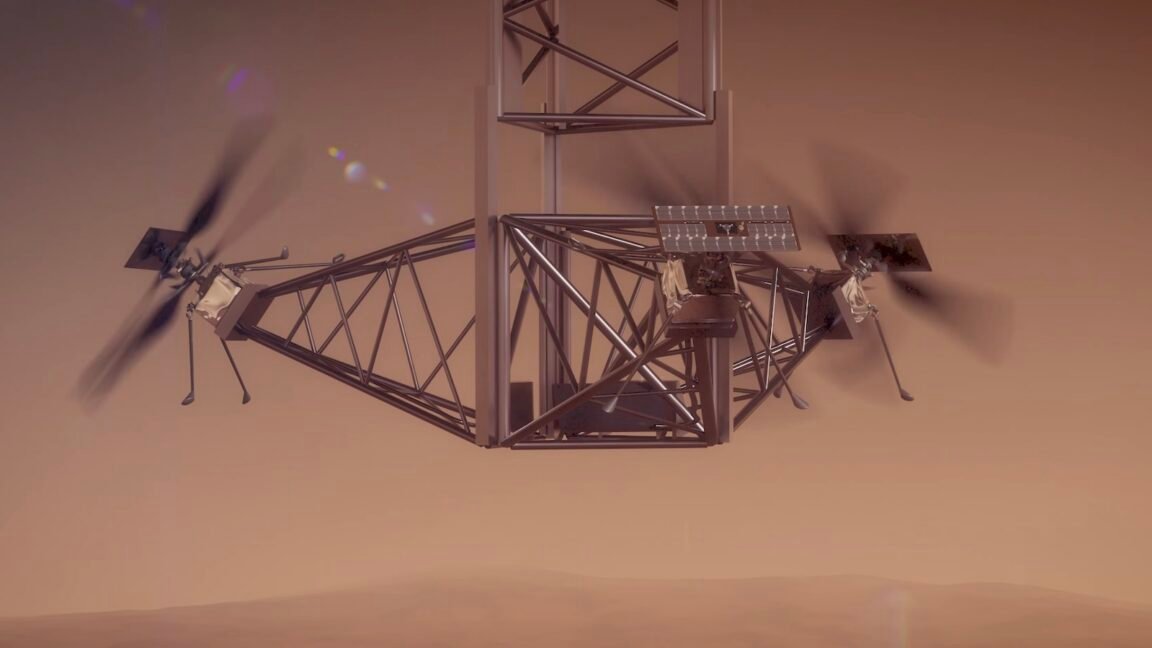
NASA plans to send three more helicopters to Mars on the SkyFall mission, which could launch as soon as late 2028. SkyFall is set to ride to the red planet aboard a nuclear-powered spacecraft named Space Reactor-1, or SR-1, one of the tech demo initiatives announced earlier this year by NASA Administrator Jared Isaacman.
Ingenuity‘s main body was not much larger than a tissue box, with a mass of just 4 pounds (1.8 kilograms) and counter-rotating rotors that spanned about 4 feet (1.2 meters). The SkyFall helicopters will be larger and heavier, and they will use a novel maneuver to land themselves on the Martian surface after entering the atmosphere cocooned inside a heat shield. This will require innovations in the helicopter’s design.
Breaking a barrier
Engineers at JPL and a private company named AeroVironment, the same partners that developed Ingenuity, recently made a breakthrough in the lab to nudge the SkyFall mission closer to reality. The tests involved the new, larger rotor blades that will convey the next-gen helicopters through the rarefied Martian atmosphere, just 1 percent the density of air at sea level on Earth.
Because of this thin atmosphere, helicopters flying on Mars must spin their rotors faster than on Earth to generate lift, and heavier vehicles need more lift than lighter ones. The rotors on the SkyFall helicopters will also be larger than those on Ingenuity, which spun its blades at 2,700 rpm, already 10 times faster than passenger helicopters on Earth. But engineers were careful to design Ingenuity not to spin its carbon-fiber rotors faster than the speed of sound out of concern that exceeding Mach 1 (roughly 540 mph on Mars) might cause the blades to shatter.
“If Chuck Yeager were here, he’d tell you things can get squirrely around Mach 1,” said Jaakko Karras, the rotor test lead at JPL, in a NASA press release. “With that in mind, we planned Ingenuity’s flights to keep the rotor blade tips at Mach 0.7 with no wind so that if we encountered a Martian headwind while in flight, the rotor tips wouldn’t go supersonic. But we want more performance from our next-gen Mars aircraft. We needed to know that our rotors could go faster safely.”
Recent testing at JPL pushed rotors past the speed of sound without damaging them, NASA announced Thursday. The rotor tips reached a top speed of Mach 1.08 in a test chamber simulating Mars’ atmosphere. Engineers didn’t know for sure what would happen to the rotors, so they lined part of the chamber with sheet metal to shield it from damage if the blades broke apart during the supersonic experiment, according to NASA.
“From a control room a few yards away from the chamber, the team watched displays showing data and a view inside the chamber as the rpm climbed as high as 3,750,” NASA said. “At that rate, the tips were traveling at Mach 0.98. Then the engineers activated a fan inside the chamber that pelted the rotors with headwinds. After each run, they increased in wind velocity for the next run.”
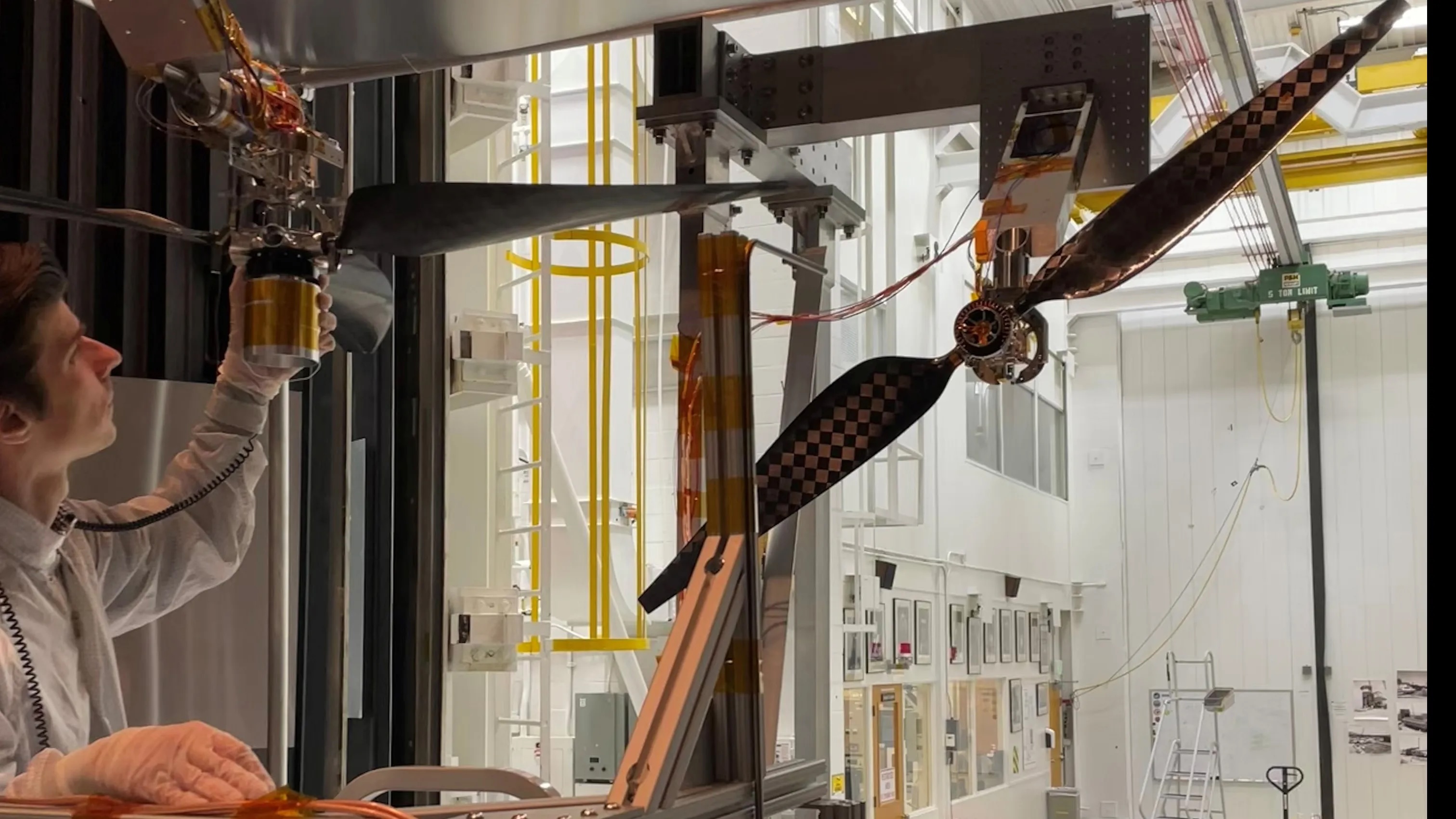
The first series of tests used a three-bladed rotor design that could be flown on missions after SkyFall. A second test campaign used the actual two-bladed design that will fly on SkyFall. These blades are slightly longer, so they reached the same supersonic speed at a lower rpm. The faster spin resulted in a 30 percent boost in lift capability.
The team pushed rotor tip speeds to Mach 1.08, boosting the Mars vehicle’s lift capability by 30 percent. This breakthrough allows future missions to support heavier scientific payloads, including advanced sensors and larger batteries for extended flight.
“We thought we’d be lucky to hit Mach 1.05, and we reached Mach 1.08 on our last runs. We’re still digging into the data, and there may be even more thrust on the table. These next-gen helicopters are going to be amazing,” said Shannah Withrow-Maser, an aerodynamicist from NASA’s Ames Research Center.
At the same time that engineers are preparing to send more helicopters to Mars, NASA is working on a more massive rotorcraft named Dragonfly destined for Saturn’s moon Titan. Dragonfly will weigh nearly a ton, but flying on more distant Titan poses fewer challenges than on Mars because its atmosphere is thicker than Earth’s.
The only payloads on the Ingenuity helicopter were two cameras: a black-and-white imager for navigation and a higher-resolution color camera. Its longest flight in 2022 covered less than a half-mile and lasted 161 seconds. The aircraft had to land and recharge its batteries using solar arrays, and it used the nearby Perseverance rover as a base station to communicate with ground teams on Earth.
The SkyFall mission won’t have a rover nearby. The helicopters will have to communicate with mission controllers through orbiting relay satellites or a direct-to-Earth link. Future rotorcraft will use larger batteries to enable longer flights. Scientists would like to mount more sophisticated instruments on Mars helicopters to search for things like ice in the Martian soil. All of this will require heavier vehicles.
Breaking the sound barrier without breaking hardware moves us a step closer to fully exploiting this new mode of planetary exploration.