Crypto exchange Coinbase to cut about 14% of workforce
Coinbase said on Tuesday it will cut about 700 jobs, or about 14% of its global workforce, as part of a restructuring plan aimed at reducing costs and repositioning the business for the AI era.
Shares of the crypto exchange were up 4.66% in premarket trading.
The company expects to complete the exercise largely in the second quarter of 2026.
Coinbase expects to incur about $50 million to $60 million in total restructuring expenses, mainly tied to employee severance and other termination benefits, with most of the charges to be recognized in the second quarter.
Financial strain, lockdowns and fear of infection during disease outbreaks magnify violence against women and girls − new research
When the world shut down due to the COVID-19 pandemic in early 2020, another crisis quietly grew behind closed doors. Reports from around the globe suggested that violence against women and girls was increasing. Governments, nongovernmental organizations and advocates began referring to the phenomenon as a “shadow pandemic.”
To determine whether these headlines and informal reports reflected reality, we led the first-ever comprehensive review of studies tracking violence against women and girls during infectious disease outbreaks across low- and middle-income countries. We focused on those regions because less research on the topic has been done there, and women and girls face specific risks, such as child marriage, that are less prevalent in wealthier nations.
Our findings, published in BMJ Global Health and co-authored with UNICEF, are both clear and concerning: Violence against women and girls tends to increase during outbreaks, and the very measures used to control disease spread can lead to that rise.
Across 53 studies measuring changes in violence against women and girls in the first year of the COVID-19 pandemic, the majority found increases, with some studies showing no change and relatively few showing declines. This pattern held across different types of violence – for example, physical domestic violence, sexual domestic violence, psychological violence or online violence – particularly committed within the home.
But even more striking was how little evidence there was from other infectious disease outbreaks. Despite the growing frequency of global health emergencies, only one study examined violence against women and girls during an outbreak other than COVID-19, specifically examining violence in Sierra Leone during both Ebola and COVID-19.
How outbreaks contribute to gender-based violence
Infectious disease outbreaks do more than spread illness. They can disrupt economies, burden health systems and reshape daily life. These shifts can amplify existing inequalities and, in many cases, increase the risk of violence.
Our research identified five key pathways through which outbreaks contribute to violence against women and girls.
The United Nations dubbed the rise in violence against women and girls during the COVID-19 pandemic ‘the shadow pandemic.’
First, job loss, reduced income and financial stress were the most consistently identified contributors to violence. When households experience economic strain, tensions rise – and women and girls often bear the consequences. In some contexts, economic stress was linked not only to intimate partner violence but also to harmful practices like child marriage.
Second, movement restrictions like lockdowns and quarantines can trap women and girls with abusive partners or family members. While these outbreak response measures are designed to reduce disease transmission, they can also isolate women from social networks and limit opportunities to seek both formal and informal help.
Third, deeming certain services as nonessential reduces people’s access to support. During COVID-19, many health, social and legal services were scaled back or became harder to access. School closures also meant that girls in some contexts faced increased risks of exploitation, early pregnancy or forced marriage.
Fourth, perpetrators may use women’s and girls’ fear of infection to control or manipulate them. For example, men sometimes discouraged their partners from leaving the home or seeking care in order to avoid disease risk.
Finally, women’s and girls’ past experiences with health systems can influence their intention to seek services in the future. In settings affected by earlier outbreaks, such as the 2014 Ebola outbreak, mistrust of health services discouraged some survivors from seeking care after experiencing violence, especially if doing so might lead to quarantine or mistreatment.
These pathways are not isolated. They often interact and reinforce one another, creating conditions in which violence becomes more likely during crises.
Building better evidence
Public health emergencies are becoming more frequent, and measures like lockdowns and limiting access to schools, clinics and other services can have unintended consequences. Our findings show that protecting women and girls needs to be part of how public health experts respond to outbreaks from the start and not something to address only after violence has already increased.
Tracking the issue in different types of outbreaks – such as cholera, influenza or Ebola – could help determine which policy responses are most protective.
But even within COVID-19 research, we uncovered important limitations. First, most studies focused on adult women, with far less attention to girls. And second, many studies relied on metrics such as the number of hotline calls or clinic visits, which can be misleading. A drop in reports does not necessarily mean a drop in violence; it may reflect reduced access to services or greater barriers to reporting.
Despite the data gaps we uncovered, our study already points to targeted strategies that can protect women and girls: reducing households’ financial stress, making services safe and easy to reach, ensuring girls’ continued access to school, and building stronger community support.
Asia fracturing into energy security haves and have-nots
The US-Iran war is exposing a hard truth: Asia is a tiered system of energy access, where wealth determines resilience.
Investors have for years treated Asia as a single growth engine. Capital flowed into the region on the assumption that, despite the clear, well-known differences between nations, many fundamentals held: stable trade routes, manageable energy costs and export-driven expansion.
But this assumption is now under strain. Roughly a fifth of global oil supply typically passes through the Strait of Hormuz, but disruption there doesn’t hit Asia evenly, though. It sorts winners from losers.
Japan, South Korea and Singapore sit at the top of this hierarchy. They import most of their energy, but they also have the financial capacity to secure it.
Japan holds more than US$1 trillion in foreign exchange reserves. South Korea has over $400 billion. These countries can defend currencies, subsidize fuel, and outbid competitors when supply tightens.
Lower down the scale, the picture becomes far more fragile. Bangladesh is running inflation above 8%, with officials warning that fuel costs are draining public finances.
Thailand, with one of Asia’s highest ratios of oil imports to GDP, has already cut its economic growth forecast to 1.5%. South Korea’s import prices surged 16.1% year-on-year in March, highlighting how quickly external shocks feed through into domestic costs.
The Asian Development Bank has cut regional growth forecasts to 4.7% from 5.1%, while raising inflation projections to 5.2%. These numbers matter, but, arguably, the pattern matters more.
Asia is splitting into tiers defined by energy security, fiscal strength and access to capital. In a tight market, of course, oil does not flow equally. It flows to those who can pay. And this creates a hierarchy of economic resilience.
For global investors, this changes how Asia should be understood. The old framework, of broad regional exposure capturing growth, is no longer sufficient.
Energy access is becoming a primary filter for capital allocation. Countries with strong reserves, credible policy and diversified supply will attract investment. Those without will see rising risk premiums.
Currency markets are already reflecting this divide, too. Japan has spent around $35 billion supporting the yen as energy costs push the currency lower. Other Asian economies don’t have the same firepower. As import bills rise, currencies will weaken, feeding further inflation and tightening financial conditions.
Bond markets will follow, as they always do. Those nations with weaker external balances and higher import dependence will face higher borrowing costs. Fiscal space will shrink precisely when governments are forced to spend more on subsidies.
Subsidies, in fact, are part of the problem. They buy time, but they don’t solve the underlying issue.
Japan can afford to cushion the impact of fuel prices. The Philippines can support public transport drivers. Vietnam can draw on emergency funds.
These measures soften the immediate impact, but they widen deficits and increase long-term vulnerability, particularly in economies with limited fiscal capacity.
The deeper shift is significantly more structural. Asia’s growth model has relied on cheap, reliable energy flowing from the Middle East, and that model, clearly, now faces sustained uncertainty.
Even if supply returns to normal, the risk premium will remain as shipping costs, insurance costs, and delivery times rise, and planning becomes harder.
Supply chains start to reflect this. The disruption in Hormuz has already contributed to a backlog of around 1,000 vessels, delaying cargo across energy and industrial inputs.
For manufacturing economies operating on tight margins and precise timelines, delays matter as much as prices. Production schedules slip, inventory costs rise and export competitiveness weakens.
All this, then, feeds directly into corporate earnings. Energy-intensive sectors, such as chemicals, transport and heavy industry, face margin compression. Companies in weaker economies struggle to pass on costs without hitting demand, and those with pricing power or exposure to energy supply gain a relative advantage.
Against this backdrop, savvy investors will need to adjust quickly.
Country selection becomes more important than regional allocation. Metrics such as foreign exchange reserves, current account balance and energy import dependence move to the center of analysis. Exposure to “Asia” as a single theme carries more risk than it once did.
China and India sit in complex positions within this hierarchy. China has scale and state control, but remains heavily dependent on imported energy. India continues to post strong growth, yet imports roughly 85% of its oil, leaving it exposed to price shocks.
Neither is insulated. Central banks across the region are, as such, facing difficult choices. Raising rates supports currencies but slows growth; yet holding rates risks deeper inflation and further currency weakness.
Singapore has already tightened policy, Australia is weighing further increases and others face similar trade-offs with less room to maneuver. The result is a region that is increasingly out of sync.
For a long time, scholars of social movements assumed that political coalitions form when different groups discover they have aligned interests. But in American history, those alignments have usually been short-lived and shaky at best. Labor unions, civil rights groups, immigration activists, and environmentalists have each followed their own logic, rarely coming together in any lasting way. In recent years, though, something more surprising has started to happen — a new kind of convergence visible in movements like “May Day Strong.”
To understand why, we need to look at the deeper structure of politics in the Trump era.
Trumpism didn’t just energise its own supporters. It redrew the entire political map into a sharp, simple binary: real Americans versus elites, insiders versus outsiders, loyalists versus enemies.
This binary did two things at once. Inside Trump’s base, it created stronger unity. But on the other side, it unintentionally created a shared sense of threat for a wide range of groups that previously had little in common. Suddenly, workers facing job insecurity, immigrants under pressure, racial justice activists, and climate organizers all found themselves staring at overlapping challenges — economic inequality, declining protections, and a system that seemed increasingly stacked against them.
This is a crucial shift. Traditional coalitions usually form around shared goals or similar ideologies. The new ones forming now are built on something different: a shared feeling of vulnerability and structural pressure. “May Day Strong” is a clear example of this emerging intersectional coalition.
Inside this movement, workers, migrants, climate activists, and racial justice groups aren’t uniting because they all agree on the same detailed platform. They’re coming together because they see themselves as targets of the same broader system of power and inequality. In their view, it’s not just a bunch of separate bad policies — it’s one connected structure.
Trumpism plays a strange, paradoxical role here. On one hand, it deliberately deepens division and polarisation. On the other, that very polarization pushes its opponents closer together. You could call it “convergence through conflict.” The harder the lines are drawn, the more likely broad coalitions become on the other side.
That said, these new coalitions are inherently unstable. They’re built on overlapping grievances rather than a deep, shared identity. Because of that, internal tensions are almost guaranteed. What feels urgent to labour organisers might feel secondary to climate activists or immigration advocates. Balancing those different priorities is one of the biggest challenges they face.
Still, this diversity can also become a strength. When these groups manage to link their issues together, they create a bigger, more powerful story. Phrases like “workers versus billionaires” or “economic justice for all” aren’t just catchy slogans — they help weave very different experiences into one larger narrative of inequality.
None of this is happening in a vacuum. Real material conditions have made it possible: widening economic gaps, unstable jobs, the rise of the gig economy, and the steady erosion of worker protections have created a shared reality that different groups can recognise in their own lives.
In the end, Trumpism didn’t create these conditions, but it accelerated them. By intensifying polarisation and weakening trust in institutions, it pushed many groups to see their struggles as connected.
The big question now is whether these coalitions can last. Can they turn temporary moments of unity into something more permanent — actual organisations and structures? If they stay just as protest movements, they’ll probably fade. But if they build real staying power, they could become a significant new force in American politics.
What we’re seeing is a reconfiguration of how social movements work in the United States. Polarisation isn’t only creating division — it’s also producing unexpected forms of convergence. Fragile as it may be, this convergence carries real potential to reshape the political landscape.
At its core, “May Day Strong” is more than just another protest. It reflects a deeper shift: moving away from strictly identity-based politics toward something more coalition-driven and intersectional.
And here’s the biggest irony: much of this new unity has been fueled, indirectly, by the very political force that set out to divide the country.
The views expressed in this article belong to the author and do not necessarily reflect the editorial policy of Middle East Monitor.
President Trump Announces ‘Shabbat 250’ Initiative as Part of Jewish American Heritage Month
President Donald Trump has proclaimed a national “Shabbat 250” initiative as part of Jewish American Heritage Month, calling on Jewish Americans to observe a National Shabbat from sundown Friday, May 15, to nightfall Saturday, May 16, 2026, in recognition of faith, freedom, and the 250th anniversary of American independence.
The initiative forms part of President Trump’s broader proclamation designating May 2026 as Jewish American Heritage Month. The president encouraged participation in what he described as a historic observance of Shabbat, marking the first time a sitting US president has explicitly called for such a national recognition.
According to the proclamation, the initiative is intended to highlight the contributions of Jewish Americans and to promote reflection and rest in line with Jewish tradition. The effort also ties into the broader commemoration of the United States’ 250th anniversary.
“From sundown on May 15 to nightfall on May 16, friends, families, and communities of all backgrounds may come together in gratitude for our great Nation. This day will recognize the sacred Jewish tradition of setting aside time for rest, reflection, and gratitude to the Almighty.”
President Trump also referenced early American history, invoking President George Washington’s letter to the Hebrew Congregation in Newport, Rhode Island, and acknowledging Revolutionary-era financier Haym Salomon as part of the historical narrative tied to Jewish contributions in the United States.
In his proclamation, President Trump said: “This month, we celebrate the contributions that Jewish Americans have made to our way of life, we honor their role in shaping the story of our Nation, and we remember that religious devotion, learning, and service to others are enduring pillars of a thriving culture. Through every trial and triumph, the contributions of Jewish Americans have shaped our past, have strengthened our communities, and will continue to inspire American greatness for generations to come.”
How do you design a $30,000 electric pickup? Inside Ford’s skunkworks.
LONG BEACH, Calif.—2026 is a strange time for electric vehicles in the US. The current administration has no desire to push for their adoption and has rescinded the federal tax credit on which EV sales have depended for years. Tariffs have made vehicles and their constituent components even more expensive, making switching to an EV for the first time an even harder pill to swallow. Manufacturers like Honda, which had three nearly production-ready EVs on deck, just killed them all unceremoniously.
It’s bleak out there.
Still, Ford has decided to stay in the game with its “Universal Electric Vehicle,” which it announced in late 2025. This highly modular platform is designed to underpin all of the Blue Oval’s electric vehicles going forward. The work has been largely conducted at Ford’s Electric Vehicle Development Center (EVDC) in sunny Long Beach, California, and Ars Technica was recently invited to tour the facility to see what makes it different from any of Ford’s other operations.
The skunkworks
Inside a bland-looking tilt-up concrete building in a new-ish business park near the Long Beach Airport, Ford is attempting to upend the way it develops new vehicles. The EVDC was conceived of as a “skunkworks,” but what is that, and why is it important for Ford’s future?
The first skunkworks was a highly autonomous, secretive division within Lockheed Martin that began in Burbank, California, in the 1940s. It got its name from its proximity to a plastics plant that made the surrounding area stink; the smell was so bad that one of the engineers assigned to the division started referring to the building as the “Skonk Works,” after a fictional product from the “Lil’ Abner” comic strip. The name stuck, but it was changed from Skonk to Skunk to avoid any lawsuits.
The EVDC lobby is a little less anonymous.
Ford
The EVDC lobby is a little less anonymous. Ford
The outside of the EVDC.
Ford
The outside of the EVDC. Ford
The EVDC lobby is a little less anonymous. Ford
The outside of the EVDC. Ford
Lockheed’s Skunk Works (an official trademark) was headed by an aeronautical engineer named Clarence Leonard Johnson—better known as Kelly Johnson. Johnson is well known today as the father of the P-38 Lightning, the U2 spy plane, and even the SR-71 Blackbird (aka the coolest plane ever).
He’s probably best known outside plane geek circles for his list of 14 rules for running a skunkworks program. Let’s run through them to understand Ford’s goals with EVDC.
1. The Skunk Works manager must be delegated practically complete control of his program in all aspects. He should report to a division president or higher.
Johnson’s first rule of running a skunkworks is arguably the most critical. The goal of a program like Ford’s EVDC is to reduce the red tape required to advance a project. This is especially important in a company like Ford, which has a deeply entrenched bureaucracy.
In EVDC’s case, this top-level manager is Alan Clarke, vice president of Advanced Development Projects. Before joining Ford in 2022, he worked in development at Tesla. This is a theme at EVDC, with many senior staff coming from Tesla. Clarke works hand in hand with Jolanta Coffey, the vehicle program director for the UEV program, who previously worked on the European Transit and USDM Expedition and Navigator.
2. Strong but small project offices must be provided both by the military and industry.
EVDC’s physical distance from both Dearborn and the EV office in Palo Alto, California, is designed to further ingrain that sense of autonomy from the big blue mothership. While the EVDC program works closely with both of those offices, day-to-day operations take place at the Long Beach location, which serves as a one-stop shop for vehicle development. EVDC spans just two buildings, with the fleet center occupying a large part of the second building.
3. The number of people having any connection with the project must be restricted in an almost vicious manner. Use a small number of good people (10–25 percent compared to the so-called normal systems).
A small team is another of the core principles outlined by Johnson in his 14 rules, and it’s arguably the most quoted today. A small, agile team is an advantage in a skunkworks because, as with the first rule, it cuts through red tape. It allows you to move quickly and adapt to failures or changes without dealing with the organizational inertia inherent in a big team.
To that end, the Ford EVDC currently has around 350 people working at Long Beach at any given time. Employees in outside offices that deal with manufacturing engineering and software, for example, bring the team size to around 480, but in Ford terms, that’s still a very small division.
4. A very simple drawing and drawing release system with great flexibility for making changes must be provided.
This is an interesting one. EVDC is extremely well-equipped with everything from three types of 3D printers to a CNC mill bigger than my first three apartments (including one just for shaping full-size clay models). This allows for rapid iteration and a simplified approval process without the need to send changed models and drawings off-site for manufacturing. Speed also comes from everyone being under one roof, preventing silos. All of that is in addition to a wood shop, a metals shop, and more. Even elements like seat design and patterning are done in-house.
5. There must be a minimum number of reports required, but important work must be recorded thoroughly.
The less time you spend justifying your decisions to upper management, the more time you have to actually do the work.
6. There must be a monthly cost review covering not only what has been spent and committed but also projected costs to the conclusion of the program.
This may seem like Project Management 101, but it goes beyond just budgeting time and money for the project’s development. Because the Universal Electric Vehicle is being designed to be as affordable as possible, constantly considering the effect of design decisions on cost is critical. This extends from material selection to making the seat mounting bolts face outward, speeding installation and reducing labor costs on the line. Ford is being relentless in this pursuit.
7. The contractor must be delegated and must assume more than normal responsibility to get good vendor bids for subcontract on the project. Commercial bid procedures are very often better than military ones.
Modern manufacturing tech has largely made Johnson’s seventh rule irrelevant. Because EVDC is so vertically integrated, from computer design to clay models, rapid prototyping, assembly, and testing, the need for outside contractors has largely been eliminated.
8. The inspection system as currently used by the Skunk Works, which has been approved by both the Air Force and Navy, meets the intent of existing military requirements and should be used on new projects. Push more basic inspection responsibility back to subcontractors and vendors. Don’t duplicate so much inspection.
If we swap contractors for engineers, this rule becomes much more relevant to what Ford is trying to do. At EVDC, the teams are fully equipped with high-level test equipment, enabling them to validate designs before they ever leave the office. There is even a mock car made of 80/20 aluminum extrusions, used to lay out an entire wiring harness and everything that attaches to it, short of a battery pack. This allows the engineers to validate not only hardware, such as the in-house modules that make up UEV’s zonal architecture, but also the software.
9. The contractor must be delegated the authority to test his final product in flight. He can and must test it in the initial stages. If he doesn’t, he rapidly loses his competency to design other vehicles.
All teams at EVDC follow their work through all stages of the project. They are in constant contact with other teams to avoid the left hand not knowing what the right hand is doing. Testing is constant, and revisions are as frequent.
10. The specifications applying to the hardware must be agreed to well in advance of contracting. The Skunk Works practice of having a specification section stating clearly which important military specification items will not knowingly be complied with and reasons therefore is highly recommended.
This one isn’t super relevant, but Ford set the specs for the UEV a while ago, giving the design teams a target to hit.
11. Funding a program must be timely so that the contractor doesn’t have to keep running to the bank to support government projects.
There’s probably a joke in here somewhere about Ford not taking the 2009 bailout.
12. There must be mutual trust between the military project organization and the contractor, the very close cooperation and liaison on a day-to-day basis. This cuts down misunderstanding and correspondence to an absolute minimum.
This is related to teams at EVDC working in close proximity. If there’s a hardware problem with the E-Box during climate chamber dyno testing, the team that designed it can simply walk over to see what failed. No travel, no Zoom calls.
13. Access by outsiders to the project and its personnel must be strictly controlled by appropriate security measures.
This is another very important rule. Johnson and the original Skunk Works were working on secret military planes and cutting-edge technology. If other nations got hold of what they were doing, there could have been very real consequences.
The situation is less serious with Ford and EVDC, but the company still takes security very seriously. Our visit to the facility was the first time anyone outside the program had been allowed in. This level of secrecy and access control is a big deal for Ford for obvious reasons, but it speaks to the nature of the work the people at EVDC do.
14. Because only a few people will be used in engineering and most other areas, ways must be provided to reward good performance by pay, not based on the number of personnel supervised.
While I can’t speak to the EVDC staff’s salaries, we can discuss why Ford chose to put this facility in Long Beach. The idea behind EVDC is to attract the best employees possible from a specific pool. Getting some of those people to move to Dearborn might be a challenge—if you’ve been to the Detroit area in January, you understand what I’m talking about. Southern California, despite its high cost of living, is a popular place to live, with great weather and plenty to do. It’s a lower lift to ask people to move from Silicon Valley (like ex-Tesla employees) to the Los Angeles area.
The electric midsize truck
So what has all this secrecy, agility, and good California sunshine gotten Ford? What have the folks behind the Universal Electric Vehicle program managed to create? Will the project bring widespread EV adoption to the US? Or will it be another F-150 Lightning—technically great, liked by critics, but not widely embraced by the truck-buying public?
We don’t know much about the first vehicle based on the UEV platform, and what I saw during the tour was abstract and focused on how the sausage is made. Still, many of the design decisions Ford is making to bring down the UEV platform’s cost seem smart rather than short-sighted, which aligns with what I’ve come to expect from the Big Three.
For example, the UEV uses the battery pack as a stressed member of the chassis, and the vehicle’s seats are even bolted to it. (BMW uses a similar approach with its Neue Klasse EVs.) This reduces the amount of sheet metal required and the time it takes to build a vehicle on the line. The reduction in complexity and parts is at the heart of the UEV program, and it doesn’t stop at the pack.
A prototype center console is scanned and measured.
Credit: Ford
A prototype center console is scanned and measured. Credit: Ford
Ford is using large castings to form the vehicle’s front and rear clips, reducing part count and increasing rigidity. That sounds great, but what happens in a crash? Would the owner be on the hook for an expensive single part rather than cheaper sheet-metal repair pieces? Ford has thought of that, too.
Vlad Bogachuk, Ford’s chief engineer of advanced vehicle structure, explained that the solution is simpler than it seems. “In our collision repair literature, we will outline the process of cutting through the casting at a designated cut line and then replacing the damaged portion with a new repair casting,” he said. “This repair part is bonded to the original casting and shouldn’t affect the integrity of the vehicle’s structure at all.”
If panel bond (essentially expensive car glue) sounds like a strange solution, keep in mind that most supercars and hypercars are held together with it and not much else.
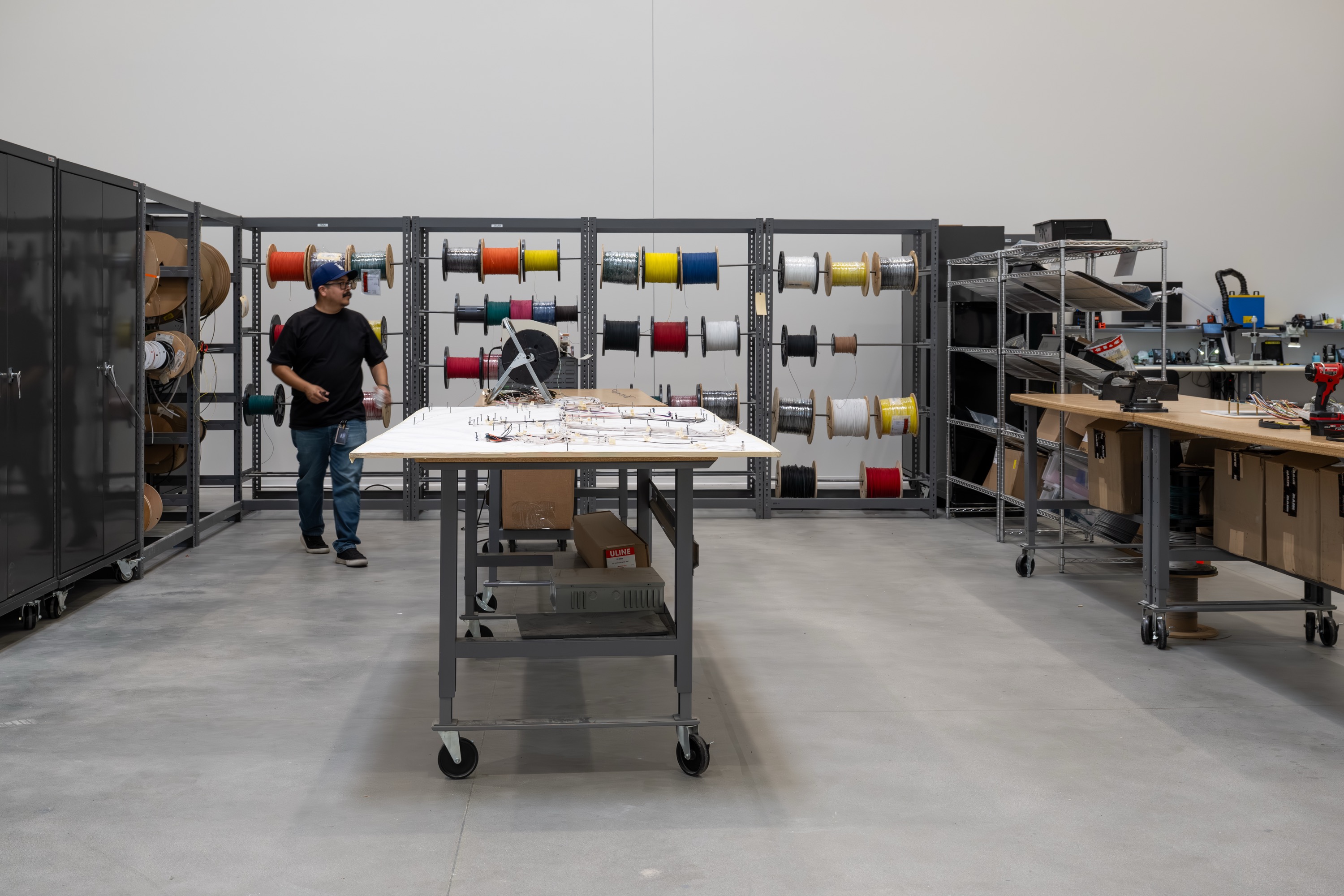
Other methods to keep costs down include “zonal architecture,” which reduces the number of separate computers and control modules, thereby also reducing the wiring harness. That is further thinned down by using 48-volt architecture instead of 12-volt, allowing for thinner wires and less copper overall. EVDC engineers are most focused on increasing efficiency and reducing manufacturing costs.
Reducing the size and mass of a car’s wiring loom is a major focus of modern car design.
Ford
Reducing the size and mass of a car’s wiring loom is a major focus of modern car design. Ford
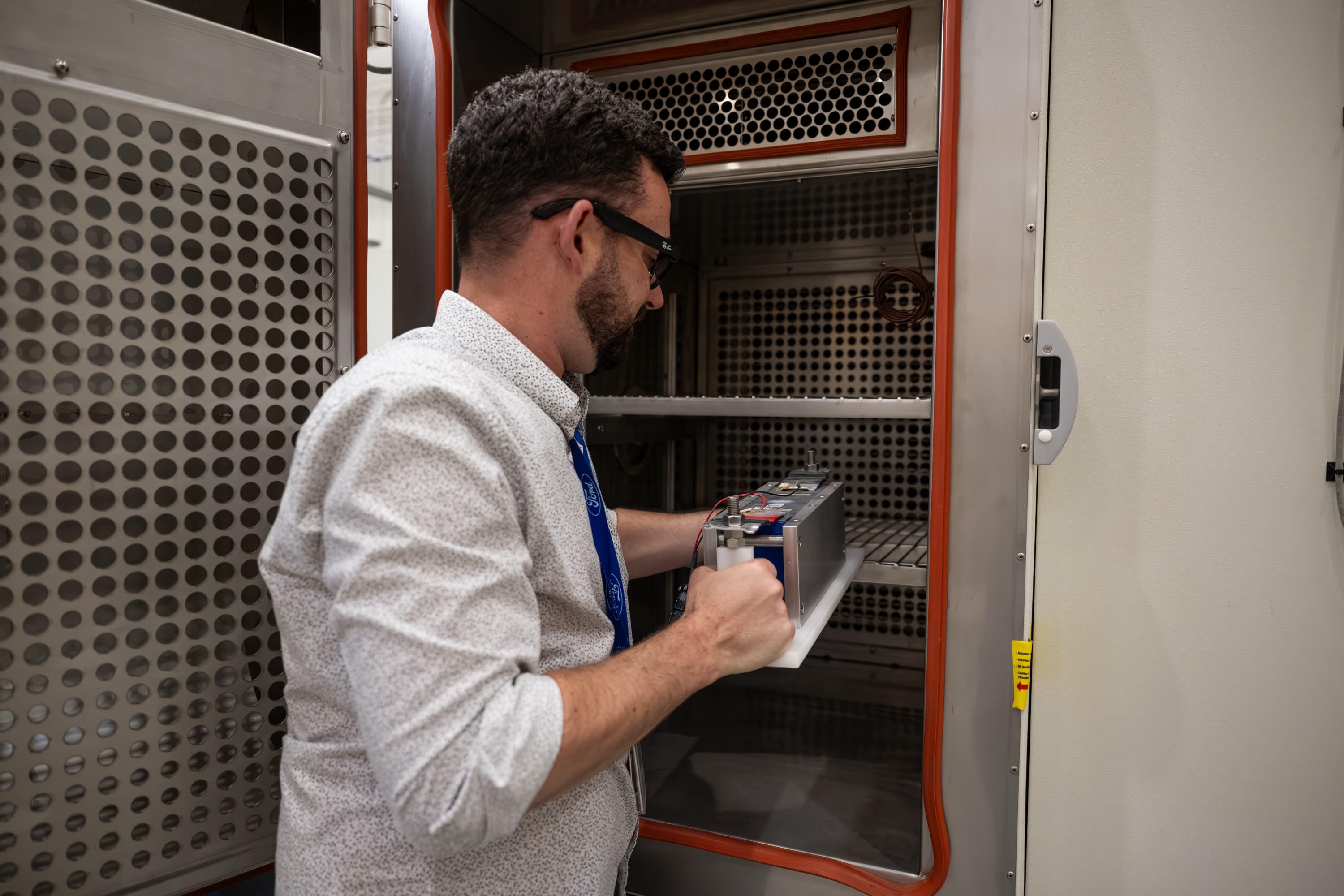
The battery lab puts cells through their paces.
Ford
The battery lab puts cells through their paces. Ford
Reducing the size and mass of a car’s wiring loom is a major focus of modern car design. Ford
The battery lab puts cells through their paces. Ford
Using lithium iron phosphate battery chemistry, despite its lower energy density when compared to lithium-ion cells, is also a calculated decision. Lithium iron phosphate, or LiFePO4, is much cheaper than lithium-ion because it doesn’t contain rare-earth minerals like cobalt. That also makes it more environmentally friendly.
Ford is hoping that making the UEV midsize truck as light and aerodynamic as possible will offset the lower energy density of LiFePO4 and still produce a vehicle with close to 300 miles (482 km) of range, seemingly the gold standard for convincing people to switch from internal combustion to electric power.
Sounds good—hope it pans out
All of this sounds encouraging, and I was impressed with the culture and facility that Ford has created in Long Beach. But if the recent lessons Honda taught us are anything to go by, the UEV’s future—and indeed that of the Electric Vehicle Development Center—are anything but certain.
Developing electric vehicles that push technology forward is expensive, and Ford is anything but a sentimental company. If the case for the UEV doesn’t make business sense—whether due to customer disinterest or the current administration and its attitudes toward environmentalism—it seems likely that CEO Jim Farley wouldn’t hesitate to cut it loose.
Chinese companies suing governments the world over
The Chinese-owned firm that operates the Port of Darwin isn’t happy about the federal government’s push to return it to an Australian owner. Now, the situation is escalating, with the stage set for an international legal showdown.
The Albanese government has been in talks with Landbridge Group, whose parent company is headquartered in Shandong province, China, to return the port to an Australian owner, following an election promise.
This case may take years to resolve. But it’s not the only example of a Chinese company taking on a national government, claiming to be unfairly excluded based on national security or other concerns.
Right now, many of these cases are still pending. But these rulings could have major financial implications if they provide a route for Chinese firms to demand compensation from governments for any losses caused by political decisions.
Back in 2015, Landbridge secured a 99-year lease to operate the port from the Northern Territory government, in a deal worth A$506 million (US$362.8 million).
The decision was not opposed at the time by the Turnbull federal government, although US President Barack Obama raised concerns, with US marines on rotation through the port.
Other groups also raised concerns about leasing the strategically important port to a Chinese firm. In the lead-up to the last federal election, both Labor and the Coalition committed to returning the port to an Australian owner if elected.
In a statement on the new proceedings, Landbridge said the move to return the port to an Australian owner was “discriminatory”. The company said it was “inconsistent with Australia’s obligations” under a major bilateral trade pact, the China-Australia Free Trade Agreement.
In a statement, the federal minister for transport and infrastructure, Catherine King, said the government was “disappointed” by the decision to lodge a case. King said the government has been in “good faith discussions” to reach a “mutually acceptable deal” with Landbridge, and intended to continue these discussions.
The International Centre for Settlement of Investment Disputes was established in 1966.
Headquartered in Washington, this body exists to settle disputes between international investors and nation-states under bilateral investment treaties. This includes the China-Australia Free Trade Agreement at the centre of this case.
The centre provides an independent arbitration panel for each dispute, not including the two countries involved.
The panel ultimately decides whether there has been unfair treatment. If so, it rules on whether a government’s proposed action should be halted or reversed, or if a company deserves compensation.
China’s pending cases
Since 2021, 11 cases have been brought by Chinese companies against different governments around the world. Eight of these are pending.
Many of these cases centre on purely economic claims of being treated unfairly. For example, in one case, a Chinese-owned lithium company is seeking compensation following the Mexican government’s decision to nationalise its lithium mining industry and expropriate the company’s planned mine in Mexico.
But others, like the Landbridge case, centre on claims a government has overreached by excluding a company based on national security concerns.
One of the most high-profile is a case launched by Huawei against the Swedish government in 2022. This came after Sweden banned Huawei and ZTE (another Chinese telecom company) from participating in the country’s 5G rollout, citing national security concerns.
Huawei is seeking compensation of US$569 million for the market losses it claims will result from this exclusion.
If the tribunal finds in favour of Huawei in this case, it could lead to further actions launched against countries (including Australia) where Huawei was banned. It could also impact other Chinese companies that have lost markets due to national security concerns.
In its statement on the new proceedings, Landbridge said it had won the lease through a “fair, open and competitive process.” It said the government’s own reviews did not find a national security risk.
Landbridge is likely to argue this means the government’s decision to exclude them is arbitrary. They are also likely to argue a forced sale would bring a lower price, and the government therefore owes the company compensation.
Compensation, if awarded, can include not just the current value of the port lease but also potential future earnings that have been forfeited due to a forced sale.
Rules-based order
The increase in Chinese companies using panels like the World Bank’s to resolve their disputes demonstrates their commitment to this international institution that was established with US and Australian support to enforce the rules-based international trading system.
These disputes may not prevent governments from making decisions based on national security. But they may cause them to think twice about the financial implications of those decisions.
DHS abuses 1930s customs law in attempt to get data on Canadian from Google
The Department of Homeland Security tried to obtain a Canadian man’s location information, activity logs, and other identifying information from Google after he criticized the Trump administration online following the killings of Renee Good and Alex Pretti by federal immigration agents in Minneapolis early this year.
Lawyers for the man, who has not been named, are alarmed in part because they say that the man has not entered the United States in more than a decade. “I don’t know what the government knows about our client’s residence, but it’s clear that the government isn’t stopping to find out,” says Michael Perloff, a senior staff attorney at the American Civil Liberties Union of the District of Columbia who is representing the man in a lawsuit against Markwayne Mullin, the secretary of DHS, over the summons. The lawsuit alleges that DHS violated the customs law that gives the agency the power to request records from businesses and other parties.
Perloff argues that the government is using the fact that big tech companies are based in the US to request information it would not otherwise be able to get. “It’s using that geographic fact to get information that otherwise would be totally outside of its jurisdiction,” he says. “I mean, we’re talking about the physical movements of a person who lives in Canada.”
DHS and Google did not immediately respond to a request for comment.
The demand for the man’s location data was included in a request DHS issued to Google called a customs summons, which is supposed to be used to investigate issues related to importing goods and collecting customs duties.
“It says right in the statute, it’s for records and testimony about the correctness of an entry, the liability of a person for duties, taxes, and fees, you know, compliance with basic customs laws,” says Chris Duncan, a former assistant chief counsel for US Customs and Border Protection who now works as a private-practice attorney representing importers and exporters. “And that’s all it was ever envisioned to be used for.”
A customs summons is a type of administrative subpoena and is not reviewed by a judge or grand jury before being sent out. According to the complaint, Google alerted the man about the request on February 9, despite an ask included in the summons “not to disclose the existence of this summons for an indefinite period of time.”
Through his attorneys, the man told WIRED he initially mistook the notification for a joke or scam before realizing it was real.
The summons, which is included in the complaint, does not give a specific reason for why the man was under investigation beyond citing the Tariff Act of 1930. The man’s lawyers contend that he did not export or import anything from the United States between September 1, 2025, to February 4, 2026, the time frame the government requested information about.
Instead, the man’s lawyers allege, the summons was filed in response to the man’s online activities, including posts that he made condemning immigration enforcement agents after the killings of Good and Pretti in January.
The man tells WIRED that watching members of the Trump administration “smear these two souls as terrorists was absolutely disgusting and enraging. People were being asked to disbelieve our own eyes so that the men responsible for killing two good Americans would go free.”
The man says of his online activity, “I felt I needed to do something that would stand out and be seen by despairing Americans to show them they had support and that they were not alone.”
The summons specifically asks for any records and other information related to “History of Account Suspensions or Violations of Terms due to Threatening or Harassing Language.” The complaint describes the man’s posts as “passionate and even sometimes off-color but never contain threats or incite violence.”
As the Trump administration’s immigration enforcement efforts have ramped up, DHS has used both customs summons and other types of administrative subpoenas to try to unmask users who are publicly critical of the agency or who attempt to track its agents’ activities. In March, after an anonymous Reddit user sued to stop DHS from obtaining their personal information through a customs summons, federal officials withdrew the administrative subpoena and issued a grand jury subpoena instead.
It’s unclear how many people have been targeted as part of these efforts. In February, The New York Times reported that Google, Reddit, Discord, and Meta had received hundreds of administrative subpoenas during the previous six months. In March, a group of US congressmembers asked tech leaders for data on how many requests their companies have received and how they’ve handled them, but it’s unclear whether they received a response. In April, the Electronic Frontier Foundation, a digital-rights nonprofit, sued DHS and Immigration and Customs Enforcement in an effort to obtain records about how many subpoenas the agencies have sent.
Both tech companies and civil liberties advocates have been concerned about DHS’s use of administrative subpoenas for years. WIRED previously found that agents issued customs summons, including ones for legitimate investigations into customs issues, more than 170,000 times between 2016 and mid-August 2022. The most common recipients of those requests included big tech firms and telecommunications companies.
In 2017, Twitter, which is now X, filed a lawsuit against DHS over what it alleged was an illegal customs summons that demanded information about who was behind an anonymous account that was critical of the first Trump administration’s immigration policies. DHS later withdrew its request, and the social media platform dropped its lawsuit in response, meaning a judge was never able to rule on whether the practice was actually illegal.
That incident triggered an investigation by the DHS Office of the Inspector General, which found that the group within DHS that had issued the request, the US Customs and Border Protection’s Office of Professional Responsibility, violated its own policies in about one out of every five summonses that the OIG reviewed.
“The saddest thing for me about all of this, as a career national security law enforcement attorney, is that if you abuse your authority like this, it undermines all the legitimate stuff you do,” says Duncan.
“There was a long time where the United States government advised other countries on how to protect people within their territory from foreign oppression,” Perloff says. “And it is appalling to realize that now other countries may have to do that about us.”
Where Iranians are going under fire – a real-time picture of displacement
Since US and Israeli strikes began on the last day of February, millions of Iranians have been living under attack, an internet blackout and tight restrictions on journalists and humanitarian agencies.
But many people are on the move, trying to get away from dangerous places or to be reunited with family at a time of conflict. In an information blackout, with internet access almost completely shut down across Iran, it’s hard to build a detailed picture of this population movement. But in the absence of conventional data on internal population displacement, we have been piecing together where people are moving by looking at faint but persistent signals of internet activity.
Our latest analysis and situation report covering the war since its outbreak, shows a clear geographic pattern and timeline of movement.
This is one of the first near real-time pictures of displacement within Iran. It complements cross-border figures from the UN’s International Organization for Migration, which recorded roughly 40,000 departures from Iran between March 3 and 10, mainly to Afghanistan, Pakistan, Turkey and Azerbaijan.
Our data offers a partial view of movement inside the country, where conventional methods of counting displaced people have largely broken down.
What the data show
In the first days of the war, our estimates indicate relative increases in population presence in provinces near the borders with Turkey, Armenia and Azerbaijan. As the conflict evolved, the pattern shifted eastward and towards the capital. By the third week, provinces bordering Afghanistan and Tehran showed the strongest signs of population concentration.
How Iran’s population has moved since the war began.Geographic Data Science Lab, University of Liverpool, Author provided (no reuse)
Tehran stands out. Despite being repeatedly struck by Israeli and US missiles, the Iranian capital shows what appears to be a modest rise in population compared with its pre-war baseline. That is consistent with research on other conflicts, where capital cities often absorb displaced people. This is because, even under bombardment, they usually offer better access to services and infrastructure.
Central and southwestern provinces, such as Qom, Isfahan, Fars and Zanjan/Qazvin – several of which host nuclear, military and defence production sites – show signs of sustained declines in estimated presence. These are also the areas with the highest concentration of recorded strikes on the Iran Strike Map, an open-source intelligence website which plots strikes on and by Iran in this conflict based on verified reports. The alignment between strikes and population declines is one of the strongest validation points in our analysis.
How we know
Weeks of active hostilities and Iran’s tight information controls have closed off most of the usual population statistics we might rely on to track population movements. Instead, we use what researchers call digital trace data – the everyday digital footprints people leave when they use connected devices.
GPS-based mobile data and Meta’s population maps have been useful in other crises, but for Iran, they are unavailable. So our main source is Cloudflare Radar, a US-based content delivery network which publishes aggregated, anonymised counts of encrypted web requests passing through its network, broken down by province.
Despite the widespread internet shutdowns, some weak internet signal remains and we were able use it, translate it to population numbers and compare these numbers with a baseline control set in December 2025 to assess increases and decreases in population. More requests than usual is a tentative signal that more people are present and online. Fewer requests may suggest fewer people or less activity.
We built a baseline model for December 2025 translating provincial internet traffic to population numbers, using WorldPop population estimates. We then applied that baseline to each day of the war, adjusting for network shocks and coverage, and cross-checked the patterns against Farsi Wikipedia pageviews for border regions and against recorded strike locations. Obviously at a time of internet restriction pageviews tend to be very few, so this information serves as validation only for our other evidence. A full account of the methods we used, with interactive maps, are on the project website.
Why it matters
The UN’s International Organization for Migration has already reported rapidly evolving displacement across more than 20 Iranian provinces. But with the internet cut, journalists barred and little official information available, even a rough picture of internal movement matters. Our findings point humanitarian agencies to three pressure points: the northwestern border corridor, the provinces adjoining Afghanistan and Tehran’s hinterland.
These patterns also matter politically. US and Israeli officials have framed the campaign as a targeted operation against Iran’s nuclear, missile and leadership infrastructure. Our data indicate whether strikes hit their intended targets. But they do show that the civilian response extends well beyond the struck sites. Estimated population is falling across several provinces and rising in others, including areas without major military infrastructure. However precise the targeting, the human footprint of this war is broad and spatially uneven.
What the data cannot show
These are proxy estimates, not head counts – they capture relative population change, not absolute numbers. There are three main caveats to consider.
First, Iran’s near-total internet blackout has kept national connectivity at 1–4% of normal levels for much of this period. A drop in requests from a province could reflect people leaving. It could also mean a cut cable or a shutdown order. We adjust for these effects, but uncertainty remains high.
Second, the data only capture people with internet-connected devices. Although we adjusted our estimates to mitigate biases, children, the elderly and poorer households may be underrepresented. Ethnic minorities who read primarily in Azerbaijani Turkish or Kurdish are less visible in our Farsi Wikipedia cross-check, which covers roughly half the population.
Third, we analyse movements that correlate with or follow attacks, not movements caused by them. People also flee ahead of strikes, return between them or move for reasons unrelated to the war. The alignment with strike data strengthens the case, but it does not prove it.
In past crises, from Ukraine to Sudan, researchers and humanitarian agencies have increasingly turned to digital trace data when the usual sources are unavailable. Iran is a hard case. Since the war began, the state has imposed a near-total internet blackout, keeping connectivity for officials and state media but cutting off most of the population, using control of the network as an instrument of wartime information control.
Even so, the digital traces still carry information about where life goes on, and where it has stopped. Used carefully – and with clear caveats – they can help the outside world maintain some visibility of a population that is otherwise hard to see.
Foreign aid’s hidden benefit: Recipients are more likely to pay the generosity forward
Foreign aid may not improve how recipients view donor countries – but it can set off a chain of goodwill that spreads far beyond the original act of giving.
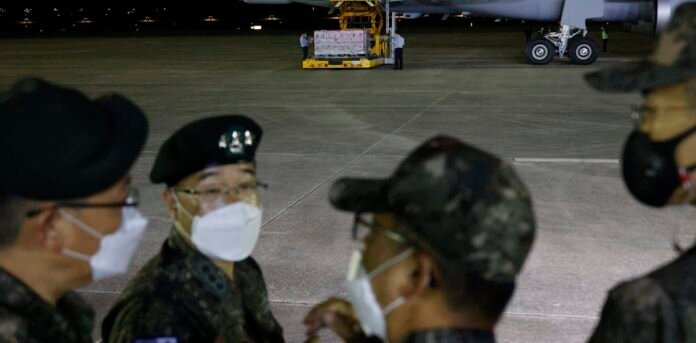
The South Korean government reserved donated Johnson & Johnson vaccines for military reservists and, for medical reasons, excluded anyone under 30. As a result, we could compare the views of South Koreans just above and below that threshold.
We found that the donated vaccines did not improve people’s views of the United States. South Koreans who received American vaccines reported similar views of the U.S. as those who had not been vaccinated.
Yet the results were striking in another way. Those who received donated American vaccines became more supportive of their own government sending aid abroad. Recipients shifted from neutrality on the matter to expressing moderate support for foreign aid, scoring about one point higher on a seven-point scale than those who didn’t make the eligibility cutoff.
There is also evidence that these effects extend beyond direct recipients. South Koreans who were simply told that the U.S. was providing vaccine aid to developing countries also became more supportive of their own government doing the same – though this effect was concentrated among political moderates.
Together, these patterns point to what social scientists call “generalized reciprocity” – the impulse not to repay kindness directly but to pass it on. In this way, one act of aid can prompt another, and spread across borders.
Why it matters
From Washington and London to Berlin and Tokyo, foreign aid budgets have been cut. In November 2020, former U.S. Agency for International Development Administrator Samantha Power invoked a common assumption when she argued that providing vaccines abroad would restore American leadership – that the value of aid lies in the goodwill it generates toward the donor.
Our findings suggest this is one way aid can matter, but not necessarily the most important.
Instead, aid may foster a form of international cooperation that does not depend on treaties or direct reciprocity between nations but emerges from ordinary people’s willingness to pass on goodwill.
If aid can trigger chains of giving across borders, then how we assess its value may need to change. Current frameworks tend to emphasize donor nations’ direct returns or strategic benefits, but the cooperative effects we identify are largely invisible to those metrics.
This suggests that current cuts may be shutting down effects that policymakers have not yet learned to measure – a form of international cooperation that, once set in motion, can generate cascading effects well beyond what any single donor nation could achieve alone.
What we don’t know
Important questions remain: Do similar patterns emerge with other forms of aid – such as disaster relief, food assistance or long-term development programs? And how long do these effects last?
There are also hints that the threshold for triggering this response may be lower than previously thought. The effect persisted even when using eligibility for donated vaccines, rather than actual receipt, as the measure – suggesting proximity to aid, not just receipt, may be enough to activate the impulse to give.
If evidence that past recipients of aid have themselves become donors strengthens public support for giving in donor countries, then aid may be more self-sustaining than critics assume – reinforced not just by its immediate effects, but by the example it sets.
The Research Brief is a short take on interesting academic work.