16 C
London
Tuesday, May 5, 2026
Home Blog

‘Wars Without Witnesses’: Press Freedom Groups Warn of Increasing Dangers to Reporters in Conflict Zones

0
‘wars-without-witnesses’:-press-freedom-groups-warn-of-increasing-dangers-to-reporters-in-conflict-zones
‘Wars Without Witnesses’: Press Freedom Groups Warn of Increasing Dangers to Reporters in Conflict Zones


Journalists covering Gaza, Lebanon, Sudan, Iran, and beyond face rising threats, restricted access, and growing uncertainty over whether press credentials still offer protection

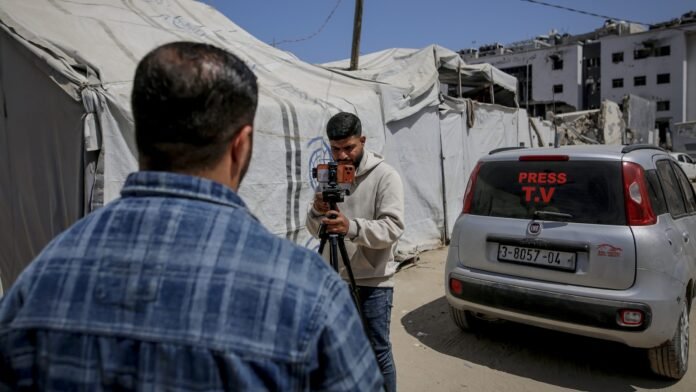
For Katrine Dige Houmøller, a Danish freelance journalist based in Lebanon, the crisis facing war reporters can be measured in one piece of equipment: the press vest.

I no longer necessarily feel protected by my press vest or the word ‘press’ painted across the roof of the car. If anything, I sometimes wonder whether it makes me easier to identify, and therefore a clearer target.

“I no longer necessarily feel protected by my press vest or the word ‘press’ painted across the roof of the car. If anything, I sometimes wonder whether it makes me easier to identify, and therefore a clearer target. That concern is grounded in a growing pattern, where more and more journalists have been directly targeted,” she told The Media Line.

Her account came as World Press Freedom Day, marked on May 3, cast renewed attention on the dangers facing journalists in conflict zones and on the shrinking space for independent reporting across the Middle East and beyond.

Houmøller’s experience in southern Lebanon illustrates how access to conflict zones is increasingly negotiated, uncertain, and never fully secure.

“We passed our details [to the Israel Defense Forces (IDF)] through UNIFIL, and the reply came back saying that ‘the IDF cannot deconflict this activity in light of the operational situation.’ The IDF simply could not guarantee our safety while we were working as journalists in the area,” she said.

“Moreover, access depends on coordination always—with the Lebanese army, General Security, Hezbollah, local authorities,” she added.

Receiving permission from the authorities does not necessarily translate into access, since the situation can change from one moment to the next.

The environment itself, she said, is defined by surveillance and unpredictability.

“In the village of Dibbine, an Israeli drone constantly hovered above us. It tracked our movements close enough that it felt almost within reach; it monitored every single step we took,” she said.

But Danny Seaman, a radio host, commentator, and former director of Israel’s Government Press Office, challenged the idea that Israeli restrictions on journalists in conflict zones such as southern Lebanon and Gaza should automatically be understood as attacks on media freedom. He framed them instead as security measures shaped by the conduct of armed groups.

“The problem is that they [journalists] are sometimes placed in those situations deliberately by terrorist organizations like Hezbollah and Hamas, to create further pressure on Israel. That is also why foreign journalists were not allowed into Gaza in the first place, because we knew they could be put in danger, since this has been a common pattern,” Seaman told The Media Line.

Houmøller said that in active conflict zones, journalism often becomes inseparable from risk assessment.

For example, while covering the war in and around the city of Nabatieh, in southern Lebanon, under heavy bombardment, “conversations among journalists shifted from reporting to exit strategies. Some suggested returning to Beirut, but the roads were considered too dangerous. It was a calculated risk—one of many that define the job,” she said.

“The work is not only about what you see, but what you hear, the direction of fighter jets, the distance of incoming strikes, whether explosions are moving closer or further away. Being a journalist inside a designated zone [an area under Israeli evacuation orders] offers no certainty. Your building can still be hit,” she added.

The conditions of freelance work add another layer of vulnerability, Houmøller said, as international outlets increasingly rely on journalists who carry the logistical, financial, and physical risks themselves.

“Working as a freelancer means carrying the entire process alone. Each step comes with a cost, and none of it is guaranteed to pay off. It is not unusual to invest in a driver and a fixer only to find that no outlet is willing to publish the story,” she said.

“Hiring a fixer in Lebanon typically costs between $200 and $350 per day. … In many cases, that is equal to, or more than, the fee paid by a media outlet,” she added.

For Martin Roux, who is in charge of the crisis desk at Reporters Without Borders (Reporters sans frontières or RSF), Houmøller’s experience reflects a broader pattern: Governments and armed actors are increasingly seeking to manage wars by limiting who can witness them.

“There is an attempt … from different parties in wars to prevent journalists from accessing the ground, from reporting in conflict areas. This is something that we saw orchestrated by the Israeli army in a very blatant way in the Gaza Strip, where the Palestinian journalists were targeted. And at the same time, the foreign press was prevented from reporting independently,” Roux told The Media Line.

Seaman disputed the allegation that journalists are being deliberately targeted by Israel, arguing that the danger comes when armed groups exploit journalistic cover.

Journalists are not a target. But when people use journalism as cover, when terrorist groups take advantage of that, and when you start seeing a pattern of individuals who are not upholding professional standards but are using the title of press as protection, then it becomes a different issue.

“Journalists are not a target. But when people use journalism as cover, when terrorist groups take advantage of that, and when you start seeing a pattern of individuals who are not upholding professional standards but are using the title of press as protection, then it becomes a different issue. I am referring to members of Hamas,” he said.

Roux said the trend extends beyond Gaza and has become a defining feature of modern war coverage.

We saw this general trend of trying to organize wars without witnesses, without professional witnesses

“We saw this general trend of trying to organize wars without witnesses, without professional witnesses. … We noticed in the war [between] Iran on one side and Israel and the US on the other, that all the parties in this war were using [the excuse of] national security to prevent reporters from doing their job,” he said.

He pointed to Sudan as another example of access collapsing under the pressure of war.

“What we saw is almost an information blackout in certain areas. For instance, if we take the siege of al-Fasher in north Darfur, very, very few reporters were still reporting from inside the siege. … One of them … was later on arrested. … The targeting of reporters has really increased this trend of information blackout in conflict areas,” Roux said.

Foreign journalists have largely been unable to independently access Gaza since the start of the war, leaving coverage dependent on Palestinian journalists inside the Strip and on secondary verification from outside. For media watchdogs, this has created a sharp imbalance: local journalists face the highest risk, while outside reporters are prevented from witnessing the war directly.

Seaman argued that the reliance on local access networks in Gaza and Lebanon creates its own journalistic problem.

“I do not have much respect for the foreign press, because they are more politically motivated than focused on doing their job. I saw how they collaborate, both politically and physically, with actors on the ground because they cannot work otherwise. They know they are not free in places like Gaza or Lebanon, and they have to work with people connected to those in control, but they do not tell their audiences this, because they would lose access,” he said.

The debate over Israel, Gaza, and Lebanon is part of a larger global deterioration documented by press freedom organizations. The latest findings from RSF place media freedom at its lowest point in 25 years. According to the 2026 World Press Freedom Index, more than half of the 180 countries assessed now fall into the categories of “difficult” or “very serious” for press freedom, while less than 1% of the global population lives in a country considered to have a “good” media environment.

RSF reported that press freedom declined in roughly 100 countries over the past year, reflecting what it described as a systemic global downturn driven by legal pressure, political hostility, and the economic fragility of media systems. The decline is not limited to authoritarian states or war zones. It is also visible in democratic systems, where political polarization, attacks on media credibility, and economic pressure on newsrooms have weakened the conditions needed for independent reporting.

The regional picture is especially severe. The Middle East and North Africa remain the most dangerous region in the world for journalists. In the 2026 index, Qatar is the highest-ranked country in the region, at 75 out of 180 countries worldwide. Still, press freedom is categorized as “problematic” there. Lebanon ranks 115, Israel 116, Syria 141, the Palestinian territories 156, and Sudan 161. Iran is the region’s lowest-ranked country, at 177.

The Committee to Protect Journalists reported that Israel was responsible for the highest number of journalist deaths globally over the past year, marking one of the deadliest periods for media workers in a single country in recent history. The figures reflect the scale and intensity of the war in Gaza, where most of those killed were Palestinian journalists operating inside the Strip, often without the possibility of evacuation or external protection.

The International Federation of Journalists also described the toll as severe.

“The IFJ recorded 128 journalists killed in the line of duty in 2025, and nine have already lost their lives this year—a number of them in war zones,” the organization told The Media Line.

“We are greatly concerned about armed conflicts in which being identified as ‘press’ has become a reason to be targeted, rather than protected. … In Ukraine, Palestine, Lebanon, and Sudan, for example, reporters are being arrested, killed, and sometimes forced into exile because of their work,” it added.

Beyond the battlefield, Anat Saragusti, who is in charge of press freedom at the Union of Journalists in Israel, said pressure on independent journalism inside Israel has taken a more political and institutional form.

“Since this government took office in late 2022, it drafted a master plan to weaken the free press in the country. It’s like a playbook of populist governments in different countries … and it plays out in different dimensions,” she told The Media Line.

“There is a very intensive legislation process targeting the public broadcaster, the commercial television … and giving benefits to the only media channel that completely aligns with the government. … There is also an attempt to create a political takeover and take control of regulatory bodies,” she added.

Seaman rejected the argument that Israeli journalists are meaningfully restricted, saying that criticism of the government remains widespread and that disputes over state funding or regulation should not be conflated with censorship.

“[Reporters] roam around freely and do whatever they want. The fact that the Israeli government does not want to fund certain outlets does not limit press freedom. Nobody is stopping them from working. They can be as critical as they want,” he said.

Saragusti linked the institutional pressure to a broader climate of public delegitimization.

“The prime minister is doing everything he can to break the trust in the media. … He called the TV channels ‘poisoning channels,’ ‘panicking channels,’ and ‘Al Jazeera channels’ to indicate that they are engaged in treason. There is an intensive smear campaign on social media against journalists. … They are threatened, cursed, intimidated … especially those who cover his trial,” she said.

She said the result is not only formal pressure but also self-censorship inside newsrooms.

“The whole package is targeting the mainstream media … and it creates an atmosphere and climate of intimidation and terror. So I guess that the journalists are adopting a mechanism of self-censorship. … The fact that the Israeli media in Hebrew hardly covered the humanitarian crisis in Gaza is because they were intimidated and they didn’t want to be framed as … Hamas supporters,” she said.

Her concerns extended to foreign journalists working in Israel.

“Foreign journalists find it very difficult to work in the country because the officials are really hostile toward them. … They are dependent on them to get accreditation. … It’s intimidating, and it’s a deterrence against international press,” she said.

Seaman said that limitations on sensitive information in a security environment should be understood as operational safeguards, not restrictions on journalism. He also argued that journalists today have more room to operate than they did in the past, even when they face constraints in active war zones.

The debate reflects two sharply different interpretations of the same environment. For press freedom advocates, access restrictions, political hostility, and journalist deaths point to a worsening crisis. For Seaman, many of those claims ignore the ways armed groups exploit media infrastructure, press credentials, and foreign journalists’ dependence on local power brokers.

For RSF, however, the broader conclusion is systemic.

“The situation hasn’t been as difficult as it was for the past 25 years … but because of these challenges, it shows that the work of journalists is needed more than ever … even in a context that has been changing dramatically year after year,” Roux said.

World Press Freedom Day in 2026, therefore, arrived less as a celebration than as a warning: In too many war zones, the word “press” no longer guarantees access, safety, or even recognition as a civilian shield. Across Gaza, Lebanon, Sudan, Ukraine, Israel, and beyond, journalism is increasingly defined by the struggle to report from places where powerful actors would often prefer no witnesses at all.
Prosecutors Had a Drugs-for-Votes Scheme “Locked Up.” Under Trump, They Were Told Not to Pursue Charges.

0
prosecutors-had-a-drugs-for-votes-scheme-“locked-up”-under-trump,-they-were-told-not-to-pursue-charges.
Prosecutors Had a Drugs-for-Votes Scheme “Locked Up.” Under Trump, They Were Told Not to Pursue Charges.

Reporting Highlights

  • Not a Typical Drug Scheme: Prosecutors in Puerto Rico found that a prison gang was giving inmates drugs in exchange for their votes for a gubernatorial candidate, Jenniffer González-Colón. 
  • Gathering Evidence: Investigators said they had a case against inmates and prison staff, and were working to determine whether González-Colón or her campaign were involved.
  • A Stalled Investigation: In early 2025, the lead prosecutor was told not to look any further into the matter. “We’re frustrated, but there’s nothing we can do,” said one source.

These highlights were written by the reporters and editors who worked on this story.

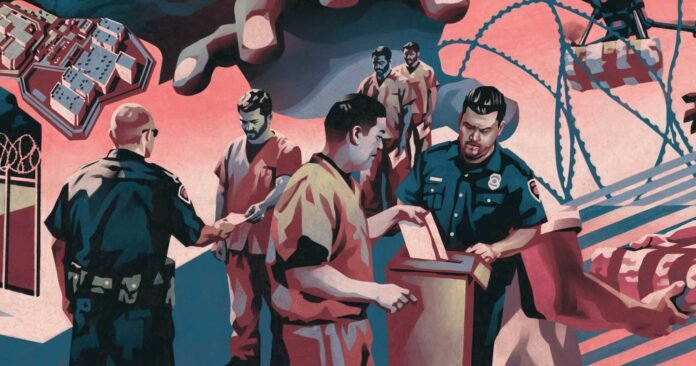
To the narcotics agents investigating drug smuggling in Puerto Rico prisons, it seemed at first like a typical scheme: associates of an inmate gang sneaking drugs into the prison, gang members distributing them inside and bank records showing the money flowing.

Then the agents discovered something unusual.

Leaders of the prison gang known as Los Tiburones, or the Sharks, were selling drugs to inmates not only for money, but for their votes. Specifically, votes for now-Gov. Jenniffer González-Colón, a longtime Republican and supporter of President Donald Trump, investigators found.

To make sure the inmates — many of whom were addicted — complied, the gang’s leaders threatened violence and to withhold drugs, the investigators learned. Corrections employees in on the plan looked the other way as the gang, formally known as Group 31, ran the enterprise.

What at first seemed like a routine drug case had turned into something bigger. Puerto Rico, along with just a couple of U.S. states, allows inmates to vote. Puerto Ricans living in the territory can vote in all contests except federal general elections. It is a felony to willfully offer money or gifts in exchange for support at the polls. A conviction carries fines of as much as $250,000 and imprisonment of up to two years.

Investigators had gathered solid evidence of election fraud implicating both inmates and staff, and they were working toward determining whether González-Colón or her campaign was involved, four people with knowledge of the case told ProPublica. They requested anonymity because they are not authorized to speak publicly about the case.

But as federal prosecutors prepared an indictment against the inmates and staff in November 2024 — just days after Trump won the election and González-Colón clinched the governorship — they received a surprising directive. Their bosses in the U.S. Attorney’s Office for the District of Puerto Rico instructed them to exclude the voting-related counts against the inmates and all charges against the prison staff, an investigation by ProPublica found.

In December, they filed an indictment charging 34 inmates and associates with crimes including drug distribution resulting in at least four overdose deaths, money laundering and possessing a firearm. And while prosecutors described the drugs-for-votes scheme in the court filing, they did not include a single charge related to it.

Soon after Trump took office, the lead prosecutor, Jorge Matos, was told by a supervisor to take the investigation no further, according to four people familiar with the case.

“Before the election, it was definitely full steam ahead,” said one person familiar with the case. “After the election, that all changed.”

Matos, who left the Justice Department in June 2025, did not respond to phone calls or texts from ProPublica or attempts to reach him on social media.

For those working on the case, the decision to scrap the investigation was especially puzzling given the new president’s agenda; Trump issued executive orders in early 2025 aimed at eradicating drug traffickers and declaring election integrity “fundamental” to maintaining American democracy.

“We invested so much effort to make a difference,” said another person. “We’re frustrated, but there’s nothing we can do.”

People close to the case wondered if politics had played a bigger role than law and order. Trump congratulated González-Colón in a letter shared at her January 2025 inauguration saying, “I am so proud of your resounding victory.” That same month, she pushed to erect a statue of him at the Capitol building in San Juan alongside other presidents who’ve visited the island. “He deserves that,” she said, according to an official post from the Federal Affairs Administration of Puerto Rico on X.

W. Stephen Muldrow, the U.S. attorney for the District of Puerto Rico, was appointed by Trump in 2019 and has served continuously since then. His name appears on the indictment along with those of three assistant U.S. attorneys. Muldrow told ProPublica his office does not comment on open investigations other than in press releases or press conferences. While a couple of the inmates have accepted plea deals, most of the drug and money-laundering cases against the inmates and associates are still making their way through the court system.

In a follow-up email, a spokesperson for the office noted the indictment was filed during the Biden administration and under the previous governor of Puerto Rico.

Charging corrupt public officials “has always been and remains a top priority” of the office, wrote spokesperson Lymarie Llovet-Ayala.

“When sufficient admissible evidence exists to charge persons involved in public corruption, as required by the Justice Manual, the Puerto Rico U.S. Attorney’s Office will aggressively pursue such charges,” she wrote.

In court documents tied to a different case, in October 2025, a magistrate judge mentioned “an unrelated white-collar investigation involving the Governor of Puerto Rico.” Muldrow’s office responded in a filing, stating, “There is no white-collar investigation (or any other investigation) of Puerto Rico Governor Jenniffer González-Colón.”

González-Colón has not been charged with a crime. The governor declined ProPublica’s repeated requests for an interview and did not respond to written questions sent to her communications team.

Muldrow had a friendly working relationship with former Attorney General Pam Bondi when she was the state attorney general in Florida and he was an assistant U.S. attorney in the middle district of that state, according to people who know him.

A Department of Justice spokesperson said in an email, “Neither Attorney General Bondi nor Acting Attorney General Blanche was involved in any charging or investigative decision in this Biden administration prosecution.”

The attorney general’s office noted in a statement that the indictment mentioned allegations of voting coercion, and said: “This office did not limit the underlying investigation in any way.”

In May 2025, in a move that federal prosecutors and political observers alike said was highly unusual, the Office of the Director of National Intelligence seized the voting machines from Puerto Rico over concerns about “vulnerabilities,” according to testimony in March by Director Tulsi Gabbard to Congress.

A spokesperson from the office told ProPublica the seizure was at the request of the U.S. attorney’s office in Puerto Rico and was “not about any election in particular.” The goal was to “assess risk to this critical infrastructure, given similar infrastructure is used throughout the United States,” the spokesperson said in an email.

Muldrow didn’t answer questions from ProPublica about the matter.

Lydia Lizarribar, an attorney for Juan Carlos Ortiz-Vazquez, a Group 31 member who prosecutors named as one of the leaders of the drug operation, declined to comment on the case.

A Party “Stronghold”

The Puerto Rican prison system has a long and well-documented history of overcrowding, inadequate medical care and other human rights violations so egregious that in the late 1970s they prompted federal oversight that continued for decades.

The grim conditions spurred inmates to form advocacy groups like Group 31, which was officially created as a nonprofit to lobby corrections officials and lawmakers to improve inmates’ quality of life. Over time, federal prosecutors say, several of these groups operating in the prisons evolved into violent criminal organizations such as Los Tiburones and Ñetas, with memberships in the thousands.

The poor conditions were also the backdrop for a push in 1980 by the New Progressive Party governor at the time, Carlos Romero Barceló, to codify voting rights for prisoners.

Inmates have been aligned with the party ever since, political analysts said. Political parties in Puerto Rico differ dramatically from those on the mainland. They don’t adhere to a straight divide among Democrats and Republicans. Instead, the two main parties center much of their focus on whether Puerto Rico should become a state and so have Republicans and Democrats within each.

It’s not unheard of for politicians of all parties to court the inmate vote, but the New Progressive Party has made it a “stronghold,” said Fernando Tormos-Aponte, a political scientist with expertise on Puerto Rico and an assistant professor of sociology at the University of Pittsburgh.

“It’s been a huge advantage for them particularly as elections in Puerto Rico have been decided by small margins,” Tormos-Aponte said of the New Progressive Party. In the 2024 general election for governor, the party won 83% of the inmate vote, according to a ProPublica tally of voter returns on the State Elections Commission’s website.

Inmate votes were especially key in the 2024 gubernatorial primary as González-Colón, a longtime New Progressive Party member, was challenging the incumbent governor of the same party.

She won the primary by fewer than 30,000 votes, according to the State Elections Commission. Local news reports said that an estimated 5,000 prisoners voted territorywide.

In her first months in office, González-Colón signed a law allowing people with criminal records to obtain professional licenses in Puerto Rico.

In July, she signed off on a law expanding inmates’ ability to hold jobs in the private sector, calling it “part of a vision of social justice,” adding “we believe in the second chance, in the value of work and in the capacity for transformation of the human being.”

In March, González-Colón signed a law requiring the parole review board increase the pace at which parole denials are reconsidered. She said in a press release the law is aimed at a “fairer, more transparent system focused on rehabilitation.”

Political analysts said rumors have swirled over the decades about coercive tactics being used to mobilize the prison vote, raising significant questions about the extent to which that support comes in exchange for favors from the ruling party.

This time was different, sources said. They had evidence. Prosecutors had “locked up” the voting-for-drugs scheme among the gang, inmates and staff, and were deep into investigating a potential political connection when Muldrow’s office pulled the plug.

“These are the type of questions you would think an administration that has publicly declared this war on drug trafficking would investigate further,” Tormos-Aponte said of the Trump administration. “You would think it would be a priority.”

For the people familiar with the prison election fraud investigation, it was clear politics were at play in the decision to abandon charges prosecutors were confident they could win. What wasn’t clear, they said, was who was pulling the strings and how. It was “like you’re watching a puppet show but you can’t see the strings,” one person said.

“You know what you’re seeing isn’t telling the whole story,” the person said. “There was some kind of invisible hand.”

Drugs for Votes

Although they excluded drugs-for-votes charges, prosecutors didn’t scrub the Dec. 12, 2024, indictment of how they believed the operation worked.

Outside associates of Los Tiburones, the indictment alleged, primarily used drones to drop drugs on prison grounds. Then staff participating in the scheme helped in the “introduction and distribution” of the drugs inside the prison or acted as lookouts. The employees also allowed the gang members to enforce their own discipline system against those who didn’t do as they asked, including when voting. Punishments included withholding food from inmates or forcing them to sit with their arms folded while they were beaten and kicked. In four cases, the drugs led to overdose deaths, the indictment says.

The indictment also alleged that Los Tiburones made connections with government officials “for the purpose of reducing prison sentences,” and the gang mandated both the prisoners’ political affiliations and “who to vote for in primary and general elections.”

A relative of one of the prisoners told ProPublica that inmates had to show their ballots to gang leaders when they voted to avoid punishment.

Puerto Rico’s Civil Rights Commission, which for decades has sent observers to polls across the territory, reported “serious difficulties” in gaining access to several prisons during the 2024 general election. After being denied entry at multiple locations, the commission successfully sought a court order, but much of the day had already passed by the time the observers were allowed in.

“We strongly condemn the lack of diligence and indifference shown by the Department of Corrections and Rehabilitation in hindering the functions of this Commission on the day of early voting in correctional institutions,” the agency later wrote in a special report on the 2024 elections.

The report said observers witnessed prisoners voting in cramped quarters that didn’t allow for privacy and having to hand their ballots to others to put in the box.

Ever Padilla-Ruiz, the commission’s executive director, told ProPublica that inmates sent written complaints to the office detailing their experiences of being pressured to vote in the primary — some for González-Colón and others for her opponent, Pedro Pierluisi. They did not mention any gangs by name, Padilla-Ruiz said.

He said inmates reported that inmate group leaders were “always sending messages” up until election day, adding that they were too afraid to say much more.

Several people familiar with the case said investigators had evidence that González-Colón had spoken to a Group 31 member, but they had not determined whether she was involved in vote buying.

One of the imprisoned gang leaders had bragged on Facebook about his connection to González-Colón, posting a picture of him talking with her on WhatsApp while the primary campaign for governor was underway, two sources said.

She clearly benefited from the scheme, they said. “There was no doubt about that,” one said, noting that thousands of votes were likely at stake.

The indictment notes that gang members were provided preferential treatment such as relaxed visitation policies and the use of Sony PlayStations, big screen TVs and cellphones, but investigators had not connected the privileges to González-Colón or her campaign.

“Latinos Are Winning”

González-Colón has been a longtime advocate for Puerto Rico statehood and has been engaged in Republican politics for more than 20 years. She was elected chair of the Republican Party of Puerto Rico in 2015 and two years later became resident commissioner, a role similar to a U.S. representative but with limited voting power in Congress.

She’s been an active participant in Latinos for Trump, praising the president over the years as “wise” and in 2019 saying on social media, “Latinos are winning under his leadership.”

As she continues to lobby for Puerto Rico to become the 51st state, González-Colón has also leaned in to her relationships with other members of Trump’s Cabinet, posting well wishes on social media to Susie Wiles, Trump’s chief of staff, and congratulating Markwayne Mullin, the Homeland Security director Trump picked to replace Kristi Noem, calling him “my good friend.”

“I know he will provide strong leadership as he works with President Donald J. Trump to strengthen our nation’s security,” she wrote in a March Facebook post.

Experts on Puerto Rican finance and politics say the relationship between González-Colón and the Trump administration is symbiotic though lopsided.

“I see it more as a situation of unrequited love,” said Alvin Velazquez, an associate law professor at Indiana University’s Maurer School of Law and an expert on Puerto Rico’s bankruptcy in 2017.

The territorial island, whose residents were granted U.S. citizenship in 1917, receives less federal funding than most states. Political leaders in Puerto Rico, González-Colón included, have perpetually lobbied for more support.

Republicans in turn have capitalized on González-Colón’s rise as she helped bolster GOP support among the Puerto Rican diaspora and other Latino voters on the mainland. Now-Secretary of State Marco Rubio endorsed González-Colón in her 2024 gubernatorial election.

Polls specifically isolating Puerto Rican voters show that Trump saw at least a 4 percentage point uptick in votes from Puerto Ricans living in states compared to the 2020 election, garnering 45% of the group’s vote in the 2024 election, according to the nonprofit research center Instituto Cervantes at Harvard University.

And perhaps most importantly, experts say, Trump has counted on González-Colón to support his strategic geopolitical initiatives in the region, including the controversial reopening of long-abandoned naval bases in Puerto Rico. González-Colón welcomed Defense Secretary Pete Hegseth to the island in September and thanked Trump on X for “recognizing the strategic value Puerto Rico has to the national security of the United States and the fight against drug cartels in our hemisphere.”

That’s despite the sentiment among many Puerto Ricans who were angered by Trump’s response to Hurricane Maria in 2017 and a comedian at one of Trump’s 2024 campaign rallies who called Puerto Rico a “floating island of garbage.” And while Trump has said that González-Colón was “wonderful to deal with and a great representative of the people,” he later called Puerto Rico “one of the most corrupt places on earth.”

India-Bangladesh weigh political fix for diplomatic rift

0
india-bangladesh-weigh-political-fix-for-diplomatic-rift
India-Bangladesh weigh political fix for diplomatic rift

Diplomacy, like commerce, runs on signals. When relations sour, the choreography of repair matters almost as much as the substance. In South Asia’s second most delicate bilateral equation, between India and Bangladesh, the recent shift in tone from New Delhi suggests a recognition that technocratic engagement alone cannot mend a political rupture.

After a period of visible strain during the tenure of the interim administration led by Muhammad Yunus, India appears to be recalibrating its approach that include multiple statements of goodwill, as well as the more telling act of dispatching a political heavyweight like Dinesh Trivedi as the next envoy.

The appointment of Dinesh Trivedi as high commissioner-designate makes the intent unmistakable. He is no retired bureaucrat assigned a largely ceremonial posting, but a seasoned politician with cabinet-level experience, deep parliamentary connections and an instinct for strategic signaling.

Having served as railway minister and remained a fixture in national politics, he offers something a conventional diplomat often cannot: direct political access, finely tuned party instincts and a sensitivity to cues that seldom surface in official dispatches.

The logic of appointing him is not obscure. Career diplomats excel at continuity and incremental progress. But when ties fray for political reasons—misread intentions, perceived slights, or asymmetries of respect—it is often a political figure who carries the requisite heft to reset the relationship.

Such envoys bring authority, signaling that the sending government is willing to invest political capital in reconciliation. Considering figures such as Dinesh Trivedi for a prominent role in Dhaka are thus part of a series of strategic gestures. They imply that India recognizes the limits of its earlier posture and seeks to engage Bangladesh on a more explicitly political plane.

This marks a tacit admission that the previous phase of engagement fell short. During the Yunus-led interim government, Delhi’s reading of Dhaka was, at best, cautious and, at worst, misconceived. Concerns about political stability and continuity of policy appear to have led India to adopt a guarded, somewhat aloof stance.

In doing so, it underestimated both the domestic legitimacy of the interim arrangement and the sensitivity of Bangladesh to perceived condescension from its larger neighbor. Diplomacy is as much about optics as outcomes; by appearing hesitant or overly calculating, India risked eroding the trust it had painstakingly built over the past decade.

The consequence was a cooling of ties at a moment when both countries had much to gain from cooperation. Trade, connectivity, and regional security initiatives all require a baseline of political comfort. Without it, even the most technically sound agreements struggle to gain traction.

New Delhi’s current pivot — emphasizing a “neighborhood-first” approach and signaling renewed engagement — suggests a recognition that the relationship cannot be managed on autopilot. It needs active tending, and that requires political attention.

The question, then, is how Dhaka should respond. One option is symmetry. If India sends a political envoy, Bangladesh could reciprocate by upgrading its own representation in Delhi, replacing the seasoned diplomat M Riaz Hamidullah with a figure of equivalent political standing, perhaps at the rank of state minister.

Such a move would align with the logic that political problems demand political interlocutors. It would also ensure that Bangladesh’s voice in Delhi carries not just diplomatic nuance but direct access to the country’s political leadership, enhancing its ability to negotiate on equal terms.

Yet reciprocity need not be automatic. There is an argument—subtle but not trivial—that Dhaka might instead choose to retain a career diplomat, thereby signaling, without overt confrontation, that it was India that misjudged the situation during the interim period.

In this reading, Bangladesh would be acknowledging India’s effort to reset ties while quietly reminding it that the burden of correction lies primarily with New Delhi. Diplomacy often operates through such calibrated asymmetries, where what is not done speaks as loudly as what is.

Still, restraint has its limits. Bangladesh’s interests are best served by maximizing strategic gain rather than scoring symbolic points. If India is willing to elevate the relationship by investing political capital, Dhaka risks underplaying its hand by responding with bureaucratic continuity alone.

A political envoy in Delhi could do more than mirror India’s move; it could actively shape the next phase of the relationship. Such a figure would be better positioned to navigate the complex intersections of domestic politics and bilateral issues, from trade imbalances to water sharing and regional connectivity.

Moreover, the regional context favors proactive engagement. South Asia remains one of the least integrated regions in the world, despite obvious complementarities. Bangladesh’s economic rise, coupled with India’s strategic ambitions, creates a window of opportunity for deeper cooperation.

But this will not materialize through inertia. It requires deliberate, high-level engagement that can cut through bureaucratic inertia and political mistrust. Political envoys, by virtue of their stature, are often better equipped to perform this role.

None of this absolves India of its earlier missteps. The present recalibration is, in effect, an attempt to amend a relationship that was allowed to drift. But diplomacy is not a courtroom; it is a marketplace of interests. The relevant question for Dhaka is not who erred, but how best to leverage the current moment.

Matching India’s initiative with a political envoy of its own would send a clear message that Bangladesh is ready not just to repair ties, but to elevate them.

In the end, the choice is between signaling and substance. Retaining a career diplomat may offer a quiet satisfaction, a reminder that Bangladesh has not forgotten India’s attitude during its interim period.

However, appointing a political envoy would offer something more valuable. A chance to reshape the future of one of South Asia’s most consequential bilateral relationships. For two neighbors bound by geography, history and economics, that is an opportunity worth seizing.

Faisal Mahmud is a Dhaka-based journalist. He was the former Minister (Press) of Bangladesh High Commission in New Delhi.

Italy opens probe into activists’ detention after Gaza aid flotilla interception

0
italy-opens-probe-into-activists’-detention-after-gaza-aid-flotilla-interception
Italy opens probe into activists’ detention after Gaza aid flotilla interception

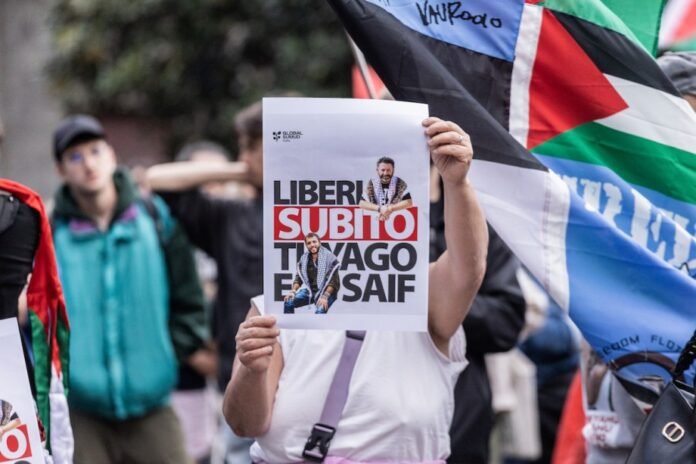
People carrying Palestinian flags and banners, gather to protest the detention of Global Sumud Flotilla activists Thiago de Avila and Saif Abu Keshek, who were seized in international waters on the night of April 29-30 by the Israeli Navy and are currently being held in Israel, on May 4, 2026 in Milan, Italy. [Andrea Carrubba - Anadolu Agency]

People carrying Palestinian flags and banners, gather to protest the detention of Global Sumud Flotilla activists Thiago de Avila and Saif Abu Keshek, who were seized in international waters on the night of April 29-30 by the Israeli Navy and are currently being held in Israel, on May 4, 2026 in Milan, Italy. [Andrea Carrubba – Anadolu Agency]

The public prosecutor’s office in Rome has opened an investigation into the alleged abduction of individuals by Israeli forces after they intercepted the Global Sumud Flotilla, a Gaza-bound aid convoy, in international waters on Thursday, Italian media reports.

According to the reports, three legal complaints have been filed against Israeli forces over the alleged abduction of two activists — Spanish national Saif Abu Keshek and Brazilian national Thiago Avila — who are currently being held in Israel. Both were on board a vessel flying the Italian flag at the time of their detention in international waters.

An Israeli court has ordered that the activists’ detention be extended for an additional two days.

The Rome prosecutor’s office had previously opened a similar investigation in October following an earlier attempt by a humanitarian flotilla to reach Gaza.

On Thursday, around 175 activists of various nationalities were detained while on board nearly 20 vessels in the flotilla, which organisers say aimed to break the Israeli blockade on the Gaza Strip, where the entry of humanitarian aid remains severely restricted.

MIT’s virtual violin offers luthiers a new design tool

0
mit’s-virtual-violin-offers-luthiers-a-new-design-tool
MIT’s virtual violin offers luthiers a new design tool

Violin makers, aka luthiers, traditionally learn from hands-on experience how to craft parts and select materials to shape an instrument’s final sound. MIT engineers hope to streamline that painstaking process with their new virtual violin. It’s a computer simulation tool that can capture the precise physics of the instrument and even reproduce a realistic sound of a plucked string, according to a paper published in the journal npj Acoustics.

Unlike more common software programs and plugins that simulate violin sounds via sampling, averaging the final sound from thousands of notes, the MIT model is based on the fundamental physics of the instrument. “We’re not saying that we can reproduce the artisan’s magic,” said co-author Nicholas Makris. “We’re just trying to understand the physics of violin sound, and perhaps help luthiers in the design process.”

Violin acoustics has long been a hot topic of research among acousticians, particularly when it comes to unlocking the secret to the superior sounds of violins crafted during the so-called “Golden Age”—notably the instruments of famed Cremona luthier Antonio Stradivari, as well as those of the Amati family and Giuseppe Guarneri. There are plenty of variables to consider, given a violin’s acoustic complexity.

Per my 2021 article, the (perceived) unique sound can’t just be due to the instrument’s geometry, although Stradivari’s geometrical approach gave us the violin’s signature shape. It might be due to the wood; some researchers have hypothesized that Stradivari used Alpine spruce grown during a period of uncommonly cold weather for the region. The annual growth rings were closer together, making the wood unusually dense. Differences in wood density, they argue, would have an impact on the instrument’s vibrational efficiency and hence its sound.

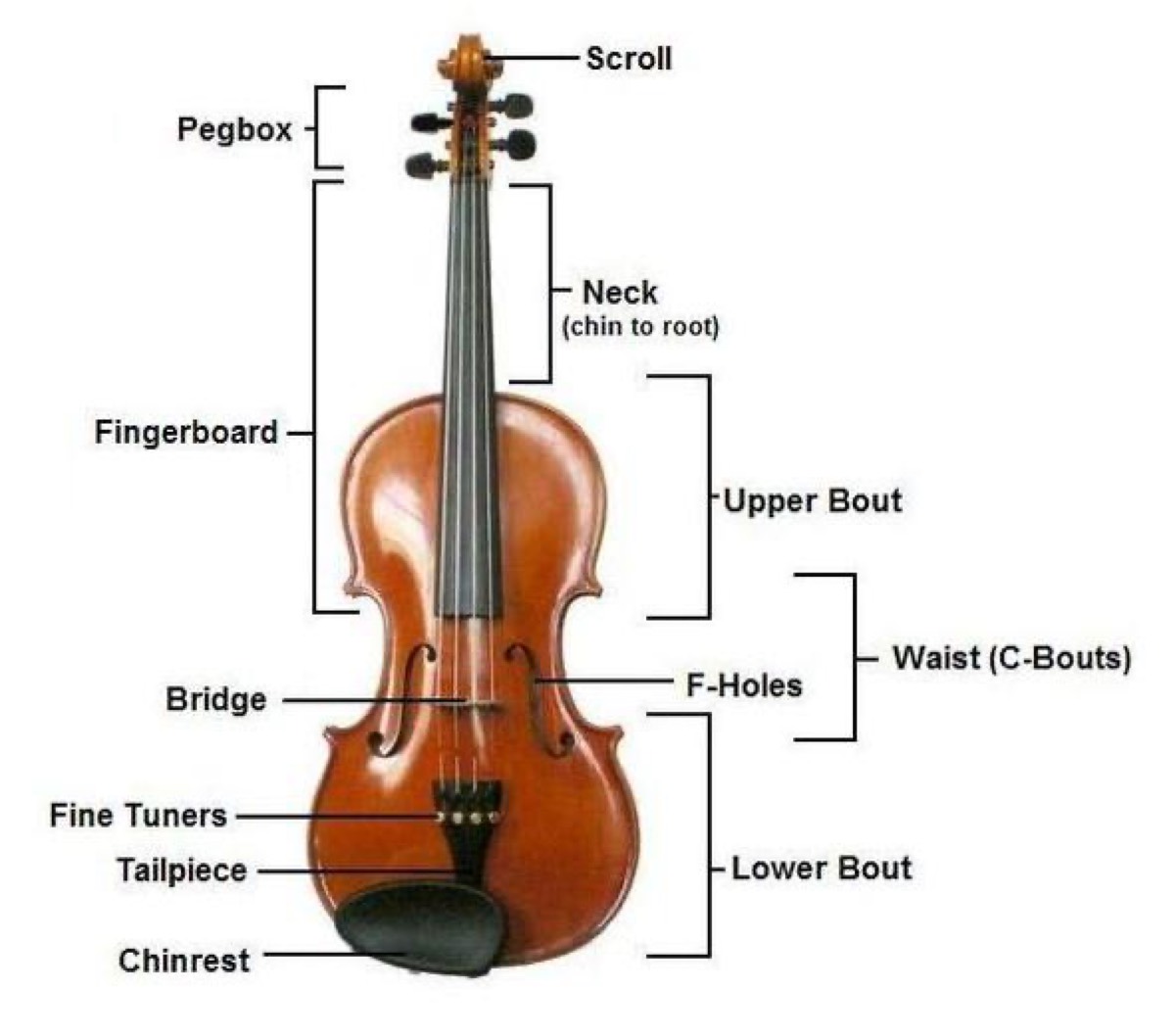
The construction of a violin

The construction of a violin.

The construction of a violin. Credit: Sotakeit/CC BY-SA 3.0

Or perhaps it was the varnish Stradivari used: a cocktail of honey, egg whites, and gum arabic. A 2022 study involving nanoscale imaging of two such instruments revealed a protein-based layer at the interface of the wood and the varnish, which may influence the wood’s natural resonance.

Biochemist Joseph Nagyvary has argued that it was the chemicals used to treat the wood that give Stradivari violins their unique sound, specifically salts of copper, iron, and chromium used to preserve the wood—all of which are excellent wood preservers but may also have altered the instruments’ acoustical properties. A 2021 study supported that argument, identifying borax, zinc, copper, alum, and lime water as the most likely chemicals affecting the sound.

CT scans have provided quite a bit of insight into the conundrum, since the technique can reveal wood density, size and shapes, volume measurements, and thickness graduation, as well as any damage or repairs to a given instrument. For instance, a 2009 study used CT scans to study the material properties of the wood. In 2011, Minnesota radiologist Steven Sirr took detailed CT scans of the 1704 “Betts” violin and then collaborated with two luthiers to make a replica.

One of the most thorough investigations was the Strad3D project, spearheaded in 2006 by the late George Bissinger. That project used 3D scanning lasers to make detailed quantitative measurements of the acoustic properties of several Stradivarius violins, essentially mapping out precisely how the instruments vibrate and produce their distinctive sound. (For what it’s worth, when I interviewed Bissinger in 2007, he was skeptical of efforts to one day reproduce the sound quality of a Stradivarius violin on a mass scale, insisting that making an instrument is as much art as science and that there is no single secret to the Stradivari sound.)

Simulating the system

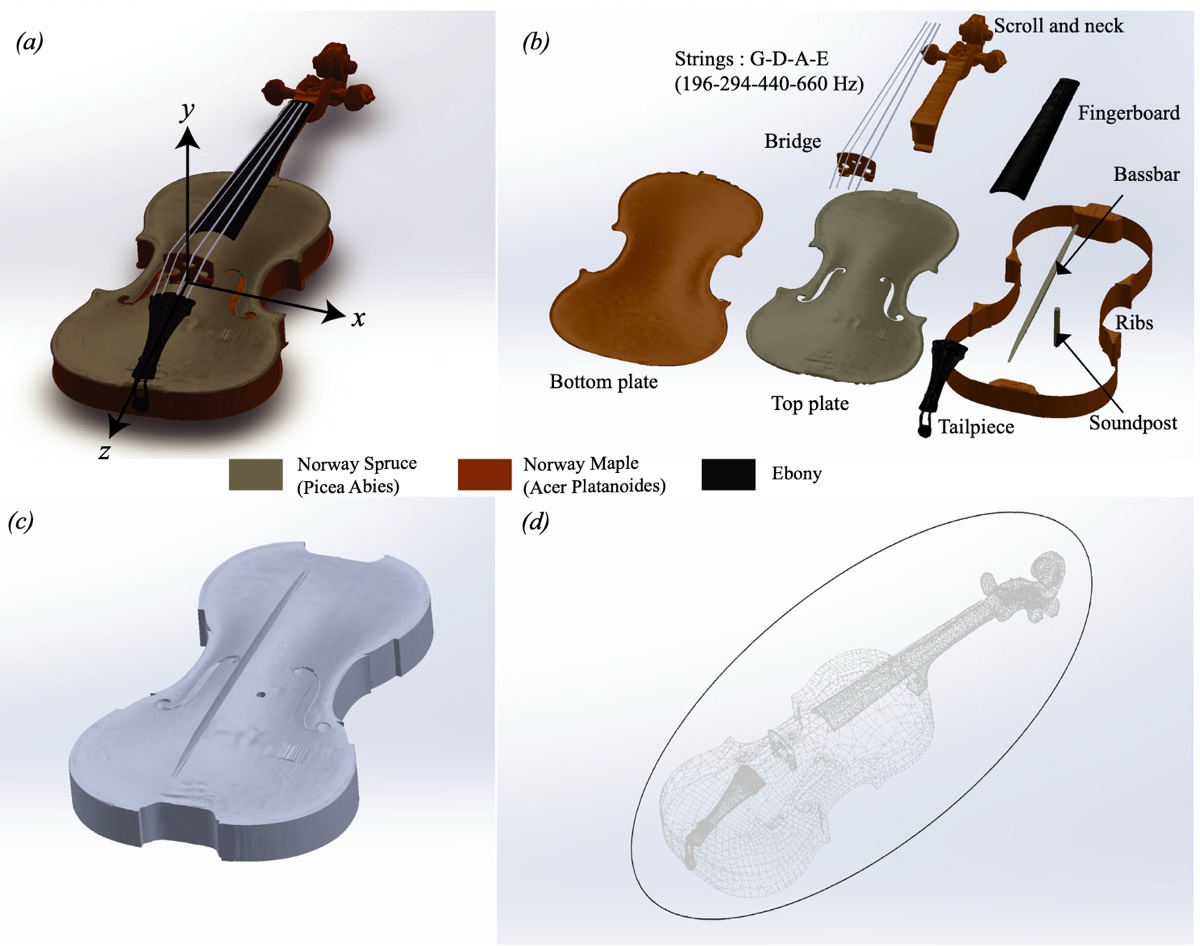
a Complete instrument. b Components, where wood types are color-coded. c Internal air domain bounded by the plates, ribs, bass bar, sound post and blocks. d External air domain consisting of an ellipsoid that encloses the violin.

Virtually reconstructed violin: (a) Complete instrument. (b) Components, where wood types are color-coded. (c) Internal air domain. (d) External air domain consisting of an ellipsoid that encloses the violin.

Virtually reconstructed violin: (a) Complete instrument. (b) Components, where wood types are color-coded. (c) Internal air domain. (d) External air domain consisting of an ellipsoid that encloses the violin. Credit: Arun Krishnadas et al., 2026

MIT’s virtual violin is based on the Strad3D project’s scan of the 1715 “Titian” Stradivarius. Makris et al. imported that data into a modeling software program and generated a 3D model of the instrument. Then they ran a simulation that broke down the violin into millions of cubes, noting which materials were used in each cube—such as the kind of wood that makes up the back plate, or whether it had natural fiber or steel strings. Next, the team used physics equations to predict how those materials would move and interact relative to every other element in the violin. Those elements include the air surrounding the instrument, simulated using acoustic wave equations.

Having built their virtual violin, Makris et al. were able to simulate the sound of a single plucked string—a playing technique called “pizzicato”—and program it to pluck out several notes of Bach’s “Fugue in G Minor,” as well as “Daisy Bell (A Bicycle Built for Two).” They have not yet figured out how to simulate bowing, which is a much more complex interaction, but it is a focus of their future research.

In the meantime, the team hopes their virtual violin will prove useful for luthiers in the early design process, enabling them to test the effects of various parameters, such as wood type or body thickness. “You can tweak the model to hear the effect on the sound,” said Makris. “Since everything obeys the laws of physics, including a violin and the music it makes, this approach can add an appreciation to what makes violin sound. But ultimately, we get most of our inspiration from the artisans.”

npj Acoustics, 2026. DOI: 10.1038/s44384-026-00049-6 (About DOIs).

Britain explores legal options to prosecute suspect in McCann disappearance

0
britain-explores-legal-options-to-prosecute-suspect-in-mccann-disappearance
Britain explores legal options to prosecute suspect in McCann disappearance


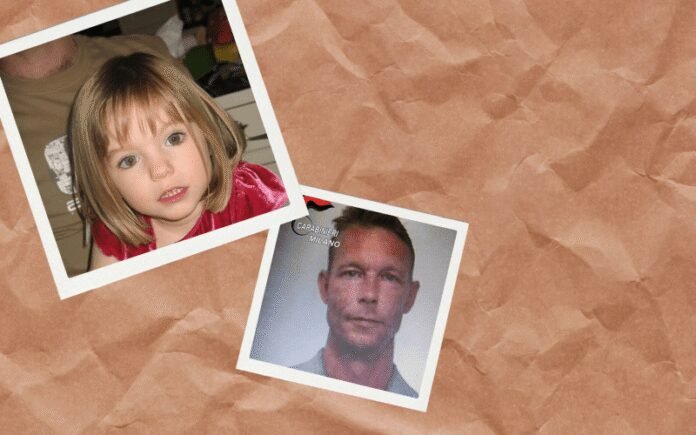
British police are seeking to bring a German suspect to trial in the disappearance of Madeleine McCann, as investigators step up efforts ahead of the 20th anniversary of her case next year.

Detectives from London’s Metropolitan Police are working to build a case against Christian Brueckner, 48, with the aim of securing charges related to abduction and murder. Officials say they believe sufficient evidence could be gathered for prosecutors to proceed.

Senior officers are leading a push to bring the suspect to trial in the United Kingdom, potentially at London’s Old Bailey. However, legal obstacles remain, including Germany’s constitutional ban on extraditing its citizens to countries outside the European Union.

The restriction could prevent German authorities from handing over Brueckner, raising the prospect of legal and diplomatic tensions between the two countries.

British officials have indicated that if extradition is not possible, efforts will continue to ensure the suspect faces justice either in Germany or in Portugal, where the alleged crime took place.

Madeleine McCann was three years old when she disappeared from a holiday apartment in Praia da Luz, Portugal, on May 3, 2007. Despite one of the largest international search efforts, she has never been found.

Brueckner, who lived near the resort at the time, was identified as a prime suspect by German authorities in 2020. He has denied any involvement.

The Metropolitan Police investigation remains officially a missing persons case, but a specialist team has been compiling evidence for the Crown Prosecution Service related to more serious charges.

A police source said investigators were determined to pursue “every available avenue” to achieve justice, noting the significance of the upcoming anniversary.

Under post-Brexit arrangements, the United Kingdom and Germany cooperate on extradition through the EU–UK Trade and Cooperation Agreement. However, Germany applies a “nationality bar,” rooted in its constitution, which prevents the extradition of its own citizens to non-EU countries.

Legal experts say this barrier cannot be waived, regardless of the seriousness of the alleged crime. One possible route could involve sharing evidence with Portuguese authorities, who may pursue prosecution within the EU’s legal framework.

British police have been working closely with counterparts in Germany and Portugal as part of a long-running investigation known as Operation Grange, launched in 2011. The inquiry has cost more than £13 million and continues to examine new leads.

Meanwhile, Madeleine’s parents, Kate McCann and Gerry McCann, marked the 19th anniversary of their daughter’s disappearance, reiterating their determination to find answers and secure justice.

German prosecutors have previously said they are confident Brueckner was responsible for Madeleine’s death, citing what they describe as strong but largely circumstantial evidence. However, no charges have been brought in connection with the case.

Authorities say the investigation remains ongoing, with no clear timeline for its conclusion.

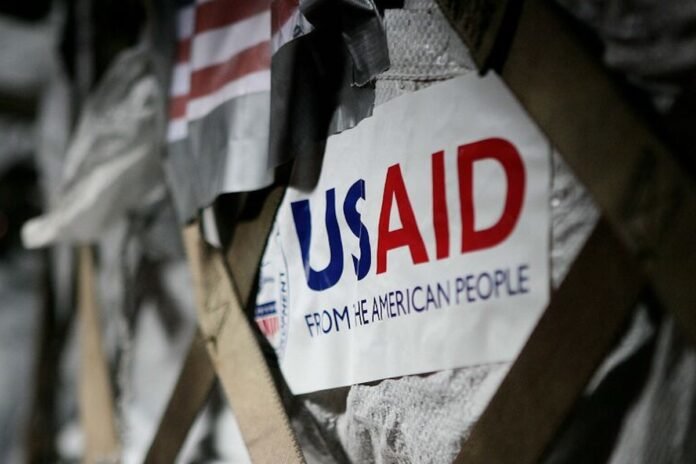
With USAID gone, Indo-Pacific allies face the fallout

0
with-usaid-gone,-indo-pacific-allies-face-the-fallout
With USAID gone, Indo-Pacific allies face the fallout

Image: YouTube Screengrab

For more than 60 years, the United States Agency for International Development (USAID) was the backbone of American development diplomacy. Today, it is gone.

But the most immediate consequence is not what many assume. It is not simply the loss of funding. It is the collapse of coordination — the quiet system that aligned the United States with allies and partners across the developing world.

I have seen how that system works from the inside. And when it breaks, the effects are immediate.

In March 2025, the US administration dismissed most remaining staff and formally notified Congress of plans to dismantle the agency and absorb limited functions into the State Department.

What had once been the world’s premier development institution is rapidly being hollowed out. This may appear to be a mere bureaucratic shift in Washington, but it is not.

For decades, USAID served as a central node connecting the US with other major development actors, including Japan, South Korea and Australia. Through formal coordination and daily operational engagement, these partnerships aligned priorities, avoided duplication and amplified collective impact.

When that node disappears, coordination does not simply continue. It fragments, projects overlap, standards diverge, strategic focus weakens and US competitors gain space — not just because they invest, but because others fail to act together.

This matters most in the Indo-Pacific. From Southeast Asia to the Pacific Islands, development assistance is not peripheral — it is strategic infrastructure. It shapes governance, builds economic ties, and influences political alignment.

Australia has long understood this, using development assistance as a central pillar of its engagement in the Pacific. Japan and South Korea have done the same across Asia and beyond.

Their own development trajectories reinforce this approach. Once aid recipients, they transformed their economies through strategic investment and long-term planning.

Today, through institutions such as the Korea International Cooperation Agency, the Japan International Cooperation Agency, and Australia’s development programs—historically led by AusAID — they are major development actors in their own right.

I have worked alongside these institutions in the field. In Paraguay and Iraq, I saw firsthand how these partnerships function — not as abstract policy, but as daily coordination across governments, agencies, and technical teams.

That coordination is not easily replaced. And China understands this. Its development model does not depend on coordination with others. It is centralized, state-driven and executed through aligned financial and operational institutions.

Where Western approaches fragment, China’s often appear more coherent and decisive. This is the strategic risk. The dismantling of USAID does not create a neutral space – it creates a vacuum in coordination, one that competitors are well positioned to exploit.

The question is not whether allies such as Australia, Japan and South Korea will step forward. They already are. The question is whether they will do so together.

For decades, development cooperation functioned as one of the quiet pillars of the international system. It strengthened alliances, reinforced shared standards and enabled collective action.

That system is now under strain, if not broken. What replaces it will shape not only development outcomes, but the future balance of influence across the Indo-Pacific.

Steven E. Hendrix is a former senior US diplomat and development official who served as the USAID senior coordinator for foreign assistance at the US State Department. As the State Department managing director for planning, performance and systems, he oversaw global strategies across US foreign assistance, including for the Asia-Pacific region.

He has coordinated closely with international development agencies, including the Korea International Cooperation Agency (KOICA), the Japan International Cooperation Agency (JICA) and Australia’s former development agency, AusAID. He is an attorney in the United States, Bolivia, Guatemala and Ghana.  

Mac mini starting price goes up to $799, may be hard to get for “months”

0
mac-mini-starting-price-goes-up-to-$799,-may-be-hard-to-get-for-“months”
Mac mini starting price goes up to $799, may be hard to get for “months”

Apple’s Mac mini and Mac Studio desktops have been increasingly difficult to buy over the course of the year—multiple configurations are listed on Apple’s site as “currently unavailable,” which almost never happens, and others will take weeks or months to ship if you order them today. A top-end version of the Mac Studio with 512GB of RAM was delisted from Apple’s store entirely.

Now, the $599 entry-level Mac mini has also been removed from Apple’s store. The cheapest Mac mini you can currently order from Apple costs $799, which gets you an M4 chip, 16GB of RAM, and 512GB of storage.

This isn’t technically a price hike; Apple has charged the same amount for these specs since launching the M4 Mac mini in late 2024. But now that the basic model with 256GB of storage has apparently been discontinued, it’s no longer possible to buy a Mac mini for its original $599 starting price unless you can find stock left over at some third-party retailer somewhere.

The last time the Mac mini’s starting price was this high was in 2018, when the last Intel-based version of the desktop was introduced. The system’s cost had been falling in the Apple Silicon era—first to $699 for the Apple M1 version, then to $599 for the M2 version. The M4 iteration increased the starting RAM allotment from 8GB to 16GB, making the entry-level model much more useful and future-proof.

Apple similarly discontinued the 256GB versions of the MacBook Air earlier this year when it introduced the new M5 models, but the company only increased the starting prices of those laptops by $100, rather than $200. A new M5 version of the Mac mini is reportedly coming later this year, and its starting price could land anywhere between $599 and $799, depending on its specs (and how much Apple is paying for memory and storage chips by then).

A $799 Mac mini ordered from Apple’s website today will take five or six weeks to show up at your door.

“Higher-than-expected demand”

Current Apple CEO Tim Cook addressed the situation on Apple’s Q2 earnings call last week as part of a larger conversation about how Apple is navigating component shortages, and he partly blamed the shortage on the popularity of those desktops among users looking to run AI agents and other tools locally.

“Both [the Mac mini and the Mac Studio] are amazing platforms for AI and agentic tools, and the customer recognition of that is happening faster than what we had predicted, and so we saw higher-than-expected demand,” said Cook. “We think looking forward that the Mac mini and the Mac Studio may take several months to reach supply-demand balance.”

Cook wasn’t specific about what components were driving the Mac mini and Studio shortages, though he did say that generally, “availability of the advanced [manufacturing] nodes our SoCs are produced on” was constrained, and “we have less flexibility in the supply chain than we normally would.” In other words, it has become harder for Apple to go to TSMC and ask for more chips because TSMC doesn’t have the spare manufacturing capacity. Cook said these constraints “primarily” affected the iPhone, though, and only affected the Mac “to a lesser extent.”

As we wrote last month, the extent of the shipping delays can probably be blamed on multiple factors. AI-related demand for the desktops and chip shortages are probably factors, but Apple is also said to be planning replacements for both systems with Apple M5-series chips later this year, and it’s common for models to see their ship times slip when replacements are imminent. Cook’s “several months” estimate could easily include the introduction of new models, plus whatever time Apple needs to catch up to pent-up demand afterward.

Cook also noted that “customer response to MacBook Neo has been off the charts, with higher-than-expected demand” and that Apple “set a March record for customers new to the Mac, partly due to the Neo.” (Note that “a March record” is not the same thing as “an all-time record,” but regardless, it seems that demand for the Neo has been healthy.)

But MacBook Neo availability has been much better than for the Mac mini or Studio. A Neo ordered directly from Apple will usually arrive in two or three weeks, but this time window has stayed roughly the same since early March. The Neo also remains widely available for same-day shipping or pickup at third-party retailers like Amazon, Walmart, and Best Buy, which is not true of most Mac mini or Studio models.

Supply constraints aside, Apple’s Q2 2026 was a successful one for the company. Apple made $111.2 billion in revenue, a 17 percent increase over Q2 of 2025, thanks to strong growth from iPhone 17 sales and its Services division. The Mac also grew 6 percent year over year despite the shortages affecting the Mac mini, Mac Studio, and MacBook Neo. But Apple isn’t immune to the industry-wide RAM shortage: Cook said that Apple expected “significantly higher memory costs” for Q3 than it paid in Q2 and that “memory costs will drive an increasing impact on our business” going forward.

This story was updated on May 4 at 10:55 am Eastern to add details about the discontinued $599 Mac mini.

The internet has a Strait of Hormuz problem

0
the-internet-has-a-strait-of-hormuz-problem
The internet has a Strait of Hormuz problem

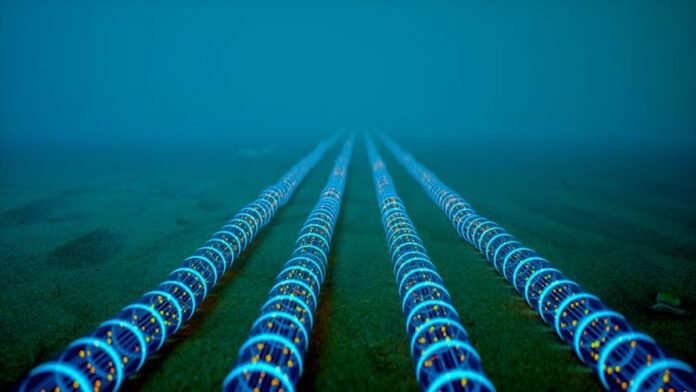
The next attack on the global economy may not arrive with a missile strike or a cyberattack on a server farm. It may arrive as silence — the sudden, eerie quiet of severed fiber-optic cables resting on the floor of the Persian Gulf, cut by a vessel whose crew will claim it was an accident.

Recent developments in the Middle East should alarm policymakers far beyond the region. Iran has already mined the Strait of Hormuz, constricting the flow of oil and gas through one of the world’s most critical energy passages.

But a quieter and potentially more consequential campaign is now underway. State-linked Iranian media outlets began circulating detailed maps of undersea cable routes, landing stations and regional data hubs across the Persian Gulf on April 22, 2026. Analysts at The Jerusalem Post have concluded that these disclosures appear to be target preparation.

To understand why this matters, consider a fact that surprises most people: nearly all global internet traffic — more than 97% — moves not through satellites but through fiber-optic cables resting on the ocean floor.

These strands, thinner than a garden hose, carry an estimated US$10 trillion in daily financial transactions. They underpin bank transfers, stock markets, cloud computing and the artificial intelligence systems now increasingly woven into the fabric of the global economy. Satellites, despite their reputation as a technological fallback, cannot come close to absorbing the load if major cables fail.

Geography concentrates the risk. At least 17 cable systems run through the Red Sea, and several more cross the Persian Gulf. These are not redundancies; they are primary arteries. Both regions are now disrupted by conflict. And both are narrow chokepoints where a single, well-placed break can reverberate across continents.

There is precedent for this kind of attack and a chilling pattern that preceded it. On February 7, 2024, the BBC reported that Yemen’s Houthi movement had shared a plan on the Telegram app outlining its intent to target undersea cables linking Europe and Asia through the Red Sea.

That same day, Foreign Policy magazine observed that even if the Houthis lacked the technical capability to execute such an attack on their own, Iran could readily supply the necessary assets. The warning was explicit, and the threat was credible, but the world largely moved on.

Less than three weeks later, the warnings materialized. On February 26, 2024, four undersea cables connecting Saudi Arabia and Djibouti were severed. The Houthis had telegraphed their intentions, and the cables were sabotaged. The pattern was unmistakable: public signaling, followed by action.

Now that pattern is repeating itself — this time potentially targeting infrastructure that connects not just a region, but the entire digital world. Iranian state-linked outlets are circulating maps of cable infrastructure with the same clinical detail the Houthis used before the 2024 attack.

The Middle East, once primarily an energy hub, has become a digital one as well — hosting more than 300 data centers across 18 countries, with Amazon, Microsoft and Google investing billions in Gulf-based cloud facilities.

Severing the cables feeding these hubs would not simply disrupt email. It would strand hundreds of billions of dollars in digital infrastructure overnight and potentially shut down the world economy, as so much of the world relies on the Internet for banking, investing and commerce every day.

What makes this threat so difficult to deter is precisely what makes it so appealing to Iran: plausible deniability. A missile strike is unmistakable aggression, triggering immediate political and military consequences.

But a vessel dragging an anchor across a cable near the Strait of Hormuz is something murkier. Was it an accident? A fishing boat that strayed off course? A proxy operating at arm’s length from Tehran?

By the time those questions are answered — and cable repair ships cannot safely enter an active conflict zone — the damage is already done, and entire regions can remain offline for weeks or months.

The legal framework designed to deter such attacks is astonishingly weak. Under the United Nations Convention on the Law of the Sea (UNCLOS), when a cable is damaged in international waters, jurisdiction to prosecute the attacker falls to that attacker’s own country, not the cable owner’s.

The result is predictable: no nation has ever been prosecuted. No cable cut has ever gone to court. When states operate through proxies, as Iran routinely does, attribution becomes even harder to establish, and the threshold for retaliation is never clearly met.

The US and more than two dozen allies signed the 2024 New York Joint Statement on undersea cable security, acknowledging the vulnerability. But acknowledgment, obviously, is not deterrence.

What is needed now is a legal framework with teeth — one that empowers cable-owning states to pursue action directly against perpetrators regardless of nationality, and that holds state sponsors accountable for attacks carried out through proxies.

Since the US is already in the region, one action it can take immediately is to guard the undersea cables to minimize the potential of a cut. The Houthis warned, and the cables were subsequently cut.

Iran is now signaling a similar but potentially more devastating cable cut. The only question is whether Washington and its partners will act before the silence comes.

Amy Paik is an adjunct professor at Johns Hopkins University School of Advanced International Studies (SAIS) and a part-time lecturer at Northeastern University. She is a recipient of the 2024–2025 Wilson International Competition Fellowship and holds a doctorate in international affairs from Johns Hopkins SAIS.

Murdered Children’s Faces Approved To Appear on Memorial Mural

0
murdered-children’s-faces-approved-to-appear-on-memorial-mural
Murdered Children’s Faces Approved To Appear on Memorial Mural


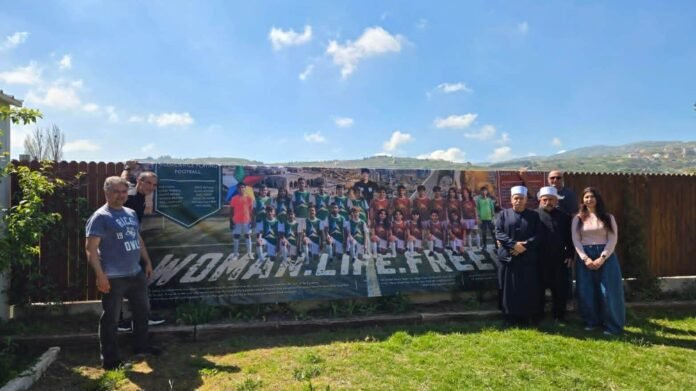
A mural in honor of children killed in regional violence and unrest in Iran will be unveiled in Israel, presenting the victims through a symbolic depiction of a children’s football match, according to project details released by its organizers and artist Hooman Khalili.

The installation centers on Druze children in green, representing 12 children killed by a Hezbollah rocket on July 27, 2024, in Majdal Shams while playing football, facing children in red symbolizing minors killed in Iran since September 2022. The figures are depicted as players rather than adversaries.

Sheik Dr. Rafea Halabi from Daliyat al-Karmel, Sheik Hussein Taraby and his son Ali from Buq’ata village, Naela and Ayman Fakher Aldin from Majdal Shams village. (Courtesy)

Above the scene appears Zahra Azadpour, a young female footballer killed during unrest in Iran in January 2026, portrayed as the referee.

The mural incorporates imagery of Nabi Shu’ayb (Jethro’s Tomb) in the Galilee and Tehran’s Azadi Tower, alongside the Lion and Sun symbol, described in the project as representing resilience and identity.

The Druze children named in the installation are Fajr Laith, Ameer Rabeea, Hazem Akram, Wadeea Ibrahim, Iseel Nashaat, Yazan Nayeif, Finis Adham, Alma Ayman, Naji Taher, Milad Muadad, and Nathem Fakher.

Children cited as among those killed in Iran include Kian Pirfalak, Sarina Esmailzadeh, Nika Shakarami, Asra Panahi, Mohammad Eghbal, Hasti Narouei, Mona Naghib, Helen Ahmadi, Ali Rezaei, and Mirshekar Abolfazl, along with others.

According to the project description, Amnesty International has reported that Iranian security forces killed children during protests using live ammunition, metal pellets, and beatings, and that authorities attempted to conceal the incidents and silence families.

Memorial wreaths for children killed in conflict (Courtesy)

Artist Hooman Khalili told The Media Line: “I see these murals and banners as the roots of something much bigger. The roots are here in Israel—but my hope is that the tree will grow and fully blossom in the United States.”

He added, “My prayer is to have this mural installed in the US before or during the FIFA World Cup, when the eyes of the world are watching. When that moment comes, I want people everywhere to see the truth—to understand the brutality of the Islamic regime and the reality that children are being targeted.”

“This is about making sure their stories are seen, remembered, and impossible to ignore,” Khalili concluded.

Hooman Khalili is an Iranian-born artist, filmmaker, and activist known for large-scale murals supporting Iranian protesters and highlighting human rights issues. Born in Tehran in 1974, he grew up in California and has worked in film, radio, and public art projects across Israel and the United States.

0FansLike
0FollowersFollow
0FollowersFollow
0SubscribersSubscribe
- Advertisement -
Google search engine

Recent Posts