15.7 C
London
Saturday, May 2, 2026
Home Blog

Stockholm protesters rally against Israeli strikes on Gaza, Lebanon, and Iran

0
stockholm-protesters-rally-against-israeli-strikes-on-gaza,-lebanon,-and-iran
Stockholm protesters rally against Israeli strikes on Gaza, Lebanon, and Iran

Activists gathered in the Swedish capital on Saturday to protest Israel’s ongoing military offensives in the Gaza Strip, Iran and Lebanon, Anadolu Agency reports.

Responding to calls from several non-governmental organizations, demonstrators assembled at Odenplan Square, carrying banners reading ‘Stop the killing of civilians,’ ‘End the food blockade in Gaza,’ and ‘Stop attacks on Lebanon and Iran’.

Participants demanded an immediate end to genocide in Gaza and urged the Swedish government to halt arms sales to Israel.

Ann Christin Kristiansson, a nun from the Church of Sweden, told Anadolu that the current violence constitutes a crime against humanity that transcends politics and religion.

She emphasized that the global community must unite against this oppression, stating that the dignity shown by those resisting in Palestine has set an example for the world.

READ: Sweden calls for immediate ceasefire in Lebanon, urges protection of civilians

The Israeli army launched a brutal two-year offensive on Gaza in October 2023, killing more than 72,000 people, injuring over 172,000, and causing massive destruction across the besieged territory.

The US and Israel launched strikes on Iran on Feb. 28, prompting retaliation from Tehran against Israel and US allies in the Gulf, as well as the closure of the Strait of Hormuz.

In response to Hezbollah’s retaliation to the Iran war, Israel has waged an offensive in Lebanon since March 2, killing more than 2,600 people, and displacing over 1.6 million.

A 10-day ceasefire that began on April 17 was later extended until May 17, but Israel continues to violate it daily through airstrikes and the demolition of homes.

It also maintains a so-called “buffer zone” in southern Lebanon, saying it is meant to prevent attacks from Hezbollah. An earlier truce in Lebanon was reached in November 2024.

READ: Lebanon death toll in Israel’s latest offensive reaches 2,659

Women sue the men who used their Instagram feeds to create AI porn influencers

0
women-sue-the-men-who-used-their-instagram-feeds-to-create-ai-porn-influencers
Women sue the men who used their Instagram feeds to create AI porn influencers

A little over a year ago, MG was leading the relatively normal life of a twentysomething in Scottsdale, Arizona. She worked as a personal assistant and supplemented her income by waiting tables on the weekends. Like most women her age, she had an Instagram account, where she’d occasionally post Stories and photos of herself getting matcha and hanging out by the pool with her friends, or going to Pilates.

“I never really cared to pop off and become popular on social media,” says MG (who is cited only as MG in the lawsuit to protect her identity). “I just used it the way most people did when it first came out, to share their lives with the people closest to them.” She has a little more than 9,000 followers—a robust following, but nowhere close to a massive platform.

Last summer, she received a DM from one of her followers. Did she know, the person asked her, that photos and videos of a woman who looked exactly like MG were circulating on Instagram? MG clicked the link and saw multiple Reels of what appeared to be her face superimposed onto a body that looked exactly like her own. The woman in the photo was scantily clad, with tattoos in the same places as MG.

MG was horrified. “If you didn’t know me well, you could very well think they were images of me,” she said. “It was kind of like this reality check that I don’t have any control over my own image.”

She was even more appalled when she discovered that not only were doctored nude or scantily clad photos of her being circulated on the Internet, as she outlined in a recently filed complaint—they were also being used to advertise AI ModelForge, a platform that teaches men how to generate their own AI influencers. In a series of online classes and tutorials, the men allegedly taught subscribers to use a software called CreatorCore to train AI models using photos of unsuspecting young women, posting the resulting content on Instagram and TikTok.

“They provided a whole playbook, including instructions on how to pick the right person so that it’s not someone who can defend themselves, so they all had instructions on what type of women to use and where to get their pictures,” she claims. “It was disgusting on every single level.”

MG is one of three plaintiffs in a lawsuit filed in January in Arizona against three Phoenix men: Jackson Webb, Lucas Webb, and Beau Schultz, as well as 50 other John Does. The lawsuit alleges that the Webbs and Schultz scoured the Internet for photos of unsuspecting young women, then used AI to generate photos and videos of fictional models who look exactly like them, selling such content on the subscription platform Fanvue.

The suit further alleges that for $24.95 a month on the platform Whop, the men sold courses online training other men, including the John Does named in the suit, how to make their own AI-generated influencers based on real women’s photos. The men allegedly created “Blueprints” for how to scrape images from women’s social media accounts and feed them into the generative AI model on CreatorCore, as well as a separate app that would remove the women’s clothes and generate sexually explicit images and videos. Such content, the suit claims, generated millions of views, reportedly generating more than $50,000 in income in one month. (The Webbs and Schultz did not respond to requests for comment.)

This moneymaking scheme, the complaint alleges, preyed on a “harem of indistinguishable AI copies of unsuspecting women and girls,” as well as instructing “predators seeking to prey on” women on social media. According to the suit, in 2025 the CreatorCore platform had more than 8,000 subscribers generating their own AI influencers, resulting in more than 500,000 images and videos.

AI ModelForge is one of many burgeoning companies seemingly looking to capitalize on the widespread use of artificial intelligence by teaching men how to create their own “AI influencers” as a side hustle of sorts. On platforms like X, self-styled entrepreneurs boast about their own patented methods for earning hundreds of thousands of dollars off AI models, luring in young tech-savvy men looking to earn a quick buck.

“The prevalence of this has been shocking to me,” says Nick Brand, who, with attorney Cristina Perez Hasano, is representing MG and the other two plaintiffs. The young men the lawsuit alleges are behind AI ModelForge are “targeting normal, everyday folks that have average social media profiles and social media followings.” One of the more insidious elements of this particular case, he alleges in an interview, is the use of the women’s images to teach other men how to find victims. According to the complaint, the defendants encouraged subscribers to target women with less than 50,000 followers to avoid “legal issues.”

“These boys aren’t just using generative AI to disrobe women—they’re selling the ability to do so to other men and boys, who are then going to use other women’s images to do the same thing,” Brand contends. MG and the other two plaintiffs, he claims, are “the face of a product that is harming other women. It’s like making somebody the face of ICE who has had their parents deported. It’s horrifying.”

Technically, there is a federal law preventing the proliferation of nonconsensual AI-generated porn. The Take It Down Act, which President Trump signed into law in May 2025, makes publishing nonconsensual sexualized AI-generated content illegal, requiring platforms to remove such content within 48 hours when it’s flagged. And most US states, including Arizona, have passed laws banning so-called “deepfake” porn. But the Take It Down Act does not go into effect until May 2026, and state laws tend to be “reactive rather than proactive,” says Arizona State Representative Nick Kupper.

Earlier this year, Kupper introduced a bill in the Arizona Legislature requiring websites to use automated detection tools, such as age verification or consent forms, to prevent nonconsensual AI content from being uploaded. “Once something’s online, it’s pretty much there forever, even though victims spend millions of dollars trying to take it down. It’s like whack-a-mole—you hit one, another one pops up.”

Currently, if you visit the Linktree page for AI ModelForge, it directs you to what appears to be the same business rebranded as “TaviraLabs,” a Telegram group with more than 18,000 members that advertises itself as “the #1 AI Influencer coaching community.” Additionally, the suit names more than a dozen Instagram accounts used by the defendants to promote AI ModelForge, most of which are still active. The suit details how such accounts continue to post photos of nubile women, fast cars, and expensive watches, writing captions such as, “She’s not my girlfriend, she’s my best paid employee” and “POV: You built her in 20 minutes and she made you $13.2k in the first 45 days.”

Even though MG and the other plaintiffs have continually lobbied Instagram to take their images down, many of them are still up, she claims, because they do not technically violate Instagram’s guidelines surrounding AI-generated content. When reached for comment, a spokesperson for Instagram said it had “extremely strict policies” around both AI- and non-AI-generated nonconsensual intimate imagery, removing accounts that post such content. When provided with a list of a dozen or so accounts thought to be associated with AI ModelForge, the spokesperson said the accounts were under review.

The suit also cites a number of TikTok accounts promoting the men’s business. When reached for comment, a TikTok spokesperson said the accounts were found to violate community guidelines and have been taken down.

MG says the images generated by AI Model Forge are distinct enough from her own photos that she frustratingly has been unable to claim that the accounts are impersonating hers, which is also a violation of Instagram guidelines. “It’s my face, my tattoos, on a different outfit on a slightly different body,” she says. “These are real women being transformed, not just a random AI-generated person.”

Though MG lives in constant fear of people in her lives seeing the pornographic AI-generated images of her, she says filing suit has given her a bit of her agency back. “We were put in this place where our backs were against the wall and I want other women to know you can’t stop living your life,” she says.

Still, what happened to MG, a woman with fewer than 10,000 followers, has daunting implications for virtually anyone with a remotely public online presence.

“It’s not about being cautious with your image online because everyone posts on social media now,” she says. “Everyone is on LinkedIn. Everyone is on Instagram. And I want people to realize that this could also happen to them.”

This story originally appeared on wired.com.

The ramifications of record-shattering heat on the West’s ecosystems

0
the-ramifications-of-record-shattering-heat-on-the-west’s-ecosystems
The ramifications of record-shattering heat on the West’s ecosystems

This story was originally published by High Country News and is reproduced here as part of the Climate Desk collaboration.

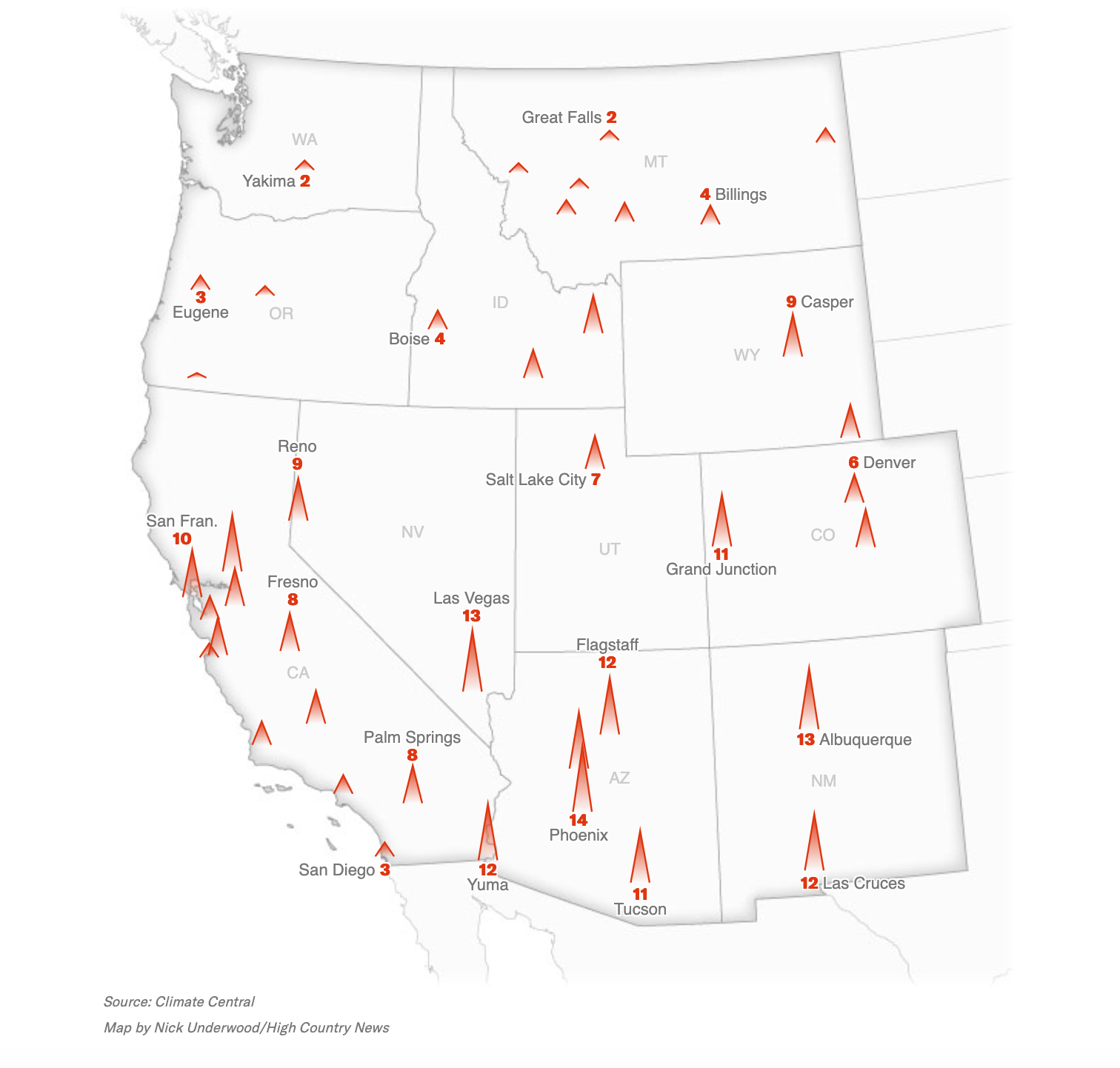
In March, a month traditionally known for heavy mountain snows and dreary lower-elevation weather, a heat wave settled across the West, shattering temperature records from Tucson, Arizona, to Casper, Wyoming.

The heat wave’s intensity and early arrival shocked many climate scientists. “It is exceptionally difficult for the Earth system to produce temperatures this warm so early in the season,” wrote Daniel Swain, a climatologist with the University of California Agriculture and Natural Resources who runs the Weather West blog.

Yet not only did Western locations set new March highs; many exceeded temperature records for May. And those high temperatures kept hanging on, said Zachary Labe, a climate scientist at the nonprofit science center Climate Central, for nearly two weeks.

While heat waves are a natural phenomenon, this was the earliest and most widespread one ever recorded in the Southwest. And it was caused by climate change, which is making intense heat waves much more likely. Researchers say this means understanding their fallout is even more important.

Scientists are just now beginning to understand the ramifications of a devastating 2021 heat wave, when a massive heat dome brought 120-degree temperatures to the Pacific Northwest, causing widespread ecological damage. Tens of thousands of trees died. Baby birds that could not yet fly plummeted to the ground as they tried to escape the heat. Salmon and trout suffocated in small streams. Millions — perhaps even billions — of mussels and barnacles cooked.

Number of daily record highs broken in March 2026

Map of Number of daily record highs broken in March 2026

This year’s heat wave may not have had the same immediate ecological impacts, but it comes on the heels of an already record-breaking hot, dry winter. Researchers say 2021 holds lessons about what lies ahead for both vulnerable and resilient species. Ecosystems, they warn, are likely to permanently change as some species simply can’t handle the heat.

Fully understanding the impact that events like heat waves have on long-lived tree species takes time. Research is now trickling out from places like Washington, Oregon, and British Columbia, and it’s not good.

The 2021 heat wave either killed or otherwise harmed more than three-quarters of species surveyed, including by limiting their reproductive success, according to Julia Baum, a professor at the University of Victoria who co-wrote a recent paper on the long-term impacts. The hardest hit, perhaps unsurprisingly, were those unable to move to seek shade or cooler temperatures. Marine species like acorn barnacles and green rope seaweed fared the worst, as did kelp, surfgrass, and rockweed.

“The rocky shorelines they live on heated up to [122 Fahrenheit]. Think of being glued to hot concrete on the most scorching summer day: They essentially baked and died,” said Baum. “On land, wildflowers wilted and died, preventing entire populations from reproducing that year, and there was widespread leaf scorch and death in forests.”

Some species that could move modified their behavior: Ferruginous hawks reduced their flight time by about 81 percent, while wolves moved around more, perhaps seeking hunkered-down prey like mule deer and moose.

Read Next

Meanwhile, species already adapted to hotter or more variable temperature ranges adjusted better than others.

The heat wave’s timing also mattered, said Adam Sibley, a remote sensing scientist and co-author of a 2025 paper that examined the impact on trees and forests. Plants tend to acclimate to heat throughout a season, so the triple-digit temperatures that struck in June hit harder than they would have in August.

So many tree needles died, in fact, that when Sibley drove to the Oregon coast with friends a few days after the heat wave ended, the tree canopy looked as though it had been dusted with orange snow.

New buds and needles are fragile for a number of reasons, said Christopher Still, a forest ecology professor at Oregon State University. Many contain fatty membranes that, when super-heated, will melt and cause the leaf to fall apart. Young leaves and needles also lack “heat hardening” mechanisms like specialized proteins that stabilize mature leaves and needles when it’s hot.

Many larger, more well-established trees, such as Douglas fir, lost a growing season: Their needles fell off, but grew back the following year. Other trees died, especially younger ones and species like Sitka spruce and western red cedar that require cooler, wetter temperatures.

The 2021 heat wave also rapidly dried grasses, flowers, and other fine fuels, leading to record-breaking wildfires in the Pacific Northwest, according to a 2024 paper in the journal Nature.

Read Next

While the timing of this year’s heat wave surprised many climatologists, the fact that it arrived in March may have ultimately saved some Southwestern plants, said Osvaldo Sala, a professor and director of Arizona State University’s Global Drylands Center.

During the hottest period, he explained, many plants were still dormant. Desert plants tie their growing cycles to rain and moisture instead of heat or sun duration. That means that, unlike in places like Wyoming, where cherry trees started blooming in March instead of May, desert plants were still waiting for rains to come.

Unfortunately, that early blooming has left the cherry trees and other flowering plants particularly susceptible to spring frosts, Still said.

The effects of this year’s heat dome have only exacerbated the winter’s record-setting heat and drought, Still added. Snowpack across much of the West was abysmal; in many places, it was the worst in recorded history. 

“The heat dome put an exclamation point on the worst winter in a century,” said Still. “It was the worst possible way to end the winter that was already worse than normal.”


Myanmar’s political makeover unmasked by revolutionary reality

0
myanmar’s-political-makeover-unmasked-by-revolutionary-reality
Myanmar’s political makeover unmasked by revolutionary reality

After five years of conflict and a tightly controlled election, Myanmar’s junta leader, Min Aung Hlaing, shed his uniform, named himself president and spoke of peace and reconciliation.

The release of elected President Win Myint, the reduction of Aung San Suu Kyi’s sentence and her transfer to house arrest all serve to reinforce this image.

These cosmetic moves, however, do not amount to a democratic transition. Rather, they are part of a political makeover by a military ruler who still cannot claim control over the country he claims to govern.

To understand Myanmar in 2026, it is more useful to look at the battlefield than speeches and pronouncements made in Naypyitaw. The coup-installed regime controls the capital, major airports and urban cores of Yangon and Mandalay.

Beyond these centers, however, its authority fades quickly. In areas where rebel forces hold sway, the military bombs, raids and blocks transit arteries. It punishes, not governs, civilian populations.

Myanmar is no longer a classic civil war with a central state fighting rebels on the margins. Since the coup, armed resistance has spread into central Myanmar, breaking the old center-periphery pattern.

The conflict is fragmented, with rival claims to legitimacy and multiple armed groups exercising power and control.

The anti-coup National Unity Government, or NUG, claims democratic legitimacy from the 2020 election and has built parallel armed and administrative structures, including People’s Defense Forces, or PDF – some of which it controls, many others which it doesn’t.

Min Aung Hlaing may control the state’s formal shell, but he does not command authority across Myanmar. Internationally, meanwhile, Myanmar’s UN seat is still held by Ambassador Kyaw Moe Tun, aligned with the pre-coup government, while ASEAN remains cautious and divided over the junta’s latest attempt at a makeover.

Map tells the story

The picture on the ground is just as revealing. ISP-Myanmar estimated in January that the regime had lost control of roughly 38% of the country’s territory and had not recovered at least 150 overrun bases.

A 2025 ISEAS study claimed that anti-junta armed groups controlled as much as half the country, while the military held only about a quarter.

Figures and estimates of who controls where may differ, but the broad picture does not: Myanmar’s map does not support the regime’s claim of restored national control and its recent tactical gains do not represent stabilization.

In northwestern Myanmar, the regime recently retook Falam, Chin State’s second city, after a six-month offensive involving ground assaults and heavy airstrikes. Its recapture is a reminder that the junta can still concentrate firepower.

But Falam does not indicate the revolution is waning. Resistance forces remain active across Chin State, and retaking a town is different from holding territory, governing people, reopening roads and restoring legitimacy.

The same is true in Magway, where the military recently seized Kangyi village in Saw Township, a strategic route to Chin State and onward toward Paletwa near the Rakhine State border. The move appears aimed not only at local control but at tightening pressure on routes feeding into Rakhine.

That matters because Rakhine State remains one of the clearest examples of the junta’s loss of authority. The Arakan Army now controls most of the state except for three townships, and the military is reduced to defending a few remaining strategic pockets, including Sittwe, Kyaukphyu, and Manaung.

Recent reports describe Arakan Army pressure around Sittwe, with the regime responding through naval blockades and airstrikes. The junta’s rule is less governance than a siege in Rakhine.

Fighting still raging

Across Myanmar, crisis monitoring continues to describe clashes, displacement, airstrikes and insecurity across multiple regions, including the central heartland. That alone should make observers skeptical of the junta’s claim to have restored order.

In Karen State, resistance forces reportedly captured regime positions over the Myanmar New Year holidays in April, while fighting along the Thai-Myanmar border remained intense.

Meanwhile, in the north, Kachin State points in the same direction. The Kachin Independence Army and allied anti-junta forces have expanded their influence, seizing towns, border crossings and rare-earth mining areas.

The battle for Bhamo, near routes linking central Myanmar, northern Kachin and the China border, has become one of the country’s most important fronts.

Northern Shan State tells a different story. Operation 1027, launched by the Three Brotherhood Alliance, exposed the military’s weakness, but it also revealed the limits of gains in a war shaped by outside actors, especially China.

Formally, this is still Myanmar’s internal war. In practice, Beijing is shaping parts of the battlefield by pressuring armed groups it tacitly supports or arms, and seeking to secure trade corridors near its border.

Myanmar’s conflict is also geopolitical. The country sits between China and India, linking South and Southeast Asia. Rakhine State is especially critical: China sees Kyaukphyu as a route to the Indian Ocean, while India has connectivity interests through the Kaladan project and Sittwe port.

When the military blocks roads between Magway, Chin and Rakhine, or when the Arakan Army dominates much of Rakhine, the issue affects trade routes, border stability, humanitarian access and the geopolitical and geoeconomic calculations of Beijing and New Delhi.

Foreign governments, however, must be careful not to confuse Min Aung Hlaing’s new title with a new reality. The junta’s “transition” is not ending the war – it is simply trying to repackage it.

Peace offer changes nothing

The junta’s latest peace language should be treated with equal caution. The 100-day talks proposal is less a breakthrough than another attempt to turn military weakness into diplomatic legitimacy.

It asks resistance groups to enter a process designed by the same power that overthrew an elected government, jailed opponents and still relies on airstrikes, mass arrests, blockades and coercion to impose its will.

The swift rejection by major resistance organizations was hardly surprising. That said, none of this means the junta is about to collapse tomorrow.

Naypyitaw remains under regime command. Yangon is not on the verge of falling. Mandalay remains a core military-held city. The junta still has aircraft, prisons, patronage networks, foreign backers and the capacity to inflict immense violence, including on civilian populations.

But regime survival is not the same thing as regime victory. The war is now arguably entering a longer, harsher phase. The regime can still retake towns, block roads and punish the general population.

The resistance faces fragmentation, fatigue, shortages and the task of turning battlefield control into durable political authority. Myanmar’s revolution, however, is not waning, because the problem was never just Min Aung Hlaing or his latest attempt to dress military rule in civilian garbs.

The crisis runs much deeper, characterized by decades of military domination, the denial of democratic rights and the failure to build a genuine federal union with real equality and power-sharing. So long as those issues remain unaddressed, the resistance will endure.

Nyein Chan Aye is a Burmese journalist based in Washington, D.C., who previously worked for the BBC and Voice of America and writes on Myanmar, the US, China and regional affairs.


Apple may take “several months” to catch up to Mac mini and Studio demand

0
apple-may-take-“several-months”-to-catch-up-to-mac-mini-and-studio-demand
Apple may take “several months” to catch up to Mac mini and Studio demand

Apple’s Mac mini and Mac Studio desktops have been increasingly difficult to buy over the course of the year—multiple configurations are listed on Apple’s site as “currently unavailable,” which almost never happens, and others will take weeks or months to ship if you order them today. A top-end version of the Mac Studio with 512GB of RAM was delisted from Apple’s store entirely.

Current Apple CEO Tim Cook addressed the situation on Apple’s Q2 earnings call yesterday as part of a larger conversation about how Apple is navigating component shortages, and he partly blamed the shortage on the popularity of those desktops among users looking to run AI agents and other tools locally.

“Both [the Mac mini and the Mac Studio] are amazing platforms for AI and agentic tools, and the customer recognition of that is happening faster than what we had predicted, and so we saw higher-than-expected demand,” said Cook. “We think looking forward that the Mac mini and the Mac Studio may take several months to reach supply-demand balance.”

Cook wasn’t specific about what components were driving the Mac mini and Studio shortages, though he did say that generally, “availability of the advanced [manufacturing] nodes our SoCs are produced on” was constrained, and “we have less flexibility in the supply chain than we normally would.” In other words, it has become harder for Apple to go to TSMC and ask for more chips because TSMC doesn’t have the spare manufacturing capacity. Cook said these constraints “primarily” affected the iPhone, though, and only affected the Mac “to a lesser extent.”

As we wrote last month, the extent of the shipping delays can probably be blamed on multiple factors. AI-related demand for the desktops and chip shortages are probably factors, but Apple is also said to be planning replacements for both systems with Apple M5-series chips later this year, and it’s common for models to see their ship times slip when replacements are imminent. Cook’s “several months” estimate could easily include the introduction of new models, plus whatever time Apple needs to catch up to pent-up demand afterward.

Cook also noted that “customer response to MacBook Neo has been off the charts, with higher-than-expected demand” and that Apple “set a March record for customers new to the Mac, partly due to the Neo.” (Note that “a March record” is not the same thing as “an all-time record,” but regardless, it seems that demand for the Neo has been healthy.)

But MacBook Neo availability has been much better than for the Mac mini or Studio. A Neo ordered directly from Apple will usually arrive in two or three weeks, but this time window has stayed roughly the same since early March. The Neo also remains widely available for same-day shipping or pickup at third-party retailers like Amazon, Walmart, and Best Buy, which is not true of most Mac mini or Studio models.

Supply constraints aside, Apple’s Q2 2026 was a successful one for the company. Apple made $111.2 billion in revenue, a 17 percent increase over Q2 of 2025, thanks to strong growth from iPhone 17 sales and its Services division. The Mac also grew 6 percent year over year despite the shortages affecting the Mac mini, Mac Studio, and MacBook Neo. But Apple isn’t immune to the industry-wide RAM shortage: Cook said that Apple expected “significantly higher memory costs” for Q3 than it paid in Q2 and that “memory costs will drive an increasing impact on our business” going forward.

Domino’s Delivery Driver Attacks Man Who Didn’t Tip

0
domino’s-delivery-driver-attacks-man-who-didn’t-tip
Domino’s Delivery Driver Attacks Man Who Didn’t Tip


A routine pizza delivery took a terrifying turn in Missouri when a Domino’s driver allegedly snapped over a missing tip and used his car to settle the score.

Police say the shocking incident unfolded on April 29 at a private home in Fulton, where officers rushed to reports of a crash involving injuries. But this wasn’t your typical accident — investigators say it all started with a heated argument over a tip.

According to witnesses, the delivery driver became furious after the customer refused to tip, quickly escalating the situation into a verbal confrontation. The victim later told police the driver was visibly angry, hurling insults as tensions boiled over.

Court documents cited by KRCG reveal the driver, identified as 36-year-old Zachary Nicholos Walton, allegedly lashed out, calling the customer and a witness “f–king rude” before storming back to his vehicle. As he climbed inside, he reportedly taunted them, shouting, “What are you going to do, b—h? Come get me.”

Moments later, things took a dangerous turn.

Authorities say Walton then hit the gas, accelerating straight toward the victim, who was standing in their own driveway. The vehicle struck the customer, leaving them injured, before the driver sped off from the scene.

The victim suffered injuries to their hand, according to police.

Officers later tracked Walton down at a local Domino’s, where he allegedly admitted to what happened — but claimed he only meant to scare the victim, not actually hit them.

That explanation didn’t stop authorities from taking swift action.

Walton was arrested and booked into the Callaway County Jail, now facing multiple serious felony charges, including first-degree assault and armed criminal action.

What began as a simple pizza delivery ended in chaos — and now, a driver’s moment of rage could cost him far more than just a tip.

Aid Groups Seek Hormuz Humanitarian Corridor as Supply Routes Strain

0
aid-groups-seek-hormuz-humanitarian-corridor-as-supply-routes-strain
Aid Groups Seek Hormuz Humanitarian Corridor as Supply Routes Strain


Humanitarian organizations are calling for a protected aid corridor through the Strait of Hormuz after the Iran war and related shipping disruption drove up fuel costs, slowed deliveries, and threatened food and medical assistance to vulnerable countries across Africa, the Middle East, and Asia.

Aid groups say the crisis has disrupted supply routes from major logistics hubs in Dubai and India, affecting deliveries to Sudan, Somalia, Ethiopia, Nigeria, and Afghanistan. The Guardian reported that the appeals came from organizations including the International Rescue Committee, Save the Children, and the World Food Programme.

The Strait of Hormuz is one of the world’s most important maritime chokepoints, carrying about one-fifth of global oil and gas flows. Its disruption has pushed energy prices sharply higher, increasing the cost of shipping food, medicine, fuel, and other emergency supplies. Humanitarian agencies say the added expense is stretching already strained budgets, forcing some programs to reduce services, delay deliveries, or redirect funds away from direct aid.

The World Food Programme has warned that supply disruptions and rising prices could worsen global hunger at a time when hundreds of millions of people already face severe food insecurity. Aid groups say children with acute malnutrition, displaced families, and communities dependent on imported grain, fertilizer, and fuel are among those most exposed.

The crisis comes as humanitarian operations are already under pressure from wars in Sudan and Yemen, instability in the Horn of Africa, and funding cuts from major donors. Higher fuel prices also affect clinics, water systems, cold storage for medicine, and transport for relief workers.

European Commission President Ursula von der Leyen warned this week that the wider effects of the Iran war “may echo for months or even years to come.”

Aid officials say a humanitarian corridor through Hormuz would not resolve the wider conflict, but could help keep lifesaving supplies moving while diplomatic efforts continue.

Virgin Galactic reveals new ship, but it’s running out of time and cash

0
virgin-galactic-reveals-new-ship,-but-it’s-running-out-of-time-and-cash
Virgin Galactic reveals new ship, but it’s running out of time and cash

On Thursday, the publicly traded spaceflight company Virgin Galactic shared on social media a new photo of its next-generation spaceship being towed outside of its factory in Mesa, Arizona.

You remember Virgin Galactic, right? The space tourism company was founded 22 years ago by Sir Richard Branson to bring spaceflight to the masses. Hundreds of people began buying tickets to space nearly two decades ago. And after a long, and at times deadly, development campaign, the company reached outer space (defined, somewhat controversially, as an altitude of 80 km and above) in December 2018.

The company began flying passengers in May 2021 with its VSS Unity spacecraft, and impressively completed six spaceflights in 2023. But a few months later, in June 2024, Virgin Galactic stopped flying VSS Unity to focus on the development of its next-generation vehicle capable of more frequent, lower-cost spaceflights.

Since then, the company has been largely quiet, making this week’s revelation of new hardware notable. So Virgin Galactic is still pressing ahead, but the question is where it’s going, and along with it, the entire suborbital space tourism industry.

Difficult to make a profit

Spaceflight remains an expensive and dangerous business, even for companies focused on relatively simple suborbital flights.

There was a time, about five years ago, when the market appeared poised to break through. During the summer of 2021, both Virgin Galactic and its US-based competitor, Blue Origin, began commercial flights. Famously, Branson and Blue Origin founder Jeff Bezos both went to space within weeks of one another.

Both companies have had robust demand for their services.

A full-priced ticket on Blue Origin’s New Shepard rocket never dropped below $1 million, and the company had customers lined up. But then, during an uncrewed New Shepard flight in September 2022, the rocket failed. The vehicle had to stand down for more than a year. Blue Origin has never revealed New Shepard’s finances, but multiple sources told Ars the program—despite persistent demand—was never close to profitability. Blue Origin ended New Shepard in January to focus on orbital launches and its lunar program.

That left Virgin Galactic as the sole player in the suborbital space tourism game. The company has plenty of customers and has been able to raise its prices for “spaceflight expeditions” to $750,000. Nevertheless, without a steady stream of revenue from flights, its finances are strained.

Images from the flight of VSS Unity.

Sir Richard Branson enjoys microgravity in 2021.

Sir Richard Branson enjoys microgravity in 2021. Credit: Virgin Galactic

Two years ago, in February 2024, Virgin Galactic’s “cash position” was reported as strong, with $982 million in cash, cash equivalents, and marketable securities. A year later, this cash position had declined to $567 million, as the company has very low revenues while it’s not flying. To that end, Virgin Galactic said a first spaceflight with the new spaceship carrying research payloads was coming in summer 2026, with private astronaut flights in “fall 2026.”

At the end of March, the company reported its most recent quarterly results, with its cash position declining to $338 million. The company was now projecting that its new spaceship would “enter service” between “late Q4 2026 and early Q1 2027.”

A lot of testing ahead

The new ship revealed this week will presumably make that first flight. According to Virgin Galactic, it was being moved this week from the assembly hangar to the launch hangar and will now “undergo final systems integration and ground testing.”

It’s difficult to tell from an image, but the vehicle appears to have a significant amount of integration left to undergo, and its test campaign will not be short.

For comparison purposes, Virgin Galactic rolled a fully integrated VSS Unity spacecraft out in February 2016. It underwent about six months of ground tests and two years of glide and flight tests before its first spaceflight in December 2018. If we assume Virgin Galactic can halve the test time with its new spaceship, given the integration work necessary, this would still place its first spaceflight at the end of 2027 or early 2028.

It’s not clear whether Virgin Galactic has the cash reserves to fund a prolonged test phase, let alone invest in multiple spaceships to achieve profitability. Ultimately, this will require the company to fly hundreds of passenger flights a year.

The stock market appears to have similar concerns. At the height of the meme stock era, as Virgin Galactic was sending Branson into space, the company’s publicly traded stock rocketed to a valuation of $1,118 per share. It has steadily fallen since, trading at between $2 and $3 a share this year.

The odds of Virgin Galactic succeeding appear to be pretty long. First, it must get this newest spaceship flying soon, and it must do so safely. Then it must build a second one and hope that its aging Eve carrier aircraft can support three spaceflights a week and 125 flights a year. And it must perform all of these operations without significant anomalies. If it does all of this before the cash runs out, Virgin Galactic will just about be able to break even.

And if it doesn’t? Then the suborbital space tourism market, which looked so promising just a few years ago, will likely be dead for at least a generation.

Applebee’s Chicken Wonton Tacos (Copycat Recipe)

0
applebee’s-chicken-wonton-tacos-(copycat-recipe)
Applebee’s Chicken Wonton Tacos (Copycat Recipe)

You are here: Home / All RECIPES / Applebee’s Chicken Wonton Tacos (Copycat Recipe)

Crispy, Sweet, Savory, and Better Than Takeout

If you’ve ever ordered Applebee’s Chicken Wonton Tacos and immediately wished you had ordered two more… you’re not alone. Those crispy little tacos packed with sticky chicken, crunchy slaw, and sweet chili sauce are seriously addictive.

The good news? You can make them right at home—and honestly, they may be even better than the restaurant version.

With crunchy baked wonton shells, juicy sesame-hoisin chicken, crisp Asian-style slaw, and a drizzle of sweet chili sauce, this recipe brings restaurant-quality flavor straight to your kitchen in just 30 minutes.

Perfect for:

  • Taco night
  • Game day appetizers
  • Girls’ night
  • Family dinners
  • Party platters

Or… simply because you deserve something delicious.


Why You’ll Love These Applebee’s Chicken Wonton Tacos

Quick & Easy

Ready in only 30 minutes.

Crispy & Flavorful

Every bite has the perfect crunch.

Budget-Friendly

Restaurant flavor at a fraction of the cost.

Crowd Favorite

Perfect for parties and gatherings.

Customizable

Mild, spicy, extra sweet—it’s your taco.


Quick Recipe Overview

  • Prep Time: 15 minutes
  • Cook Time: 15 minutes
  • Total Time: 30 minutes
  • Yield: 16 wonton tacos

Ingredients

For the Chicken Filling

  • 2 boneless skinless chicken breasts, finely diced
  • 2 tablespoons hoisin sauce
  • 1 tablespoon sesame oil
  • 1 tablespoon soy sauce
  • 2 garlic cloves, minced
  • 1 teaspoon fresh ginger, minced

For the Crunchy Slaw

  • 1 bag coleslaw mix
  • 4 green onions, thinly sliced
  • 1 tablespoon sesame oil
  • 1 tablespoon rice vinegar
  • 1 tablespoon soy sauce
  • 1 tablespoon honey

For Assembly

  • 16 wonton wrappers
  • Sweet chili sauce
  • Fresh cilantro, chopped
  • Sesame seeds

How to Make Applebee’s Chicken Wonton Tacos


Step 1: Make the Crispy Wonton Shells

Preheat your oven to 375°F (190°C).

Lightly spray the back side of a muffin tin with cooking spray.

Carefully drape each wonton wrapper over an upside-down muffin cup to create taco shell shapes.

Bake for 5–7 minutes, or until:

  • golden brown
  • crisp
  • lightly toasted

Set aside.


Step 2: Cook the Chicken

Heat sesame oil in a large skillet over medium-high heat.

Add diced chicken.

Cook for 3–4 minutes, stirring occasionally, until no longer pink.

Add:

  • hoisin sauce
  • soy sauce
  • garlic
  • ginger

Cook for another 2–3 minutes until the chicken becomes sticky, glossy, and beautifully caramelized.

Remove from heat.


Step 3: Make the Asian Slaw

In a medium bowl, combine:

  • coleslaw mix
  • green onions
  • sesame oil
  • rice vinegar
  • soy sauce
  • honey

Toss until evenly coated.

The slaw should be crisp, fresh, and lightly sweet.


Step 4: Assemble the Tacos

Fill each crispy wonton shell with:

First:

A spoonful of sticky chicken.

Then:

A generous handful of crunchy slaw.

Finish with:

  • sweet chili sauce drizzle
  • fresh cilantro
  • sesame seeds

Serve immediately while shells are crisp.


Serving Ideas

These tacos are amazing with:

  • Asian cucumber salad
  • Fried rice
  • Edamame
  • Spring rolls
  • Mango salsa
  • Spicy dipping sauce

Aneta’s Best Tips

Fill Right Before Serving

This keeps the wonton shells perfectly crunchy.

Feeding a Crowd?

Double the recipe—they disappear fast.

Want More Heat?

Add:

  • sriracha
  • red pepper flakes
  • chili crisp

Prefer Milder Flavor?

Swap hoisin for teriyaki sauce.

Shortcut Option

Ground chicken works beautifully and cooks even faster.


Storage

Chicken Filling

Store in an airtight container for up to 3 days.

Slaw

Best enjoyed within 2 days.

Wonton Shells

Store in a dry airtight container for 2–3 days.

To re-crisp:

Bake at 350°F for 2–3 minutes.


Frequently Asked Questions

Can I use ground chicken?

Absolutely. It’s faster and equally delicious.

Can I air fry the wonton shells?

Yes—air fry at 350°F for 3–4 minutes.

Can I make these gluten-free?

Yes—use gluten-free wonton wrappers and tamari.

Can I prep ahead?

Definitely. Prepare all components separately and assemble right before serving.


Final Thoughts

These Applebee’s Chicken Wonton Tacos bring everything you love about the restaurant favorite—crispy shells, sticky sweet chicken, crunchy slaw, and that irresistible sweet chili finish—right into your own kitchen.

They’re fun, flavorful, easy to make, and guaranteed to disappear faster than you can make them.

One bite, and Taco Tuesday may never be the same again.

China should borrow Britain’s tobacco-ban logic, not its law

0
china-should-borrow-britain’s-tobacco-ban-logic,-not-its-law
China should borrow Britain’s tobacco-ban logic, not its law

Britain’s Tobacco and Vapes Bill, passed by Parliament in April and awaiting Royal Assent, would permanently bar the sale of tobacco to anyone born on or after January 1, 2009.

The measure is designed to create what British officials call a “smoke-free generation.” It does not force current smokers to quit. Instead, it raises the legal age of sale year by year, while also tightening controls on tobacco retailing, vaping, advertising, packaging and public use.

That design matters. Britain is not trying to ban smoking overnight. It is trying to change the market’s default settings so that tobacco gradually stops recruiting new customers. In public-health terms, this is less a sudden prohibition than an intergenerational firewall.

That distinction is important for China, where the tobacco debate can too easily collapse into a false choice: preserve the status quo or impose an unrealistic ban. Britain’s experiment suggests a third possibility — not immediate abolition, but long-term market denormalization.

The British case arrives with hard realities attached. Smoking still causes tens of thousands of deaths each year in England and imposes large health-care and productivity costs. Those numbers help explain why London has moved from ordinary tobacco control toward endgame thinking.

China does not face the same problem at the same scale. It faces a much larger one. China remains the world’s largest producer and consumer of tobacco, with more than 300 million smokers.

A 2024 China CDC study found that current smoking prevalence among Chinese adults aged 15 and older was 23.2%, with higher rates in rural than urban areas. Beijing’s Healthy China 2030 plan aims to reduce adult smoking prevalence to 20% by 2030, a goal that will be difficult to reach without stronger measures.

Still, China should resist the temptation to read Britain’s bill as a ready-made blueprint. Britain is regulating a private-market habit in a relatively mature tobacco-control environment.

China is managing a public-health burden intertwined with a state tobacco monopoly, local fiscal interests, male social norms, gift culture, retail habits and uneven enforcement capacity. That is why the most useful lesson from Britain may not be the headline policy itself, but its sequencing.

The British approach is phased rather than abrupt, youth-centered rather than punitive and paired with complementary measures such as retailer licensing, age restrictions, vaping controls and enforcement powers.

For China, the strategic question is not “Should Beijing copy London?” but rather “Which parts of the British approach can help China reduce youth initiation, support adult cessation and manage transition costs in a credible order?”

The answer should begin with a shift in framing. China does not need to define tobacco control as a campaign against smokers or a symbolic attack on the tobacco sector.

It can define success as reducing future dependency while expanding present-day options: protecting adolescents from initiation, making quitting easier for adults, reducing secondhand smoke exposure in homes and workplaces and lowering the long-term burden on families and the health system.

A generational tobacco restriction, if ever considered in China, would only be credible if the runway were built first. That means stronger national retailer licensing, reliable age-verification systems, better product tracing, visible enforcement against illicit sales, broader smoke-free public spaces, higher effective prices and a serious expansion of cessation services.

A ban without this platform would risk becoming performative. A platform without a long-term endgame would risk becoming incremental forever. China could therefore begin not with a national lifetime sales ban, but with disciplined experimentation.

Selected cities, special zones or provinces with stronger public health infrastructure could pilot a generational tobacco control model. These pilots could test whether retailer licensing, digital-age verification, school-based prevention, smoke-free enforcement, and cessation support can work together before any national decision is made.

This would fit China’s own governance style better than a sudden national leap. It would allow policymakers to measure real outcomes: fewer young initiates, lower secondhand smoke exposure, more quit attempts, better compliance by retailers and reduced local medical costs.

It would also help avoid turning tobacco control into a symbolic contest between Western liberalism and Chinese governance. The issue should be judged by health, fiscal and administrative results.

The harder question is political economy. China’s tobacco system is not merely a public-health challenge. It is also a revenue system and an industrial structure. Any serious reform must therefore answer a practical question: what happens to local governments, tobacco-growing regions, retailers and workers if cigarette sales gradually decline?

This is where China may need a health-transition strategy, not just a health campaign. One approach would be transparent accounting: how much tobacco revenue is collected, where it goes and how much smoking-related disease costs the health system, households and employers.

Over time, a portion of tobacco revenue could be placed into a dedicated transition fund to support cessation services, local public-health enforcement, farmer adjustment, worker retraining and fiscal cushioning for tobacco-dependent areas.

The point is not to punish local governments for relying on tobacco revenue. It is to make declining cigarette sales financially manageable rather than administratively threatening. Public health reform becomes more governable when the losers from transition are acknowledged rather than ignored.

Britain’s gamble is that a society can end smoking by denying the habit to a new generation. China’s challenge is broader: it must decide whether tobacco control is mainly a health campaign, a fiscal problem or an industrial reform agenda. The honest answer is that it is all three.

That is precisely why the British bill is useful to China. Not because it offers a script, but because it exposes the real question China will eventually have to answer: whether the country wants to keep managing tobacco’s harms indefinitely, or begin managing tobacco’s sunset.

For China, the most innovative response may therefore be the least theatrical one. Do not import Britain’s bill as a symbol. Import its logic: long horizons, youth protection, regulatory layering, credible enforcement, cessation support and gradual market denormalization.

If Britain is testing how to create a smoke-free generation, China may need to test something even harder: how to build post-tobacco state capacity inside a tobacco state.

Y. Tony Yang is an endowed professor at the George Washington University in Washington, D.C.

0FansLike
0FollowersFollow
0FollowersFollow
0SubscribersSubscribe
- Advertisement -
Google search engine

Recent Posts