8.5 C
London
Thursday, May 14, 2026
Home Blog

Fired hacker twins forget to end Teams recording, capture own crimes

0
fired-hacker-twins-forget-to-end-teams-recording,-capture-own-crimes
Fired hacker twins forget to end Teams recording, capture own crimes

Perhaps you remember Muneeb and Sohaib Akhter, the 34-year-old twin brothers we profiled earlier this week. Although they had the tech chops to commit years of petty crimes (like stealing airline miles), what landed them in truly serious trouble was deleting 96 US government databases in the hour after both were fired last year by the same federal IT contractor, Opexus. (Opexus had just found out that both brothers had previously been in prison for cyberfraud.)

The pair come off less as cybercriminal masterminds than as galumphing galoots—that is to say, a pair of bumbling oafs who thought that asking AI how to cover their tracks was going to keep them out of federal prison.

One of the minor mysteries I encountered while writing the piece was that the government had a verbatim transcript of everything the brothers said to each other during their hour-long deletion spree. The two men lived together in Arlington, Virginia, so it made sense that they might be chatting in the same room rather than by text or instant message. But how the heck had the government gotten access to the audio? Supersecret software bugging? Crazy corporate spyware running on their company laptops? FBI agent in the bushes with a microphone?

I couldn’t figure it out, and the answer didn’t appear in any of the court documents I read. But a helpful source today pointed me to the answer. It is contained within a court filing that bears the unpropitious name, “UNITED STATES’ RESPONSE IN OPPOSITION TO DEFENDANT’S MOTION TO REVOKE THE DETENTION ORDER.”

This is the kind of title that practically begs you not to read its contents. Yet the file turns out to be fascinating. And it reveals that our galumphing galoots were supersecretly recorded by… themselves.

On accident.

Because they forgot to stop recording the Teams meeting in which they were fired.

You can’t make this stuff up, folks.

Here’s how prosecutors put it:

On February 18, 2025, two human resources (HR) employees of Company-1 [Opexus] scheduled a Microsoft Teams meeting with Sohaib and Muneeb. Sohaib recorded the meeting starting at 4:48pm Eastern Standard Time. The HR personnel left the meeting approximately 2 minutes and 40 seconds into the recording. Apparently unbeknownst to the defendants, the meeting continued recording the next hour of interactions between the brothers.

And what did the pair discuss? Fortunately, this obscure document gives us a much fuller picture. If you’ve ever wondered what it sounds like to be in the room while cybercriminals do their thing, it sounds something like this:

SOHAIB: “Still connected? Still on the VPN?”

SOHAIB: “Delete all their databases?”

MUNEEB: “Eh, they can recover them…backups, I’m pretty sure.”

SOHAIB: “Daily backups?”

MUNEEB: “Yup.”

SOHAIB: “What’s the plan [then]? We gonna take care of severance or are we gonna do something about…” “Should we retort to whatever they send us by saying we need $25,000 each? Hm?”

MUNEEB: “We are doing petty shit now.”

MUNEEB: “I’m going to wipe my computer clean.”

SOHAIB: “I can’t access the system but I still have the email address for their customers for eCase and FOIAXpress.”

MUNEEB and SOHAIB discuss being compensated by Company-1.

MUNEEB: “I’m not gonna threaten them shit, that’s like could be shown as some sort of . . .”

SOHAIB: “It depends on how you write it. Just say, ‘according to our previous agreement, this is the tally of the amount that I’ve been [paid], if you pay it up front, then I have no reason to communicate with customers.’”

MUNEEB: “I’m good.”

SOHAIB: “Whatcha working on man?”

MUNEEB: “Nothing important, man.”

SOHAIB: “Why won’t you tell me? I ain’t gonna snitch.”

MUNEEB: “Don’t need to. Don’t worry about it.”

MUNEEB: “People are logged out for the day, this is the perfect time.”

SOHAIB: “How do you still have access? When did you connect to their VPN?”

MUNEEB: “10 minutes before their stupid meeting.”

SOHAIB: “You might still have access to it until the end of the day. Until at least 6 hours.”

MUNEEB: “Don’t worry about it man. Don’t worry about it.”

SOHAIB: “I see you are cleaning out their database backups.”

MUNEEB: “Don’t worry about it. You don’t do nothing. Don’t try nothin’. They are looking at you, they are not looking at me.”

SOHAIB: “[G]oing to RDP into their systems and delete all their data.”

[inaudible]

SOHAIB: “The ramifications for that would be worse though.”

MUNEEB: “What are you talking about? I didn’t do nothing. They closed my access when they had that meeting.”

SOHAIB: “Alright, if you have good plausible deniability.”

SOHAIB and MUNEEB then have additional discussion about deleting backups and changing DNS information.

MUNEEB: “Eh, they can recover from yesterday. [The IT manager] will have some work to do.”

MUNEEB and SOHAIB discuss Company-1 customers, including Veteran’s Affairs OIG, Education Department OIG, DHS OIG, and customer data.

MUNEEB: “DHS was a big [customer].”

SOHAIB: “Just go into each of them and start the delete process. It will take its time. . . It will eventually delete all their files.”

MUNEEB: “Sabes, don’t say nothin’, OK, don’t worry about it.”

SOHAIB: “I ain’t sayin’ shit.”

SOHAIB: “You should have thought about it prior, man.”

MUNEEB: “What do you mean? Like had a kill script, what do you mean?”

SOHAIB: “Blackmailing them in for some money would’ve been…”

MUNEEB: “No, you do not do that. That’s proof of guilt, man.”

SOHAIB: “No but the thing was you always have your opinion, I could just communicate with their customers.”

MUNEEB: “Communicate with their customers is a different thing!”

SOHAIB: “So you’re saying these are two separate things?”

MUNEEB: “There ya go. Go say that man, go argue for that, then they’ll think you’re the one behind this shit.”

SOHAIB: “. . . They’re gonna probably raid this place.”

MUNEEB: “Eh, I’ll clean this shit up. I don’t got shit.”

SOHAIB: “We also gotta clean stuff up from the other house man.”

MUNEEB: “Get rid of that shit.”

SOHAIB: “Deleting their filesystems would be a harder fix.”

MUNEEB: “Mhhmm, especially if you clear it out.”

MUNEEB: “Everything that I did, I’m making sure it’s protected. That it’s clean.”

MUNEEB: “Don’t worry, we’ll go to Texas.”

Neither brother is currently in Texas; both are in federal prison. Sohaib was found guilty at trial last week, while Muneeb pleaded guilty in April 2026—but has been furiously trying to take back his plea ever since through a series of handwritten letters to the judge.
How severe has the economic impact of the Iran war been for the Gulf states?

0
how-severe-has-the-economic-impact-of-the-iran-war-been-for-the-gulf-states?
How severe has the economic impact of the Iran war been for the Gulf states?

The US and Israel’s war on Iran has cast a long shadow over the Gulf. It has placed many of the economies that make up the Gulf Cooperation Council (GCC) regional grouping – Bahrain, Kuwait, Oman, Qatar, the United Arab Emirates (UAE) and Saudi Arabia – under substantial strain.

Since the war began in February, the World Bank has downgraded its 2026 GDP growth forecast for the region from 4.4% to just 1.3%. Some thinktanks, including Oxford Economics, even predict that some GCC economies will enter recession in the second half of the year.

However, the effects of the war have differed across the region. While the Gulf states are often viewed as a unified economic bloc bound by a shared dependence on hydrocarbons, the conflict has revealed significant differences in their economic vulnerability and resilience.

Countries like Qatar and Kuwait have seen their oil and gas exports seriously disrupted by the effective closure of the Strait of Hormuz. But Saudi Arabia and the UAE, which have access to bypass infrastructure, have been partly able to circumvent this limitation.

Saudi Arabia has diverted 7 million barrels of crude per day through its east-west pipeline, allowing it to export oil from Yanbu on the Red Sea. The UAE, meanwhile, has utilised a pipeline from Habshan to Fujairah to export up to 1.8 million barrels of oil each day from the Gulf of Oman.

This infrastructure has enabled both countries to capitalise on soaring global oil prices. Saudi Aramco, Saudi Arabia’s state oil company, reported a 26% jump in profits in the first quarter of 2026.

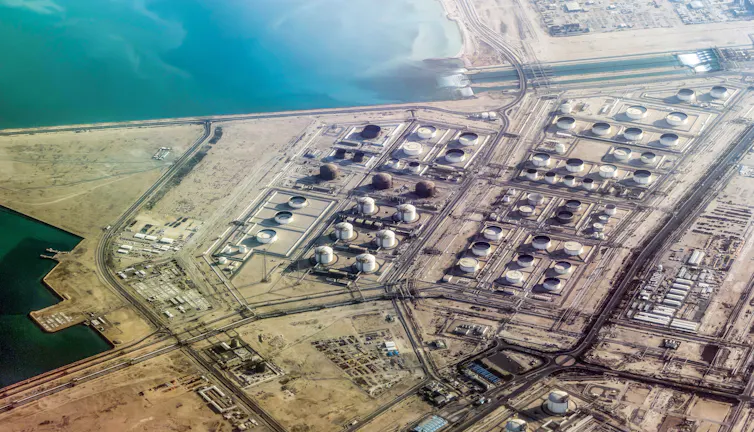
An aerial view of Qatar's Ras Laffan industrial complex.

Iranian attacks have caused significant damage to Qatar’s Ras Laffan industrial complex. Hannibal Hanschke / EPA

Disruption to energy exports is one part of the story. The war has also caused substantial physical damage to energy infrastructure across the region. Around 80 energy facilities, ranging from production plants to refineries and pipelines, have been targeted by Iranian missile and drone attacks so far.

It will take months – and in some cases years – to repair the damage (which stands at an estimated US$58 billion) once the war ends. Qatar’s liquified natural gas industry, in particular, has suffered serious damage. QatarEnergy, the state-owned energy company, says it will take up to five years to repair its Ras Laffan industrial hub alone.

Gulf diversification

The GCC states have adopted strategies to diversify their economies away from a dependency on hydrocarbons. Tourism and aviation are two central pillars of this, with GCC countries investing heavily in these sectors. The Gulf is now home to some of the busiest international airport hubs in the world.

But these industries, too, have been damaged by the war. Financial analysis firm, Moody’s, suggested recently that hotel occupancy in Dubai is set to plummet to 10% in the second quarter of 2026 from 80% before the war. Some Iranian attacks have targeted civilian areas, including hotels and residential buildings, prompting tourists to stay away.

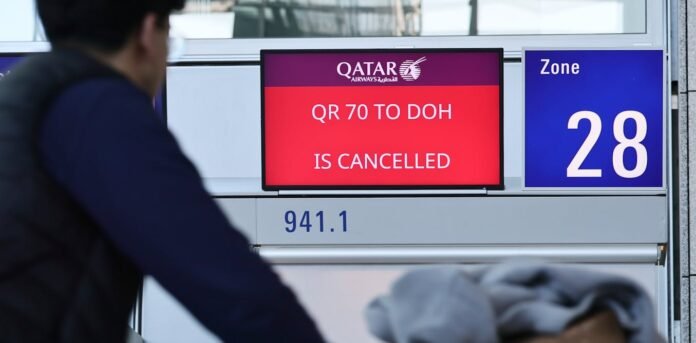
The Iran war has also placed Gulf airlines such as Emirates, Etihad and Qatar Airways under increasing financial pressure. More than 30,000 flights to the Middle East were cancelled in the first month of the war and jet fuel prices – the biggest variable cost to airlines – are up 90% on the annual average.

The logistics sector is another area of Gulf diversification. It has grown rapidly since the early 2000s thanks to the region’s strategic position between east-west trade routes. The UAE’s Jebel Ali Port, for instance, is now one of the world’s largest container ports and the base of Dubai’s multinational logistics firm, DP World.

However, Jebel Ali has seen a 40% drop in vessels due to the war, with container carriers rerouting to alternatives such as Salalah in Oman and Colombo in Sri Lanka. And while DP World has opened emergency land corridors to ports outside the Gulf to keep cargo moving, these routes are costly and have limited capacity.

The UAE and Qatar also both serve as major air freight hubs, acting as bridges for cargo travelling between Asia and Europe. But this has been affected by the war too. Freight rates have increased following attacks on both Dubai and Doha that led to grounded flights and air space closures.

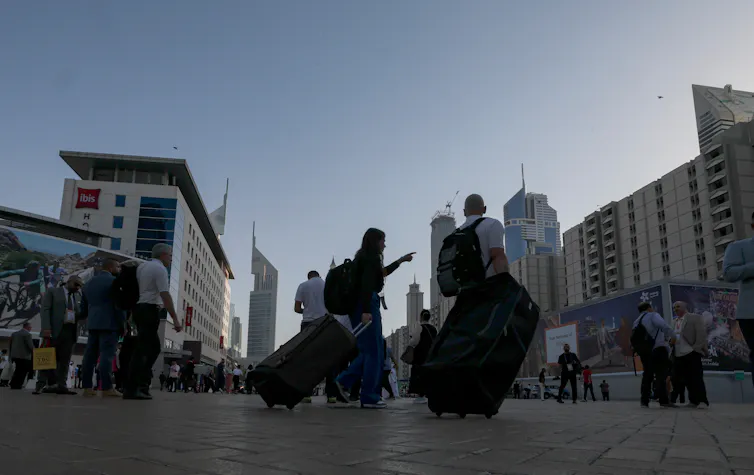
Tourists carrying their luggage through Dubai.

Tourists carrying their luggage through Dubai in April 2025. Ali Haider / EPA

In the long-term, the economic impact of the war on the Gulf economies will hinge on its duration and political outcome. But the risks are firmly tilted to the downside. The fiscal outlook for some GCC states is deteriorating, with several facing scenarios where government spending exceeds revenue. Public sector debt in some GCC states is rising too.

Moody’s has downgraded its outlook on Bahrain, which was already facing longstanding financial issues prior to the war, from “stable” to “negative”. This will make it harder for Bahrain to access much-needed capital and increase future borrowing costs.

GCC economies invest their surplus oil and gas revenues through sovereign wealth funds, which collectively manage between US$4 trillion and US$6 trillion in global assets. Governments are likely to draw on these funds to support domestic spending on reconstruction and bolstering their defences after the war.

This could undermine their future potential to fund large long-term diversification mega-projects such as Saudi Arabia’s Neom City. Plans for Neom, which was initially proposed as a linear city to home 9 million people, have already been scaled down in recent years due to issues including funding pressures.

The Gulf’s loss of “safe-haven” status due to the war, and the resulting reputational damage, cannot easily be reversed. Even after the conflict ends, higher risk premiums will persist for those doing business in the Gulf. Shipping disruptions could take months to unwind, and a prolonged closure of the Strait of Hormuz would be likely to trigger permanent rerouting.

If the conflict drags on, structural shifts in global supply chains may deepen, with lasting costs for the Gulf economies.

Trump-Xi summit puts US exports, Iran at center of reset bid

0
trump-xi-summit-puts-us-exports,-iran-at-center-of-reset-bid
Trump-Xi summit puts US exports, Iran at center of reset bid

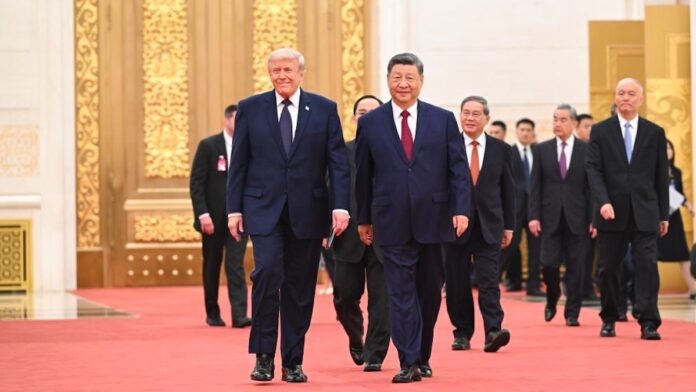
US President Donald Trump’s Beijing summit with Chinese President Xi Jinping has produced a package of Chinese commitments on US soybeans, energy and aircraft, giving both governments a basis to steady relations after years of trade and security tensions.

The two-hour-and-15-minute meeting between Trump and Xi has also laid the groundwork for Washington and Beijing to rebuild bilateral relations after years of escalating trade conflicts, export controls and geopolitical disputes. Trump invited Xi and his wife, Peng Liyuan, to visit the White House on September 24.

Trump told Fox News on Thursday that Xi has committed to helping the US on Iran and agreed to buy US soybeans, oil, liquefied natural gas (LNG) and other energy products. He said China would purchase 200 Boeing 737 jets.

A US official said Xi had opposed the militarization of the Strait of Hormuz and any effort to charge a toll for its use, while showing interest in buying more American oil to reduce China’s dependence on the strait in the future. 

“Both countries agreed that Iran can never have a nuclear weapon,” the official said.

US Treasury Secretary Scott Bessent said Washington has already secured a major soybean commitment from China, confirming that one of the main agricultural pledges from the previous Trump-Xi summit remained in place.

“And then soybeans, we have a very large purchase commitment from the Busan agreement for the next three years. So beans are really all taken care of,” he said in an interview with CNBC on Thursday.

At the previous Trump-Xi summit in South Korea last October, China agreed to purchase 25 million metric tons of US soybeans annually over the following three years.

Global geopolitical situations have changed since Washington captured Venezuelan leader Nicolas Maduro and his wife in January and began blocking ships from entering or leaving Iranian ports in April. Some Chinese pundits said the Middle East conflicts and global supply chain tensions have made Trump’s energy purchase request easier for Beijing to accept.

Reuters reported on Thursday that Chinese Customs appeared to have renewed licenses for hundreds of US beef exporters on Thursday, a move that would have restored market access for many plants whose permissions had expired over the past year. But then the Customs reverted the registration status of those exporters to “expired” on its website. It was unclear why Beijing made those moves.

Before the trip, observers have said Trump’s mission in China was straightforward. He wanted to help American farmers and manufacturers increase sales to China, giving Republican candidates a stronger economic message ahead of the mid-term elections in November.

Other US goals included pressing China to stop buying Iranian oil or supplying Tehran with drone parts and missile-related materials, and calling for the release of Hong Kong pro-democracy businessman Jimmy Lai.

Media reports said the two governments are expected to hold further talks to cut tariffs on about US$30 billion worth of imports not linked to national security concerns.

Meanwhile, Nvidia Chief Executive Jensen Huang’s last-minute hop onto Trump’s plane in Alaska to join the Beijing trip fueled market hopes that the two countries might have agreed on an arrangement allowing Chinese firms to import and deploy Nvidia’s H200 graphics processing units (GPUs).

Reuters reported on Thursday that the US Commerce Department has cleared about 10 Chinese firms to buy Nvidia’s H200 chips, including Alibaba, Tencent, TikTok parent ByteDance and JD.com. The US also approved Lenovo and Foxconn as distributors. Nvidia has not delivered any H200 chips to China, as Beijing has urged local firms to prioritize domestic chips over foreign processors.

Details about possible shipments of H200 to China were not immediately available.

China’s rejuvenation meets MAGA

For Beijing, Xi’s top priority at the meeting was to rebuild China-US relations and prevent heavy US tariffs from returning in early November 2026, after a one-year truce. Beijing also wants the Trump administration to stop arms sales to Taiwan and roll back tariffs and export controls on China.

At a banquet held in honor of Trump and his delegation, Xi said China-US relations concern the wellbeing of more than 1.7 billion people in both countries and affect the interests of more than eight billion people worldwide. He said both sides should rise to that historic responsibility and steer the giant ship of China-US relations steadily in the right direction.

Xi framed his own national rejuvenation agenda and Trump’s “Make America Great Again (MAGA)” slogan as compatible rather than conflicting goals.

“The people of China and the US are both great people. Achieving the great rejuvenation of the Chinese nation and making America great again can go hand in hand. We can help each other succeed and advance the well-being of the whole world,” Xi said in a toast.

In the US, MAGA is a Republican slogan closely tied to Trump. In China, Xi’s “great rejuvenation of the Chinese nation” refers to Beijing’s goal of making China wealthy, powerful and central to global affairs by 2049, while reversing what the Communist Party calls a century of national humiliation by Western powers. The concept is also tied to Beijing’s goal of reunification with Taiwan.

“If the Taiwan issue is handled properly, the bilateral relationship between China and the US will be overall stable,” Xi told Trump in the official meeting on Thursday. “Otherwise, the two countries will have clashes and even conflicts, putting the entire relationship in great jeopardy.” 

Safeguarding cross-strait peace and stability is the biggest common denominator between China and the US, he added, emphasizing that “Taiwan independence” and cross-Strait peace are as irreconcilable as fire and water. He urged the US side to exercise extra caution in handling the Taiwan question.

“I have agreed with President Trump on a new vision of building a constructive China-US relationship of strategic stability,” Xi said. “I look forward to working together with you to set the course and steer the giant ship of China-US relations, so as to make 2026 a historic, landmark year that opens up a new chapter in China-US relations.”

The new vision will provide strategic guidance for bilateral relations over the next three years and beyond, and should be welcomed by the people of both countries as well as the international community, he said.

“China-US economic ties are mutually beneficial and win-win in nature,” he said. “Where disagreements and frictions exist, equal-footed consultation is the only right choice.”

He said the two governments should implement the consensus reached by the leaders and make better use of communication channels in political, diplomatic and military-to-military fields. He added that the two sides should also expand exchanges and cooperation in trade, health, agriculture, tourism, people-to-people ties and law enforcement.

Thucydides Trap

During the official meeting with Trump, Xi expressed his wishes in three questions.

“Can China and the US overcome the Thucydides Trap and create a new paradigm of major-country relations? Can we meet global challenges together and provide greater stability for the world? Can we build a bright future together for our bilateral relations in the interest of the well-being of the two peoples and the future of humanity?” he said. “These are the questions vital to history, to the world and to the people.”

The Thucydides Trap is a term popularized by American political scientist Graham Allison to describe the risk of war when a rising power challenges an established power. In China-US relations, it refers to whether Beijing’s rise and Washington’s strategic dominance can be managed without military conflict.

“Some US commentators and policymakers had in recent years treated China-US rivalry as unavoidable, saying the two countries had already fallen into the Thucydides Trap and were bound to compete for supremacy,” said Cui Hongjian, a professor at the Academy of Regional and Global Governance at Beijing Foreign Studies University. “This pessimistic and negative sentiment not only affected China-US relations, but also affected the international community, raising the sense of insecurity and uncertainty.”

He said the latest Trump-Xi meeting, coming after their summit in Busan, showed both sides wanted to move the relationship away from pessimism and back toward controlled engagement.

“This has resolved a major psychological concern in the international community,” he said. “This interaction is expected to reverse that sense of losing control and put the two countries back on a track of reasonably and effectively managing their relationship.”

Read: Trump-Xi summit to weigh US energy sales amid Hormuz crisis

Follow Jeff Pao on X at @jeffpao3

Tourists Flee Disney’s Childhood Home in Horror

0
tourists-flee-disney’s-childhood-home-in-horror
Tourists Flee Disney’s Childhood Home in Horror


The house where Walt Disney once dreamed up a future filled with magic is now surrounded by scenes visitors say look more like a disaster zone.

Tourists traveling to Kansas City to see the legendary creator’s childhood home are being met with piles of garbage, discarded needles, abandoned vehicles and homeless encampments spreading through nearby alleys and streets.

What should feel like a nostalgic stop connected to the man behind Disneyland has instead become a disturbing wake-up call for shocked visitors.

Disney’s former home on Bellefontaine Avenue still looks picture-perfect from the outside. The historic property features a cozy front porch, rocking chairs and the kind of old-fashioned charm that feels pulled straight from a Disney movie.

But just around the corner, the fantasy reportedly falls apart fast.

Overflowing trash, debris and signs of drug activity have become impossible to ignore as the area surrounding the iconic home continues to deteriorate.

“It gives this place a bad name,” homeowner Roberta Young told Fox 4 Kansas City.

Young, who owns the property and gives tours to Disney fans from around the world, said the neighborhood has dramatically spiraled downhill in recent years.

“Even when I came up, it was not this bad,” she said.

The growing crisis comes as Kansas City prepares to host four World Cup games this summer, with thousands of tourists expected to pour into the city.

Young fears visitors will see the chaos surrounding Disney’s childhood home and leave horrified.

Kansas City reportedly has around 3,000 homeless people living on its streets, with local reports claiming the city now has one of the highest homeless populations per capita in the region.

The city has pledged millions of dollars to address the crisis, but officials admitted they cannot force people to leave encampments or accept treatment.

Meanwhile, neighbors say conditions continue getting worse.

Young said she wants city leaders to aggressively clean up the neighborhood and help addicts get off the streets before the international spotlight arrives for the World Cup.

“What I actually want and hope and pray that they get to do is to clean up the alley,” she said.

“At least 100 days in a rehab to clean these people up and maybe they can get their self together in order to get a job.”

The situation is especially heartbreaking considering the home’s place in American history.

Disney moved to Kansas City when he was nine years old and spent much of his childhood there before eventually launching the entertainment empire that would become one of the most recognizable brands on Earth.

He attended school nearby, studied art in the city and even created some of his earliest animated projects there before leaving for Hollywood in 1923.

Now, the once-magical neighborhood tied to the birth of Disney’s empire is becoming known for something far darker.

DOJ Escalates War on Trans Youth Healthcare With Criminal Subpoenas

0


In an escalation of its efforts to criminalize and eradicate trans healthcare, Donald Trump’s administration has sent its first known criminal subpoenas to hospitals that have provided gender-affirming care for young trans people. 

New York University Langone received a criminal grand jury subpoena last week from the US Attorney’s Office in the Northern District of Texas demanding information about teens who received care from the hospital’s now-shuttered trans youth health program, as well as information on the medical staff who provided that care. 

In accordance with a New York state shield law, the hospital posted a public notice to inform affected patients. The notice also said “several” other institutions had received similar subpoenas, which the hospital said demands “information pertaining to patients under the age of 18 who received gender affirming care” between 2020 and 2026.

Previous administrative subpoenas for confidential patient information have been reliably quashed in courts around the country as blatantly unconstitutional, illegal intrusions into patient privacy. So far, these have been related only to civil investigations. The Langone subpoena means that the federal government has now launched a criminal investigation into trans youth healthcare providers, and in Northern Texas, a judicial district prone to extreme, right-wing decisions. 

What we do know for certain is that resisting every government demand here is the only acceptable path forward. 

It appears that providers, not the trans patients or their guardians, are the target of the criminal investigation. Since federal grand juries are the black boxes of the criminal legal system, little information is available about the details of the case. It is not even publicly known what charges the prosecutors could be pursuing. The subpoena demands sweeping information including medical records relating to any patients under 18 who received gender-affirming treatments, including puberty blockers, hormone treatments, or any other “clinical services.” What we do know for certain is that resisting every government demand here is the only acceptable path forward. 

When it comes to healthcare providers, New York’s Shield Law is specifically in place as a protection from out-of-state prosecution. But the law has not yet been robustly tested against a federal case. 

“The hospital may try to fight the subpoena, in whole or in part, in court — but because the federal government is strategically pursuing the case in one of the most conservative courts in the country, Langone faces an uphill battle,” S. Baum wrote in the trans news and advocacy site Erin in the Morning. “This round of litigation could also put the efficacy of Shield Laws to the test.”

The Justice Department’s aim, whether or not the grand jury leads to prosecutions, is to further intimidate and harass healthcare providers and hospital administrators nationwide into preemptively ending services for trans young people. Many institutions, including NYU Langone, have already complied and stopped providing such care. Convening the grand jury is yet another direct and immediate attack on trans kids and adults, and a threat to bodily autonomy and medical confidentiality more broadly.

We also know by now that the Constitution or our country’s laws are no constraint on the Trump administration. Prosecutors and lawmakers will continue to throw everything they can against the wall until something sticks to establish a new political-legal reality — one usually achieved after a case winds its way up to a favorable federal judge, and eventually the far-right Supreme Court. 

Meanwhile, NYU Langone has shown itself to be an easy target. In response to threats from the federal government last year to withhold funding, the hospital ended its Transgender Youth Health Program. Despite the fact that a federal court in April ruled that the government cannot withhold funding over trans healthcare provision, more than 40 hospital systems have stopped providing necessary medical care to trans youth based on the Trump regime’s threats. 

The fact that Langone already bent to Trump’s demands by shuttering the program but is still facing a potential criminal probe only proves the folly of compliance. Should the hospital, or any other hospital system, supply federal prosecutors with patient’s or worker’s personal information, patients would be well within their rights to sue for HIPAA violations and potentially even civil rights violations given the discriminatory nature of the request. Patients and their families can also file a motion against the subpoena — a precedent that has been set when it comes to administrative subpoenas asking for trans patients’ information. 

“If you capitulate, you’ve actually opened yourself up to liability for selling out your constituents.”

Earlier this year, for example, the families of six trans teens who had received treatment at the Children’s Hospital Los Angeles filed a motion to quash an administrative subpoena on behalf of themselves and more than 3,000 other transgender youth patients and families whose identities and private medical information the subpoena demanded. A settlement was reached, in which the government withdrew the subpoena requests seeking patient-identifying information and instructed Children’s Hospital to redact all such information from any documents produced.

Meanwhile, a federal judge in the Northern District of Texas — from the same district where the criminal grand jury is empanelled — ruled earlier this month that Rhode Island Hospital in Providence must comply with a Justice Department administrative subpoena for trans youth patient information, including names, addresses, Social Security numbers, and medical records. In response, the Rhode Island Office of Child Advocate filed an emergency motion to quash the request. In a hearing over the motion in a Providence court, U.S. District Judge Mary McElroy slammed the Justice Department for conducting a “fishing expedition” by seeking medical records and patient information in a scrambling effort to criminalize healthcare provision; she also said the case was quite clearly “shopped” to Texas. 

For institutions and individuals, the stakes for resisting a criminal grand jury subpoena are higher. Individuals can be jailed and fined for the length of the grand jury in order to compel them to testify, and institutions can be slapped with hefty fines. But the consequences of giving in are graver still: Hospitals that capitulate to these demands could be subject to costly patient class action over privacy and rights violations. Institutions that hand over information are also aiding the potential criminal prosecution of medical care providers — an attack on the entire medical profession.

“If NYU Langone and other providers turn the confidential data of their patients over to the Trump-appointed U.S. Attorney for Northern Texas, everyone’s privacy, everyone’s healthcare, everyone’s civil rights are compromised,” Brad Lander, the former New York City comptroller and congressional candidate, wrote on Bluesky.

In March, a federal court ruled that a case brought by Columbia University students could proceed against the university. The lawsuit argues the university became a “third-party collaborator” in unconstitutional actions when it supplied the names and disciplinary records of students involved in Palestine solidarity organizing. The court determined Columbia could be found liable as a “state actor” for acting under government coercion to suppress student speech. Students and civil rights advocates sued the school for handing over student information in response to a congressional subpoena. While a civil, rather than a criminal, case, the finding should make institutions reflect on their readiness to comply with discriminatory and unconstitutional requests from this administration. 

“If the calculus before was that it’s better to comply with the federal government because it is either face saving or economically saving for these private institutions, now there’s the counterbalance: If you capitulate, you’ve actually opened yourself up to liability for selling out your constituents,” civil rights attorney and CUNY law professor Zal Shroff, who is representing plaintiffs in the case against Columbia, told me. 

Given that a federal grand jury subpoena is itself explicitly coercive, it’s unclear whether exactly the same legal claim could be made against NYU should it comply with the government’s demands. Shroff noted, “It may be that they are seeking to use the criminal process to avoid what has been found in the civil process,” but that nonetheless, “legal consequences work in multiple ways” when it comes to people’s ability to challenge private entities for their compliance with the administration’s harms. Continued complicity with Trump’s regime, however, has a known result. 

“NYU caved and ended care and they’re still being hit with a grand jury subpoena. It’s incredibly clear that no amount of preemptive compliance will stop this attack,” Harvard Law instructor Alejandra Caraballo wrote on Bluesky. “You either fight or you will be destroyed by this administration. Caving will not save you.” 

Israeli attacks kill 200 children in Lebanon since March 2: UNICEF

0
israeli-attacks-kill-200-children-in-lebanon-since-march-2:-unicef
Israeli attacks kill 200 children in Lebanon since March 2: UNICEF

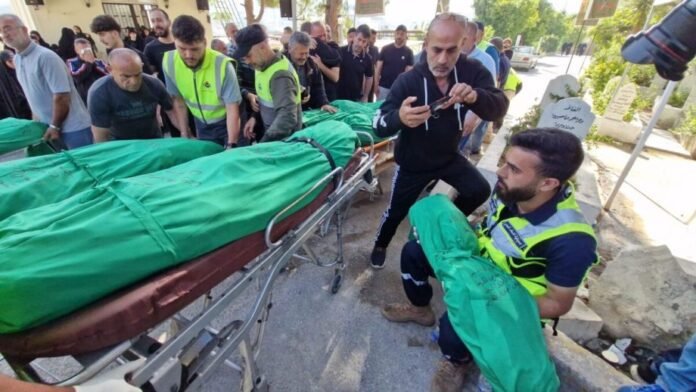
At least 200 children have been killed in Lebanon as a result of ongoing Israeli attacks on the country since March 2, UNICEF said Thursday, Anadolu reports.

“Children in Lebanon continue to be at the sharp end of ongoing violence, displacement and exposure to traumatic events,” the UN organization said in a statement.

UNICEF said at least 59 children were killed or injured in Lebanon during the past week despite a ceasefire agreement that has been in effect since April 17.

According to the organization, 23 children have been killed and 93 others injured since April 17, describing the figures as “a stark reminder of the ongoing risks children continue to face.”

The agency said the overall toll among children since March 2 has reached 200 killed and 806 injured, equivalent to nearly 14 children killed or wounded every day.

“Children are being killed and injured when they should be returning to classrooms, playing with friends, and recovering from months of fear and upheaval,” the statement said.

UNICEF added that beyond the direct impact of bombs and airstrikes, an estimated 770,000 children are experiencing “heightened distress” from repeated exposure to violence, loss and displacement.

It warned that the lack of mental health and psychosocial support services within safe and stable environments could expose those children to the “serious risk of developing chronic or lifelong mental health issues.”

“Nearly a month ago, an agreement was reached to silence the weapons and stop the violence. Reality is proving to be very different. Continued attacks are killing and injuring children, deepening their exposure to trauma and leaving devastating consequences that could last a lifetime,” said Edouard Beigbeder, UNICEF Regional Director for the Middle East and North Africa.

The agency called on all parties to protect children, comply with international humanitarian law and take all necessary measures to ensure the continuation of the ceasefire.

Since March 2, Israeli attacks in Lebanon have killed more than 2,896 people, injured over 8,824, and displaced more than 1.6 million, about one-fifth of the country’s population, according to Lebanese officials.

The Israeli army continues daily strikes in Lebanon and exchanges of fire with Hezbollah despite a ceasefire that was announced on April 17 and later extended until May 17.

Cell phone users can’t stop incriminating themselves

0
cell-phone-users-can’t-stop-incriminating-themselves
Cell phone users can’t stop incriminating themselves

“What kind of doctor was dr. pepper,” Utah real estate agent Kouri Richins once asked a search engine. (Sadly, there was no actual Dr. Pepper.)

But it was Richins’ less innocuous online searches that helped a jury find her guilty of murdering her husband Eric via fentanyl overdose—and of hoping to collect life insurance policies she had opened in his name but without his knowledge.

Richins was yesterday sentenced to life in prison without parole; her Internet history played a key role in the trial. A few weeks after Utah police began their investigation into Eric’s March 2022 death, they seized Kouri’s iPhone. Comparisons with records from her cell phone provider suggested that numerous text messages around the time of Eric’s death had been deleted from the device. In addition, cell phone tower pings helped establish where Kouri had been in the days before Eric’s death, which were a key piece of evidence in the state’s case against her.

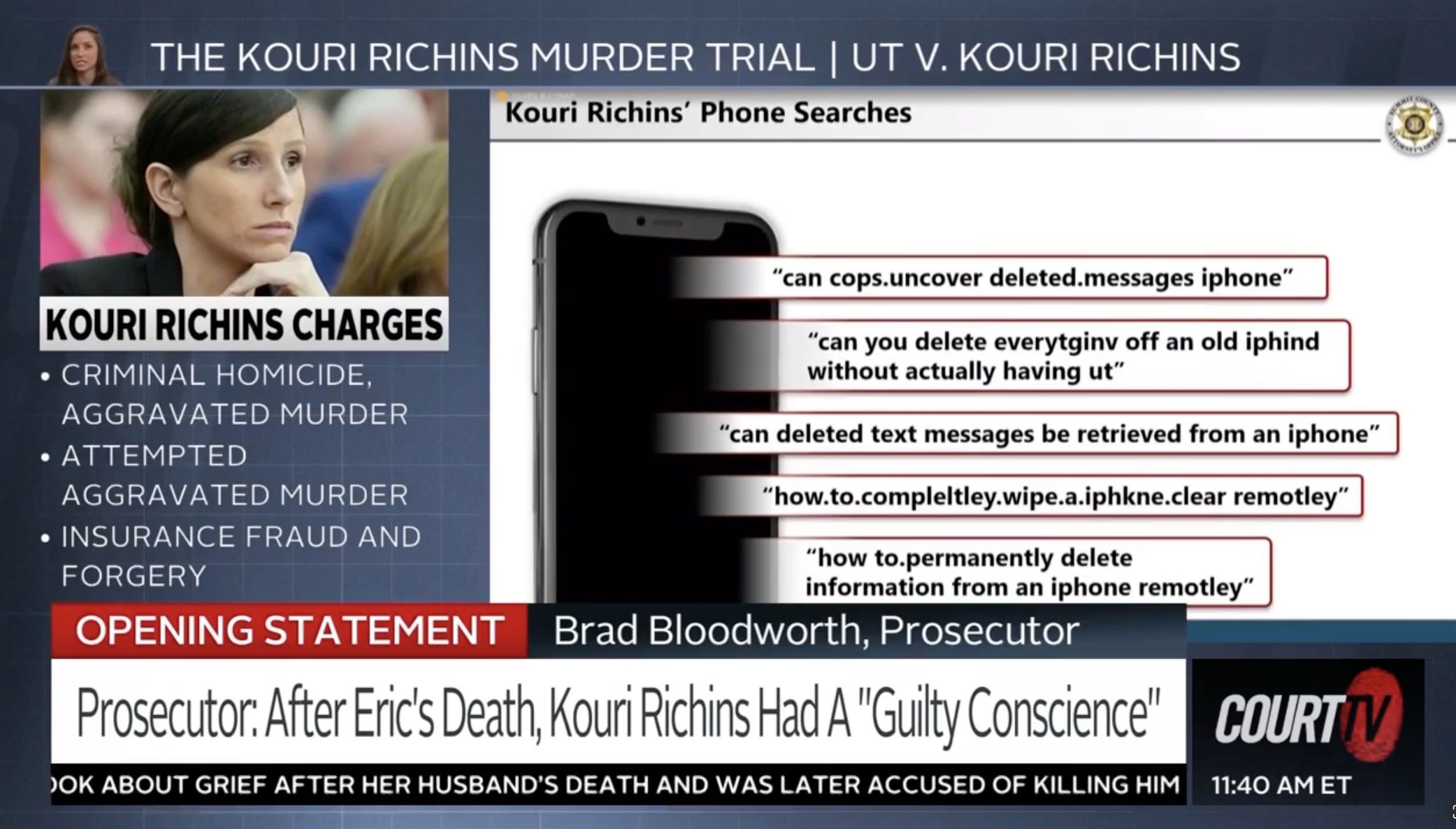
But it was her second iPhone that really made headlines. In April 2022, Kouri bought a replacement for her seized device and soon began searching for things which, at the very least, looked suspicious. Here are the five searches prosecutors decided to present to the jury during opening statements (which you can still watch on CourtTV) at Kouri’s trial earlier this year:

  • “can you delete everytginv off an old iphind without actually having ut” [sic throughout]
  • “can deleted text messages be retrieved from an iphone”
  • “how.to.compleltley.wipe.a.iphkne.clear remotely”
  • “can cops force you to do a lie detector test”
  • “women utah prison”

Later in the trial, prosecutors called Chris Kotrodimos (watch his testimony on CourtTV) to the stand. Kotrodimos was a cop turned private investigator who specialized in digital forensics, and he created a PowerPoint presentation showing even more relevant searches taken from this second phone. These included:

  • “can cops.uncover deleted.messages iphone”
  • “how to.permanently delete information from an iphone remotely”
  • “luxury prisons for the rich in America”
  • “if someone is poisoned, what does it go down on the death certificate as”

But this wasn’t even the full story. The New York Times notes that a “forensic analysis of burner phones used by Ms. Richins showed searches for… ‘how long does life insurance companies takento.pay’ and ‘what is a lethal.does.of.fetanyl.’”

Kotrodimos noted that Kouri had also visited web pages titled “what happens to deleted messages” and “how do police and forensic analysts recover deleted data from phones.”

And a local news channel said that she had accessed articles called “Signs of Being Under Federal Investigation” and “Delay in Claim Payment for Death Certificate with Pending Cause of Death.”

Many of these searches and articles could be explained as attempts to understand the case evidence or to prepare for future outcomes. Still, the repeated emphasis on remote deletion of iPhone data looks more sinister, and the messages certainly helped the prosecution. A jury convicted Kouri Richins of murder and various forms of financial and insurance fraud.

Photo of One of the exhibits from Richins' trial.

One of the exhibits from Richins’ trial.

One of the exhibits from Richins’ trial.

Am I going to jail?

In HBO’s The Wire, criminal mastermind Stringer Bell famously had the good sense to know that one should not be “taking notes on a criminal fucking conspiracy.” But in case after case (after case!) that I cover, this is a lesson that defendants simply seem not to learn. Many will blab specific and even lurid details of their alleged crimes into search engines, text messages, and now AI tools.

For instance, there was the strange 2024 case from Minnesota in which Samantha Petersen, high on meth, hit an Amish buggy with her car. She killed two children and a horse. When police arrived, Petersen’s twin sister tried to convince police that she (the twin) had been the driver.

The evidence against Samantha included, as usual, phone information, which revealed Internet searches for “what happens if you get in an accident with an Amish buggy and kill two people” and “if you hit a buggy and kill two people are you going to prison?”

Thanks to other phone data, this wasn’t a particularly tough case to crack. According to the New York Times:

An employee at [the grocery chain] Hy-Vee, where both sisters worked, told investigators they had received a hysterical call from Samantha Petersen on the morning of the crash in which she said she was high on methamphetamines and had killed two Amish children…

She also sent a text message to another person admitting she had killed the children, according to the complaint.

Petersen pleaded guilty in 2025 and was later sentenced to four years in prison. Her twin sister got 90 days.

So many stories

Examples can be multiplied almost infinitely.

Hanging out in “child free” subreddits and researching how hot a car must be to kill a child might not seem suspicious until your young child turns up dead in a hot car days later.

This Internet evidence was used to help convict Justin Ross Harris of intentionally killing his son Cooper back in 2014. In 2022, however, the Georgia Supreme Court tossed out the murder verdict (PDF), saying that prosecutors had introduced needlessly inflammatory and prejudicial material about Harris’ personal life at his trial.

What kind of material? Well, it too came from Harris’ phone. Harris had been sexting multiple women throughout the day his son died in the car, so prosecutors used “nine color pictures of Appellant’s erect penis that the State extracted from messages and blew up to full-page size as separate exhibits,” the court said.

Though this did have some relevance for establishing motive and state of mind, it was far too lurid and may have swayed the jury unreasonably, the court said. Harris was no longer seen as a murderer, and the state decided not to retry him.

But he didn’t get out of prison, because his phone had also revealed “lewd and sometimes illegal sexual messages and pictures with four minors,” which had landed him in jail on separate charges. He was finally released in 2025.

Or there’s the case of the Florida woman accused of strangling and robbing her own friend for money to buy drugs. In the hour before the killing, police say the woman searched for:

  • “chemicals to passout a person”
  • “making people faint”
  • “ways to kill people in their sleep”
  • “how to suffocate someone”
  • “how to poison someone”

This was allegedly in addition to visiting a Yahoo! Answers page called “Whats on those rags that make people pass out?“ and a Wikipedia entry for “murder-suicide.“

Our phones, our confessors

From nude photos to questions about dead children and “luxury prisons for the rich,” our devices have become such a part of our lives that there is almost nothing people will not confide to them.

This extreme trust sits uneasily against an extreme paranoia about our gadgets. For years—as just one example—enough people have asked whether Facebook listens to your microphone without permission that the company has an official response.

But as examples like those above illustrate, there’s little reason for companies to resort to outright spying like this, because users simply can’t wait to divulge the most intimate details of their minds and bodies voluntarily. Even if you’re a privacy mode-using pro, your search history may be just a quick subpoena away.

Nuclear energy set for comeback in Italy under new government framework

0
nuclear-energy-set-for-comeback-in-italy-under-new-government-framework
Nuclear energy set for comeback in Italy under new government framework


The Italian government is set to approve a framework for the resumption of nuclear power this summer, Prime Minister Giorgia Meloni told parliament.

Italy abandoned nuclear energy following a referendum held after the Chernobyl disaster nearly 40 years ago, but the government is now pursuing a return to the technology using next-generation small modular reactors operated by the private sector.

Meloni said an enabling law for the nuclear restart would be approved in the coming months, with the government arguing the policy would strengthen energy autonomy and reduce costs, particularly in the context of heightened geopolitical tensions linked to the Iran war.

During her address at “Prime Minister’s Time” in the Senate, Meloni also said her government remained open to cooperation with the opposition on national priorities including employment, healthcare, demographic decline and electoral reform, although opposition parties have already dismissed the overture.

She reiterated that wages, business incentives and birth rates remain central policy priorities, adding that under her administration the number of precarious workers has fallen while stable employment has increased. She also said young people should see staying in Italy as a viable choice rather than a “forced sacrifice,” amid continued concerns over brain drain.

On wages, Meloni said stronger collective bargaining was needed to raise pay levels. She also stated that by the end of March, 76% of funds allocated under the EU’s National Recovery and Resilience Plan (NRRP) had been spent, describing implementation as effective.

The prime minister also clashed with centrist Italia Viva leader and former premier Matteo Renzi over the government’s housing programme. She defended the initiative, arguing that housing is a fundamental need rather than a luxury, and highlighted plans to deliver around 100,000 new homes over the next decade, including social housing and subsidised options.

Meloni also criticised elements of the opposition, accusing critics of failing to recognise the utility of government housing policies. In broader comments, she suggested that EU-level decision-making structures can obstruct national policy due to veto constraints, and warned that geopolitical tensions could weigh on Italian growth.

She added that she had recently visited a supermarket and observed continued public support for the government. Meloni also said her administration had only raised taxes on banks, insurers and energy companies, and pledged further tax cuts next year, while the opposition, citing Istat data, argues Italy is facing record taxation levels.

Separately, opposition leader Matteo Renzi said the government resembled “the Addams Family,” underscoring the increasingly adversarial tone of parliamentary exchanges.

As tick bites surge, conspiracy theories follow

0
as-tick-bites-surge,-conspiracy-theories-follow
As tick bites surge, conspiracy theories follow

“Tell you what,” Drew Maciel told his Instagram followers in April, “I’m sick of finding dead moose.” He zoomed in on a dead bull moose lying prone on the ground, running the camera over clusters of ticks nestled within every crevice of the corpse.

Maciel is a shed hunter, meaning he collects antlers that have been naturally “shed” by wildlife. But a winter tick feeding frenzy in Maine, driven by rising temperatures, means that this year he kept finding dead animals. Up to 90 percent of the moose calves tracked by scientists in recent years have been bled to death by ticks — an ongoing crisis in a state that prizes these largest of all deer species.

But where scientists see the hand of climate change at work — average temperatures in Maine have risen 3 degrees Fahrenheit since 1985 — others see the designs of a global cabal. 

“Human engineered biological warfare,” read a comment on Maciel’s video posted by Dries Van Langenhove, a far-right former member of the Belgian government who was recently convicted of violating the country’s Holocaust denial laws. The comment got 32,000 likes. “It’s Bill Gates,” someone else posted.  

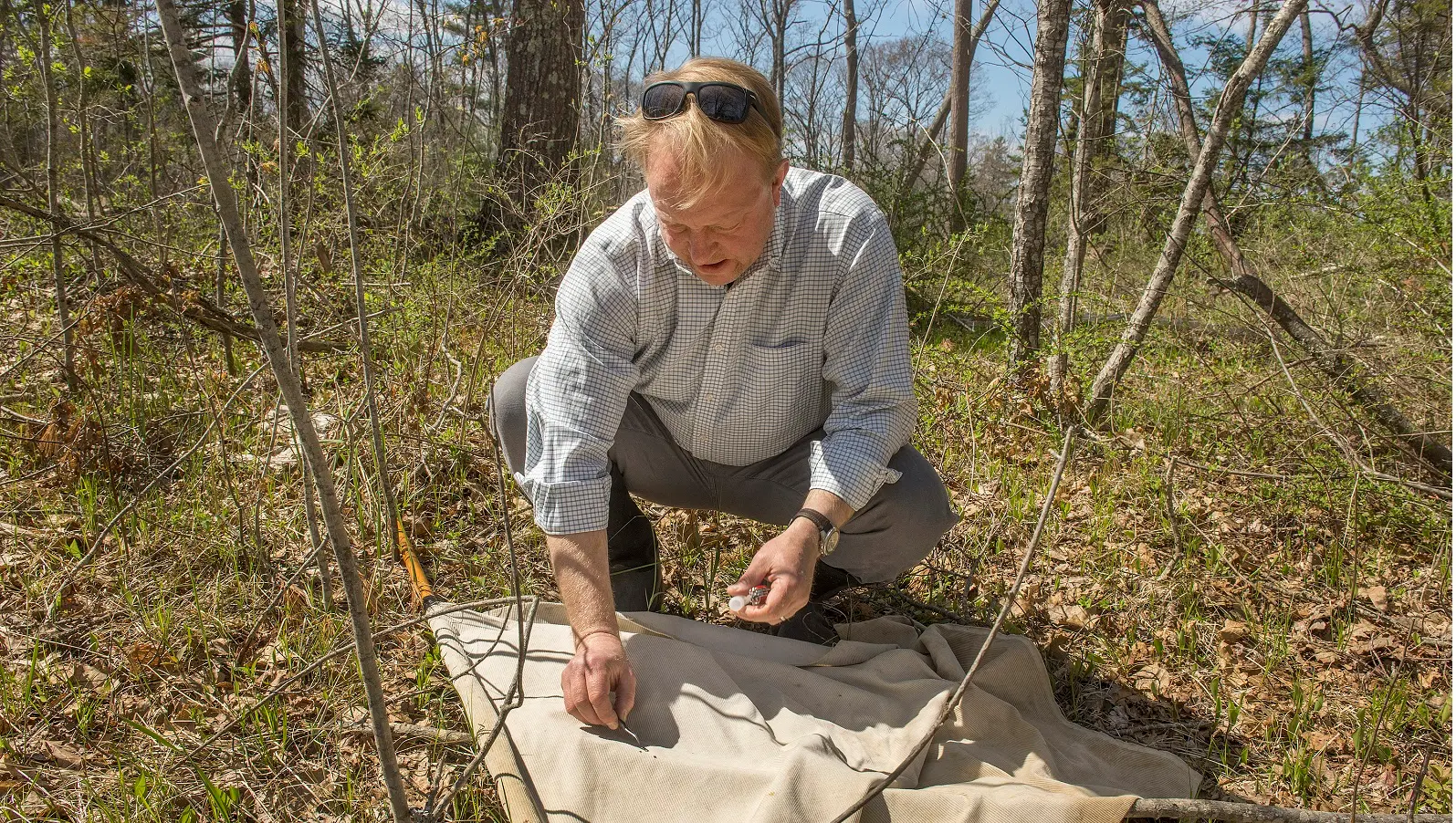
Chuck Lubelczyk, a vector-borne ecologist with Maine Medical Center, collects ticks at a site in Cape Elizabeth. John Ewing / Portland Press Herald / Getty Images

These posts are part of a wave of tick-related conspiracy theories garnering millions of views online. In April, a self-proclaimed holistic doctor on Instagram claimed to have spoken with multiple farmers in the Midwest who told her that they were finding boxes of ticks dumped on their properties. “Something is happening with ticks right now, and farmers are starting to talk,” she posted alongside a video that got 10 million views across Facebook, Instagram, and TikTok. The MAHA Moms Coalition, a nationwide group inspired by the Trump administration’s Make America Healthy Again agenda, reposted the claim asking affected farmers to come forward.

The theory dates back to 2023, with viral claims that Pfizer and Valneva, pharmaceutical companies developing a vaccine for Lyme disease, were planting boxes of ticks on farms to drum up demand for their product. 

A separate theory that gained traction around the same time linked a British research program to genetically modify cattle ticks, funded in part by the Bill and Melinda Gates Foundation, to rising cases of red meat allergies in the U.S. The biggest problem with that theory is that the allergy, Alpha-gal syndrome, is caused by the bite of a Lone Star tick — a completely different species from the cattle ticks in the research program.

While all these conspiracies involve different ticks, different diseases, and different alleged culprits, they are often treated as interchangeable evidence of the same broader claim: that rising tick encounters are a part of a nefarious human plot. 

The theories are right about one thing: Ticks are getting worse. Some of the same ecological changes fueling Maine’s winter tick boom are also making tick encounters more common in broad swaths of the U.S. The arachnids are showing up earlier in the year, expanding into new terrain, and biting people more often than they used to. But the force driving those shifts is not a clandestine bioweapons program, a vaccine plot, or Bill Gates — it’s climate change. 

A screenshot of an Instagram post furthering the unproven claim that Midwestern farmers are finding boxes of ticks left behind on their properties. Instagram

Richard Ostfeld, an ecologist at the Cary Institute of Ecosystem Studies, said a warming world is “bringing ticks out earlier in the year” in states like New York, where he lives. “It used to be we were pretty safe in the month of May,” he said. “Now, not so much.”

Tick season is off to an unusually early start across most of the U.S. this year, the Centers for Disease Control and Prevention, or CDC, said in an alert published late last month. Emergency room visits for tick bites in four of the five geographic regions the agency tracks are the highest they’ve been for this time of year since the CDC started keeping tabs on tick-borne illness rates in 2017. 

While the CDC hasn’t said what’s behind the uptick in bites this spring, ample snow cover earlier in the year helped insulate adult ticks from the cold of winter, and an early spring bloom across much of the U.S. likely brought those hungry adults out of the leaf litter earlier than normal. But regardless of the specific dynamics at play this year, rising average temperatures will lead to more robust tick exposure on balance. That’s because warmer temperatures both coax ticks north into territory that was once too cold to host them and also extend the length of time that ticks are active every year.

More tick bites mean more opportunities for infection — and the list of infections doctors are watching for is getting longer. Positive tests for alpha-gal syndrome have increased 100-fold since 2013; nearly half a million people in the U.S. now carry an allergy to red meat. Cases of anaplasmosis, a disease carried by black-legged ticks that hospitalizes roughly 30 percent of the people who contract it, increased 16-fold between 2000 and 2017. Babesiosis, a malaria-like illness also carried by black-legged ticks, has risen roughly 10 percent year-over-year since 2015. It’s not uncommon now for a single tick to carry two or more diseases. 

Ecologists who study ticks see an interwoven mix of factors driving these increases. Land-use and wildlife changes are increasing contact between humans and ticks, invasive and expanding tick species are bringing different disease risks to new parts of the country, and better testing and reporting of tick-borne illnesses is making diseases more visible. But there is widespread agreement in the scientific community that those trends are unfolding against the backdrop of climate change.

Ostfeld worries that the complexity of the factors that lead to higher rates of tick-borne disease, paired with the allure of online conspiracies, will make it harder for people to understand why backyards in some parts of the country are getting more dangerous. “The more I read about people actually believing some of these conspiracy theories, the more I worry that even moderately complex explanations or phenomena we care about — like how likely we are to get bitten by a tick — might be too much,” he said.

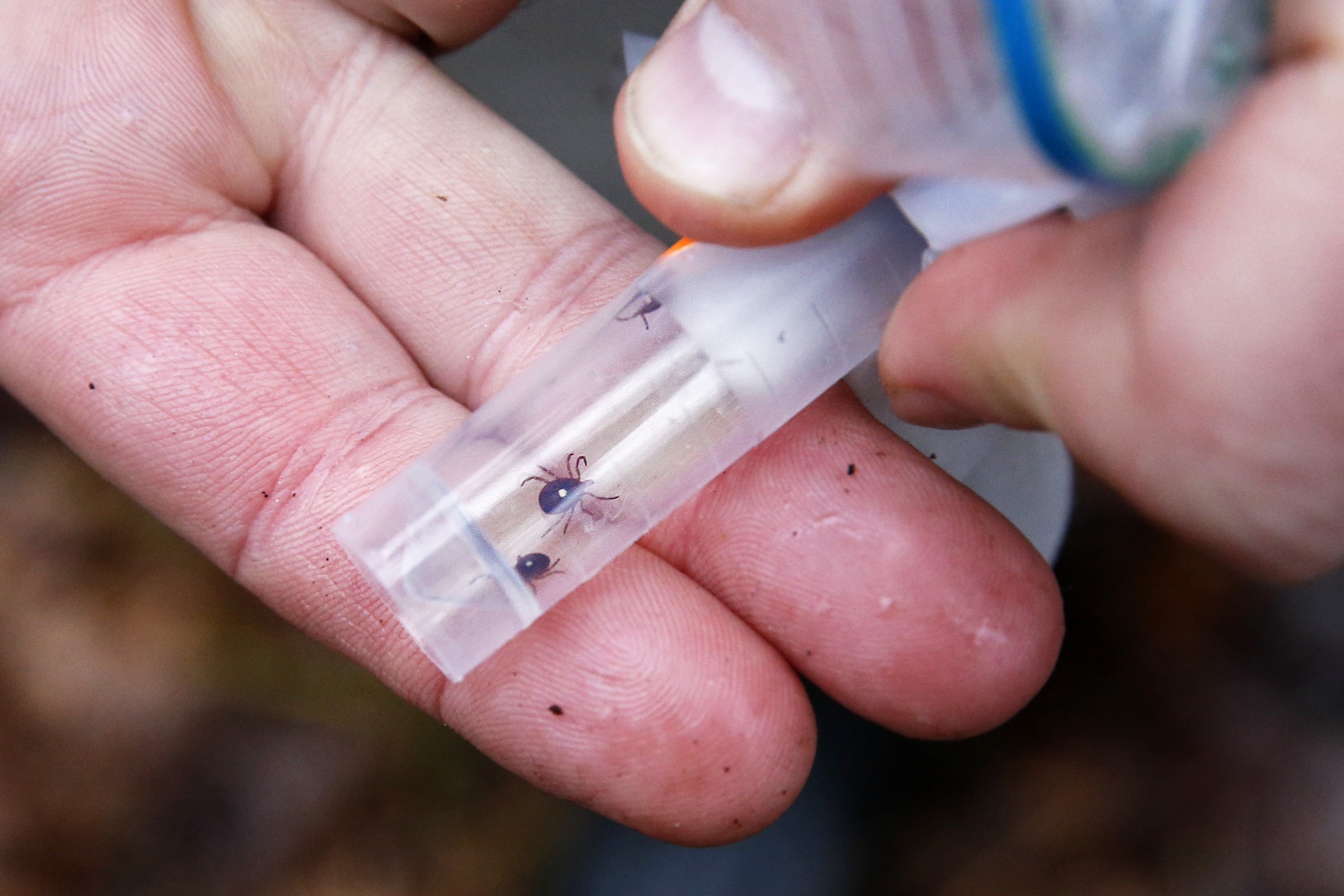
A close-up of pink hands holding a clear plastic tube containing three small black ticks

Scientists collect Lone Star ticks, which can cause an allergic reaction to red meat, for research. Ben McCanna / Portland Portland Press Herald via Getty Images

It doesn’t help that conspiracies about ticks have now been legitimized by federal government officials. Robert F. Kennedy Jr., the Secretary of Health and Human Services, has at various times in his career opined that Lyme disease, which now affects an estimated half a million Americans every year, was created as a byproduct of vaccine research and originally used as a military bioweapon. (This flies in the face of genomic evidence that the bacteria causing Lyme has existed in North America for at least 60,000 years.)

Both Kennedy and Tucker Carlson, one of America’s most prominent Republican-aligned media figures, have hosted the writer Kris Newby on their podcasts in recent years. In both cases, Newby espoused debunked claims about the military origins of Lyme.  

The idea that Lyme disease and other tick-borne illnesses were created by a U.S. military bioweapons program is so pervasive that a formal initiative to investigate the origin has twice been introduced by lawmakers in the House of Representatives. Chris Smith, a Republican representative from New Jersey who spearheaded those efforts, was successful on his second attempt. A directive in the National Defense Authorization Act for Fiscal Year 2026, signed by President Donald Trump last December, includes a provision requiring the Government Accountability Office, or GAO, to investigate whether the military used ticks as biological warfare agents in the middle of the twentieth century. 

“GAO will be fully empowered to leave no stone unturned, and now it’ll have a congressional mandate to get to the bottom of it, because they were weaponizing ticks,” Smith said at a Lyme disease roundtable convened by Secretary Kennedy last year. 

But away from the congressional roundtables and viral videos, the plot begins to lose some of its drama. Even in the Midwest, where millions of social media viewers have been told that boxes of ticks are being dumped on unsuspecting farmers, evidence of foul play is hard to find. Terry Hoerbert and her husband Bob own Little Brown Cow Dairy, a small dairy farm in Delavan, Illinois. The lane down to the farm is short, Terry said, so she would have seen someone dropping off packages of ticks. Had the Hoerberts heard of any other farms in the area receiving packages of live ticks?

“We have not,” Terry told me. “You are the first to enlighten us.”


Counterterrorism Czar’s Blueprint Targets Leftists, Ignores Far-Right Violence and Heaps Praise on Trump

0
counterterrorism-czar’s-blueprint-targets-leftists,-ignores-far-right-violence-and-heaps-praise-on-trump
Counterterrorism Czar’s Blueprint Targets Leftists, Ignores Far-Right Violence and Heaps Praise on Trump

For a year, White House counterterrorism czar Sebastian Gorka promoted the national strategy he was drafting, saying he was pouring his “life’s work” into a “massive” blueprint that would overhaul the U.S. approach to combating terrorist threats.

The finished product, released May 6 after months of delays, is a 16-page, typo-sprinkled document that ranks threats based on politics rather than intelligence assessments, according to several current and former counterterrorism officials and threat analysts.

Islamist militant groups, the perennial top concern, now come second to Latin American drug cartels. The violent far right, which the FBI has repeatedly called the leading domestic threat, doesn’t merit a mention. Meanwhile, militant leftists, a small subset of extremist violence in the United States, are portrayed as a threat on par with global terrorist networks such as al-Qaida.

“A new type of domestic terrorism has emerged,” the document says, “driven by violent extremists who have adopted ideologies antithetical to freedom and the American way of life.”

Gorka’s strategy — the subject of a recent ProPublica report — lavishes praise on President Donald Trump’s national security agenda but offers few details about plans to tackle the administration’s top priorities: Latin American “narcoterrorists,” Islamist militant groups, and violent leftist antifascists and anarchists.

Gorka, who coordinates White House counterterrorism policy at the National Security Council, has called the document a “return to common sense” after a 2021 strategy by President Joe Biden centered on mostly far-right domestic threats. The new strategy mentions Biden seven times.

“What it tells me is that this administration is not paying attention to the data, to what our allies are seeing globally, or to where the biggest threats of violence come from or how they might be prevented,” said Cynthia Miller-Idriss, founding director of the Polarization and Extremism Research and Innovation Lab at American University.

Republican leaders often portrayed Biden’s focus on the violent far right as the Democrats cracking down on conservative organizing. That idea fueled Trump’s blanket pardon of more than 1,500 defendants, including those who attacked police, in the Jan. 6, 2021, storming of the U.S. Capitol.

Gorka did not reply to a request for comment. The White House, asked about criticisms of the plan, referred to a number of Gorka’s public statements touting it. Olivia Wales, a White House spokesperson, added in an email, “President Trump is crushing terrorist threats to the United States and will never let cartels, Jihadists, or the governments who support them plot against our citizens with impunity.”

Here are five notable aspects of the plan, compiled from interviews with counterterrorism personnel and researchers’ published critiques:

1. It’s about Trump, not terrorism.

The counterterrorism strategy begins with a signed foreword by Trump, who sets the tone by claiming credit for ending “four years of weakness, failure, surrender, and humiliation under the last administration.”

Analysts say the rest of the strategy often reads like a valentine rather than a sober national security communique. Under Trump’s leadership, it states, “America is again the world’s most powerful nation, with the largest economy in history, the most advanced technologies, and the bravest and most skilled warfighters the world has ever seen.”

The strategy’s top threat categories align with the president’s pet issues, including the villainizing of Democrats and leftist dissent. The language also echoes debunked right-wing conspiracy theories the president has shared about a stolen election, a purported genocide of Christians and existential threats to Western civilization by what the strategy calls “alien cultures.” One section refers to Christians as “the most persecuted people on Earth.”

“This was once a serious document written by serious people” across Democratic and Republican presidencies, veteran terrorism analyst and former Obama administration official Juliette Kayyem lamented on X. “Now it reads like a partisan screed.”

2. Data counter the priorities.

Analysts say the most obvious hole is the omission of violent far-right movements. Federal authorities have said for years that neo-Nazi and anti-government militia groups pose the most active and lethal domestic threats, though recently authorities have noted increases in leftist and mixed-motive attacks.

For example, on Sept. 10, the same day conservative youth leader Charlie Kirk was assassinated at an outdoor event in Utah, a 16-year-old gunman who was steeped in online forums for white supremacy and mass-shooter fandom opened fire at a Colorado high school, critically wounding two students before killing himself.

The strategy is concerned only with the kind of violent extremism the White House ascribes to Kirk’s alleged shooter, who is labeled a violent left-wing “radical who espoused extreme transgender ideologies.” Terrorism analysts say the attack motives do not appear so clear-cut; the suspect, who has yet to go to trial, reportedly comes from a Republican family but had shifted politically and had expressed opposition to the “hatred” he said Kirk spread.

Just last week, a lawsuit related to a deadly shooting last year at Florida State University revealed that the gunman had used ChatGPT to explore “his interests in Hitler, Nazis, fascism” and other far-right topics.

In a social media post, Jacob Ware, a terrorism researcher who has written extensively about the militant right, called the case a “friendly reminder that the #Trump administration’s new United States Counterterrorism Strategy does not mention far-right violent extremism.”

A man in a suit with a serious expression stands behind a gate with his hands clasped together. He has his eyes fixed on the foreground, where President Donald Trump is a blurred figure addressing a crowd.
Gorka’s counterterrorism strategy begins with a signed foreword by President Donald Trump, who claims credit for ending “four years of weakness, failure, surrender, and humiliation.” Justin Lane/Getty Images

3. Policies undermine strategy.

Several of the White House’s stated counterterrorism objectives conflict with the president’s own actions, analysts say.

For one, the pledge of stepped-up efforts to thwart plots doesn’t factor in the diminished capacity of federal agencies since Trump slashed the national security workforce last year and diverted counterterrorism resources to his mass deportation campaign.

Terrorism analyst Colin Clarke, executive director of the security-focused Soufan Center and a Gorka critic, summarized the document as “highly partisan & mostly incoherent.”

It touts the seizure of Venezuelan President Nicolás Maduro in a U.S. military operation as the important capture of a “narco-terrorist outlaw.” But weeks before the Maduro raid, Trump had granted a pardon to former Honduran President Juan Orlando Hernández, who was serving 45 years for trafficking 400 tons of cocaine into the United States.

Another U.S. goal is to aggressively counter anti-American propaganda by Islamist extremist groups, which the administration says have been driven from strongholds in the Middle East and are “exploiting the ungoverned spaces” across Africa. Places where “a resurgent terror threat is the reality,” according to the strategy, include West Africa, the Sahel region, Sudan and Somalia.

Yet efforts to counter anti-American messaging are undermined by increased U.S. airstrikes with civilian casualties, particularly in Somalia and Yemen, and the cutoff of humanitarian programs across the continent, conflict monitors say. U.S. aid has been a lifeline for communities whose desperation can be exploited by militant recruiters.

The strategy calls for a “light military footprint” in Africa, with the expectation that African leaders will take on a greater share of counterterrorism work. But Trump’s halting of foreign aid hobbled regional counterterrorism programs. Conflict monitors, now watching with alarm as Islamist militants capture territory and stage attacks in Mali, urge the administration to pay closer attention to the restive Sahel region and other hot spots.

“Terrorists are on the verge of recreating a new caliphate sanctuary that could serve as an incubator for attacks against the US homeland and interests abroad,” Alex Plitsas, a security analyst and former Obama-era Pentagon official, wrote this month after visiting U.S. Africa Command.

“The result is a warning for Washington: when the United States and its partners step back, jihadist groups and adversarial powers fill the space,” Plitsas wrote.

The strategy also disparages “failed ‘forever war’ policies” at a time Trump’s base is wrestling with his decision to launch the U.S.-Israeli war in Iran, a state sponsor of terrorism.

In a call with reporters after his plan was released, Gorka got defensive when asked how the Iran operation was not a “forever war” that could endanger Americans. He called critics “testicularly challenged.”

Anna Kelly, a White House spokesperson, drew a distinction: “Unlike the ‘forever wars’ of the past with vague objectives and ever-expanding timelines, President Trump is leading the most transparent administration in history, and he kept Americans apprised of the scope and defined objectives for Operation Epic Fury.”

4. Successes are exaggerated.

Trump’s preface opens by celebrating counterterrorism achievements that analysts describe as inflated or lacking in nuance.

One example is the claim that, within 43 days of Trump’s return to office, the U.S. had apprehended “the terrorist mastermind” of the deadly Abbey Gate attack in Kabul. In 2021, a suicide bomber detonated in a crowd of civilians outside an airport gate during the chaotic U.S. military withdrawal from Afghanistan, killing more than 150 Afghans and 13 American service members.

In March, the Justice Department hailed the arrest of Afghan national Mohammad Sharifullah, an Islamist militant it said had “orchestrated” the attack. Gorka has publicly recounted the dramatic scene of waiting on the tarmac in the cold at 3 a.m., alongside several Cabinet members, to welcome the plane carrying the handcuffed “man who was responsible for the murder, the massacre.”

Last month, just before Gorka’s strategy was released, a federal jury dealt a blow to the “mastermind” narrative by returning a mixed verdict. Sharifullah was convicted of aiding the terrorist group known as Islamic State Khorasan, but the jury deadlocked on whether there was sufficient evidence to hold him responsible for the Abbey Gate deaths. The difference shapes how much time Sharifullah could spend behind bars — the more serious charge was eligible for a life sentence.

A Justice Department news release about the conviction (but not the deadlock) was scrubbed of references to Sharifullah as an orchestrator and did not use the “mastermind” language that appeared days later in the White House strategy.

Analysts also expressed skepticism about the blueprint’s claim that “hundreds of Jihadist terrorists in multiple countries” had been killed in recent U.S. counterterrorism operations. The administration releases virtually no details about the identities of those targeted or the circumstances of their deaths. Humanitarian groups say they fear the operations could be causing uncounted civilian casualties.

5. Opponents are targeted.

Rights watchdogs say the strategy hints at ways Trump administration officials will attempt to build terrorism cases against U.S. leftist and Muslim activists through nebulous or nonexistent ties to transnational militant movements.

A link to a foreign entity formally designated as a terrorist group opens the door for government surveillance and potential charges related to providing aid — “material support” in legal jargon — to a foreign terrorist organization.

Analysts say that’s why the Trump administration has pursued designations targeting leftist militant groups in Europe under the label of antifa, as well as some branches of the Muslim Brotherhood.

The Brotherhood is a century-old Islamist group that renounced violence in the 1970s, though spinoffs such as Hamas remain active and on the U.S. blacklist. Republicans have long tried to portray U.S.-based Muslim advocacy groups as a foothold for the Brotherhood.

The document also calls for the rapid “neutralization of violent secular political groups whose ideology is anti-American, radically pro-transgender, and anarchist.” Researchers called the terms ill-defined and said they aren’t used in international counterterrorism work.

Miller-Idriss’ overarching concern about the Trump counterterrorism doctrine: “How damaging could it be? Both in the things it’s ignoring and the things that it’s emphasizing.”

0FansLike
0FollowersFollow
0FollowersFollow
0SubscribersSubscribe
- Advertisement -
Google search engine

Recent Posts