Takaichi on a mission to remake Japan’s place in Asia
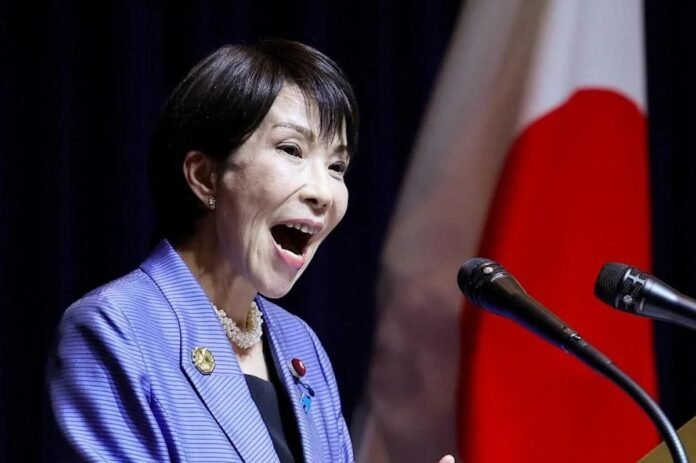
Japanese Prime Minister Sanae Takaichi is visiting Vietnam from May 1-3 and Australia from May 3-5, with energy security, critical minerals and China’s maritime posture expected on the agenda.
The most consequential element may be a foreign policy address she is expected to deliver in Hanoi, setting out a revised version of Japan’s Indo-Pacific strategy. But the trip is also shaped by what has come before it.
Takaichi has moved quickly since taking office in October 2025. She attended the ASEAN summit in Malaysia and APEC in South Korea within weeks of becoming prime minister, hosted Donald Trump in Tokyo and launched shuttle diplomacy with South Korean President Lee Jae-myung in January. A landslide election victory in February gave her the strongest domestic mandate of any Japanese prime minister since World War II.
In March, Canadian Prime Minister Mark Carney visited Tokyo and the two sides signed a Comprehensive Strategic Partnership covering defense, energy, critical minerals and technology.
India welcomed Japan’s recent decision to lift its longstanding ban on lethal arms exports, with both sides already coordinating the transfer of Japanese equipment used on Mogami-class vessels.
The picture is broader still. Tokyo is deepening its engagement with AUKUS Pillar II, maintaining the Quad, advancing trilateral defense cooperation through the US-Japan-Australia TSD and the US-Japan-Philippines framework, and co-developing a next-generation fighter with the UK and Italy under GCAP.
The sharpest test of Takaichi’s diplomacy came in March, when she traveled to Washington for a summit with Trump held against the backdrop of the Iran conflict. The United States had been pressing its allies to help secure the Strait of Hormuz.
Takaichi navigated the meeting by offering political support without making concrete naval commitments, citing constitutional constraints under Article 9. She left Washington with alliance cohesion intact but with Japan’s energy vulnerabilities laid bare.
The Vietnam and Australia visits follow directly from that experience: if the Trump summit was about managing an ally whose demands Japan cannot fully meet, Hanoi and Canberra are about deepening partnerships in which the interests are more clearly mutual and the vulnerabilities are shared.
The Hormuz question
The Iran conflict has made energy security an immediate concern for both countries. Japan relies on Australia for approximately 40% of its LNG and around 60% of its coal, but the dependency runs in both directions: Japan is one of Australia’s largest and most stable energy customers.
A recent East Asia Forum analysis described the two countries as existentially important to each other’s economic security. The Hormuz disruption threatens both Japan’s supply and Australia’s market access.
Takaichi is expected to seek Albanese’s cooperation on stable energy flows and safe navigation through the Strait of Hormuz. Australian Foreign Minister Penny Wong traveled to Tokyo ahead of the visit to discuss trade and energy security.
Takaichi is also reportedly bringing fuel assurances backed by Japan’s more than 200 days of strategic fuel stocks, a signal aimed at calming Australian consumers — and an illustration of the mutuality, with Japan offering its reserves to stabilize a market that keeps its own industry running.
Vietnam presents a different dimension of the same problem. Hanoi has asked Japan for assistance securing oil supplies, and Takaichi is expected to explore how Tokyo can cooperate during her summit with Prime Minister Le Minh Hung.
Critical minerals and the China factor
Japan’s long-term investment in diversifying its critical minerals supply away from Chinese dominance is now a central feature of its relationships with both Australia and Vietnam.
The Japan–Australia minerals partnership is the most mature example. Japan’s decade-long backing of Lynas Rare Earths, beginning in 2012, has helped build the largest rare earth producer outside China, but it has also helped build an Australian industry that would not exist at its current scale without Japan’s patient capital.
Lynas now supplies 7,200 metric tonnes annually of neodymium and praseodymium under a contract extending to 2038, with a minimum price guarantee. Australia’s Iluka processing facility, backed by $1.65 billion in government investment, adds further depth.
Vietnam holds some of the world’s largest rare earth reserves, yet its production and refining capacity remain limited. Closing that gap is one of the things Takaichi’s visit may seek to address.
The most significant deliverable from the Vietnam stop may be a foreign policy address in which Takaichi is expected to announce a revised version of Japan’s “Free and Open Indo-Pacific” strategy, the framework Shinzo Abe proposed a decade ago.
The updated version is expected to focus on three pillars: strengthening economic foundations, pursuing growth through shared challenges, and deepening security cooperation. The tilt toward economic security reflects the shift in the strategic environment since Abe first outlined the concept.
The choice of Hanoi as the venue is telling. Launching the revised strategy in a Southeast Asian capital rather than at a multilateral forum or alongside an alliance partner signals that the framework is meant to address the region’s own interests, not only Japan’s treaty allies’ concerns.
Anniversary language will frame the occasion, but the real test is whether the visit produces specific commitments that go beyond what already exists. Australia’s own 2026 National Defence Strategy places partnerships at the center of its posture and names Japan as “an indispensable partner.”
For Vietnam, the Indo-Pacific speech lands in a relationship that already has considerable depth. Japan is Vietnam’s largest ODA donor, its third-largest investor with $78.6 billion in registered capital, and its largest labor cooperation partner.
The two countries upgraded to a Comprehensive Strategic Partnership in 2023. The question is whether the revised framework produces new institutional mechanisms or funded initiatives that move the partnership into areas such as critical minerals processing, where progress has so far been slow.
The damage has not been repaired, and it has narrowed Japan’s ability to hedge between Washington and Beijing. The Vietnam and Australia visits are, in part, an effort to build the partnerships that can sustain a more assertive Japan in a region where its room for maneuver with China has contracted considerably.
Lam Duc Vu is a Vietnam-based risk analyst focused on regional trade and geopolitics
Howdy’s dated $3/month ad-free streaming service said to have 1M subscribers
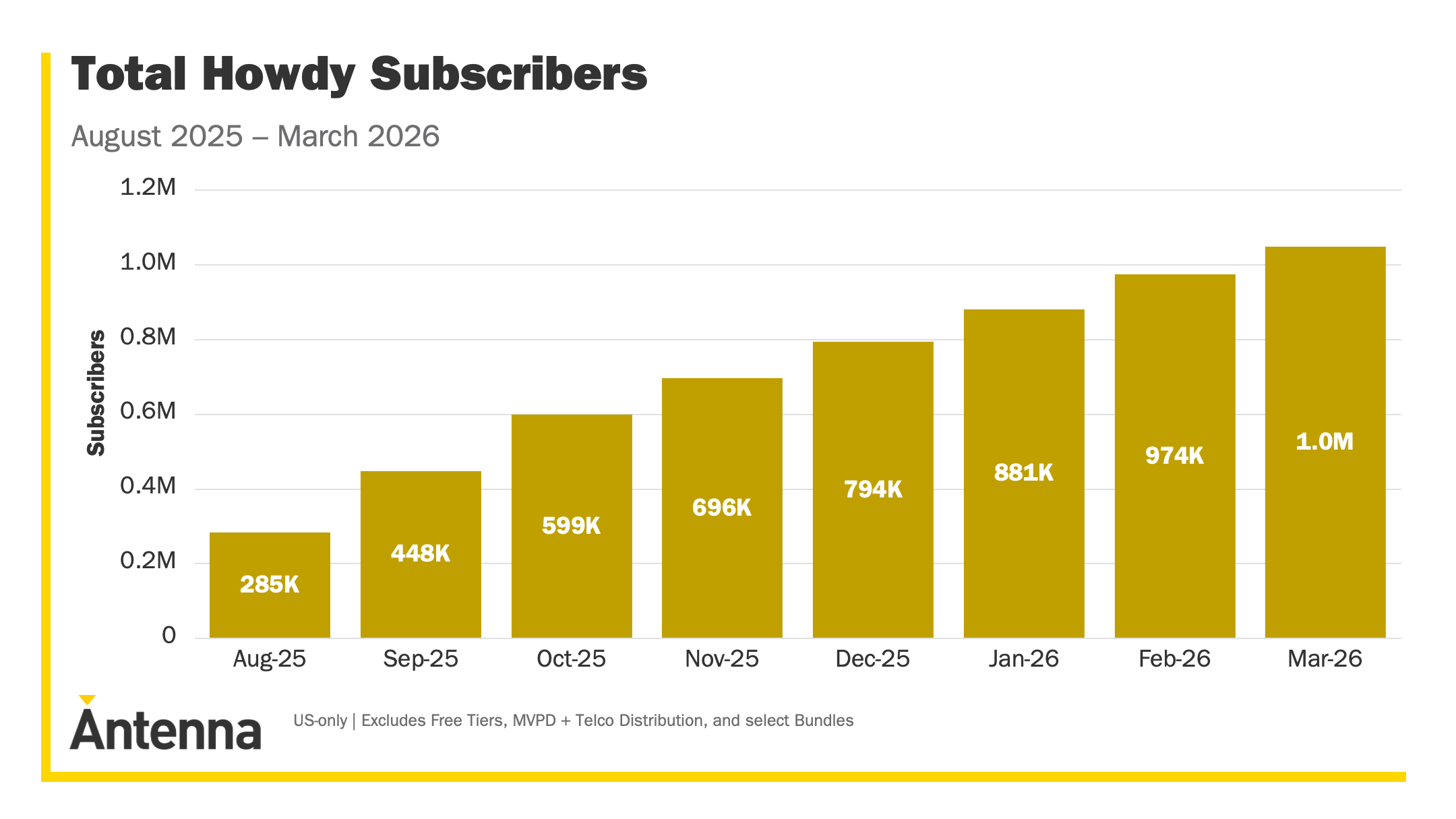
Six months after its launch, research firm Antenna estimates that the Howdy streaming service has more than 1 million subscribers.
Roku debuted Howdy in August. The subscription video-on-demand (SVOD) service is $3 per month and doesn’t have commercials.
In an announcement today, Antenna estimated that almost 300,000 people signed up for Howdy in August and that the service gained 100,000 subscribers in each subsequent month.
Credit: Antenna
Credit: Antenna
Roku initially only offered the service through The Roku Channel, which is Roku’s free ad-supported streaming television (FAST) service. People can also subscribe to non-Roku streaming services, like Apple TV and HBO Max, through The Roku Channel. Since Howdy launched, it has represented 23 percent of all SVOD subscriptions made through The Roku Channel, Antenna said.
Howdy doesn’t claim to offer the latest and greatest TV shows or movies. In fact, part of its slogan is: “Almost everything you want to watch.” Currently, its list of featured movies is notably dated with titles including Brooklyn’s Finest (2009), Foxcatcher (2014), Edge of Tomorrow (2014), Raw Deal (1986), and The Age of Innocence (1993). Under “recently added TV,” you’ll find All of Us (2003–2007), Mad TV (1995–2009), Nash Bridges (1996–2001), Nip/Tuck (2003–2010), and Southland (2010–2013).
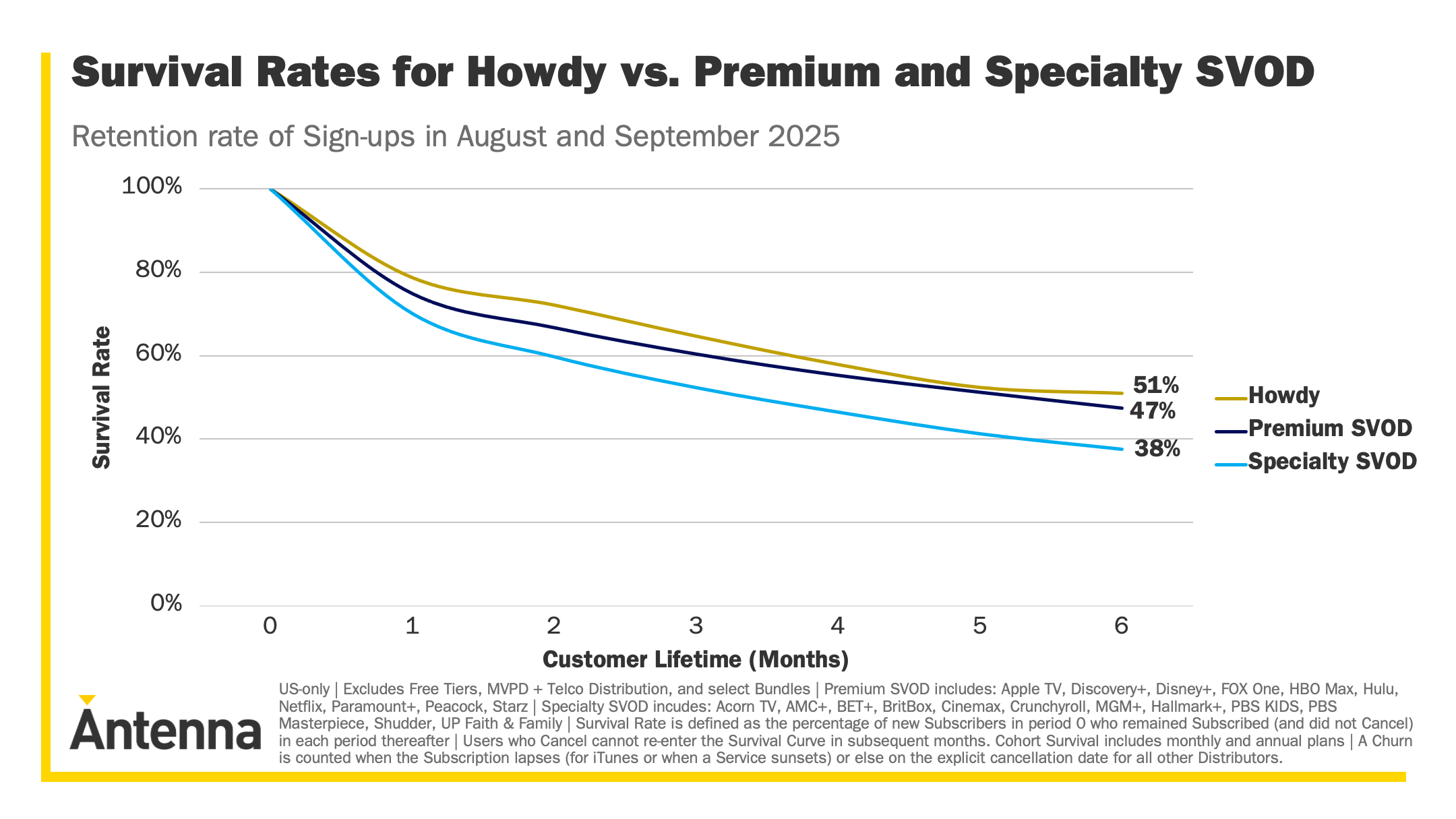
Howdy is very young, but Antenna reported that most people who signed up for Howdy when it first launched have kept their subscriptions:
Among sign-ups to Howdy in August and September 2025, Antenna estimates that 51 percent were still subscribed 6 months later. That 6-month Survival Rate sits ahead of the Premium SVOD average (47 percent) and the Specialty SVOD average (38 percent). The $2.99 price point likely plays a role here, as the low monthly commitment reduces the friction that drives churn on higher-priced services.
Credit: Antenna
Credit: Antenna
Roku hasn’t confirmed Antenna’s figures or provided its own subscriber count for Howdy.
“We’re pleased with Howdy’s strong early performance,” a spokesperson told The Hollywood Reporter (THR). “While we aren’t confirming any third‑party data, we’re encouraged by the momentum we’re seeing so far and the positive reception from streamers.”
Roku’s head of content, Lisa Holme, told THR in February that Howdy would get newer movies soon.
“The vast majority of Howdy subscribers are [The Roku Channel] viewers who are now just adding Howdy on top as another part of the ecosystem,” she added.
UAE’s departure from Opec tells a story about the limited future of oil production
The decision by the United Arab Emirates to leave the oil producers’ cartel Opec after 59 years is more than a symbolic break. It highlights a growing divide among major oil producers over how to respond to a changing energy landscape, and will weaken the group’s ability to manage global supply.
In the short term, the impact of the UAE’s exit will be limited. The world still needs every available barrel of oil, and the UAE accounts for some 3-4% of global production. But the forces behind the decision are more significant than the move itself. They are both economic and political – and the war in Iran helped the two align.
For years, the UAE has been investing heavily to expand its oil production capacity, spending around US$150 billion (£111 billion) to push its potential daily output close to 5 million barrels. But Opec quotas have prevented it from fully exploiting that capacity. Actual production has remained well below its potential at about 3.5 million barrels a day (mbd), with some 5 mbd capacity, constrained by the Opec quota system designed to restrict supply and support prices, generally shaped by the de facto leader, Saudi Arabia.
This has created a tension. Why invest to produce more oil if you are not allowed to sell it?
Abu Dhabi’s answer reflects a different economic model. The UAE can balance its budget at much lower oil prices than Saudi Arabia (just below $50 v Saudi $90 a barrel or more), giving it less incentive to restrict output. Instead, it has prioritised maximising its oil exports.
That strategy is also shaped by expectations about the future. As countries such as China accelerate the electrification of transport, the hitherto steady and reliable demand for oil is slowing and becoming less reliable. Over time, it is likely to plateau. UAE is also well ahead of the Saudis in energy transition – and maintain their net zero target as 2050, compared to the Saudi 2060.
From the UAE’s perspective, the bigger risk is not falling prices, but leaving oil in the ground that may never be sold.
Shifting geopolitics
The timing of the exit is not just about economics. It also reflects shifting political and security calculations, particularly after the UAE came under heavy, sustained attack during the war in Iran.
In Abu Dhabi, there is a growing sense that regional institutions and partnerships, such as the Gulf Cooperation Council (GCC) offered limited support during that period. Anwar Gargash, a senior presidential adviser, told reporters that: “The GCC’s stance was the weakest historically, considering the nature of the attack and the threat it posed to everyone,” adding that he “expected such a weak stance from the Arab League … But I don’t expect it from the GCC, and I am surprised by it.”
That experience has reinforced a more independent foreign policy. The UAE has strengthened ties with the US and Israel, building on the agreement it signed as part of the 2020 Abraham accords. The relationship with Israel is seen not just an economic and security partnership, but as a channel for influence inside the White House.
At the same time, relations with Saudi Arabia have become more strained, with differences over regional conflicts in Somalia and Yemen and economic strategy increasingly visible. Leaving Opec is both an economic decision and a geopolitical signal.
The UAE’s departure also raises questions about the future of Opec itself. The group once controlled more than half of global oil production. Today, its share is much smaller (no more than 35%), and internal divisions over production quotas are more pronounced. Quotas, long the core of its strategy, are increasingly seen as uneven constraints rather than shared commitments.
UAE energy minister, Suhail Al Mazrouei, explains the decision to leave Opec.
Saudi Arabia remains the only member with significant spare capacity, giving it outsized influence. The result is an organisation that still matters, but is less cohesive than it once was.
Not necessarily a win for the US
Some have hailed the UAE’s exit as a victory for Donald Trump, who has repeatedly criticised Opec for keeping oil prices high. A weaker OPEC would indeed lead to higher output and lower prices at the pump.
But sustained lower prices would also put pressure on higher-cost producers, including the US oil patch, which has been one of Opec’s main competitors in recent years. It benefited from the cartel’s restraint when it came to capping oil production. So what now looks like a geopolitical win could, over time, become an economic challenge.
For now, I believe that the UAE’s exit will not dramatically reshape oil markets. Demand remains strong enough to absorb additional supply, particularly as countries rebuild their inventories when Iran reopens the Strait of Hormuz. But the deeper significance lies in what the decision reveals.
Oil producers are no longer aligned around a single strategy. Some are trying to manage scarcity and keep prices high. Others are racing to monetise their resources before demand peaks and they end up with stranded assets. That divergence is likely to grow – and may ultimately prove more consequential than any single country leaving the cartel.
We may be entering a new age where oil is going to play a much lesser role in our lives.
End of an Era: SWISS airlines to Scrap Inflight Duty-Free Shopping
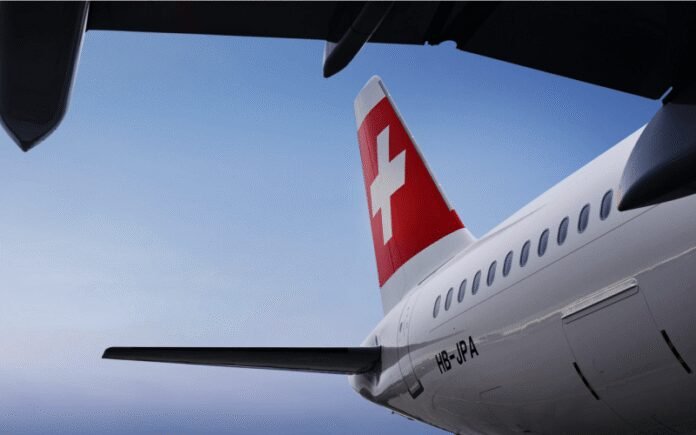
Swiss International Air Lines (SWISS) will end duty-free sales on board its flights, marking the close of a long-standing retail practice in commercial aviation as the carrier adjusts to changing passenger habits and cost pressures.
The airline said it would phase out inflight sales of perfumes, alcohol and other tax-free goods, a feature that for decades formed part of the traditional long-haul travel experience. The decision reflects declining demand for onboard shopping, as travelers increasingly purchase goods online or at airport retail outlets instead.
Industry observers note that duty-free sales once served as a meaningful ancillary revenue stream, particularly on intercontinental routes. However, the model has come under strain in recent years due to shifts in consumer behaviour, tighter cabin service routines and the growing emphasis on operational efficiency.
Swiss International Air Lines indicated that removing onboard sales would simplify service procedures for cabin crews and allow greater focus on core hospitality functions. The move is also expected to reduce logistical complexity tied to stocking, handling and accounting for retail inventory across a global network.
The airline, part of the Lufthansa Group, operates flights from its main hub in Zurich and serves destinations across Europe, Asia and the Americas.
While inflight duty-free once carried a certain prestige — associated with international travel at a time when cross-border shopping was less accessible — its relevance has steadily diminished. Airports now offer extensive retail environments, often with broader product ranges and competitive pricing, eroding the comparative advantage of onboard sales.
The decision by Swiss International Air Lines aligns with a wider recalibration across the aviation sector, where airlines are reassessing legacy service elements against contemporary cost discipline and passenger expectations.
No immediate impact on ticket prices or onboard catering services is expected, the airline said, underscoring that the adjustment is operational rather than customer-facing.
For frequent flyers, the change signals a subtle but notable shift: the gradual disappearance of one of air travel’s more traditional rituals, as the industry continues to prioritise efficiency over nostalgia.
At Least Two Dead After Plane Crashes into Building
A routine landing turned into a nightmare in seconds when a small plane suddenly dropped out of the sky and slammed straight into an airport hangar — killing two people instantly and leaving at least 11 others burned and fighting for recovery.
The terrifying crash unfolded Wednesday afternoon at Parafield Airport in South Australia, where witnesses say the twin-engine aircraft appeared to struggle mid-air before taking a sudden, sickening dive.
“It just pitched… then went straight down,” eyewitness Joshua Lee Swanell said, describing the moment the plane lost control. “You could hear it struggling — and then it was over in seconds.”
The aircraft smashed into the hangar with devastating force, killing the pilot and a passenger on impact. Within moments, the building erupted into flames, sending thick black smoke billowing high into the sky — visible for miles.
Inside the hangar, chaos broke out.
At least 11 people on the ground — including several student pilots — were caught in the blast zone and suffered burns. Emergency crews rushed them to nearby hospitals, splitting victims between Royal Adelaide Hospital and Lyell McEwin Hospital due to the scale of the disaster.
First responders flooded the scene just after 2:10 p.m., as fire crews battled the raging inferno and authorities locked down the entire airport. All flights were halted, with only returning aircraft allowed to land under strict control.
Nearby residents described a scene straight out of a disaster movie.
“It looked massive,” one local told radio reporters. “Fire trucks just kept coming… you could see black smoke pouring out of the hangar like something exploded.”
Within minutes, the smoke became so thick that visibility near the crash site dropped to near zero. Officials warned people in surrounding neighborhoods to stay indoors, citing potential breathing risks from the toxic plume.
Authorities are still working to determine exactly how many people were inside the hangar at the time — and what caused the aircraft to suddenly nosedive.
Investigators from the Australian Transport Safety Bureau have already launched a full-scale probe, dispatching specialists in aircraft operations, engineering, and human factors to comb through the wreckage and piece together what went wrong.
For now, the haunting question remains: what caused a routine landing to turn into a deadly freefall?
TOKYO — As the US-Israeli war on Iran drags on indefinitely, Asia is realizing the extent to which 2026 is a major game-changer for a region that had been “the main driver of global growth.”
This is the International Monetary Fund’s characterization. But what a difference two months of hostilities in the Middle East make for Asian economies from Japan to Indonesia.
Since bombs began falling on Tehran on February 28, the resulting surge in the costs of energy and fertilizer — and the coming jump in food prices — has governments scrambling to sandbag their economies.
Unfortunately, many are already running out of plays. Typical responses like subsidies, curbing fuel use and asking those who can work from home to do so aren’t doing the trick.
Though “Asia entered 2026 on a strong footing,” notes IMF economist Andrea Pescatori, “the war in the Middle East and the ensuing energy supply shock are raising inflation, weakening external balances, and narrowing policy options, underscoring the region’s dependence on imported oil and gas.”
The bottom line, he adds, these “headwinds will test Asia’s resilience.”
The intensity will increase the longer the conflict lasts. US President Donald Trump is reportedly telling White House staffers to prepare for an extended period of US naval blockade activity of the Strait of Hormuz. The Middle East conflict, now stretching into a third month with scant sign of resolution, means oil prices will continue racing higher.
Even if the war winds down in early May, the World Bank thinks energy prices will surge by 24% this year to their highest since Russia’s full-scale invasion of Ukraine four years ago.
“The war is hitting the global economy in cumulative waves,” says World Bank chief economist Indermit Gill. “First through higher energy prices, then higher food prices, and finally, higher inflation, which will push up interest rates and make debt even more expensive.”
Gill stresses that the energy shock will hit the poorest populations hardest, exacerbating the troubles of highly indebted developing countries. Yet Asia’s biggest, most advanced economies will also feel the pain.
Take Japan, where central bank officials took a reluctant pass on tightening policy on Tuesday. The Bank of Japan’s “hawkish hold,” as many economists put it, saw no fewer than three of its nine board members dissent in favor of a rate hike to 1%.
The decision to leave short-term rates at 0.75% seemed all the more perplexing, given that the BOJ forecasts inflation will climb to 2.8% this year. That’s well above the 2% target. But the BOJ is hemmed in by slowing growth — a roughly 0.5.% rate in 2026. In other words, stagflation.
The Iran war, meanwhile, is sending mixed signals to Japan. As Stefan Angrick, head Japan economist at Moody’s Analytics, says, “nominal pay growth has softened, and labor market indicators have worsened since late 2025.
At the same time, policymakers have grown increasingly uneasy about the yen’s pronounced weakness. The currency has averaged about 159 to the dollar for more than a month and has slid to multidecade lows against both the euro and the Swiss franc.”
China is also scrambling. Despite chatter that China is more insulated from the turmoil than most top economies, Xi Jinping’s government is springing into action as the fallout from Iran’s turmoil imperils global demand.
A Politburo meeting on Tuesday focused on strengthening China’s supply chains. According to Xinhua, the Politburo argued that “since the start of this year, China’s economy has got off to a strong start, with key indicators coming in better than expected.”
But, the Politburo noted, “it’s essential to bolster confidence and step up efforts with stronger and more concrete measures to ensure economic work is carried out effectively.”
Signals coming from the meeting, says economist Zhang Zhiwei, president of Pinpoint Asset Management, suggest “the government is aware of the difficulties and challenges the economy faces.” At this stage, Zhang concludes, the government “seems to be relying on monetary policy to mitigate the economic difficulties.”
If the fallout on global demand worsens and slams demand for Chinese goods, Beijing would likely become more aggressive with stimulus measures. One worry is false confidence about China’s ability to maintain 4.5% to 5% this year.
Though China beat forecasts in the first quarter by growing 5% year-on-year, the data “doesn’t yet reflect the impact of higher oil prices,” write analysts at Guosheng Securities. “The real test will begin in the second quarter.”
It’s problematic, too, that “growth remains lopsided towards exports,” says Tianchen Xu, senior economist at Economist Intelligence Unit.
In March, exports slowed sharply, increasing just 2.5% year-on-year. It was the smallest increase in five months. That put China’s March trade surplus at just $51.13 billion, far below expectations of $108 billion.
Until now, there’s been an argument that the risk of external shocks causing a sustained wage-price spiral in advanced Asia — including Japan, South Korea, Singapore and Taiwan — is low.
That’s “even with the Middle East conflict keeping energy prices elevated,” as Betty Wang at Oxford Economics wrote in an April 20 report. “Instead, labor market tightness and productivity appear to be the main drivers of wage volatility in modern times.”
Wang argued that “compared with the 2022 Russia-Ukraine war, when the oil price surge pushed up inflation and nominal wages across all four economies, labor markets are now softer, except in Japan.”
Demand conditions, Wang noted, “are also more subdued and fragmented, weighed down by tariff uncertainties and weaker confidence. These factors should limit the risk of broader price transmission to wages. Against this backdrop, policymakers should have greater scope to look through near-term price shocks.”
Yet with Asian officials now bracing for deepening Iran war fallout as hostilities stretch into May and beyond, officials are racing to batten down the hatches.
Korea, for example, was quick to roll out a $7.1 billion stimulus package to mitigate energy supply shocks. But the economy’s 70% dependence on Middle Eastern oil passing through the threatened Strait of Hormuz is a clear and present danger to inflation. The won’s recent drop to 17-year lows means Asia’s fourth-biggest economy must import commodities at elevated prices via an undervalued currency.
Oil shortages have led key Southeast Asian economies like Indonesia and the Philippines to look to Russia. Thailand is looking Vladimir Putin’s way for fertilizer.
For now, ASEAN governments are prioritizing short-term needs over any geopolitical fallout. In Brunei this week, at a meeting of the foreign ministers from the Association of Southeast Asian Nations, European Union foreign policy chief Kaja Kallas called on ASEAN to see the “big picture” that purchases from Russia will help Putin continue the Ukraine war.
Albert Park, chief economist at the Asian Development Bank, points out that adverse effects on growth will be “most severe” for economies in developing Southeast Asia, with inflation rising highest in South Asian economies.
These scenarios, Park notes, reflect a high degree of uncertainty about how the conflict and associated disruptions will evolve and should be treated with caution. In addition to higher energy prices, they account for broader supply chain disruptions and a global tightening of financial conditions.
“Prolonged energy disruptions could force economies in developing Asia and the Pacific to navigate a difficult trade-off between weaker growth and higher inflation,” Park says. “Governments should focus on containing market stress and protecting the most vulnerable, while adopting policies to improve longer-term resilience.”
In a recent report, JP Morgan analysts note that ASEAN economies are among the most exposed to the conflict given their heavy reliance on Middle Eastern energy imports — roughly half of Asia’s crude and over a third of its gas imports transit through the Strait of Hormuz.
As they write: “The impact of the conflict has been immediate and severe: the Philippines declared a national energy emergency after gasoline prices more than doubled, Indonesia and Vietnam introduced energy rationing, and Thailand’s fisheries sector began shutting down due to a surge in marine fuel costs.”
The macro consequences, JP Morgan points out, may be acute if oil prices remain sustained at $100 or higher for several months. Higher energy prices feed directly into food inflation — which accounts for 25–35% of ASEAN consumer price index baskets — compressing household purchasing power and weighing on consumption.
Central banks, of course, are confronting a classic stagflation dilemma: they must tighten policy to rein in inflation even as growth momentum weakens, and they have limited fiscal space to soften the impact.
In the Philippines, the challenge is tougher. With only about 45 days of crude stockpile coverage, it remains exposed to prolonged fiscal strain and persistent pressure on the currency.
Indonesia’s fuel subsidy costs are mounting, and Thailand’s tourism and fisheries sectors are facing major disruptions. It’s worth noting that Asian importers pay a premium for oil in their region, which largely trades on Dubai prices, which have a spread over Brent prices. This implies roughly 30% higher effective crude costs than headlines might suggest.
Not everyone is worried about Asia’s prospects. “Asian economies are most sensitive to energy costs, though resilience differs by region,” says Isaac Thong, lead manager of the Aberdeen Asian Income Fund.
“From a market perspective, Asia’s overall exposure to conflict-related risks is limited, and the trust is predominantly positioned in high-quality compounders and consistent businesses. These companies are well placed to continue delivering returns amid the current uncertainty.”
For many, though, the biggest problem is uncertainty about where the Iran conflict is heading.
“About two months in, we remain stuck in the limbo of the US-Iran conflict, which has left the Strait of Hormuz largely closed and much of the world starved of the critical oil flows needed to power the global economy,” says Tian Yong Woon, economist at Haver Analytics.
In truth, Woon notes, “commodity and market valuations do not hinge so much on a peace deal itself, but rather on the resumption of oil flows through the Strait, something that could materialize even in the absence of a formal deal, though any agreement that includes and credibly delivers such a reopening would likely be warmly received by markets.”
Until then, Woon notes, “market gyrations are likely to persist, with prices fluctuating in response to each new snippet of news. And “the world will continue both to be starved of, while gradually adapting to, the drip feed of oil flows emerging from the Strait.”
As Asia struggles to answer these economic questions — and those it doesn’t yet know to ask — it’s in harm’s way as much as any time in the last 25 years.
Nvidia fixes the 8GB RAM problem with one of its GPUs—if you can pay for it
Whether you’re a gamer trying to play recent AAA titles at high resolutions and maxed-out settings or an AI enthusiast trying to run models locally, we’ve reached the point where a GPU with 8GB of video memory is a pretty limiting bottleneck. But because of ongoing memory shortages and price spikes, it’s also a uniquely bad time for GPU makers to attempt to fix this problem—rumors suggested that a RAM-boosting mid-generation “Super” refresh for Nvidia’s RTX 50-series GPUs was quietly delayed or canceled earlier this year, at least in part because of memory costs.
One of Nvidia’s GPUs is getting a RAM upgrade, according to an announcement the company buried at the bottom of a blog post about a routine Game Ready driver update. The laptop version of the GeForce RTX 5070 is getting a bump from 8GB to 12GB of GDDR7, a 50 percent increase that should reduce some performance bottlenecks and generally future-proof the GPU.
Otherwise, the 12GB version of the mobile RTX 5070 is the same as the 8GB version. The RAM is still connected to the GPU with a 128-bit memory interface, and the GPU still has 4,608 CUDA cores. The mobile 5070 uses the same GB206 silicon die as the desktop RTX 5060 instead of the larger, more powerful GB205 die in the desktop version of the RTX 5070, meaning that despite the RAM increase, the desktop version remains a much more powerful GPU.
But the main problem is the price, not the specs.
Modular laptop maker Framework was one of the first to announce a product including the new 12GB RTX 5070: an update to the Framework Laptop 16. It serves mostly to highlight what an awful deal the mobile RTX 5070 is right now; as a standalone upgrade, the 8GB version costs $699, and the 12GB version costs a whopping $1,199, a 71.5 percent increase for an otherwise identical GPU. (The pricing is similar when you’re buying a new Laptop 16, and the GeForce GPUs are also only available with the more expensive, higher-end AMD Ryzen CPU options.)
Framework has blamed “the pricing we’re seeing from silicon suppliers” for the new module’s price, and it said the price for the 8GB version was also likely to go up “once we deplete our current inventory of the GDDR7 capacity it uses.”
Framework is just one manufacturer, but other laptop makers will be dealing with the same suppliers and pricing problems. Unfortunately, this suggests that we can all look forward to paying as much for a 12GB RTX 5070 as we used to pay for an entire midrange gaming PC.
Marco Rubio Is Rebranding the State Department as Explicitly Christian
The State Department has shifted its public image in favor of explicit Christian messaging and iconography and away from secular and multicultural causes, an analysis by The Intercept of the department’s Instagram posts has found.
Posts marking Passover, Good Friday, and Easter in 2026 included explicitly religious messaging, including imagery of Christian crosses and references to “Christ’s sacrifice” and the Resurrection. The Intercept’s analysis, which catalogued of the department’s Instagram posts from 2020 through early 2026, found these posts show a clear change in messaging not only from the Biden years, but also from President Donald Trump’s first term.
“From a digital diplomacy point of view, this looks like more than a change in images. It suggests a shift in how the U.S. government is presenting itself online,” said Corneliu Bjola, a professor of digital diplomacy at the University of Oxford. “In earlier years, posts projected a broad and inclusive image — what you might call ‘the shiny city on the hill.’ The 2026 pattern points to a narrower and more controlled message about strength and authority — ‘fortress America.’”
Long considered the government’s primary diplomatic arm, the State Department historically used its account to highlight a wide range of international, cultural, and religious observances. In 2020, under the leadership of former Secretary of State Mike Pompeo, the State Department used its account to mark holidays and observances including Juneteenth, Chinese New Year, Ramadan, Eid al-Fitr, Eid al-Adha, Yom Kippur, and Kwanzaa.
Since Secretary of State Marco Rubio assumed his role, observance-related posts have been limited to Christian and Jewish holidays, including one that featured an impassioned speech by Rubio describing the resurrection of Jesus Christ. The account has not marked major Islamic holidays or other widely observed cultural events that it routinely highlighted in prior years.
Federal agencies have already faced scrutiny over controversial social media posts. The Department of Homeland Security has recently drawn scrutiny for using a neo-Nazi-linked song in a recruiting post, and the Department of Labor has faced criticism for social media imagery depicting an all-white, all-male workforce in a 1950s-style campaign, including a post that read, “One Homeland. One People. One Heritage. Remember who you are, American.”
Meanwhile, the State Department has moved away from posts highlighting multiculturalism in the United States and abroad.
Under Pompeo, the State Department made posts highlighting initiatives such as the International Religious Freedom Alliance and women’s empowerment efforts. The account also recognized events such as World Press Freedom Day, World Refugee Day, Asian American and Pacific Islander Heritage Month, and the International Day of Reflection on the Rwanda Genocide, among others.
The range narrows significantly under Rubio. Posts during this period place greater emphasis on borders, sovereignty, and enforcement, alongside a more limited set of cultural and religious observances. In September 2025, the account featured a video of Rubio meeting with Prime Minister Benjamin Netanyahu in Israel as the country continued its assault on Gaza in what human rights groups and some international observers have described as a genocide.
In 2025, posts marking observances were limited to a small set of holidays and commemorations, including International Holocaust Remembrance Day, Yom HaShoah, Independence Day, Labor Day, Columbus Day, Christmas, and D-Day. Several posts emphasized religious or national themes, including a Columbus Day post that referenced “glory to God and country.”
The posts have also shifted to heavily feature the likeness of President Donald Trump. In early 2026, roughly 40 percent of posts included Trump’s image, a higher share than during either the Biden administration or Trump’s first term. On Tuesday, The Bulwark reported that the State Department is finalizing plans to include President Donald Trump’s image in a redesigned U.S. passport.
Asked why the account no longer marks a broader range of international and religious observances, including major Islamic holidays that had been featured in prior years, a State Department spokesperson said the content reflects the priorities of the current administration.
“Our content reflects the priorities of the current administration, including a renewed focus on seriousness and diplomacy.”
“Obviously, the president is featured prominently in our posts. He sets U.S. foreign policy, and the State Department’s role is to execute and communicate that agenda,” the spokesperson said. “Our content reflects the priorities of the current administration, including a renewed focus on seriousness and diplomacy. Decisions about what to highlight, including observances, are made by communications professionals.”
Rather than highlighting diplomatic events or cultural observances, the account frequently features stylized graphics of Trump and administration officials alongside slogans emphasizing immigration enforcement, national sovereignty and security. Some posts resemble campaign messaging, including phrases such as “Send Them Back” and “This Is Our Hemisphere,” as well as graphics touting policy outcomes like visa revocations.
Former U.S. diplomats and public diplomacy officials told The Intercept the shift marks a break from long-standing norms that have historically emphasized nonpartisan messaging and broad cultural representation in official government communications.
Daniel Kreiss, a political communication scholar at the University of North Carolina at Chapel Hill, said the shift reflects a broader pattern across government agencies.
“The cultural and religious diversity that represents all of America — and frankly, for the State Department, the world — is no longer being represented, based on your data, in favor of overrepresenting what the administration cares about,” Kreiss said. “It’s sending a key public signal that these agencies are operating faithfully to the president and his coalition.”
The shift, experts say, is not just about what the United States chooses to show the world, but also what it no longer does. In digital diplomacy, what is omitted can be as consequential as what is shown.
FIFA Could Make Billions From the World Cup. Host Cities Will Get Little in Return.
Reporting Highlights
Lopsided Contracts: Experts say World Cup contracts lock host cities out of prospective revenues more than ever, leaving FIFA with a larger share of the revenue.
Texans on the Hook: A Texas taxpayer-funded program helps cover costs, but the state struggles to calculate whether there is a benefit.
Lacking Transparency: Many cities have fought the release of their contracts with FIFA. Those that are public have key cost and revenue information redacted.
These highlights were written by the reporters and editors who worked on this story.
When Texas dedicated $22 million to host the 2017 Super Bowl between the New England Patriots and the Atlanta Falcons, state officials expected a return on their investment.
But a state analysis after the Patriots’ thrilling comeback win said it was “impossible” to tell if Texas taxpayers broke even on their investments.
If anything, Texas came up $14 million short, according to a breakdown of tax revenues in the same analysis.
Texas taxpayers likely will be on the hook again when Houston and Dallas welcome the FIFA World Cup this June and July. The cities are among 11 in the U.S. that have agreed to shoulder hundreds of millions of dollars in costs for the soccer tournament, subsidizing a World Cup expected to generate $11 billion in profits for FIFA.
Host cities and their local organizing committees will pay for security at the matches, cover the cost of retrofitting their stadiums to better accommodate soccer and operate fan festivals in addition to the main matches. Originally, they were supposed to pay to transport FIFA officials to all matches, as well, though that requirement has been waived, according to Houston organizers.
The cities get little tangible benefit in return. They do not see a slice of game-day revenues from ticket sales, concessions and merchandise, or parking. Even selling tickets or suites in exchange for corporate sponsorships — usually a key revenue generator for local organizers — was restricted by FIFA this year.
Cities had to agree to FIFA’s demands before the U.S., Mexico and Canada even submitted their bid in 2017 to host the World Cup, and many of those host city contracts remain secret. Now, as the event nears, some cities are questioning whether those agreements will leave them paying for more than they get in return.
“Everybody signed an agreement that was very, very one-sided,” said Alan Rothenberg, who is on the Los Angeles host committee for the 2026 World Cup and was the president of U.S. Soccer the last time the country hosted the tournament in 1994.
Then, some host cities would get a slice of game-day revenues, such as a share of the money made from selling food and drinks at the matches. U.S. Soccer also covered the bill for security at the games and other organizing expenses, Rothenberg said. That helped cities take in more money than they spent, making hosting a more attractive endeavor.
This time around, the agreement was so lopsided that at least one city, Chicago, withdrew during the bidding. And in some cities that moved forward, concerns have grown as the matches near. Officials in Foxborough, Massachusetts, threatened in February to withhold permits for the matches unless FIFA or the owner of the Patriots committed to paying $7.8 million in security costs ahead of time. Foxborough ultimately approved the permits after local World Cup organizers agreed to pay the bill in advance.
“At this point, I think a lot of people are looking at Chicago and thinking they were the smart ones,” Rothenberg said. “They looked at the terms of the agreement and said, ‘No, thanks.’ I don’t think anybody in the 11 host cities thought it would be as tough as it seems to be.”
Re-created for legibility by the Houston ChronicleThe World Cup contracts place full responsibility for “overall safety and security” and “all taxes, duties and levies” on the host cities.Re-created for legibility by the Houston Chronicle The World Cup contracts place full responsibility for “overall safety and security” and “all taxes, duties and levies” on the host cities.Re-created for legibility by the Houston Chronicle
FIFA did not respond to questions about those criticisms. Instead, it provided a written response stating that it is working closely with its host sponsors and expects cities to benefit.
“The FIFA World Cup 2026 is projected to generate significant economic activity across Canada, Mexico and the United States, spanning tourism, hospitality, employment and long-term global visibility,” said Jhamie Chin, a FIFA spokesperson.
The host cities use external nonprofits to organize and run the tournament’s logistics and raise money for the costs of hosting. Chris Canetti, who runs Houston’s host committee, said the city’s organizers have been able to overcome any challenges the contract has presented.
“This event is going to have a substantial economic impact on our region, from hundreds of thousands of visitors coming through,” Canetti said. “We’re making an investment in that. I think this is good for our community at the end of the day.”
The Houston Chronicle sought to better understand the agreements cities made with FIFA and their implications for taxpayers by reviewing records from all U.S. host cities. Most refused to hand over the contracts, including Houston, which argued that releasing the documents would undercut its ability to negotiate for future events; Dallas did not oppose the release but sent the request to the Texas attorney general to allow third parties to object if they wanted.
The two cities asked the Texas attorney general for permission to keep them out of the public’s view. The attorney general’s office ruled that Houston and Dallas must release their contracts, though they were allowed to redact key financial figures, including how much FIFA is paying to rent stadiums for the event.
The Chronicle reviewed the two Texas contracts, along with those of four other host sites — Kansas City, New York/New Jersey, Philadelphia and Seattle — that made their agreements available. Together, the contracts show that almost all of the costs for organizing the tournament fall on the cities, whose ability to collect revenue is limited.
Those agreements, according to Rothenberg and other experts, lock host cities out of prospective revenues more than ever, leaving FIFA with a larger share of the revenue.
Fans cheer as teams are announced during the 2026 FIFA World Cup draw in Houston in December.Jason Fochtman/Houston Chronicle
Texas Taxpayers on the Hook
In Houston, at least, most of the organizing costs are not expected to be borne by local governments.
“The host committee holds the contract with FIFA. We are 100% responsible for finding the funding to cover all of those expenses, and none of that comes from the city or the county,” Canetti said about the agreements.
The contracts do not make clear who is on the hook if the host committee cannot cover the costs. Canetti said he is confident Houston’s committee will have more money than it needs for the expenses, and any surplus funds would be donated to charitable efforts. The host committee that Canetti runs uses a mix of revenue generated from corporate sponsorships, the money FIFA pays to rent NRG Stadium and subsidies from state and federal governments.
That includes $65 million from the federal government to help Houston pay for security, part of a broader $625 million investment by American taxpayers in the World Cup.
The committee also expects to draw tens of millions of dollars from Texas’ Major Events Reimbursement Program, an offshoot of the state’s Event Trust Funds established in 1999 when Texas was vying to host the Olympics. Canetti did not reveal the precise amount Houston believes it will receive, and the Chronicle is still waiting for the governor’s office to respond to records requests for its communications with the committee.
Chris Canetti, president of the FIFA World Cup 2026 Houston host committee, speaks during a press conference.Melissa Phillip/Houston Chronicle
The reimbursement fund was key to ensuring Houston did not lose money when it hosted the Super Bowl. It is expected to be a difference-maker again in covering World Cup costs, helping ensure Houston and Dallas are in a better position than other host cities that don’t receive state money. But it means Texas taxpayers bear a significant share of the costs.
Kelly Dowe, the city’s finance director when it hosted the Super Bowl in 2017, assumed the city would be left with the costs. He was surprised when the host committee for that event effectively paid the full bill, in large part with $22 million in state funds. But these big events, while a boon to specific industries like hotels, bars and restaurants, are hardly a driver in a city’s budget.
“It doesn’t make money for the city, per se,” Dowe said. “You’re glad to break even.”
Texas has made available about $263 million since 2015 to help cities cover the costs of dozens of events, subsidizing everything from a Super Bowl to Junior Olympics and cutting horse competitions. But program administrators have consistently struggled to verify that the events are creating a positive return on investment for taxpayers.
Under the program, cities seeking to host competitive sporting events apply for state funding, using estimates of how much they think revenue from sales, liquor and other state taxes will increase as a result of an event. That amount forms the basis of how much money the city is eligible for, and then it can submit expenses for reimbursement after the event. That included $21.9 million to Houston’s Super Bowl in 2017, $23 million to Austin’s Formula 1 United States Grand Prix event in 2019 and $31 million to the same event in 2021.
As the program grew, it began drawing criticism from across the political spectrum. Then-state Sen. Wendy Davis, a Democrat, pushed a bill in 2013 to audit the program, saying, “We’re handing these things out like candy.” The bill did not pass, but state auditors reviewed the program in 2015.
The audit suggested that officials in the Texas comptroller’s office, which originally administered the program, were not vetting the number of out-of-town visitors stringently enough to ensure an economic benefit. It also found they were not verifying that invoices sent by cities were directly related to the events they were hosting.
The comptroller’s office added rules in late 2014 clarifying what kinds of spending would be allowable for reimbursement, and, in 2015, the Legislature moved the trust funds to the governor’s office of economic development and tourism.
But the move has not made it any easier for the state officials who administer the program to distill complicated economic data, and they continue to write in their reports that they cannot tell whether the events bring a positive impact. In 2020, five years after the program was transferred to the governor’s office, the conservative Texas Public Policy Foundation, which has been a strong supporter of Gov. Greg Abbott, released a report criticizing the program, saying its vision “points to a misunderstanding of how economies work.”
Andrew Mahaleris, an Abbott spokesperson, said the governor’s office commissioned an economic impact analysis for the 2024 fiscal year that showed 840,000 nonlocal visitors spending more than $615 million in Texas, with a positive economic impact of more than $1.2 billion.
It’s unclear how the numbers in that study were calculated, and Mahaleris did not respond to requests to provide the study to the Chronicle.
“Event Trust Funds are critical tools that help Texas communities attract events to the state,” Mahaleris said.
When state officials review the taxes they collect after the events, they come to a different conclusion. State officials are limited in the types of economic indicators they assess. For example, they look at the amount of sales taxes collected in cities and counties, but that data does not identify how much comes from out-of-state visitors for the specific events the state is subsidizing.
“Houston is a giant economy, a region as big as some states,” said Dowe, the former Houston finance director. “As big a deal as the Super Bowl or the World Cup would be, it doesn’t move the overall economy as much as other factors — manufacturing, oil and gas, the refining that goes on at the ship channel. Any movement on those would far outweigh the noise in the signal from the World Cup.”
After every one of the last 40 events the state program has helped fund since 2015, state officials said that “neither a positive nor negative impact is determinable.”
Construction on Houston’s Main Street Promenade in March. The work is expected to be ready for the World Cup in early June and is one of many upgrades aimed at making the downtown area more accommodating for the thousands expected during the event.Jason Fochtman/Houston Chronicle
FIFA Projection Is “Insanity”
Supporters of using taxpayer dollars to attract major sporting events maintain that host cities get economic benefits from the exposure that comes with the spotlight of widely watched matches.
Those figures are not insignificant, according to FIFA, which points to a study it released in April with the World Trade Organization that estimates the tournament will bring $47 billion in economic impact across the United States. FIFA deferred questions about the study to the WTO, which directed questions to OpenEconomics, an Italian firm that it said prepared the report. OpenEconomics did not respond to a request for comment.
Experts say such calculations are almost always exaggerated and that the true numbers are difficult to pinpoint. The billions promised in the report by FIFA and the WTO are “insanity,” said Victor Matheson, a professor at the College of the Holy Cross in Worcester, Massachusetts, who has studied the economics of big sporting events like the Super Bowl and the World Cup for decades.
“This would mean every game is generating $400 million, or roughly $5,000 to $7,000 per fan,” he said. “But the most telling thing is that FIFA is right on the front cover as an author/sponsor of a report that says that FIFA is awesome. This report is better thought of as a press release rather than a serious piece of economic research.”
Recent reports have shown hotel prices dropping as the tournament nears, which could indicate fewer people plan to travel for the games. That would be a major factor for host cities, since out-of-town visitors are key to driving a positive economic impact.
Houston does not receive a net benefit from its own residents attending the World Cup. Those people are spending money they likely would have spent in the city anyway, a principle economists call substitution. An event like the World Cup can also crowd out other events, like conferences, that would have drawn out-of-towners to the city. And, of course, much of the money spent at the games flows to entities like FIFA that are not based in Houston.
All of those factors make it difficult to assess the true economic impact on a city or state, Matheson said. That math requires a large set of assumptions, and promoters will usually tweak those assumptions in their favor to drive up the total.
It can be even harder to fully track the public spending needed to cover the hosting duties.
The contracts reviewed by the Chronicle include a clause under which cities promise to “agree to do all things necessary to preserve their confidentiality,” unless required by local law to release them. And the nonprofit organizing committees generally are not subject to public disclosure laws.
Chin, the FIFA spokesperson, said the contracts contain information that is “commercially sensitive,” and it is standard to withhold them for “global events of this scale.”
As a result, many of the details about taxpayers’ investments remain out of public view. They include figures about how much FIFA will pay each city to use its stadium, which local companies have agreed to donate millions toward preparations and what benefits they receive in return, the tax breaks that FIFA will enjoy from each city, and how each host committee plans to pay for the extensive preparations that go into hosting the tournament.
The contracts the Chronicle obtained provide broad categories of responsibility that fall under a host city’s purview — security, transportation and retrofitting stadiums, among them. But the documents rarely attach dollar figures to those efforts.
Academic experts say the system’s secrecy is by design.
“It’s atrocious how secretive they are with these sorts of taxpayer-funded events,” said David Cuillier, director of The Freedom of Information Project at the University of Florida. “These cities are going to invest a lot of money in hosting FIFA, and the people who are paying for that should know. They should know how much money and how it’s being spent. That’s why we have open records laws.”
2 Injured in Golders Green London Stabbing Attack; Suspect Targeted Jews, Patrol Group Says
Two people were injured after being stabbed Wednesday in Golders Green, a north London suburb with a large Jewish population, as authorities detained a suspect following reports he targeted Jews in the area.
Shomrim, a Jewish neighborhood patrol group operating in the neighborhood, said it apprehended a male suspect who was “attempting to stab Jewish members of the public.” The group reported that two victims were wounded and were receiving treatment from Hatzolah, a volunteer emergency medical service.
According to the patrol group, police arrived at the scene and at one point deployed a taser before taking the suspect into custody. An investigation into the incident is ongoing.
British Prime Minister Keir Starmer addressed the attack in Parliament, calling it “deeply concerning.” He said authorities were examining the circumstances and emphasized the need to be “absolutely clear in our determination to deal with any of these offences, the likes of which we’ve seen too much recently.”
Golders Green is home to approximately 15,000 residents, with about half identified as Jewish, according to 2021 census data. The area includes several synagogues as well as dozens of Jewish schools and restaurants.
The stabbing is another in a series of antisemitic incidents in the UK. Just weeks earlier, several Hatzolah vehicles were damaged in an arson attack, and there were a number of attacks on synagogues. An attempted arson was also reported in the area on Monday.