We Need to Kick Prediction Market Betting Out of Journalism While We Still Can
Jonathan Reiss is a co-founder of the Media and Democracy Project.
Every time you turn around recently, it feels like there’s new reporting about insiders cashing in on prediction markets. On Thursday, a U.S. Army Special Forces soldier who was involved in the raid to capture Nicolás Maduro in Venezuela was arrested on charges that he used classified information to make more than $400,000 by betting on the operation before it happened. In the hours before the U.S. attacked Iran, hundreds of anonymous bets over $1,000 were placed on the U.S. striking Iran by the next day, which the New York Times said suggested that some users might’ve “seen the strike coming.”
Prediction markets, such as industry leaders Polymarket and Kalshi, have exploded in popularity. They create or exacerbate an array of problems, but at the Media and Democracy Project, or MAD, we believe they have the potential to severely harm the way news is reported, perceived, and engaged with — threats that deserve far more attention from the public.
MAD calls the use of prediction markets in news stories “casino journalism.” There is too much already, and it is likely to get much worse if not nipped in the bud. But we are optimistic it can be stopped if news organizations recognize the threat and respond.
Earlier this year, the Wall Street Journal’s publisher, Dow Jones, announced a partnership with Polymarket. The Associated Press, CNN, Substack, and CNBC have all made similar deals, the terms of which have not been disclosed. So it was extremely troubling to see the Wall Street Journal report that “Polymarket Bets See Over 70% Chance of U.S. Forces Entering Iran in Next Month” on March 30, and not just because of the fear of a broader war. This so-called news story provided none of the journalistic insight that was touted when the partnership was announced — just the betting odds. It looks more like an advertisement for their new partner than real journalism and, while the betting market was active, had a link to Polymarket.
Do news organizations and journalists really want to gamify the news? What are the long-term impacts on a paper if they make a practice of such reporting? Should news outlets see the betting markets as partners? News organizations, the practice of journalism, and the public are all much better served if the media outlets instead set policies constraining the use of these markets in their reporting and altogether forbidding financial deals where the outlet profits from the success of the prediction markets.
MAD has long called for less horse-race journalism and more substantive reporting. Many others have done so for even longer, including New York University journalism professor Jay Rosen, who has pushed for a focus on “not the odds, but the stakes.” But prediction markets are horse-race journalism taken to its most cynical end point, one that will only serve to supercharge reporting on who’s up and who’s down at any given moment, particularly because these markets are open 24/7.
Prediction markets turn events that have an impact on people’s lives — and carry a real human cost — into pure entertainment.
There are many ways prediction markets can be manipulated or misbehave in other ways, but let’s consider their stated best-case use. Suppose that prediction markets achieve their claims of providing better forecasts than other methods. Even if that were true, casino journalism is bad for journalism and the public. Predictions crowd out coverage of substance. In politics, this means less information to help voters evaluate candidates. Focusing on the odds gives the impression that the horse race is more important than the issues. Prediction markets turn events that have an impact on people’s lives — and carry a real human cost — into pure entertainment.
Tarek Mansour, the CEO of Kalshi, has said it does a “very, very good job at distilling information and surfacing truth to people,” even as it seeks to “financialize everything.” He presents it as providing a new, better source of information and as changing the way their readers digest the news. In an interview with the Financial Times in February, he said, “Prediction markets don’t make money off somebody’s losses, they make money off somebody’s engagement.” But the type of engagement matters a great deal. Increasing the nicotine content of cigarettes increases smokers’ “engagement” with the tobacco industry. Gambling is also addictive; as sports betting has become commonplace, participants have found that, over time, they mostly lose. Promoting these markets as part of the news is likely to damage readers’ trust and can also harm their overall well-being.
Quite apart from the questionable news content of prediction market bets, the news industry needs to recognize how implicated it is in shaping how these markets function. Most of the “propositions” offered on these markets are based on news reports; reporters provide the raw material on which these bets are made. In effect, traders on prediction markets are betting on the content of news stories.
This has tremendous potential to be a corrupting influence on journalists. An Israeli journalist recently received death threats over his refusal to rewrite his report on an Iranian missile strike, on which $23 million of prediction market “investments” were riding. As the markets become larger, and their use in news increases, the incentive for market manipulation will also grow. There could be intense temptation for insider trading of all kinds that would destroy the credibility and integrity of these markets, bringing the news business down with it. There are already many worrisome incidents related to these markets, such as the soldier who enriched himself based on classified info. Centering prediction markets will create a substantial risk of scandals that will implicate and embarrass news organizations.
MAD is heartened that most news outlets have not engaged in deals or embedded prediction market prices as news. The New York Times’ Guidelines on Integrity begin with the statement, “Our greatest strength is the authority and reputation of The Times. We must do nothing that would undermine or dilute it and everything possible to enhance it.” So we are hopeful that the Times and other responsible news outlets will defend their reputations by setting clear public policies limiting how prediction markets may be used and what kinds of business relationships they will engage in.
Any news organizations that have already signed on with Kalshi or Polymarket should publicly disclose the terms of these relationships. Reporters should be forbidden from citing the markets as valid forecasts and should be barred from using the platforms themselves. We encourage more reporting on substantive impacts of governmental actions and less speculation on the prospects that the policies will be implemented.
Horse-race journalism was already a detriment to nurturing an informed citizenry. But casino journalism has no place at all in any functioning democracy.
In Tazewell County, Illinois, Michael Deppert depends on a natural pool of water beneath the sandy soils of his farm to irrigate the pumpkins, corn and soybeans growing in his fields.
So when a data center was proposed about eight miles away, he feared it would tap the same aquifer, potentially eroding crop yields and profits.
Deppert, who is also the president of the local farm bureau lobby group, says locals were also “nervous” about how a data center would affect the “good, clean drinking water.” Residents launched a fierce opposition campaign, packing city council meetings and mounting petitions. After several months, the project, led by developer Western Hospitality Partners, was scrapped.
“You just can’t lay down and let everybody do whatever they wish,” Deppert says.
It is just one of the many pockets of resistance opening up across rural America, where a backlash against the explosive growth of the infrastructure for AI and cloud computing is at its sharpest.
Data centers, once clustered around cities and towns, are moving into farm country in search of cheap land and tax incentives. According to Pew Research Center, 67 percent of planned data centers are in rural areas, while 87 percent of existing data centers are in urban ones.
“Rural communities have become a target,” says Miquel Vila, lead analyst at Data Center Watch, a research project run by AI security company 10a Labs. More than 160 new AI-focused data centers have been built across the US in the past three years, a roughly 70 percent increase on the total, according to Bloomberg data.
Credit: Financial Times
Credit: Financial Times
As the industry has expanded, public opinion has hardened against it. Pew research found that Americans are far more likely to view data centers as harmful than beneficial in terms of environmental impact, domestic energy costs and quality of life in nearby communities.
The issue is awkward for President Donald Trump and his party. Republican strategists are increasingly wary that the administration’s support for AI could trigger a backlash among key voter blocs, including farming communities, ahead of November’s midterm elections. Around 78 percent of US counties dependent on agriculture voted for him in 2024, according to analysis of election data by Investigate Midwest.
In rural areas from Illinois to West Virginia, new data center proposals have led to packed public meetings and organised opposition as residents push back. In Indiana, shots were fired at a local lawmaker’s home and a note left on his doorstep reading “no data centers.” Democratic politicians have called for tighter regulation and Republicans in several states have campaigned against new developments, reflecting the backlash.
Even in solidly Republican Texas, agriculture commissioner Sid Miller has argued that projects should be directed towards less productive land, warning that the “unchecked spread of data centers onto prime farm and ranch land is a real and growing threat to our food supply.”
But the picture is mixed for farmers. While some worry about the industrialisation of once-agrarian communities, others welcome the opportunity to cash in on soaring land prices or to generate additional income.
The debate has reverberations far beyond America’s farm belt, pitting two visions of the country’s economic development against each other. In the view of the White House and much of Big Tech, the data centers will help the US maintain its lead in AI. Expectations about the growth the infrastructure will deliver underpin everything from sky-high share valuations to state and federal tax breaks granted in the hope of new jobs and investment.
But rural communities, along with many Americans, worry about the immediate impact of data centers on water and power costs and the broader disruption they represent for people’s way of life.
Credit: Financial Times
Credit: Financial Times
Environmental groups say there is a lack of transparency. Of the four data center projects that the Sierra Club in West Virginia is tracking, none have disclosed detailed water plans and most intend to build their own gas-fired plants, raising concerns about air pollution as well as water use.
For rural communities already wary of outside development, the combination of secrecy and scale has deepened resentment. Jim Kotcon, chair of the conservation committee for the West Virginia chapter of the environmental lobby group the Sierra Club, is “not opposed to data centers per se,” but argues they must be “done right.”
Otherwise, he says, rural counties risk being left with depleted aquifers, new sources of pollution and, if the boom proves short-lived, stranded assets with no obligation on developers to clean them up.
Three hours’ drive north of Deppert’s farm in Illinois, Jamie Walters points towards a cluster of vast pale concrete buildings rising from the prairie outside the town of DeKalb. “That’s Meta,” he says. “And that’s only half built.”
Ponds for retaining cooling water, electricity substations and high-voltage lines cut across a landscape where the Walters family has farmed for five generations. Soon the farm itself will be ringed by data centers and infrastructure.
But Walters is sanguine about it. He has leased hundreds of acres for solar panels and is under contract to supply renewable power for the data centers. Where corn might net $100 an acre in a good year, he says, an acre given over to solar can generate thousands.
Although he runs a whiskey distillery—for which pure water is vital—Walters says he is “cautiously optimistic” after a second data center developer, Edged, promised to use a closed-loop system, which uses less water, to cool its servers.
“It’s change,” he says. “But I’d rather be inside the process than standing on the outside saying no.”
America’s tech giants are relying on willing farmers like Walters as they race to build the backbone of the AI revolution they believe will transform productivity and deliver big financial returns.
Data centers have already emerged as a significant driver of economic expansion in the US, accounting for 80 percent of private sector growth in the first half of 2025, according to S&P Global.
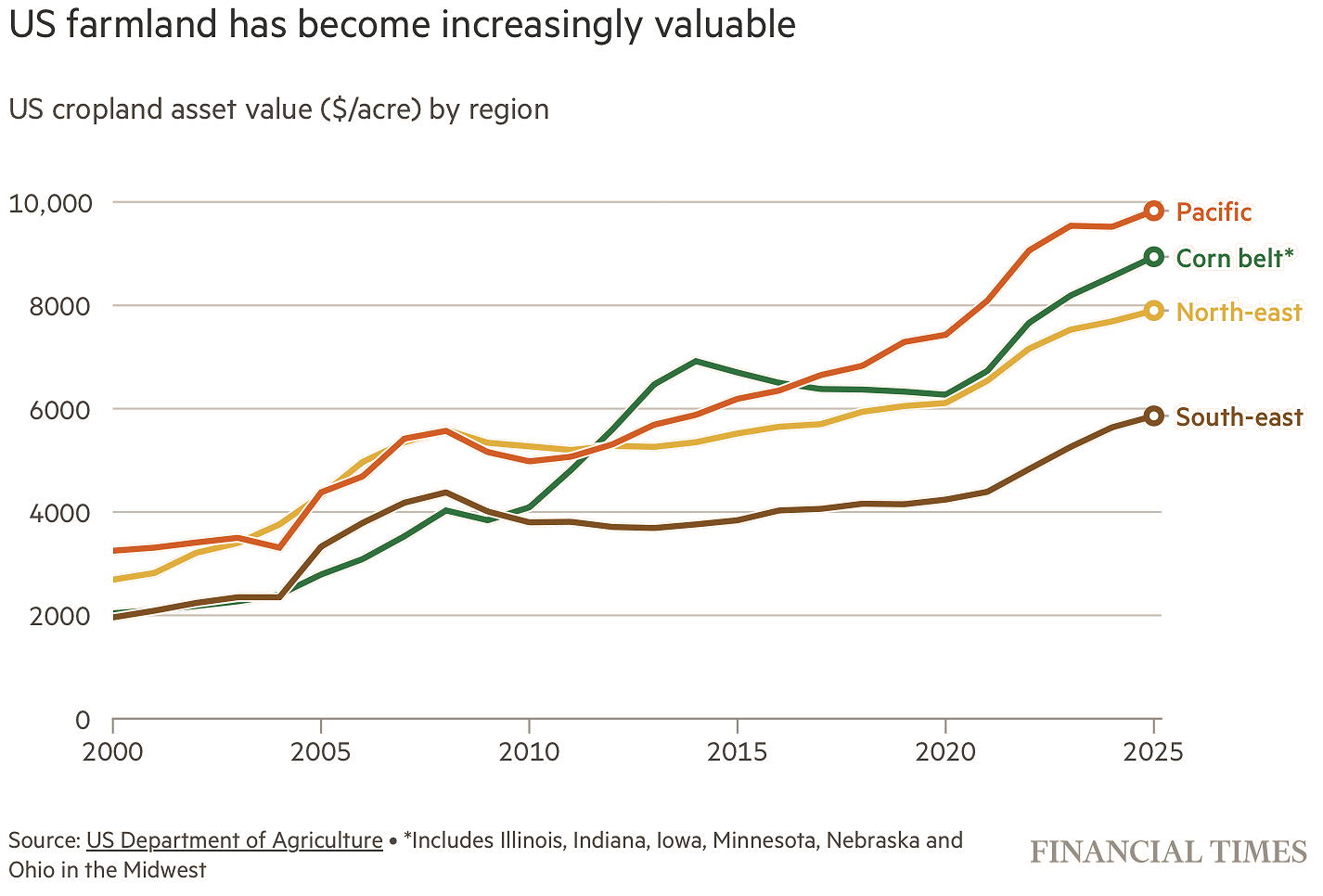
The rush for sites is beginning to reshape land markets, but often in highly specific pockets that are well connected to electricity grids. “Anywhere there’s a path to power . . . that’s where data center developers are flocking,” says Jason Bell of real estate group JLL.
He notes that land with sufficient capacity, for example in New Jersey, can sell for five to ten times more than similar land without power access but that there is a wide range of estimates.
Curt Covington, a senior director at land financing group AgAmerica, agrees that developers are often “bidding up the price” for farmland. He adds that while some farmers will not dream of selling land they have worked for generations, others take a more pragmatic view if they are situated in would-be development corridors. “If [they] can get 1.5 times what this property is worth . . . they’ll part with their land.”
Credit: Financial Times
Credit: Financial Times
But not all farmers see the opportunity. In Yorkville, on the outskirts of Chicago, Bob Stewart, who farms corn and soybeans, says “it’s sad to see” the region’s rich black soils “get turned into development.”
Large-scale farming requires ever more acreage to remain viable, he says, as thin margins force farmers to spread rising input costs over more land. Soaring land prices driven by data center development make it harder for those who want to keep farming and expand.
“If we want to buy more [land], so that my kids can take over, we’d like farm prices to stay kind of where they’re at,” he says.
For data center developers, a vast tract of land is just the first necessity. Spare grid capacity is also vital given an up-and-running center’s energy demands.
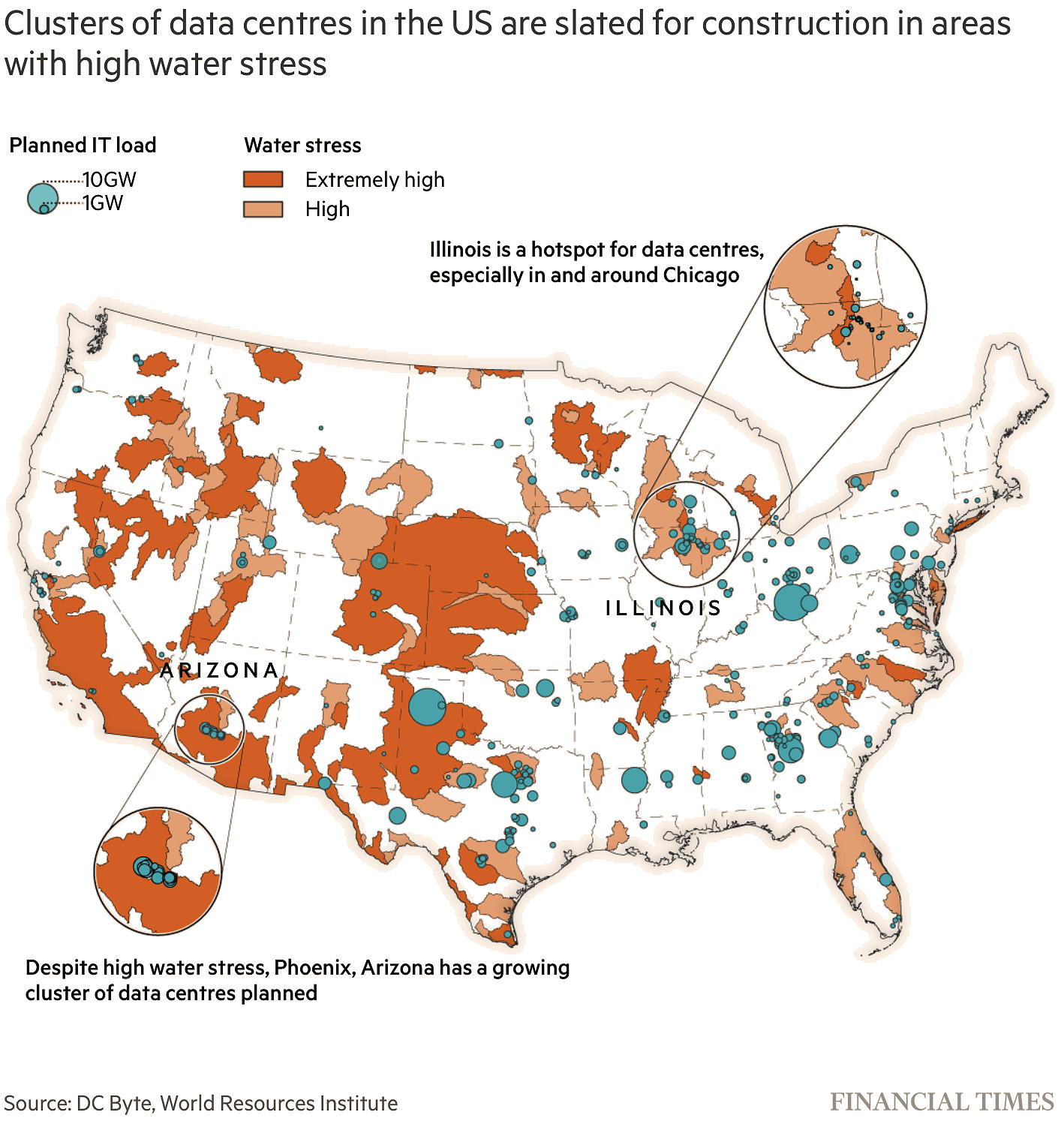
This means that many developments are being constructed in sparsely populated states that also experience periodic and severe drought, such as Arizona and Texas. Around two-fifths of all US data centers are located in areas of high water stress, according to S&P Global.
Heather Cooley, director of research at the Pacific Institute, a research group, says that energy and water consumption at data centers peaks during the summer months, just as it does in agriculture. “Adding another large load at peak capacity puts a lot of strain on the system and adds cost,” Cooley adds.
In DeKalb, a city of around 40,000 people, water demand averages just over 3 million gallons a day, rising to in excess of 4.5 million gallons at peak. The latter figure is broadly comparable to the needs of a single large AI data center.
Meta has a small data center in DeKalb and is permitted to consume 1.2 million gallons of water each day, according to a developer agreement. Meter data from the site shared with the FT shows on average it draws around 40,000 gallons each day, though this average obscures peak figures.
DeKalb’s mayor Cohen Barnes argues that Meta’s consumption is not as high as many might think. “Compare [Meta’s consumption] to a dormitory when the university is in session,” he says, noting that the tech giant’s consumption is lower than nearby Northern Illinois University’s student housing complex.
Barnes says that the Meta facility has brought broader benefits. “The data center itself pays an enormous amount of property taxes, and in the state of Illinois, our school system is funded primarily by property taxes,” he says. He adds that a $33 million elementary school was recently constructed in one of DeKalb’s most disenfranchised neighbourhoods due to funding he attributes to Meta.
But the data centers of today are not the colossal data centers planned for tomorrow. Researchers at the Lawrence Berkeley Laboratory forecast that so-called hyperscaler data centers will consume anywhere between 60 billion and 124 billion liters (16 billion and 33 billion gallons) of water on-site each year in 2028. This figure excludes the indirect water use tied to electricity generation, which the lab previously forecast could be as much as 12 times higher than direct consumption.
It is numbers like these that have people up in arms in the mountains of Tucker County, West Virginia.
There, a complex of gas-powered data centers has been proposed near the small town of Davis. Residents have filed “literally hundreds” of comment letters and petitions with state agencies, according to Kotcon of the West Virginia chapter of the Sierra Club.
Tucker County sits high on the ridge, with no rivers flowing into it and limited water storage. The town’s treatment plant can produce about 250,000 gallons a day and, Kotcon says, ran dry during a recent drought, forcing farmers to rely on the local fire department to truck in water to keep their cattle alive.
Against that backdrop, the prospect of a single large data center requiring “millions of gallons a day,” several times what the plant in Davis can produce even in optimal weather, has become a focal point for increasingly bitter opposition. “When the well runs dry, we learn the value of water,” Kotcon says.
Data center operators are pushing back against protests by stressing the growing efficiencies at their facilities.
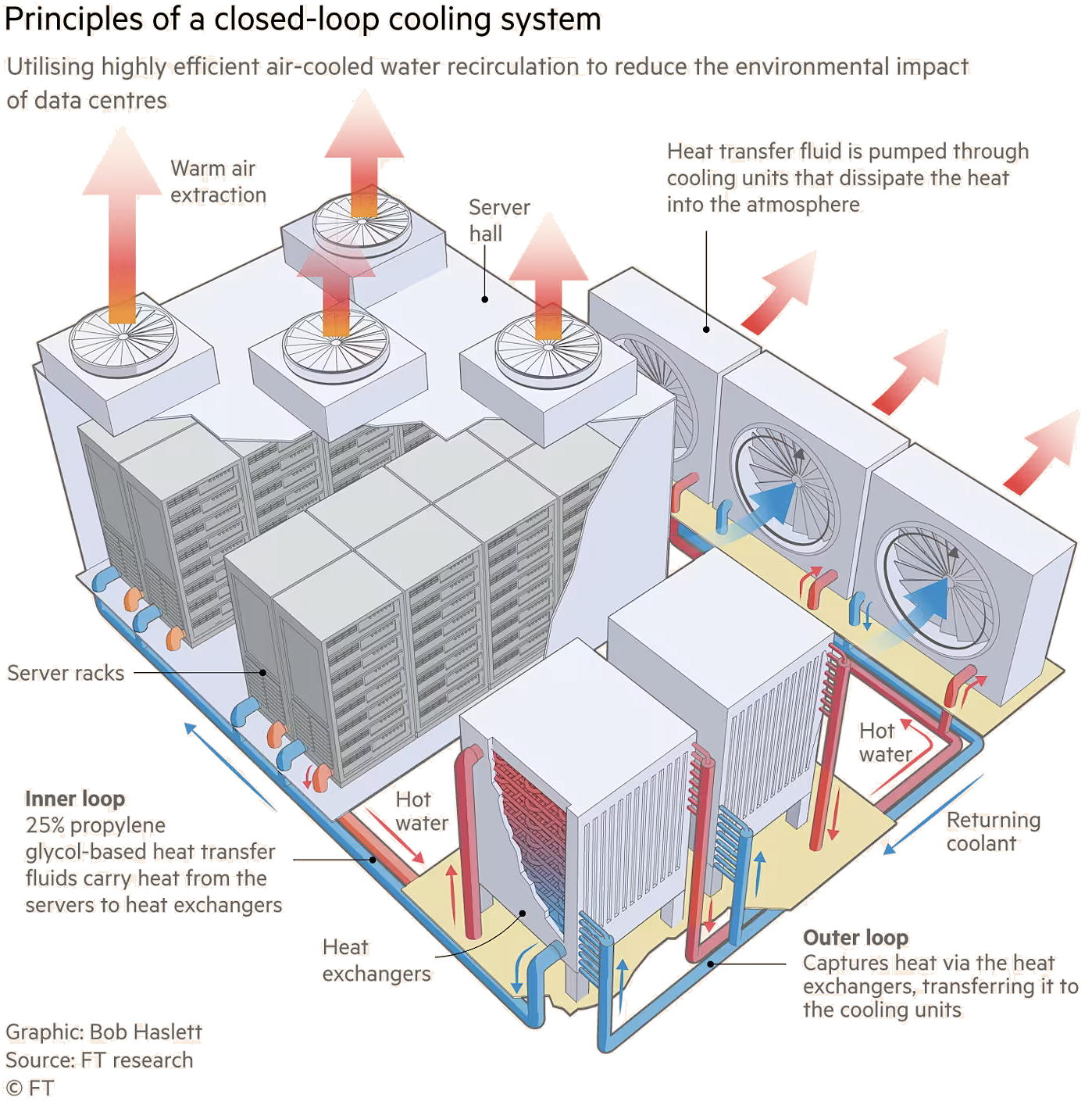
The most frequently touted is the introduction of “closed loop” systems. These pump coolant through pipes to dissipate heat from servers rather than evaporating water as has been the case in the past. Chipmaker Nvidia says it has also developed more energy-efficient chips that require even less cooling.
Credit: Financial Times
Credit: Financial Times
These systems are not without issues. Shaolei Ren, a researcher at the University of California, Riverside, who studies data center infrastructure, says operators using alternatives to water-based cooling use “25-35 percent more electricity” in summer, in effect shifting pressure from local water systems to regional electricity grids.
But industry executives argue that the trade-off between water and energy is often misunderstood. Doug Adams of NTT Global Data Centers, the world’s third-largest data center operator, says closed-loop systems can reduce overall energy demand. “It’s more costly to build up front but in the long run it’s more efficient to use [coolant] to evacuate heat,” he says.
OpenAI chief Sam Altman—whose start-up has committed to spend $600 billion on infrastructure by the end of 2030, according to people familiar with the matter—recently bristled at the suggestion that data centers consume huge amounts of water. Appearing at the India AI summit in February, he said that concerns about AI’s water consumption were “totally fake” arguing that evaporative cooling was a problem of the past.
Yet the sheer scale of the projects planned for the next five years by hyperscalers and others means that water consumption is expected to surge.
Compounding fears is a suspicion that AI facilities are driving up energy prices. On average, American bill payers—including residential, commercial and industrial customers—paid over 6 percent more for electricity year on year at the end of 2025. This increase was starkly higher in the mid-Atlantic states which house a large number of data centers such as Pennsylvania and Virginia, where bills rose by 19 and 10 percent respectively.
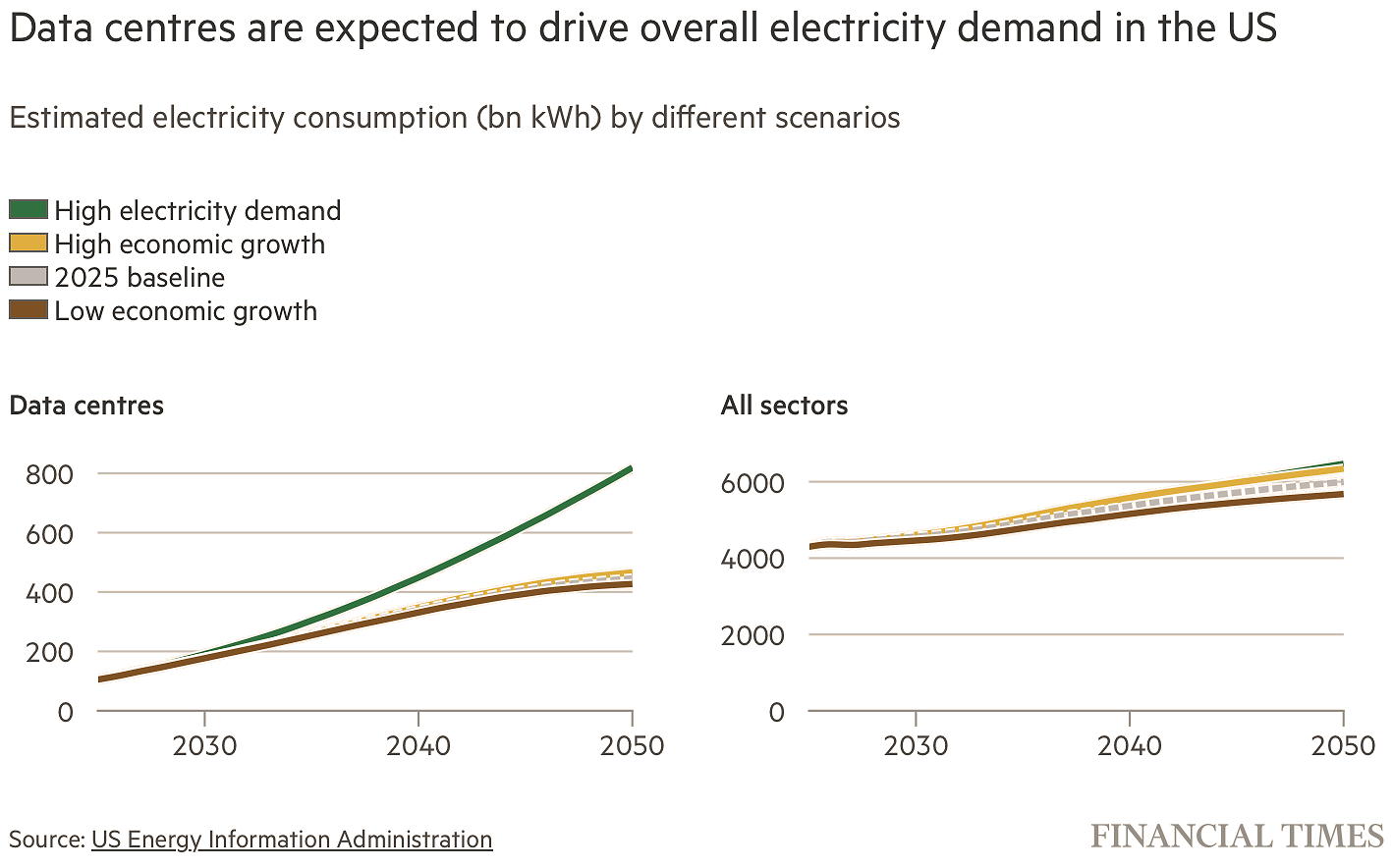
Of the roughly 100GW of additional electricity capacity that the US is projected to need at peak times by 2030, roughly half will be used by data centers, according to the Department of Energy.
In Illinois, Deppert says rising energy demand is feeding into already tight margins for farmers. “Everything we do is energy intensive,” he says. “If those costs keep going up, that comes straight off the bottom line.”
Tech executives have sought to allay such fears, committing last month to “build, bring or buy new-generation capacity for data centers and pay the full cost of infrastructure upgrades required to support their operations.”
Increasingly, however, popular resistance is having an impact. Amazon was forced to abandon a proposed data center project in Tucson, Arizona, after residents raised concerns over water and energy use, while Microsoft faced opposition in Caledonia, Wisconsin, over similar issues.
Small towns across the US are also skeptical of the industry’s promised economic benefits. “Technology companies talk about a sense of urgency. This is only the case because they’re in an arms race,” says Jonathan Koomey, a former project scientist at Berkeley Lab. “Is there a social urgency? I’m not sure there is one.”
Council elections take place for some Palestinians – but continuing mass displacement makes Gaza poll farcical
There was an election, of sorts, in Gaza at the weekend. It was a very limited vote – only people registered to vote in the central Gaza city of Deir al-Balah were able to cast a ballot. This made up a total electorate of 70,000 people, and of them, only 23% actually voted.
Hamas did not field any candidates and the municipal election has been described as a largely symbolic exercise by the Palestinian Authority (PA). The PA, which is dominated by Fatah under Palestinian president, Mahmoud Abbas, wants to link the West Bank and Gaza politically ahead of a possible presidential campaign at some stage in the future.
The low turnout in the Gaza poll was not unexpected given the continuing instability in the Strip. A joint report on Gaza published earlier this month by the UN, EU and World Bank, estimated that the Israeli military has displaced more than 1.9 million Palestinians in the last two-and-a-half years.
Less reported – but no less important – is the fact that this displacement continues, despite the ceasefire agreement announced in October 2025. The situation remains volatile, with the Israeli military having killed more than 738 Palestinians in Gaza since then.
All the signs are that this displacement will last. The Israeli army remains on the ground in more than half of the Gaza Strip, which is now divided by the so-called “yellow line” established shortly after the ceasefire. Although the line was originally announced as a temporary measure ahead of the military’s full withdrawal, there is every sign of it becoming a fixed border. Israel’s military chief of staff, Lieutenant-General Eyal Zamir appeared to confirm this when he visited Gaza in December 2025 and described the yellow line as “a new border line”.
Now virtually the entire Palestinian population of Gaza – the vast majority of whom have been forced to move at least once during the conflict, now widely recognised as a genocide – are confined to its eastern side. Any Palestinian who crosses the line risks being shot by the Israeli army.
More than 200 Palestinians have already lost their lives in this way. Most infamously, the Israeli army killed 11 members of the Abu Shaaban family, including seven children, as they were driving back to their home in the early weeks of the ceasefire.
By forcibly preventing Palestinians from returning to their homes, Israel is making the Palestinian people’s displacement permanent. And as the majority of Gaza’s Palestinians were already refugees before the Israeli assault began in October 2023, many see this policy as continuation of what they call the Nakba_ – or “catastrophe”. This began in 1948, when Zionist militias and the Israeli army displaced and expelled at least 750,000 Palestinians, leading more than 200,000 to seek refuge in Gaza.
Complicating matters further still, the Israeli military has repeatedly moved the yellow line further inward, seizing more territory in a de facto land grab. According to recent estimates, the side of the line occupied by the Israeli military now comprises more than 58% of the territory of the Gaza Strip.
At the same time as this ongoing internal displacement, controversial schemes to transfer Palestinians out of Gaza altogether are continuing. Since 2023, both the Israeli government and the White House have discussed numerous proposals for the Palestinians’ mass relocation from Gaza. Indonesia, Libya, Sudan, Congo and Somalia have all been touted as possible destinations. The Trump administration also proposed offering Palestinians US$5,000 (£3,680) to leave Gaza “voluntarily”.
Despite the ceasefire agreed in October 2025, funerals continue in Gaza, with more than 738 Palestinians killed by the Israeli military since October’s ceasefire.EPA/Haitham Imad
This operation came to light when 153 Palestinians were forced to spend 12 hours on an airport runway in South Africa after landing there without the required travel documents. Media investigations subsequently found that their journey had been facilitated by an organisation called Al Majd Europe, which calls itself a humanitarian agency working to evacuate Muslims from conflict zones. Palestinians pay US$2,000 upfront to Al Majd Europe which then arranges for their departure from Gaza.
Behind the scenes, the evacuation scheme is orchestrated by the organisation Ad Kan, whose leader Gilad Ach openly backed Trump’s plans for mass transfer from Gaza.
After bussing the Palestinians from Gaza to southern Israel, the organisations arrange for them to fly from Ramon airport to a range of destinations, including Indonesia, Malaysia and South Africa.
Some of the Palestinians who have been relocated in this way report not knowing where they are going. There are striking parallels with the 1970s, when the Israeli authorities tried to illicitly deport thousands of Palestinians from Gaza to Paraguay.
In effect, then, Israel is pushing Gaza’s 2 million Palestinians into a confined part of the Strip while simultaneously working to relocate them out of Palestine altogether. And with international attention largely now turned away from Gaza, there is alarmingly little to stop these plans getting considerably further – before it is too late.
Singapore’s AI neutrality is cracking under US-China pressure
A rear view of the large Merlion statue at Merlion Park, Singapore. Photo: Wikimedia Commons, Timelezz, cc-by-2.0
Singapore built its edge on something rare: neutrality that actually worked. Capital moved in, companies set up and deals got done without politics getting in the way.
From where I sit, that predictability has always been “The Product.” Yet, it seems that pressure on that model is now out in the open as it grapples with striking a balance between the US and China.
As announced this week, China is forcing Meta to unwind its US$2 billion acquisition of Singapore-based AI startup Manus, a company with Chinese roots in what amounts to much more than a blocked deal.
It seems to show that location no longer protects you. Origin and control now matter more than where a company is registered. I don’t see this as an isolated move. I see a system tightening.
AI has, over the last couple of years, moved into the category of strategic infrastructure. And governments are treating it accordingly.
Washington has already restricted outbound investment into Chinese advanced tech. Beijing is now tightening control over outbound ownership and talent. Both sides are drawing lines, and those lines are starting to overlap. Singapore sits directly in that overlapping region.
The scale matters here. More than $140 billion in foreign direct investment flowed into Singapore in 2024, one of the highest levels globally relative to its size.
Over 80 of the world’s top 100 tech firms run regional operations from there. Southeast Asia’s AI funding, roughly $6 billion in 2025, is largely structured through Singapore before being deployed.
Capital still wants to be in Singapore, that hasn’t changed, but it looks like freedom around that capital has.
For years, Singapore has acted as a bridge. Founders could relocate, restructure and access global capital without being forced into one geopolitical system. Investors could back companies with cross-border exposure and still expect a clean exit.
Chinese regulators are now looking past incorporation and focusing on origin, meaning where the technology was built, who built it and where it ends up. A Singapore address might no longer neutralize those questions.
From an investor’s perspective, this could mean behavior shifts quickly. Founders could choose sides earlier. Hybrid models of Chinese roots, Singapore structure and Western exit are likely to become harder to execute. Building for both systems at once introduces too much risk.
Valuations will start to reflect that new reality. Companies sitting between systems will carry a discount because of execution uncertainty. Clean alignment, fully inside one system, will command a premium because the path to exit is clearer.
Against this backdrop, cross-border M&A in AI can be expected to slow. Not because deals aren’t attractive, but because too many may be blocked. Boards and investors will avoid transactions where approval risk is obvious and fewer deals attempted means less liquidity across the middle.
Singapore could, I suspect, feel that directly. The city-state’s fundamentals remain strong, of course. There’s legal clarity, infrastructure and connectivity that still attract capital and talent.
This isn’t disappearing, but what’s changing is the ceiling on how globally those companies can operate. A Singapore-based company with Chinese founders and US buyers is no longer viewed as neutral.
This, therefore, is going to change how regulators respond and how investors assess risk. From where I sit, this leads to a more fragmented system.
Global tech is not unwinding completely, but it appears that it could be splitting into overlapping blocs. AI sits at the center of that split because it touches productivity, defense, finance and information all at once.
If this plays out, investors need to adjust fast. Understanding where a company sits politically is becoming as important as understanding what it does commercially. Of course, growth still matters, margins still matter, but now alignment does too.
Nigel Green is CEO and founder of the deVere Group
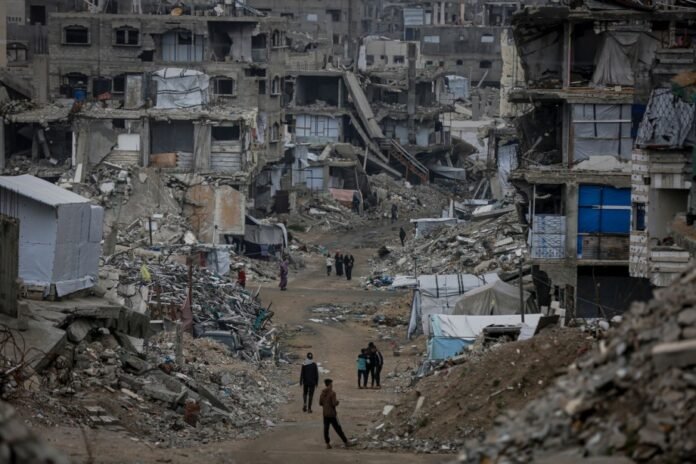
How the UN maintains Gaza as an exception to the detriment of the Palestinian people
Palestinians living in the Sheikh Radwan neighborhood struggle to maintain daily life under difficult conditions as the ongoing Israeli policy and attacks cause widespread destruction, while cold weather and heavy rainfall flood and damage tents, forcing residents to seek alternative shelter solutions despite limited resources, in Gaza City, Palestine, on March 29, 2026. [Saeed M. M. T. Jaras – Anadolu Agency]
“Lebanon cannot be another Gaza,” the UN Secretary General’s Spokesperson Stephane Dujarric said last week in response to a question during a press briefing regarding Israel’s war in Lebanon. Earlier this month, Israeli Finance Minister Bezalel Smotrich openly spoke about Israel’s plans to extend its non-declared borders into Syria and Lebanon, besides the encroachment already in place and extending in Gaza. Israeli ministers also spoke of applying the same tactics used in Gaza to South Lebanon.
Dujarric’s statement carries as much weight as contradiction in UN rhetoric. Lebanon cannot be another Gaza, and yet, the UN is doing nothing to stop Israel from expanding its borders and increasing its kill toll. On that level, Lebanon is on a par with Gaza – the UN’s silent complicity makes them comparable.
However, not once since October 2023 have we heard any UN official sound a warning about Gaza in terms of comparison. What would UN Secretary General Antonio Guterres, or Dujarric, have said? Gaza cannot become another Gaza? There is no comparison to what Gaza has suffered in increasing increments.
Israel then decided genocide would not only be possible but also acceptable, because the UN constitutes the legacy of former colonial powers masquerading as alleged guardians of human rights.
For Dujarric to be able to make such a statement, the UN must assume accountability. Had the international community truly worked to stop Israel’s genocide in Gaza, Dujarric would not be able to elicit a comparison. The UN would not be able to turn Gaza into a mere reference for other realities, while completely ignoring the realities created there for Palestinians by Israel’s colonial violence and genocide.
READ: Israel detains 1,800 Palestinian children since Gaza war began
At any given moment, and with the UN’s tacit blessings, Gaza can become another destroyed Gaza. From Operation Protective Edge in 2014 to the genocide that started in October 2023, Israel went from partial to the near absolute destruction of Gaza. Dujarric’s rhetorical concern for Lebanon and its comparison to Gaza normalises the genocide in Gaza even further. It is not a question of taking an absolute stance against genocide, but ensuring the genocidal tactics are not replicated in Lebanon, which makes Gaza a contemporary reference point. The difference is that while Lebanon cannot be another Gaza, Gaza was forced into becoming the reference for a genocide that carries not only impunity but complete normalisation. And the normalisation of genocide is specific to Gaza.
In UN rhetoric, Gaza maintains relevance but not importance.
Lebanon should not suffer what Palestinians have suffered. However, the international duty to protect Palestinians in Gaza from genocide should have eclipsed any need for future references in similar Israeli colonial aggressions.
For UN officials to make such statements, it should be clarified that the UN allowed Israel’s genocide to happen in Gaza. This selectivity – in rhetoric not in practice – illustrates how the UN was fine with all the tactics Israel used to ethnically cleanse Gaza, to normalise genocide only in Gaza’s context. Israel couldn’t have asked for better rhetorical contradictions at an international level. The underlying UN message is that genocide is a war crime – anywhere except in Gaza.
OPINION: Is the EU willing to deconstruct colonialism and its role in maintaining it?
The views expressed in this article belong to the author and do not necessarily reflect the editorial policy of Middle East Monitor.
Ukraine Summons Israeli Ambassador Over Alleged Stolen Grain; Israel Rejects Claims
Ukraine’s foreign ministry said it had summoned Israeli Ambassador Michael Brodsky after allegations that grain shipped by Russia from occupied Ukrainian territory had been accepted at Israeli ports, according to Reuters.
The move follows similar earlier accusations that have strained ties between the two countries, including a dispute on social media Monday and a prior discussion between the countries’ foreign ministers on April 15. A Ukrainian diplomatic source said Israel had previously “brushed off” complaints regarding the issue.
Ukrainian Foreign Minister Andrii Sybiha wrote on X that “Friendly Ukrainian-Israeli relations have the potential to benefit both countries, and Russia’s illegal trade with stolen Ukrainian grain should not undermine them.” He added, “Now that another such vessel has arrived in Haifa, we once again warn Israel against accepting the stolen grain and harming our relations.”
Sybiha said Ukraine had “already officially summoned the Israeli ambassador to [the Ukrainian foreign ministry] tomorrow morning to present our protest note and request appropriate action.”
Israel rejected the claims, with Foreign Minister Gideon Sa’ar responding on X, “Allegations are not evidence,” and adding, “Evidence substantiating the allegations have yet to be provided.” Sa’ar said the matter would be reviewed and that international law would be upheld.
Israel has said Ukrainian officials have not provided evidence to support the accusations.
Haaretz reported that a vessel, the Panormitis, believed to be carrying grain from occupied Ukrainian territory, was awaiting permission to dock in Haifa. The newspaper also said four shipments of grain from occupied Ukraine had already been unloaded in Israel this year.
Kyiv considers grain produced in the four regions Russia claimed as its own since its 2022 invasion, as well as in Crimea, annexed by Russia in 2014, to have been taken by Moscow.
Israel said it would investigate the matter and ensure that international law is being followed.
Lufthansa Unveils ‘Economy Basic’ With Europe’s Smallest Cabin Bag Allowance
fthansa is introducing a new “Economy Basic” fare that offers Europe’s smallest free cabin‑bag allowance as the airline seeks to compete more aggressively with low‑cost carriers. The fare, available on short‑ and medium‑haul routes from 19 May, is designed as an entry‑level option for price‑sensitive travelers.
The new allowance permits only a small personal item with a maximum volume of 18 liters, significantly below the free limits offered by Ryanair, Wizz Air and easyJet. Lufthansa says the dimensions comply with the minimum standard agreed between EU transport ministers and the Airlines for Europe trade group.
The fare is part of a broader restructuring that expands Lufthansa’s economy‑class options to five tiers, ranging from the bare‑bones Economy Basic to Economy Flex, which includes priority boarding and flexible rebooking. Passengers can pay to add carry‑on or checked baggage, while elite status holders — including HON Circle, Senator and Star Alliance Gold members — may bring an additional cabin bag even under the new restrictions.
The move comes as airlines continue negotiations with the European Commission over rules that could require carriers to allow a free roll‑aboard suitcase. Lufthansa argues that such a mandate would increase delays and raise fares.
The new fare will also apply across the Lufthansa Group, including Swiss, Austrian Airlines and Brussels Airlines.
If you’re looking for a dinner that’s quick, comforting, and packed with flavor, this BBQ Ranch Chicken Casserole is exactly what you need. With tender shredded chicken, smoky BBQ sauce, and creamy ranch dressing
It’s one of those recipes that feels like a warm hug—simple to prepare, incredibly satisfying, and perfect for weeknight meals or casual gatherings.
💛 Why You’ll Love This Recipe
⏱ Ready in about 30–35 minutes
🧀 Loaded with melty, cheesy goodness
🍗 Perfect for using leftover or rotisserie chicken
👨👩👧👦 Kid-friendly and crowd-pleasing
🥘 One dish = easy cleanup
🛒 Ingredients
2 cups cooked chicken, shredded
1 cup BBQ sauce
1 cup ranch dressing
1 cup shredded cheese (cheddar or your favorite)
1 tsp garlic powder
1 tsp onion powder
1 cup cooked rice or pasta (optional)
Green onions, chopped (for garnish)
👩🍳 Instructions
1. Preheat the Oven
Set oven to 350°F (175°C) and grease a baking dish.
2. Mix the Filling
In a large bowl, combine:
Shredded chicken
BBQ sauce
Ranch dressing
Garlic powder
Onion powder
Rice or pasta (optional)
Mix until everything is well coated.
3. Assemble
Transfer the mixture to the baking dish and spread evenly.
4. Add Cheese
Sprinkle shredded cheese generously over the top.
5. Bake
Bake for 20–25 minutes until cheese is melted, bubbly, and slightly golden.
6. Serve
Let cool for a few minutes, then garnish with green onions and serve warm.
🍽️ What to Serve With It
🥗 Fresh green salad
🥖 Garlic bread
🥕 Roasted vegetables
🥬 Coleslaw for a crunchy contrast
🍹 Iced tea or lemonade
💡 Tips for Best Results
Use rotisserie chicken to save time
Don’t overbake—watch the cheese carefully
Add a little hot sauce for extra kick 🔥
Swap cheese types for different flavors (mozzarella, Monterey Jack)
🔄 Variations
🦃 Replace chicken with turkey
🌱 Use plant-based protein for a vegetarian version
🌮 Add corn, beans, or jalapeños for a Tex-Mex twist
🧊 Storage & Reheating
Fridge: 3–4 days in airtight container
Freezer: up to 2 months
Reheat: oven at 350°F (175°C) until warm
✨ Final Thoughts
BBQ Ranch Chicken Casserole is the ultimate easy comfort food—creamy, cheesy, and bursting with bold flavors. Whether you’re cooking for your family or just want something satisfying without the effort, this recipe always delivers.
These days, the hype is all about AI and robots, but almost a decade ago, the tech du jour was self-driving. You couldn’t swing a lanyard at CES for the latter half of the last decade without hitting a robotaxi; post-COVID, the number of startups has shrunk, but the technology has definitely matured. Go to the right cities—San Francisco and Austin, Texas, spring to mind—and you might see dozens of sensor-festooned vehicles among the downtown traffic.
The pod-like robotaxis belonging to Zoox stand out. Other robotaxi developers are retrofitting existing vehicles like Hyundai Ioniq 5s with sensors and the computing power necessary for self-driving. Zoox, which was bought by Amazon in 2020, did that with its test fleet, but as it starts to offer ride-hailing services—currently in Las Vegas and San Francisco—it’s doing so with a purpose-built design that looks like it just drove off the set of a big-budget sci-fi production.
“A robotaxi is not a car; it’s not a human-driven vehicle, and the requirements are wildly different, although it has to live in that world,” explained Chris Stoffel, director of robot industrial design and studio engineering at Zoox.
It all starts with the sensors, each perched on a little ledge projecting from the top four corners of the robotaxi’s body. From up there, each has an unobstructed, high-level view, giving the Zoox robotaxi good situational awareness, particularly straight ahead. “Because we don’t have a traditional hood, we’ve optimized our frontal coverage in a way that would be nearly impossible on a retrofitted vehicle,” said Zoox director of sensor engineering Ryan McMichaels.
Zoox’s robotaxi has a friendly, welcoming design.
Credit: Zoox
Zoox’s robotaxi has a friendly, welcoming design. Credit: Zoox
Then there’s the fact that the robotaxi doesn’t care whether it’s coming or going, thanks to its symmetrical, bidirectional design. The advantages are tantalizing, particularly for a vehicle that’s going to be summoned on demand. There’s no more need for a three-point turn, and with its symmetrical steering axles, it should have unparalleled agility. For example, since both axles have the same degrees of steering, the Zoox robotaxi can crab walk far more effectively than the GM Hummer EV performing its party trick.
“Not only do we do that for the maneuverability, but also the redundancy of the vehicle,” said Stoffel. “The hardware inside of the vehicle, it’s the same rack, it’s the same EDU on both ends, same battery pack—kind of split in both ends—two HVAC units. There’s a lot of redundancy built in there. It kind of got the kitchen sink of redundancy as we wanted to make sure this first product really could complete the mission,” Stoffel told me.
“We’re picking people up and we’re dropping them off. How do we do that better than anyone else? The idea to get into a spot that no one can or down a street or maneuverability that no one can, because we are really focused primarily on dense urban areas at the moment,” Stoffel said.
The interior is designed to be calming.
Zoox
The interior is designed to be calming. Zoox
Hard-wearing, but functional.
Zoox
Hard-wearing, but functional. Zoox
The interior is designed to be calming. Zoox
Hard-wearing, but functional. Zoox
I haven’t had a chance to try out the rider experience yet, but I’m curious to see how it compares to the black cabs I grew up with in London. Those aren’t symmetrical, but they do have extremely tight turning radii, and an interior for riders that seats five with a pair of rear-facing jump seats—the best seat in the house for some.
Zoox’s interior is a little more stylish than the passenger compartment of a London taxi, though, with cup holders and wireless charging pads on both benches. “When you get into the vehicle… designing for calm is what we’ve wanted to go for. And the way we do that is nothing demands your attention. When you get into this thing, it’s very simple, it’s very clean, very continuous. Nothing is demanding your attention, allowing you to settle in. As simple as just doing your seatbelt and hitting go, you’re on your way,” Stoffel told me.
Zoox’s robotaxis are currently deployed in Las Vegas, San Francisco, and Austin, with Miami next in the works.
Elvis’ Biggest Tragedy: He Planned to Marry and Start Over Then Died Hours Later
In a heartbreaking twist that still haunts fans decades later, Elvis Presley was reportedly just hours away from a brand-new chapter in life before tragedy struck.
According to those closest to him, the King of Rock and Roll wasn’t spiraling without hope — he was planning a full comeback.
His then-girlfriend Ginger Alden revealed that the two had just set a wedding date the very night before his sudden death on August 16, 1977. The 42-year-old icon was also dreaming of a fresh start, including a new film project and even redecorating his famous Graceland mansion.
“He wanted to do a movie called Mission,” Alden recalled. “And just hours before… we had set a wedding date.”
But that future never came.
Alden would later discover Elvis unresponsive on the bathroom floor — a devastating moment that would mark the end of one of the most legendary lives in American music history.
Behind the fame, those closest to Elvis say there was a growing sense of urgency — and fear.
Women who loved him, including ex-wife Priscilla Presley and longtime girlfriend Linda Thompson, reportedly did everything they could to keep him alive.
Author Alanna Nash claimed Thompson would stay awake through the night just to make sure Elvis was still breathing.
But the superstar’s inner circle says he struggled to accept help — weighed down by addiction, pressure, and the expectations of being Elvis.
By the time of his death, insiders say he felt trapped — stuck between an exhausting tour schedule, financial stress, and declining health.
Those closest to Elvis insist he knew things had gone too far — and he wanted out.
His friend and spiritual advisor Larry Geller revealed the singer had made a dramatic decision: he was going to change everything.
“He said, ‘We’ll do it in September,’” Geller recalled.
But Elvis never made it to September.
According to Geller, the plan was bold — finish one last short tour, then walk away from the spotlight entirely. The idea was to take a full year off, focus on his health, and escape to Hawaii for a complete reset.
“He knew his life was on the line,” Geller said. “He wanted to get off the pills.”
Elvis’ life may have looked glamorous, but insiders say it had become a cage.
His longtime manager Colonel Tom Parker was accused of tightly controlling his career — even blocking the singer from touring Europe, something Elvis desperately wanted.
At the same time, his spending habits and generosity reportedly left him under financial pressure, forcing him to keep performing even when he was exhausted.
“He gave too much away,” Nash said. “And he kept working.”
Even those closest to Elvis saw the warning signs.
His daughter, Lisa Marie Presley, was just nine years old at the time — but she noticed her father was changing.
“He was not happy,” she once said, recalling his worsening temper and declining health.
Behind the scenes, nurses and loved ones tried everything — diets, exercise, detox attempts — but nothing stuck. Elvis reportedly relied heavily on prescription medications, convincing himself it wasn’t a problem because they were doctor-approved.
Meanwhile, friends say he had started searching for something deeper.
“He wanted to find God,” Geller’s daughter shared, adding that Elvis had dreams of becoming a gospel singer and reconnecting with his faith.
In one chilling admission before his death, Elvis reportedly confided in Geller:
“I know I have to make dramatic changes… I know my life is on the line.”
It was a moment of clarity — but tragically, it came too late.
Alden says their final exchange still echoes in her mind.
“He said, ‘I’m going to the bathroom to read,’” she recalled.
Hours later, she found him dead.
For those who loved him, the pain wasn’t just losing Elvis — it was knowing how close he was to turning everything around.
Nearly five decades later, the story of Elvis Presley’s final days remains one of the most haunting “what ifs” in pop culture.
He had plans. He had hope. He was ready to change.
But time ran out.
As Geller put it: “Don’t wait. It doesn’t matter who you are — when you know you need to change, you have to do it now.”







![Palestinians living in the Sheikh Radwan neighborhood struggle to maintain daily life under difficult conditions as the ongoing Israeli policy and attacks cause widespread destruction, while cold weather and heavy rainfall flood and damage tents, forcing residents to seek alternative shelter solutions despite limited resources, in Gaza City, Palestine, on March 29, 2026. [Saeed M. M. T. Jaras - Anadolu Agency]](https://i0.wp.com/www.middleeastmonitor.com/wp-content/uploads/2026/03/AA-20260329-40960293-40960260-HARSH_WEATHER_AND_DESTRUCTION_DEEPEN_STRUGGLES_IN_GAZA.jpg?fit=920%2C613&ssl=1)