20.9 C
London
Saturday, April 25, 2026
Home Blog

American journalist Tucker Carlson feels ‘betrayed,’ criticizes Trump on Iran war: Report

0
american-journalist-tucker-carlson-feels-‘betrayed,’-criticizes-trump-on-iran-war:-report
American journalist Tucker Carlson feels ‘betrayed,’ criticizes Trump on Iran war: Report

Political commentator and former Fox News host Tucker Carlson said he feels “betrayed,” criticizing US President Donald Trump’s Iran war, Anadolu reports.

In an interview with The Wall Street Journal, Carlson said, “I don’t hate Trump. I hate this war and the direction that the US government is taking,” adding that “I feel betrayed.”

The report said that Carlson has opposed the Jan. 3 US operation on Venezuela that led to the capture of President Nicolas Maduro, adding that he is now “the most prominent opponent of the Iran war” initiated by the US and Israeli strikes against Iran that began on Feb. 28.

READ: Tucker Carlson claims CIA read his messages, says US preparing foreign agent case against him

“Why can’t the US government act on behalf of its own citizens?” Carlson asked before adding, “This is a generational problem that didn’t start with Trump.”

“If anything, Trump just proved the system was stronger than him,” he remarked.

Earlier this month, Trump said in a Truth Social post that Carlson was a “low IQ person” who is “always easy to beat” and “highly overrated.”

Carlson had previously been one of Trump’s most prominent media allies. At the 2024 Republican National Convention, he said Trump’s survival of an assassination attempt during the campaign amounted to “divine intervention,” suggesting God had preserved him for a purpose.

READ: Trump cancels Witkoff, Kushner’s trip to Pakistan for talks with Iran

Netanyahu Says Early-Stage Prostate Cancer Was Treated Successfully After Radiation Therapy  

0
netanyahu-says-early-stage-prostate-cancer-was-treated-successfully-after-radiation-therapy  
Netanyahu Says Early-Stage Prostate Cancer Was Treated Successfully After Radiation Therapy  


Israeli Prime Minister Benjamin Netanyahu announced Friday on X that he was diagnosed with early-stage prostate cancer and underwent treatment in Jerusalem, adding that the condition was fully treated and that he is now healthy. 

The 76-year-old leader said a malignant growth measuring less than 1 centimeter was identified during routine follow-up examinations after a December 2024 procedure for a benign prostate enlargement. Physicians described the finding as a very early-stage tumor with no evidence of spread or metastasis. 

Netanyahu received targeted radiation therapy at Hadassah Medical Center in Jerusalem. The course of treatment concluded about two and a half months before his public disclosure in April 2026. According to his doctors, subsequent imaging and blood tests indicate the disease has disappeared. 

In his statement, Netanyahu said he remains in “excellent physical condition.” 

While he was in treatment, Netanyahu requested that his annual health report be delayed so it would not be released “at the height of the war, to prevent the Iranian terror regime from spreading further false propaganda against Israel.” 

The disclosure adds to a series of recent medical procedures. In December 2024, Netanyahu underwent surgery for a benign enlarged prostate. Earlier, in March 2024, he had surgery to treat a hernia. In July 2023, he was fitted with a pacemaker following what was described as a “transient heart block” and “fainting episode.” 

Despite the medical history, Netanyahu said the cancer diagnosis was caught early and treated successfully. 

Report: Samsung execs worried company could lose money on smartphones for the first time

0
report:-samsung-execs-worried-company-could-lose-money-on-smartphones-for-the-first-time
Report: Samsung execs worried company could lose money on smartphones for the first time

Selling smartphones used to be easy—everyone wanted one, and every new phone was a lot better than the one that came before. Things are different now that smartphones are mature products. Plenty of manufacturers have thrown in the towel, leaving big players like Samsung to sell a new phone every couple of years. But even Samsung may find it tough to turn a profit in 2026 due to the ongoing race to build more AI capacity.

According to Money Today (Korean), Samsung MX (mobile experience) head TM Roh has warned company leadership that it could be headed for the first net loss on smartphones in the company’s history. Even during times of economic strife or amid pandemic-related supply chain chaos, Samsung still made money on smartphones. The skyrocketing price of DRAM and NAND may be what finally breaks the streak despite strong Galaxy S26 sales.

Shortages of these components have affected all types of computing hardware, from consumer laptops to servers. The LPDDR5x memory found in most mobile devices is increasingly important for AI. Nvidia’s Vera AI CPU, which will replace Grace later in 2026, will have up to 1.5 TB of LPDDR5x memory. The company’s upcoming rack-scale AI platforms will have 36 Vera CPUs alongside 72 Rubin GPUs. The CPUs in a single server will consume enough RAM for 4,600 Galaxy S26 Ultra devices (12GB each).

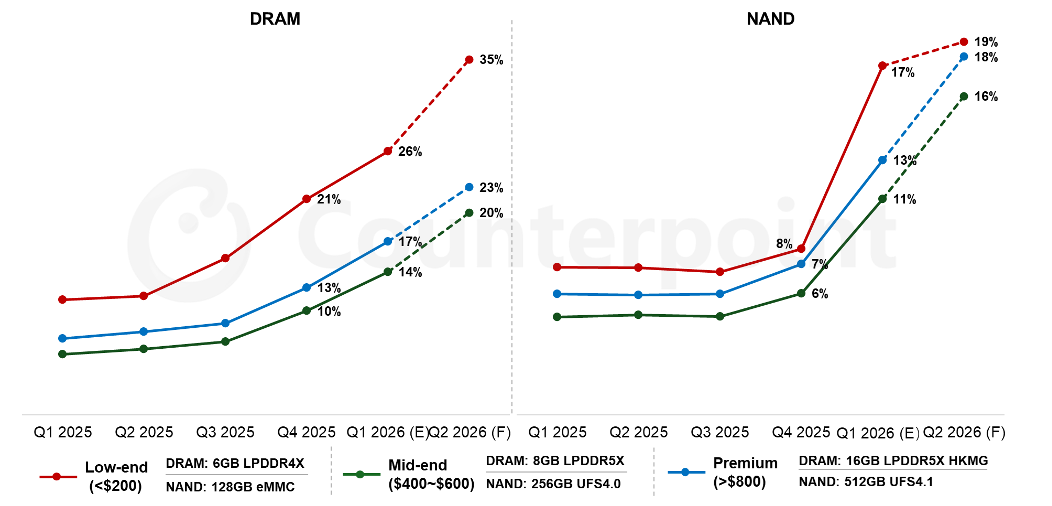
Until recently, the application processor (which includes the cellular radio) was the most expensive component of most smartphones, and the display usually came in right below that. The AI era has upended the formula, roughly doubling the cost of memory and storage. According to Counterpoint Research, RAM will account for more than a third of the cost of building a budget phone in mid-2026. Even with more expensive devices, memory is still north of 20 percent of the cost.

chart of memory and storage component prices

Manufacturing smartphones is getting much more expensive.

Manufacturing smartphones is getting much more expensive. Credit: Counterpoint Research

The good news for Samsung is that while the MX division struggles, its semiconductor division is raking it in. Samsung Semiconductor has smashed records in the first quarter of 2026, earning an estimated $38 billion (KRW 57.2 trillion) in profit. That’s more than seven times its net from Q1 2025.

Samsung, Micron, and SK Hynix are all accelerating plans to expand memory and storage production lines—Samsung specifically has started spinning down LPDDR4 production to boost the supply of LPDDR5—but Nekkei Asia projects that won’t be enough. Even with best-case improvements in output, DRAM production in 2027 could fall 40 percent short of expected demand. The only thing that could challenge that prediction is a substantial change in demand for AI applications. With most of the world’s tech giants firmly committed to expanding AI compute through next year, it’s unlikely that supply constraints will ease soon.

Higher demand, higher prices

There are already signs that RAM and storage costs are making phones more expensive. Motorola recently raised the price of its Moto G budget phones by up to 50 percent. Low-cost devices like the Moto G will feel the rising cost of components the most, making the very idea of a budget phone in the coming years suspect.

With the prospect of sinking profitability in 2026, Samsung is also making changes. The recently released Galaxy A37 and A57 mid-range devices come with a $50 price hike over the last generation. The company has also increased prices on some more expensive devices, adding $80 to the Galaxy Z Flip 7 (512 GB) and Z Fold 7 (512 GB and 1 TB). Some of its tablets are also more spendy, including a $100 increase for the Galaxy Tab S11.

With profitability in doubt, Samsung is on the verge of releasing new, ultra-expensive phones. This summer, the company will debut a new generation of Galaxy Z foldables, which are always priced even higher than the Galaxy S series. These devices come with ample storage and RAM to help justify the exorbitant price tags. That makes them prime candidates for price hikes that leave foldables even more unrealistically expensive.

Greece to be overtaken by Italy as euro zone’s most indebted country in 2026

0
greece-to-be-overtaken-by-italy-as-euro-zone’s-most-indebted-country-in-2026
Greece to be overtaken by Italy as euro zone’s most indebted country in 2026


Greece will no longer be the euro zone’s most indebted country by the ​end of this year, with its public debt set ‌to fall below Italy’s, according to sources and data from Italy’s new budget plan.

Greek debt is estimated to be reduced to about 137% of gross domestic ​product this year from 145% in 2025, two senior officials ​told Reuters.

By contrast, Italy sees its debt rising from 137.1% ⁠of GDP in 2025 to 138.6% in 2026, under the Treasury’s ​multi-year budget plan (DFP) published on Thursday.

“Greece will not be the most ​indebted country in the euro zone – from this year”, one of the two Greek officials told Reuters.

The new estimate for Greece’s debt ratio will be ​included in the country’s new multi-year fiscal plan that will be ​submitted to the European Commission at the end of this month.

Italy’s debt will ‌remain ⁠virtually stable at 138.5% in 2027, before declining to 137.9% in 2028 and to 136.3% the following year, its budget plan showed.

Since 2020, Greece’s public debt – the highest in the euro zone over ​the last two ​decades – has ⁠shrunk by more than 45 percentage points to 145% of gross domestic product last year. Italy cut ​its debt by some 17 percentage points over ​the same ⁠period.

Greece, which is recovering from a decade-long financial crisis and three bailouts totalling about 280 billion euros, plans to repay ahead of schedule loans worth ⁠some ​7 billion euros from its first ​bailout later in the year.

Via Reuters

Soldier won $410K in Polymarket bets on timing of Maduro capture, US alleges

0
soldier-won-$410k-in-polymarket-bets-on-timing-of-maduro-capture,-us-alleges
Soldier won $410K in Polymarket bets on timing of Maduro capture, US alleges

A US Army soldier was arrested for insider trading after being accused of making prediction-market wagers on the timing of the military’s capture of Venezuelan President Nicolás Maduro.

Army soldier Gannon Ken Van Dyke made a profit of nearly $410,000 by making bets on Polymarket, and he was indicted on charges of unlawful use of confidential government information for personal gain, theft of nonpublic government information, commodities fraud, wire fraud, and making an unlawful monetary transaction, the Department of Justice announced yesterday.

“As alleged in the indictment, Van Dyke participated in the planning and execution of the US military operation to capture Nicolás Maduro, called ‘Operation Absolute Resolve,’ and Van Dyke used his access to classified information about that operation to personally profit,” the DOJ said.

Van Dyke, a 38-year-old North Carolina resident stationed at Fort Bragg in Fayetteville, has been an active-duty soldier since 2008 and a master sergeant with US Army Special Forces since 2023, according to the indictment. He was bound by nondisclosure agreements forbidding him from revealing classified or sensitive military information.

Van Dyke allegedly started making bets about a week before the January 3 capture of Maduro. He was charged in US District Court for the Southern District of New York.

“Van Dyke won his wagers on those contracts,” and “profited approximately $409,881,” the DOJ said. He later “sent most of his proceeds to a foreign cryptocurrency vault before depositing them into a newly created online brokerage account,” and “took steps to conceal his identity as the trader in the Maduro- and Venezuela-related markets,” the DOJ said.

Trump: It’s like “Pete Rose betting on his own team”

The DOJ described the bets as follows:

As alleged, on or about Dec. 26, 2025, Van Dyke created a Polymarket account, funded it, and began trading on Maduro- and Venezuela-related markets. In total, Van Dyke made approximately 13 bets from Dec. 27, 2025, through the evening of Jan. 26. Those bets all took the “YES” position on “US Forces in Venezuela… by January 31, 2026”; “Maduro out by… January 31, 2026”; “Will the US invade Venezuela by… January 31,”; or “Trump invokes War Powers against Venezuela by… January 31.” Van Dyke bet a total of approximately $33,034 on those outcomes while in possession of classified nonpublic information about Operation Absolute Resolve.

President Trump was asked about Van Dyke at the White House on Thursday, and responded by comparing the wagers to “Pete Rose betting on his own team,” according to CNBC. “Pete Rose, they kept him out of the Hall of Fame because he bet on his own team,” Trump was quoted as saying. “Now, if he bet against his team, that would be no good, but he bet on his own team. I’ll look into it.”

CNBC wrote that when “a reporter noted there have been other allegations of insider trading on prediction markets about the Iran war, Trump said, ‘You know the whole world, unfortunately, has become somewhat of a casino.’” Trump also said that he is “not happy with any of that stuff.”

Polymarket said in a statement yesterday that it “identified a user trading on classified government information,” and “referred the matter to the DOJ and cooperated with their investigation. Insider trading has no place on Polymarket. Today’s arrest is proof the system works.”

Trump Jr. firm invested in Polymarket

Polymarket last year announced an investment from a venture capital firm backed by Donald Trump Jr., and added Trump Jr. to its advisory board. The investment was reportedly at least $10 million. Trump Jr. is also a strategic advisor for Kalshi, another major prediction market.

Some US states have tried to impose stricter regulations on prediction markets, but are facing pushback from the Trump administration. The US won a court ruling finding that the federal government’s jurisdiction over prediction markets prevents New Jersey from enforcing laws that prohibit betting on college sports and require licenses to offer other types of sports wagers.

Van Dyke became involved in the planning and execution of Operation Absolute Resolve on or about December 8, 2025, the indictment said. Van Dyke “possessed material nonpublic information about that operation at the time of each and every trade he placed in Maduro- and Venezuela-related markets,” and had received that information “under a duty of trust and confidence to maintain the confidentiality of such classified information and to not use it for personal matters or gain,” the indictment said.

The indictment said that hours after Maduro’s capture, a photo was taken depicting Van Dyke “on what appears to be the deck of a ship at sea, at sunrise wearing US military fatigues, and carrying a rifle, standing alongside three other individuals wearing US military fatigues.” The photo was uploaded to Van Dyke’s Google account, the indictment said.

Shortly after the Maduro operation, “reports of unusual trading in Maduro-related contracts on Polymarket appeared in the press and on social media,” the DOJ said. The agency alleged that Van Dyke reacted to the reports by trying to conceal his trades.

“On or about January 6, 2026, for example, Van Dyke asked Polymarket to delete his Polymarket account, falsely claiming that he had lost access to the email address to which the account had been associated,” the DOJ said. “That same day, Van Dyke changed the email registered to his cryptocurrency exchange account to an email address that was not subscribed to in his name, and which he had created on or about Dec. 14, 2025.”

Van Dyke also faces CFTC lawsuit

The DOJ press release said the combined maximum penalty of the charges is 60 years in prison, but noted that the maximums “are prescribed by Congress and provided here for informational purposes only, as any sentencing of the defendant will be determined by the judge.”

The Commodity Futures Trading Commission (CFTC) separately filed a civil complaint against Van Dyke, also in the Southern District of New York. The agency said it is seeking “restitution, disgorgement, civil monetary penalties, trading and registration bans, and a permanent injunction against further violations of the Commodity Exchange Act and CFTC regulations.”

Van Dyke “was entrusted with confidential information about US operations and yet took action that endangered US national security and put the lives of American service members in harm’s way,” CFTC Chairman Michael Selig said.

The case is “the first time the CFTC has charged insider trading involving event contracts, and the first time the CFTC has used the so-called ‘Eddie Murphy Rule’ to bring charges based on the misuse of government information,” the agency said. The Eddie Murphy rule is named after the actor because of the insider trading scheme depicted in Trading Places, which involved futures contracts for frozen concentrated orange juice.

Autopilot Steers Plane Towards Mountain as Pilots Distracted

0
autopilot-steers-plane-towards-mountain-as-pilots-distracted
Autopilot Steers Plane Towards Mountain as Pilots Distracted


A routine flight turned into a near-disaster when a passenger jet carrying 94 people suddenly veered toward mountainous terrain—all because of a critical oversight in the cockpit.

According to a newly released report from the Australian Transport Safety Bureau, the frightening incident unfolded last July when an Alliance Airlines Embraer ERJ 190 departed Cairns under the cover of night, heading for Brisbane.

But moments after takeoff, something wasn’t right.

The captain quickly noticed the aircraft wasn’t climbing as expected. Behind the scenes, a dangerous chain reaction was already unfolding. Investigators say the pilots became distracted during the critical takeoff phase—and shockingly “inadvertently omitted” retracting the landing gear, a basic but crucial step.

Things escalated fast.

As the first officer initiated a turn and switched on autopilot, the jet suddenly began banking the wrong way—straight toward nearby mountainous terrain. The cockpit crew scrambled as the captain barked instructions to correct course, realizing just how close things were getting.

Then came another risky move.

In a split-second reaction, the captain yanked up the landing gear—but did so while the aircraft was traveling about 17 knots above the maximum safe retraction speed, adding even more danger to an already tense situation.

Miraculously, disaster was avoided.

The plane stabilized, continued its flight, and landed safely with no injuries reported. But the investigation paints a chilling picture of how quickly routine operations can spiral when focus slips—even for a moment.

ATSB Director of Transport Safety Stuart Macleod said the crew became overly focused on the flight path, which increased their workload and delayed their recognition of the critical error.

It’s a stark reminder that even in highly automated cockpits, human attention remains the last line of defense—and when that breaks down, the margin for error disappears fast.

China’s rising threat looms over Japan-Australia frigate deal

0
china’s-rising-threat-looms-over-japan-australia-frigate-deal
China’s rising threat looms over Japan-Australia frigate deal

Japan’s decision to supply advanced frigates to Australia marks a major step in defense cooperation between the two countries as questions over US commitment in the Pacific coincide with China’s expanding naval reach.

Multiple media outlets reported that Australia and Japan signed contracts in Melbourne to launch an A$10 billion (US$6.5–US$7 billion) warship program to supply the Royal Australian Navy with next-generation frigates, marking Japan’s most consequential military export since lifting its arms export ban in 2014, according to statements by Australian and Japanese defense officials.

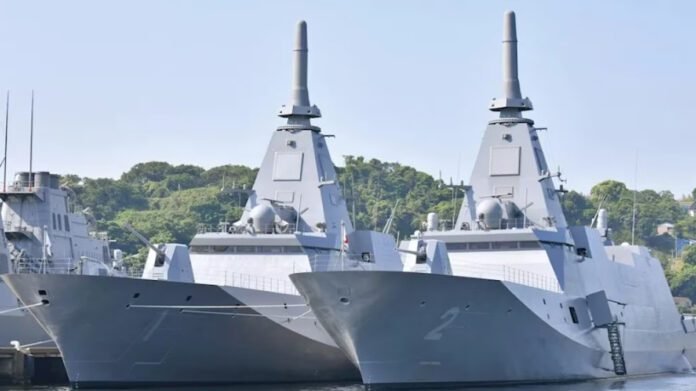
The agreement, signed by Australian Defense Minister Richard Marles and Japanese Defense Minister Shinjiro Koizumi aboard the Mogami-class frigate JS Kumano, covers an initial three ships to be built by Mitsubishi Heavy Industries in Japan, with the first due for delivery around 2029, followed by eight more to be constructed in Western Australia.

The vessels, designed for anti-submarine warfare, surface strikes and air defense, will replace Australia’s aging ANZAC-class fleet and are intended to secure vital sea lanes and northern approaches amid China’s expanding military presence in the Indo-Pacific.

The deal, first agreed in August 2025 after Japan beat Germany’s bid, underscores deepening bilateral security ties as Japan broadens partnerships beyond its alliance with the United States and Australia accelerates naval modernization, with both sides highlighting the project as a rapid, strategically significant upgrade to Australia’s maritime capabilities.

Looking at the possible motivations behind Japan’s sale of high-end frigates to Australia, George Friedman, in a Geopolitical Futures interview this month, frames it as part of a significant evolution in Pacific geopolitics, as Japan and Australia move to assume greater responsibility for regional security amid a reduced US role.

Friedman argues that both countries—maritime island nations positioned to the north and south of China—share a common strategic interest in maintaining control of surrounding sea lanes. He emphasizes that their cooperation is driven less by trust than by a “common fear” that China could expand its economic and potentially military influence if the US is not present to constrain it.

Delving into doubts over the US commitment in the Pacific, Zack Cooper said in a March 2026 interview for the Center for Strategic and International Studies (CSIS) that the US Pivot to Asia was long on rhetoric but short on action, noting that Washington has struggled to follow through on prioritizing the region.

He pointed to the continued pull of Middle Eastern conflicts, including the redeployment of US forces from Asia, as evidence that US policy has repeatedly fallen short of its stated ambitions in the region.

Against this backdrop, the frigate deal is less a procurement decision than a test case for how far regional powers can go in securing their interests without the US.

Such US shortcomings in the Pacific may have increased security anxieties in Japan. A December 2025 International Crisis Group (ICG) report notes that Japan fears a conflict over Taiwan could directly undermine its security amid China’s growing military power.

The report states that Japanese strategists worry China may seek to take Taiwan by force, potentially leaving Japan isolated in a region where China is increasingly dominant and projecting power beyond the first island chain.

It adds that tensions have intensified following Japanese Prime Minister Sanae Takaichi’s remarks that a blockade of Taiwan could constitute a “survival-threatening situation,” highlighting concerns over Japan’s proximity to Taiwan and the risk that a contingency there could escalate into a wider regional crisis involving US forces based in Japan.

Highlighting Australia’s concerns over China’s expanding naval reach, Zong He notes in a February 2026 China Maritime Studies Institute (CMSI) report that the February 2025 deployment of a Type 055 destroyer-led task force into the Tasman Sea — operating about 150 nautical miles off Sydney and circumnavigating Australia — demonstrated long-range navigation capabilities and sustained operational endurance.

He notes that while Australian officials stated the deployment complied with international law and posed no threat, they emphasized the need to “carefully study” the mission and conduct a “comprehensive assessment” of its objectives, reflecting caution over China’s growing ability to operate in Australia’s surrounding waters.

Regarding how Japan’s frigate sale to Australia could become a focal point of minilateralism between the two countries, Moyuru Tanaka notes in a November 2025 CSIS article that the Mogami-class frigate program could deepen Australia–Japan defense cooperation by strengthening interoperability, enhancing deterrence and reinforcing supply chain coordination.

He adds that operating common platforms and systems would support long-term sustainment over a roughly 40-year service life, enabling shared maintenance, spare parts production and closer industrial collaboration between Japan and Australia.

Furthermore, Alex Bristow notes in a December 2025 report for the Australian Strategic Policy Institute (ASPI) that Australia and Japan are pursuing a “partial division of labor” in the Pacific to better coordinate defense activities, particularly in securing sea lines of communication and preparing for potential conflict with China.

He adds that such coordination would improve efficiency, reduce duplication and strengthen deterrence, while still operating alongside the US, which remains central to both countries’ security planning in the region.

Yet this emerging minilateralism carries structural limits. Shiro Armstrong notes in a July 2025 article in Asia-Pacific Review that middle powers such as Australia and Japan are “lacking the power to unilaterally alter the global status quo” and depend on the US for security while relying on China as their largest trading partner for economic prosperity.

He adds that their coalition-building efforts are constrained by a “collective action problem,” as differing national interests, domestic constraints and competing priorities undermine coordination among like-minded states.

China is also likely to push back forcefully against minilateralism it perceives as containment. In a January 2026 report for the S. Rajaratnam School of International Studies (RSIS), Xue Gong notes that China uses economic punishment against Japan not primarily to compel an immediate policy reversal, but rather as a form of strategic signaling to demonstrate resolve and defend its core interests.

Gong adds that such measures are intended to impose visible costs and send a deterrent message to third parties, particularly US allies and partners, that crossing China’s sovereignty-defined red lines—such as in Taiwan—will carry consequences.

Similarly, Nathan Attrill notes in a March 2026 ASPI article that in a Taiwan contingency, China would seek to keep Australia “intimidated, distracted and internally consumed enough to stay put.”

He says China would likely “turn every coercive dial” simultaneously — political warfare, cyber operations, economic coercion, maritime pressure and diplomatic maneuvering — while deploying naval forces near Australia’s maritime approaches, probing critical infrastructure such as ports, energy grids, financial systems and communications networks and conducting disinformation campaigns highlighting economic costs, alliance entrapment and escalation risks.

Ultimately, the durability of the Japan–Australia security alignment depends less on shared threat perceptions than on both countries maintaining political will, economic resilience and industrial capacity to resist prolonged Chinese coercion and strategic pressure.

Artemis II broke Fred Haise’s distance record, but he is happy to pass it on

0
artemis-ii-broke-fred-haise’s-distance-record,-but-he-is-happy-to-pass-it-on
Artemis II broke Fred Haise’s distance record, but he is happy to pass it on

With the circumlunar flight of Artemis II, and the prospect of landing astronauts on the lunar surface within a few years, humanity is preempting an era where the imprint of visiting the Moon would be erased from living memory.

There are five men still alive who flew to the Moon on NASA’s Apollo missions. All are now in their 90s. Between 1968 and 1972, 24 astronauts visited the Moon, and 12 of them walked on its surface. We’ll have to wait a little longer to add to the roster of Moonwalkers, but there are four new names to etch on the list of lunar explorers.

The Artemis II astronauts, all in their 40s or 50s, flew a little more than 4,000 miles from the Moon, higher above the surface than the Apollo lunar missions. The four-person crew on Artemis II set a new record for the farthest humans have ever traveled from Earth: 252,756 miles (406,771 kilometers).

Artemis II broke the record set on the Apollo 13 mission in April 1970, when astronauts Jim Lovell, Jack Swigert, and Fred Haise soared to a maximum distance from Earth of 248,655 miles (400,171 kilometers). Ars recently visited with Haise to discuss his perspective on the record and the Artemis II mission, and we include the interview later in this story.

The Apollo 13 record stood for almost exactly 56 years. NASA officials, astronauts, and space enthusiasts alike hope the Artemis II record won’t last quite as long.

Parsing the numbers

When might Artemis II’s record actually be broken? Missions heading to the lunar surface won’t have to venture so far beyond the far side of the Moon. Artemis II followed a free-return trajectory, using the Moon’s gravity to slingshot the Orion capsule back toward the Earth for reentry.

But there are other factors that make calculating the distance of future Artemis missions a little complicated. These considerations center on orbital dynamics. The Moon’s 27-day orbit around the Earth is not a perfect circle. On average, the distance between the centers of the Earth and the Moon ranges between about 225,800 and 252,000 miles (363,400 to 405,500 km).

The Sun’s gravitational influence throws the Moon’s orbit into a constant state of change. Sometimes the Moon’s perigee, or nearest point to Earth, is closer than average. Similarly, the Moon’s apogee stretches farther from Earth on some orbits. The Moon’s apogee can reach as far as 252,727 miles (406,725 km). The Moon’s orbit only touches this distance about once every 5,000 years, but it routinely gets close (within 100 km, or 62 miles, three times between now and 2040). A NASA website explains all of this in extensive detail.

Suffice it to say, it is impossible to predict when humans might break the Artemis II distance record. NASA planned to place the Gateway mini-space station into a so-called near-rectilinear halo orbit looping as close as 1,900 miles (3,000 km) and as far as 43,500 miles (70,000 km) from the Moon, opening up opportunities for astronauts to reach greater distances from Earth than Artemis II.

This is where NASA planned to send future Artemis crews to meet up with lunar landers to carry them to the Moon’s south pole. The space agency has now canceled Gateway to focus on building a base on the lunar surface, where astronauts can learn to harvest resources like water, live in partial gravity, and prove out technologies for future expeditions to Mars.

The Artemis II astronauts captured this view of the Moon, showing the rugged lunar terrain, on April 6, 2026.

The Artemis II astronauts captured this view of the Moon, showing the rugged lunar terrain, on April 6, 2026. Credit: NASA

NASA hasn’t yet selected a new orbit for Artemis crews and their Orion spacecraft to rendezvous with human-rated landers, but the meetup point will certainly be closer to the Moon. The Orion spacecraft’s service module lacks the ability to reach a low-lunar orbit—Apollo missions circled the Moon at altitudes of below 70 miles (110 km)—and then safely return to Earth. Ars recently reported on the factors in NASA’s decision on a new orbit for Orion at the Moon, including the capabilities of Orion itself, a higher-performing upper stage on the Space Launch System rocket, and the ability of NASA’s Human Landing System vehicles—provided by SpaceX or Blue Origin—to shuttle between that orbit and the lunar surface.

The bottom line: Astronauts likely won’t exceed Artemis II’s distance from Earth on most lunar landing missions, but it’s conceivable that on some occasions, circumstances will align to propel a crew a little beyond the 252,756-mile mark. The sure bet will come when someone finally takes aim at Mars.

“Big disappointment”

Haise, the only Apollo 13 astronaut still living, didn’t care much for the record he and his crewmates set in 1970. It was a consolation prize, of sorts, for Haise. You probably know the story of Apollo 13’s aborted lunar landing and the around-the-clock, high-stakes effort to bring the crew home.

Still, among the more than 100 billion people who have walked the Earth in human history, the Artemis II astronauts have ventured farther from the cradle than anyone else. Sure, it’s not walking on the Moon, but it’s something more than a piece of trivia.

Haise, 92, spoke with Ars as Artemis II made its way back to Earth earlier this month. We present our conversation below, lightly edited for clarity.

Ars: How closely have you followed the Artemis II mission?

Fred Haise: Not real close. Today, I have not seen anything. I just got home from my great-grandson’s baseball game. I noticed, from their projected flight plan, they’re past the Moon, sort of on their cruise back toward Earth for the reentry. I’ve seen the pictures they’ve shot, which are excellent. They have better cameras and better equipment than we had on Apollo, because it really looks like they got much higher-resolution pictures than we were able to from that altitude.

Ars: I presume this all brings back some memories for you.

Haise: Vaguely. When they splash down Friday, if you go to the next day, Saturday, the 11th, that’s when I launched, 56 years ago. So, yes, I’ve lived several lifetimes, the Shuttle program, then in the business world. It was a long time ago.

Ars: Was the distance record ever a big deal to you?

Haise: Somebody figured out how to get it in Guinness to make us feel better because we didn’t land. That was the big disappointment. I hoped to walk on the Moon, and that went away. If you look at the so-called distance record, all the orbits around the Moon, all the missions that went, were 60 miles or so [from the Moon]. If you take our flight, it just so happened that the Moon was a little farther away. The Moon doesn’t go in a circle. It’s an ellipse, so it was kind of at its farthest point from Earth, and we were only a little above the normal orbit. It wasn’t a big deal. It just coincided with the fact that the Moon was farther away from the Earth.

Ars: Are you surprised your record stood for as long as it did?

Haise: It’s a surprise, mainly because our US government hasn’t supported programs to get us back. The average citizen I know and talk to a lot, they somehow think NASA has a big pot of gold somewhere that they can just use to do whatever they want. They don’t realize that to get monies to do things, be it unmanned research, satellite programs or whatever, including any manned program, it requires getting money from Congress and through the annual budgeting cycle.

NASA spent [nearly] 25 or 30 years making this [Orion] capsule. They finally got it made. The Artemis I mission, when did they fly? It was two-and-a-half years ago, without people, right? And here it is, the first time it’s ever flown with people. That’s the nature of the business in space. Apollo was, uniquely, I would say, the only program that was fully funded, supported from the president through Congress from the start to achieving the goal, which was to land by the end of the decade. Even then, the funding started getting cut. That’s the nature of the business. But the average person I talk to, a lot of them are children, of course. I don’t expect them to know that. But a lot of the citizens I talk to, they have absolutely no idea of how a program is spawned and how it’s budgeted to keep it alive and make it happen.

Ars: It’s remarkable looking back at Apollo, when you guys were typically landing on the Moon every four to six months.

Haise: Actually, from the Apollo 7 launch through Apollo 11, we launched every two months. Every two months. Then we started slipping. After Apollo 11, when they made the landing in July of that year, they slipped. Apollo 12 was normally to be flown in September, but even then, they slipped it to November, so it waited four months to launch. Then they stretched us even further. On 13, we went all the way to the next April, because of budget cuts.

Ars: It’s been two-and-a-half years since Artemis I, and it will be another year or longer until Artemis III, an Earth orbit mission.

Haise: You could accomplish it faster if you had the program laid out and funded it. I mean, it’s that simple. It ain’t simple to plan it and everything. But if you had the program planned and laid out and done the technology trades and everything, and a preliminary design for where you’re headed with what you’re doing, if you fund it, you can go accomplish it. There’s no magic to it. It’s just you need to apply the money and the resources, the right people, the right engineering, and you can do it.

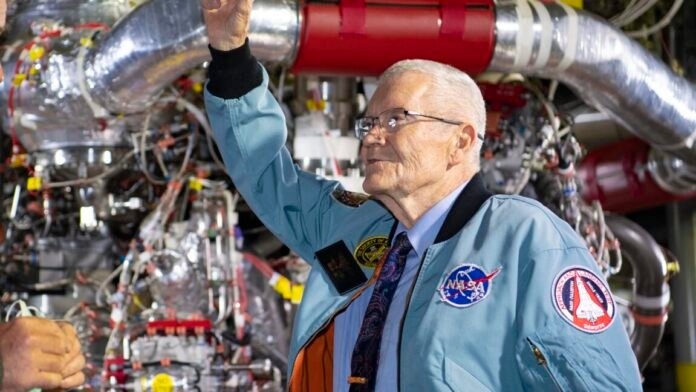
NASA astronaut Fred Haise, center, moments after exiting the Apollo 13 command module following splashdown in the South Pacific Ocean on April 17, 1970.

NASA astronaut Fred Haise, center, moments after exiting the Apollo 13 command module following splashdown in the South Pacific Ocean on April 17, 1970. Credit: NASA

Ars: What do you remember about being on the far side of the Moon?

Haise: We had done a maneuver earlier, approaching the Moon, because where our explosion happened, we were not on a path to get home. We were not on a free return, which they were on this [Artemis II] flight … When our capsule had the explosion and we had to shut it down, the very first thing to work on after getting the LM (Lunar Module) powered up was to use its rocket engine to change our path to get us sort of in a rough direction of heading home. And that first burn we did looped us around the Moon. Then we did a second maneuver, the biggest one, using the decent landing engine after we passed the Moon. That shaved 10 to 12 hours off our return time, which was helpful, because the LM didn’t have enough power if we kept it powered up, so we had to critically power it down and only had battery power.

Going around the Moon, after we finished that burn, and Jack [Swigert] and I were tourists. We got out our cameras and put color and black and white film packs in it, and shot a lot of pictures. We got pictures with a little better resolution, but still didn’t get anywhere near like they’ve taken on Artemis II. Hopefully, some of their pictures are near the South Pole, which is where it’s hoped that we’ll land someday and actually have a lunar base, close to the water ice in some of the craters near the South Pole.

Ars: Did you have an opportunity to take in the view at the Moon?

Haise: Jim (Lovell) wasn’t as interested as I was. He was too disappointed about not landing, and he had been already once. So he had seen the Moon quite a bit on Apollo 8, when they went around a number of orbits.

Ars: Did you have a chance to meet with any of the Artemis II astronauts before they flew?

Haise: I had lunch with Victor Glover one time after he had flown the Dragon capsule, the second flight in the Dragon. I wanted to know a little bit about Dragon. I met the commander [Reid Wiseman] at an event one time in Houston, and that was quite a while ago. It was before his wife passed away. In fact, she was at the luncheon also.

I met Christina Koch, the youngest member of the crew, a couple of times. She very nicely came to speak at the Memorial Tree ceremony for [Apollo 15 astronaut] Al Worden [at Johnson Space Center in Houston]. Al was head of the Astronaut Scholarship Foundation. He was the chairman when she was given an award that helped her with education funding. So she appreciated that, and came and spoke at Al’s event, and then I met her again at Jim Lovell’s son’s house. Jeffrey [Lovell], he lives in Houston here, and he hosted an event at his house, again, trying to draw in some people he had invited to help fund the Astronaut Scholarship Foundation, which gives out over 30 scholarships a year.

Ars: What else stands out to you about the Artemis II mission?

Haise: My commander, as you know, recorded a message for the crew with his son, Jeffrey, and his daughter, Susan. Unfortunately, Jim passed away, but the message was read up to them. I was FaceTiming with Jim at least once a week over the years, and he unfortunately passed away last year.

Ars: That was very poignant. There have been a lot of touching moments on this mission.

Haise: One of the biggest values, I feel, is the photography. Hopefully, they got good photography of the proposed eventual landing places. But the biggest value of all, and this is underplayed in the media, is this was a test flight. Who rode the rocket before? Nobody. How many humans have ridden in that capsule? Nobody. So they tested the capsule … to make sure it’s OK, testing all its variety of systems and making sure everything is working. To me, it was a great test pilot mission. Everybody’s got so excited about some pictures, which is good, but to me, I was a test pilot, so that’s the way I look at the mission. This was a great test pilot mission.

Ars: This mission seems to have captured a lot of public interest. I’m sure you can understand that after everything that’s been written about Apollo 13.

Haise: Apollo 13, to young people, when they hear a little bit about the story in school, it’s like a folktale, a survival folktale, much like many you may read about, like Shackleton’s sailing ship that got trapped in the ice. Apollo 13 has gotten to be in the same class as that. That makes it interesting.

Netanyahu’s Risky Bet on Strongmen Is Coming Due

0
netanyahu’s-risky-bet-on-strongmen-is-coming-due
Netanyahu’s Risky Bet on Strongmen Is Coming Due


Personal alliances with controversial leaders leave Israel exposed when political winds shift in Europe and beyond

“And a new Pharaoh arose who did not know Joseph.” This is the introductory sentence in the first chapter of Exodus, where the children of Israel were enslaved. Leadership changes often have dramatic consequences.

Hungary is about to undergo a major shift in leadership—almost a regime change—following its elections, and it will have major ramifications for Prime Minister Benjamin Netanyahu, Israel, and its relationship with Europe.

In politics and government, when elections result in the ruling party being replaced by the opposition, there often is a major departure from the policies and direction of the outgoing regime, driven by grievances and resentments.

Hungary was ruled by Viktor Orbán for 16 years. He was a controversial leader of the far-right Fidesz party and governed in a semi-authoritarian manner. While Hungary was a member of the European Economic Community, Orbán often adopted policies opposing it. He also opposed European support for Ukraine in its war with Russia.

Had Orbán been born 50 years earlier, he would have been the perfect prototype to lead Hungary’s communist regime under the tutelage of its Soviet patrons.

Although his Fidesz party was alleged to have had antisemitic roots, Orbán positioned himself as an outlier in his support of Israel. There was also a bromance between him and Netanyahu, which ran counter to the general disdain that many Europeans hold toward Netanyahu and his conduct in the current conflict between Israel and the Islamic Republic of Iran.

Orbán’s rule was also marked by his efforts to control the judiciary and restrict freedom of speech, as well as by accusations of corruption.

This culminated in his overwhelming defeat in the recent election, which saw the rise of Péter Magyar, a former member of his party who defected and established Tisza, a new center-right party whose platform advocated realignment with Europe.

In monitoring the reactions to his ascent to power, the soothsayers like to point out that his center-right party won’t alter direction in the same manner as would the election of a left-wing party. They are wrong.

One of Magyar’s first acts was to overturn Orbán’s rejection of the International Court of Justice based in The Hague.

Magyar is also likely to have taken umbrage with Netanyahu as a result of Netanyahu’s personal investment in strong ties with Orbán. Orbán’s other bromance was with President Donald Trump, who went so far as to send Vice President JD Vance on the eve of the election in an effort to boost him.

The US has already downgraded its relations with Europe, especially over the North Atlantic Treaty Organization, the Iranian conflict, and Europe’s disastrous economic, immigration, and social policies. Yet for the US, Hungary is largely irrelevant in its efforts to adjust its relations with Europe.

The same cannot be said for Israel. Israel’s relations with the major European powers have steadily eroded to varying degrees since October 7.

France and the UK, both with large Muslim constituencies, have already recognized the State of Palestine without predicating it on the disarmament of Hamas and the reform of the Palestinian Authority.

Embargoes on arms sales have been imposed by most European countries.

Antisemitism is rife, with synagogues being attacked and Jews being targeted in the streets. Anti-Israel demonstrations are occurring throughout Europe. Israeli tourists are being attacked in the streets, and Israeli artists are being canceled in the arts. Campaigns are ongoing to further isolate Israel in trade, commerce, and sports.

The cowboy-style diplomacy conducted by President Trump, first in relation to Greenland and later through the joint attacks with Israel on Iran, has further alienated Europeans. They have long adopted policies of appeasement toward Iran, often at Israel’s expense.

European leaders will grumble but succumb to President Trump. They will take out their frustrations on Israel.

France and the UK have already called on Israel to cease hostilities against Hezbollah in Lebanon, despite Hezbollah having entered the war on behalf of its Iranian patrons and against the wishes of the Lebanese government.

Italy, whose right-wing government was initially very supportive of Israel in 2023, has gradually shifted away. Cracks are even emerging in Germany, whose unique relationship with Israel has been a bulwark against European efforts to further isolate Israel.

The European Economic Community is one of Israel’s major trading partners because of trade agreements that provide Israel with access to European markets. Israel participates in numerous areas of cooperation in science, technology, research and development, and agriculture.

Europe’s embrace of human rights language and the redefinition of international law through the International Court of Justice and the United Nations Human Rights Council have caused major harm to Israel’s standing.

These bodies have adopted a pro-Palestinian approach. The outrageous arrest warrants issued against Netanyahu and former Defense Minister Yoav Gallant for alleged war crimes have left Netanyahu not only unable to visit most European capitals but also seeking to avoid flying over their territory.

Unlike Macron and Starmer, Orbán refused to recognize the International Court of Justice and pointedly hosted Netanyahu on a state visit to Hungary.

Retribution and revenge will prevail, and while Magyar will be eager to demonstrate that his government will not embark on a new radical agenda that will cause mayhem in Hungary, he will find Israel an easy target for venting pent-up frustrations after 16 years of Orbán’s rule.

For Netanyahu, his foreign policy of cavorting with controversial leaders such as Orbán carried huge risks. With Orbán’s departure, he will find it extremely difficult to nurture a similar relationship with Magyar. Orbán’s inclination to veto European Economic Community moves against Israel has been eliminated.

More worrying for Israel has been the manner in which Netanyahu has managed relations with the US.

On the one hand, the personal relationship he has fostered with President Trump has brought immediate and major results, especially in the current conflict with Iran and its proxies. For this, Netanyahu deserves credit.

Yet he has also echoed President Trump’s ongoing tirades against the Biden administration’s management of the conflict before President Trump’s return to office.

There was much to criticize in the Biden administration’s management of the conflict after the initial month. Its ongoing calls for a two-state solution, its restraint of Israel from entering Rafah, and its limits on sales of certain kinds of munitions were damaging.

It is nonetheless unseemly for Israel, and especially its prime minister, to be seen engaging in the same kind of rhetoric employed by President Trump. Former President Joe Biden was personally favorably disposed toward Israel throughout his term, as was his secretary of state, Antony Blinken. The US still provided a veto at the United Nations Security Council.

The concern is that if and when the Democrats return to power, they will also regard Israel as a soft target for venting their frustrations from the Trump years. Whether that happens in two years or later, the Democratic Party’s automatic support for Israel is being eviscerated.

The radical left is determined to purge the moderates and replace them with members who have adopted extremely hostile positions toward Israel. By attacking the Biden years, Netanyahu is alienating whatever support Israel can hope to receive from what remains of the moderate base of the Democratic Party.

The only saving grace is that by the time 2028 arrives, Israel will hopefully have eliminated many of the threats it has faced since October 7 and made itself an indispensable actor in the Middle East that no administration can ignore.


Global hunger crisis to worsen in 2026 as war, drought and aid cuts bite, United Nations report warns

0
global-hunger-crisis-to-worsen-in-2026-as-war,-drought-and-aid-cuts-bite,-united-nations-report-warns
Global hunger crisis to worsen in 2026 as war, drought and aid cuts bite, United Nations report warns


Conflict, drought and shrinking aid will keep global hunger at ​critical levels in 2026, with food insecurity expected to worsen in some of the world’s most ‌fragile countries, according to the 2026 Global Report on Food Crises.

The 10th edition of the hunger monitor, published by a coalition of development and humanitarian organisations, said that acute hunger had doubled over the past decade with two famines declared last year for the first ​time in the report’s history – in Gaza and Sudan.

See full report HERE

In total, 266 million people in 47 countries and ​territories faced high levels of acute food insecurity in 2025, while 1.4 million people faced ⁠catastrophic conditions in parts of Haiti, Mali, Gaza, South Sudan, Sudan and Yemen.

In 2025 alone, 35.5 million children worldwide ​were acutely malnourished, including nearly 10 million suffering from severe acute malnutrition.

Looking at this year, the report said severity levels ​remained critical, with only Haiti expected to escape from the worst “catastrophic” band thanks to a slight improvement in security and increased humanitarian aid.

“We are no longer seeing just temporary shocks, but persistent shocks over time,” said Alvaro Lario, head of the U.N. International Fund for ​Agricultural Development, which helps draw up the annual report.

“The main message is that food insecurity is not an isolated ​issue anymore, but is putting pressure on global stability,” he told Reuters.

WAR ON IRAN LIKELY TO WORSEN FOOD CRISES

The U.S.-Israeli war on Iran ‌has ⁠added to the alarm, Lario said, warning that prolonged disruption to energy and fertilizer trade could spill over into global food markets and worsen hunger in import-dependent countries already in crisis.

“Even if the conflict in the Middle East were to end right now, we know that a lot of the food price shocks and inflation will happen in the ​next six months,” he said.

Even ​before the added stress ⁠of this latest war, West Africa and the Sahel looked likely to remain under heavy pressure this year from conflict and persistent inflation, particularly in Nigeria, Mali, Niger and Burkina ​Faso.

Nigeria alone is projected to see one of the largest increases in food insecurity ​in 2026, ⁠with 4.1 million more people expected to face acute hunger.

In East Africa, failed rains across much of the Horn of Africa are expected to deepen suffering in Somalia and Kenya, where drought, insecurity, high food prices and reduced humanitarian aid are ⁠likely to ​drive worsening conditions.

The report also warned that humanitarian and development financing for ​food sectors in crisis fell sharply in 2025 and is projected to decline further.

Humanitarian food-sector funding is estimated to have dropped by some 39% ​last year from 2024 levels, while development assistance contracted by at least 15%.

0FansLike
0FollowersFollow
0FollowersFollow
0SubscribersSubscribe
- Advertisement -
Google search engine

Recent Posts