King Charles in US for state visit amid differences over Iran war
Britain’s King Charles and Queen Camilla arrived in the United States on Monday for a four-day trip, welcomed by self-proclaimed royal fan Donald Trump even as the U.S. president has differed with the British government over the Iran war.
The state visit, by far the most high-profile and consequential of Charles’ reign, marks the 250th anniversary of the U.S. Declaration of Independence from British rule, and is the first to the country by a British monarch in two decades.
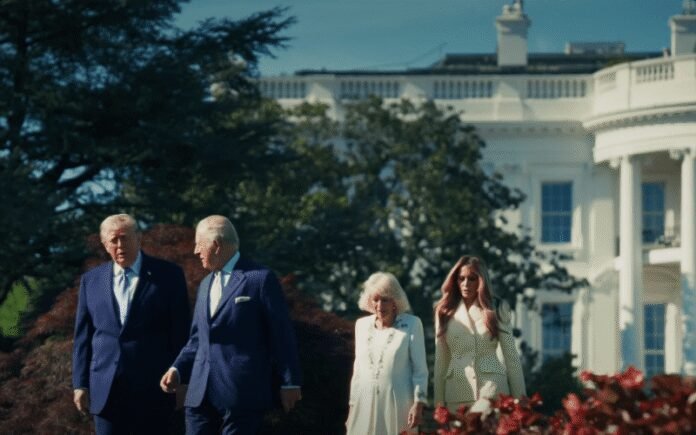
After landing at Joint Base Andrews, the site of a brief arrival ceremony, Charles and Camilla proceeded to the White House, where they were greeted by Trump and first lady Melania Trump, who exchanged kisses on the cheek with the king and queen while the president shook their hands. The four stood briefly for photographers before retreating inside for a private tea.
The king and queen later appeared at a garden party at the British ambassador’s recently renovated residence, where a choir sang the British and American national anthems.
Charles and Camilla mingled with a crowd that included media leaders, Washington socialites and officials such as U.S. Senator Ted Cruz, Treasury Secretary Scott Bessent and ambassadors from other countries.
The week’s schedule also includes a Tuesday address to Congress, a lavish state dinner at the White House and a Wednesday stop in New York City. The Washington events take place with much of the capital city still on edge following the White House Correspondents’ Association dinner shooting on Saturday.
The king’s speech to Congress will last about 20 minutes, a palace source said. While written on the advice of the British government, much of the language and tone come from Charles himself, the source added.
The king will note that while the UK and U.S. have not always agreed on all matters over the past 250 years, “time and again, our two countries have always found ways to come together.” He will say that by defending their shared democratic values the two countries can promote security and prosperity for the world.
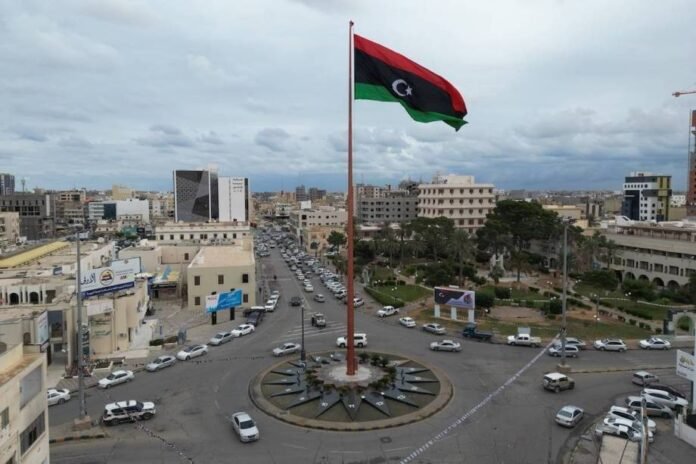
The Libyan foreign minister in the Tripoli-based government, Taher Al-Baour, held talks Monday with his Greek counterpart, Giorgos Gerapetritis, to disuss maritime border demarcation and bilateral relations, Anadolu reports.
Discussions in the Libyan capital dwelt on avenues to expand cooperation in strategic sectors, including energy, infrastructure, and maritime transport, Libya’s Foreign Ministry said in a statement.
The two diplomats also discussed irregular migration, stressing the need for a comprehensive approach based on burden-sharing, enhanced security, technical cooperation, and increased training programs, the statement said.
READ: More than 7,600 migrants died or went missing in 2025, UN agency says
The talks between the two sides also took up the work of the joint Libyan-Greek technical committee on maritime border demarcation, with the two sides reaffirming their commitment to continuing constructive dialogue in line with international law.
Tensions between the two countries date back to 2004 over energy-rich areas near the island of Crete, where negotiations on maritime boundaries stalled.
In July 2020, both sides agreed to form a joint technical committee, which began its work in September 2025 with talks held in Athens.
Tensions resurfaced in 2025 after Greece launched an international tender for oil and gas exploration south of Crete, including areas disputed with Libya, inviting strong objections from Libyan authorities.
READ: UN says 53 migrants dead or missing after boat sinks off Libya
With new patch design, the Crew-13 astronauts clearly aren’t superstitious
NASA has assigned its first crew to launch on a mission “13” since Apollo 13 “had a problem” on the way to the Moon 56 years ago.
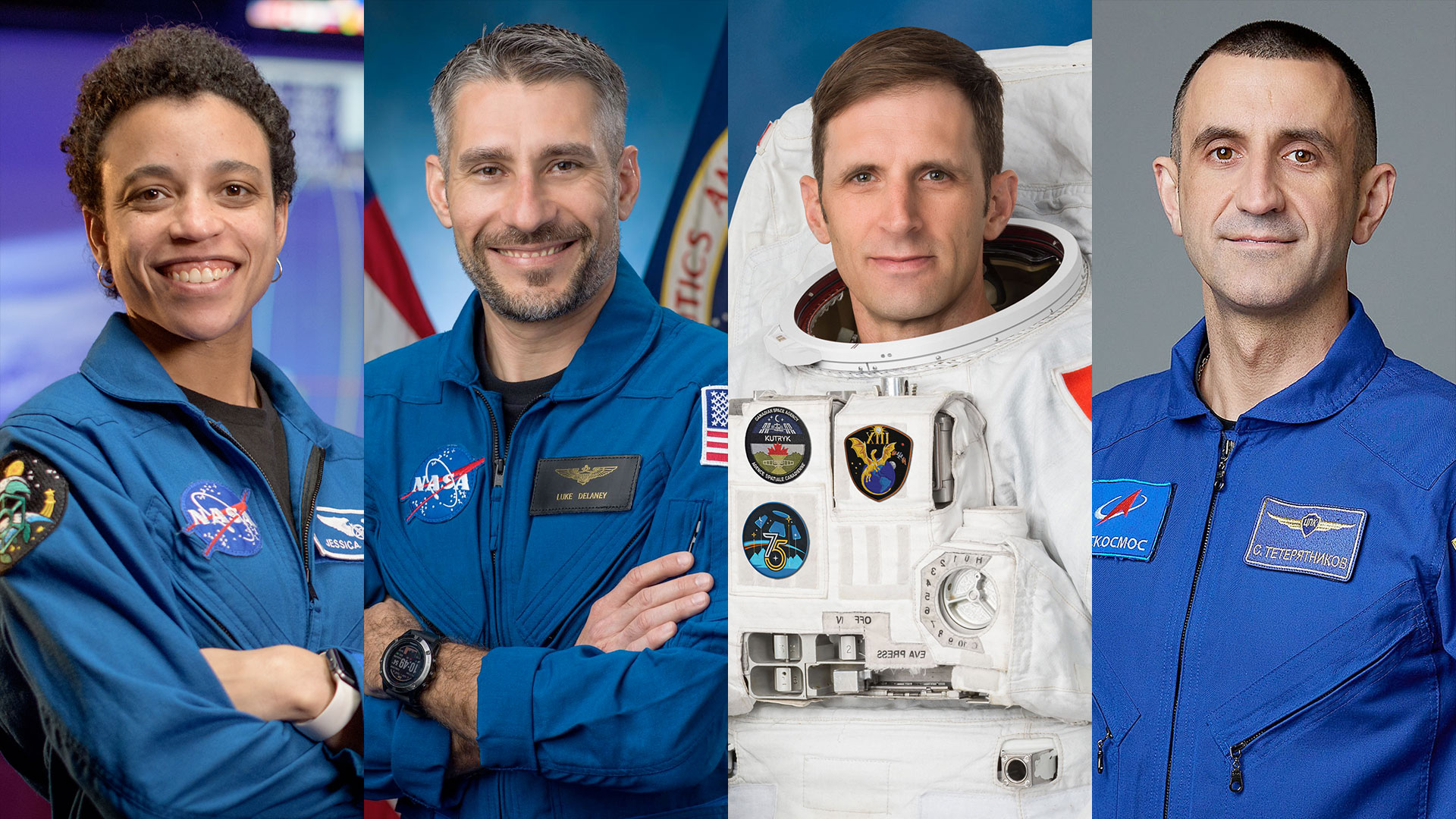
Jessica Watkins and Luke Delaney with NASA, Joshua Kutryk with the Canadian Space Agency, and Roscosmos cosmonaut Sergey Teteryatnikov will lift off for the International Space Station as Crew-13 on a SpaceX Dragon spacecraft in mid-September. The four will serve as members of the station’s Expedition 75 and 76 crews, before returning to Earth about five months later.
“This flight is the 13th crew rotation with SpaceX,” NASA’s announcement read. “The crew will conduct scientific investigations and technology demonstrations to help prepare humans for future exploration missions to the moon and Mars, and benefit people on Earth.”
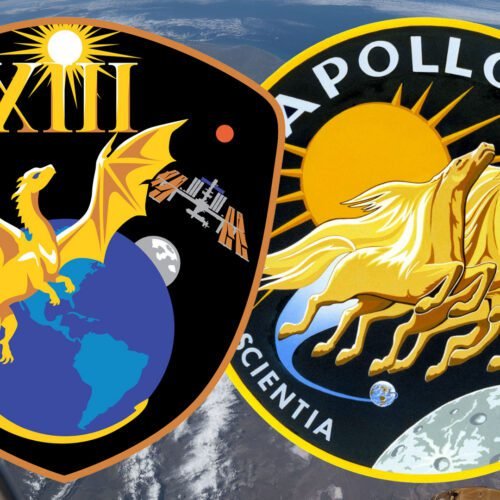
Rather than give in to triskaidekaphobia (the fear or avoidance of 13), the crew is embracing it, or at least their connection to the last US launch to be similarly numbered. The Crew-13 mission patch includes visual nods to the insignia worn by Apollo 13 astronauts Jim Lovell, Fred Haise, and Jack Swigert in April 1970.
NASA’s SpaceX Crew-13 members Jessica Watkins, Luke Delaney, Joshua Kutryk and Sergey Teteryatnikov.
Credit: NASA/CSA/Roscosmos
NASA’s SpaceX Crew-13 members Jessica Watkins, Luke Delaney, Joshua Kutryk and Sergey Teteryatnikov. Credit: NASA/CSA/Roscosmos
Imitation is an option
“NASA’s SpaceX Crew-13 patch looks ardently toward the future of space exploration while honoring the legacy of those who came before,” reads the official description of the emblem.
At the center of the Crew-13 patch is a golden dragon, which is both a reference to the name of SpaceX’s capsule and the golden horses depicted on the Apollo 13 insignia. (Lovell and his crewmates worked with NASA contract artist Norman Tiller and muralist and sculptor Lumen Winter, who proposed the equestrian design, to create their flight badge.)
The dragon’s tail on the Crew-13 patch wraps around Earth in a manner reminiscent of the blue contrail that connects Earth with the horses on the Apollo 13 insignia. In the 1970 artwork, it was a nod to the Roman and Greek god Apollo; today, it is a “bridge between Earth, the International Space Station, the moon and Mars,” per NASA’s caption.
The use of Roman numerals for “XIII” (13) and the lack of crew names on the Crew-13 patch also mimic elements of the design from almost six decades ago, wherein the golden stars are symbolic of the Crew-13 families, and the overall capsule shape (as opposed to a circle) references the “possibilities born out of human collaboration toward a common goal,” according to the space agency.
It comes after 12
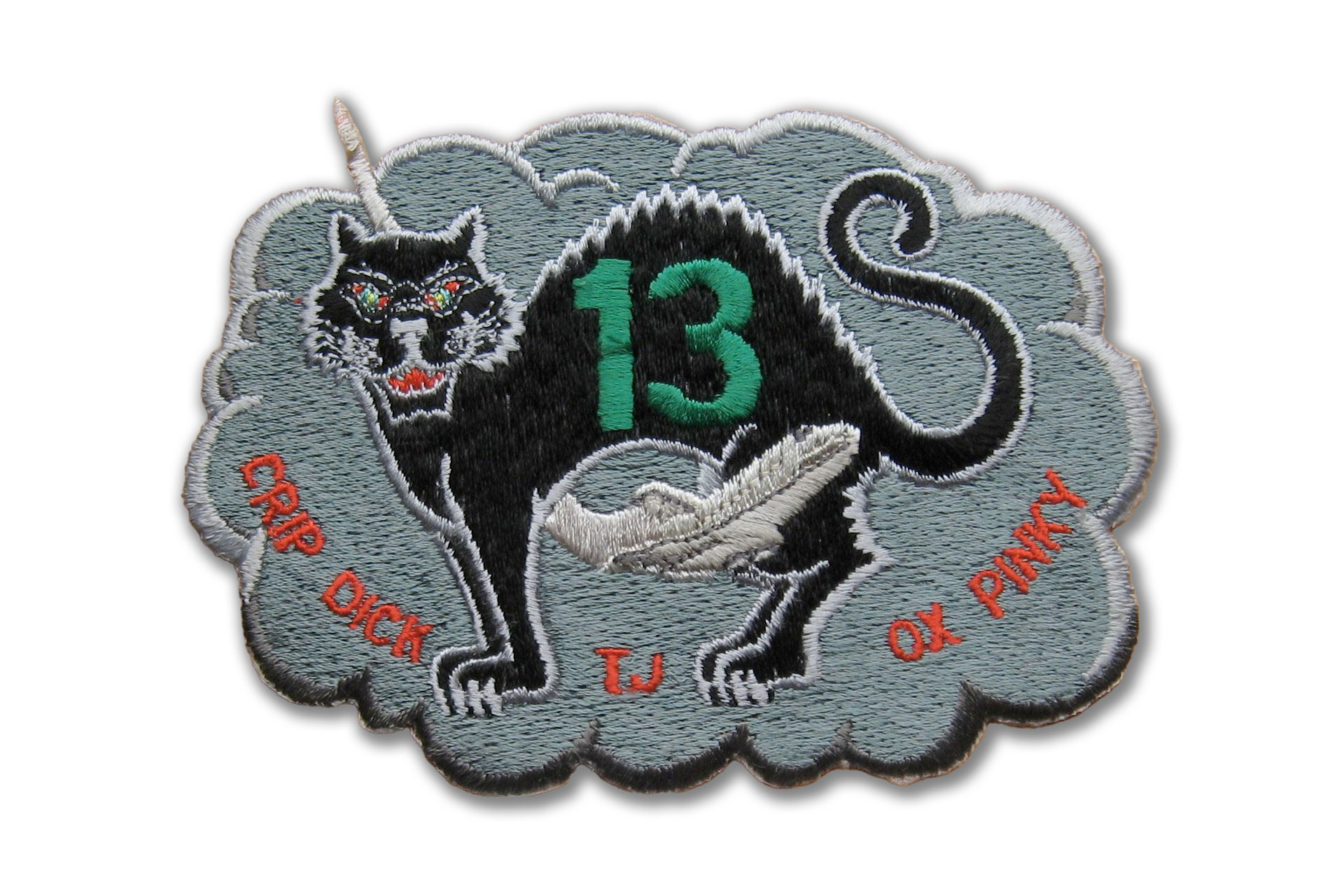
The STS-13 crew, redesignated STS-41-C, created this patch that highlights superstitions and triskaidekaphobia.
The STS-13 crew, redesignated STS-41-C, created this patch that highlights superstitions and triskaidekaphobia. Credit: collectSPACE.com
Prior to Crew-13, NASA managers leaned into the superstition and devised a less intuitive but more data-driven designation that went into effect after the ninth space shuttle mission. Hence, what would have been STS-13 became STS-41-C, where the 4 was the fiscal year (1984), the 1 was the launch site (Kennedy Space Center in Florida), and C was the order of launch (C was the third planned flight of the year).
“I mentioned it was 41-C that originally was STS-13, and my friend Jim Beggs, who was the administrator of NASA, had triskaidekaphobia, and he said, ‘There’s not going to be [another] Apollo 13 or a Shuttle 13, so come up with a new numbering system.’ So we did come up with this complex system for numbering the shuttles during that period of time,” said Bob Crippen, STS-41C commander, in a NASA oral history interview.
NASA later reverted to a straightforward numerical designation after the loss of the space shuttle Challenger and the STS-51L crew in January 1986. As such, there was an STS-113, which launched aboard space shuttle Endeavour in 2002, but not before having to make late crew changes due to medical issues. The last time that NASA faced the same decision was on Apollo 13.
“We were joking a lot about being number 113,” commander Ken Bowersox told the press at the time. He added that to play it safe, the mission patch used Roman numerals (CXIII).
On board the International Space Station, the 13th crewed expedition began on April 1, 2006, 10 days before the 36th anniversary of the Apollo 13 launch.
The Russian space program launched six crewed missions designated as number 13. At least one of those times, the head of the country’s space agency suggested it be skipped.
“Many people have superstitious beliefs,” said Roscosmos director Anatoly Perminov, according to his press secretary, in 2008. “That’s why I think that it is a good idea to change the number of the next spaceship.”
Despite the concern, Soyuz TMA-13 went forward as planned. As did Soyuz 13, Soyuz T-13, and Soyuz TM-13 before it.
Soyuz TMA-13M launched Reid Wiseman, and Soyuz MS-13 landed with Christina Koch. Both US astronauts went on to fly aboard NASA’s Artemis II mission earlier this month, a crewed fly-by of the Moon that broke the distance record set by the Apollo 13 astronauts.
Some seemingly regular events are so massive in their implications across various domains that they deserve their own write-up. TSMC’s highly unusual public complaint of ASML’s latest EUV pricing falls in that category.
Not only because the “very very expensive” complainer is relentless in utilizing its own pricing power, but also because it is not usual for these institutions to wash their dirty linen in public.
We had discussed the near-monopsony and near-monopoly clash one sees in the TSMC and ASML battle first in 2024. Time to refresh in more detail as we traverse through Elon Musk’s Terafab, Japan’s Rapidus, Samsung’s strike, and a few other topics, while first discussing whether ASML’s famed equipments are sufficient when one is thinking about a fab, aka whether a fab can be built by anyone with enough cash, and then whether they are necessary.
Part One: the Sufficient Question
The premise sounds rhetorical, almost juvenile. Of course a fab is more than an ASML machine. But the version of this question worth asking is sharper. Every semiconductor fab in the world is a collection of equipment whose suppliers are well-known and, China aside, accessible to any major economy or tech oligarch with the cash to pay.
So can someone with enough will and enough budget build a leading-edge fab from a standing start?
The Catalog is Open. The Barrier is Elsewhere.
Walk through what a leading-edge capital expenditure actually buys. You get EUV scanners from ASML. You get deposition and etch tools from Lam Research, Applied Materials, and Tokyo Electron. You fold in metrology and materials from KLA, Shin-Etsu, Lasertec, BESI, and Teradyne. The tools are astronomically expensive, but the catalog is wide open.
Yet, this open catalog raises a glaring paradox: Why would TSMC, currently benefiting from an unprecedented global supply crunch, use plans to defer its latest fab development as a negotiating tool against its suppliers?
The lesson the catalog does not teach is that the equipment, even when assembled in a multi-billion Dollar clean room, is the easy part. The hard part is everywhere. Most of those problems are not solved by buying a tool.
Each is solved by tens of thousands of correction loops, accumulated over decades, written in process documents that no single engineer carries in their head and no rival can copy by hiring twenty defectors. The table below covers some of the more devilish operating challenges that even with the best equipment up and running.
The above list is a small sample collection of the things that go into making a successful fab operation. In fact, what goes into making a cutting-edge fab is as describable as writing an essay on what makes a great artist with common pestles in her hand. It is the art part that makes TSMC wield its pricing power against everyone around it, including the supposed 100% market-share supplier like ASML.
However, there is another point out here, particularly in light of the high-sounding plans of some of the newer players from around the globe.
ASML has new clients, or does it?
Regardless of what we say above, there is a rising horde of entities that want to embark on building semiconductor manufacturing facilities, including some at the most advanced end. We may try to claim that the cutting edge is impossible for anyone without experience, but not everyone believes in it.
Musk is certainly one of them. Everything about Terafab defies conventional logic. The initial budget is massive, but plausible at around US$25 billion. While the project will have Intel as a partner, one must remember the lack of experience and no working chip team.
The target of a terawatt of compute requires over 20m Rubin-class wafers and over 15m HBM4E wafers, apart from a lot of other things. At realistic yields and cycle times, that is more than the capacity of a few hundred of the best current fabs. The spread between announcement and physics is two orders of magnitude.
A more grounded, yet incredibly risky, plan is unfolding in Japan. Rapidus, founded in 2022, has backing from eight Japanese conglomerates and the government, as well as technology transferred from IBM. Cumulative public funding has reached roughly $15 billion.
Mass production is targeted for 2027, starting at 6,000 wafers per month and scaling to 30,000 later. For comparison, TSMC produces over 150,000 at leading nodes. There is no way to say whether Rapidus will succeed in these goals, but some experts see the possibility of competitive operations in single digits even by 2030.
China is the third experiment, the forced one. Sanctions block EUV. SMIC has nonetheless built a 7nm-class node using DUV multi-patterning, and Huawei’s Kirin 9030 sits between 7nm and 5nm. The engineering is genuine. So is the cost. SMIC’s 7nm yield is estimated at 20-40% against TSMC’s ~80% at the same node. The 5nm-class yield is reportedly under 20%. Per-chip cost runs roughly 50% above TSMC’s EUV-based equivalent.
The pattern across three live experiments is the same, supplemented by a half a dozen other announcements from Saudi Arabia, India, to Germany and other places in Europe. Money buys the equipment, and possibly the people. What it cannot buy is the experience that is critical in mastering the tiny steps. The instruments are sold from a catalog. The art is not.
The Apple Paradigm: The Danger of Weaponized Leverage
The cleanest way to test the “money plus engineering equals fab” thesis is to walk through the graveyard of those who tried. The list of entities that failed to crack the leading edge of semiconductor manufacturing reads like a tech hall of fame: IBM, Motorola, Texas Instruments, and a litany of once-dominant Japanese conglomerates.
None of these titans lacked capital. None lacked brilliant engineers. Each had access to the exact same equipment catalog as TSMC, often years earlier. What they lacked was the institutional art. Money buys the instruments; it does not buy the instinct.
This is precisely why ASML cannot simply replace TSMC with a syndicate of ambitious upstarts. On paper, ASML holds all the cards. They possess a 100% absolute monopoly on the EUV lithography machines required to keep the AI revolution breathing. But a monopoly is only as powerful as its buyer’s capacity to consume.
TSMC is not just a customer; it is a monopsony of competence. It is the only entity on earth capable of absorbing ASML’s bleeding-edge supply at the volume required to fund ASML’s massive R&D pipelines.
If TSMC pauses its CapEx, ASML’s forward revenue projections crater. TSMC’s pricing power isn’t merely derived from being the biggest; it comes from being the only player who knows how to wield the world’s most expensive paintbrush without ruining the canvas.
So when TSMC walks into an industry symposium and publicly balks at ASML’s staggering $350 million price tag, it is running a playbook it learned from the other side of the table. For the better part of a decade, Apple did to TSMC exactly what TSMC is now attempting to do to ASML.
Apple was its apex customer. It was effectively the only client with the sheer volume necessary to justify the financial risk of TSMC’s each new node for best part of last two decades. Apple weaponized that leverage, extracting preferential pricing and exclusive first-run access that no other customer could match.
TSMC accepted the squeeze because Apple’s commitment bankrolled their process leadership. But while TSMC fueled Apple’s multi-trillion-dollar ascent, its own profit margins were kept on a tight, Cupertino-controlled leash.
By now, the tables have turned. Buoyed by the insatiable demands of Nvidia, AMD, and the broader compute ecosystem, TSMC’s customer base has broadened. They no longer rely exclusively on Apple to keep the lights on. Consequently, the era of absolute preferential treatment has also ended.
Today, TSMC dictates pricing and timeline terms to the iPhone maker without hesitation, forcing even Apple to wait in line.
The warning for 2026: the fracturing dependency
This history reveals the long-term peril of TSMC’s current standoff with ASML. TSMC is aggressively flexing its monopsony muscles, betting that it remains irreplaceable.
But ASML’s customer base is broadening in the exact same way TSMC’s did. The dependency is fracturing. Memory manufacturers are now voracious consumers of EUV systems.
SK Hynix aggressively procured roughly thirty EUV machines in early 2026, willingly paying a premium for expedited delivery, while Samsung accelerates its own EUV purchases for 1c DRAM. Meanwhile, Intel, desperate to claw back foundry leadership, has already committed entirely to High-NA for its 14A node.
The reality in 2026 is stark: the customer refusing to pay the premium for High-NA EUV is exactly one. Everyone else is buying. ASML didn’t necessarily engineer this independence; the market’s broadening demand for compute is doing it for them. TSMC’s leverage is real but could be peaking, and they must tread carefully.
In the semiconductor industry, it is remarkably wise not to do unto your suppliers what you wished your greatest customer had not done unto you.
Part Two: The Necessary Question
Equipment is not enough. That is settled. The harder question is whether ASML’s latest equipment is necessary, or whether the industry can keep extracting performance from older tools and clever process work for long enough to call ASML’s bluff.
The art of squeezing more out of the same
When TSMC took the stage in April 2026 and declared it would stick with its current generation of EUV lithography through at least 2029, the industry gasped. Stripped of corporate theater, TSMC’s claim was a profound flex of engineering arrogance: they believe they can indefinitely find throughput, defect, and design-rule improvements without writing a 350 million euro check for ASML’s bleeding-edge High-NA tools.
And as an engineering matter, they are largely right. The quietest, most consequential story of the past five years has not been the invention of new machines, but the ruthless extraction of performance from existing ones.
The argument adds up to something. A leading-edge logic node circa 2026 is using a roughly twenty-twenty vintage EUV scanner running at twice the productivity, with better resists, better masks, better software, and a process flow that has been reorganised around what the existing tool can do well.
None of this is free, and none of this is finished. But it does mean that the question “do we need High-NA in 2027” has a credible answer of no. TSMC believes the extension runs to A14 in 2028 and possibly to A13 in 2029 without crossing into High-NA. Others may disagree on timing, but no one in the industry argues the extension is fictional.
China takes the same playbook to its limit
China is running the same extension play, except without EUV at all. The result is the most strenuous test in the industry of how far cleverness can substitute for the latest tool.
Sanctions block ASML EUV exports to mainland China and have done since 2019. SMIC has nonetheless built a 7nm-class node using DUV multi-patterning, with each layer requiring three or four exposures where TSMC uses one.
Huawei’s Kirin 9000s shipped in the Mate 60 Pro in 2023 was the first commercial proof. The Kirin 9030, announced in 2025, sits between 7nm and 5nm by TechInsights’ measurement and is the most advanced chip currently producible in China.
The engineering is genuine. The cost is also genuine. SMIC’s 7nm yield is widely estimated at twenty to forty percent against TSMC’s eighty plus at the same node. The 5nm-class yield is reportedly under twenty. Per-chip cost runs roughly fifty percent above TSMC’s EUV-based equivalent. The workaround works, but it pays a tax that only sovereign demand can absorb.
The infrastructure to support a longer Chinese run without EUV is now being built. SMEE, the state-backed lithography effort, has 90nm DUV in production and a 28nm immersion system in late development. Shanghai Yuliangsheng, linked to Huawei’s SiCarrier, delivered an immersion DUV tool to SMIC for testing in September 2025.
SiCarrier debuted more than 30 domestic process tools at SEMICON China in 2025. Domestic equipment share inside Chinese fabs rose from roughly 25% in 2024 to 35% in 2025. None of this matches ASML at the leading edge. All of it threatens ASML’s position at mature nodes and also poses other worth-keeping-in-mind questions about the future.
There is even a Chinese EUV prototype. In December 2025, Huawei and SiCarrier confirmed a functional EUV light source using laser-induced discharge plasma rather than ASML’s laser-produced plasma architecture. The prototype generates 13.5nm light at roughly 100 to 150 watts against ASML’s 250 plus. No working chip has been produced.
The most realistic forecasts put a Chinese EUV production attempt in 2028 and a competitive system in 2030. Even if these dates slip by two years, which they probably will, the long-term threat is not zero. Other extension paths exist outside China. Canon’s nanoimprint lithography, the FPA-1200NZ2C launched in 2023, prints features at 14nm resolution at roughly a quarter of an EUV scanner’s price and a tenth of the power.
It works for memory, particularly 3D NAND and certain DRAM layers, where overlay tolerances are forgiving. It does not work for leading-edge logic, where defectivity is too high and overlay too tight. Directed self-assembly, in which block copolymers organize themselves into patterns at sub-EUV resolutions, has been a promising laboratory technology for 15 years and remains so.
Each of these is an argument against the proposition that ASML is forever. None is an argument that ASML is dispensable in 2026.
The toll collector’s gambit
But there is a fatal flaw in the extraction thesis. Squeezing more life out of current machines is a brilliant strategy, but none of it is free. And the entity collecting the toll is still ASML.
TSMC’s narrative implies a break from ASML’s pricing power, but the reality is an inescapable tether. Extending the current generation of EUV scanners is not a solo endeavor; it requires deep, continuous, and highly expensive collaboration with the manufacturer. When TSMC upgrades an NXE:3800E scanner from 220 to 230 wafers per hour, ASML doesn’t send a technician with a wrench.
ASML sends a software key. That upgrade is sold as a premium productivity package. The new resists require multi-year qualification loops with ASML. The replacement parts, the laser maintenance, the optics calibration—it is a closed ecosystem. The cumulative effect is that a 2020-vintage EUV tool, fully upgraded, runs roughly twice as productively in 2026 as it did at delivery, but ASML has monetized every single step of that evolution.
For decades, ASML operated like a bespoke European R&D lab that happened to sell machines. In 2026, they have finally realized they are an absolute monopoly, and they are learning to wield the pricing power that comes with it, perhaps like memory makers in 2026.
If TSMC refuses to buy the 350 million-euro High-NA tool, ASML will not starve. They simply tighten the screws on the installed base. They control the service contracts and the software upgrades for the standard EUV machines TSMC desperately needs to execute its “extraction” strategy. ASML owns the air supply.
The deeper point is that ASML’s pricing power is not limited to High-NA. ASML is also the sole-source supplier of Low-NA EUV, and the dominant supplier of advanced DUV immersion. Nikon and Canon are present in DUV but irrelevant at the leading edge of immersion.
The same monopoly that lets ASML price High-NA at EUR 350 million applies, in slightly diluted form, to the Low-NA tools every fab in the world is currently running and will continue to run for the next decade. ASML has held DUV pricing roughly flat through 2024 to 2026, which is a choice, not a constraint. If ASML decides to raise DUV prices materially in 2027 or 2028, the customers’ realistic responses are limited.
Furthermore, the physics of extraction has a hard, mathematically brutal limit. As feature sizes drop into the angstrom era, stochastic defects, or random errors caused by the unpredictable behavior of individual photons, multiply exponentially. Multi-patterning on standard EUV requires running the same fragile wafer through the scanner two, three, or four times.
Below the A14 generation, the layer count, the mask count, and the sheer cycle time of multi-patterned standard EUV start to shatter the economic viability of the node. You end up spending more money trying to force the old machine to work than you would have spent simply buying the new one.
The rest of the industry has already done this math. The memory makers concluded that the line crosses even earlier for DRAM than it does for logic. SK Hynix installed its first High-NA EUV tool in late 2025 to secure dominance in 1c DRAM and HBM. Samsung is aggressively integrating High-NA into its 2nm logic survival plan.
Intel, fighting for its foundry life, has committed entirely to High-NA for its 14A node. Once again, the customer holding out at €350 million is, as of April 2026, exactly one
Conclusion: The expiration of politeness
For 14 years, ASML has held an absolute monopoly on the most strategically critical machine in the global economy, yet it has wielded that power with baffling restraint. By any standard metric, they have operated more like a distinguished European research syndicate than a capitalist apex predator.
Their pricing tracks engineering costs rather than desperate scarcity, and their CFO frames supplier negotiations as “healthy peer pressure.” But this politeness has an expiration date. Every employee in Veldhoven must be watching the boardrooms at its Taiwanese and Korean clients gloat over absurd, historic margins.
ASML must learn how to ask for more like the employees of these companies. These downstream giants wield immense pricing power and are forced into massive capital expenditures to stretch their roadmaps. As the singular physical chokepoint of the entire silicon revolution, ASML should, by every law of monopoly economics, be extracting a vastly larger tax.
The complication is that ASML does not sell across a counter to a fragmented market; it sits across a bespoke table from three or four sovereign corporate states. This extreme buyer concentration is the only reason ASML’s dominance has historically felt like a partnership rather than an extortion racket.
TSMC has aggressively weaponized this dynamic, publicly drawing a line in the sand by deferring High-NA EUV until 2029. And, TSMC’s threat is now colliding with ASML’s bulletproof ledger. Backed by SK Hynix placing its largest EUV order in history and a 38 billion euro order book, ASML can mathematically afford to let TSMC sit out the High-NA generation and still coast into a record-breaking decade.
Everything we have mapped out is theoretical leverage, but high-stakes negotiations ultimately boil down to a single behavioral variable: who blinks first. Will the next price list for standard Low-NA tools surge the way it mathematically could? Will the next software productivity package be priced like an incremental upgrade, or like the ransom-ware of enterprise tech?
History suggests we should temper our expectations. The 2012 customer co-investment fundamentally wired ASML to view these giants as partners, led by a CEO who publicly refuses to be a “bottleneck.” ASML’s politeness is also reflected in how it is never seen lobbying for China business the way someone like Nvidia does. It may not succeed, but it does not even try.
So the conclusion is brutally simple. ASML holds every single card required to win this hand; the only question is whether they have finally learned how to play them.
Nilesh Jasani is the founder and CEO of GenInnov Pte Ltd Singapore. This article first appeared on www.geninnov.ai and is republished with permission. Read the original here.Read more at www.geninnov.ai/blog
NGO Monitor Accuses Doctors Without Borders of Promoting Anti-Israel ‘Genocide’ Claims
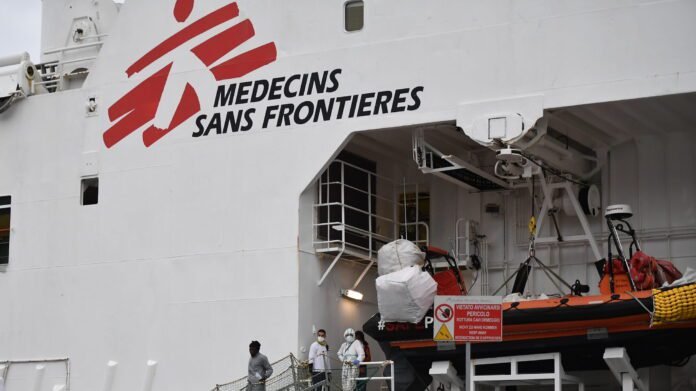
NGO Monitor on Monday released a 35-page report in Jerusalem alleging that Médecins Sans Frontières (MSF)/Doctors Without Borders has become a leading source of anti-Israel misinformation, particularly in promoting claims of “genocide” related to Gaza.
The report examines MSF’s publications, messaging, and political activities, noting that the organization operates in more than 70 countries and has a $2.4 billion budget. It asserts that MSF has shifted from a humanitarian focus to what it describes as an “unprecedented influence operation” targeting Israel.
According to the study, MSF played a central role in anti-Israel campaigns and what it calls Holocaust inversion narratives, including the “genocide” accusation. It further alleges systemic omission of Hamas’ use of hospitals in Gaza for attacks and the application of legal arguments directed solely at Israel.
The report also cites links to Hamas and other groups among MSF staff and volunteers and says MSF personnel in Gaza did not address Hamas’ presence in medical facilities.
The findings also address MSF’s refusal to comply with Israeli anti-terror registration requirements and examine its messaging following the October 7, 2023, Hamas attacks. The report states MSF joined advocacy efforts describing Israel’s response as “genocide,” relying on what it calls manipulated evidence and excluding what it describes as key operational context.
“In its ‘genocide’ propaganda and heinous Holocaust inversion, many MSF officials promoted blatantly false testimonies, violating basic principles of medical ethics,” said Prof. Gerald M. Steinberg, President of NGO Monitor.
“To restore its shattered reputation and resume its mission of providing aid, an independent investigation leading to fundamental organizational changes and close oversight is vital. MSF in its current framework is no longer a trustworthy humanitarian organization,” he said.
The report also states that MSF’s claims were amplified in international media, professional medical journals, university frameworks, United Nations agencies, and proceedings before international courts.
Recommendations include independent investigations into MSF International and its national branches, including MSF USA and MSF UK; an end to “genocide” and related allegations; external vetting of personnel; and a review of charitable status.
EU tells Google to open up AI on Android; Google says that’s “unwarranted intervention”
In January, the European Commission began an initial investigation, known as a specification proceeding, into how Google has implemented AI in the Android operating system. The results are in, and the EU says Android needs to be more open, which is not surprising. Meanwhile, Google says this amounts to “unwarranted intervention,” which is equally unsurprising. Regardless of Google’s characterization of the investigation, the commission may force Google to make Android AI changes this summer.
This action stems from the continent’s Digital Markets Act (DMA), a sweeping law that designates seven dominant technology companies as “gatekeepers” that are subject to greater regulation to ensure fair competition. Google has consistently spoken against the regulations imposed under the DMA, but it and the other gatekeepers have been subject to the law for several years now, and there’s little chance the commission backs away from it.
The issue before the commission currently is the built-in advantage for Gemini on Android. When you turn on any Google-powered Android phone, Gemini is already there and gets special treatment at the system level. The European Commission is taking aim at the lack of features available to third-party AI services. The commission believes that there are too many experiences on Android that only work with Google’s Gemini AI, and as a gatekeeper, Google must change that.
“As we navigate the rapidly evolving landscape of AI, it is clear that interoperability is key to unlocking the full potential of these technologies,” said Commission VP for Tech Sovereignty Henna Virkkunen in a statement. “These measures will open up Android devices to a wider range of AI services, so that users will have the freedom to choose the AI services that best meet their needs and values, without sacrificing functionality.”
The commission does have a solid track record pushing for openness so far. Since the DMA came into force, Google has been required to make numerous changes to its business in Europe, like implementing search choice screens on Android, allowing alternative payment methods in the Play Store, and limiting data sharing across services. Now, the EU wants Google to make the Android platform more hospitable to third-party AI services.
Google’s objection focuses on preserving the autonomy for device makers (including Google) to customize AI services. “This unwarranted intervention would strip away that autonomy, mandate access to sensitive hardware and device permissions; unnecessarily driving up costs while undermining critical privacy and security protections for European users,” said Google senior competition counsel Claire Kelly.
EU rules could mean more AI, not less
Just because Gemini is preinstalled on virtually every Android phone doesn’t mean you have to use it. You can easily install ChatGPT or Grok and turn to that chatbot when the need arises. However, these apps won’t have the same access to data and features as Gemini. The commission cites a few examples where Gemini is the only route, like sending an email in your default mail client or sharing a photo with friends.
European regulators are proposing several broad changes to the way AI tools operate on Android phones. Some of this is straightforward, like allowing third-party AI tools to be invoked system-wide via hot words or button presses. This might also include allowing AI tools to view screen context when the user opens them. Context also extends to allowing alternative AI systems to access local data to generate proactive suggestions and summaries. The report actually describes something that sounds like Google’s Magic Cue, which relies on Gemini to offer suggestions based on your activity.
Gemini has exclusive system-level access to generate proactive suggestions on many Android phones.
Credit: Google
Gemini has exclusive system-level access to generate proactive suggestions on many Android phones. Credit: Google
Google has also started experimenting with allowing AI to control certain apps. As we saw when this feature debuted on the Galaxy S26, Gemini is currently pretty bad at using apps on your behalf. The commission wants to explore allowing other AI services to autonomously control installed apps and system features on Android phones. Maybe someone else could do better?
Many of the Gemini AI features in Android, including Magic Cue, rely on running local models, and Google has been slow to allow third parties the system access to make that work effectively. So the EU is also suggesting a mandate that would ensure developers have the necessary hardware access to run local models “with high levels of performance, availability and responsiveness.”
Finally, Google may be required under the DMA to create new APIs and offer technical assistance to other AI makers who want to plug into Android. The commission also specifies that these tools must be made available free of charge.
So far, this is just a framework for how AI on Android might change. The European Commission is currently accepting feedback from interested parties. That part of the process will wrap up on May 13. A final decision on this investigation will be made no later than July 27 of this year. Failure to enact required changes could result in big fines. The DMA allows for penalties up to 10 percent of a company’s annual global revenue.
Google probably won’t be required to fling the doors open right away, though. Creating avenues for third-party AI apps to access system tools and data would take time. Rushing the process could risk security or privacy issues. And naturally, there’s no guarantee any of these proposed changes would be seen outside of the EU.
A young country singer who once turned heads on national TV is gone in a flash of tragedy.
Dylan Carter, a breakout talent from season 24 of The Voice, has died at just 24 years old after a horrific car crash in South Carolina, sending shockwaves through fans and his tight-knit hometown community.
The rising country artist was killed late Saturday, April 25, in Colleton County following a road collision, according to local officials. News of his sudden death was confirmed by Moncks Corner Mayor Thomas Hamilton Jr., who shared an emotional tribute as the town grappled with the loss.
“Our family is heartbroken,” the mayor said in a statement. “Dylan wasn’t just a gifted performer who lit up our events—he was a friend. His kindness, his charm, and his presence meant so much to all of us.”
The tragedy is even more gut-wrenching considering Carter was just days away from taking the stage again. He had been scheduled to perform on April 27 at Moncks Corner’s popular “Music on Main” event—an appearance that will now never happen.
A native of St. George, South Carolina, Carter first captured national attention in 2023 when he appeared on The Voice, landing on Reba McEntire’s team after a stunning blind audition that earned him a rare four-chair turn. His emotional performance of I Look to You, dedicated to his late mother, struck a chord with viewers across the country.
Though his journey on the show ended during the Battle Rounds—after performing Til You Can’t—Carter didn’t fade away. Instead, he returned home and quietly built a life that blended music, business, and giving back.
Known locally as “The Singing Realtor,” Carter balanced gigs and songwriting with a career in real estate, using his day job to fuel his dreams on stage. But it was his heart for others that truly set him apart.
He co-founded The Local Voice, a nonprofit focused on helping women battling breast cancer through music-driven fundraisers and community events. In a heartbreaking Facebook tribute, the organization described him as “the heart of what we do.”
“Dylan believed every voice matters,” the post read. “Through his music, his kindness, and his smile, he brought people together and made everyone feel seen.”
Friends say Carter’s impact stretched far beyond his performances—from county fairs like the Coastal Carolina Fair to local charity stages, he was a familiar face with an unforgettable voice.
Now, that voice has been silenced far too soon.
His sudden death adds to a growing string of tragedies rocking the country music world, leaving fans once again asking how quickly rising stars can be taken before their time.
Legal questions US lawyers can’t answer about the Iran war
There is a recurring temptation in American foreign policy to treat legal argument as a substitute for strategic thought. The controversy over Operation Epic Fury has yielded a remarkable specimen of this tendency.
That the United States acted outside the bounds of international law is, or should be, without dispute. The exchange has been conducted with admirable technical precision and has produced, so far, almost no light on the question that will determine whether this war was wise.
The State Department’s legal adviser published the administration’s fullest account of its legal position on April 21. The central claim that Operation Epic Fury is a continuation of an existing armed conflict with Iran is not credible.
For years, Iran has directed proxy forces against American troops, launched ballistic missiles, accelerated a nuclear program and, most recently, closed the Strait of Hormuz. Whether these accumulated acts satisfy the requirements of the UN Charter’s self-defense provisions is indeed a legal question. It is, however, not the most important question.
That the administration’s legal position is unpersuasive on its own terms is clear to most lawyers. The Rubinstein memorandum does not specify particular armed attacks that could justify a right of self-defense. Additionally, the necessity requirement calls for more than just a general pattern of hostility.
Yet the critics, in pressing these points, assume that the purpose of international legal constraints on the use of force is to produce correct outcomes, rather than to discipline the process by which states arrive at their decisions.
The Caroline doctrine emerged from a 19th-century dispute over a wooden steamboat on the Niagara River. Its application to a nuclear-threshold state that commands a network of regional proxies requires a judgment that the law cannot supply.
The international legal order they are defending was constructed by the US and its allies in the aftermath of 1945, and its authority has always depended on the US’s willingness to uphold it by force when necessary.
The real question is whether its limits, as presently understood, reflect the real distribution of threats in today’s world rather than the threat landscape perceived in San Francisco 80 years ago.
The test is whether the exception serves a sustainable order or merely convenience. What is needed now is an honest reckoning. If the existing framework is genuinely inadequate to address threats like Iran’s, the US should lead an effort to modernize it through multilateral negotiations — not circumvent it unilaterally and hope the world adjusts in its wake.
The shifting rationales that have accompanied Operation Epic Fury — self-defense, collective defense of Israel, preemption of imminent attack, historical grievance over the 1979 hostage crisis — are by any legal measure an embarrassment for Washington.
Consistency in the justification for the use of force matters because allies must be able to rely on the principles that govern American action, and adversaries must be able to calculate the limits beyond which US force will be employed.
An administration that cannot maintain a coherent account of why it went to war signals that no principle actually governs it — an invitation to the most dangerous kind of miscalculation.
The Trump administration should immediately settle on a single defensible rationale, such as the closure of the Strait of Hormuz as an act of economic warfare threatening the global order and abandon the others entirely.
Two months after the outbreak of hostilities, the US has offered no clear account of the political order it intends to establish in the Gulf. The killing of Iran’s Supreme Leader Ali Khamenei and the targeting of Iran’s command structure were not, by themselves, a strategy.
They disrupted an existing order without a demonstrated plan for what comes next. History’s judgments on such disruptions — Iraq in 2003 is the obvious comparison — are not encouraging. Regime change is not a realistic objective; the question is whether the surviving Iranian leadership can be pressured into a negotiated settlement.
At minimum, the Trump administration must answer three questions: which faction within Iran’s remaining power structure can deliver such a settlement and through what channel; what concrete, verifiable concessions — reopening the Strait, freezing its nuclear program, ceasing proxy operations against American forces — constitute an acceptable outcome; and which regional partners, Saudi Arabia, the UAE or Turkey, are best positioned to serve as back-channel interlocutors, and at what price.
The US built the postwar international order. It has a greater stake than any other power in the norms that order embodies. But norms are sustained by the willingness to act in their defense, not by the elegance with which lawyers describe them. The responsibility to convert force into a lasting political settlement rests with statesmen —a duty lawyers cannot fulfill on their behalf.
The Trump administration must act immediately. The first step would be to designate a senior envoy who, with the help of regional stakeholders with the necessary relationships to facilitate progress, could, within 90 days, identify capable Iranian intermediaries and obtain verifiable commitments on the Strait of Hormuz, Iran’s nuclear program and its proxies.
This approach would not be aimed at regime change but at fulfilling the essential conditions to justify the existing use of force.
Eric Alter is a non-resident senior fellow at the Atlantic Council’s Middle East programs and a former UN civil servant.
OpenAI ends its exclusive partnership with Microsoft
Since Microsoft invested $1 billion in OpenAI in 2019, the exclusive partnership between the two firms has been one of the strongest and most consequential in the AI industry. Today, though, OpenAI and Microsoft jointlyannounced an amended agreement that will allow the company to go beyond Microsoft’s Azure and “serve all its products to customers across any cloud provider.”
The announcement clarifies that Microsoft will continue to have a license for OpenAI’s IP and models through 2032 and that Azure will remain the “primary cloud partner” for OpenAI during that time (should Microsoft continue to be able to honor that). But Microsoft’s license “will now be non-exclusive,” the announcement reads, letting OpenAI make its models available through other major cloud providers going forward.
While OpenAI will continue to make the same 20 percent revenue share payments to Microsoft under the amended deal, that total payment will now be limited to an unspecified cap and is only guaranteed to run through 2030. Importantly, that revenue share is now “independent of OpenAI’s technology progress,” an apparent reference to the infamous “AGI clause” in the original partnership that would have scrapped the exclusivity deal if and when OpenAI achieved the hard-to-gauge benchmark of artificial general intelligence.
Microsoft and OpenAI’s amended agreement comes two months after a $50 billion deal between Amazon and OpenAI that included plans for certain OpenAI models to run on Amaon Web Services. The Financial Times reported that Microsoft threatened legal action over that deal, though today’s amendment should moot that as a legal issue.
In a memo sent to staffers earlier this month (and obtained by CNBC), OpenAI Chief Revenue Officer Denise Dresser said the Microsoft partnership had “limited our ability to meet enterprises where they are — for many that’s [Amazon] Bedrock.” Interest in running OpenAI’s models through Amazon’s cloud has “been frankly staggering,” Dresser reportedly wrote.
Amazon CEO Andy Jassy said on social media Monday afternoon that he was “excited to make OpenAI’s models available directly to customers on Bedrock in the coming weeks, alongside the upcoming Stateful Runtime Environment. With this, builders will have even more choice to pick the right model for the right job.”
China defends firms as US sanctions Hengli over Iran oil
China has vowed to safeguard domestic enterprises after the United States imposed sanctions on a Dalian-based oil refiner and several Hong Kong-registered shipping firms over alleged involvement in the Iranian oil trade and shipments.
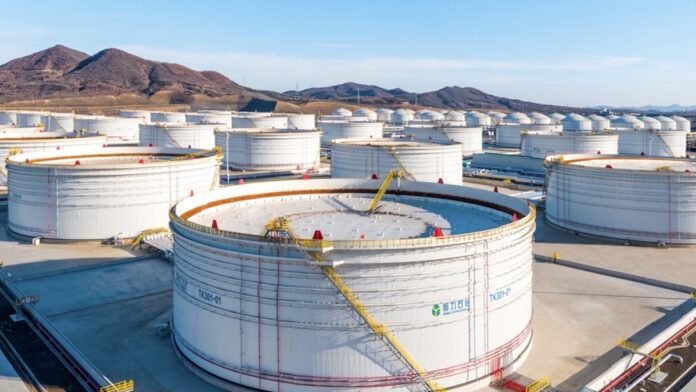
The US Treasury Department’s Office of Foreign Assets Control (OFAC) on April 24 added Hengli Petrochemical (Dalian) Refinery Co Ltd to the Specially Designated Nationals and Blocked Persons List (SDN List), describing it as China’s second-largest independent “teapot” refiner and “one of Tehran’s most valued customers.
The OFAC said Hengli (Dalian) generated hundreds of millions of dollars for Iran’s military through crude purchases. It said that, since at least 2023, the company has received more than five million barrels of Iranian crude from multiple sanctioned shadow‑fleet vessels.
In parallel, the US also sanctioned around 40 shipping firms and vessels alleged to be operating as part of Iran’s so-called shadow fleet. These vessels are registered in jurisdictions including Hong Kong, mainland China, the United Arab Emirates, Vietnam and Malaysia.
Hengli Petrochemical Co, a Shanghai-listed company and the parent of the sanctioned Hengli (Dalian), said it has always operated in full compliance with applicable laws and regulations. It said it has never traded with Iran, and that all suppliers certify their crude is sourced from jurisdictions not under US sanctions.
“The US Treasury’s decision to place Hengli (Dalian) on the SDN List lacks factual and legal basis and constitutes a unilateral sanction. We firmly oppose these groundless allegations and unlawful measures, and will take all necessary steps to safeguard the legitimate rights and interests of the company and its shareholders,” Hengli said.
It added that operations remain normal with high utilization rates, production and sales proceeding as planned, and crude inventories sufficient for more than three months, with procurement unaffected.
“China opposes illicit unilateral sanctions that have no basis in international law. We urge the US to stop willfully slapping sanctions and using long-arm jurisdiction. China will firmly defend the lawful rights and interests of Chinese companies,” Lin Jian, a spokesperson of the Chinese Foreign Ministry, said in a regular media briefing on Monday.
On April 14, Hengli Petrochemical Co said its revenue fell 14.9% year-on-year to 201 billion yuan (US$28 billion) in 2025, while net profit rose 0.4% to 7.1 billion yuan. Its refining and petrochemical complex in Dalian is one of China’s four major private refining projects, alongside others led by Zhejiang Petroleum and Chemical Co Ltd and Shenghong Petrochemical Group.
The richest woman in China
The refinery at the center of the dispute is owned by Fan Hongwei, widely regarded as one of China’s wealthiest self-made women on the Hurun Rich List.
She began in 1994 by acquiring a near-bankrupt textile plant in Suzhou with her husband, Chen Jianhua, then scaled it rapidly through capacity expansion and opportunistic equipment purchases during the Asian financial crisis. In the early 2000s, she moved upstream to secure supply, investing heavily in the production of purified terephthalic acid (PTA) and driving down costs.
In 2010, the group won a bid for the large refining and petrochemical project on Dalian’s Changxing Island, beating several state-owned competitors, and built a 20‑million‑metric-ton complex. The move cemented a vertically integrated model and established the company as a major private energy and manufacturing powerhouse.
In October 2022, Fan was named China’s richest woman by Bloomberg, overtaking Longfor Group co-founder Wu Yajun. She has consistently ranked among the top self-made women on the Hurun Rich List. In 2026, she was placed eighth among the world’s wealthiest self-made women.
“Just as news emerged that the US and Iran might resume peace talks, Washington moved swiftly to escalate sanctions,” says Hua Xiangming, a Jiangsu-based columnist. “Many in the international community see this as an attempt to gain leverage at the negotiating table.”
He says targeting foreign refineries and freezing overseas assets to strengthen bargaining power reflects “a typical form of hegemonic politics,” adding that such actions have effectively abandoned any pretense of adherence to free trade or market principles.
“The so-called evidence chain is highly ambiguous. The US Treasury claims the sanctions are linked to billions of dollars’ worth of Iranian oil purchases, yet the details remain unclear,” he says, warning that the weaponization of the US dollar will prompt more countries to accelerate their de-dollarization efforts.
“The dollar’s share of global reserves has fallen below 60%, a multi-decade low. Countries now see that relying on dollar settlement risks asset freezes and financial coercion,” he says. “Alternatives are emerging, from non-dollar oil pricing to new payment channels such as China’s Cross-Border Interbank Payment System (CIPS), accelerating efforts to reduce dependence on the dollar.”
Secondary sanctions
On April 15, US Treasury Secretary Scott Bessent said Washington had warned banks across multiple jurisdictions, including two in Hong Kong, about the potential imposition of secondary sanctions if they process transactions linked to Iran.
The Telegraph reported on April 21 that a US federal court in New York had ordered five major global banks, including HSBC, Standard Chartered, JPMorgan, Citibank and Bank of New York Mellon, to hand over documents in a civil case linked to alleged Iran sanctions evasion. The banks are not accused of wrongdoing and are involved only in their capacity as correspondent lenders.
The OFAC said on April 24 that some of the sanctioned vessels are linked to Hong Kong entities:
Lisboa, owned by Hong Kong-based Lisboa Shipping Company Limited, carried more than 2.5 million barrels of Iranian naphtha to the UAE between July 2025 and January 2026.
Lynn, owned by Hong Kong-based Ting Tao Company Limited, conducted ship-to-ship transfers of Iranian crude oil off the coast of Malaysia before delivering the cargo to China.
Stellar Beverly, owned by Hong Kong-based Yegua Trading Limited, transported over two million barrels of Iranian crude to China in 2025.
Covenio, owned by Hong Kong-based Extensive Shipping Limited, has moved more than six million barrels of Iranian oil to China since early 2025.
Golden Sunrise, owned by Hong Kong-based Xifoides Group Limited, has transported several million barrels of Iranian oil since mid-2025.
Citing information from the Treasury Department, US media reported that Iran routed roughly US$9 billion in 2024 through US correspondent accounts using networks of front companies, with activity concentrated in Hong Kong, Oman and the UAE.
A Henan-based columnist says the reported US$9 billion in transactions during 2024 has become “a hot potato” for financial institutions.
“Banks now have to comb through records to identify Iran-related flows and report them, a process that could take months,” he says. “During that time, business may be disrupted and costs will rise, leaving institutions that prioritize stability facing significant operational strain.”
“To manage risk, banks are likely to tighten scrutiny of Middle East clients, especially those linked to Iran-related trade,” he says.
He says that, over the medium and long term, Iran will find alternative channels to keep funds moving, while oil traders may turn to currencies such as the euro or the renminbi to reduce reliance on the dollar.