Why Italy’s Giorgia Meloni broke with Donald Trump
The Italian prime minister and leader of the far-right Brothers of Italy party, Giorgia Meloni, has made fostering ties with foreign leaders a central part of her political strategy. A few years before winning Italy’s 2022 general elections, she started cultivating ties with the US and European conservative world as part of a broader political rebranding effort aimed at projecting a more moderate image at home and gaining legitimacy abroad.
She subsequently became a familiar face within Donald Trump’s “Make America Great Again” (Maga) movement. Meloni shares similar views to Maga on migration, sovereignty and national identity. She also aligns with the movement on a constellation of other themes ranging from fighting against “wokeism” and defending the traditional family to the rejection of liberalism, globalism and environmentalism.
After Trump was elected as US president for the second time in late 2024, Meloni’s ties with the American far-right suddenly became a matter of foreign policy. But her relationship with Trump has turned out to be a more demanding balancing act than Meloni may have anticipated. And now their alliance – at least for the time being – appears to be over.
On April 13 Meloni described Trump’s recent social media attack on Pope Leo, who had criticised the US and Israel’s war on Iran, as “unacceptable”. This prompted a rebuke from Trump, who said Meloni “lacked courage” for not joining the war. The conditions for this breakdown have been in place for some time.
Trump and Meloni’s alliance
Trump and Meloni’s shared far-right traits should not hide some key differences between the two leaders. In foreign policy, Meloni has adopted a pro-Nato position and is a staunch supporter of Ukraine. These positions have aided Meloni in what has been called her quest for “respectability”, but they clash with Trump’s lack of support for Ukraine and belligerent position towards Nato.
Politically, Meloni has also faced constraints that have moderated her leadership. Externally, the EU’s institutional and financial straitjacket has required Meloni to work collaboratively with the bloc. This requirement has limited Meloni’s room for manoeuvre in her dealings with Trump and clashes with the US president’s rejection of multilateralism.
Internally, the logic of coalition politics – in particular the moderating presence of the pro-European Forza Italia party in her government – and the fact that centrist voters represent a decisive constituency in Italy have both acted as a further centripetal force on Meloni’s agenda.
Despite these divergences, Meloni’s ideological closeness to Trump did initially translate into diplomatic gains that helped boost her profile with fellow EU leaders. She was the first EU leader to meet with Trump after the imposition of his global trade tariff regime in 2025.
Meloni also managed to organise a trilateral meeting in Rome with the president of the European Commission, Ursula von der Leyen, and the US vice-president, J.D. Vance. Following the meting, Vance called Meloni a “bridge” between the two sides of the Atlantic.
Still, beyond the legitimacy gains for Meloni and her party, the material advantages Italy has extracted from her relationship with Trump have been limited. Italy was not spared trade tariffs, for instance. Nor did it manage to obtain a discount on Trump’s demand for Nato members to raise military spending to 5% of their GDP.
People celebrate the results of the recent judicial reform referendum in Palermo, Italy, on March 23.Lara Sirignano / EPA
The scarcity of tangible policy gains from her ties with Trump may be one reason for Meloni’s decision to distance herself from the US president. But Italian domestic politics are another important factor.
The indirect effects of Trump’s policies are likely to have played a key role in the recent defeat Meloni suffered in a referendum on judicial reform. This referendum, which came one month into Trump’s war in Iran, morphed into a vote on the Meloni government.
The Iran war has caused energy prices across Europe to rise and has generated fears among Italians of possible security repercussions. With a recent survey indicating 79% of Italians now hold a negative opinion on Trump, it seems that voters used the referendum to signal their discontent to Meloni ahead of general elections in 2027.
Opposition parties, both on the left and right, hailed the result as a sign that voters are looking for change. And Roberto Vannacci, a former general turned politician, is capitalising on voters’ increased unease with the impact of Trump’s policies. He has criticised Meloni for what he sees as her Washington-first alignment and soft approach to key far-right issues.
Trump’s attack on the Pope – indefensible for Meloni as someone who has defined herself as a Christian and whose party draws on a vast Catholic electorate – gave the Italian prime minister the exit she needed to signal her distance from Trump’s recent actions to voters.
Meloni’s agenda remains far-right in its orientation, aligning with Trump’s in many ways from identity politics and migration to his stance on the green transition. How these ideological similarities are received by Italian voters over the coming year is likely to play a crucial role in determining Meloni’s political future.
As the US Navy moves to deploy thousands of unmanned surface vessels in the Indo-Pacific, questions are mounting over whether these drone swarms can deliver meaningful combat and deterrent effects against China.
This month, USNI News reported that the US Navy is looking to field thousands of unmanned surface vessels (USVs) in the Indo-Pacific by 2030 to strengthen deterrence against China.
At the Navy League’s Sea-Air-Space Symposium in National Harbor, Maryland, Captain Garrett Miller, head of Surface Development Group One, said the initiative will include over 30 medium unmanned surface vessels (MUSVs) and thousands of smaller USVs, alongside unmanned aerial systems (UAS) operating from both crewed and uncrewed ships, based on projected operational requirements through 2045.
The move aligns with the US Indo-Pacific Command’s (INDOPACOM) “hellscape” concept, which envisions swarms of autonomous systems to defeat and deter Chinese military actions, including a potential invasion of Taiwan.
Drawing partly on Ukraine’s use of maritime drones against Russia and recent Middle East operations, the US Navy aims to adapt such tactics for the Pacific, though officials cautioned that vast distances and open-ocean conditions pose challenges compared to confined seas.
Rear Admiral Douglas Sasse noted that Indo-Pacific operations will require more innovative approaches. Recent tests, including autonomous refueling of a medium USV, underscore progress, while deployments alongside carrier strike groups are expected to enhance surveillance, flexibility and maritime domain awareness.
The planned large-scale deployment of USV swarms in the Indo-Pacific raises questions about their effectiveness at the tactical, operational, and strategic levels in enhancing combat performance and deterrence against China.
At the tactical level, USV swarms derive their effectiveness from overwhelming defenses, exploiting cost asymmetry, and sustaining pressure to degrade combat endurance.
Scott Savitz notes in a January 2023 RAND article that explosive USVs can strike ships by massing in swarms and approaching from multiple angles, making them difficult to detect and intercept.
Savitz says these USVs can strike the waterline with payloads larger than comparably sized missiles or uncrewed aircraft, potentially inflicting devastating damage. He adds that even one or two USVs penetrating defenses would constitute mission success.
Furthermore, Rudraksh Pathak notes in a March 2026 article for the Center for International Maritime Security (CIMSEC) that autonomous systems achieve effectiveness by exploiting cost asymmetry and defensive saturation, creating an “interceptor trap” in which defenders are forced to expend scarce, high-value missiles against low-cost targets, eventually depleting their magazines and compelling withdrawal.
He adds that such systems do not need to penetrate defenses perfectly; they only need to force defenders to use their most capable weapons against low-value targets, degrading operational tempo and endurance over time.
Together, these dynamics suggest that USV swarms are less about decisive strikes than cumulative degradation of defenses.
Drawing on tactical lessons from the Iran war, Kateryna Bondar notes in a March 2026 article for the Center for Strategic and International Studies (CSIS) that drone campaigns are effective because they generate sustained pressure at relatively low cost, allowing actors to impose economic, psychological, and operational strain while preserving higher-end missile assets.
She highlights that Iran’s campaign followed a two-phase pattern—an initial large-scale saturation wave followed by a steadier, sustained tempo of strikes over several days—demonstrating how drones function as a persistent campaign tool rather than a one-off strike asset.
In a Taiwan Strait scenario, USV swarms could challenge the People’s Liberation Army Navy’s (PLAN) defenses and drain their operational endurance with costly attacks. Their success hinges on resilient targeting and communication but may be limited by range and layered Chinese defenses.
Yet tactical disruption alone does not guarantee operational success, as battlefield effects must be translated into coordinated force employment. At the operational level, USV swarms hinge on integration into existing naval formations and broader joint and allied frameworks.
George Galdorisi, in a February 2026 CIMSEC article, describes incorporating USVs into a hybrid fleet through man–machine teaming, where uncrewed and crewed platforms operate as a coordinated, synergistic force.
He highlights the use of large USVs as “trucks” to transport and deploy smaller USVs, unmanned underwater vehicles (UUVs), and unmanned aerial vehicles (UAVs) into contested areas.
He adds that this approach enables distributed operations while allowing crewed ships to remain out of range of adversary anti-access/area denial (A2/AD) systems, provided they are supported by robust command-and-control.
Furthermore, Thomas Clare notes in a November 2025 Center for Strategic and Budgetary Assessments (CSBA) report that USVs have proven effective at enabling sea denial and extending operational reach, but their employment is constrained by factors such as range, control links, and the need for supporting infrastructure.
He suggests that USVs are best used as part of a broader attrition-and-distributed-operations campaign rather than as standalone solutions, highlighting both their potential and their limitations.
Considering Taiwan Strait operations, USVs would serve as forward-deployed, networked extensions of manned forces, supporting distributed, multi-domain operations from standoff ranges. Their effectiveness depends on resilient command links, ISR integration, and access to forward-positioned systems. Even so, effective employment at scale depends on more than force structure.
Beyond operational integration, their broader value lies in shaping strategic deterrence by influencing how adversaries assess risk and assess their own success.
Xidi Chen and Lun Li note in a February 2026 Frontiers in Political Science article that unmanned maritime vehicles offer advantages such as low cost, potential for mass deployment, long endurance, and the avoidance of personnel casualties, enabling states to enhance maritime situational awareness and reshape patterns of maritime competition.
They add that these characteristics enable small and medium-sized states to narrow capability gaps in specific operational areas and to strengthen their ability to achieve area denial and deterrence.
They further argue that the unmanned nature of these systems reduces personnel risks, easing political and public constraints and expanding leaders’ strategic freedom of action. This shifts deterrence from high-end punishment to persistent, theater-specific pressure.
Furthermore, Christopher Knight argues in a September 2024 Proceedings article that unmanned systems can support deterrence by enabling theater deterrence, defined as the deployment of sufficient localized combat power within a specific geographic area to make an adversary question whether its intended operation will succeed.
He notes that, unlike nuclear deterrence, which operates at the high end of the conflict spectrum, unmanned systems can be tailored to specific operational problems and deployed forward to help counter capabilities such as China’s A2/AD approach.
He emphasizes that their deterrent value depends on organizing, testing, proliferating and visibly demonstrating these systems to influence adversary calculations before conflict.
USV swarms can boost deterrence by offering flexible, forward-deployed capabilities that challenge Chinese planning and raise doubts about invasion, but their impact relies on credible integration and clear demonstration to sway China’s decisions before conflict.
Ultimately, USV swarms will matter less for their scale than for whether they can be turned into credible, networked combat systems that contribute to a larger operational framework and shape adversary perceptions for deterrence.
Rocket Report: Artemis III rocket getting ready; SpaceX is now an AI company
Welcome to Edition 8.38 of the Rocket Report! The big news this week concerned the third launch of the New Glenn rocket. The first 15 minutes of the flight were exhilarating for Blue Origin, seeing a previously flown rocket take flight and then triumphantly land on a barge at sea. But then the highest of highs was followed by the company’s first loss of an orbital payload, the AST SpaceMobile satellite being injected into a low orbit due to an upper stage failure. We’ve heard it was due to a valve problem, but that would be no scoop as it seems like it’s always the valves that fail in this industry.
As always, we welcome reader submissions, and if you don’t want to miss an issue, please subscribe using the box below (the form will not appear on AMP-enabled versions of the site). Each report will include information on small-, medium-, and heavy-lift rockets as well as a quick look ahead at the next three launches on the calendar.
Canada’s spaceport plans are not without critics. About a month ago, the Canadian National Defense Minister, David McGuinty, announced an “historic investment” of $200 million over 10 years to Maritime Launch Services for the lease of a dedicated “space launch pad” in Nova Scotia. But some local residents, including Marie Lumsden, are pushing back. Writing in the Halifax Examiner, Lumsden shares a photo of a small concrete pad at the end of a gravel road (the entirety of the spaceport). The residents have formed a group, Action Against the Canso Spaceport, because they have “genuine concerns about this project and the people behind it.”
A litany of concerns … The article outlines some of the organization’s concerns about the spaceport, Maritime Launch Services, and a “revolving door” of team members. There are also questions about an environmental assessment by the Nova Scotia Environment and Climate Change regarding the environmental risks of launching a Ukrainian rocket with a mix of UDMH/LOX/kerosene fuels. “This project was approved by an utterly inappropriate and broken environmental assessment process whose outcome, despite the outcry of NSECC staff, is determined by lobbyists, unscrupulous proponents, and their friends in high political places,” Lumsden. (submitted by Adapheon)
Rocket Lab launches “origami” satellite. An Electron rocket on Thursday launched the Japanese space agency’s Innovative Satellite Technology Demonstration-4 mission, which aims to test advanced space tech developed by startups and universities, The Independent reports. Among the payloads was a small 10 cm cube that unfolds to a 2.5-meter array.
A lot of unfolding … Rocket Lab’s name for the mission, its second for JAXA, was “Kakushin Rising.” JAXA describes the 10cm cube as “an unprecedentedly lightweight and highly packable deployable array antenna for space, with antenna elements attached to a two-layer deployable membrane that can be folded using origami techniques.” It sounds pretty cool.
The Ars Technica Rocket Report
The easiest way to keep up with Eric Berger’s and Stephen Clark’s reporting on all things space is to sign up for our newsletter. We’ll collect their stories and deliver them straight to your inbox.
Astrobotic tests rotating detonation engine. Astrobotic on Thursday announced the successful hot fire testing of its Chakram rotating detonation rocket engine (RDRE) at NASA’s Marshall Space Flight Center. Two Chakram engine prototypes completed eight successful hot-fire tests, accumulating more than 470 seconds of total run time without any discernible damage to the engine hardware, the company said. The campaign included a 300-second continuous burn, which is believed to have set the record for the longest duration hot firing of an RDRE engine to date.
Plans to incorporate over time … During testing, each engine produced more than 4,000 pounds of thrust, making Chakram one of the most powerful such engines ever demonstrated. This successful test campaign represents an important milestone in Astrobotic’s development of rotating detonation rocket engines to improve the performance and payload capacity of its spacecraft. Astrobotic plans to incorporate this state-of-the-art propulsion technology into future vehicles, including Griffin-class lunar landers, Xodiac- and Xogdor-class reusable rockets, and an orbital transfer vehicle currently in development.
SpaceX eyes financial future as an AI company. Reuters reviewed the forthcoming S-1 regulatory filing for SpaceX, in which companies disclose their financials and key risks before going public, and there were some eye-opening details. SpaceX estimates that its total addressable market—the maximum revenue a company could generate if it captured every customer in a particular market—could be as much as $28.5 trillion.
But where money does that come from? … SpaceX expects more than 90 percent of that market, or $26.5 trillion, to stem from the AI sector. The vast majority of that, $22.7 trillion, could come from AI for businesses. The company is moving ahead with an IPO expected this summer targeting a valuation of roughly $1.75 trillion and seeking to raise about $75 billion, which would make it the largest initial public offering in history. “We believe we have identified the largest actionable total addressable market in human history,” according to the filing.
Falcon boosters have now landed 600 times. SpaceX completed its 600th Falcon booster landing during a Starlink mission Sunday, Spaceflight Now reports. The Starlink 17-22 mission added another 25 broadband Internet satellites into the company’s low Earth orbit constellation that consists of more than 10,200 spacecraft.
Don’t forget the hard-working ships … SpaceX used Falcon 9 first stage booster B1097, which was flying for the seventh time. It previously launched Sentinel-6B, Twilight, and five previous batches of Starlink satellites. A little more than eight minutes after liftoff, B1097 landed on the SpaceX drone ship, “Of Course I Still Love You.” It was the 191st landing on this vessel. Another droneship, “Just Read the Instructions,” will now be dedicated to supporting Starship operations.
Two steps forward, one step back for New Glenn. The third flight of Blue Origin’s heavy-lift New Glenn launcher began Sunday with the company’s first successful reflight of an orbital-class booster, but ended with a setback for Jeff Bezos’ flagship rocket, Ars reports. After the launch, the booster settled onto the ship for a smoky but on-target touchdown less than 10 minutes after liftoff. The landing marked the end of the second flight for this booster, a stunning success for the company.
Second-stage issues … But Blue Origin could not celebrate the achievement for long. Within a couple of hours, it became clear that something went wrong with the mission’s remaining milestones. Blue Origin confirmed New Glenn’s upper stage missed its aim and released its payload, a cellular broadband communications satellite for AST SpaceMobile, into an inaccurate orbit. The satellite later reentered Earth’s atmosphere. The second stage issue will force Blue Origin to stand down New Glenn at a time when NASA needs the vehicle to ramp up operations to support the Artemis Program.
Vulcan issue proves costly to Northrop. Northrop Grumman said Tuesday it had taken a $71 million charge due to an anomaly with a solid rocket booster that grounded the Vulcan Centaur rocket, Space News reports. The problem occurred on a February 12 launch, when one of four GEM 63XL boosters attached to the rocket shed debris about 65 seconds after liftoff.
Payloads waiting to go to space … After the mission, which concluded successfully, United Launch Alliance called the incident a “significant performance anomaly” that would need to be investigated prior to Vulcan’s next flight. This was the second time in four Vulcan missions that a solid rocket booster suffered an issue. The problems have delayed the launch of several payloads for the US Space Force. For more on this, read on.
Space Force may use Vulcan for lower-risk missions. Amid an ongoing investigation into a solid rocket motor anomaly that grounded United Launch Alliance’s Vulcan rocket for US national security missions, the Space Force is exploring options to use the heavy-lift launch vehicle for less complex missions, Aviation Week reports. Since the issue is restricted to the Northrop Grumman-built solid rocket motor, the service is considering flying Vulcan without those boosters, Col. Eric Zarybnisky, acting program acquisition executive for space access, said.
No solids, no problem … The Space Force could launch certain missions without solid rocket boosters that carry lower mass or are bound for lower orbits. For example, the service could launch an upcoming Space Development Agency mission on Vulcan, Lt. Gen. Philip Garrant, Space Systems Command chief, told reporters in a separate briefing. “Essentially, if it doesn’t rely on a solid, there’s no reason why we can’t launch, and I’m committed to supporting that and keeping that mission going,” he said. The Space Force has switched four GPS III missions from a Vulcan rocket to a SpaceX Falcon 9 vehicle since December 2024
NASA rolls out Artemis III core stage. NASA said this week it has rolled out the core stage of the agency’s Space Launch System (SLS) rocket that will launch the crewed Artemis III mission in 2027. The stage departed from the agency’s Michoud Assembly Facility in New Orleans on Monday for shipment to NASA’s Kennedy Space Center in Florida. Using highly specialized transporters, engineers maneuvered the top four-fifths of the SLS core stage, the section containing the liquid hydrogen tank, liquid oxygen tank, intertank, and forward skirt, from inside NASA Michoud to the agency’s Pegasus barge.
Launching sometime in 2027 … After the core stage arrives at Kennedy Space Center in Florida, teams will complete the stage outfitting and vertical integration, and the agency’s Exploration Ground Systems Program will stack the rocket’s components in preparation for launch. Next year’s Artemis III mission will launch astronauts to Earth’s orbit aboard the Orion spacecraft on top of SLS to test rendezvous and docking capabilities between Orion and commercial spacecraft needed to land Artemis IV astronauts on the Moon in 2028.
Next three launches
April 25: Long March 6 | Unknown payload | Taiyuan Satellite Launch Center, China | 12:15 UTC
April 25: Soyuz 2.1a | Progress MS-34 | Baikonur Cosmodrome, Kazakhstan | 22:21 UTC
April 26: Falcon 9 | Starlink 17=16 | Vandenberg Space Force Base, Calif. | 14:00 UTC
It’s primary season, this time against a backdrop of heightened concerns and awareness of powerful figures skirting accountability for sexual abuse and misconduct. Survivors of convicted sex offender Jeffrey Epstein have “made accountability for sexual abuse and sexual violence an electoral issue,” says Intercept politics reporter Jessica Washington.
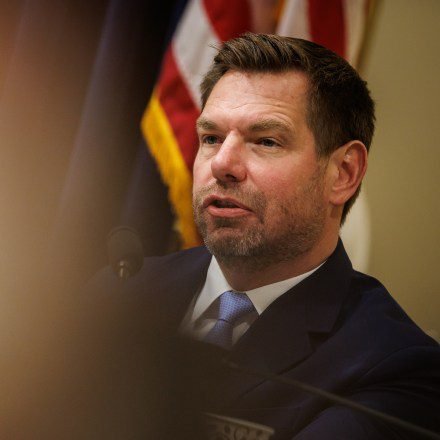
One of the biggest stories to shake up politics in recent weeks are sexual assault allegations that upended Rep. Eric Swalwell’s bid to become the next governor of California, forcing the Democratic front-runner to also resign from his House seat. “You also have to give some credit to Democrats as well for immediately moving on these allegations very swiftly,” says Washington.
This week on The Intercept Briefing, Washington and Intercept senior politics reporter Akela Lacy speak to host Jordan Uhl about the themes emerging this midterm election season. They talk about how the crowded California gubernatorial race is boosting Republicans to the top of the ticket to why powerful factions of the Democratic Party are hyperfixating on Twitch streamer Hasan Piker, rather than leveraging Trump’s sinking approval rating. “This is about not wanting to share power with the left,” notes Washington.
They also discuss what makes a candidate or elected official a progressive. “We’ve seen a lot of candidates, particularly 2028 candidates, whether senatorial or gubernatorial, who have had long-standing relationships with AIPAC or demonstrated pro-Israel policy records like Rahm Emanuel, Cory Booker, Josh Shapiro, Ruben Gallego, all come out now against AIPAC or distancing themselves from AIPAC,” says Lacy. “It doesn’t really matter if you’re rejecting AIPAC money, if you aren’t changing any of the policies that you adopt with respect to how the U.S. treats Israel.”
For all that and more listen to the full conversation of The Intercept Briefing on Apple Podcasts, Spotify, YouTube, or wherever you listen.
Transcript
Jordan Uhl: Welcome to The Intercept Briefing. I’m Jordan Uhl, an Intercept contributor and your host today, joined by my co-hosts.
Jessica Washington: I’m Jessica Washington, politics reporter for The Intercept.
Akela Lacy: And I’m Akela Lacy, senior politics reporter at The Intercept.
JU: Today we’re bringing you a midterm elections update. Except rather than diving into the various horse races, we’re going to talk about some crucial themes emerging that we’re reporting on here at The Intercept.
Jessie, let’s start with you. One of the biggest stories to shake up politics in recent weeks are sexual assault allegations that upended California congressman Eric Swalwell’s bid to become the next governor of California, and appears to have completely ended his political career, forcing him to resign from his House seat. We’ll get into the California governor’s race in a bit. But to start, Jessie, remind us of the sequence of events that led to Swalwell dropping out of the race.
JW: It was a really swift turnaround. In late March, we began to hear on social media from mostly influencers who were talking about stories they had heard from friends, from other women involved in politics, related to allegations against Swalwell. But many of those allegations online were incredibly vague.
That all shifted on April 10, which was a Friday when a San Francisco Chronicle article dropped accusing Swalwell of sexually assaulting a former staffer. Shortly after that, CNN dropped another story, labeling the former staffer’s accusations as rape and also detailing sexual harassment allegations from other women. Within hours of that story dropping, over a dozen Democrats pulled their endorsements, including a really high-profile endorsement from Adam Schiff. We also began to hear reports that Nancy Pelosi and Hakeem Jeffries — top Democratic leadership — had called Swalwell to tell him that he should drop out of the governor’s race.
Then over that weekend, on Sunday [April 12] I believe, he dropped out of the race. By Monday, he had resigned from office.
JU: You write in your story that The Intercept has not been able to independently verify the allegations. In a statement posted last week, Sara Azari, a criminal defense attorney representing Swalwell, wrote that the former congressman “categorically and unequivocally denies each and every allegation of sexual misconduct and assault that has been leveled against him,” calling the accusations “a ruthless and shameless attempt to smear Congressman Swalwell.”
I think that’s something that has been interesting to me. He’s trying to frame all of this as an attempt to stop his candidacy for governor. For me, I see that and think, OK, then why did you resign from Congress? How do you thread that needle, Jessie?
JW: I think that is obviously a question for Eric Swalwell. But I will say that these allegations have been in the ether for years. These are not new allegations, although they are new to much of the public. You talk to people on the Hill, and these are things that they have heard for years.
JU: Now, Jessie, you said it was an unusually swift fallout in part due to the public sentiment around the Epstein files. Could you talk about that?
JW: When I was writing this story, originally, I hadn’t thought about the role of the survivors themselves as much in the story. I’m speaking specifically about Epstein survivors. But we have to give a lot of credit to those women for making sexual abuse, sexual assault, sexual harassment, making these issues electoral issues — issues that the public really cares about.
The Epstein survivors “made accountability for sexual abuse and sexual violence an electoral issue.”
So you have two things going on. You have the fact that these survivors have made this an electoral issue — made accountability for sexual abuse and sexual violence an electoral issue. And you also have to give some credit to Democrats as well for immediately moving on these allegations very swiftly. From their perspective, it is incredibly hypocritical for them to not hold Swalwell accountable while also running simultaneously on the Epstein files, running on accountability, running on this idea that we have to hold the Epstein class — people who are abusers — accountable. I think they couldn’t run on that effectively and also not hold Swalwell accountable once these allegations were made public.
JU: Now, on Monday, the House Committee on Ethics published a list of 28 representatives who have been investigated by the committee for alleged sexual misconduct. The oldest case dates back to 1976. Recent investigations include Swalwell; Tony Gonzales, Republican of Texas; Cory Mills, Republican of Florida who is facing allegations of “sexual misconduct and/or dating violence.” That investigation is ongoing; he denies the charges. And notably a few years have passed but also on the list is Matt Gaetz, Republican and former congressman of Florida.
Jessie, are you seeing more efforts to take allegations more seriously and hold members of Congress accountable?
JW: There definitely is a shift in Congress, and obviously that shift has to do a little bit with Swalwell. We’ve talked about the Epstein files in terms of more of an effort to hold these members accountable for their abuse of women. I will say the fact that there was no movement on Gonzales or Mills until after Swalwell allegations came forth, one could question whether or not Republicans are a faithful partner in this, or if they just see another political opportunity. But there does seem to be at least a rhetorical shift on the Hill when it comes to taking these problems seriously.
AL: I would agree that I think the speed of Democrats consolidating around “Get this guy out of Congress” is new. But I would also say, we did see this moment of reckoning in 2017, 2018, with the first round of “Me Too,” when it appears that a lot of these allegations were already known around that time or had happened prior to that.
JW: That actually came up in my piece when I was speaking to people who had worked both on the Hill and also as campaign staffers. The fact that a lot of these rumors — about Swalwell, but also obviously there are rumors about other politicians, Democratic politicians as well — that these rumors were known, and that people didn’t do anything. What we’re seeing is a reaction to the public being aware of these allegations, and also I would say the severity of the allegations.
We’re talking about really horrific allegations of sexual assault — we do have to acknowledge again that Swalwell denies — but I think it’s the severity of the allegations and the fact that they were made public. But it is a little soon for Democrats to be patting themselves on the back when many of these allegations were floating around the ether on the Hill.
JU: Interestingly, on Monday, Rep. Nancy Mace, a Republican of South Carolina, introduced a resolution to expel Mills from Congress. I’m curious to see how that goes.
But for both of you, this is actually a sizable potential shakeup in Congress. And we haven’t even talked about others who were facing possible expulsion. Like Rep. Sheila Cherfilus-McCormick, a Florida Democrat who was found guilty by the Ethics Committee for financial misconduct, which she denied. On Tuesday, she announced her resignation.
What does this all mean for Republican’s majority in Congress? What effect, if any, might it have on which party will hold the majority next?
AL: So right now, Republicans have a slim majority in the House — 217, and one Independent who caucuses with Republicans — to Democrats, who have 213. Democrats are optimistic that they’re going to win back the House in midterms even prior to all of this.
There’s two Republicans that are facing these allegations right now, so off the bat, that doesn’t give Democrats the majority, obviously, but it could potentially help. We don’t know what’s happening with Tony Gonzales or Cory Mills at this point. The fact that two Democrats have now resigned obviously factors into that, but midterm watch, they are expected to potentially win back the House and are even looking at possibly the Senate, obviously, as we’ve been talking about on this show.
I think, if anything, I don’t know that this really plays well for Democrats because Eric Swalwell is the face of this at this point. I don’t know if the floodgates have opened yet, maybe you could say that we’re talking about four or five people at this point. Obviously, Sheila Cherfilus-McCormick is not a sexual misconduct allegation, but obviously, a shakeup is happening. Who knows what else can happen?
We’re in the height of primary season right now, and it’s going to be a long summer. I imagine that we’re going to see more things continue to come up, especially because the “oppo” people are going crazy right now, so it remains to be seen. But again, the baseline prior to this was: It’s a possibility for Republicans to lose the House. I don’t see this necessarily changing that, but it could complicate things for Democrats if more of them come under fire.
JW: The “oppo” angle is actually really interesting. It’s something that people who aren’t journalists or aren’t in the political world aren’t that aware of.
Campaigns research each other. They research their opponents, and they come up with these spreadsheets of documents against the opponents — all of their different weak points, including these various allegations that are floating around against them. So during campaign season, you do see people digging up a lot more — I don’t want to call something like sexual harassment “dirt” — but these negative allegations about people. So that’s something that you see a lot in campaign season. That’s why we might end up seeing more and more come out about these candidates.
JU: Now, I want to pivot back to Swalwell and the California governor’s race. This is something I’ve been watching closely as a Californian. It’s a crowded race, even with Swalwell exiting. Former Secretary of Health and Human Services, Xavier Becerra who was previously California’s attorney general, got a boost from Swalwell’s departure, making him tied with billionaire Tom Steyer. Former congresswoman Katie Porter is not far behind them.
Akela, you wrote about a progressive group that is trying to rally Democrats around Steyer. Can you tell us about this group and why they’re endorsing him over other candidates in the race?
AL: Xavier Becerra was polling in single digits pretty much up until Swalwell’s exit. Some polls have shown him pulling ahead or tied. The Emerson poll that everyone was looking at right after Swalwell dropped out, had him at 10 percent — well behind the first two Republican candidates and Tom Steyer, but tied with Katie Porter.
The article that you’re talking about, Jordan, we wrote an exclusive about Our Revolution endorsing Tom Steyer. This is the progressive group that Bernie Sanders founded after his 2016 presidential campaign. They have built their mission around attacking wealth and power in politics, and so endorsing a billionaire raised a lot of eyebrows and questions about that — how endorsing Steyer advances that mission, which I spoke at length with their executive director about.
This is the first billionaire Our Revolution has endorsed. It was fun fact checking that because we were like, how many billionaires have run for office? We pretty much know all of them. It wasn’t JB Pritzker, it wasn’t Michael Bloomberg. That in itself is historic for a group that has fashioned itself in the way that Our Revolution has.
They have recently tweeted [in 2025], “We shouldn’t have billionaires,” so this is what we’re talking about. They were very open about that being a big contradiction, to their credit, I will say. Their view is that in this field, which is extremely crowded, the fact that two Republicans have been leading the race basically since January should give pause to progressives and Democrats about whether they’re going to consolidate behind a candidate or risk handing the seat to a Republican.
Another initial question that I had: What about Katie Porter? She has the longest record in office of a progressive official of the candidates in the pool and the highest name recognition for a progressive. They basically said that she was the first candidate to jump into the race, but she still hasn’t pulled ahead or demonstrated a clear path to victory in polling.
They didn’t speak to this, but I will mention that Katie Porter has faced backlash in recent years after a video surfaced of her yelling at a staffer. I don’t know how much that’s affecting her race right now, but I think that tarnished her image a little bit for some people. I don’t know that the average California voter knows that happened necessarily, but they seem to think that she did not have a chance of winning, basically, was the bottom line.
So they were like, yeah, there are concerns about us endorsing a billionaire, there are questions about how that aligns with our broader project. But in this instance, if the alternative is having a Republican run California for the first time in the last two governors, then they would rather back someone who they say has used his wealth and power to advance progressive ideals, investing in advocacy around climate change and electing progressive officials.
“If the alternative is having a Republican run California … then they would rather back someone who they say has used his wealth and power to advance progressive ideals.”
I will say Tom Steyer has also faced criticism for benefiting from the policies that help billionaires pay lower taxes. Although he himself has said that he and billionaires should pay more in taxes. But I think a lot of people have a lot of questions, which I think are fair, about what he will do in office.
This is also someone who has spent the most on his own race. He spent over $120 million on his gubernatorial campaign so far. This is coming off of spending $300 million on a failed presidential bid in 2020.
They also said that Steyer aggressively sought Our Revolution’s endorsement throughout the entire race and that Katie Porter did seek their endorsement but did so later in the race. They had endorsed against her in the California Senate race in 2020. They endorsed Barbara Lee against Katie Porter, and they said that her campaign’s performance in that race did not inspire confidence that she would be able to win another statewide race.
[Break]
JU: It is a crowded and confusing field for the dynamics you just laid out. The policy differences, the disparity in personal wealth, all of those things make for a tough decision for many people in California on the left. But because of the way the election works here with a jungle primary, the two leading candidates advance to the general election, regardless of party affiliation.
Right now, if polling remains the same before the primary in June and more Democrats don’t drop out, California could end up with two Republicans at the top of the ticket come November. Who are those Republican candidates?
AL: Buckle up. [Laughs] Number one, the person who is in first place, we’ll start with Steve Hilton, who is a former Fox News analyst and a former Conservative Party adviser in the U.K.. He worked under Margaret Thatcher, for context. Steve Hilton was born in the U.K. and immigrated to the U.S. He is endorsed by Donald Trump. Pretty run-of-the-mill Republican dude who’s close with Trump.
I’ll leave it at that because the next person is even more interesting. [Riverside County] Sheriff Chad Bianco was a dues-paying member of the Oath Keepers, the group that you may remember from leading the attack on the Capitol on January 6. He was a dues-paying member in 2014; he was not at January 6. He also endorsed Trump. Trump has not endorsed him, obviously, he endorsed Steve Hilton. But those are the two top candidates in the gubernatorial race at this point in time.
JU: Now, I want to mention that this sheriff, Chad Bianco, took it upon himself to seize 650,000 ballots in March to investigate alleged voter fraud. A CalMatters probe found that “his sprawling investigation was based on the thinnest of evidence and raise alarms over how the November elections could be disrupted by the unproven claims of fringe groups and ideologically aligned officials.” For both of you, what do you make of this, and are there other cases of attempts to undermine voters through so-called “election integrity” efforts that you’re watching?
AL: Bianco — people know that he was in the Oath Keepers, but like he’s obviously distanced himself from that, he’s no longer a dues paying member, yada, yada, yada. But that is a direct outgrowth of that kind of extremist, militant, anti-government ideology that that group is built on. That runs as an undercurrent in a lot of these MAGA figures, in terms of undermining democratic institutions in the name of election integrity and this warped, very dangerous dystopian framing of our election system that leads to things like people storming the Capitol on January 6 and trying to overturn the results of the election and trying to hang the vice president. Just want to put a finer point on that.
He’s also part of the “constitutional sheriffs” movement, which sounds scary. They believe that they have more power than the president and the courts and that they’re some of the most powerful officials in the country.
I think this sort of campaign of election interference that we’ve seen balloon, particularly during Trump’s first term, and again, taking shape in his second term under the guise of election integrity is one of the harder things to cover, for us. But it’s one of the most insidious forces that have far reaching ramifications for democratic elections and voting rights more broadly. But it’s one of the hardest things to cover until after it happens.
“It’s one of the hardest things to cover until after it happens.”
So we’re at the point right now where this is not a huge issue in primary season. There’s already been some reporting on how Trump officials are talking about this and not necessarily about what’s being done, but that they’re definitely open about talking about sending ICE to polls. Talking about getting rid of voter protection measures or election integrity measures at the state level. We’ll likely see more of that ramp up between when primary season ends and in November. So it’s a little hard to say right now, but this is definitely part of their playbook.
JW: We’ve definitely seen Trump and his allies really talk about voter integrity and try and shift this narrative.
Obviously, I think as most of our listeners know, voter fraud is incredibly rare. The measures that the Trump administration is suggesting wouldn’t really target any of those, again, incredibly rare instances of voter fraud. We’ve also seen allies of the Trump administration, obviously on Capitol Hill, try and push through the Save Act, which would make it much harder for many different groups to vote because of the increased requirements on documentation. That failed this week in the Senate.
As Akela mentioned, the Trump administration has been floating the idea of sending ICE to the polls. We know that former Attorney General Pam Bondi had asked for the voter rolls in Minnesota as well. So there’s this confluence of different groups connected to the Trump administration, connected to some of these more fringe movements that are working to make this election much more difficult for many different groups to vote.
JU: In 2024, we saw Democrats running to the center on issues like immigration and transgender rights. But this year we’ve seen more Democrats style themselves as progressives, especially when it comes to immigration and issues like AIPAC funding. Are candidates paying a penalty for appearing inauthentic on those issues?
JW: I did a story about this earlier this year, focused on Seth Moulton and the fact that in 2024, he was one of the main Democrats really coming out and pushing anti-transgender rhetoric, saying that Democrats supporting transgender rights publicly had led to a backlash among voters.
Now he’s running in 2026 in Massachusetts against one of the most progressive senators in the country, Ed Markey. So we’re seeing a different shift of tone from him. He’s obviously not making those same comments that he was making in 2024, but he’s also talking about his record on LGBTQ rights, trying to shift the narrative around him. It’s not only not working, there’s a backlash that we’re seeing toward inauthenticity. Now, whether or not the average voter is paying attention in that way, I’m not sure. But certainly when you’re looking at people who are more politically plugged in — and primary voters tend to be much more politically plugged in — there is more of a backlash for inauthenticity and for shifting on issues without a sincere apology or a sincere conversation about why your viewpoints have changed.
JU: There’s a lot of discourse online around who is a progressive candidate and whose questionable past or background or lack thereof should be overlooked because they are saying the right things currently. What do you both think? Do you think these criticisms are just unhelpful purity tests or that people should be taking a more critical look at the candidates they are championing?
AL: I feel like this question about purity tests is a little bit ill-fitted to what we’re actually talking about, which is, what are candidates’ policies? It’s not so much about a purity test. It’s a question of, is what you’re running on actually what you do in office? That’s not a purity test, I don’t think.
Candidates who have been very vocal about abolishing ICE or rejecting AIPAC money or these clear litmus tests — which they are litmus tests — know that is something that’s going to be on their record. It’s not something that they can waffle on once they’re in office. If you say you’re not going to take AIPAC money and then you take AIPAC money, people are going to find out. If you say I’m going to abolish ICE, and then you don’t abolish ICE, people are going to find out.
Whereas, incumbents who may have voted for moderate or conservative immigration policy in the past who are now coming out and saying, “Abolish ICE,” or candidates like Cory Booker who have taken tons of AIPAC money and boasted about texting with their president and been to their annual policy conferences — coming out and saying that he’s no longer taking AIPAC money as part of a broader pledge to reject corporate PAC money, not singling out AIPAC because he obviously doesn’t want to draw their ire. That is a fair case for people to ask questions about “OK, what does this actually mean?” And again, that’s not a purity test because he’s adopting the purity test. It’s like, what is he actually going to do?
We’ve seen a lot of candidates, particularly 2028 candidates, whether senatorial or gubernatorial who have had long-standing relationships with AIPAC or demonstrated pro-Israel policy records like Rahm Emanuel, Cory Booker, Josh Shapiro, Ruben Gallego, all come out now against AIPAC or distancing themselves from AIPAC.
In Josh Shapiro’s case, he says like, they don’t give to governors, I’ve never taken AIPAC money. But he has a very pro-Israel policy record and has fashioned himself as someone who is resisting the wave of criticism of Israel in the Democratic Party and standing firm in his pro-Israel bonafides, while still saying that he’s critical of Netanyahu and stuff like that.
Cory Booker was asked about this recently on Pod Save America, where they were pressing him on why he refused to call Benjamin Netanyahu a war criminal. It doesn’t really matter if you’re rejecting AIPAC money, if you aren’t changing any of the policies that you adopt with respect to how the U.S. treats Israel.
Cory Booker did vote for Sen. Bernie Sanders’s measures to block the sale of bombs and bulldozers to Israel. So that was a shift in his position. That’s the kind of thing where you can say, well, this litmus test worked; if he’s actually changing his policy on this, then people don’t have a reason to necessarily question the proclamations that he’s making.
But I do think people should be asking questions beyond “Does this person take AIPAC money?” They should be asking where do they stand on all of these other policy questions that they’ll be voting on once they’re elected or reelected.
“It doesn’t really matter if you’re rejecting AIPAC money, if you aren’t changing any of the policies that you adopt with respect to how the U.S. treats Israel.”
JW: To Akela’s point, you can’t have Democrats who voted for the Laken Riley Act, which makes it much easier to deport people in the United States, who are then now decrying what Trump and ICE are doing in the streets and saying they’re going to hold Trump accountable when in office — when they haven’t been holding ICE accountable while in the legislature.
JU: On the topic of online discourse, for several weeks now, powerful factions within the Democratic Party have been going after Twitch streamer Hasan Piker. It started to pick up about a month ago after he participated in a convoy to deliver food, medicine and solar panels to Cuba, a country in which President Donald Trump’s oil embargo has led to a humanitarian crisis.
I really can’t believe that attacks on Piker’s character are continuing for this long. If you Google his name, multiple stories come up that are just a few days old, from The Hill and The Atlantic and the New York Post. There are real issues that the party establishment could focus on, like Trump’s sinking approval rating, the war, the economy, and ongoing threats to our democracy. But yet, they appear to be hyperfocused on Piker’s influence. What do you all make of this?
AL: It’s mind-numbingly stupid. This is just a straw man thing, I don’t know how to say it better than that. Hasan Piker is a straw man. He has never spoken for the Democratic Party. He’s a streamer that candidates are either going on his show or campaigning with. And yes, you can say well the left or Democrats often criticize shows that candidates go on, because they’re outright Nazis or they were at the Capitol on January 6 or something and that’s just not what we’re talking about. I think the false equivalence between someone like a Nick Fuentes or like an outright white nationalist working with or campaigning with Republicans, and somehow drawing a parallel between that and Democrats talking to Hasan Piker — it’s insulting to people’s intelligence to try to make that comparison.
I think because a lot of people don’t know who he is, or the context, unfortunately gets swept up in thinking that this is something that they should actually be paying attention to and trying to make a decision about. It is an illustration of how broken our media and political ecosystems is that national outlets spending air time covering this as if it’s a real news development — because that fuels the fire. That’s why we’re still talking about it, and that’s why we’re talking about it on this show. But hopefully with a better take.
JW: This is about not wanting to share power with the left. This isn’t about the comments that Hasan Piker made. This isn’t about, oh, Democrats shouldn’t be on this platform or that platform. These are some of the same people who were pushing Democrats to go on Joe Rogan.
“This is about not wanting to share power with the left.”
So it doesn’t hold water. This is about not wanting to share power with the left, wanting to weaken one of its, to them, one of its strongest and loudest voices. It’s an attack on the left. It’s not about Hasan Piker or about Twitch or anything else.
JU: You can’t tell me that Democrats have a problem reaching young men and then when you have somebody who does reach young men and has pulled them to the left — you will see in his audience, in his chat, in his fans’ comments, many people will admit to being sucked into the right-wing pipeline and admitting and thanking him for pulling them out. You can’t tell me that you have a problem and he is not part of the solution, and expect me to think that is a sound argument.
It is about narrative control. It is about preserving legacy institutions and part of it is about weaponizing hollow accusations of antisemitism, and that’s why you see groups like the Anti-Defamation League take shots at him.
In parallel, there’s also a threat to the status quo and their corporate ties. That’s why centrist group Third Way has been pushing this. And then it’s about where the party sits, like you say, both of you — it’s about not ceding power to the left, not including the left in this “big tent.” That’s why you have never-Trumpers who they say they’re former Republicans, but by their acts demonstrate, at least to me, that they still are Republicans also joining that growing chorus.
It is, in my opinion, misguided and shortsighted.
JW: Third Way pushing this is just— the fact that this was a group that was earlier saying, we can’t talk about diversity, we have to move against transgender rights, let’s take away actual rights in order to win. But now the line is, oh, well, if we win, but we win with Hasan Piker, that’s going to be the worst thing in the world. The whole thing is a little bit laughable. They’re willing to sacrifice actual human rights, but what they’re not willing to do is have anyone sit down with Hasan Piker.
AL: It’s easier to blame someone who isn’t responsible for your policy failures for being popular. That’s not the reason that Third Way is unpopular. It’s because they’re bad at what they do.
JU: So when it comes to actual issues people are unhappy about, a new AP poll shows that Trump’s approval rating on the economy is sinking even more, due to his policies from tariffs to new wars in the Middle East. That’s on top of violent immigration raids, the handling of the Epstein files, and more signs of a weakening economy as the Fed reports zero net job creation in the private sector, and the Wall Street Journal reporting we’ve entered an “era of mega-layoff[s].” Meanwhile, the Trump family’s business empire is growing exponentially this term. Is Democratic leadership leveraging any of this? How is it showing up in campaigns? What are you both seeing? And are there signs that any of this will cost Republicans control of the House and maybe Senate?
JW: I think this is really coming up in Democratic campaigns in this word “affordability.” We’re hearing every single campaign talk about the fact that the United States is not affordable for working-class people. That’s clearly a shot at Trump’s economy. That’s really how I see Democrats capitalizing on it, mostly in campaign season.
AL: Senate Minority Leader Chuck Schumer has been talking about how many federal jobs the Trump administration has lost or cut with various cuts to different agencies. And yes, as Jessie said, this is showing up as an affordability chorus among different Democratic campaigns. Affordability, sure, is a unifying message — but I think being able to tie the fact that there is a net zero job creation to Trump seems like something that they should be screaming from the hilltops all together at once.
It’s hard to tell in situations where they are hitting the message correctly because we have spent a lot of time on this show criticizing Democrats for not having a clear or focused messaging campaign. But when leaders might be getting the message out, like what is the party doing as a whole to have a unified front on that or directly tie it to Trump, I think is something that they’re still not quite on par with Republicans on.
I keep thinking about the first federal government shutdown under Trump, when you went to the White House website, and it was like, “Democrats have shut down the government.” We don’t see that kind of succinct counter-messaging from Democrats.
I’m reading this headline from a Schumer press release, and it’s so long. I’m just going to read it to you: “SCHUMER REVEALS: AS TRUMP ATTACKS & EVISCERATES FEDERAL WORKFORCE, NEW YORKERS PAY THE PRICE WITH OVER 8,000 FEDERAL JOBS LOST IN THE PAST YEAR ALONE ACROSS NY – WITH DAMAGING CUTS TO LOCAL SOCIAL SECURITY OFFICES, VETERANS AFFAIRS, USDA OFFICES, AND OTHER VITAL FEDERAL SERVICES.”
Like, that’s not a slogan. That’s the Senate minority leader’s press office putting this out. It feels like there should be some sort of unified campaign. I’m not a political strategist, but when you look at the messaging next to each other, what Republicans are doing and what Democrats are doing, it seems like a missed opportunity to really hit the nail on the head on who’s responsible for this.
JW: You see Democrats talking about affordability hitting on Trump, but I think you’re right that there’s a real opportunity for Democrats to hit Republicans over the head with this, and we’re not seeing it as aggressive as we know Republicans would be in this alternate situation.
JU: This is going to be an interesting midterm, and I will look to both of you for guidance and clarity as things get even more chaotic. I want to thank you both for joining me on The Intercept Briefing.
AL: Thank you, Jordan.
JW: Thank you.
JW: And that does it for this episode.
This episode was produced by Laura Flynn. Ben Muessig is our editor-in-chief. Maia Hibbett is our Managing Editor. Chelsey B. Coombs is our social and video producer. Fei Liu is our product and design manager. Nara Shin is our copy editor. Will Stanton mixed our show. Legal review by David Bralow.
Slip Stream provided our theme music.
This show and our reporting at The Intercept doesn’t exist without you. Your donation, no matter the amount, makes a real difference. Keep our investigations free and fearless at theintercept.com/join.
And if you haven’t already, please subscribe to The Intercept Briefing wherever you listen to podcasts. Do leave us a rating or a review, it helps other listeners to find us.
Let us know what you think of this episode, or If you want to send us a general message, email us at podcasts@theintercept.com.
Israel appoints envoy to Christian world after soldier destroy Jesus status in southern Lebanon
Israel has appointed a special envoy to the Christian world, in a move seen as an effort to improve its international image following after an Israeli soldier destroyed a statue of Jesus Christ in southern Lebanon.
In a statement on Thursday, the Israeli Foreign Ministry said Gideon Sa’ar had appointed George Deek as special envoy to the Christian world.
The ministry said the appointment aims to strengthen Israel’s relations with Christian communities globally.
Deek, a career diplomat with 18 years of experience, most recently served as Israel’s ambassador to Azerbaijan and is described as the first Christian ambassador in Israel’s history. He has also received the Foreign Ministry’s Director General’s Award for Excellence.
According to the statement, Deek is a member of the Arab Christian community in Jaffa and has long been active within it. His father, Youssef Deek, previously served as head of the Orthodox Christian community in Jaffa and Israel.
Sa’ar claimed Israel “attaches great importance to its relations with the Christian world and with its Christian friends around the globe”, expressing confidence that Deek would contribute to strengthening ties and deepening relations with Christian communities worldwide.
READ: UN says destruction of Jesus statue by Israeli soldier in Lebanon ‘shocking’
Apple stops weirdly storing data that let cops spy on Signal chats
Apple fixed a security bug that made it possible for cops to access content from deleted Signal messages.
Vulnerable users hoping to evade law enforcement surveillance often use encrypted apps like Signal to communicate sensitive information. That’s why users felt blindsided when 404 Media reported that Apple was unexpectedly storing push notifications displaying parts of encrypted messages for up to a month. This occurred even after the message was set to disappear and the app itself was deleted from the device.
404 Media flagged the issue after speaking to multiple people who attended a hearing where the FBI testified that it “was able to forensically extract copies of incoming Signal messages from a defendant’s iPhone, even after the app was deleted, because copies of the content were saved in the device’s push notification database.” The shocking revelation came in a case that 404 Media noted was “the first time authorities charged people for alleged ‘Antifa’ activities after President Trump designated the umbrella term a terrorist organization.”
On Wednesday, Apple confirmed that it had fixed a bug allowing the FBI to access this content. Affected users concerned about push notifications can update their devices to stop what Apple characterized as “notifications marked for deletion” that “could be unexpectedly retained on the device.”
According to Apple, the push notifications should never have been stored, but a “logging issue” failed to redact data.
On Bluesky, Signal celebrated the update, saying it was “very happy” that Apple did not delay fixing the bug.
“We’re grateful to Apple for the quick action here, and for understanding and acting on the stakes of this kind of issue,” Signal’s post said. “It takes an ecosystem to preserve the fundamental human right to private communication.”
In their post, Signal confirmed that after users update their devices, “no action is needed for this fix to protect Signal users on iOS.”
“Once you install the patch, all inadvertently-preserved notifications will be deleted and no forthcoming notifications will be preserved for deleted applications,” Signal said.
Ars could not immediately reach Apple or Signal for additional comments.
User panic remains
On Signal’s thread, however, users debated whether the update was sufficient, with some urging that best practice is likely still to disable message previews entirely to limit device access to sensitive chats. Previously, Signal president Meredith Whittaker had posted on Bluesky to remind users that they can update Signal settings to “Show ‘No Name or Content’” in push notifications and avoid privacy concerns. Some users agreed that enabling message previews on any kind of device—not just Apple’s—seemed unwise in light of 404 Media’s reporting.
“By having message previews in notifications, you’re giv[ing] the OS access to that content without being sure how it will handle those messages,” a Bluesky user “LofiTurtle” wrote. “This patch removes one known method, but for full assurance you should just turn off previews so the OS never sees it in the first place.”
Another Bluesky user, “Alexndr,” speculated that Apple’s update suggested there may be other concerning content stored in ways that might frustrate other app users.
“The notification content surviving app deletion is the wild part,” Alexndr wrote. “Glad it’s patched but makes you wonder what else is sitting in iOS notification caches.”
Somewhat defending Apple, a Bluesky user, “Coyote,” emphasized that Apple’s blog made it clear that it wasn’t a caching issue, but a logging issue.
“Notification content wasn’t supposed to make it into diagnostic logs but sometimes did,” Coyote suggested. “Specifically happened when you get a notification the phone can’t handle, like when the app it is for has been deleted.”
For Apple users, questions likely remain since governments seem keen to access encrypted chats however they can. Apple made headlines last year for pulling end-to-end encryption in the United Kingdom to avoid complying with a law that made it easier for government officials to spy on encrypted chats. 404 Media noted that globally, law enforcement has increasingly relied on “push notifications more broadly as an investigative strategy.” Last year, Apple caved to legal demands that “gave governments data on thousands of push notifications,” 404 Media reported.
Porsche, under pressure to cut costs, divests from iconic Italian sportscar maker Bugatti
Porsche has agreed to sell its stakes in sportscar makers Bugatti and Rimac to a consortium led by a U.S. fund co-founded by a scion of Egypt’s billionaire Sawiris family, one of the co-investors said in a statement on Friday.
Under the deal, Porsche will divest a 45% stake in Bugatti Rimac, the joint venture hosting the iconic Italian brand, as well as a 20.6% stake in Rimac Group, said BlueFive Capital, one of the acquiring investors.
While the investment firm did not disclose the financial terms for the deal, Reuters reported in 2022 that Croatia’s Rimac had a valuation of over 2 billion euros ($2.34 billion).
“In setting up the joint venture Bugatti Rimac together with Rimac Group, we successfully laid the foundation for Bugatti’s future,” Porsche CEO Michael Leiters said in the statement.
“Now, with the sale of our stake, we are focusing Porsche on the core business.”
PORSCHE UNDER PRESSURE TO CUT COSTS, FREE UP CAPITAL
Porsche AG formed the joint venture with Rimac in 2021, with the German automaker’s then CEO Oliver Blume touting it as a marriage of Bugatti’s expertise in hypercars with Rimac’s innovative strength in the field of electric mobility.
Since then, however, Porsche has become a burden for parent Volkswagen , with profit margins crashing to a mere 1.1% last year, down from 14.1% in 2024, as the company was squeezed by U.S. tariffs and falling demand in China.
Now, Leiters, who took over as CEO at the beginning of the year, is under pressure to cut costs and free up capital.
Rimac said in November that it was in talks with Porsche over the structure of the joint venture.
BlueFive Capital, which has $15 billion in assets under management, said on Friday it was one of the investors in the consortium led by HOF Capital, a U.S.-based fund co-founded by Onsi Sawiris.
Launched in November 2024, BlueFive Capital has offices across the Gulf, in London and Beijing and offers private equity, real estate, infrastructure and financial products to private wealth, institutional and retail clients.
Rimac Group is set to take control of Bugatti Rimac and form a strategic partnership with BlueFive Capital and HOF Capital “to support its continued growth,” when the deal is completed, BlueFive Capital said in a statement.
Ukraine defies Trump as rift over war strategy deepens
Subscribe nowwith a one-month trial for only $1, then enjoy the first year at an exclusive rate of just $99.
Germany’s strategic shift faces stark economic constraints Diego Faßnacht reports that Berlin’s push for greater military ambition is colliding with weak growth, fiscal strain and structural economic decline, leaving Germany attempting to project power abroad while its domestic capacity steadily erodes.
China alarmed by the Rites of Spring at Yasukuni Shrine Scott Foster reports that tensions with China and South Korea have flared after political visits and offerings at Yasukuni Shrine, as Japan simultaneously advances defense exports and deepens military ties with Australia.
Kiev bets on Trump’s diminishing political authority James Davis reports that Ukraine’s leadership is increasingly defying Washington, calculating that Donald Trump’s weakening political position and shifting US priorities will allow Kiev to prolong the war and rely more heavily on European backing.
President Trump Announces 3-Week Ceasefire Extension; Points To Hezbollah as Core Issue
President Donald Trump said Thursday that the ceasefire between Israel and Lebanon would be extended by three weeks following a meeting at the White House. He also said the US would work with both countries to deal with Hezbollah.
The extension was announced in a post on Truth Social. The ceasefire was scheduled to end on Sunday. President Trump wrote the meeting “went very well” and added that the United States would cooperate with Lebanon “to help it protect itself from Hezbollah.”
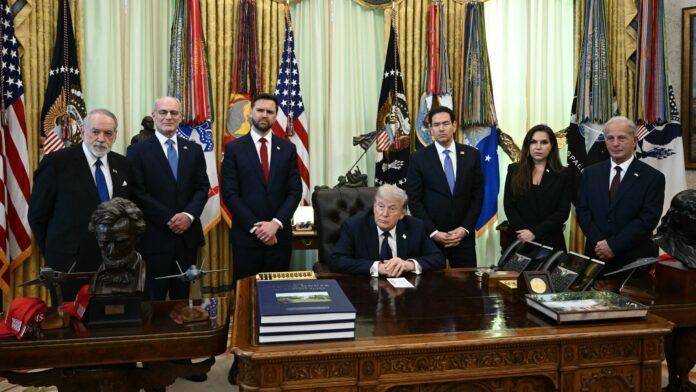
The president said he hosted “High Ranking Representatives of Israel and Lebanon in the Oval Office” alongside Vice President JD Vance, Secretary of State Marco Rubio, and US ambassadors Mike Huckabee and Michel Issa.
He added that Lebanese President Joseph Aoun and Israeli Prime Minister Benjamin Netanyahu are expected to visit the White House “in the coming weeks.”
“They do have Hezbollah to think about,” PresidentTrump said. “We are going to be working with Lebanon to get things straightened out in that country. I think it will be a wonderful thing to get this worked out simultaneously with what we are doing in Iran.”
The conflict between Israel and Lebanon resumed after Hezbollah struck Israel, describing the attack as retaliation for the assassination of Iran’s Supreme Leader Ali Khamenei on February 28.
Following the meeting, US Ambassador to Israel Mike Huckabee posted on social media that tensions between the countries are driven by Hezbollah. “The people of Lebanon and the people of Israel are neighbors, and they want to get along – and they can get along… The problem is not Lebanon; the problem is not Israel. The problem is Hezbollah.”
President Trump also said he is prepared to wait for “the best deal” in efforts to end the conflict with Iran.
Michael Jackson Called ‘Worse Than Jeffrey Epstein’
The controversy surrounding Michael Jackson just roared back to life—and this time, it’s louder than ever.
In a jaw-dropping new interview, Leaving Neverland director Dan Reed didn’t hold back, comparing the King of Pop to convicted sex offender Jeffrey Epstein and doubling down on his belief that the late superstar abused children.
Reed, whose explosive 2019 documentary shook the music world, is once again stirring outrage as a brand-new Jackson biopic hits theaters—without addressing the dark allegations that have followed the singer for decades.
“How can you tell an authentic story about Michael Jackson without ever mentioning the fact that he was seriously accused of being a child molester?” Reed told The Hollywood Reporter, blasting the film for what critics are calling a “sanitized” version of Jackson’s life.
The original documentary, Leaving Neverland, featured emotional interviews with Wade Robson and James Safechuck, who both alleged they were sexually abused by Jackson as children. The four-hour exposé became a cultural lightning rod—earning an Emmy while also igniting fierce backlash.
Jackson, who died in 2009, was never convicted of any crime and was acquitted in a high-profile 2005 trial. His estate has consistently denied all allegations, calling the documentary “one-sided propaganda” targeting a man who can no longer defend himself.
Still, Reed is standing firm.
“I think Jackson was genuinely a very nasty man and hurt a lot of children,” he said bluntly, adding that fame and talent don’t erase alleged abuse.
But the drama doesn’t stop there.
Reed also revealed the behind-the-scenes legal battle that led to Leaving Neverland vanishing from HBO in 2024—sparking confusion and speculation among viewers.
According to Reed, Jackson’s estate leaned on a decades-old contract tied to a 1992 concert special, arguing it included a sweeping non-disparagement clause that blocked HBO from airing anything critical of the singer.
“They argued it applied forever… to everything HBO would ever do,” Reed said, calling the claim “patently ridiculous.”
Despite that, HBO ultimately reached a settlement with the estate—and quietly pulled the documentary after six years on the platform.
Fans hoping to rewatch it may have to wait. Reed says he’ll regain the rights in 2029 and plans to resell the film so it can be widely available again.
Meanwhile, the legal fight is far from over.
Robson and Safechuck are currently pursuing a staggering $400 million lawsuit against Jackson’s estate, alleging the singer abused them and that his inner circle enabled it.
At the same time, Hollywood is moving full speed ahead with Michael, a big-budget biopic directed by Antoine Fuqua and starring Jackson’s real-life nephew Jaafar Jackson.
Despite brutal reviews—some calling it “bland” and “egregiously incomplete”—the film is still expected to rake in massive numbers at the box office, with projections hitting $150 million worldwide.
Behind the scenes, the movie reportedly underwent major last-minute changes. Early versions allegedly included scenes tied to the abuse investigations, but those storylines were cut—reportedly due to legal restrictions connected to past settlements.
Even more telling: several key figures from Jackson’s inner circle, including family members, declined to participate.
So as the box office surges and the headlines pile up, one thing is clear—decades after his death, Michael Jackson remains one of the most polarizing figures in entertainment history.
And with new claims, legal battles, and Hollywood retellings colliding all at once, this story isn’t fading anytime soon.