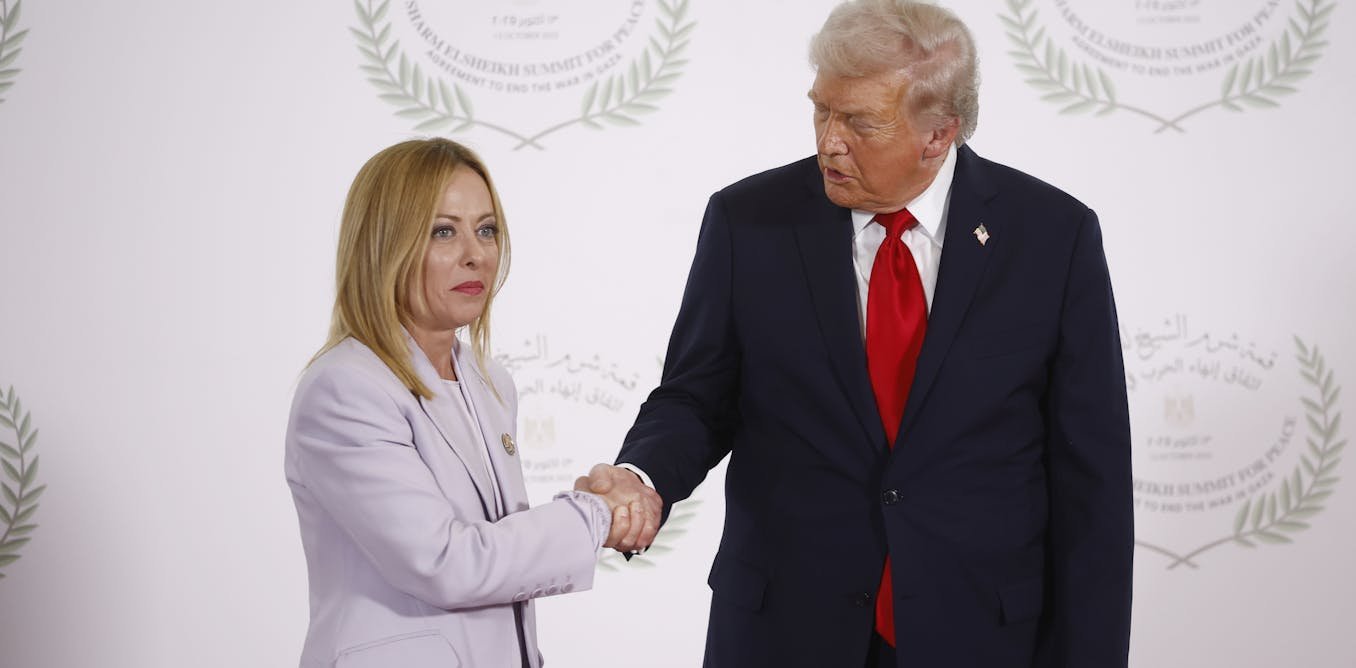
The Italian prime minister and leader of the far-right Brothers of Italy party, Giorgia Meloni, has made fostering ties with foreign leaders a central part of her political strategy. A few years before winning Italy’s 2022 general elections, she started cultivating ties with the US and European conservative world as part of a broader political rebranding effort aimed at projecting a more moderate image at home and gaining legitimacy abroad.
She subsequently became a familiar face within Donald Trump’s “Make America Great Again” (Maga) movement. Meloni shares similar views to Maga on migration, sovereignty and national identity. She also aligns with the movement on a constellation of other themes ranging from fighting against “wokeism” and defending the traditional family to the rejection of liberalism, globalism and environmentalism.
After Trump was elected as US president for the second time in late 2024, Meloni’s ties with the American far-right suddenly became a matter of foreign policy. But her relationship with Trump has turned out to be a more demanding balancing act than Meloni may have anticipated. And now their alliance – at least for the time being – appears to be over.
On April 13 Meloni described Trump’s recent social media attack on Pope Leo, who had criticised the US and Israel’s war on Iran, as “unacceptable”. This prompted a rebuke from Trump, who said Meloni “lacked courage” for not joining the war. The conditions for this breakdown have been in place for some time.
Trump and Meloni’s alliance
Trump and Meloni’s shared far-right traits should not hide some key differences between the two leaders. In foreign policy, Meloni has adopted a pro-Nato position and is a staunch supporter of Ukraine. These positions have aided Meloni in what has been called her quest for “respectability”, but they clash with Trump’s lack of support for Ukraine and belligerent position towards Nato.
Politically, Meloni has also faced constraints that have moderated her leadership. Externally, the EU’s institutional and financial straitjacket has required Meloni to work collaboratively with the bloc. This requirement has limited Meloni’s room for manoeuvre in her dealings with Trump and clashes with the US president’s rejection of multilateralism.
Internally, the logic of coalition politics – in particular the moderating presence of the pro-European Forza Italia party in her government – and the fact that centrist voters represent a decisive constituency in Italy have both acted as a further centripetal force on Meloni’s agenda.
Despite these divergences, Meloni’s ideological closeness to Trump did initially translate into diplomatic gains that helped boost her profile with fellow EU leaders. She was the first EU leader to meet with Trump after the imposition of his global trade tariff regime in 2025.
Meloni also managed to organise a trilateral meeting in Rome with the president of the European Commission, Ursula von der Leyen, and the US vice-president, J.D. Vance. Following the meting, Vance called Meloni a “bridge” between the two sides of the Atlantic.
Still, beyond the legitimacy gains for Meloni and her party, the material advantages Italy has extracted from her relationship with Trump have been limited. Italy was not spared trade tariffs, for instance. Nor did it manage to obtain a discount on Trump’s demand for Nato members to raise military spending to 5% of their GDP.
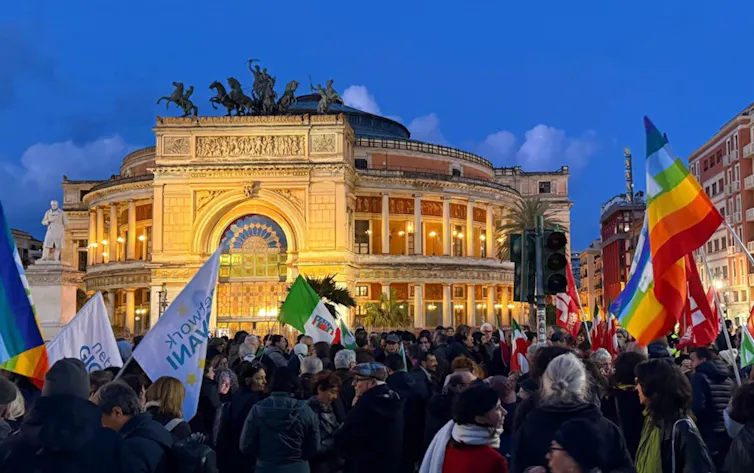
The scarcity of tangible policy gains from her ties with Trump may be one reason for Meloni’s decision to distance herself from the US president. But Italian domestic politics are another important factor.
The indirect effects of Trump’s policies are likely to have played a key role in the recent defeat Meloni suffered in a referendum on judicial reform. This referendum, which came one month into Trump’s war in Iran, morphed into a vote on the Meloni government.
The Iran war has caused energy prices across Europe to rise and has generated fears among Italians of possible security repercussions. With a recent survey indicating 79% of Italians now hold a negative opinion on Trump, it seems that voters used the referendum to signal their discontent to Meloni ahead of general elections in 2027.
Opposition parties, both on the left and right, hailed the result as a sign that voters are looking for change. And Roberto Vannacci, a former general turned politician, is capitalising on voters’ increased unease with the impact of Trump’s policies. He has criticised Meloni for what he sees as her Washington-first alignment and soft approach to key far-right issues.
Trump’s attack on the Pope – indefensible for Meloni as someone who has defined herself as a Christian and whose party draws on a vast Catholic electorate – gave the Italian prime minister the exit she needed to signal her distance from Trump’s recent actions to voters.
Meloni’s agenda remains far-right in its orientation, aligning with Trump’s in many ways from identity politics and migration to his stance on the green transition. How these ideological similarities are received by Italian voters over the coming year is likely to play a crucial role in determining Meloni’s political future.