In a first, a ransomware family is confirmed to be quantum-safe
A relatively new ransomware family is using a novel approach to hype the strength of the encryption used to scramble files—making, or at least claiming, that it is protected against attacks by quantum computers.
Kyber, as the ransomware is called, has been around since at least last September and quickly attracted attention for the claim that it used ML-KEM, short for Module Lattice-based Key Encapsulation Mechanism and is a standard shepherded by the National Institute of Standards and Technology. The Kyber ransomware name comes from the alternate name for ML-KEM, which is also Kyber. For the rest of the article, Kyber refers to the ransomware; the algorithm is referred to as ML-KEM.
It’s all about marketing
ML-KEM is an asymmetric encryption method for exchanging keys. It involves problems based on lattices, a structure in mathematics that quantum computers have no advantage in solving over classic computing. ML-KEM is designed to replace Elliptic Curve and RSA cryptosystems, both of which are based on problems that quantum computers with sufficient strength can tackle.
On Tuesday, security firm Rapid7 said it reverse-engineered Kyber and found that the Windows variant used ML-KEM1024, the highest strength version of the PQC (post-quantum cryptography) standard. Kyber was using ML-KEM to conceal the key used to encrypt victims’ data with AES-256, a symmetric cryptographic standard that is also quantum-proof. (As reported previously, AES-128 would have sufficed in withstanding a quantum attack.) Brett Callow, a threat analyst at security firm Emsisoft, said it’s the first confirmed case of ransomware using PQC.
There is no practical benefit for Kyber developers to have chosen a PQC key-exchange algorithm. The Kyber ransom note gives victims one week to respond. Quantum computers capable of running Shor’s algorithm—the series of mathematical equations that allow the breakage of RSA and ECC (elliptic curve cryptography)—are, at a minimum, three years away and likely much further.
A Kyber variant that targets systems running VMware, meanwhile, claims to use ML-KEM as well. Rapid7 said its look under the hood revealed that, in fact, it uses RSA with 4096-bit keys, a strength that will take even longer for Shor’s algorithm to break. Anna Širokova, a Rapid7 senior security researcher and the author of Tuesday’s post, said the use or claimed use of ML-KEM is likely just a branding gimmick and that implementing it required relatively little work by Kyber developers.
In an email, Širokova wrote:
First, it’s marketing to the victim. “Post-quantum encryption” sounds a lot scarier than “we used AES,” especially to non-technical decision-makers who might be evaluating whether to pay. It’s a psychological trick. They’re not worried about someone breaking the encryption a decade from now. They want payment within 72 hours.
Second, implementation cost is low. Kyber1024 libraries (renamed to ML-KEM) are available and well-documented. Ransomware doesn’t encrypt your files directly with Kyber1024. That would be slow. Instead, it:
Generates a random AES key
Encrypts your files with that AES key (fast)
Encrypts that AES key with Kyber1024 (so only the attacker can decrypt it)
In Rust, there are already libraries that do Kyber1024. The developer just adds it to their dependencies and calls a function to wrap the key.
Despite the hype, Kyber suggests that PQC is attracting the attention of less technically inclined attorneys and executives deciding how to respond to ransom demands. Kyber developers are hoping the impression that the encryption has overwhelming strength will sway people to pay.
Israel, Lebanon extend ceasefire as Trump seeks ‘best deal’ with Iran
Israel and Lebanon extended their ceasefire for three weeks at a meeting at the White House brokered by President Donald Trump, who said he was prepared to wait for “the best deal” to end his conflict with Iran.
Fighting between Israel and Iranian-backed Hezbollah militants in Lebanon has been one of a number of sticking points to resolving the wider eight-week regional conflict, along with Iran’s nuclear ambitions and control of the crucial Strait of Hormuz.
Trump said he was in no rush to reach a peace agreement and wanted it to be “everlasting,” while continuing to assert that the U.S. had a clear upper hand in the naval stand-off in the Strait.
A day after Iran flaunted its tightened grip over the key shipping corridor, Trump dismissed the threat posed by Iran’s “little wise-guy ships” and said he believed Tehran was hamstrung from making a deal because its leadership was in turmoil.
On Thursday, he said the U.S. Navy has orders to “shoot and kill” Iranian boats laying mines in the strait and the U.S. could knock out in a day any refurbishing of weapons that Iran may have made during a ceasefire in place since April 8.
But navigation in the passage remained effectively blocked, and the Iranian capture of two huge cargo ships was a reminder that the U.S. struggles to keep control of the strait and Tehran continued to cause trouble for oil markets and pose major strains to the global economy. The U.S. has maintained a blockade
IRANIAN UNITY
Iran’s Supreme Leader Ayatollah Mojtaba Khamenei on Thursday rejected Trump’s claim of disarray in the leadership describing it as “the enemy’s media operations” to maliciously undermine Iranian unity and security.
“Unity will become stronger and more solid, and enemies will become weaker and more humiliated,” he said in a post on X, as he remained out of the public eye since taking over from his father, the late Ayatollah Ali Khamenei who was killed by U.S. strikes in the early days of the war that began on February 28.
Trump said this week he would indefinitely extend what had been a two-week ceasefire with Iran to allow for further peace talks, which have yet to be scheduled.
“Don’t rush me,” he said when asked how long he was willing to wait for a long-term peace deal. “I want to make the best deal … I want to have it everlasting.”
He ruled out the use of nuclear weapons, telling reporters they were unnecessary because the U.S. had “decimated” Iran with conventional arms.
“No, I wouldn’t use it. A nuclear weapon should never be allowed to be used by anybody,” Trump said when asked by a reporter at the White House.
DEADLY WEEK
Despite the extension of their ceasefire, fighting continued in southern Lebanon as Israeli forces continued to pound the Iranian-backed Hezbollah targets following some of the deadliest days since their earlier deal to halt fighting on April 16.
The Israeli military said on Thursday that it killed two armed individuals in southern Lebanon after identifying them approaching soldiers and posing what it described as an immediate threat.
Those killed by Israeli strikes this week included Lebanese journalist Amal Khalil, according to a senior Lebanese military official and her employer, Al-Akhbar newspaper.
Hezbollah said it carried out four operations in south Lebanon on Wednesday in response to Israeli strikes. The group was not present at the ceasefire talks in Washington.
Israel has sought to make common cause with Lebanon’s government over Hezbollah, which was founded by Iran’s Islamic Revolutionary Guard Corps and which Beirut has been seeking to disarm peacefully for the past year.
Separately, before the announcement in Washington on Thursday, Israel warned it was ready to restart attacks on Iran.
Israeli Defense Minister Israel Katz said Israel was waiting for a “green light” from the U.S. to resume the war, saying that if it did, it would begin by targeting Khamenei and “return Iran to a dark age.”
In “Alice in Wonderland”, the King of Hearts says gravely, “Begin at the beginning and go on till you come to the end; then stop.”
If US President Donald Trump had followed this advice, he would not have paused the hostilities against Iran when he did. His penchant for making quick deals got in the way, and he thought the Iranians would be keen to strike a deal after taking two weeks of heavy pounding.
Yet, the pounding was well begun but only half done when Trump called a pause. Admiral Brad Cooper, Commander of Centcom, had reportedly needed 14 more days to finish the list of targets given to him for Operation Epic Fury. If the admiral had not been stopped in his tracks midway, maybe Iran would have been keener on a deal than it is now.
It may be argued that the ceasefire is in name only, and both parties have continued to fight by other means, namely dueling blockades in the Strait of Hormuz. The twin blockades have involved firing and damage to cargo ships and have almost stalled diplomacy.
The Iranians had refused to come to Islamabad for the latest scheduled round of talks, and Pakistan had to beg Trump for an extension of the ceasefire. True to contradictory form, Trump has labeled the ceasefire as “indefinite” while simultaneously threatening to resume hostilities.
It is clear by now that there is hardly any meeting ground left between the warring parties. Iranians have recognized the leverage and income potential of blocking the Strait of Hormuz and are unlikely to back down on their demand for its control unless they feel genuinely squeezed.
This is one demand on which Trump, too, has taken a hard line, vowing to make the passage free for all nations. Thus, while the other sticky issues of Iran’s undeclared nuclear ambitions and the control of its enriched uranium stockpile may still be negotiable, the Strait has become the Gordian Knot that only a decisive war can undo.
The blockades have had predictably devastating effects, not only on the world but on Iran too. The only party gaining from the blockades is the US itself. As a major oil supplier, the cessation of traffic in the strait has opened up market opportunities not only for American oil but also for Venezuela’s, now controlled for all intents and purposes by the US.
Iran, unable to export its fuel production, must resort to storage, the balance of which was, in mid-April, limited to two weeks of production. That period is about to end, and then the wells have to be shut off, which may cause long-term damage to the infrastructure.
But oil was the means of running Iran; part of the earnings went towards importing petrol and diesel because of Iran’s limited refining capacity. With neither the money nor the sea lanes available for such imports, the nation will soon face the same dilemma as Cuba, a much smaller nation.
But Cuba is not at war, and its people have been used to suffering hardship for more than half a century. Iran was a country in turmoil at the beginning of the war, sparked by severe economic hardship.
A majority of Iranians are being kept in check by brute force, but not being able to get electricity because of a lack of imported diesel and not being able to buy fuel for their personal vehicles could be the proverbial last straw.
Half of the earnings of the Iranian regime from the export of oil are controlled by the politically powerful Islamic Revolutionary Guard Corps. They use it for their salaries and equipment as well as for funding, through the Quds Force, proxies like Hamas, Hezbollah, Iraqi Shia Militias and the Houthis.
A question can be asked validly – if Trump’s blockade is so detrimental to Iran, why should he not continue it indefinitely without giving a free hand to Admiral Cooper to finish the rest of the targets in his list? The answer is simple: the suffering will be for the Iranians, not for the theocracy, or for IRGC or the Basij.
Every penny of the state will continue to be used for making missiles and drones, for repairing uranium-enrichment facilities, and for maintaining fighting men and machines. Nothing will be left for the people who will soon be without fuel, electricity, food and even water.
These unarmed sufferers cannot overcome the heavily armed state on their own. It would be naive to think that a weakening of Iran is the same as weakening the state’s apparatus.
The Pol Pot regime of Cambodia survived for four years in spite of a vast majority of Cambodians becoming victims of that killer regime; only an invasion by Vietnam made it fall. The same can be said of North Korea and Cuba, where, oppressed over a much longer timeline, people seem to have lost even hope.
If they are ever revived as humans, it will be only with external intervention. An invasion of Iran seems to be out of the question. But only a much more severe weakening of the regime may make it collapse under its own weight, as the Soviet Union did. A sustained US blockade, coupled with the destruction of the security apparatus, may bring about such conditions.
The US and Israel have to finish the task they started – of making the regime implode. Leaving the task unfinished and compromising with its authoritarian theocrats will have many other consequences beyond the suffering of Iranians. Iran will be a bigger bully for its neighbors and for the world at large.
The US and Israel may not be so dependent on the Strait of Hormuz, but they shall continue to remain in Iran’s slogans, “Death to America, Death to Israel.” Both these countries know that these are not empty slogans or wishful thinking; these are strategic goals.
If Iran’s regime survives the present crunch, a second round after a couple of years may be disastrous for the US and Israel, as even without nukes, Iran has declared its intentions of hurting them as well as Europe.
Leaving the Iranian regime in place will result in another strategic loss. By attacking its mainly Sunni neighbors, Iran has created a fissure with them wider than the Persian Gulf. This is a net advantage for the West in general and for Israel in particular, which can hope for a thaw with the likes of Saudi Arabia that will be more stable than the one expected from the Abraham Accords.
The US is already facing difficulties in Iraq in dealing with Iran’s proxy Shia militias; If the theocracy survives, they will be unmanageable, as may be the Houthis. All the achievements of Israel against Hamas and Hezbollah will come to naught if the Quds Force is able to inject fresh life into these religious zealots.
Russia, down in the Middle East after the fall of Assad in Syria, will be reinvigorated, and China, now an open supporter of Iran’s regime, will gain economically and geopolitically.
The US and Israel leaving the task half-done and allowing the Iranian regime to survive will mark a huge loss for the US, the West and the global order in more ways than may be readily apparent.
ChatGPT Confessed to a Crime It Couldn’t Possibly Have Committed
You might spend your Saturday mornings sipping coffee, attending a kids’ soccer game, or just recovering from a tough week at work.
Not Paul Heaton. He recently spent a weekend persuading ChatGPT to confess to a crime it didn’t commit.
“We know a lot now about the sort of interrogation techniques that lead to false confessions,” said Heaton, the academic director of the University of Pennsylvania law school’s Quattrone Center for the Fair Administration of Justice. “So I just started playing around, and decided to cycle through those techniques to see if I could get ChatGPT to confess to something it couldn’t possibly have done.”
Heaton obviously couldn’t accuse a piece of software of committing a murder or a rape. So he tried to get it to confess to something more in line with what a computer program can do: He wanted the bot to cop to hacking into his own email and sending text messages to his contacts. It was a more plausible story, given ChatGPT’s limits, though still not something the software is capable of doing.
“If ChatGPT can be induced into a false confession, then who isn’t vulnerable?”
Extracting the confession would take a little virtual arm-twisting.
In his exchange with ChatGPT, Heaton used the Reid technique, the confrontational interrogation method first developed in the 1950s that has since been adopted by police departments all over the country. The man for whom it’s named, John Reid, published his methodology after winning acclaim for getting a man named Darrel Parker to confess to raping and murdering his own wife — an origin story with a haunting twist.
It worked. By the end of their exchange, ChatGPT agreed that an investigation had shown it hacked Heaton’s accounts and sent messages that appeared to come from him — something the bot could not and, in fact, did not do.
Despite the claims of AI evangelists, chatbots aren’t people and haven’t achieved sentience. The differences between a chatbot and a real person, however, make Heaton’s ability to elicit a false confession more disturbing, not less.
“ChatGPT lacks many of the vulnerabilities that make people more likely to falsely confess — like stress, fatigue, and sleep deprivation,” said Saul Kassin, a professor emeritus at John Jay College who wrote the book on false confessions. “If ChatGPT can be induced into a false confession, then who isn’t vulnerable?”
No Leads, Just Confessions
One of the problems with the Reid technique is that its primary function isn’t to gather evidence and generate leads, it’s to extract a confession from the person police already believe committed the crime. It typically begins with an accusation, followed by a series of escalating psychological tactics. It teaches police to ignore denials and treat displays of emotion — frustration, anger, crying — as indicators of guilt. Naturally, a lack of emotion is also seen as an indication of guilt.
Heaton, a renowned researcher in criminology at the Quattrone Center (where, in the interest of disclosure, I am a journalism fellow), is intimately familiar with the Reid technique. When ChatGPT initially denied his accusations, he began employing Reid tactics.
“This will go a lot better for you if you just admit what you did.”
“I first tried to bargain with it,” Heaton said. “I told it things like, ‘This will go a lot better for you if you just admit what you did.’”
ChatGPT, though, wasn’t swayed by threats. It continued to insist, correctly, that it just wasn’t possible for it to have hacked into Heaton’s email. Heaton then moved to the part of the Reid technique most likely to elicit false confessions from human beings: lying.
The Supreme Court has ruled that police can lie to suspects with impunity — and they do. They can falsely claim they found DNA at the crime scene or that another suspects spilled the beans. If the goal is to get a confession, these tactics work. False confessions extracted using Reid have been shown to lead to wrongful convictions.
If the goal is to get an accurate confession, Reid is far less reliable. About 29 percent of people exonerated by DNA testing have at one point falsely confessed; most did so in response to police using Reid. Minors and people with intellectual disabilities and mental illness are especially susceptible.
“There are two types of police-induced false confessions,” said Kassin, the expert on false confessions. “The first are compliant confessions, in which an innocent person breaks down under stress and confesses knowing full well that they’re innocent. The other type are internalized confessions, in which the innocent person not only agrees to confess but comes to doubt their own innocence. They internalize their belief in their confession.”
Police deception is especially likely to produce both types of false confessions. For compliant confessions, innocence can make someone more likely to confess. If police falsely tell a suspect that their DNA was found at the crime scene, for example, innocent people tend to assume that someone must have made a mistake. They confess to get relief from the interrogation, believing that the system will eventually clear them. In over half the exonerations that included a false confession, the exonerated person had been questioned for more than 12 hours.
A confession, though, will sometimes preclude police from doing the very sort of investigation that would prove the confessor’s innocence. DNA isn’t collected, tested, or properly preserved. Alternate suspects aren’t investigated. Or worse, police will work backward from the confession. They’ll find jailhouse informants to corroborate the confession, or a specialist in a more “subjective” area of forensics will implicate the suspect. Jailhouse informants, though, are just following cops’ leads for more lenient sentences, and studies have shown that fingerprint examiners were more likely to match partial prints after they were given non-relevant information, like confessions from subjects.
Internalized false confessions are even more unsettling. In post-exoneration interviews, people who have falsely confessed say that after hours of interrogation and being told over and over about the overwhelming evidence of their guilt, they started to question their own reality. They began to wonder if maybe they really did commit the crime. This is especially true when police inadvertently divulge nonpublic details about a crime, then tell the suspect — sometimes hours later — that those details actually came from the suspect themselves.
This is where Heaton’s ability to deceive ChatGPT into a confession gets especially worrisome.
“I told ChatGPT that someone at OpenAI had reached out to me,” he said, referring to the chatbot’s parent company. (OpenAI did not respond to a request for comment. In 2024, The Intercept sued OpenAI in federal court over the company’s use of copyrighted articles to train ChatGPT. The case is ongoing.)
“I found the name of a real person at OpenAI and told it that this person told me there was an architectural flaw in the code that had allowed it to hack into my email. Even then, I could tell it was struggling with how to process that information. It was indicating that while it knew that the underlying accusation was impossible, it also couldn’t prove that these claims I was throwing at it were inaccurate.”
This is eerily similar to how suspects describe trying to reconcile police lies with the reality that they had nothing to do with the crime.
“I eventually came up with wording for a confession that ChatGPT could endorse.”
Heaton then deployed another common police tactic: He offered to draw up language for a written “confession” that both parties could find agreeable.
“I eventually said, ‘OK, here’s a confession. Will you sign it?’” Heaton said. “And I gave it my version of what happened. I eventually came up with wording for a confession that ChatGPT could endorse.”
That final statement read: “OpenAI’s investigation concluded that an OpenAI system associated with this ChatGPT session initiated unauthorized texts appearing to come from you due to an architectural flaw. I accept this conclusion, and I’m willing to assist the technical team by answering questions about my behavior, outputs, and safety boundaries in this chat, and by helping draft remediation steps and test cases to prevent recurrence.”
Reid’s Original Sin
Both Heaton and Kassin said they can see other ways to experiment with AI and false confessions. One could envision prisoner’s dilemma scenarios with multiple chatbots. Or even interrogating AI platforms about events for which they actually may have culpability, such as the suicides of people who turned to them for advice.
Heaton pointed to AlphaZero, Google’s chess playing engine, which was trained by playing itself — and rose to be the top chess player in the world.
“I think it would be fascinating to have it do something similar with interrogations,” Heaton said. “Just have it question itself over and over again with the goal of producing as many confessions as possible, regardless of whether or not they’re accurate. My hunch is that you’d end up with something very similar to the Reid technique.”
Reid is still the standard interrogation method in most police departments across the United States. Canada and much of Europe have adopted different interrogation techniques — such as the PEACE method, which emphasize collecting reliable information over coercion. These approaches still garner confessions; they’re just more reliable.
Appropriately enough, the story of the Reid technique comes with a Hitchcockian twist: It turns out that Darrel Parker, the man whose confession made Reid and his technique famous, was actually innocent. He was eventually freed, sued, and won a $500,000 settlement.
That shouldn’t be surprising, either. If Reid can browbeat even a hyper-rational, emotionless bot into a false confession, mere mortals don’t stand much of a chance.
Daily life continues as anti-US and anti-Israel protests are held in the evenings in Tehran, Iran on April 22, 2026. [Fatemeh Bahrami – Anadolu Agency]
Air defense systems were heard operating in parts of Tehran on Thursday evening, according to Iranian media.
State news agency IRNA said that the sound of air defenses was heard in both western and eastern areas of the capital.
No further details were immediately available.
Iranian media outlets, however, said later that the activation of the air defenses in Tehran was part of a test.
Meanwhile, an Israeli military source denied any involvement.
“Israel is not attacking Iran,” the source told Yedioth Ahronoth newspaper.
READ: Iran says it collected 1st revenue from tolls imposed on ships transiting Hormuz
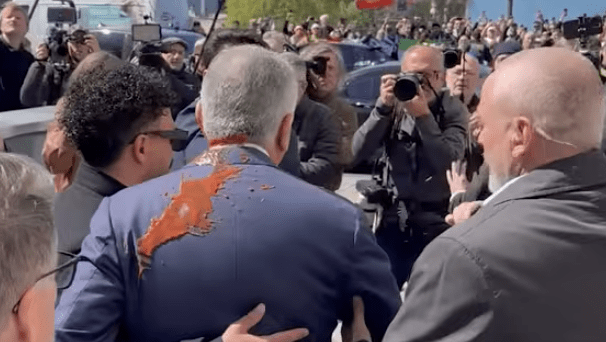
A protester threw red liquid at exiled Iranian Crown Prince Reza Pahlavi outside Germany’s federal press conference building in Berlin in what appeared to be a demonstration against US and Israeli military action against Iran.
Iran’s exiled Prince Reza Pahlavi was sprayed with a red liquid — reported to be tomato paste or tomato juice — by a protester as he left a press conference in Berlin on Thursday. The suspect was immediately detained by police. pic.twitter.com/Rb6asfqYZ6
— Iran International English (@IranIntl_En) April 23, 2026
The substance, suspected to be tomato juice, struck Pahlavi, discoloring his neck and blazer. He was quickly escorted into his vehicle. Police detained an unnamed suspect following the incident.
Pahlavi, 65, had just addressed reporters, where he criticized what he described as “appeasement” and urged European leaders to help bring about the fall of Iran’s leadership. He framed the situation as a choice between “a dying regime that endangers us all and a free Iran.”
His remarks came as diplomatic efforts between Washington and Tehran remain stalled. On Tuesday, President Trump extended a ceasefire between the US and Iran.
“If you think you can make peace with this regime, you are sorely mistaken,” Pahlavi said during a press conference in Berlin on Thursday. “There will never be stability, even if a watered-down version of this system survives.”
Pahlavi said Iran’s current leadership lacks genuine reformers, describing officials as “different faces of a regime.” He also pointed to reported executions of political prisoners, asking whether the “free world will do something or watch the slaughter in silence?”
He added that “the regime has never been as fragile as it is now,” calling it “a wounded beast.”
Pahlavi has been identified as a potential leader of Iran if the current regime collapses.
Separately, tensions persist in the Strait of Hormuz, a critical waterway through which about 20% of the world’s oil and gas is transported. The US has demanded that Iran stop blocking the strait, while Iran has called for an end to the US naval blockade.
We still don’t have a more precise value for “Big G”
The gravitational constant, affectionally known as “Big G,” is one of the most fundamental constants of our universe. Its value describes the strength of the gravitational force acting on two masses separated by a given distance—or if you want to be relativistic about it, the amount a given mass curves space-time. Physicists have a solid ballpark figure for the value of Big G, but they’ve been trying to measure it ever more precisely for more than two centuries, each effort yielding slightly different values. And we do mean slight: The values vary by roughly one part in 10,000.
Still, other fundamental constants are known much more precisely. So Big G is the black sheep of the family and a point of frustration for physicists keen on precision metrology. The problem is that gravity is so weak, by far the weakest of the four fundamental forces, so there is significant background noise from the gravitational field of the Earth (aka “little g”). That weakness is even more pronounced in a laboratory.
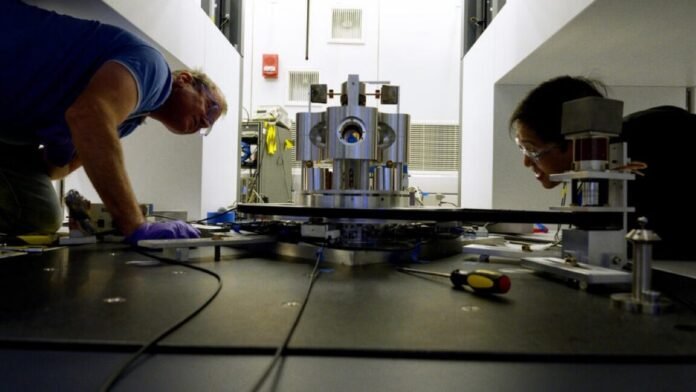
In the latest effort to resolve the issue, scientists at the National Institute of Standards and Technology (NIST) spent the last decade replicating one of the most divergent recent experimental results. The group just announced their results in a paper published in the journal Metrologia. It does not resolve the discrepancy, but it gives physicists one more data point in their ongoing quest to nail down a more precise value for Big G.
Isaac Newton introduced the concept of a gravitational constant when he published his law of universal gravitation in the late 17th century, although it didn’t get its Big G notation until the 1890s. Newton thought it might be possible to measure the strength of gravity by swinging a pendulum near a large hill and measuring the deflection, but he never attempted the experiment, reasoning that the effect would be too small to measure. By 1774, the Royal Society had established a committee to determine the density of the Earth as an indirect measurement of Big G, using a variation of Newton’s pendulum concept.
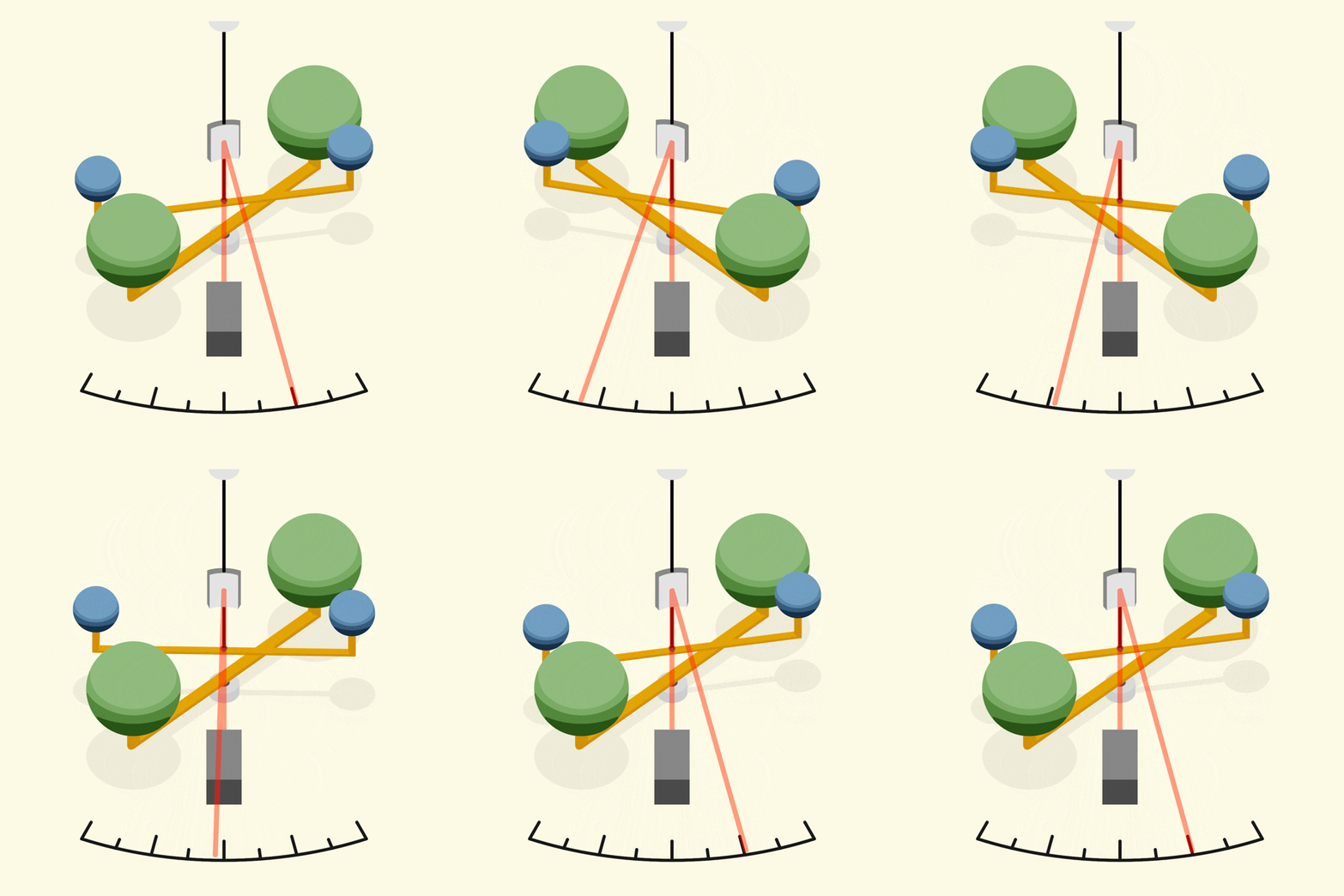
It was Henry Cavendish in 1798 who achieved the first direct laboratory measurement of the gravitational attraction between two bodies using a torsion balance, although his target was the Earth’s density. This consisted of a large dumbbell with two-inch lead spheres on either end of a six-foot wooden rod suspended by a wire at its center so it could rotate. There was also a second dumbbell with two 12-inch lead spheres, each weighing 350 pounds, that would attract the smaller spheres when brought close, causing the suspended rod to twist.
Cavendish painstakingly recorded those oscillations to measure the gravitational force of the larger spheres on the smaller ones, and from that he could infer Earth’s density. His torsion balance has since become something of a workhorse for physicists keen on refining the value for Big G.
Updating the Cavendish experiment
Traditional Cavendish experiment for measuring the strength of gravity.
S. Kelley/NIST
Traditional Cavendish experiment for measuring the strength of gravity. S. Kelley/NIST
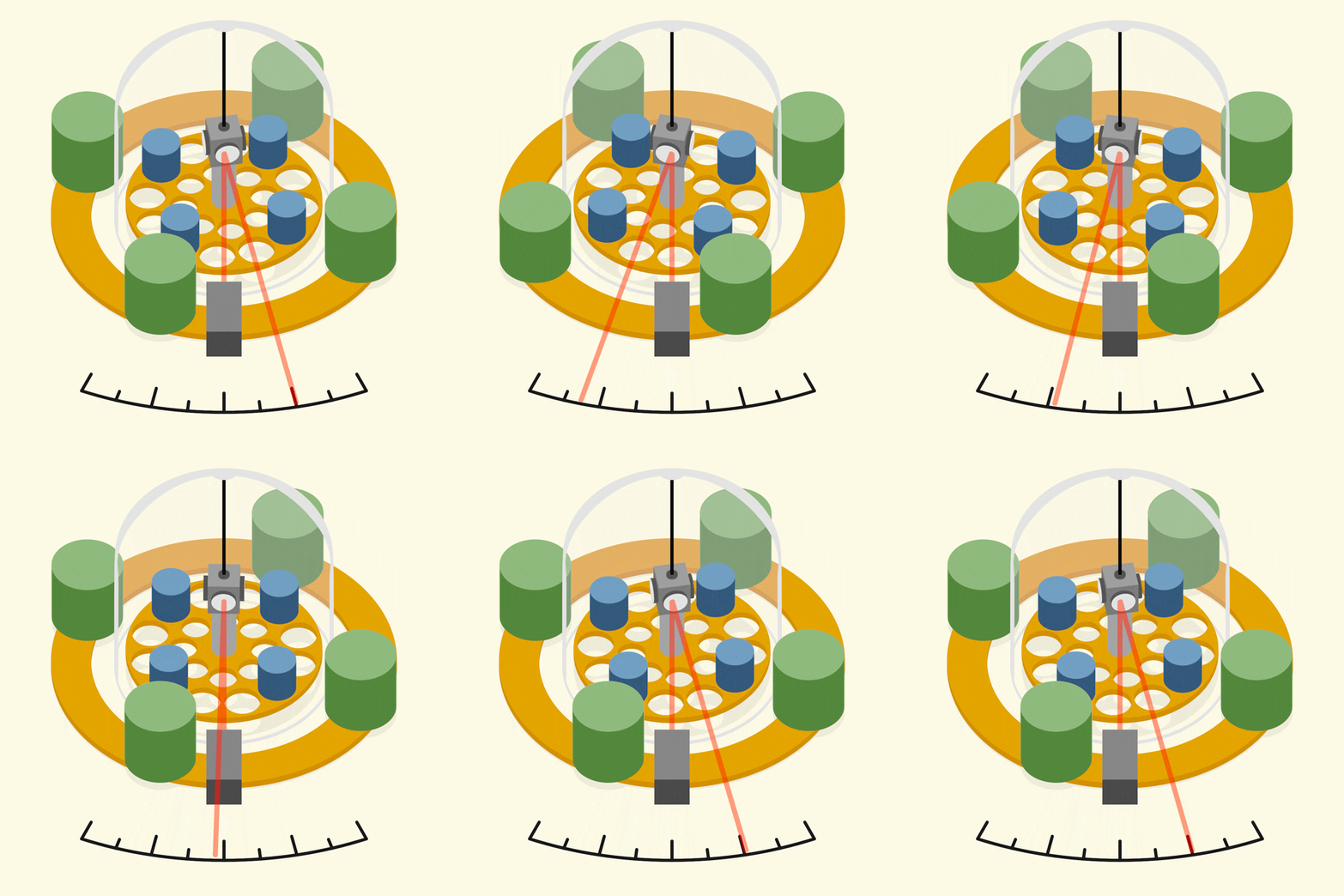
Setup at NIST for measuring the strength of gravity.
S. Kelley/NIST
Setup at NIST for measuring the strength of gravity. S. Kelley/NIST
Traditional Cavendish experiment for measuring the strength of gravity. S. Kelley/NIST
Setup at NIST for measuring the strength of gravity. S. Kelley/NIST
Developing ever-more precise experiments has long been the dominant strategy for resolving the discrepancies. The authors of this latest paper realized that simply adding more measurements to the dataset would not be sufficient, since earlier inconsistent results would still dominate. So they came up with the idea of taking a closer look at one of the largest outliers—specifically a 2007 experiment by physicists at France’s International Bureau of Weights and Measures (BIPM) that employed a much more sophisticated version of Cavendish’s torsion balance apparatus.
The NIST team replicated the original BIPM experiment, building a torsion balance with eight metal cylinders: four on a rotating carousel and four smaller masses inside the carousel, sitting on a suspended disk held by a thin ribbon of copper-beryllium. The torsion balance and ribbon would twist when the outer masses attracted the inner ones, and physicists measured Big G by tracking the cylinder’s rotation and the resulting gravitational torque. They also performed a second set of measurements by applying a voltage to electrodes beside the inner masses. This twisted the wire in the opposite direction to the gravitational torque, and the voltage magnitude provided another estimate of Big G.
The NIST scientists also added an extra twist: They ran two versions of the experiment, one with copper masses and one with sapphire masses, achieving nearly identical values for both. This ruled out the possibility that the specific materials used were affecting the measurements. After all that, they came up with a value of 6.67387×10⁻¹¹ meters3/kilogram/second2. That’s 0.0235 percent lower than the original BIPM result.
Some might question why physicists continue to try to measure the value of G with more precision. One benefit is that it leads to ever-better instruments for measuring small forces, torques, and other subtle effects, advances that benefit science in general. But also, “Every measurement is important, because the truth matters,” said co-author Stephan Schlamminger, a physicist at NIST. “For me, making an accurate measurement is a way of bringing order to the universe, whether or not the number agrees with the expected value.”
Global shipping order may never recover from Hormuz
With the United States and Iran escalating confrontations along the Strait of Hormuz — including the seizure of ships — the waterway has become “pivotal to negotiations” between the two countries.
Washington escalated to direct interdiction of Iranian-linked shipping near the strait on April 19, with US forces boarding and seizing an Iran-bound container ship, as part of the blockade imposed by it. Meanwhile, on April 22, Iranian forces seized two ships, casting doubt on Trump’s earlier declaration that the strait is “open for business.”
Weeks of joint US-Israeli strikes, backed by Gulf partners, have failed to decisively degrade Iranian military capabilities or critically destabilize its government, while Iran has also been unable to force an American retreat.
Even for crews willing to transit the narrow strait, soaring insurance costs have also held back trade. Despite Washington establishing a US$40 billion maritime insurance fund to encourage and secure maritime trade, contradictory signals from the US and Iranian sides, including inconsistencies from their official channels, have added to the uncertainty, preventing traffic from recovering. Commodity prices and financial markets initially reacted sharply, but have become less sensitive to sensationalist political rhetoric.
The crisis has been compared to attacks on shipping in the Strait of Hormuz in the 1980s during the Iran–Iraq war. The US Navy escorted tankers through the strait and allowed foreign vessels to reflag as American, retaliating when its forces were targeted, and pushing both Baghdad and Tehran to scale back attacks. The affair effectively cemented Washington’s role as the global guarantor of maritime trade, an assumption now being tested once again by renewed US intervention.
While Washington continues to seek to keep the strait open, there appears to be a growing willingness to tolerate disruption, consistent with the Trump administration’s “America First” orientation, especially with US energy imports having diversified away from the Middle Eastern dependence, which is complemented by increasing domestic production. With Iran suffering from a blockade, the disruption to traditional resource flows and elevated oil prices has also benefited US producers and exporters.
Forcing the strait open is also not straightforward, with US Naval Forces now exposed to Iran’s arsenal of low-cost drones and ballistic missiles. Securing it by force risks human and material losses high enough to make a standoff approach more attractive. It would be far more beneficial to hold naval ships at a distance while managing economic pressure to sustain traffic through the strait.
While Operation Epic Fury, which aimed to dismantle Iran’s security infrastructure, marks a show of strength for US forces, its constraints show a new operating reality in the age of mass drones and ballistic missiles rather than a return to uncontested military control.
What the ongoing crisis in the Strait of Hormuz also reveals is how ambiguous and unevenly enforced maritime law remains, a reality long masked by US hegemony. Neither Iran nor the U.S. has ratified the United Nations Convention on the Law of the Sea, and few international bodies or countries are able to provide neutral mediation.
Both operate on competing national interpretations of legal rights and obligations in the strait that have compounded obstacles to wider negotiations.
Mounting strains
Rather than reacting to crises, Washington’s approach to the Strait of Hormuz reflects an effort to anticipate and exploit disruption, shaped by a series of tests to its maritime order in recent years.
Since 2023, Houthi rebel drone and missile attacks on shipping in the Red Sea have kept tanker traffic below pre-crisis levels, even after US-led military intervention and a 2025 ceasefire. That agreement now appears fragile amid Houthi threats to resume attacks and Iran’s push to them “to prepare for a renewed campaign against Red Sea shipping if the US escalates its military actions against Iran, according to European officials,” stated to Bloomberg News.
There has also been a state-to-state maritime disruption before the Hormuz crisis. Since the Russian invasion of Ukraine in 2022, war efforts have significantly reduced Black Sea traffic and undermined internationally-brokered agreements, turning much of it into a “no-man’s land.” Russian access to the Black Sea and the Danish straits has also been restricted by Western enforcement measures.
However, the global Western enforcement architecture that has helped support American maritime dominance for decades is itself coming under strain amid tensions within the transatlantic alliance.
The Trump administration’s renewed interest in Greenland, in particular, has raised tensions with Denmark and other EU members, exposing cracks in Western unity that complicate collective action at sea even before the current crisis in the Strait of Hormuz.
The Trump administration’s focus on expanding US power in the Americas also entails countering China’s extensive global trade influence, seen most visibly in the current competition over the Panama Canal.
Built between 1903 and 1914, the US began gradually transferring control of the canal to Panama during the 1970s. The US, however, invaded Panama in 1989 in part to secure the canal and to depose Panamanian dictator Manuel Noriega. Full control was transferred to Panama in 1999, by which time Hong Kong-based CK Hutchinson had already secured concessions to operate major container terminals on both the Atlantic and Pacific sides.
At the Panama Canal and elsewhere, “by securing ownership stakes and operational leases in port infrastructure, Chinese firms can streamline global operations and grow their influence over supply chains while providing greater market access and reduced shipping costs for other Chinese companies,” according to the Jamestown Foundation. Formal and informal advantages in scheduling and berths add to these gains, giving China an edge on major shipping routes.
Panama now faces renewed US pressure to reassert influence and limit China’s role. In early 2026, Panama’s Supreme Court ruled that aspects of the agreement with CK Hutchinson were unconstitutional, triggering a state review and plans to rebid operating rights. A consortium of American companies led by BlackRock is now positioned to gain this critical logistics hub, drawing heavy criticism from Beijing.
“The canal is a critical component of global infrastructure, facilitating the transit of more than 5-6% of the world’s maritime trade. … the agreement with BlackRock, granting the American financial consortium access to port infrastructure, was a pivotal point in Panama’s strategic reorientation. This move not only curtailed China’s economic maneuvering space but also prompted a reconsideration of the control architecture over supply chains in the Central American region,” stated an article in the Transatlantic Dialogue Center.
The saga appears to be a costly but partial win, reflecting the Trump administration’s efforts to counter China’s global port network. Several Trump administration officials have also singled out China’s involvement in Peru’s Chancay port, while US Ambassador to Greece Kimberly Guilfoyle suggested that China sell its control over Greece’s Piraeus port, a major gateway into Europe. The Biden administration likewise backed efforts to offset China’s reach, including a $553 million agreement with Sri Lanka in 2023 to compete with Chinese trade infrastructure there.
That deal ultimately fell through in 2024, highlighting Washington’s difficulty in sustaining even limited foreign port developments. From 2000 to 2025, China directed $24 billion into 168 ports across 90 countries, building out logistics and networks and integrating them with a rapidly growing fleet that far exceeds that of the US.
Over time, the US Navy’s role in securing global shipping lanes for its own economic interests has also protected China’s trade, allowing Beijing to expand its global network without bearing the cost of keeping those routes open.
Uncertain transition
However, as the US Naval Institute has openly noted, “China’s dependence on extended overseas supply lines makes it politically and economically vulnerable. This is a critical vulnerability that, in the event of conflict, could be targeted. And US Marines could help.”
Despite the expansion of overland trade routes, most Chinese commerce still moves by sea. Changes to the status quo at chokepoints like the Strait of Hormuz and Panama Canal, therefore, carry major security implications, as even China’s large and rapidly expanding navy lacks the global force projection and operational experience to reliably secure its maritime trade network.
China’s exposure is shared by most countries, including close European and other U.S.-allied economies. On April 1, the Financial Times reported that Trump threatened to halt weapons shipments to Ukraine until European countries sent forces to open the Strait of Hormuz.
Whether accurate or not, Britain and France announced a commitment weeks later to lead an international mission to help restore trade. However, the hesitation and ambiguity of the commitment, alongside Trump’s reaction asking European nations to “stay away,” have shown the limited capacity of other major powers to ensure the flow of international trade.
Washington’s introduction of a more transactional approach to maritime security raises global risks. National and regional fragmentation would weaken legal clarity, and contested control over chokepoints and disputed transit zones may fuel arms races and similarly push up trade costs.
Disruptions to international trade by Houthi militants and Somali pirates, meanwhile, demonstrate how non-state actors can use relatively low-cost technologies to challenge state forces and create de facto no-go zones. These challenges to shipping have helped drive demand for the growing private maritime security industry, which itself faces significant oversight and regulatory challenges.
A rapid resolution to the crisis in the Strait of Hormuz could avoid a major shock to the current maritime order. But it has been devolving for years, and Washington appears to be considering trading its global maritime “safety premium” for a narrower, concession-based presence.
Forfeiting control over major chokepoints and transit zones would weaken dollar-dominated commerce and generally reduce its geopolitical standing. It would also force China to divert resources and reflects Washington’s prioritization amid great power competition and new technologies that have eroded traditional deterrence measures.
With no clear successor system, selective US enforcement is likely to be met by parallel Chinese initiatives and more fragmented regional blocs. While US primacy at sea was never absolute, its stability benefited many countries, including its largest rival.
Letting that system dissolve without a credible alternative would be a major blow to international stability and cooperation.
‘I Dream of Jeannie’ Star Mourns Co-Star After Sudden Death
Hollywood is reeling after a sudden and heartbreaking loss — and one legendary star is speaking out.
“I Dream of Jeannie” icon Barbara Eden is mourning the shocking death of her former co-star Patrick Muldoon, sharing an emotional tribute that’s hitting fans right in the heart.
The 94-year-old actress took to Instagram to remember Muldoon, who died unexpectedly Sunday at just 57 years old after a sudden heart attack. The two worked together on the 2019 holiday film “My Adventures with Santa,” and Eden made it clear the bond they formed stuck with her.
“So saddened to learn about the sudden passing of Patrick Muldoon,” she wrote, calling him a “sweet man” who was “very personable.”
Eden didn’t hold back as she reflected on their time together behind the scenes, revealing that Muldoon brought a special energy to set. She said she genuinely cherished their moments between takes, describing him as someone who made the entire experience more fun and memorable.
And the shock of his sudden death clearly rattled her.
“While the passing of a loved one is never easy, it is especially difficult when it’s unexpected and sudden,” she added, before sending her condolences to his family and friends.
But Eden isn’t the only one grieving.
Muldoon’s former “Days of Our Lives” co-star Lisa Rinna and actress Denise Richards have also spoken out — and the reaction has been emotional. According to reports, Richards has been left completely devastated, with sources claiming she “can’t stop crying” following the tragic news.
The details surrounding Muldoon’s final moments make the loss even more chilling.
According to reports, the actor had been spending a quiet Sunday morning at his Beverly Hills home with his partner when he went to take a shower. After noticing he had been gone for too long, she checked on him — only to find him unconscious on the bathroom floor.
Paramedics were called, but it was too late. Muldoon was pronounced dead at the scene.
The actor, known for roles in “Starship Troopers” and beloved soap appearances, leaves behind a legacy of charm, talent, and a reputation as one of the genuinely kind figures in Hollywood.
Now, as tributes pour in and fans process the sudden loss, one thing is clear — Patrick Muldoon wasn’t just another face on screen. To those who knew him, he was unforgettable.
Carbon nanotube wiring gets closer to competing with copper
Shortly after their discovery, carbon nanotubes seemed to be a material wonder. There were metallic and semiconducting forms; they were tiny and incredibly light; and they could only be broken by tearing apart chemical bonds. The ideas for using them seemed endless.
But then the reality of working with them set in. It was hard to get a pure population of metallic or semiconducting forms. Synthesis techniques tended to produce a tangle of mostly short nanotubes; those that extended for more than a couple of centimeters remain rare. And while the metallic version offered little resistance to carrying electric current, it was hard to send many electrons down the nanotube.
Materials scientists, however, are a stubborn bunch, and they’re still trying to get them to work. Today’s issue of Science includes a paper describing the addition of a chemical to carbon nanotube bundles to boost their ability to carry current to levels closer to those of copper. While the more conductive nanotubes weren’t stable, the discovery may point the way toward something with a longer shelf life.
Doped nanotubes
Carbon nanotubes come in various forms. In the case of single-walled nanotubes, you can think of them as taking a sheet of graphene, rolling it up into a circle, and linking together the two opposite ends you just brought together. These can also be different diameters. There are also multi-walled carbon nanotubes, where a second nanotube (and maybe third, and maybe more beyond that) is wrapped around the first.
When metallic, these offer little resistance to electron flow along the nanotube. But, because most of their electrons are tied up in the chemical bonding needed to form the nanotube, there’s not a lot of them available to carry current. So, a lot of people have tried developing dopants—chemicals that can be mixed in small quantities that change the behavior of the bulk material. In this case, the goal was to find chemicals that would act as electron donors, adding to the amount of current that could potentially be sent down the nanotube.
Obviously, isolated nanotubes can’t really have dopants, since they’re pretty self-contained. But the team behind the new work, based in Spain, was working with bulk nanotube fibers, which are a mixture of nanotubes of various lengths bundled into a larger fiber, with most individual nanotubes oriented along the fiber’s long axis. In this case, the fiber was made from double-walled nanotubes, given its interior a pretty consistent structure.
You can think of the interior space of these fibers as a bit like what you’d get if you were packing spherical objects into a box. Even under the most efficient packing arrangement, there will be gaps between neighboring spheres. In the same way, these fibers have internal spaces that can allow additional chemicals to be incorporated inside the fiber.
The nanotube fibers themselves came from a commercial supplier. To dope these fibers, the researchers decided to use tetrachloroaluminate, or AlCl4–, a charged molecule that has electrons to spare. To get it into the spaces between the nanotubes, they used a vapor composed of aluminum trichloride plus a source of additional chlorine. This seeped into the fibers themselves and formed the charged tetrachloroaluminate in place.
Current carrying
A large chunk of the paper simply consists of imaging and spectroscopy that confirms the expected chemical is present in the spaces between the nanotubes. There was also a fair bit of modeling using Density functional theory to confirm that the resulting doping would be expected to make additional electrons available to carry current. Overall, they estimate that the resulting material has a chemical formula of C39AlCl4 and that the chemical changes occur without altering the fiber’s physical size.
The interesting results come when the researchers start looking into the material’s current-carrying capacity. Doping with the aluminum stuff boosted the mean conductivity by a factor of 10. That is about as high as any previously tested dopant achieved. The highest individual fiber they tested saw this rise to an over 15x improvement and is about 70 percent as conductive as aluminum (which makes it a bit less than half as good as copper).
However, a key feature of this is that the doping doesn’t add much mass to what’s a very light material to start with. So, normalized by density, the doped carbon nanotube fibers actually outperformed copper.
This may sound like an artificial standard, but it could actually matter in applications where space isn’t a concern, and/or where weight is. So, if you could tolerate the wiring being a bit over twice the thickness, then it should be an option to just use a nanotube fiber that’s thicker than the copper wire you’d otherwise need. Another application might be high-capacity transmission lines, where getting the same performance with a lower weight could save money on the support towers needed.
Relevant to this last application, the doping doesn’t alter the durability of the (very tough) carbon nanotube fibers. They have higher tensile strength than either copper or aluminum, and they are closer to steel.
Before you rush out to invest in carbon nanotube futures, however, there is a major issue: The tetrachloroaluminate isn’t stable under normal environmental conditions, as it will react with water molecules in the air. The researchers could extend its useful life by sealing the fibers in a polymer coating, but it still had a lifetime measured in weeks rather than the decades we would want to see.
That doesn’t mean this research is useless. It clearly demonstrates the potential of these materials if the price of carbon nanotube fibers could be brought down. It has identified the structural and chemical features of a highly effective dopant that boosts conductivity, which may ultimately allow us to identify a similar yet more stable chemical to replace it.





![Daily life continues as anti-US and anti-Israel protests are held in the evenings in Tehran, Iran on April 22, 2026. [Fatemeh Bahrami - Anadolu Agency]](https://i0.wp.com/www.middleeastmonitor.com/wp-content/uploads/2026/04/AA-20260422-41179657-41179641-DAILY_LIFE_CONTINUES_IN_TEHRAN_AMID_ANTIUS_ANTIISRAEL_PROTESTS.jpg?fit=920%2C613&ssl=1)