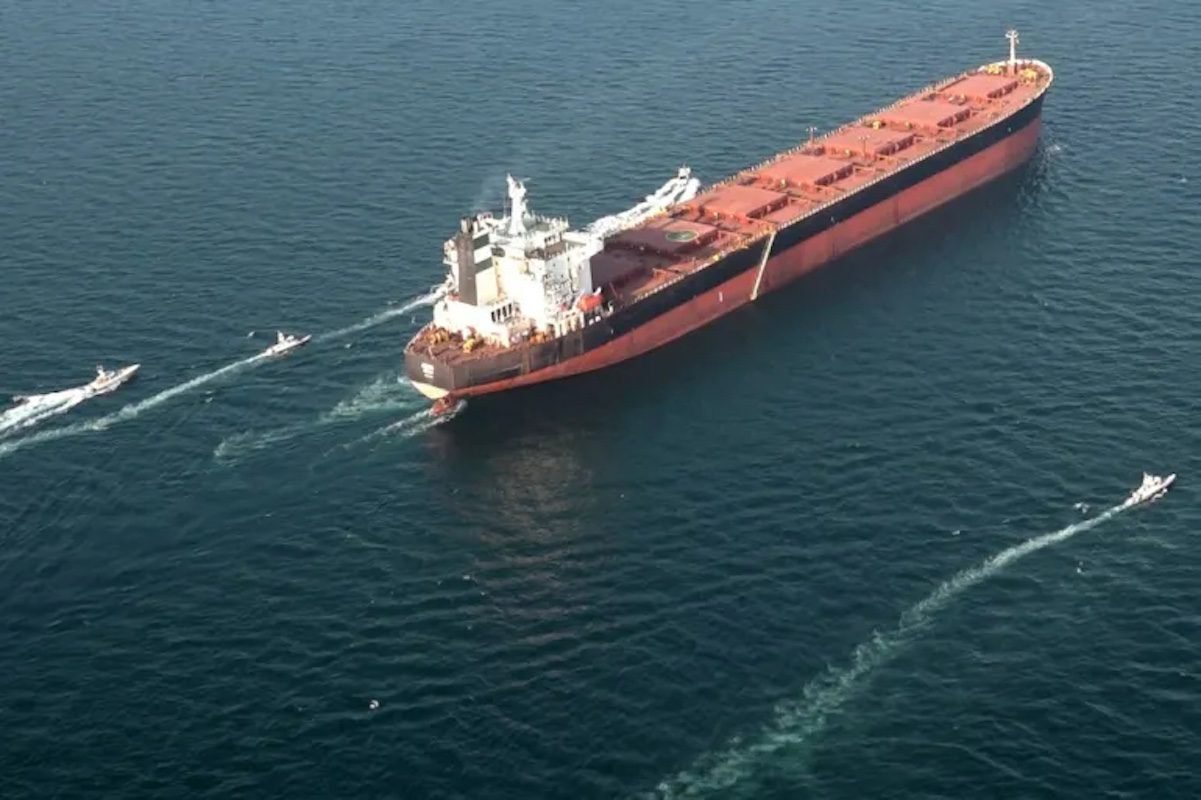
With the United States and Iran escalating confrontations along the Strait of Hormuz — including the seizure of ships — the waterway has become “pivotal to negotiations” between the two countries.
Washington escalated to direct interdiction of Iranian-linked shipping near the strait on April 19, with US forces boarding and seizing an Iran-bound container ship, as part of the blockade imposed by it. Meanwhile, on April 22, Iranian forces seized two ships, casting doubt on Trump’s earlier declaration that the strait is “open for business.”
Weeks of joint US-Israeli strikes, backed by Gulf partners, have failed to decisively degrade Iranian military capabilities or critically destabilize its government, while Iran has also been unable to force an American retreat.
The crisis has caused traffic through the Strait of Hormuz to plummet. The waterway is one of the most “critical oil transit chokepoints,” with roughly 25% of the world’s seaborne oil and about 20 percent of its liquefied natural gas (LNG) passing through it.
Even for crews willing to transit the narrow strait, soaring insurance costs have also held back trade. Despite Washington establishing a US$40 billion maritime insurance fund to encourage and secure maritime trade, contradictory signals from the US and Iranian sides, including inconsistencies from their official channels, have added to the uncertainty, preventing traffic from recovering. Commodity prices and financial markets initially reacted sharply, but have become less sensitive to sensationalist political rhetoric.
The crisis has been compared to attacks on shipping in the Strait of Hormuz in the 1980s during the Iran–Iraq war. The US Navy escorted tankers through the strait and allowed foreign vessels to reflag as American, retaliating when its forces were targeted, and pushing both Baghdad and Tehran to scale back attacks. The affair effectively cemented Washington’s role as the global guarantor of maritime trade, an assumption now being tested once again by renewed US intervention.
While Washington continues to seek to keep the strait open, there appears to be a growing willingness to tolerate disruption, consistent with the Trump administration’s “America First” orientation, especially with US energy imports having diversified away from the Middle Eastern dependence, which is complemented by increasing domestic production. With Iran suffering from a blockade, the disruption to traditional resource flows and elevated oil prices has also benefited US producers and exporters.
Forcing the strait open is also not straightforward, with US Naval Forces now exposed to Iran’s arsenal of low-cost drones and ballistic missiles. Securing it by force risks human and material losses high enough to make a standoff approach more attractive. It would be far more beneficial to hold naval ships at a distance while managing economic pressure to sustain traffic through the strait.
While Operation Epic Fury, which aimed to dismantle Iran’s security infrastructure, marks a show of strength for US forces, its constraints show a new operating reality in the age of mass drones and ballistic missiles rather than a return to uncontested military control.
What the ongoing crisis in the Strait of Hormuz also reveals is how ambiguous and unevenly enforced maritime law remains, a reality long masked by US hegemony. Neither Iran nor the U.S. has ratified the United Nations Convention on the Law of the Sea, and few international bodies or countries are able to provide neutral mediation.
Both operate on competing national interpretations of legal rights and obligations in the strait that have compounded obstacles to wider negotiations.
Mounting strains
Rather than reacting to crises, Washington’s approach to the Strait of Hormuz reflects an effort to anticipate and exploit disruption, shaped by a series of tests to its maritime order in recent years.
Since 2023, Houthi rebel drone and missile attacks on shipping in the Red Sea have kept tanker traffic below pre-crisis levels, even after US-led military intervention and a 2025 ceasefire. That agreement now appears fragile amid Houthi threats to resume attacks and Iran’s push to them “to prepare for a renewed campaign against Red Sea shipping if the US escalates its military actions against Iran, according to European officials,” stated to Bloomberg News.
Simultaneously with the Houthis’ Red Sea campaign, nearby Somali piracy has also rebounded. Driven in part by foreign fishing and toxic waste dumping in Somali waters, piracy grew rapidly off the country’s coast in the late 2000s and early 2010s before a sustained international effort led by the US, NATO, and the EU brought it under control. Its resurgence is indicative of the weakening of international maritime security cooperation and the limits of US enforcement capacity.
There has also been a state-to-state maritime disruption before the Hormuz crisis. Since the Russian invasion of Ukraine in 2022, war efforts have significantly reduced Black Sea traffic and undermined internationally-brokered agreements, turning much of it into a “no-man’s land.” Russian access to the Black Sea and the Danish straits has also been restricted by Western enforcement measures.
However, the global Western enforcement architecture that has helped support American maritime dominance for decades is itself coming under strain amid tensions within the transatlantic alliance.
The Trump administration’s renewed interest in Greenland, in particular, has raised tensions with Denmark and other EU members, exposing cracks in Western unity that complicate collective action at sea even before the current crisis in the Strait of Hormuz.
The Trump administration’s focus on expanding US power in the Americas also entails countering China’s extensive global trade influence, seen most visibly in the current competition over the Panama Canal.
Built between 1903 and 1914, the US began gradually transferring control of the canal to Panama during the 1970s. The US, however, invaded Panama in 1989 in part to secure the canal and to depose Panamanian dictator Manuel Noriega. Full control was transferred to Panama in 1999, by which time Hong Kong-based CK Hutchinson had already secured concessions to operate major container terminals on both the Atlantic and Pacific sides.
At the Panama Canal and elsewhere, “by securing ownership stakes and operational leases in port infrastructure, Chinese firms can streamline global operations and grow their influence over supply chains while providing greater market access and reduced shipping costs for other Chinese companies,” according to the Jamestown Foundation. Formal and informal advantages in scheduling and berths add to these gains, giving China an edge on major shipping routes.
Panama now faces renewed US pressure to reassert influence and limit China’s role. In early 2026, Panama’s Supreme Court ruled that aspects of the agreement with CK Hutchinson were unconstitutional, triggering a state review and plans to rebid operating rights. A consortium of American companies led by BlackRock is now positioned to gain this critical logistics hub, drawing heavy criticism from Beijing.
“The canal is a critical component of global infrastructure, facilitating the transit of more than 5-6% of the world’s maritime trade. … the agreement with BlackRock, granting the American financial consortium access to port infrastructure, was a pivotal point in Panama’s strategic reorientation. This move not only curtailed China’s economic maneuvering space but also prompted a reconsideration of the control architecture over supply chains in the Central American region,” stated an article in the Transatlantic Dialogue Center.
The saga appears to be a costly but partial win, reflecting the Trump administration’s efforts to counter China’s global port network. Several Trump administration officials have also singled out China’s involvement in Peru’s Chancay port, while US Ambassador to Greece Kimberly Guilfoyle suggested that China sell its control over Greece’s Piraeus port, a major gateway into Europe. The Biden administration likewise backed efforts to offset China’s reach, including a $553 million agreement with Sri Lanka in 2023 to compete with Chinese trade infrastructure there.
That deal ultimately fell through in 2024, highlighting Washington’s difficulty in sustaining even limited foreign port developments. From 2000 to 2025, China directed $24 billion into 168 ports across 90 countries, building out logistics and networks and integrating them with a rapidly growing fleet that far exceeds that of the US.
Over time, the US Navy’s role in securing global shipping lanes for its own economic interests has also protected China’s trade, allowing Beijing to expand its global network without bearing the cost of keeping those routes open.
Uncertain transition
However, as the US Naval Institute has openly noted, “China’s dependence on extended overseas supply lines makes it politically and economically vulnerable. This is a critical vulnerability that, in the event of conflict, could be targeted. And US Marines could help.”
Despite the expansion of overland trade routes, most Chinese commerce still moves by sea. Changes to the status quo at chokepoints like the Strait of Hormuz and Panama Canal, therefore, carry major security implications, as even China’s large and rapidly expanding navy lacks the global force projection and operational experience to reliably secure its maritime trade network.
China’s exposure is shared by most countries, including close European and other U.S.-allied economies. On April 1, the Financial Times reported that Trump threatened to halt weapons shipments to Ukraine until European countries sent forces to open the Strait of Hormuz.
Whether accurate or not, Britain and France announced a commitment weeks later to lead an international mission to help restore trade. However, the hesitation and ambiguity of the commitment, alongside Trump’s reaction asking European nations to “stay away,” have shown the limited capacity of other major powers to ensure the flow of international trade.
Washington’s introduction of a more transactional approach to maritime security raises global risks. National and regional fragmentation would weaken legal clarity, and contested control over chokepoints and disputed transit zones may fuel arms races and similarly push up trade costs.
Disruptions to international trade by Houthi militants and Somali pirates, meanwhile, demonstrate how non-state actors can use relatively low-cost technologies to challenge state forces and create de facto no-go zones. These challenges to shipping have helped drive demand for the growing private maritime security industry, which itself faces significant oversight and regulatory challenges.
A rapid resolution to the crisis in the Strait of Hormuz could avoid a major shock to the current maritime order. But it has been devolving for years, and Washington appears to be considering trading its global maritime “safety premium” for a narrower, concession-based presence.
Forfeiting control over major chokepoints and transit zones would weaken dollar-dominated commerce and generally reduce its geopolitical standing. It would also force China to divert resources and reflects Washington’s prioritization amid great power competition and new technologies that have eroded traditional deterrence measures.
With no clear successor system, selective US enforcement is likely to be met by parallel Chinese initiatives and more fragmented regional blocs. While US primacy at sea was never absolute, its stability benefited many countries, including its largest rival.
Letting that system dissolve without a credible alternative would be a major blow to international stability and cooperation.
John P Ruehl is an Australian-American journalist living in Washington, DC, and a world affairs correspondent for the Independent Media Institute. He is a contributor to several foreign affairs publications, and his book, Budget Superpower: How Russia Challenges the West With an Economy Smaller Than Texas’, was published in December 2022. Follow him on X @john_ruehl.
This article was produced by Economy for All, a project of the Independent Media Institute, and is republished with kind permission.