5.8 C
London
Friday, April 24, 2026
Home Blog

Sulfur squeeze: Gulf chaos is coming for Asia’s food prices

0
sulfur-squeeze:-gulf-chaos-is-coming-for-asia’s-food-prices
Sulfur squeeze: Gulf chaos is coming for Asia’s food prices

Fertilizer input stress is beginning to rebuild upstream as shipping disruptions continue to constrain flows through critical energy and chemical corridors.

Recent developments across Middle Eastern routes, namely the blockades at the Strait of Hormuz, combined with tightening export conditions in key producing countries, are reshaping the availability and timing of essential inputs such as sulfur and sulfuric acid.

These pressures are emerging at a moment when global logistics remain unsettled and regional risks are elevated. The system is entering a phase where logistical execution is becoming a central variable.

Vessel availability, insurance constraints and routing risks are influencing the movement of materials that sit at the base of fertilizer production. These pressures are emerging even as headline energy prices remain mixed, creating a disconnect between upstream conditions and visible market signals.

Shipping data point to a sustained period of disruption. Freight, bunker and risk indicators remain elevated, with flow constraints persisting across strategic corridors. Traffic through the Strait of Hormuz has fallen sharply, with some industry trackers reporting that only a handful of vessels have crossed the corridor in recent days.

Chemical tanker rates on Middle East routes have risen in line with higher bunker costs and longer detours, with additional rerouting through the Red Sea and around the Cape of Good Hope increasing transit times and operational costs. Market participants continue to adjust routes and timing, although normalization remains limited as operational risks stay high.

These constraints are feeding directly into fertilizer markets. Nitrogen-linked producers have shown relative strength over recent sessions, supported by margin expansion as natural gas prices soften. This configuration reflects a system where cost structures are shifting in response to processing and delivery constraints.

Phosphate markets are particularly sensitive to this dynamic. Sulfuric acid remains a key processing input, and disruptions in its availability influence production schedules and output efficiency.

Delays in upstream inputs translate into slower throughput, introducing timing mismatches across the value chain. These effects tend to accumulate gradually before becoming visible in final product markets.

At the broader agricultural level, price action suggests that transmission remains selective. Wheat and other food grains are showing steady gains, supported by tighter input conditions and stable demand.

Corn is holding a firmer profile, although downstream signals remain mixed. Soybean meal and parts of the feed complex are not confirming the move, indicating that the adjustment is progressing at different speeds across segments.

This selective transmission reflects differences in input intensity, regional exposure and timing. Crops with higher sensitivity to fertilizer inputs and more immediate planting cycles tend to respond earlier. Others remain anchored to existing supply conditions and inventory buffers, which delays the full expression of upstream stress.

Soft commodities illustrate this divergence clearly. Cotton is strengthening on the back of firmer input conditions and stable demand expectations, while coffee is trading under pressure due to regional supply dynamics. These movements show how the same upstream environment can produce varied outcomes depending on crop structure and exposure.

Asia sits at the center of this evolving configuration. The region’s agricultural system relies heavily on imported inputs, particularly for fertilizer production and application.

Dependence on external suppliers for sulfur, ammonia and processed fertilizers creates a structural sensitivity to disruptions in global flows. When upstream constraints emerge, they tend to propagate through import channels with a lag.

A second layer is beginning to take shape. The combination of higher maritime insurance premia, dollar-denominated freight costs and tighter compliance requirements is encouraging some Asian buyers to explore alternative settlement channels and diversified routing options.

This shift reflects a broader trend toward multipolar logistics, where producers and importers seek to reduce exposure to single-corridor risks and concentrated insurance markets.

This lagged transmission is critical for understanding potential inflation dynamics. Food price adjustments rarely occur simultaneously with input shocks. They develop as inventories are drawn down, production cycles adjust and procurement strategies shift. This process can create a period of apparent stability followed by more pronounced adjustments once buffers weaken.

Policy implications are beginning to emerge. Several Asian economies maintain fertilizer subsidy frameworks to stabilize farm costs and protect household budgets. Rising input prices and tighter supply conditions could place pressure on these systems.

Countries with large agricultural sectors and significant subsidy exposure may face difficult policy choices if procurement costs rise or delivery schedules slip. The interaction between market dynamics and policy response will influence outcomes over the coming months.

The current environment suggests that the system is entering a phase in which upstream constraints are becoming more visible, while downstream effects remain in the early stages of transmission. Logistics, routing and processing capacity are emerging as central variables in determining how these pressures evolve.

As shipping conditions remain constrained and input flows continue to face friction, the effects are likely to build progressively within the agricultural system. Asia’s exposure to imported inputs places the region in a position where these dynamics can influence pricing and policy with a delay, shaping the next phase of food market adjustments.

The broader implication is that the next phase of food-system stress may stem from delayed access to the inputs that enable production. As these constraints accumulate, Asia could enter a period in which inflationary pressures emerge after policymakers assume the system has stabilized.

This timing gap is becoming a central vulnerability and is beginning to take shape now.

Luca Mattei is founder and chief analyst at LM Trading & Development, EcoModities Research Initiative


US accuses China of “industrial-scale” AI theft. China says it’s “slander.”

0
us-accuses-china-of-“industrial-scale”-ai-theft-china-says-it’s-“slander.”
US accuses China of “industrial-scale” AI theft. China says it’s “slander.”

The US is preparing to crack down on China’s allegedly “industrial-scale theft of American artificial intelligence labs’ intellectual property,” the Financial Times reported Thursday.

Since the launch of DeepSeek—a Chinese model that OpenAI claimed was trained using outputs from its models—other AI firms have accused global rivals of using a method called distillation to steal their IP. In January, Google claimed that “commercially motivated” actors not limited to China attempted to clone its Gemini AI chatbot by promoting the model more than 100,000 times in bids to train cheaper copycats. The next month, Anthropic accused Chinese firms DeepSeek, Moonshot, and MiniMax of using the same tactic to generate “over 16 million exchanges with Claude through approximately 24,000 fraudulent accounts.” Also in February, OpenAI confirmed that most attacks it saw originated from China.

For the US, these distillation attacks supposedly threaten to help China quickly catch up in the AI race. In a memo that FT reviewed, the director of the White House Office of Science and Technology Policy, Michael Kratsios, warned that “the US government has information indicating that foreign entities, principally based in China, are engaged in deliberate, industrial-scale campaigns to distill US frontier AI systems.”

According to Kratsios, Chinese campaigns were “leveraging tens of thousands of proxy accounts to evade detection and using jailbreaking techniques to expose proprietary information.” His memo said that US firms would soon gain access to government information to help them combat the apparent attacks.

So far, AI firms have alleged that such attacks violate their terms of service, but Congress may update laws soon to further equip US companies fighting the alleged fraud.

Kratsios confirmed in his memo that the US is exploring measures “to hold foreign actors accountable for industrial-scale distillation campaigns.”

Congress has already received some marching orders, but it remains unclear how fast lawmakers will act. In an April report, the House’s Select Committee on China advised that Congress “should direct the Commerce Department’s Bureau of Industry and Security (BIS) and the Department of Justice (DOJ)” to “treat model extraction as industrial espionage” and “impose penalties severe enough to deter Beijing’s theft of American innovation.”

Specifically, the committee recommended that the State Department assess whether the distillation attacks violate laws like the Economic Espionage Act and the Computer Fraud and Abuse Act. They also want “adversarial distillation” clearly defined and officially categorized as a controlled technology transfer, which would make it easier to restrict fraudulent Chinese access to models.

If such steps were taken, the US could prosecute bad actors and impose heavy financial penalties that might dissuade Chinese firms from treating “serious violations as a tolerable cost of doing business,” the committee’s report said.

China slams accusations as “pure slander”

Kratsios’ memo threatening a crackdown comes ahead of Donald Trump’s highly anticipated meeting with China’s president Xi Jinping next month.

Trump has claimed that the meeting will be “special” and “much will be accomplished.” However, at least one analyst told the South China Morning Post that the war in Iran means that Trump has “lost almost all his bargaining chips” at a time when the US and China are seeking to stabilize a trade relationship that has been tense since Trump took office.

China seems unlikely to tolerate Kratsios’ allegations. Liu Pengyu, a spokesperson for the Chinese embassy in Washington, DC, told FT that the White House accusations were “pure slander.”

“China has always been committed to promoting scientific and technological progress through cooperation and healthy competition,” Pengyu said. “China attaches great importance to the protection of intellectual property rights.”

Whether Trump will side with AI firms that want to see China cut off from their models and sanctioned for distillation attacks has yet to be seen. Trump has, in the past, been accused of making big concessions to China on export control matters that experts have claimed threaten US national security and the economy, as US firms claim the distillation attacks do.

Some of Trump’s concessions may need to be reversed to fight the alleged “industrial espionage.”

Chris McGuire, a technology security expert at the Council on Foreign Relations, told FT that “Chinese AI firms are relying on distillation attacks to offset deficits in AI computing power and illicitly reproduce the core capabilities of US models.” To stop them, the US may need to tighten export controls that Trump loosened, such as allowing Nvidia chip sales to China so long as the US gets a 25 percent cut. That bizarre deal made “no sense” to experts who warned that Trump’s odd move could have opened the door for China to demand access to America’s most advanced AI chips.

Strait of Hormuz: Iran’s ‘nuclear deterrent’

0
strait-of-hormuz:-iran’s-‘nuclear-deterrent’
Strait of Hormuz: Iran’s ‘nuclear deterrent’

This is the text from The Conversation UK’s World Affairs Briefing email. Sign up here to receive weekly analysis of the latest developments in international relations, direct to your inbox.


Napoleon Bonaparte is said to have commented in connection with his invasion of Russia that “geography is destiny”. Take a look at a live maritime tracker to see how Napoleon’s aphorism is playing out in the Middle East today. There are presently hundreds of vessels either side of the Strait of Hormuz, idling in either the Persian Gulf or the Gulf of Oman. But nothing is passing though.

In normal times, 20% of the world’s oil flows through this waterway. But since the US and Israel began to launch attacks at the end of February, Iran has effectively closed down the Strait, both by depositing mines and by threatening to board any ships trying to pass without their permission.

The US has countered with its own blockade. And both sides have demonstrated how serious they are in recent days by threatening, boarding or forcing vessels to reroute.

That Iran would close the Strait of Hormuz should have come as no surprise to anyone. The leaders of the Islamic Republic have threatened to do so every time they have felt under threat over more than four decades. Christian Emery, an expert in US-Iran relations and Persian Gulf security at University College London, believes this is why no previous US president has chosen to launch a full-scale attack on Iran.

As we’ve already seen, the ability of Iran to hugely disrupt the global economy by shutting down the Strait was obvious: “The only person who seems not to have understood this is Donald Trump,” Emery concludes.


Read more: Has the Strait of Hormuz emerged as Iran’s most powerful form of deterrence?


So now there appears to be a deadlock. It’s an unwinnable war, write Bamo Nouri and Inderjeet Parmar, experts in international security at City St George’s, University of London. The US and Israel may enjoy massive military superiority over Iran, but this is beside the point, Nouri and Parmar believe.

While both the US president, Donald Trump, and Israeli prime minister, Benjamin Netanyahu, need to be able to demonstrate to their voters that they have emerged triumphant, Iran isn’t looking to win. It is looking to endure – while making sure that the cost of this conflict becomes unsustainable. And not just for the US and Israel, but for pretty much everybody else besides.

We’re already seeing that. Oil prices have surged and reserves are coming under strain. Supply chains are disrupted. And political friction is stressing relationships, not just between the US and its Nato allies, but – more ominously – with China, which typically buys between 80% and 90% of Iran’s oil exports and said this week that the Strait must be opened without delay.

Iran, our experts conclude, “does not need to win. It only needs to prevent its adversaries from achieving their aims. So far, it has done exactly that.”


Read more: Middle East conflict looks increasingly like a war nobody can win


There’s a principle in classical game theory which explains why Iran’s position is so strong. It’s known as Rubinstein bargaining, writes Renaud Foucart, an economist at Lancaster University. As Foucart explains it, this holds that in a conflict the respective strength of adversaries each depends on two things: “how badly off it would be without a resolution, and how impatient it is to get things resolved”.

As we’ve heard, all the pressure is on the US, while the leverage is mainly in Iran’s hands. “The US’s position is much weaker than first thought because of a stretch of water the world can’t do without,” he concludes.


Read more: The Strait of Hormuz shows how everything is now about leverage


On Tuesday, as we waited to see what might happen if the 14-day deadline imposed by Trump on April 8 expired without Tehran opening the Strait, it was clear that both the US and Iran, to varying degrees, were looking for an off-ramp. The blockade is financially ruinous for Iran – whether it is losing US$500 million (£370 million) a day, as Trump claims, we don’t know. But the shutting down of its oil exports is hitting an already parlous economy and this week the social security minister said 2 million people had lost their jobs since the beginning of the war.

For Trump, it’s soaring prices at the gas pumps and the prospect of rising inflation angering voters ahead of November’s midterm elections. The war is very unpopular with Americans – and, significantly, it’s beginning to fracture the Maga coalition which brought Trump to power in the 2024 election.

A gas station in the US showing high prices at the pumps.

Fuel prices have risen in the US and across much of the rest of the world. EPA/Jim Lo Scalzo

But there are ways both sides can find off-ramps, writes David Galbreath of the University of Bath. The key thing is to find a settlement that the leaders of both sides can sell as a “win”.

For Iran, this could be an easing of sanctions and access to some of the many billions of dollars of frozen assets held overseas. It could be a recognition of its right to enrich uranium to the level needed for medical uses – particularly given the recent assertion by the Chinese president, Xi Jinping, that such a solution would “safeguard its [Iran’s] national sovereignty”.

We know a little about what Iran is prepared to offer because a great deal of it was on the table in February when the US and Israel launched their strikes. But one of the stumbling blocks for the US president appears to be that Iran’s proposals may too closely resemble the deal struck in 2015 by his predecessor, Barack Obama.

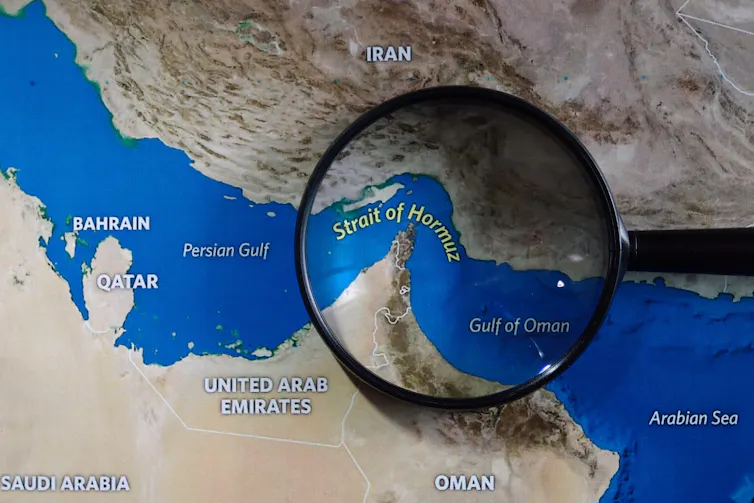
Map of Strait of Hormuz with magnifying glass.

Signalling it is willing to open the Strait of Hormuz could be one way for Iran to signal it is willing to make concessions. But this would need to be matched by the US. Sipa US/Alamy Live News

But Galbreath concludes that as things stand, some combination of opening the Strait of Hormuz, acceptance of limits on uranium enrichment and agreeing to stringent inspections could be made to appear a “win” for Trump. This could be a starting point, writes Galbreath, in what is known in conflict resolution as “sequenced de‑escalation”. It could deliver an initial settlement and allow negotiators on both sides to get to work and hammer out the details. Obama’s treaty took 20 months to agree. It’s early days yet.


Read more: Middle East conflict: how the US and Iran could step back from the brink


One stumbling block is likely to be that there appears to be something of a power struggle raging at the top of Iranian politics. This was seen very clearly last weekend, when Iran’s foreign minister, Abbas Araghchi, announced that the Strait of Hormuz was completely open, only to be swiftly overruled by the Islamic Revolutionary Guard Corps (IRGC), which said it would decide when and how the Strait would be opened.

Since then, a new figure has emerged at the head of the IRGC: a longtime guards member and hardline former commander of its elite Quds force, Ahmad Vahidi. And it seems that with Iran’s freshly minted supreme leader, Mojtaba Khamenei, badly injured after the attack that killed his father on February 28, Vahidi is now calling the shots in Iran. Andreas Krieg, an expert in Middle East politics at King’s College London explains the power struggle that has led to Vahidi assuming control.


Read more: Who is calling the shots in Iran?


Sign up to receive our weekly World Affairs Briefing newsletter from The Conversation UK. Every Thursday we’ll bring you expert analysis of the big stories in international relations.


Spy drones are compromising America’s nuclear triad

0
spy-drones-are-compromising-america’s-nuclear-triad
Spy drones are compromising America’s nuclear triad

On March 8 a single high altitude drone crossed the perimeter of Barksdale Air Force base in Louisiana late at night, then disappeared. Some thought it was just another civilian operating a drone, but that theory became suspect when the drone carried out maneuvers over weapon storage areas on the base.

The use of spies and drones is part of an intensifying pattern of Chinese intelligence gathering with a long term aim of neutralizing US nuclear capabilities.

What happened

(The timeline data below were gathered from Gemini AI by Google.)

After the March 8 single drone event at Barksdale, on March 9 between 3 am and 7 am, 12 to 15 drones appeared over the Barksdale flight line. These came in “waves” and stayed over the base for as around four hours. Reports say that the drones had their lights on. This forced all air operations and loading work to halt and, for an undisclosed period, workers and personnel were instructed to shelter in place.

Between March 10 and March 13, smaller drone groups (three to five drones each) appeared intermittently, usually between 10 pm and 2 am. These drones did not loiter as long – typically 45 to 90 minutes – but moved in “racetrack” patterns around the base’s northern and southern boundaries of the base.

On March 15, a final drone formation was detected moving at high speed toward the Bossier City side of the base before vanishing from radar.

Very little is known about these drones. According to eye witnesses, the drones flew at relatively low altitude (around 1,000 feet) and were tracked, for a time, on radar. They were seen from the ground and, no doubt, photographed. However, no photos of the drones have been released. It is not clear whether the drones were electrically powered or used liquid fuel, but electrically powered drones normally can’t stay aloft much longer than 90 minutes. Although they were seen from the ground, no one has disclosed the type of drone.

Drones with lights are usually associated with commercial drones used for photography, agriculture, mapping and other tasks. US military drones also are equipped with navigation and anti-collision lights, similar to those on manned aircraft. Personnel at the base were equipped with shotgun-like handheld electronic jammers. Efforts to jam or confuse the drones failed.

Most commercial jammers are designed to handle typical drone frequencies, which are similar to wireless and cellular telephones.

Modern drones, if not autonomous, are controlled by remote operators and the drone flight path is determined by GPS, if present.

Autonomous drones, on the other hand, do not link back to remote operators but are programmed to carry out a task or sequence of tasks. They may use GPS, although they could also use a modern form of feature and terrain recognition, and they may send information linked to satellites, either Starlink, which has become a major drone combat feature in the Ukraine war, or another satellite service. Or they could simply store information onboard until they return home.

It is likely the drones over Barksdale used frequency-hopping radios and encryption, making jamming difficult to impossible. Many countries now produce software-defined radios, frequency-hopping platforms and software to encrypt the hopping pattern. A number of Chinese companies sell such components commercially.

Speculation #1

No one can say exactly what kind of navigation or communication systems were involved in the Barksdale case, although ground personnel were impressed at how the drones functioned and how they “scattered” making tracking them outside the base impossible.

There is considerable speculation on the purpose of the intrusions.

One early theory is that the drones were run by the War Department or another US agency (such as NSA or CIA) and were evaluating how the air base would respond and what actions they would take.

If that was their purpose, they found that the answer was “not much” other than to learn that the jammers did not work. Nonetheless there are good reasons to dismiss this speculative theory, because the War Department and other national security agencies and organizations were aware of the few capabilities at US domestic bases, since none of them have air defense systems. Moreover, the incursions happened when the B-52s were needed in wartime.

Barksdale AFB is home to the US 2nd Bomber Wing that is made up of three squadrons of B-52H aircraft, and also the home to the 307th B-52 Bomber Group, made up of two squadrons, an Air Force Reserve unit.

An image of the new RR F130 engines. Photo: Rolls-Royce

Barksdale supports the venerable B-52 strategic bomber, an aircraft that has been around for many decades but has often been modernized. Today the Air Force is ordering newer, more efficient engines for the behemoth bomber (it features 8 engines made by Rolls Royce – F130 engines) and will be changing out the radar to the latest AESA standard and creating a fully digital cockpit. The newly modified B-52s will become the B-52J, although it will take at least a decade before the “J” modifications are completed.

A JASSM Missile loading onto a B-52 at Barksdale.

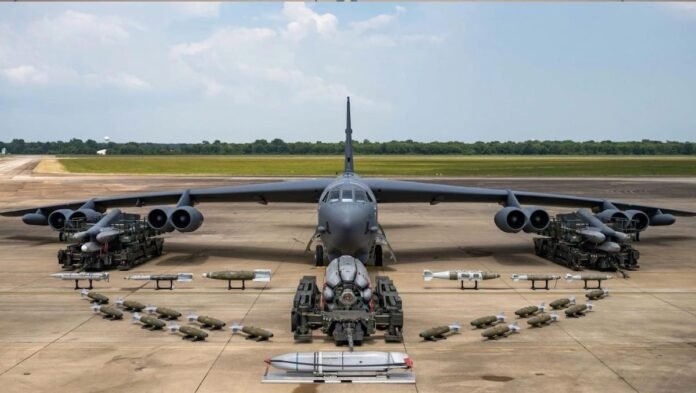
The B-52 is a dual-capable bomber – it can carry both conventional and nuclear weapons. Conventional weapons include AGM-86B cruise missiles, AGM-158 Joint Air-to-Surface Standoff Missiles (JASSM), and Joint Direct Attack Munitions (JDAM), along with Harpoon anti-ship missiles. Included in this list is the 5,000-pound class GBU-72/B Advanced 5K Penetrator. It is not certified to carry the biggest bunker buster, the 30,000-pound GBU-57, which is carried on the B-2 stealth bomber.

An ALCM being loaded on a B-52 at Barksdale.

The B-52 also carries nuclear weapons. Approximately 46 of the active fleet carry the nuclearAGM-86B ALCM (carrying 20+ air launched cruise missiles), and in the past nuclear gravity bombs such as the B61, B83, and high-yield B53.

The fleet is transitioning to carry the upcoming AGM-181 Long-Range Standoff (LRSO) cruise missile, which will replace the aging ALCM.

The AGM-86B is called a “dial a yield” weapon, in which operators can select a nuclear explosion between 5 and 150 kilotons (kt). For reference, the uranium Hiroshima atomic bomb had a yield of about 15 kt. The AGM-86B ALCM dates to 1982, although it has been updated. When released at altitude, it drops down to tree-top level and uses terrain mapping (TERCOM) and GPS. AGM-86B has a range of about 1,500 miles.

A newer, extended-range LRSO is in the works, but the current version will be retained until at least 2033. A non-nuclear version of the AGM-86B, designed AGM-86C/D has been used on missions since 1991 (it is designated as a Conventional ALCM or CALCM).

It is noteworthy that there are 76 active duty B-52 aircraft, 58 in the 2nd and 5th bomber squadrons, and 18 operated by the Reserves. While not all the B52s are approved to carry nuclear payloads, 46 of them are certified and are part of the US strategic Nuclear Triad.

Speculation #2

The US Nuclear Triad consists of land-based intercontinental ballistic missiles (ICBMs), submarine-launched ballistic missiles (SLBMs), and strategic aircraft (bombers).

A second theory regards storage, starting from the fact that Barksdale being part of the Triad can store or at least handle nuclear weapons. Barksdale is also completing, if it has not already finished, new storage areas for nuclear weapons. The idea is Barksdale will replace the current nuclear weapons storage (for B-52s) at Minot Air Force Base in North Dakota. In practice it removes the delay time to move nuclear weapons down to Louisiana from Minot, a little less than three hours’ flight time, but the time calculation must include the availability of aircraft and the time to load and unload and then reload.

Were the drones trying to determine if any nuclear ALCMs were transported down from Minot or already locally stored, or whether they were being loaded on the B-52s being dispatched to Iran? It is impossible to know, but otherwise what purpose would there be for Iran, or for its partners – especially China, which has been providing battlefield intelligence to Iran using high powered spy satellites – to perform risky drone intrusions over a US base part of America’s Nuclear Triad?

If the idea was only to see how many B-52s were launched, all that would be necessary is to stand near the end of the Barksdale runway and count takeoffs.

Clearly the nuclear activities at Barksdale are of great significance to countries like China and Russia. We have seen nothing of the Russians recently, but China is uber-active.

Speculation #3

The Barksdale drone incursions are part of an intensive Chinese effort to try and find ways to compromise the US Nuclear Triad. The use of spies and drones is part of an intensifying pattern of Chinese intelligence gathering with a long-term aim of neutralizing US nuclear capabilities.

Unlike Speculations #1 and 2, Speculation #3 is proven by spies captured and incidents recorded.

The Chinese have been photographing US naval and air bases. A number of their agents, typically the most amateurish ones, have been caught.

On April 9, 2026, a 21-year-old Chinese student, Tianrui Liang, was arrested at JFK International Airport while attempting to flee the country. He is accused of using a high-powered telephoto lens to photograph aircraft at Offutt Air Force Base in Nebraska in March 2026. Offutt is the headquarters of US Strategic Command (STRATCOM), which oversees the US nuclear command and control (NC3) system.

He also attempted to photograph B-1B strategic bombers at Ellsworth AFB in South Dakota, but the bombers had been moved. He also reportedly visited Tinker AFB in Oklahoma City. Tinker supports the E-3 AWACS and KC-135 refueling tankers.

Internal Department of War (DOW) and FBI tracking indicates that there have been over 150 documented incidents of Chinese nationals attempting to access U.S. military installations and other sensitive government sites since early 2023.

In late January and early February 2023, China launched a number of “weather” balloons. One of them flew over Alaska, then Canada, and then into the United States. It made a number of loops around Malmstrom AFB focusing on the 341st Missile Wing which manages 150 Minuteman II ICBM silos. Reports say the balloon operated over the base between 24 and 48 hours; was linked by the Iridium satellite to China, which maneuvered the craft; and sent data through US internet service providers.

Sailors assigned to Explosive Ordnance Disposal Group 2 on Feb. 5, 2023, recover portions of a high-altitude Chinese surveillance balloon off the coast of Myrtle Beach, S.C. A U.S. fighter jet shot down the balloon over U.S. territorial waters on Feb. 4, 2023. Photo: Tyler Thompson / US Navy

The balloon was finally shot down along the coast of South Carolina after a public outcry forced the Biden administration to take action. There is, allegedly, a 75-page report on the exploitation of the balloon’s electronics (which would have filled three school buses), but the report has not been released.

While China knows exactly what was onboard the spy balloon, and the US probably knows almost as much, very little information has been released, leaving Americans guessing.

Over the last two years, Malmstrom AFB in Montana has reported multiple instances of unidentified drone swarms operating over its missile silos and launch control centers. Malmstrom operates, maintains, and secures the Minuteman III intercontinental ballistic missile (ICBM) system, America’s number one nuclear strike force.

A schematic of a missile in its silo. Photo: US Air Force

A national security scandal

The use of drones over strategic nuclear bases and other sensitive locations is a national security scandal. The fact that not a single drone has been captured or shot down, and that the government continues to be in denial, is extremely worrisome.

Because drone intrusions have taken place in the northeastern, north-central and southern United States suggests that there are secret foreign drone teams operating on US territory, or very close to US territory. Yet despite multiple drone observations, the launch points remain undiscovered and no operators have been apprehended.

America’s nuclear bases and command centers do not have air defenses and are sitting ducks.

The government’s response to the threat is far below any acceptable standard, suggesting the government is more interested in burying the evidence than catching the malefactors.

Stephen Bryen is a former US deputy under secretary of defense. You can read this article and many others on his newsletter Weapons and Strategy.

Trump Says ‘Clock Is Ticking’ for Iran as Talks Stall, Israel Signals Readiness for Renewed War

0
trump-says-‘clock-is-ticking’-for-iran-as-talks-stall,-israel-signals-readiness-for-renewed-war
Trump Says ‘Clock Is Ticking’ for Iran as Talks Stall, Israel Signals Readiness for Renewed War


President Donald Trump said Thursday that “The clock is ticking for Iran” as peace talks remain stalled and fighting continues over the Strait of Hormuz. In addition, Israel’s defense minister declared readiness for renewed war against Iran pending US approval. 

President Trump wrote that he was not under pressure to reach a ceasefire, criticizing media coverage of his position. “For those people, fewer in number now than ever before, that are reading The Failing New York Times, or watching Fake News CNN, that think that I am “anxious” to end the War (if you would even call it that!) with Iran, please be advised that I am possibly the least pressured person ever to be in this position. I have all the time in the World, but Iran doesn’t—The clock is ticking!” 

He also pointed to recent US military actions, stating: “Iran’s Navy is lying at the bottom of the Sea, their Air Force is demolished, their Anti-Aircraft and Radar Weaponry is gone, their leaders are no longer with us, the Blockade is airtight and strong and, from there, it only gets worse — Time is not on their side!” 

President Trump added: “A Deal will only be made when it’s appropriate and good for the United States of America, our Allies and, in fact, the rest of the World.” 

On Tuesday, President Trump extended the ceasefire, with no indication of its duration or when negotiations may resume. 

Separately, Defense Minister Israel Katz held a security assessment Thursday evening at the Kirya military headquarters and said Israel is prepared for further conflict. 

“Israel is prepared to renew the war against Iran. The IDF is ready in both defense and offense, and the targets have been marked.” 

“We are waiting for a green light from the United States,” he continued, to “complete the elimination of the Khamenei dynasty” and “return Iran to the Dark Ages” by exploding energy facilities and economic infrastructure. 


The mandate to speak: Before the world goes dark

0
the-mandate-to-speak:-before-the-world-goes-dark
The mandate to speak: Before the world goes dark

In 2017, twenty-seven psychiatrists and mental health professionals broke their profession’s long standing ‘Goldwater rule’  against diagnosing public figures from afar.  They published a book titled  The Dangerous Case of Donald Trump, and in it, they wrote a sentence that should have stopped the world cold: 

‘Trump is now the most powerful head of state in the world, and one of the most impulsive , arrogant, ignorant, disorganised, chaotic, nihilistic , self-contradictory , self-important and self-serving.  He has his finger on the triggers of a thousand or more of the most powerful thermonuclear weapons in the world.  That means he could kill more people in a few seconds than any dictator in past history has been able to kill during  his entire years in power’

That was nine years ago. Today, that warning is no longer prophecy, it is the reality.

The man who sits in the White House governs not by deliberation or diplomacy,  but by impulsive digital barks fired into the atmosphere every few minutes, often forgetting what he himself said an hour earlier.

He has embraced AI-generated deepfakes as a routine tool of political communication , blurring reality into propaganda.  In his most recent foray AI kitsch, (April 12) while attacking Pope Leo XIV as ‘weak on crime’, Trump  cast himself as a digital messiah.  Yet, beneath this surreal veneer of virtual omnipotence, the world cannot afford to forget that the same man holds, in his trembling hand, the nuclear codes of the most powerful military the world has ever known.

READ: Trump orders Navy to shoot any boat laying mines in Strait of Hormuz amid ceasefire

I’m not here to repeat the obvious labels of ‘mad’ or ‘deranged’ that already saturate the airwaves. Stating he is ‘crazy’ is just describing the scenery. I am here to connect the dots and raise a warning: we aren’t headed for chaos—we are headed for catastrophe, and we are standing on the edge of something much worse than a personality flaw.

The Unprecedented Triple Threat

History offers echoes of erratic leaders: Caligula’s cruelty, Nixon’s calculated ‘madman’ bluff, the Cold War’s existential brinkmanship. But none of those parallels capture the lethal novelty of today. What makes this moment peculiar is the fusion of three elements:

  1. A president whose cognitive decline and emotional instability are now widely acknowledged, even by former allies, and increasingly by members of his own party. 
  2. The speed of AI and social media , which allows a single delusional or enraged thought to circle the globe in seconds, triggering markets, and rattling  allies and adversaries alike.
  3. The absence of any filter- no diplomatic cable to revise, no national security advisor to intercept, no adult in the room to say ‘ Sir, you cannot tweet that’.

The result is a structurally incoherent foreign policy that mystifies  the entire global stage.  And beyond the bombs and threats of war, there is another casualty: the collective peace of mind of billions who go to bed wondering if tomorrow will bring a trade war, a military confrontation or an inexplicable reversal, all because one man woke up in an uncouth mood and recklessly started scrolling his screen. 

The Evolving Regional Inferno 

We have already seen what this president’s mental state, combined with his unconditional acquiescence to Benjamin Netanyahu and Israel’s lobby in Washington, has produced. 

The genocide in Gaza happened  because of US weapons and diplomatic cover flowing without pause. Now the same president is openly threatening to obliterate Iran within hours,  and all this not through careful diplomatic channels, but through profane,  erratic and often contradictory social media outbursts.

His threats about ending civilisation , his obscene demands to open strategic waterways,  his messianic AI generated postings – all of this is public, and all of it is terrifying. This incoherent impulse-driven governance is nothing less than a direct enabler of mass death.  And the world watches in horror.  

In the last two weeks , the Iran war has frozen into a stalemate that looks increasingly like a strategic defeat for the United States.  A fragile ceasefire , repeatedly extended, now has ‘no time frame’, a clear admission that Trump’s promised victory has not arrived as Iran still blocks the strait of Hormuz. Trump is trapped: renewing the war risks catastrophic casualties and economic pain across the board. So he does nothing, hoping the problem will solve itself. Meanwhile Israel quietly  pushes for chaos, not only in Iran but the whole region,  knowing  that a weaker and distracted America is easier to drag into a wider war.  

READ: US extends sanctions waivers on Iran, Russia

The Iranian Psychiatrists’ Letter

It is worth noting that the alarm is no longer confined to American professionals. On 7 April 2026, the Iranian Psychological Society published an open letter to their US counterparts calling for a formal , scientific examination of Trump’s behavioural patterns,  which they say pose a direct threat to global peace.  They pointed to his ‘ hostile rhetoric, extreme attention- seeking trait, lack of empathy and narcissism, impulsivity and delusional thoughts, disconnecting from reality , disregarding others’ rights , threats and insults toward other nations, contradictions, and antisocial and inhuman behaviour’.   They further stated that Trump ‘ is not bound by any rules, and like a psychopath, has led the world into a pit of fire and destruction’.  They concluded with a powerful statement:  ‘Regardless of geographical borders, we share a common responsibility to uphold the mental health of humanity and contribute to global peace and justice’. 

This should  not be read as a political statement from an adversarial state.  It is a professional plea from mental health experts who recognise that the psychological stability of world leaders directly affects the fate of us all.

The Moral Question the World Cannot Escape

If this man’s madness only affected his own country, we might look away and say ‘ This is America’s problem’. But his decisions , or whims, can level a city, start a war, and shatter global alliances. Every nation on earth now has a stake in the mental state of the American president. 

 This brings us to the concept the United Nations adopted in 2005 : The Responsibility to Protect, ( or R2P).  R2P holds that sovereignty is not absolute.  When a state manifestly fails to protect its own people from mass atrocities – or as here, actively enables them elsewhere – the international community has a moral , and in extreme cases, a legal duty to intervene. 

Though the legal reality is clear, and there is no mechanism for the world to step in and say: ‘This president is too dangerous to remain at the helm’ , yet,  the absence of a legal mechanism does not erase the moral imperative. The world has a duty to speak, loudly, clearly and without hesitation.

READ: 27 journalists killed in Israeli attacks in Lebanon, press union says

What Speaking Looks Like

Speaking means  every foreign leader, every international organization , every major newspaper, every professional body of psychiatrists and psychologists,  every religious authority and every ordinary citizen on every continent saying the same thing: 

‘The president of the United States is not mentally fit to command a nuclear arsenal. His behaviour is erratic, his memory is failing, and his impulsive use of social media and AI -generated disinformation is a direct threat to global peace. We demand that those with constitutional power to remove him- the Vice president and the cabinet invoke the 25th Amendment . And if they will not, we demand the American people vote him out of office before it is too late’ .

This is not interference in American  democracy. This is self-defence by the rest of the world, because we live in the unprecedented dangers of governing by tweet, AI and cognitive decline. No nation has a right to hold the world hostage to its internal failures.

The 2017 Book was a Warning.  2026 Is the Reckoning

Those twenty-seven psychiatrists were ridiculed and marginalised for breaking their professional norms. They were told they were being hysterical, that they should stay in their lane, and that a president’s mental health was not their concern.  But they were right.

 As the world navigates this volatile climate, the primary threat is no longer just the prospect of reckless action, but the equally grave danger of reckless inaction. This is the true peril of the Trump era. Rather than looking away, the international community must undertake the urgent task of refusing  to normalize the situation.

It is time to speak the truth—that a mentally deteriorating man now holds ultimate power, enabling current atrocities while openly courting catastrophic new wars.

Because if we look away, and the unthinkable happens, we will have no one to blame but ourselves. 

OPINION: Fascism for the digital age

The views expressed in this article belong to the author and do not necessarily reflect the editorial policy of Middle East Monitor.

Visitors to this private space station won’t be wearing shorts and T-shirts

0
visitors-to-this-private-space-station-won’t-be-wearing-shorts-and-t-shirts
Visitors to this private space station won’t be wearing shorts and T-shirts

After more than 25 years of US astronauts wearing off-the-rack clothes while living in Earth orbit, a company working to launch the world’s first commercial space station has adopted a more custom approach to its crew attire.

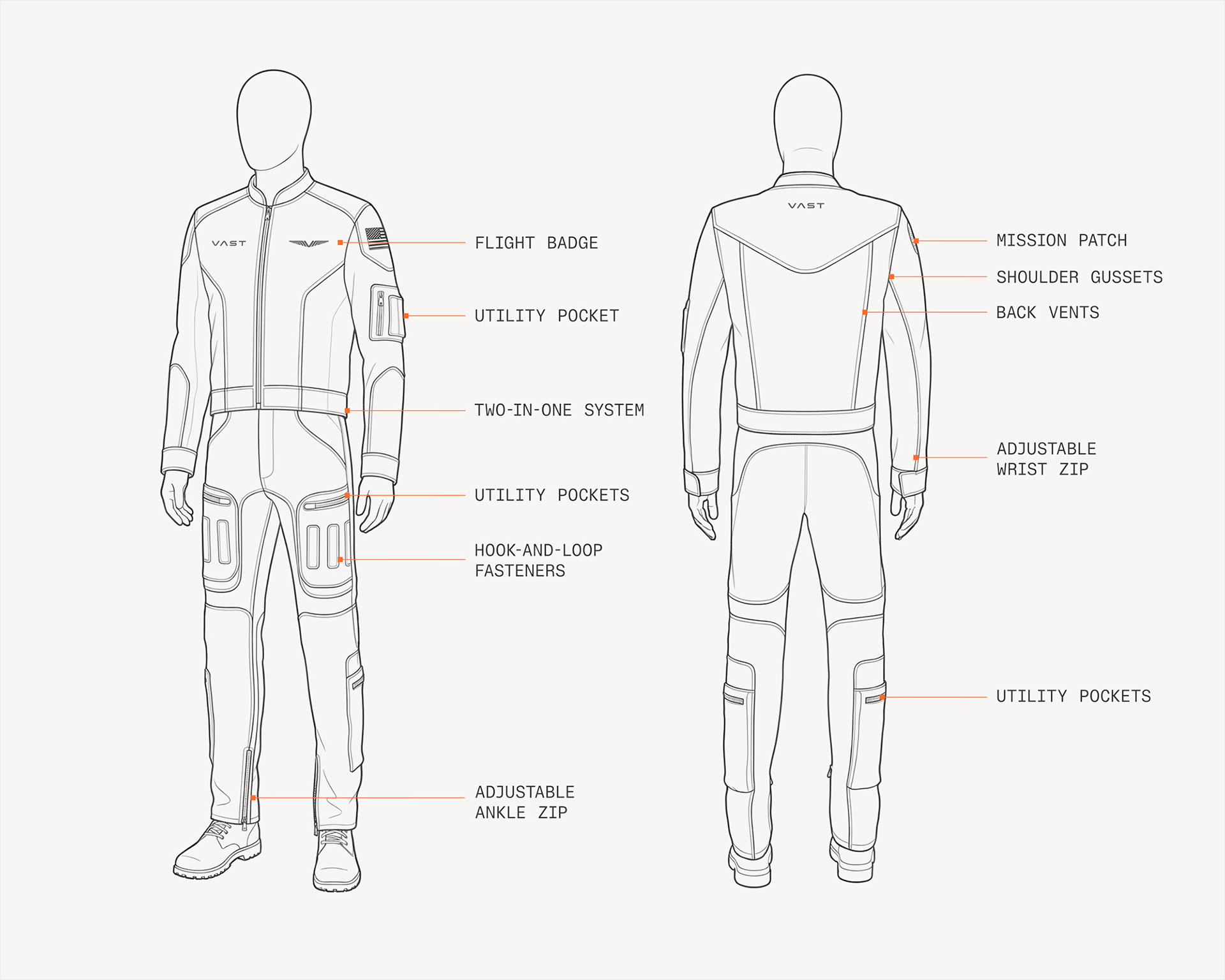
Vast has revealed its astronaut flight suit, a two-piece outfit designed to be worn both on and off the planet. The company also certified a custom-Swiss wristwatch for use aboard its upcoming Haven-1 space station.

“Over the last two decades on the International Space Station, astronauts have moved away from wearing flight suits every day,” Drew Feustel, Vast’s lead astronaut and former NASA mission specialist who spent 225 days in space, said in a statement. “The environment has become safer and more like how we work on Earth.”

Feustel contributed to the design of the Vast Astronaut Flight Suit.

“We wanted to honor the tradition and history of aviation in human spaceflight and flight suits themselves,” he said.

From used to use-driven

The origin of US astronauts adopting a uniform flight suit dates to the original Mercury pilots and an iconic photo showing them standing in front of an F-106 jet while wearing a hodgepodge of colors and military garments.

“When we were selected as astronauts in 1959, little effort was made to create a standard flying suit for us. Our classic photo in front of the F-106 jet shows how we had scrounged around to get flight equipment from the various armed services,” Mercury astronaut Gordon Cooper once said. “The dark blue NASA flight suit was mainly a result of the publication of that one photograph.”

Astronaut flight suits originated after this 1961 photograph of the Mercury 7, which is said to have inspired NASA to adopt a uniform look for its then-burgeoning corps.

Astronaut flight suits originated after this 1961 photograph of the Mercury 7, which is said to have inspired NASA to adopt a uniform look for its then-burgeoning corps. Credit: NASA

At first, NASA’s blue flight suits were used only on the ground and on board aircraft. The Mercury and Gemini spacecraft were too cramped to change clothing, so on those early missions, the crew members remained in their pressure suits. Apollo was the first time that NASA astronauts could doff their bulky spacesuits for a shirt-sleeve-type environment. Their in-flight wear included a jacket and trousers made out of a fire-resistant glass fiber.

The same was true for life on the first US space station, Skylab. Instead of Beta Cloth, though, the crew’s outerwear was made out of polybenzimidazole (PBI), a less-itchy, fire-resistant golden-brown fabric.

The space shuttle initially saw the return to coveralls and two-piece flight suits that were worn throughout the entire mission. Crew members could also switch into matching powder-blue shorts and shed their pleated jackets for just polo shirts. This approach turned out to be too casual, though, and after Challenger and its seven-person crew were lost in 1986, NASA returned to using pressure suits for launch and landing.

The International Space Station, at least on the US operating side, adopted the later shuttle-era style of polo or rugby shirts coupled with slacks. On the winged orbiters, the dark blue legwear was custom to the program and covered in Velcro. On the ISS, NASA sought a commercial solution: Cabela’s hiker pants.

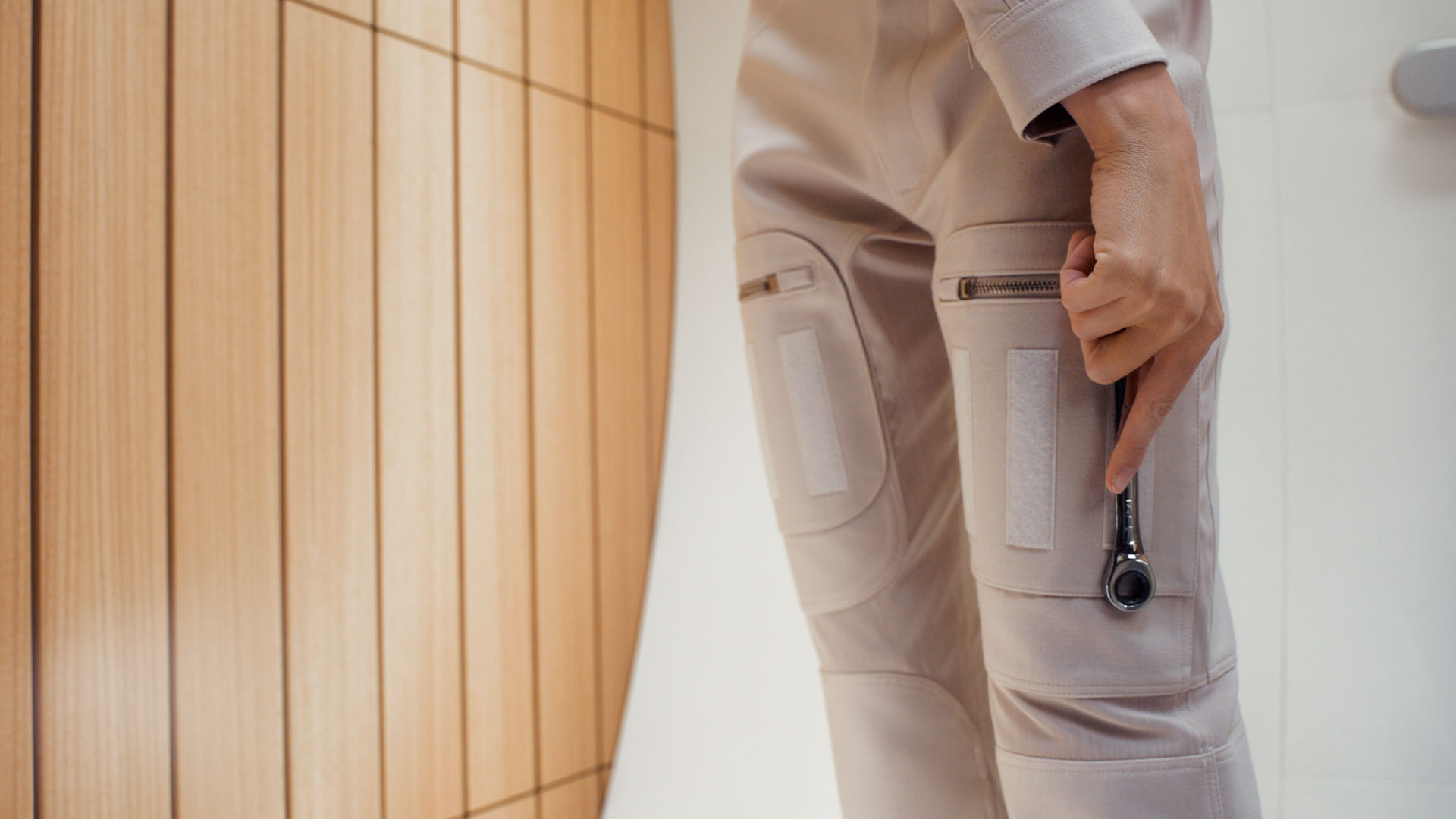
The Vast Astronaut Flight Suit has pockets and hook-and-fastener (Velcro) attach points to keep crew members’ tools handy.

The Vast Astronaut Flight Suit has pockets and hook-and-fastener (Velcro) attach points to keep crew members’ tools handy. Credit: Vast

Vast stepped back from off-the-shelf solutions to meet its “human-centric approach to design.” Over the next year, the suit will continue to undergo iterative testing and refinement, including material validation for safety, durability, and compatibility with the station’s environment.

Specifically suited

The Vast Astronaut Flight Suit was developed with the company’s clients in mind, from its fit to its features.

Worn as either a one- or two-piece garment by zipping (or unzipping) the jacket from the pants, the flight suit will be tailored to each crew member while also offering increased comfort and mobility through back vents and shoulder gussets. The suit also has pockets and hook-and-loop fasteners (Velcro) so tools can be easily stowed and retrieved.

With utility in mind, Vast sought to create a highly functional flight suit optimized for both training on Earth and daily use aboard Haven-1 in orbit.

With utility in mind, Vast sought to create a highly functional flight suit optimized for both training on Earth and daily use aboard Haven-1 in orbit. Credit: Vast

“In microgravity, you need your hands free and your tools always within reach,” said former NASA astronaut Megan McArthur, who is also advising Vast. “You’re constantly moving through small spaces and positioning your body in ways we don’t experience on Earth.”

Despite its clean white color and uniform design, the suit also provides for points of personal customization. Each crew’s suits will sport their own mission patch, and it has a place for each crew member’s flight badge, “wings” that they will individually earn from Vast “by launching, living on orbit and performing mission operations in space,” according to the company.

Separate from the flight suit but along the same lines, each Vast crew member will also wear the Pilot’s Venturer Vertical Drive, a timepiece designed by the Swiss luxury watchmaker IWC Schaffhausen and tested in partnership with Vast. IWC engineered the watch to meet the challenges presented during human spaceflight, including replacing the crown with a more glove-friendly rotating bezel. Vast ensured the watch could withstand vibrations and pressure changes and be compatible with the Haven-1 on-board environment.

a black face and white strap on a wristwatch is seen floating above Earth in this rendering

IWC Schaffhausen partnered with Vast to certify its Pilot’s Venturer Vertical Drive, a wristwatch designed for space.

IWC Schaffhausen partnered with Vast to certify its Pilot’s Venturer Vertical Drive, a wristwatch designed for space. Credit: IWC Schaffhausen

(IWC Schaffhausen is offering the Pilot’s Venturer Vertical Drive to anyone for $28,200.)

“It’s something astronauts can actually use,” said Feustel. “This is the flight suit for the commercial, crewed spaceflight era, and it’s really just the beginning.”

Pope Leo heading back to Rome after outspoken Africa tour

0
pope-leo-heading-back-to-rome-after-outspoken-africa-tour
Pope Leo heading back to Rome after outspoken Africa tour


Pope Leo returns to Rome on Thursday after wrapping up ‌an ambitious four-nation Africa tour in which he forcefully decried the direction of global leadership, denouncing despotism and war, and drew the ire of U.S. President Donald Trump.

The first U.S. ​pope closed the nearly 18,000 km (11,185 miles) tour with a final ​Mass in a stadium in Equatorial Guinea, where tens of ⁠thousands began gathering in pouring rain before dawn for a last ​chance to see him.

Leo told worshippers in a homily, his 25th speech over ​the 10-day tour, that the Christian message means “every people is set free from the slavery of evil”. He urged them to live their faith with joy.

The pope has taken ​on a new forceful speaking style during his time in Africa, in ​which he also visited Algeria, Cameroon and Angola.

Leo has warned that the whims of the ‌world’s ⁠richest threaten peace, decried violations of international law by “neocolonial” global powers, and said the world was “being ravaged by a handful of tyrants“.

Trump attacked Leo as “terrible” on April 12, on the eve of Leo’s Africa tour, in an apparent ​response to the ​pope’s criticisms of the ⁠U.S.-Israeli war on Iran. He lobbed several more critiques throughout the first week of the tour.

Leo told Reuters on ​April 13 that he would keep raising his voice, despite ​Trump’s ⁠criticism. He later clarified to reporters that the speeches for the tour were written weeks ago, and not aimed directly at Trump.

The pope, departing shortly after midday ⁠on ​Thursday, is due to arrive at Rome’s Fiumicino ​airport a little before 8 p.m. (1800 GMT). He is expected to hold a news conference ​aboard the flight.

Source:  Reuters

Kash Patel Is Using MAGA’s Favorite Tool to Muzzle the Free Press

0
kash-patel-is-using-maga’s-favorite-tool-to-muzzle-the-free-press
Kash Patel Is Using MAGA’s Favorite Tool to Muzzle the Free Press


Eoin Higgins is the author of “Owned: How Tech Billionaires on the Right Bought the Loudest Voice on the Left.”

Smarting from the humiliation of a report published at The Atlantic about his time in office, FBI Director Kash Patel did what conservatives have done over and over in the age of Trump: He sued for defamation. 

The Atlantic’s story detailed allegations about Patel’s mismanagement of the office and FBI staffers’ concerns that his behavior has become borderline dangerous. According to the magazine’s reporting, staffers have observed that the director frequently drinks to the point of intoxication and has been unreachable behind closed doors multiple times, at one point necessitating agents breaking down a door. In his lawsuit, Patel said that the allegations are demonstrably false. 

Patel’s case — which names the publication and the writer as defendants and demands $250 million in damages — doesn’t appear very strong; it’s unlikely he’ll win in court. But a legal victory isn’t necessarily the goal. Such lawsuits apply financial pressure and ensure newsrooms think twice before publishing critical articles in the future.

For all the modern right-wing movement’s bleating about its commitment to free speech, in practice they’re anything but, with a demonstrated penchant for using the legal system as a cudgel against people who say things they don’t like. Known as strategic lawsuits against public participation, or SLAPP, they are a tool of the powerful — and have multiple levels of use.

Most immediately, SLAPP allows plaintiffs the potential to muzzle their critics, who will be less likely to launch attacks against someone who has already proven litigious. This applies not only to the defendant, whether it’s an individual or an institution, but also to others like them who will think twice rather than risk a protracted (and expensive) legal battle.

Even if these anti-free speech crusaders don’t win a judgment, they have a good chance of draining their opponents’ bank accounts. 

Typically, the more deep-pocketed someone, or their backers, are, the more they can bleed out defendants by dragging on court cases for as long as possible, racking up legal bills that will have to be paid. Most publishers and newsrooms have lawyers on retainer or in-house, but their legal insurance deductibles are still high, potentially running into the hundreds of thousands of dollars per case. 

Even if these anti-free speech crusaders don’t win a judgment, they have a good chance of draining their opponents’ bank accounts — and breaking their spirits. 

Federal action is is sorely needed to make sure the use of SLAPP doesn’t spiral further out of control. Many states, including New York and Minnesota, have anti-SLAPP laws on the books, but their application in federal courts remains unsettled. Patel filed his suit in D.C. federal court, where the appellate court says the anti-SLAAP statute does not apply. 

Universal application of these laws is needed so the powerful can’t turn to federal courts for meritless filings, and some lawmakers, like Rep. Jamie Raskin, D-Md., and Sen. Ron Wyden, D-Ore., have introduced legislation to that end. So far, however, those bills have not made it to law. 

Patel is far from the only conservative figure to deploy the courts as a weapon against his critics, and this isn’t even his first shot at it; he has an ongoing 2019 lawsuit against Politico, for that outlet’s reporting on his time with the National Security Council during Donald Trump’s first term, and another defamation action, against former FBI official Frank Figliuzzi for comments on MS NOW, was dismissed on Tuesday.

Trump’s manipulation of the legal system to punish detractors predates his time in politics, but it’s gone into overdrive since his first term. The president has filed multiple defamation suits against members of the media and their organizations, including $475 million against CNN in 2022 (which was dismissed in 2023); the Pulitzer Prize Board for an award he objected to in 2022 (ongoing); journalist Bob Woodward and his publisher Simon & Schuster in 2023 (dismissed); ABC News in 2024 (settled for $15 million); CBS parent Paramount in 2024 (settled for $16 million); the Wall Street Journal in 2025 (dismissed), the New York Times in 2025 for $15 billion (ongoing), the BBC in 2025 for $10 billion (ongoing); and others. To be clear, this is not an exhaustive list. 

Trump and Patel are two of the better known conservative figures attacking free speech via the courts, but it’s a mainstay tactic in MAGA world. Laura Loomer, an Islamophobic off-and-on ally of Trump, sued late-night personality Bill Maher over comments he made about her relationship with the president (the case was thrown out on Wednesday evening). In 2013, Trump sued Maher for breach of contract after the HBO pundit promised $5 million to charity if the then-real estate magnate could prove his mother was not an orangutan. (Trump withdrew the case.) 

Elon Musk, the tech billionaire with close ties to the White House, used his X social media platform to file a suit against Media Matters for America over its reporting on ad content running alongside antisemitic posts on the site. And David Sacks, another tech billionaire who worked as Trump’s crypto and AI czar, threatened the New York Times over its reporting on his conflicts of interest in a public legal letter last December

Closer to home, I’m currently being sued, along with my publisher, Hachette, for more than $1 million by conservative pundit Matt Taibbi over my book, “Owned: How Tech Billionaires on the Right Bought the Loudest Voices on the Left,” which delves into his ideological shift to the right. And the editor of this piece you’re reading now, Katherine Krueger, was sued for $100 million alongside her former employer Splinter by 2016 Trump spokesperson Jason Miller for a story about a court filing that alleged he drugged a woman with an abortion pill. Miller refuted the allegation, but that case was thrown out on summary judgment because it accurately reported what was in the court filing; mine is ongoing.

In some circumstances, as Trump found after he was elected to a second term in 2024, SLAPP lawsuits can succeed, irrespective of the strength or weakness of the claim. ABC News and Paramount settled with Trump in what are widely regarded as payoffs to a powerful figure who can control their corporate future. Corporations have made the calculation: Better to get on his good side than risk four years of retribution, and, after all, what’s a few million dollars compared to the benefits of having the world’s most powerful person looking kindly on you?

Whether or not Patel expects to win a $250 million judgment, a central claim in his lawsuit is that his word is enough to shut down speech. 

But for the right wing, SLAPP suits also serve to make an ideological point. Whether or not Patel expects to win a $250 million judgment, a central claim in his lawsuit is that his word is enough to shut down speech. 

Because he told The Atlantic the claims in their article weren’t true, they shouldn’t have published it, the complaint argues: “Defendants published the Article with actual malice, despite being expressly warned, hours before publication, that the central allegations were categorically false.” The objections of a powerful man should be enough to avoid bad press, this line of reasoning goes; publishing anything to the contrary is wrong. 

That’s the animating principle behind the right-wing’s relationship with the media. If they disagree with it or find it embarrassing, you shouldn’t publish it; if you disobey, you must be punished. 

It wasn’t until Trump — and decades of ideological capture of the courts — that there was the potential to regularly use the legal system as a weapon against critics. Until there are First Amendment protections against SLAPP, we can expect the powerful to continue dragging their detractors to court. 

Merz rearming Germany to free Europe from big power intimidation

0
merz-rearming-germany-to-free-europe-from-big-power-intimidation
Merz rearming Germany to free Europe from big power intimidation

Germany has announced a massive rearmament plan that includes development of new and sophisticated offensive weaponry and an increase in military manpower to levels not seen in Western Europe since the Cold War.

The plan is built on a dual goal of countering perceived threats from an expansionist Russia and aggressive China while replacing Europe’s defense dependency on an increasingly unpredictable and even hostile United States.

And Germany is prepared to take on the chore of freeing European from big power intimidation.

“We are transforming the Bundeswehr into Europe’s strongest conventional army,” said German Defense Minister Boris Pistorius, as he laid out the future “strategic orientation” of German’s armed forces.

“In the short term, we are enhancing our defensive capabilities. In the medium term, we aim for a significant buildup of capacity. In the long term, we will ensure technological superiority.”

Pistorius issued these intentions Wednesday as he put meat on the bones of statements made by German Chancellor Friedrich Merz, who has taken a hawkish view of a need for a strong European defense.

Merz cites both Russia’s war on Ukraine and US President Donald Trump’s hostility toward the NATO alliance as necessitating self-reliance. On occasion, he throws China into the mix of foreign threats.

In February at the annual Munich Security Conference, Merz forecast a dangerous environment for an under-defended Europe.

“First and foremost,” he said, “There is Russia’s violent revisionism, a brutal war against Ukraine, against our political order, with the most severe war crimes being committed on a daily basis.”

He went ominously on, saying that, “If, after the fall of the Berlin Wall, there was a unipolar moment in history, it has long gone. The United States’ claim to leadership is being challenged, perhaps even forfeited.”

He referred to China as a country that “has the ambition to shape global affairs, laying the foundations for this over many years with strategic patience.

“In the foreseeable future, Beijing could draw level with the US in terms of military might,” he warned, “reinterpreting the international order on its own terms.”

According to a Defense Ministry document issued by Pistorius, Germany plans $1 trillion worth of new defense projects to be completed by 2035. Among the priority items are:

• Development of air defense, long-range missile strike capabilities and the ability to wage new data-driven warfare. New technologies such as artificial intelligence are also set to play a new role.

• Creation of “deep strike” rockets, cruise missiles and armed drones to hit targets far beyond front line positions. The weapons will be designed to strike command and control centers, enemy supply routes and infrastructure used by the enemy to launch its attacks.

• An increase of combat manpower from the current 200,000 to 460,000, to combine active troops and reservists. Also non-combat reserve units will be mounted to aid the country’s likely role as Europe’s chief logistical hub.

• Reduction of bureaucratic logjams by employing digital processing to eliminate paperwork. Artificial intelligence short cuts would be introduced to speed decision making.

“These strategies are living documents,” Pistorius cautioned, pledging that they will be periodically updated. Some innovations will not be publicized. “Otherwise,” he explained, “We might as well add Vladimir Putin to our email distribution list.”

Other NATO countries have articulated upgrades in defense capabilities, though none has been as expansive as Germany’s. France has said it will increase its nuclear weapons-deterrent weaponry. Great Britain said that, at high technical levels, its defenses are up to date, but the hardware beneath is antiquated. Italy is developing defense projects with partner countries.

Merz’s opinion of the Russian threat contrasts sharply with the views of two previous chancellors, Gerhard Schroeder and Angela Merkel. Each downplayed military development needs.

Schroeder, who served as chancellor from 1998 to 2005, fostered close and friendly relations with Vladimir Putin. He focused on satisfying Germany’s appetite for supplies of Russian natural gas and on his own desire to distance Germany from Washington’s sphere of influence.

Schroeder’s sponsorship of the Nord Stream 2 undersea gas pipeline that ran from Russia to Germany symbolized his desire for a close economic partnership with the Kremlin and distance from Washington.

After he left office, he worked as a paid lobbyist for Gazprom, the Russian energy giant.

When Putin launched his first invasion of Ukraine in 2014, Schroeder blamed NATO.

Politically, he also took a soft line on Putin’s constant insistence that Ukraine was part of Russia. He blamed Russia’s 2014 invasion and annexation of Crimea not on Putin’s imperialist proclivities but simply on the Russian leader’s “fears about being encircled.”

During his tenure in office, Schroeder reduced defense spending to a post-Cold War low: 1.3% of gross domestic product.

Merkel was less effusively positive with Putin, but nonetheless maintained the notion that dialogue and good economic relations would domesticate Moscow. She opposed placing strong sanctions on Russia after its first invasion of Ukraine. Sanctions were especially desired by Poland and the Baltic states bordering the former Soviet Union.

Merkel insisted on completing the Nord Stream 2 project, which US President Joe Biden gave his go-ahead to finish in 2021. Trump had opposed the project during his first 2017-2021 stint in office. Someone blew up the pipeline on September 26, 2022.

Although Merkel had once been considered Europe’s leading political figure, her notion of taming Putin with the candy of trade and frequent consultations diminished her prestige in Europe, where some dismissed it as Pollyannaish.  

After leaving office, Merkel was unapologetic. She contended that she clearly understood Putin’s bullying proclivities: “I always knew he wanted to destroy Europe.” Yet, she argued, it was important to keep “a trade connection” with “the world’s second largest nuclear power.”

“I don’t see that I should now have to say that was wrong,” she told an audience in Berlin. “And, therefore, I will not apologize.”

Merz’s approach is different: to provide a European alternative in world affairs, an independent yet muscular Europa über alles, with a kinder, gentler Germany in the lead.

0FansLike
0FollowersFollow
0FollowersFollow
0SubscribersSubscribe
- Advertisement -
Google search engine

Recent Posts