Home Blog

Why Germany is building an ark for US climate data

0
why-germany-is-building-an-ark-for-us-climate-data
Why Germany is building an ark for US climate data

This story was originally published by Yale E360 and is reproduced here as part of the Climate Desk collaboration.​

In a modern five-story building in the center of Hamburg, Germany, technicians are preparing to install several new “racks” — gray metal casings that hold computing hardware — alongside the scores that already line the narrow, dimly lit corridors of the German Climate Computing Center, or DKRZ, one of the world’s largest repositories for climate simulation data. The new equipment will add about 5 petabytes of storage capacity to the 254 petabytes of data already stored here. One petabyte of data is equivalent to the storage space needed for roughly 200 million high-resolution images.

Under normal circumstances, the DKRZ’s mission is to provide computing power and storage to the German climate science community. But these new racks will serve a different and highly sensitive purpose: They will store backup versions of climate simulations from the other side of the Atlantic. The operation aims to ensure that essential work performed by U.S. scientists for the next major U.N. climate assessment, due in 2029, cannot be meddled with or compromised by the administration of President Trump, which has slashed funding for climate research, buried scientific reports, removed references to human-caused warming from dozens of government websites, and sought to prevent satellites from collecting key climate data. 

Leaders of German science organizations publicly cite these actions as their primary motivation for creating backups. The German Research Foundation, the country’s main science funding body, believes that the Trump administration could block European access to data and research findings stored in the U.S. “The deletion of data has also become a possibility,” said the foundation’s program manager, Kathrin Winkler, “and there is a risk that [data] could be manipulated to skew findings in a desired direction.” 

Trust in U.S. science policy has fallen to a low point in Europe, and fears of losing scientific data are mounting. The U.S. government quit both the U.N. Intergovernmental Panel on Climate Change, or IPCC, and the U.N. Framework Convention on Climate Change in January, though U.S. researchers are still contributing to global climate science. To support them, the German Research Foundation in late 2025 set up a program, with a budget of $35 million, to provide a safe haven for permanently storing copies of U.S. data from public and open sources.

The DKRZ project is called CMIP7-ark — a lifeboat for the U.S. contribution to the seventh IPCC assessment. Six other projects for U.S. science datasets, with names like SHIELD and SEND (Secure Endangered Earth Data), have also received funding. Christopher Kadow, head of the data analysis division at the DKRZ, said, “We cannot simply accept that important contributions might be lost for technical or political reasons.”
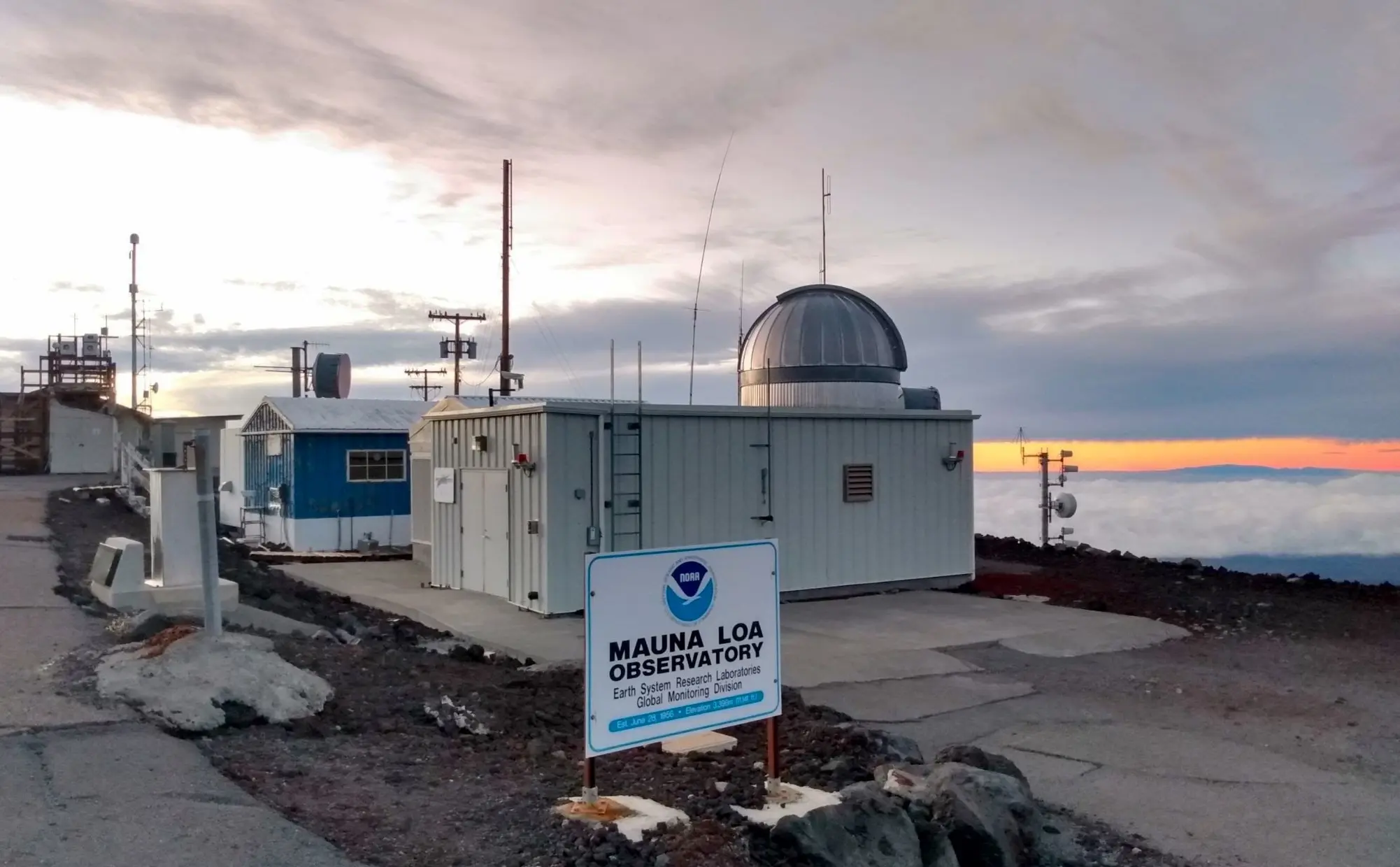
iconic time series of atmospheric carbon dioxide concentrations made at Hawai‘i’s Mauna Loa Observatory, have been ongoing for decades and are critical for tracking environmental change. (In 2025, the Trump administration tried to defund and close the observatory, but later Congress rejected its proposed cuts.)

While detailed datasets are essential for research, it is not standard procedure to back them up in alternate locations. Most scientific datasets are physically stored on hard drives or magnetic tapes at the universities or institutions where they are generated. One simple reason for this is that, until recently, the world seemed safe enough that scientists saw no need for off-site backups. Another reason is that transferring and storing such large amounts of information is complicated. Sending petabytes of data through the internet takes months, and renting faster fiber optic cables can be extremely costly. Often, the most cost-effective way to transfer large volumes of data is to put them on hard drives or far cheaper magnetic tapes and send them through the “sneakernet,” which means they are physically transported by car, plane, or ship. 

Still, the process is expensive and arduous, so most datasets have been kept in just one place. But in a world where political upheaval, cyberattacks, and armed conflicts are becoming more frequent, this practice is increasingly considered to be precarious. “If data is stored at only one site, there is a much greater risk of loss from events such as extreme weather or infrastructure failure,” said Eleanor O’Rourke, the U.K.-based director of the International Project Office of the Coupled Model Intercomparison Project, which coordinates global climate models for the IPCC’s assessments. Climate simulations for the IPCC are now considered so critical that overseas repositories are thought necessary for all contributions.

Until recently, the idea that the U.S. science community would have to track or rescue lost datasets was unthinkable. After all, environmental data generated or funded by U.S. government agencies was paid for by taxpayers and generally remains in the public domain. Yet these datasets exist in physical forms at specific locations and require dedicated experts to maintain them, which makes them vulnerable to human interference, as well as natural disasters, technical problems like short circuits or battery explosions, and neglect. “The data repositories, digital asset management services, and preservation systems that ensure research data remains open and accessible are often overlooked — until they disappear,” data experts Jennifer Gibson and Kaitlin Thaney warned recently. 

Read Next

One example of political interference is the recent threat to 300 federally funded datasets carefully built up over decades by NASA’s Socioeconomic Data and Applications Center, or SEDAC. Alex de Sherbinin, the former SEDAC manager, said the center was founded to “serve as a bridge between the Earth and social-science research communities,” integrating remote sensing data with information on human population, poverty, and infrastructure.

In early April 2025, de Sherbinin was shocked to discover that SEDAC’s datasets had been completely removed by Elon Musk’s Department of Government Efficiency team. It took immense efforts by various institutions, quickly scraping datasets from active servers while they were still operational, to secure the information and transfer it to a new host: the Harvard Dataverse Repository. Assumptions that U.S. government agencies will store scientific data long-term “are proving tenuous at best, given the anti-science predisposition of the current administration,” de Sherbinin said.

Numerous similar projects aim to relocate or duplicate datasets within the U.S. But the U.S. is far from the only country where data is vulnerable, and political interference is not the only risk.

Several research institutions around the world, including a multidisciplinary scientific research center in Croatia and an institute for industrial engineering in Germany, have in recent years been the target of elaborate hacking operations, in which intruders block access to files and demand money to restore them. Victims of cybercrimes rarely disclose publicly which files were targeted, but it’s clear that such attacks can affect scientific data collections.

And then there’s war. Russia’s attacks on Ukraine have not only caused mass civilian death and suffering but also immense damage to the country’s science. “Universities and research institutes have been targeted by Russian bombardments, and in some cases they were completely destroyed,” said Anastasiia Lutsenko, a Ukrainian researcher at the Max Planck Institute for Innovation and Competition in Munich, whose work focuses on how her country’s science system is responding to the war. The Russians, she said, “know how much lasting harm they can inflict by attacking science.” 

Lutsenko cites the transfer of data and samples to secure locations as an important step. Even before Russia’s 2022 invasion, a German-Polish-Ukrainian collaboration helped digitize records of early meteorological observations — conducted between 1808 and 1880 at eight Ukrainian meteorological stations — and transferred them to a server at the University of Giessen, Germany. This eliminated the risk of losing valuable historical data in the war. A similar transfer took place after missiles struck near the servers holding Ukraine’s contribution to the Global Biodiversity Information Facility’s records in Kharkiv at the start of Russia’s invasion. 

The need for increased resilience — the ability to remain functional despite shocks and fully recover from them — was the focus of the American Geophysical Union, or AGU, gathering held in Berlin this March. There, nearly 100 experts, primarily from the U.S. and Europe, discussed how to respond to the Trump administration’s attacks on science. 
Read Next

The AGU represents more than 60,000 Earth and space scientists worldwide, and it has emerged as a leader in efforts to protect science and scientists from the Trump administration’s politically motivated attacks. When the administration refused to send U.S. experts to IPCC meetings in 2025, the AGU formed the U.S. Academic Alliance for the IPCC and nominated nearly 300 U.S. scientists to be authors of the IPCC’s next assessment. And in the summer of 2025, it launched its Data Resilience Project, a global initiative to rethink how science is organized.

AGU president-elect Ben Zaitchik believes that science is at an inflection point. “We have engaged in triage efforts to ensure data remains usable and accessible,” he said at the Berlin meeting. “But we clearly now have arrived at a moment where we must fundamentally reimagine data organization and maintenance for long-term viability and growth.” 

Creating backups of datasets and storing them in secure, distant locations was identified as a priority measure during the meeting, as was coordinating a global data community aimed at mitigating current and future risks. Such an effort was vital not only for scientists, an AGU spokesperson noted, “but also for engineers, public safety officials, health experts, policymakers, and a wide array of industries and communities globally,” which depend on scientific data. As a result of the Berlin meeting, a broad coalition of German national research centers was formed to offer safe storage for public domain information to scientists from the U.S. and other countries.

In addition to the DKRZ efforts, other initiatives have emerged across various fields. For example, the Senckenberg Natural History Museum, in Frankfurt, saves data from wildlife trail cameras in Ukraine and biodiversity data from war-ridden Yemen. “We want to ensure that biodiversity data remains usable even under crisis conditions,” a Senckenberg spokesperson said.

For such transfers, it is critical to store not only the data itself but also any specialized software required to read and analyze it. “We’re developing protocols and procedures for exchanging data, distributing multiple copies globally, and ensuring that the data remains analyzable indefinitely,” said Frank Oliver Glöckner, a professor of Earth systems data science at the University of Bremen and the head of Pangaea, a long-term data repository run by the Alfred Wegener Institute for Polar and Marine Research and the university, both of which are preparing to integrate data from a U.S. climate research center slated for closure. 

Glöckner said he believes that President Trump “has, to a certain extent, done science a favor by making it clear how important it is to not just hoard data in one place but to truly share it with the global scientific community.”

“It would be ideal if, in the future, all climate data worldwide were connected via digital pipelines,” said Kadow, of the DKRZ. “That way, in the event of a threat, we could simply flip a switch to secure it elsewhere.” In the future, he said, this could also benefit researchers in Germany, where the AfD, an extreme far-right party that denies climate science, recently won a state election for the first time. “We don’t know what political shifts may occur in Germany,” he said. “We aren’t completely protected from risks or developments like those in the U.S. either.”

What the Prairieland Jury Never Got to Hear

0
what-the-prairieland-jury-never-got-to-hear
What the Prairieland Jury Never Got to Hear


On the last day of the Prairieland trial, in which nine Texas protesters were accused of crimes including providing material support to terrorists, the attorney for activist Benjamin Song presented a novel argument that, if true, would have upended the federal government’s case.

Song had been charged with attempted murder for allegedly firing a gun at the first police officer who arrived on the scene after a noise demonstration outside U.S. Immigration and Customs Enforcement’s Prairieland Detention Center in Alvarado on July 4, 2025.

The defense — more than a dozen attorneys representing clients with varying degrees of involvement in the protest — had rested their argument without calling a single expert witness, owing to what they thought was the weakness of the government’s case.

“Attempted murder requires that you intend to kill. And if the government can’t prove that intent, that’s a not guilty — period.”

During closing arguments, however, Phillip Hayes, Song’s attorney, raised what he said was a major flaw in the government’s depiction of what happened: Song never aimed his weapon at the police officer. Relying on evidence introduced by the prosecution — a photograph of the bullet, witness testimony, and CCTV footage of the incident — Hayes said his client never intended to shoot Alvarado Police Department Lt. Thomas Gross.

Rather, Hayes said, Song fired his weapon at the ground and the bullet ricocheted off a hard surface before striking the officer just below the neck. That would explain the plumes of dust that were visible in the video. According to Hayes, the only photo of the bullet, which appears severely bent and with several missing fragments, backs up the theory.

“Attempted murder requires that you intend to kill,” Hayes, a lanky, soft-spoken criminal defense attorney, told the jury on March 11. “And if the government can’t prove that intent, that’s a not guilty — period.”

The jury didn’t bite. Instead of being acquitted, Song was convicted and sentenced to 100 years in prison.

One reason the ricochet theory didn’t play a bigger role in the trial was that the federal government prevented it from being fully aired. Key details about the shooting, and the officer’s actions, were only revealed during the trial itself. Prosecution motions and favorable rulings by the judge, a Trump appointee, made it difficult for Song’s lawyers to fully vet the idea or argue that he had acted in self-defense.

And an independent ballistics expert hired by Song’s defense team before the trial was denied access to the defendant in federal prison. As a routine part of any case about a murder or a shooting involving a police officer, said Daryl Parker, the former Marine Corps officer and criminal defense investigator hired by Song’s team, a ballistics expert will meet with an alleged shooter to collect information. Nothing about the Prairieland case, however, was turning out to be routine.

It was the first time in his 25-year career that the forensics expert had been denied access to a client in a federal facility.

In emails reviewed by The Intercept, Parker and Hayes repeatedly wrote to Federal Medical Center Fort Worth, the federal detention center where Song was held before and during the trial, asking to visit the defendant. All the requests went unanswered. (FMC Fort Worth declined to respond to a request for comment.)

Parker never got a response from the jail official in charge of Song’s detention, let alone visitation rights.

“We sent him everything he asked for,” Parker, speaking publicly for the first time about the case, told The Intercept. “But approval never came.”

It was the first time in his 25-year career that the forensics expert had been denied access to a client in a federal facility.

In the end, members of the jury never received a full airing of the argument nor the multiple pieces of evidence that support it.

The ricochet theory, though, may yet be part of Song’s appeal and the basis of a new trial, according to two lawyers on Song’s defense team in his state-level case. New evidence, including material revealed for the first time in this Intercept investigation, shows that Song, a former Marine reservist and expert marksman, may have never intended to shoot the police officer.

New Evidence

The Prairieland case was touted by the Trump administration as the government’s first prosecution of an “antifa cell,” moving from indictment to trial in the Northern District of Texas in just a few months. For such a complex high-profile case, there wasn’t much time to prepare. And key pieces of information were hidden within or even omitted from discovery.

Buried within the tens of thousands of pages of evidence provided to the defense team was a grainy photograph: the government’s only image of the bullet that struck the police officer. According to two ballistics experts interviewed for this story, the photo is of such poor quality that it is difficult to conclude anything from the image alone.

Shaun Jaikissoon, a former firearms examiner with the New York City Police Department for 10 years who now has his own consulting firm, said the photo of the fragment provided by the prosecution tells us almost nothing and may even be deemed “unsuitable,” meaning it lacks value for a forensic analysis.

Parker, the independent ballistics expert hired by the defense team, said he agreed the photo was of little value.

“It is sparse,” he said. “You should have images of the end of the bullet — 360 degrees — so you can properly evaluate it.”

Despite the photograph’s limitations, it does reveal that the bullet was severely deformed, indicating a possible ricochet.

“It’s a copper banana,” said Parker. “It obviously struck something.”

The opinion is shared by one of the government’s own witnesses. During the trial, Philip Stout, a forensic scientist for the Texas Department of Public Safety, described the extreme curvature of the bullet as characteristic of a projectile fired into a water tank.

“When you’re dealing with higher velocity bullets, they slow down very quickly, so it gets that curved — I refer to it as a banana shape, but it’s more of a semicircle shape,” said Stout. “What that tells me is that bullet struck something and slowed down very quickly.”

Other questions arose from the shooting and investigation, Parker said. Perhaps most important is the fact that Gross’s bulletproof vest — level IIIA soft body armor — would not have been able to withstand the force of a bullet fired from an AR-15-style rifle at such close range. Even the label on the vest, introduced into evidence by the government, says: “This is NOT intended to protect against rifle fire.”

According to Parker, if the bullet had struck Gross directly — without first hitting another surface or object — it would have ripped through him “like Swiss cheese” and almost certainly killed him. Instead, the bullet came to rest inside Gross’s vest, with Gross sustaining minor injuries. He was released from the hospital a few hours later.

“The standard body armor that police officers wear is not rated for rifles,” Parker said. “It’s only rated for handguns. It’s not even rated for knives.”

“The fact that the officer is not dead, to me, is a big red flag that Song wasn’t aiming at him.”

Another clue that points to a ricochet, according to Parker, is Song’s skill as a marksman, especially given the short distance between the two shooters and Song’s previous training as a Marine.

“The fact that the officer is not dead, to me, is a big red flag that Song wasn’t aiming at him,” Parker told The Intercept.

Together, this new evidence of a ricochet matches the information that became apparent only during the trial when Gross testified that he drew his weapon first and aimed at a fleeing protester. Drawing on this testimony, along with video evidence, Song recounted the same version of events in a statement he read during sentencing.

“When I saw Lieutenant Thomas Gross stop pursuing and point his gun at the back of a running, unarmed protester, like he testified, I was terrified,” Song said. “As a firearms instructor and a United States Marine Corps veteran, I understood what I was seeing. As the evidence shows, I did not want to hurt anyone.”

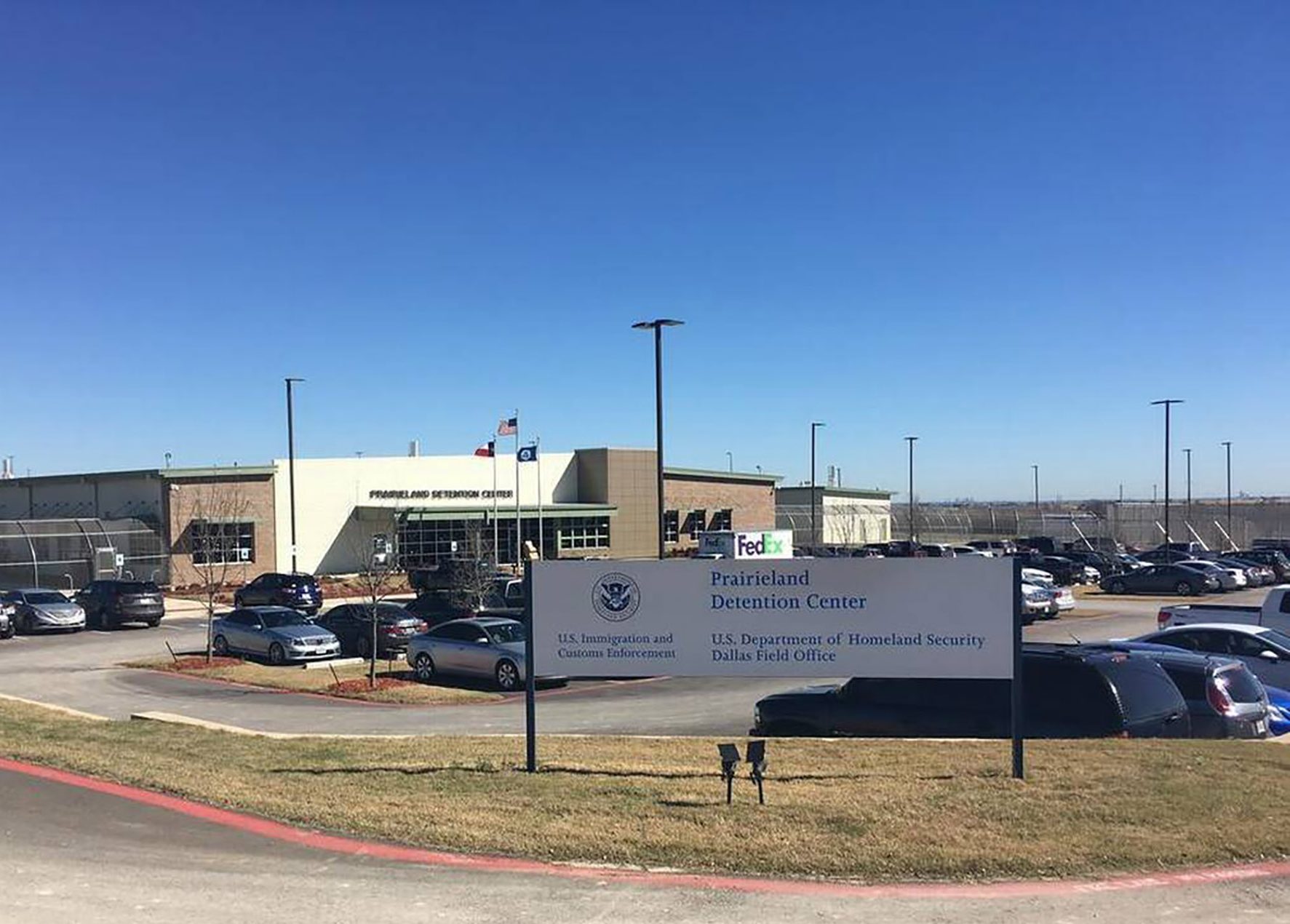
A group ambushed corrections and police officers outside the Prairieland Detention Center in Alvarado, Texas, on July 4, 2025, creating a distraction with fireworks and graffiti before firing upon officers with semiautomatic rifles. (Mark David Smith/Fort Worth Star-Telegram/Tribune News Service via Getty Images)
U.S. Immigration and Customs Enforcement’s Prairieland Detention Center in Alvarado, Texas, on July 7, 2026. Photo: Mark David Smith/Fort Worth Star-Telegram/Tribune News Service via Getty Images

Shots Fired

That Gross drew first and aimed at a protester’s back were among the facts that, according to Song’s lawyers, were not revealed to the defense until the trial itself. Also missing from the pre-trial discovery was evidence indicating that bullets fired at the scene struck the ground. The marks in the pavement were not documented as part of the investigation.

Given these late-breaking revelations, Song’s lawyers had to scramble in the middle of the trial to put together their argument. Song’s defense team, in a motion for a new trial filed in April, said that the failure to disclose evidence of the bullet strikes sooner deprived them of the ability to make their case that Song never intended to shoot officer Gross.  

The existence of bullet strikes was only revealed during the second week of the trial, when evidence from the investigation, headed up by the Texas Rangers, an elite unit within the state’s Department of Public Safety, was divulged in court. Texas Ranger Billy James Hill Jr., responsible for photographing the scene, admitted during cross-examination to finding “recent looking defects in the concrete surface.”

Tailim Song, Benjamin Song’s father and a civil attorney who was part of his son’s defense team, said the ricochet theory only began to take shape when they learned about the deformations in the road.

“It really didn’t come home until the Rangers said there were fresh bullet strikes in the concrete.”

“In my mind,” Tailim Song said, “it really didn’t come home until the Rangers said there were fresh bullet strikes in the concrete.”

The photographs from the scene, however, didn’t include shots of the ground. When asked during the trial whether he had taken any photos of what he believed to be bullet strikes, Hill, the Texas Ranger, responded that it “wasn’t part of my responsibility.”

Hill had taken photographs using a high-tech camera system called a Leica RTC360 Digital Crime Scene Scanner, which creates reconstructions of the alleged events. The reconstruction, however, omitted photographs and chemical swabs of where the bullets had struck the pavement as well as the crucial trajectory analysis and shooter-position determinations. (The Texas Department of Public Safety and the Department of Justice did not respond to questions about the investigation or crime scene reconstruction.)

Ryan Rider, a crime scene reconstruction expert and former Texas police officer who teaches classes on the Leica device at Tarleton State University, said the technology, if used properly, can provide precise measurements — down to the millimeter — of the bullet’s pathway in relation to the shooter.

“It does tell you a story,” he said.

Rider also said shootings involving officers are potentially chaotic environments with multiple agencies involved in collecting evidence, interviewing witnesses, and securing the crime scene. In the Prairieland case, Alvarado Police Department; the Johnson County, Texas, Sheriff’s Office; the Department of Homeland Security; the Bureau of Alcohol, Tobacco, Firearms, and Explosives; and the FBI; in addition to the Texas Rangers; were all present. Not documenting the bullet strikes — especially if the Rangers knew they were there, as Hill acknowledged in court — is hard to explain, Rider added.

“A trooper shouldn’t be up on the stand saying, ‘That wasn’t my responsibility,’” Rider said. “If they’re on the scene, people are going to expect them to be the ones to say, ‘Hey, get pictures of this.’”

“A trooper shouldn’t be up on the stand saying, ‘That wasn’t my responsibility.’”

With the gaps in the forensic evidence and crucial facts withheld until the middle of the three-week trial, defense attorneys couldn’t pull together a coherent, countervailing version of events quickly enough. Even when they tried, as evidence undermining the government’s claims trickled out, the lawyers faced new hurdles.

Gross gave his testimony early in the trial about drawing his gun first, information that was left off a police report and not included in discovery. Then the judge granted a prosecutors’ motion barring Song’s lawyers from using a self-defense argument, which became a frequent point of contention.

At one point, during his closing argument, Hayes, Song’s defense attorney, suggested that Gross may not have been justified in pulling his weapon so quickly. The judge, a member of the conservative Federalist Society, admonished Hayes for treading too close to a rationale for self-defense.

Appealing for His Life

The Prairieland trial unfolded as Trump escalated his crackdown on anti-ICE protests across the country. The verdicts were celebrated by the Trump administration as its first successful prosecution of a violent “antifa cell,” and the first eight defendants were sentenced to more than 450 years in prison altogether.

“These guilty verdicts and convictions rightly reflect the vicious, armed attack that these Antifa cell members planned and executed against law enforcement and detention center officers on the night of July 4 last year,” a top Department of Justice official said after the convictions were handed down.

The government’s narrative rested on the premise that the noise demonstration was an organized ambush of law enforcement officers and that Song’s intent from the outset was to kill a police officer. But this version of events relies on an incomplete picture of what transpired that night.

Whether information that came to light during the trial is adjudicated as part of the appeals process will be decided by the 5th U.S. Circuit Court of Appeals, one of the most conservative courts in the country and one that Trump’s Justice Department has used to secure favorable rulings.

Patrick McLain, an attorney representing another Prairieland defendant, said it would likely be several months before any appeals are filed; it is still unclear what the focus will be and if the defendants will mount a coordinated effort. 

“My hope is that we’re going to have nine solid briefs that are mutually supporting and not contradictory,” McLain said. 

The 5th Circuit has not issued a briefing notice. Once it does, defense teams will have 40 days to submit their documents, according to John Kuchera, Song’s court-appointed appellate lawyer. Kuchera, reached by phone, said he has not yet had time to review the record and has not met with Song. He declined to comment on whether the theory about the bullet would be included in the appeal.

“What my opinions are about anything will show up in my brief,” he said. “Whatever issues that I think need to be addressed will be in that.”

Ultimately, the 5th Circuit will decide if evidence in the Prairieland case, including the bullet that struck Gross, can be reexamined and if Song, who now faces the prospect of spending the rest of his life in prison, will be granted a new trial.

Prince Philip’s Secret ‘Female Confidante’ Revealed

0
prince-philip’s-secret-‘female-confidante’-revealed
Prince Philip’s Secret ‘Female Confidante’ Revealed


Prince Philip spent more than 70 years at Queen Elizabeth II’s side — but in his final chapter, another woman reportedly became one of the most trusted people in his private world.

Penelope Knatchbull, Countess Mountbatten of Burma, was a longtime royal insider, family friend and fellow carriage-driving enthusiast who is said to have become an especially important companion during Philip’s quiet retirement at Wood Farm.

The Duke of Edinburgh retreated to the secluded farmhouse on the Sandringham estate after stepping away from public duties in 2017, trading palace schedules, royal engagements and constant scrutiny for a far more private existence.

And according to royal biographer Hugo Vickers, Knatchbull was among the people who regularly spent time with him there.

The revelation has renewed fascination with one of the most intriguing friendships in Philip’s later life.

By the time Philip retired at age 96, he had spent decades carrying out royal duties and supporting the Queen through one of the longest reigns in British history.

Wood Farm offered something completely different.

There, Philip could reportedly read, paint, spend time outdoors and indulge his lifelong passion for carriage driving without the rigid structure of palace life.

Vickers writes that Philip was particularly happy there and largely made the Norfolk farmhouse his home during the first years of retirement.

For a man who had spent most of his adult life surrounded by aides, officials and cameras, the change was dramatic.

It also meant Philip and the Queen increasingly followed different daily routines.

Elizabeth continued carrying out her responsibilities as monarch while Philip spent significant stretches of time in Norfolk.

That arrangement has sometimes been described in dramatic terms, but there is no evidence that the couple had ended their marriage.

They remained married until Philip’s death in 2021 after more than 73 years together.

Still, Philip’s new freedom created room for friendships that were far removed from official royal life — and Knatchbull appears to have been one of the most significant.

Knatchbull was not simply another member of the royal social circle.

She shared Philip’s deep love of carriage driving, a sport he embraced after giving up polo.

Philip became one of carriage driving’s most prominent supporters and helped shape international competition rules.

Knatchbull also took part in the sport herself, giving the pair a shared interest that had little to do with royal protocol.

Their friendship stretched back decades.

She married Norton Knatchbull in 1979, linking her even more closely to Philip’s extended family.

Norton is the grandson of Lord Louis Mountbatten, Philip’s uncle and one of the most influential figures in the royal family’s modern history.

That connection placed Knatchbull firmly inside a circle Philip knew and trusted.

Knatchbull endured unimaginable tragedy when her youngest daughter, Leonora, died of kidney cancer at just 5 years old in 1991.

She later created a children’s cancer fund in her daughter’s memory.

Over the years, Knatchbull remained a familiar figure at royal events and equestrian gatherings, and her friendship with Philip continued.

By the time Philip stepped away from public life, theirs was already a longstanding relationship built on family ties, shared interests and trust.

That closeness has naturally fueled years of speculation.

But there is no substantiated evidence that Philip and Knatchbull were romantically involved.

Public accounts have consistently described her as a close friend and confidante.

What is clear is that she occupied a remarkably trusted position in his life.

Philip’s retirement also marked one of the biggest changes in his marriage to Elizabeth.

For decades, the couple had lived within the same demanding royal machine.

After 2017, their schedules looked very different.

Philip increasingly stayed at Wood Farm while the Queen remained tied to official duties.

Vickers has written that Elizabeth would visit Norfolk, including for weekends, while Philip enjoyed the independence of retirement.

That physical separation has generated attention because it was so different from the image of the royal couple the public had known for generations.

But their marriage endured.

During the COVID-19 pandemic, Philip and Elizabeth were brought back together for an extended period at Windsor Castle, where they lived with a reduced staff.

Philip ultimately died there on April 9, 2021, at the age of 99.

Knatchbull remained close to the family after his death.

She attended Philip’s funeral and was also present at Queen Elizabeth’s state funeral in September 2022.

Philip’s final years appear to have been defined by a freedom he had rarely enjoyed before.

He was no longer racing from engagement to engagement.

He could decide how to spend his days, pursue his interests and surround himself with a much smaller circle.

Knatchbull was reportedly part of that circle.

And that is what makes their friendship so fascinating.

This was not simply a casual royal acquaintance.

She was a woman who had known Philip for years, understood his family, shared his interests and remained close during one of the most private periods of his life.

For a prince who had spent decades performing his role in public, Wood Farm became the place where he could finally disappear from view.

And Penelope Knatchbull appears to have been one of the people he trusted enough to let inside that private world.

Morocco-Israel Ties Deepen as Protesters Demand ‘No Ambassador, No Embassy’

0
morocco-israel-ties-deepen-as-protesters-demand-‘no-ambassador,-no-embassy’
Morocco-Israel Ties Deepen as Protesters Demand ‘No Ambassador, No Embassy’


As protesters marched against the embassy upgrade, the king’s Jerusalem agency met Palestinian leaders in the city and in Ramallah

Moroccan opponents of normalization with Israel were wrapping up three days of protests Sunday against the kingdom’s decision to upgrade relations to full embassies, even as Rabat moved forward with plans to exchange ambassadors and deepen economic ties with Israel.

The demonstrations followed a Sept. 16 announcement in New York by Moroccan Foreign Minister Nasser Bourita, Israeli Foreign Minister Gideon Sa’ar and US Ambassador to the United Nations Mike Waltz that the two countries would elevate their liaison offices to embassies and appoint ambassadors. They also agreed to conclude investment-protection and double-taxation agreements by the end of the year.

“There are always demonstrations against normalization,” Yasmine Hasnaoui, a political scientist at Hassan First University in Settat, told The Media Line. “Morocco does not stop those things. Has Morocco changed its course? Morocco did not stop its relations with Israel, because Morocco sees itself as a mediator in the Palestinian and Israeli cause.”

The upgrade builds on the 2020 agreement under which Morocco restored formal relations with Israel and President Donald Trump, during his first term, recognized Moroccan sovereignty over Western Sahara. Morocco also hosts African Lion, the largest US military exercise in Africa.

The Moroccan Front for Supporting Palestine and Opposing Normalization announced the protest campaign on Sept. 17, calling the embassy upgrade a further deepening of relations with Israel. Another coalition, the Moroccan Commission for Supporting the Nation’s Causes, said it organized 76 events in 45 cities on Friday.

In Rabat, demonstrators gathered outside Parliament chanting, “The people want the fall of normalization,” according to Moroccan media. Protesters in Marrakech shouted, “No ambassador, no embassy.” No serious disturbances were reported.

Moaz al-Hajri, national coordinator of the Front, also criticized the Israeli liaison office’s move to Mehdi Ben Barka Avenue in Rabat, calling the location “a provocation to the Moroccan people and to the memory of the martyr Mehdi Ben Barka.”

Ben Barka, a prominent independence-era opposition leader, advocated constitutional limits on royal power, land reform and state-led development before disappearing in Paris in 1965. Israeli journalists have reported that Mossad assisted Moroccan agents in tracking him.

Those long-running questions about political power and the distribution of economic gains also surfaced during Morocco’s parliamentary election Wednesday.

Final results issued Friday gave the palace-aligned Authenticity and Modernity Party 97 of the 395 seats in parliament. The National Rally of Independents won 66, Istiqlal 65 and the Islamist Justice and Development Party, known as the PJD, 54, up sharply from 13 in 2021. Turnout fell to about 38% from about 50% five years ago.

At a party council Saturday, PJD leader Abdelilah Benkirane credited the result to “great success from God” and said the public once again viewed the party as “a truly serious party.” He did not attribute its gains to the anti-normalization campaign.

The PJD itself headed Morocco’s government when relations with Israel were restored in 2020.

“They are against normalization, and they have demonstrated that on several occasions, except when they were in government,” Hasnaoui said. “They will take to the streets against what Morocco has done recently in upgrading the status of relations and establishing embassies. But I do not think it will touch the sovereignty of the country when it comes to the Western Sahara.”

Einat Levi, an expert on Morocco and Israeli-Moroccan relations who previously headed economic and academic affairs at Israel’s mission in Morocco, said ties between the two countries have deeper foundations than electoral politics.

Morocco-Israel relations are anchored in something broader than party politics

“Morocco-Israel relations are anchored in something broader than party politics,” she told The Media Line. “They reflect a strategic direction led by the king and the highest levels of the Moroccan state, built on long-standing ties, shared interests and a common heritage.”

Western Sahara remains central to that strategy.

Morocco claims sovereignty over the former Spanish colony, while the Algeria-backed Polisario Front seeks independence. UN Security Council Resolution 2797, adopted in October 2025, called for negotiations using Morocco’s 2007 autonomy proposal as a basis while reaffirming the goal of a mutually acceptable settlement consistent with the principle of self-determination. The mandate of the UN peacekeeping mission in Western Sahara expires Oct. 31.

Morocco has simultaneously maintained a public commitment to the Palestinian cause.

Speaking at the United Nations last week, Bourita defended the UN Relief and Works Agency for Palestine Refugees in the Near East (UNRWA), criticized Israeli annexation proposals in the West Bank and condemned settler violence.

UNRWA has become a major point of contention between Israel and many of its regional partners. Israel accuses the agency of allowing Hamas infiltration and says its treatment of Palestinian refugee status perpetuates the conflict. A UN investigation found that nine UNRWA employees may have participated in the Oct. 7, 2023, Hamas attack, and Israel subsequently barred the agency from operating on its territory. UNRWA rejects claims that recognizing descendants of Palestinian refugees is unique to the agency, noting that multigenerational refugee status also exists in other prolonged refugee situations.

Morocco has also pledged to deploy a military field hospital to Gaza. King Mohammed VI chairs the Organization of Islamic Cooperation’s Al-Quds Committee, which focuses on Jerusalem and Palestinian issues.

Morocco is there to mediate

“The king is head of the Al-Quds Committee,” Hasnaoui said. “That does not mean they are with Israel. Morocco is there to mediate.”

The committee’s operational arm, the Bayt Mal Al-Quds Acharif Agency, spent part of the protest week holding consultations in Ramallah and Jerusalem. Mohamed Salem Echarkaoui, the agency’s acting director, met Palestinian officials, Muslim and Christian religious figures, universities, hospitals and business representatives as the organization develops its 2027-2030 plan.

The agency says it wants to move gradually from direct assistance toward employment, entrepreneurship and longer-term economic support in Jerusalem.

Israel’s diplomatic presence in Morocco has had its own complications. Israel recalled its first envoy in Rabat, David Govrin, in 2022 during a misconduct investigation. He was later cleared and returned. Israeli personnel were withdrawn for about 10 months after the Oct. 7 attacks.

The current head of mission, Yossi Ben-David, a Likud member and former mayor of Tiberias, was appointed in 2024. Israel has not yet named the ambassador who would head the newly upgraded embassy, and with Israeli elections scheduled for Oct. 27, the appointment could fall to the next government.

Eli Bar-On, a former senior Israeli official who heads the regional development organization MENA2050, said the United States has been integral to the relationship from the beginning.

“In many ways, it has been a trilateral relationship: Israel, Morocco and the United States,” he told The Media Line. “Both Israel and Morocco have very strong alliances with the US, and that was a key pillar of this relationship.”

Since the Gaza war began, Bar-On said, visits by Israeli ministers and officials “have not stopped, but they have been kept quiet, and that was for the benefit of the relationship.”

He also pointed to security cooperation. Israel accepted Moroccan participation in the US-backed stabilization force in Gaza, he said, and Israeli-owned BlueBird Aero Systems has been linked in Israeli and Moroccan media to drone production in Morocco.

Levi said the diplomatic upgrade could create new economic opportunities, but only if the two governments translate agreements into practical arrangements.

Diplomatic momentum does not last forever

“Diplomatic momentum does not last forever,” she said. “The task now is to build on what has already been achieved and, above all, to give real substance to the many agreements signed since relations were renewed. The burden of proof is now on us.”

The embassy upgrade means “for the first time, an Israeli ambassador will be formally accredited to Morocco,” she said. Yet without agreements covering double taxation, customs and other trade issues, “doing business between Israel and Morocco remains less competitive compared with other markets.”

People-to-people ties have endured even through the political tension. Pilgrimages by Israelis of Moroccan descent to Jewish holy sites “never really stopped,” Levi said, and restored direct flights are heavily booked.

Nearly 1 million Israeli Jews trace their family roots to Morocco, making them one of Israel’s largest communities with origins in Arab and Muslim countries.

“Finally,” Levi said of the diplomatic upgrade. “The hope is that Morocco can become not only a place of nostalgia and heritage, but an integral part of their future as well.”

The next Moroccan government will face pressures extending far beyond foreign policy.

Under the constitution, King Mohammed VI appoints the head of government from the party that wins the most parliamentary seats, while retaining control over foreign policy, defense and religious affairs. He has not yet named a new head of government from the Authenticity and Modernity Party.

Hasnaoui said the election result comes against a backdrop of youth frustration, social protest and sharp disparities between Morocco’s infrastructure ambitions and everyday living conditions.

“We do not want to have another Ceuta or another Gen Z movement,” she said, referring to this summer’s attempted mass crossings into the Spanish enclave of Ceuta and last year’s youth protests.

Those protests began in Agadir after eight women died following cesarean sections at a public hospital. Weeks later, the king opened a new university hospital there, while the 2026 budget increased spending on health and education and provided tens of thousands of new public-sector positions.

It does not make sense that Morocco is going at two speeds

“It does not make sense that Morocco is going at two speeds,” Hasnaoui said, “one where you have the infrastructure, the high-speed train, the biggest projects, and another where human development is way behind.”

The contrast is visible in the automobile industry. Morocco has become a major vehicle manufacturing and export center, with annual production capacity above 500,000 vehicles, yet a 2025 survey found that about 70% of Moroccan households did not own a car.

“The success of the next phase of Morocco’s development should be measured not only in kilometers of railway, or the size of the ports, or the beautiful buildings in Rabat,” Hasnaoui said, “but in whether a young Moroccan in Dakhla, in Errachidia, in Fez or in the Atlas region can say that this economic transformation has created an opportunity for me.”

That tension between modernization, identity and political continuity will also be on display next month in Fez.

The Museum of Moroccan Jewish Culture is scheduled to open Oct. 12 in the city’s historic Jewish quarter on land donated by the local Jewish community. The state-funded museum, launched by King Mohammed VI in 2019, will trace more than 2,500 years of Jewish life in Morocco. Moroccan media describe it as the first publicly funded museum devoted entirely to Jewish culture in an Arab or Muslim country.

At Casablanca’s Beth El synagogue on Yom Kippur last week, Serge Berdugo, secretary-general of the Council of Jewish Communities of Morocco, prayed that the new year would bring “a peaceful and just resolution to the fratricidal conflicts that are bringing grief to the Middle East.”

Bar-On said Rabat is also watching Israel’s Oct. 27 election.

“In Morocco they will also want to see what kind of government Israel has after the elections,” he said.

Israeli army kills 2 Palestinians, wounds 7 others in new Gaza truce violations

0
israeli-army-kills-2-palestinians,-wounds-7-others-in-new-gaza-truce-violations
Israeli army kills 2 Palestinians, wounds 7 others in new Gaza truce violations

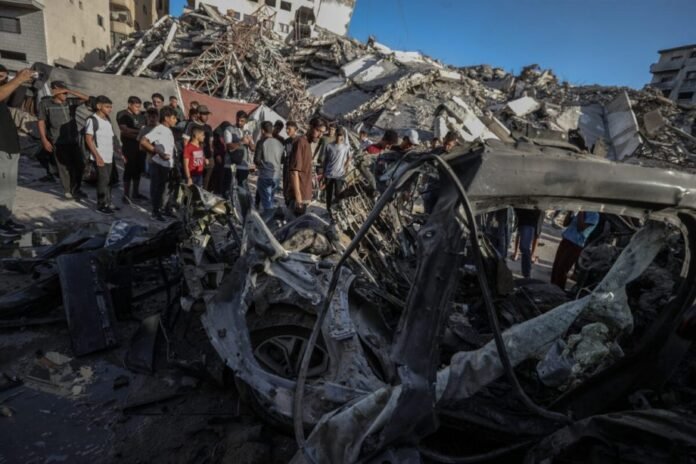
Two Palestinians were killed, and seven others injured Sunday in Israeli attacks on the Gaza Strip, amid Tel Aviv’s daily violations of a ceasefire agreement in place since October 2025, medical sources said, Anadolu reports.

The sources told Anadolu that 28-year-old Palestinian Uday Adli al-Assar was killed in an Israeli drone strike on the Al-Mawasi area west of Khan Younis in southern Gaza.

The body of another Palestinian and an unspecified number of injured people were brought to Al-Shifa Hospital after an Israeli drone strike hit a civilian vehicle in the industrial area south of Gaza City, the sources said.

Two Palestinians were injured, including one critically, when an Israeli drone shelled a gathering of people near the White Mosque in the Al-Shati refugee camp west of Gaza City, they added.

In a separate attack, five Palestinians were injured when an Israeli drone struck near tents housing displaced people around the Sheikh Radwan neighborhood market in northern Gaza City, the sources added.

Eyewitnesses told Anadolu that Israeli forces opened heavy fire toward western and eastern parts of Gaza City, west of Beit Lahia in northern Gaza, and areas east of Khan Younis and northwest of Rafah in the south.

The strikes come amid Israel’s continuing violations of the truce that has been in place since Oct. 10, 2025.

​​​​​​​The truce was intended to end Israel’s genocidal war that has killed more than 74,000 Palestinians and injured over 175,000 others in Gaza since October 2023.

What is in the US-Greenland-Denmark security deal?

0
what-is-in-the-us-greenland-denmark-security-deal?
What is in the US-Greenland-Denmark security deal?


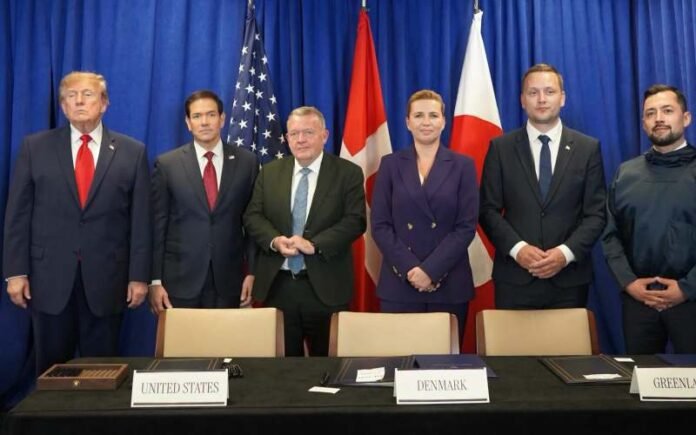
US President Donald Trump and the leaders of Greenland and Denmark signed an agreement on Tuesday ​that permits a larger US military presence on Greenland and may resolve a standoff over the strategically located and mineral-rich island.

The agreement, signed during Trump’s visit to ‌the UN General Assembly in New York, stops short of Trump’s demand that the US annex Greenland as a US territory to head off the growing Arctic presence of Russia and China.

But the deal does codify a greater US military presence on the icy territory, an option that emerged as Greenland leaders argued against a complete US takeover.

A text of the deal released after the event said the US can establish a “Golden Dome” defense system in Greenland ​as a shield against ballistic missile threats. The shortest route from Europe to North America runs via the Arctic island, which is the location of the northernmost US military ​base.

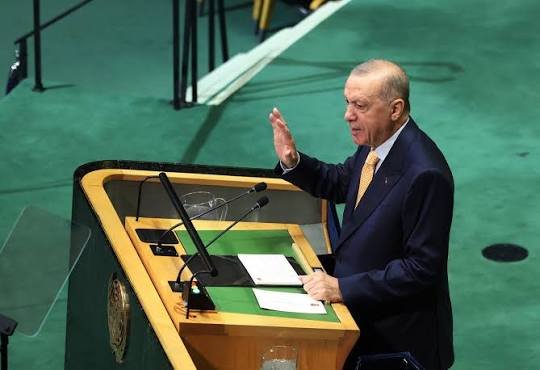
In his speech to the assembled world leaders at the UN before the signing ceremony, Trump said the agreement gives the US “permanent ⁠control over security and all other needs on that territory.”

“No US adversary will ever be permitted to establish a military presence in Greenland any more, or make sensitive investments there without our ​express written approval,” Trump said.

Trump signed the agreement along with Danish Prime Minister Mette Frederiksen and Greenland Prime Minister Jens-Frederik Nielsen in a trilateral ceremony after Trump gave his UN speech.

​Frederiksen described the agreement as a deal that can “last forever” and said it underlines the importance of the NATO alliance and respects Greenland’s right to self-determination.

A STRONG NATO

Nielsen emphasized the importance of NATO in the Arctic region. “We believe that it is vital to keep NATO strong, also in the Arctic, where the alliance has a key role to play,” he said.

At a press conference after the signing, Nielsen said Greenlanders must now go ​through a process of restoring trust with the US. Trump’s threats to take the island by force had strained relations with both Greenland and Denmark.

“I believe the crisis is over now, ​but I don’t think the conflict is over in the sense that this agreement could very well be used – if the Americans wish – as a platform to force through further concessions,” said Mikkel Vedby Rasmussen, ‌a political science ⁠professor at the University of Copenhagen.

Greenland, a former colony and now a semi-autonomous territory of the Kingdom of Denmark, sits between the Arctic and North America and holds vast energy resources.

The US already operates Pituffik Space Base in remote northwestern Greenland. The deal opens two new military sites: Narsarsuaq, a former Cold War airbase whose population has dwindled to just a few dozen, and Mestersvig, currently used by the Sirius Dog Sled Patrol, a Danish special forces unit.

“We will immediately begin the process of developing a large military presence in the appropriate location. We will be building ​two very major military bases,” Trump said in ​his UN speech.

Trump’s refusal to rule ⁠out military or economic force to acquire Greenland triggered a diplomatic crisis in January within NATO and forced Denmark and the island’s government into months of intensive negotiations.

The text of the agreement says it amends a 1951 defense treaty that had been the legal basis for the US ​presence.

It adds that Washington may seek further bases in the future, with details decided by mutual agreement. The deal has no end ​date, grants US aircraft and ⁠vessels broad access across Greenland and its territorial waters, and bars non-NATO states from establishing military installations on the island.

It also restricts foreign investment, effectively blocking states and investors from countries outside NATO, NATO partners and the European Union from holding control or significant influence in sectors deemed particularly sensitive, including critical infrastructure and resource extraction.

The deal, which needs approval by the parliaments of Denmark and ⁠Greenland, marks ​a shift from Trump’s earlier ambitions for an outright acquisition of Greenland, an island three times the size of ​Texas with a population of only 57,000 scattered along its rugged coastline.

But it represents the first major increase in US military infrastructure in Greenland since the Cold War, when the US maintained 17 installations and more than 10,000 personnel ​there.

Source:  Reuters

This Sukkot, Help Us Keep Independent Journalism Standing

0
this-sukkot,-help-us-keep-independent-journalism-standing
This Sukkot, Help Us Keep Independent Journalism Standing


Sukkot is a Jewish holiday, but its themes reach far beyond any one faith tradition.

At its heart is a simple idea: the structures we rely on are more fragile than they seem. Security can be shaken. Familiar routines can disappear. What helps people endure are the things that outlast walls and institutions — gratitude, hospitality, community, humility and responsibility for one another.

Those ideas feel especially relevant in today’s Middle East.

Across the region, wars, political upheaval and rapidly changing alliances continue to reshape lives. At the same time, people everywhere are trying to make sense of an information environment saturated with misinformation, propaganda, algorithmically amplified outrage and artificial intelligence-generated content.

In such a moment, trustworthy journalism is one of the institutions we cannot afford to lose.

For more than 25 years, The Media Line has reported directly from across the Middle East as an independent American nonprofit news organization, with journalists and sources throughout a region where facts are often contested before the smoke has even cleared.

Through the Mideast Daily News, we bring that reporting directly to you.

Our journalists cover Gaza and Jerusalem, Syria and Iran, the Gulf, North Africa and beyond. We speak with government officials, diplomats, academics, business leaders and people whose lives are shaped by the events behind the headlines. We provide context that cannot be produced simply by aggregating what others have already reported.

That independence comes with real costs.

The Media Line was recently targeted in a sophisticated cyberattack intended to disrupt our operations. At the same time, we are investing in stronger digital security and preparing a new website built for an age in which readers need more than another stream of headlines.

Our goal is to help people understand how to evaluate what they are seeing and reading. The new platform will expand our contextual journalism and introduce specialized coverage of technology, health, science, and infrastructure, while strengthening our role as a teaching news agency committed to news literacy.

We are also expanding our Press & Policy Student Program, an intensive three-month internship offered in Jerusalem and remotely. Students studying journalism, international relations, and public policy learn directly from veteran journalists, diplomats, and policymakers. The program has already produced 100 alumni, with graduates going on to work at CBS, Reuters, Bloomberg, Univision, The Arizona Republic, and other news organizations. We hope to reach 200 participants over the next four years.

Sukkot is also associated with gathering and welcoming guests. That message, too, is universal.

At a time when the Middle East is so often reduced to opposing camps, good journalism should create room for complexity. It should allow Israelis, Palestinians, Arabs, Iranians, Americans, and others to be heard while still testing claims against facts. It should resist propaganda, stereotypes, and easy conclusions.

That is the journalism we are asking you to support.

This season offers a useful reminder that even something fragile can endure when it is carefully built and sustained by a community.

Independent journalism works much the same way.

Your contribution helps us protect our digital infrastructure, launch our new platform, train the next generation of journalists, and keep reporters working throughout the Middle East.

Please consider making a donation and becoming part of the community that keeps the Mideast Daily News and The Media Line strong.

In a season that invites reflection on gratitude, shelter, and shared responsibility, we are deeply grateful that you read our work, share it, and believe that independent reporting still matters.

Thank you for standing with us.

The “Satanic Panic” Made Her a True-Crime Obsession. The Truth Is More Haunting.

0
the-“satanic-panic”-made-her-a-true-crime-obsession-the-truth-is-more-haunting.
The “Satanic Panic” Made Her a True-Crime Obsession. The Truth Is More Haunting.


Before she became infamous as one of the youngest American women ever sentenced to die, Christa Gail Pike was a North Carolina teenager who broke into a community center to steal some candy. At 5-foot-3, with thick auburn curls, she’d been in trouble at home and in school but not with the law. A juvenile court judge put Pike on probation, but she ran afoul of the rules. In the fall of 1991, when she was 15, Pike was sent to the Juvenile Evaluation Center in Swannanoa. She arrived just before Thanksgiving.

Nestled in the Blue Ridge mountains, just minutes away from Asheville, the center first opened in the 1960s as a “haven for troubled children,” in the words of the press. It was supposed to be an alternative to more severe “training schools,” but by the 1990s was skewed toward punishment. According to former staff, progress was measured in points, which were added or subtracted according to a child’s behavior. Infractions ranged from having “contraband” — including pencils or pens, which were allowable only in sanctioned study areas — to running away.

The system didn’t work for Pike. “She was not following the rules or she was doing something to sabotage herself,” one social worker would later testify at a hearing in Pike’s case. Although her violations weren’t generally serious, they did keep her stuck in place. Most kids stayed at the center for a few months; Pike stayed for well over a year.

It seemed possible that Pike might not actually want to go home. From the time she was a little girl, she’d been hurt and neglected by the adults who were supposed to protect her. Months before arriving in Swannanoa, Pike had been temporarily removed from her home by the state’s social services agency, which found that her mother’s live-in boyfriend was physically and sexually abusing her. Shortly afterward, Pike wrote a letter to her best friend saying she wanted to kill herself. Among a list of reasons, she wrote that she’d been raped by a different man, a neighbor who assaulted her when she was 11 years old.

Nevertheless, Pike stood out among her peers at the juvenile center. She was engaging and intelligent; she earned her GED and became a teacher’s assistant. “Christa was open and willing to grow,” one counselor would later write in a clemency letter on Pike’s behalf. “Though she had psychological struggles and resulting behavioral difficulties, I could see that Christa was a good child who was trying to find her place in the world. I never saw Christa act aggressively or violently. She was trying to figure out how to heal from her traumas.”

“She is so much more than the darkness which has followed her from childhood into adulthood.”

Pike finally left Swannanoa in March 1993. The following year, the counselor got a letter from her in the mail. “She shared that she would be visiting Asheville soon and invited me to meet up with her,” the counselor recalled in the clemency letter. But the visit never happened. In January 1995, Pike was arrested alongside two other teenagers while enrolled at a Jobs Corp program in Knoxville, Tennessee. At 18, she was charged with first-degree murder.

The crime seemed pulled from a horror movie — an act of savagery that would become imprinted in the public psyche. Nineteen-year-old Colleen Slemmer, one of Pike’s classmates, had been lured into a secluded corner of a city park, then beaten, bludgeoned, and slashed with a boxcutter. Her body was found naked from the waist up. On her chest, her attackers had carved a pentagram.

Pike admitted her guilt within days. In a tape-recorded statement to investigators, she sobbed that she had begun hitting Slemmer and just didn’t stop. “I literally thought I was going crazy cause I’d never seen myself act like that before in my life,” she said. Before long, witnesses came forward with disturbing new details. In the public’s eye, Pike transformed from an 18-year-old who committed a shocking act of violence into a woman driven by the devil himself.

Weeks after her 20th birthday, Pike was convicted and sentenced to die.

Pike had been on death row for nearly 30 years when Tennessee announced her execution date: September 30, 2026. In a lengthy clemency petition submitted earlier this month, Pike’s lawyers urged Gov. Bill Lee to spare her life. They told a story of Pike’s upbringing that her jury never heard, a childhood shaped by untreated mental illness and sexual abuse beginning when she was just two years old. They enclosed dozens of letters from people who have known Pike over the years, including in North Carolina.

“We in North Carolina — myself included — failed Christa.”

One of the letters came from the lawyer who represented Pike in her first juvenile delinquency hearing, not long before she was sent to Swannanoa. Now a retired tribal court judge, he was filled with regret. “In my view, this proceeding was the most pivotal event of Christa’s sad childhood,” he wrote. It set in motion everything that would follow. Rather than treating her like a vulnerable child in need of support, the juvenile system had compounded her trauma through more punishment, with devastating consequences.

“I regret to tell you, Governor, that we in North Carolina — myself included — failed Christa,” he wrote. He urged Lee to make up for his state’s mistakes. “She is so much more than the darkness which has followed her from childhood into adulthood.”

If Lee does not show mercy — and barring any last-minute intervention by the courts — Pike will be executed by lethal injection at Riverbend Maximum Security Institution on Wednesday at 10 a.m. She would be the 19th woman executed in the country in the modern death penalty era — and the first woman put to death in Tennessee in two centuries.

Pike, who turned 50 this year, has spent her entire adult life at the Tennessee Prison for Women in Nashville, nearly all of it in solitary confinement. Although there was one other woman living under a death sentence when Pike first arrived at the prison, her sentence was commuted and she was paroled in 2011.

One of Pike’s co-defendants was released long ago, while the other, her then-boyfriend, Tadaryl Shipp, remains eligible for parole. Shipp was 17 when he participated in Slemmer’s murder, which prevented prosecutors from seeking the death penalty under state law. In a letter asking Lee to grant clemency, Shipp’s trial lawyer wrote that he was surprised that Pike’s attorneys had not emphasized her boyfriend’s role at her 1996 trial. “When I represented Tadaryl in his 1997 trial,” he wrote, “the defense I presented was to shift as much blame as possible to Christa.”

Like many women condemned to die, Pike became an object of lurid fascination. In 1998, after Texas executed Karla Faye Tucker, interview requests poured in from talk shows, filmmakers, and journalists all over the world, according to the Knoxville News Sentinel, which compared the level of interest to that of the late Martin Luther King Jr. assassin James Earl Ray. Pike, the newspaper said, “has become a death-row celebrity, a child star of the true-crime beat.”

The article described Pike as a “savvy subject,” a kinder version of an accusation that has followed Pike from the start: that she reveled in her notoriety while showing no signs of remorse. For many people, including Slemmer’s mother, who plans to witness Pike’s execution, the image of an unrepentant killer basking in attention has remained fixed in time. So has the claim by the lead detective that Pike was filled with excitement by the murder. He told interviewers in the 2025 podcast series “Unrestorable” that Pike was “giddy” while recounting what she’d done. “This was the greatest thing that ever happened to her,” he said. “She was just happy as a lark.”

Audio of Pike interrogation’s does not match these descriptions — and numerous people who know Pike say that she has expressed remorse for years. One woman, who began visiting her 30 years ago, wrote in a clemency letter that Pike has matured into a compassionate person who cares for those around her. “She has told me repeatedly that she would trade places with Colleen Slemmer so that her mother … could have her daughter back,” she wrote.

Although the Tennessee Department of Correction routinely denies interviews with people under a death sentence, Pike addressed the matter through one of her attorneys for the 2025 podcast. The older she has gotten, she said, the more she has absorbed the magnitude of what she stole from Slemmer and her family. “She had a whole world of her own that I just jerked her out of. And there’s a big empty spot there, where she could be shining right now. And she’s not.”

Pike’s case may stand out for its brutality and sensationalism, but her background shares much in common with other people on death row, especially women, whose lives are frequently marked by sexual violence and trauma. One clinical psychologist describes the amount of abuse and neglect Pike experienced from the time she was a preschooler as “almost impossible to grasp.”

This history should have been key to Pike’s defense. But like many others condemned to die, she was also tried in an era in which attorneys assigned to capital cases were often not up to the task. Pike was represented by a pair of court-appointed lawyers who were inexperienced and overworked. Neither had ever handled a capital case — nor had her trial judge.

Perhaps most telling, her own lead attorney would end up being one of a slew of people who seemed eager to cash in on the case. Post-conviction records show that he asked Pike to sign an agreement giving him the rights to her story. “My thought was, I would write a book on Christa, the human side of Christa,” he later testified at a court hearing. “I thought to do that I would probably need to get some kind of release. It was one of those spur of the moment things. I drew it up, I took it over, she signed it. Nothing ever became of it.”

“Looking back,” he added, “it’s probably something I shouldn’t have done.”

There would be no shortage of people telling Pike’s story. Her crime has been described in countless articles, podcasts, and sensationalistic TV series with names like “Mean Girl Murders.” All of them include a disturbing and singular detail that has come to define the case: Slemmer’s body was found with a piece of her skull missing. It would be discovered in the pocket of a jacket belonging to Pike.

“When the piece of skull got out, that’s kind of the death knell for Christa,” a former Knoxville journalist who now creates true-crime coloring books told the “Unrestorable” podcast. “You’re not coming back from that.”

This ghoulish revelation fueled the belief that Pike was driven by satanic beliefs. The murder coincided with a societal fixation now known as the “satanic panic,” in which reports of devil-worshipping cults took hold across the country during the 1980s and ’90s, leading to false accusations and wrongful convictions. Fears were especially pronounced when it came to young people, who appeared to be “dabbling in the trappings of satanism,” as the AP reported in 1988, “whether serious or as a prank.” In most cases, there was nothing to back up the hysteria. But many saw Pike’s case as chilling proof that the crisis was real.

The lead investigator in Pike’s case, Knox County Police Detective Randy York, had attended a training on satanism and cults just before Slemmer was killed. In interviews, he has maintained that the pentagram was the key that unlocked the case; a woman called police to say that her daughter was in the Jobs Corp program and was worried about a satanic cult, which ultimately led York to Pike. But there was a more straightforward link: Slemmer was in the same residential program as her attackers. On the day of the murder, all four teenagers signed out at the same time. Only Slemmer failed to sign back in.

Regardless, it was Shipp, not Pike, who was interested in satanism. The teenager kept a satanic altar in his room. But as his lawyer would later write in his clemency letter for Pike, for all the focus on satanism, “that was never the motivation behind what happened.” By most accounts, Pike targeted Slemmer because she believed that she wanted to steal her boyfriend; Pike has said she did not plan to kill Slemmer, only to fight her. But there was no explaining such a senseless crime. “We were all just really screwed up kids,” Pike said on the “Unrestorable” podcast. “We were all going through things that no one understood.”

Pike’s lawyers have long argued that the media frenzy over the crime made it impossible to get a fair trial. Nearly every prospective juror had heard of the case. News cameras filmed the trial from beginning to end, which cast further scrutiny on Pike’s demeanor. Wearing modest floral dresses day after day, Pike was deemed to be inappropriately cheerful, enjoying the limelight of her case.

In his own letter asking for clemency, Pike’s lead trial attorney, William Talman, said that he, too, was unnerved by his client’s seeming contentment at the crowds in the courtroom. As he remembers it, she told him at one point that she was “happy,” which struck him as bizarre. When he asked her why, he wrote, she responded in a way that has haunted him ever since. “It was the first time in her life that she could remember so many members of her family being there for her.”

It’s possible that Pike would have been sentenced to death no matter what her lawyers did. But her legal team has long argued that Talman and his co-counsel failed their client in key ways. On the eve of the trial, prosecutors offered Pike a plea deal that would have sent her to prison for life. She declined. Pike has said that Talman assured her that a jury would never vote to execute a pretty young girl — an account he has denied. But he conceded in court testimony that he should have done a better job discussing the offer with her.

Case records show that Talman’s most devastating blunder was his mishandling of the sentencing trial — the single most critical part of any death penalty case. Today, capital defense attorneys are trained to prioritize mitigation, delving into a client’s early life to uncover any history of abuse, trauma, and mental illness — factors that can persuade jurors to spare a client’s life. Between Pike’s age at the time of the murder and her harrowing childhood, there was plenty to draw from. A clinical psychologist hired as Pike’s mitigation expert put together binders of information that Talman planned to use. But for reasons long in dispute, Talman decided at the last minute not to call her as a witness.

At a post-conviction hearing, Talman cited two reasons for his hasty decision. For one, he had discovered during the trial that the psychologist had previously been in a romantic relationship with the lead prosecutor. Although she would testify that it was long over by then, she admitted that she didn’t disclose it as early as she should have.

The other reason, according to Talman, was that the judge ordered him to hand over copies of his expert’s binders to the lead prosecutor, who flagged parts that might bolster their case for the death penalty. “He had about a million stickies, little sticky notes, in the report,” Talman said. He feared that the file would end up doing more harm than good.

In the end, that’s precisely what happened. Talman did not call the witness with the best chance of conveying Pike’s lifelong trauma, while the state pulled the most damaging details from the defense’s own file to use against his client. In his closing statement, the prosecutor described Pike as a “monster that we have to deal with.” It took the jury less than an hour and a half to sentence her to death.

Colleen Slemmer Would have turned 51 this month. Her mother, May Martinez, has often expressed indignation over the attention devoted to Pike. She feels it has eclipsed the memory of her daughter, a caring young woman who helped students with disabilities and loved working on computers with her stepdad. Martinez told the Nashville Banner that she hopes the execution will bring her peace – “and that Colleen can always be remembered as the sweet little girl that she was.”

Pike’s advocates emphasize that their calls for clemency should never be mistaken for a lack of compassion for her victim. As they stepped up their appeals to the governor last week, youth counselor Sarah Bailey joined a press conference in Nashville, where she said she knew what it was like to lose a loved one to homicide – someone murdered her own son. She also knew what it was like “to have adults decide who you are while you are still becoming a person.” Bailey was convicted of murder for a crime she committed at 16, a devastating mistake that for years defined her “entire identity.”

Finally, she knew Pike. When she got to prison as a frightened teenager, Pike helped her navigate the world around her. “She sent me stamps, she sent me commissary, and she sent me love,” Bailey said. “That said a lot about who she was, and that says a lot about who she has become.”

Bailey echoed what many have said about Pike in recent years. Some of the most urgent pleas for mercy have come from women whose voices are the least often heard. “I’d like to ask that you look past the fact that I am incarcerated when reading this,” one clemency letter reads. “I am an inmate; however, I am also a woman who understands the importance of seeing people as the human beings that we all are.”

“The Christa you will meet today is a far cry from the one who walked through the doors from the beginning,” the letter goes on. “For those of us who have found themselves housed near Christa she has offered hope when there should have only been despair. In a time of pain and struggle, Christa’s small voice rings out to let you know that you are not alone.”

After UNGA: Can a broken memorandum be put back together?

0
after-unga:-can-a-broken-memorandum-be-put-back-together?
After UNGA: Can a broken memorandum be put back together?

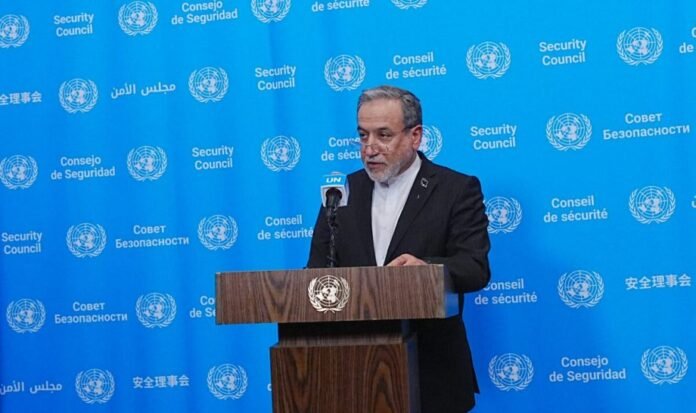
For a moment this week, the freeze between Washington and Tehran looked like it might actually crack. On 23rd September, Iranian Foreign Minister Abbas Araghchi sat down with US envoys Steve Witkoff and Jared Kushner in New York — the most senior direct contact between the two sides since the Islamabad Memorandum of Understanding fell apart two months earlier. Three days later, Araghchi told the New York Times and The Guardian that the Strait of Hormuz could reopen within a week, if Washington met Tehran’s conditions.

That one conditional sentence tells you almost everything about where this stands. Not resolved. Not fully back to war footing either. Suspended somewhere in between, where both sides already know roughly what a deal would look like, and neither has been willing to move first.

A memorandum that didn’t survive its own deadline

It is worth being honest about what actually collapsed here. The Islamabad Memorandum, signed 17th June after talks Pakistan brokered — with Army Chief Asim Munir reportedly playing a direct role — gave Washington and Tehran 60 days to turn a fragile ceasefire into something lasting. That window closed in mid-August with nothing to show for it. Iran’s position, as Araghchi laid out in a call with Japan’s foreign minister on 8th September, is that the region’s current tension traces back to what he called Washington’s “regrettable violation” of its Islamabad commitments, and that the US returning to those commitments is what would actually normalize the Strait. Washington hasn’t accepted that version of events. And in the space between those two positions, the fighting didn’t stop — both militaries traded strikes through early-to-mid September, and Iran seized a US underwater drone operating in contested waters along the way.

That’s the backdrop this year’s UNGA walked into. Not a lull that needs managing. An active, costly war still looking for an exit.

Why this round might be different

Two things set this month apart from the summer’s failed talks. First, the setting itself has changed — instead of formal, mediated summits like Islamabad or Bürgenstock, this was direct, informal contact between Iranian and American officials on the sidelines of the UN. That’s a format that lets both sides test the water without the political cost of watching another formal round collapse in public. Second, Iranian President Masoud Pezeshkian went out of his way to credit Pakistan’s “constructive efforts as a mediator” — which tells you Tehran still wants Islamabad in the room, even after the memorandum Pakistan brokered didn’t hold. That’s leverage Pakistan could use, if it chooses to.

Set against that, Trump’s own signals this week didn’t exactly line up. He praised Tuesday’s indirect talks, then turned around and gave what Al Jazeera’s Tehran correspondent called a “pugnacious” address to the same Assembly.

Analysts in New York — the Australian Strategic Policy Institute’s Adel Abdel Ghafar among them — describe it as “genuine” movement mixed with “a fair amount of posturing.” That sounds about right for a negotiation where both governments still need to look tough at home while quietly talking to each other.

READ: Iran just gave Washington a deadline. Watch Islamabad, not the White House

What a real deal would actually require

Reopening the Strait in seven days, if Araghchi’s offer holds, would only be a symptom of a deal — not the deal itself. Getting to something durable still means resolving three things the Islamabad Memorandum never really settled: verification mechanisms for Iran’s nuclear program that both sides genuinely trust; a regional security setup that doesn’t lean entirely on U.S. military guarantees the Gulf states have grown wary of; and unfrozen Iranian assets, which Araghchi has named specifically as a condition Washington still hasn’t met.

Skip past those in favor of a quick Hormuz reopening, and you repeat the exact mistake the June memorandum made — a deadline-driven document that looked like resolution without touching what actually caused the war.

Pakistan’s narrowing window

For Islamabad, this isn’t just about diplomatic prestige. Pakistan brokered the ceasefire that ended the initial war, hosted the Islamabad Talks that failed, and put its own name behind the memorandum that expired right on schedule in August. Pezeshkian’s public thanks this week suggests that credibility survived the memorandum’s failure — but it won’t survive forever if Pakistan keeps getting associated with frameworks that quietly run out the clock.

If the Araghchi-Witkoff-Kushner contact in New York turns into something real, Pakistan has an opening to step back in as convener rather than spectator. If it doesn’t, the next round of escalation happens with Islamabad watching from the sidelines of a process it used to lead.

The real test

The real test of this UNGA round isn’t whether Araghchi’s seven-day Hormuz offer actually holds — offers like that have been made and missed before, more than once. The test is whether Washington and Tehran can build something that survives contact with an actual deadline, which is exactly what the Islamabad Memorandum failed to do the first time. Everything Pezeshkian, Araghchi and Trump said in New York this week suggests neither side wants to be blamed for failure. Whether that turns into an agreement that actually holds — that’s the only question worth watching now.

The Makkah Pact’s first test: Can Pakistan defend Saudi Arabia without entering Yemen’s war?

The views expressed in this article belong to the author and do not necessarily reflect the editorial policy of Middle East Monitor.

Erdoğan tells UN that Europe cannot be safe without Turkey

0
erdogan-tells-un-that-europe-cannot-be-safe-without-turkey
Erdoğan tells UN that Europe cannot be safe without Turkey


CdecorporatedispatchEdit Profile

Turkish President Recep Tayyip Erdoğan has called for Turkey to play a more central role in Europe’s security architecture, arguing that the continent cannot be fully secure without Ankara’s involvement.

Addressing the United Nations General Assembly in New York, Erdoğan said a Europe that excludes Turkey from its security arrangements “cannot possibly be stronger or safer”. Turkey has been a member of NATO since 1952, but its bid to join the European Union has been effectively frozen for almost a decade.

Erdoğan pointed to Turkey’s role within NATO and its hosting of the alliance’s summit in July as evidence of its commitment to European security.

He also said Turkey wanted to shape its future relationship with the EU around a strategic vision based on security and cooperation, and called for Brussels to adopt the same approach. Erdoğan has made similar arguments since April 2025, when he said European security was “unthinkable without Turkey”.

via Euronews

0FansLike
0FollowersFollow
0FollowersFollow
0SubscribersSubscribe
- Advertisement -
Google search engine

Recent Posts