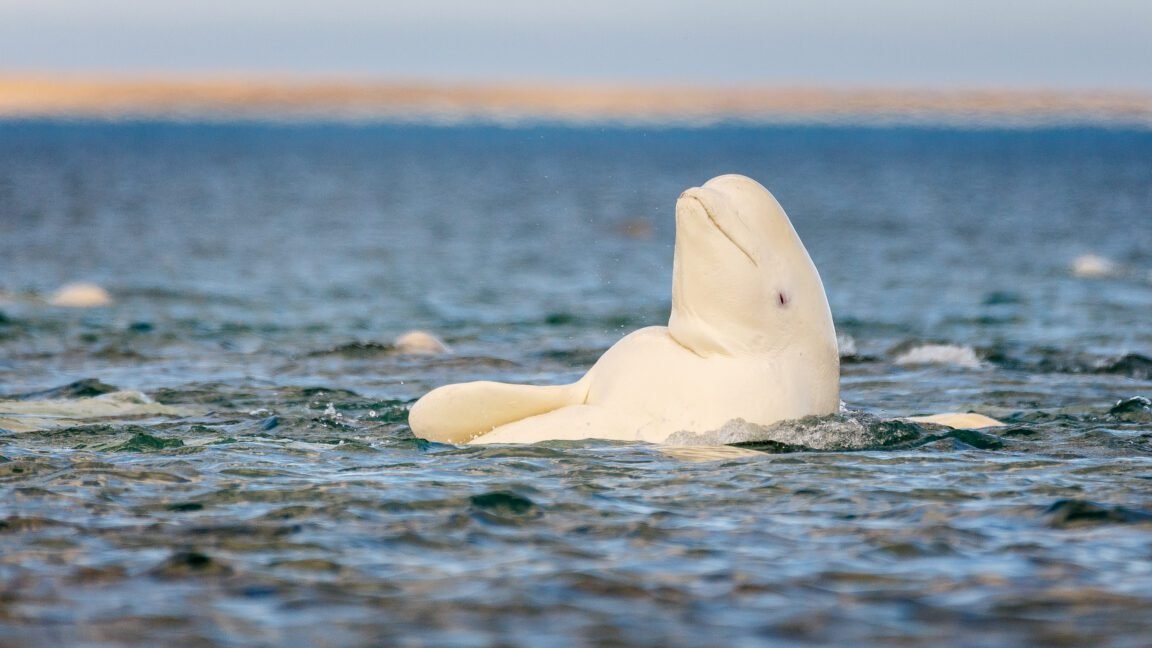
In hours of underwater video footage from a New York aquarium, a beluga whale named Natasha stretches her neck, pirouettes, nods, and shakes her head in front of a two-way mirror. Her daughter Maris does much the same. According to a new study published in PLOS One, both animals show the behavioral hallmarks of mirror self-recognition—a cognitive ability long considered a marker of self-awareness, and one that had never before been documented in beluga whales.
If the result holds up, belugas join a remarkably short list. The mirror self-recognition test (MSR) has been passed, with varying degrees of confidence, by humans (starting around age two), a handful of great apes (chimps, bonobos, orangutans, and—somewhat contentiously—gorillas), Asian elephants, bottlenose dolphins, probably magpies, possibly orcas, and, if you can believe it, a cleaner wrasse. That’s it. No dogs, no cats, no monkeys. Plenty of species we had assumed were self-aware have been tested and failed.
Looking at the mirror
So what is this test, exactly, and what is it supposed to tell us?
The procedure is this: While the animal isn’t looking, researchers place a mark on a spot it can only see via a reflection. A mirror is then put in front of the animal while the researchers watch. If the animal touches or examines the mark while looking at its reflection, it comprehends that the figure in the mirror is itself. The test is intuitive and easy to perform—and almost no species passes.
Why is this a test of self-awareness in the first place? The logic, going back to the psychologist Gordon Gallup (who invented the test in 1970), is that to use a mirror as a tool for inspecting your own body, you need a mental representation of yourself as a distinct entity. A piece of silvered glass, in this telling, can pry open a lot of cognitive doors.
Gallup himself is a tough grader. Plenty of positive results have been announced over the decades, and he’s pushed back on most of them. If an animal doesn’t show clear self-directed behavior—actively trying to touch or examine the mark—the test, in his view, fails. On that score, the beluga results sit right at the edge.
Revisiting old data
The footage is more than two decades old. “After the initial study we were hoping to conduct more studies with additional belugas over the next years but that was not possible,” senior author Diana Reiss said in an email. “Inspired by the numerous studies over the past years reporting on different aspects of beluga whale cognition and behavior, we decided to revisit and digitize the original videotapes and conduct a rigorous analysis.” Some tapes had degraded in the meantime, and portions of the original data were lost.
The original experiment exposed four belugas to the mirror together, in their usual social housing. Only Natasha and Maris showed sustained interest, so only they advanced to the experimental phase, where they were marked with waterproof lipstick during feeding sessions. Because the animals were awake and could feel the application, the researchers ran sham-mark controls: the same procedure, but without the pigment. The whales only showed self-recognition-like behaviors after being actually marked.
“The two beluga whales showed the same progression of behavioral stages reported for other species that show evidence of MSR,” first author Alexander Mildener said in an email. “The whales did not exhibit self-directed behaviors in the absence of the mirror or in the control condition. One of the whales also passed the mark test by demonstrating mark-directed behavior by orienting the area of her body that was temporarily marked toward the mirror.”
The sample is tiny, but that’s not unusual—if even a single animal can do something, the species is in principle capable of it. The harder question is whether what Natasha and Maris did really counts. Some of the most-cited behaviors—bubble bite play, barrel rolls—are documented forms of solo play that belugas engage in even without a mirror nearby. Their increased time spent at the reflective surface is suggestive, but doesn’t rule out the possibility that the mirror was just a novel source of stimulation.
The one genuinely mark-directed behavior came from Natasha, who repeatedly pressed the marked area—behind her right ear—against the mirror. Without arms, she couldn’t point. It’s the strongest data point in the study, but a softer kind of evidence than a chimp or an elephant typically delivers.
Even granting that belugas pass—and given that dolphins do, and orcas plausibly do too, it wouldn’t be a shock—the more interesting question is what a result like this tells us. Or, conversely: What does failing actually mean? One of the most persistent criticisms is that many animals fail simply because mirrors carry little relevance in their perceptual world. Anil Seth, a neuroscientist at the University of Sussex, told Ars in an email that “the MSR is not a test of consciousness itself, but a test of a particular kind of the ability to recognize one’s own body (or face). Failure to reliably pass the MSR does not mean that an animal lacks consciousness, or any form of selfhood.”
The test, he added, is motivated by what feels natural to humans. “It may well not feel natural to other species, even if they have the same kind of ability,” He said. “This raises various other reasons why animals might ‘fail’ the test: they may not like making eye contact, they might not like mirrors, or they simply just might not care enough about a very strange task.”
Seth has argued that consciousness may be something like an integrated experience of our perceptions, broadly construed—a view consistent with the increasingly mainstream idea that consciousness exists in degrees and forms across many species. If perceptions are central to the sense of self, that sense will look different depending on how each animal perceives the world. Humans are heavily visual; bats lean on echolocation; for dogs, smell is everything. That’s why researchers like Alexandra Horowitz, who heads the Dog Cognition Lab at Barnard College, have been working on an olfactory version of the test.
From the opposite direction come critics who argue the test fails to measure self-awareness even when an animal passes it. That’s the position of Alex Jordan, an evolutionary biologist at the Max Planck Institute of Animal Behavior in Germany and co-author of the PLOS Biology studies on the cleaner wrasse. The wrasse passes the mirror test, Jordan says—but that doesn’t necessarily mean the fish is self-aware. The test was designed around us, and suffers from both anthropocentrism (treating humans as the yardstick) and anthropomorphism (projecting human traits onto other animals).
The mirror test, then, has problems from every angle. As Seth put it in his email: “When looking for evidence of consciousness or selfhood, it’s important to complement tests like the MSR with other tests”—ones that take into account what might be salient in a particular animal’s own perceptual world. And yet the MSR remains one of the few tools we have for trying to glimpse inside the minds of other animals—and, perhaps, our own. The trick is knowing exactly what it can, and can’t, tell us.
PLOS One, 2026. DOI: 10.1371/journal.pone.0348287
Federica Sgorbissa is a science journalist; she writes about neuroscience and cognitive science for Italian and international outlets.