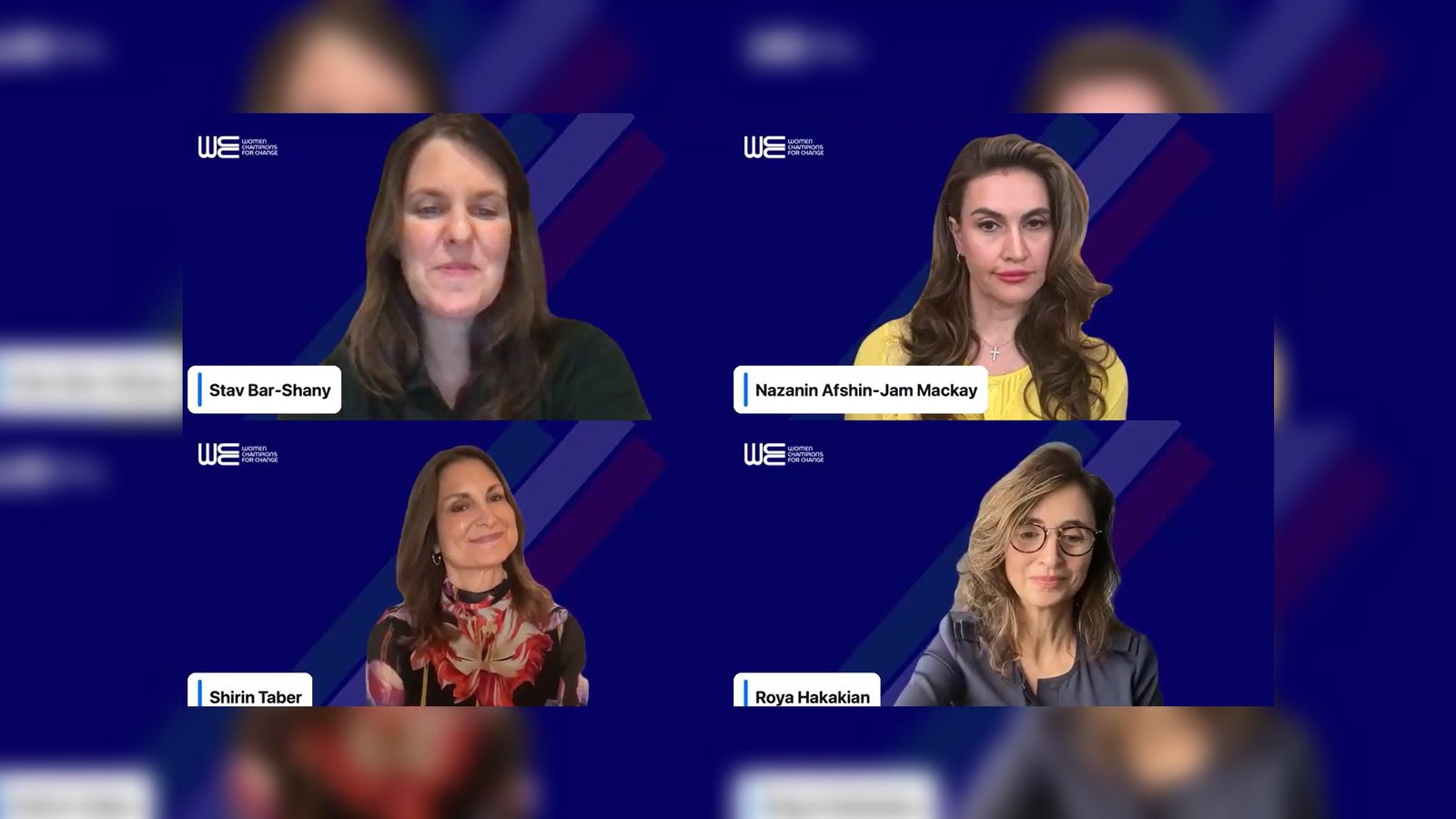
“Women’s Voices Redefine the Conversation on Iran’s Future” is my report on a webinar that refused to treat Iran as a chessboard and instead brought it back to human scale: women speaking from exile, activism, faith, and memory about what it means to stand with the Iranian people. In a discussion convened by Women Champions for Change, Israeli moderator Stav Bar-Shany joined three Iranian-born speakers—Nazanin Afshin-Jam Mackay, Roya Hakakian, and Shirin Taber—for a conversation shaped less by slogans than by lived experience.
What emerged was not neat consensus but something better: a serious argument about repression, protest, war, and the fragile mechanics of change. Afshin-Jam Mackay traced her activism from efforts to save individual lives to a conviction that only regime change can address the deeper disease. She spoke of the courage of Iranians, especially women and young people, and placed recent protests in a long line of resistance stretching from 1979 through the January 2026 unrest. Hakakian brought a cooler, harder warning. She said she had long rejected the idea that the Islamic Republic could reform itself and argued that the regime’s legal, constitutional, and religious structure was built to resist meaningful change. She also warned that mixed international messaging after the war risked convincing Iranians that the regime, though weak, was somehow still untouchable.
Taber added a different register—partly political, partly moral, and deeply personal. Drawing on her Iranian Muslim father and American Christian mother, she spoke about coexistence, women’s freedom, and the need to prepare now for a post-regime future through education, civil society, and cross-border ties. The panelists differed on intervention and messaging, but they converged on one point: bombs do not build democracy, and real change requires patience, structure, and moral clarity.
That is what gives the piece its force. I show that the most revealing conversations about Iran may not come from the usual parade of strategists and strongmen, but from women who have carried the costs of revolution, exile, and hope in their own lives. Read the full article; it is richer, sharper, and more human than the standard geopolitical script.