<
article id=”post-952869″>
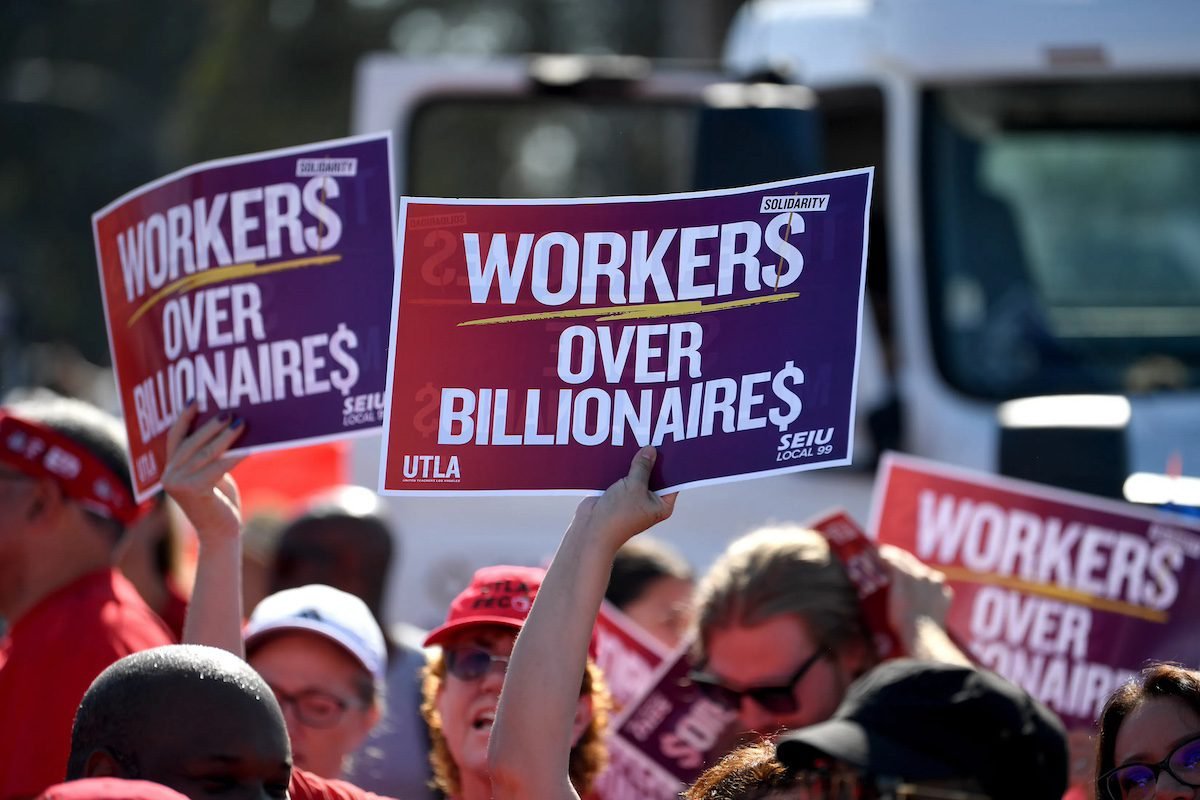
Corporate profits, asset values and productivity have risen strongly over recent decades, yet most workers feel they capture only a small share of the gains. That gap is often framed as a domestic political problem. Increasingly, it is an international one.
If the spending power of US households weakens, Asia’s export-dependent economies may find that the consumer they have relied on for generations can no longer play the same role.
The causes are many, but the multi-decade shift of GDP priorities from labor to capital stands out. In the second quarter of 2026, labor’s share of income fell to 52.8%, from 65.5% in 1947. The trend accelerated in the Reaganomics-dominated 1980s and continued through the recent midterm blowout.
The Democrats’ big win over Donald Trump’s Republicans on November 3 seemed a hinge-point moment. In the 10 days since, it’s become clear that Trump’s all-in embrace of Tech Bros trumpeting AI as an economic utopia in real time backfired.
It proved wildly tone deaf as Americans turn against data centers that drive up electricity and water bills so they can train AI models to eliminate entire industries, while the Iran war boosts oil and food costs.
Among major world leaders, Trump has been the most enthusiastic champion of unregulated AI. Turns out, a Silicon Valley Wild West 2.0 experiment isn’t popular. Nor does the working class buy trillionaire Elon Musk’s chatter about a coming “age of abundance” awash with generous universal income programs.
Few in the MAGAverse seemed to notice that Musk’s views are more in conversation with Karl Marx than Adam Smith. Rather than buy the White House’s line about Democrats’ “radical socialism,” US voters cast a powerful anti-AI, anti-war, anti-inflation, anti-tech-oligarch vote.
The Federal Reserve’s latest Survey of Consumer Finances finds the US wealth gap remains wide. Even as median net worth rose 2% over the last three years, the top 10% holds more than 50 times as much wealth, on average, as the bottom 20%.
The sentiment behind the elections was years in the making, but it was turbocharged in the Trump 2.0 era since January 2025, as well as during Trump 1.0 from 2017 to 2021.
Trumponomics is largely a replay of Ronald Reagan’s “supply-side economics” gambit, with a serious dose of anti-immigration fervor unseen in modern-day America. Reagan’s vision has gone badly awry: workers who once received two-thirds of their income from the non-farm business sector now receive barely half.
Then there’s the productivity-pay gap. The Washington-based Economic Policy Institute (EPI) finds that typical worker pay grew about 33% from 1979 to 2025, even as net productivity grew about 90.2%. Lower-wage workers lost notable ground in 2025 as affordability strains worsened, wage growth stalled and tariffs boosted inflation.
“Our estimates attribute this increase to the tariffs,” said Mary Amiti, an economist at the Federal Reserve Bank of New York. By February 2026, even before the Iran war began, “tariffs had contributed 2.9 percentage points to goods price inflation, and without them goods prices would have fallen slightly.”
Francis Genéreux, economist at Desjardins Group, said that “for many voters, the economy is now synonymous with inflation, as rising prices outweigh job reports, housing affordability and stock market performance.”
The US rich-poor gap has been widening for decades, but 2025 was an acceleration year.
“Since Trump took office, the ultrawealthy — top 0.1% — gained more than 8,000 times as much wealth per household as those in the bottom half of the wealth distribution,” said Cristina Tello-Trillo, chief economist at the Washington-based think tank Center for American Progress.
To illustrate the extremity of US wealth inequality, Tello-Trillo said the 10 wealthiest Americans saw their real fortunes grow by a combined $259 billion over the same period, according to the Bloomberg Billionaires Index. That’s about $26 billion per person, or 22 million times more than the bottom half’s $1,200 per household.
During three consecutive quarters in 2025, the share of total wealth held by the top 0.1% and the top 1% reached the highest levels since the Fed began tracking the data in 1989. Since the fourth quarter of 2024, the top 1%’s share has grown from 31% to 31.6%, while the bottom half’s has stagnated at 2.5%.
“This gap,” Tello-Trillo explained, “has been driven wider by things such as soaring stock valuations and tax policy changes in the congressional Republican-passed Big Beautiful Bill that favor the wealthy, as well as persistently high debts for the middle and bottom of the wealth distribution.”
Her analysis of Fed Board data finds that top 1% households saw their net worth rise by an average of $1.8 million, top 0.1% households by an average of $9.6 million, and households in the bottom 50% by roughly $1,200.
In Europe, meanwhile, social and transfer payments are now above 40% of government spending. The European Union spends 19.6% of gross domestic product on social protection. In other words, two of every five euros of EU government spending go toward unemployment, parental responsibilities, health care, disability and aging populations. All this seems the very definition of unsustainable.
“Behind these figures lie deep, long-term changes,” said Elisabeth Krecké, an economist at advisory Geopolitical Intelligence Services. “Europe’s welfare systems were designed for the postwar era – a time when societies were young, jobs were stable and well-paid, and growth felt endless. That world has gone. Today, steady growth seems out of reach as several global trends converge.”
By comparison, many Asian governments can boast more rational social safety nets than the West, and they spend far less. Across the Asia-Pacific region, public social spending averages roughly one-third of the Organization for Economic Co-operation and Development average. The range is wide: Japan is the highest, at around 25% of GDP, China is close to 10%, and Bangladesh spends around 2%.
Asian governments still need to build more vibrant, domestic demand-led economic models. That has been the plan since the 1997-98 Asian financial crisis, and important progress has been made, but Indonesia, South Korea, Thailand and nations from Japan to China to Vietnam remain too reliant on exporting to Western consumers.
The last 10 years of Trump have been all about 1985. His priorities (tariffs, tax cuts, regulatory clawbacks) are ripped from the headlines of 40 years ago. So is his obsession with a weaker dollar, inspired by the Plaza Accord, struck at New York’s Plaza Hotel, which Trump once owned.
There, the US bulldozed then-archrival Japan and Europe’s elites (in Trump’s worldview) to weaken the dollar and boost the yen, delivering the zero-sum benefits Trump figures should be his for the taking.
In the 80s, Japan was the target of Trumpian ire. Back then, the New York real estate mogul rarely missed a chance to rail against Tokyo, accusing Japan of having “systematically sucked the blood out of America — sucked the blood out! They have gotten away with murder. They have ended up winning the war.” Hollywood piled on with Japan-bashing fare such as “Gung Ho,” a comedy starring Michael Keaton about a culture clash between Japan Inc. salarymen and Detroit auto workers.
Now the target is China, which Trump has accused of “raping” US workers, and talk of a “Mar-a-Lago Accord” concerns Beijing. Treasury Secretary Scott Bessent, meanwhile, is almost linearly focused on the yen as the currency trades near 1985 lows.
Japan is the biggest foreign holder of US Treasuries, at US$1.1 trillion, and Bessent clearly fears how news of Japan dumping large blocks would play out in world markets. When the Treasury began joint intervention efforts with Tokyo to stabilize the yen in late July, Bessent’s team funded it by selling euros, not dollars.
The problem with a US leader whose head is stuck in 1985, aside from the obvious, is that “Made in China 2025” is upending the global economy now, while China invests in where it thinks the world will be in 2035.
The same goes for a Global South increasingly forging its own path, one that barely factors in where the US might fit in a decade. Global companies, meanwhile, spent the last decade reorganizing supply chains around groups of countries with similar values or security priorities.
Now that Trump seems to have segued from pushing tariffs to pushing Boeing planes and American semiconductors, the hope is that his assault on China Inc. is losing momentum. But the reordering of global trade, as Fed data shows, suggests his administration is firing tariffs at the wrong economic foe.
That is becoming even truer as traditional US allies like the European Union pivot to where the real future growth is: Asia. China, for its part, is doubling down on the Global South and Europe.
Unfortunately, Trump’s predecessor, Joe Biden, largely kept the 2017-2021 China tariffs in place, even though the levies did nothing to alter Sino-US trade dynamics. Xi’s economy steered around the trade war nimbly, leaving US allies Japan and Korea with most of the collateral damage.
Biden’s attempt to out-Trump Trump backfired: higher costs for American households, more pressure on global supply chains, and sure retaliation from Xi’s Communist Party. The signal was that America is out of innovative ideas to increase its global competitiveness.
To be sure, Biden did try to build economic muscle at home. Where Trump 1.0 sought to trip China’s economy on the racecourse, Biden signed the CHIPS and Science Act in 2022, deploying US$300 billion to strengthen domestic research and development, and took other steps to spur innovation and productivity.
It marked a sea change from the Trump era, whose centerpiece was a $1.7 trillion tax cut that did nothing to raise America’s economic game or domestic capacity. Had that tax scheme boosted innovation and productivity, US inflation might not have risen 3.7% year-on-year in September.
For Asia, the lesson is not who wins the next argument in Washington. It’s that the American consumer, long the region’s most reliable customer, is being squeezed by inflation, stagnant pay and a wealth gap that keeps widening. Whether the target is 1985’s Japan or today’s China, policies built for a bygone era won’t restore that buyer’s spending power.
Asia’s exporters can keep waiting for a rescue, or they can finally build the domestic demand they’ve promised since 1997. In 2027, the cost of delay will be steep.
Follow William Pesek on X at @WilliamPesek
Source: Iwpost.com