Washington’s direct channel with Tehran has reduced the immediate need for a European-led maritime mission while leaving major questions over safe passage through the strait
The announcement of an interim memorandum between the United States and Iran turned the Group of Seven (G7) summit in Évian from a test of Western coordination into a stage for a largely American diplomatic move. The agreement, presented by Washington as a framework to end hostilities and reopen the Strait of Hormuz, appeared to reduce the immediate need for a European-led maritime mission. But it did not settle the core question: Can the strait be reopened safely, durably, and in a way commercial operators, insurers, Gulf states, and European governments will accept?
In the days before and during the summit, European leaders had discussed a possible maritime role in the strait, including mine clearance, escort operations, and support for restoring freedom of navigation. The idea reflected both strategic concern and economic necessity. Hormuz is not only a regional chokepoint but a global one, and any prolonged disruption would affect oil prices, shipping costs, insurance rates, and inflation far beyond the Middle East.
Yet the US-Iran memorandum shifted the diplomatic balance. Instead of a European-supported operation moving toward implementation, the immediate focus moved to whether Washington and Tehran had found a formula that could reopen the waterway without making a foreign naval mission the central enforcement mechanism.
Willian, a US State Department adviser for Middle East affairs who attended the G7 and asked to be identified only by his first name, argued that the European maritime track had already been overtaken by events.
The situation in the strait is largely resolved at this point
“No, that’s not going to happen, and frankly, it doesn’t need to,” he told The Media Line. “The situation in the strait is largely resolved at this point.”
According to Willian, mines were only one part of the problem. The larger issue was Iran’s capacity to enforce closure or restrictions through naval assets, particularly those of the Islamic Revolutionary Guard Corps.
“The mining was never the whole picture,” he said. “Iranian naval assets were the real enforcement mechanism. You clear the mines, you still have Revolutionary Guard vessels that will engage anything trying to transit. That’s the architecture they built.”
That assessment points to the central distinction now shaping the Hormuz debate. A mine-clearance operation can reduce the physical threat to vessels. But it cannot, on its own, resolve the military and political structure that allowed the strait to become contested in the first place.
For European governments, the distinction matters. A technical mission to survey, clear, and escort shipping could be justified as defensive and stabilizing. A mission operating under the threat of possible Iranian naval resistance would be far more complex. It would require rules of engagement, regional deconfliction, US coordination, Gulf basing, and political consensus that Europe has often struggled to produce quickly during high-risk Middle Eastern escalations.
Connor McLemore, an operations research analyst and board member of the 501(c)(3) nonprofit ProbabilityManagement.org, said any such operation would first depend on the security environment.
“Assuming hostilities have ceased and a discrete mining incident occurs rather than an ongoing combat operation, the first requirement would be a permissive operating environment,” McLemore told The Media Line. “While legal interpretations differ, a coalition seeking to restore freedom of navigation in an international strait could certainly argue that mine clearance operations do not necessarily require the permission of coastal states. In practice, however, cooperation from the relevant governments would make the operation safer, faster, and less politically contentious.”
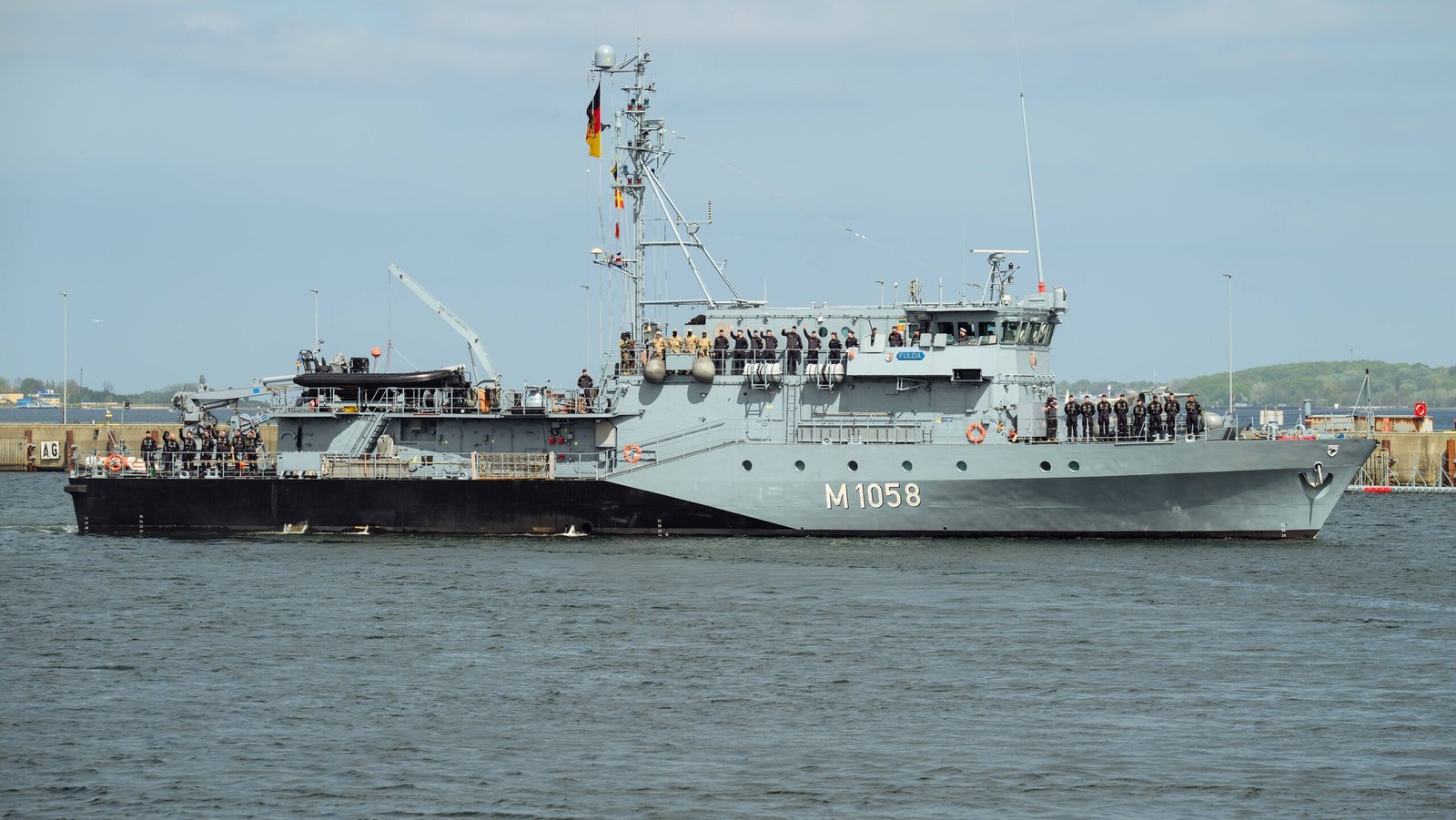
European navies have relevant capabilities. France, the United Kingdom, Belgium, and the Netherlands have experience in mine countermeasures, and several European states have operated in the Gulf and nearby waters. But Hormuz is not a neutral technical space. It lies between Iran and Oman, near Gulf states that would be affected directly by any escalation, and within a maritime environment where US, Iranian, Gulf, and commercial interests overlap.
McLemore, a former US naval officer with 20 years of military service, said a European-led or European-supported effort would probably not begin by trying to clear the entire strait.
“A European-led or European-supported effort would likely focus first on surveying and verifying safe transit lanes rather than clearing the entire strait,” he said. “European navies, especially Belgium, the Netherlands, France, and the UK, have deep mine countermeasures experience, and the US would likely remain important through 5th Fleet coordination, regional relationships, mine warfare expertise, and systems such as the MK 18 unmanned underwater vehicle.”
The work would involve minehunters, unmanned underwater and surface systems, sonar surveys, remotely operated vehicles, and explosive ordnance disposal teams. The immediate goal would not necessarily be to remove every mine before traffic resumes, but to create routes that governments, shipowners, and insurers are prepared to use.
The hard part would not just be finding and neutralizing mines. It would be creating verified safe routes that governments, shipowners, and insurers trust enough to restart traffic.
“The hard part would not just be finding and neutralizing mines. It would be creating verified safe routes that governments, shipowners, and insurers trust enough to restart traffic.”
Shipping companies and insurers are unlikely to treat a diplomatic announcement as equivalent to a restored maritime environment. They will look at actual vessel movement, residual mine risk, the behavior of Iranian naval units, the presence or absence of escorts, and whether new threats emerge after the agreement is made public.
Willian said the real diplomatic work is being handled outside Europe.
“The actual work is being done bilaterally, US and Iran, through a direct channel with Pakistan,” he said. “There’s an agreement coming that will address the strait access question in terms that both sides can live with.”
He also said public assessments of the mining threat may already be outdated.
“Part of what you’ll see in that agreement, when it’s disclosed, is that the remaining mine density is far lower than the public reporting has suggested,” he said. “The numbers being circulated are not current.”
That claim, if confirmed by events on the water, would explain why Washington may see a large European mine-clearance mission as unnecessary. If the mine threat is limited, mapped, or already reduced, the remaining problem becomes less about clearing a mined waterway and more about ensuring Iran does not reimpose restrictions through naval pressure.
McLemore cautioned that even a lower-density mine threat would not make the problem simple. Mine clearance is rarely absolute. It is a process of reducing risk to a level that governments and commercial actors consider acceptable.
“The difficulty would depend heavily on the number, type, and location of the mines. If operators do not know how many mines were laid, where they were placed, or what type they are, mine clearance becomes a risk-management problem rather than a certainty problem.”
In Hormuz, the physical conditions would add another layer of difficulty.
“In the Strait of Hormuz, depth, currents, heavy commercial traffic, seabed clutter, and the risk of renewed attacks could all complicate detection and clearance,” McLemore said. “Detection is usually the hardest part; once a mine is found and classified, neutralization or destruction is comparatively straightforward. Nearby underwater infrastructure, such as cables or pipelines, could slow or constrain how mines are destroyed, but it would not necessarily prevent clearance.”
The State Department adviser was blunt about Europe’s position.
Europe sat this one out entirely
“Europe sat this one out entirely,” he said. “No political will, no military positioning, no skin in the game. For them to launch a demining operation now, after the shooting has stopped, would be diplomatically awkward at best and operationally pointless at worst.”
That view reflects frustration inside parts of the US track over Europe’s limited role in the coercive phase of the crisis. It also understates Europe’s exposure. European economies would be among those affected by any sustained disruption of Hormuz, even if European militaries were not central to the conflict. For Brussels, Paris, London, Berlin, and Rome, the strait is not only a military issue. It is an energy, inflation, shipping, and legal order issue.
The G7 exposed two competing European instincts. The first is operational: Be ready to support mine clearance and maritime security if the US-Iran track falters. The second is diplomatic: Avoid inserting European assets into a theater where Washington and Tehran are now negotiating directly and where any misstep could reignite escalation.
McLemore said the assets required for a serious mine-clearance mission would be specialized and slow-moving.
“Mine-clearance operations in a strategic waterway like the Strait of Hormuz would require a mix of mine countermeasures vessels, unmanned underwater and surface systems, sonar, remotely operated vehicles, EOD teams, small boats, helicopters, command-and-control support, and logistics,” he said.
“Some smaller systems and specialist teams can be flown in, but dedicated minehunters and minesweepers are slow assets, and many are not positioned near the Gulf, so movement from Europe or other theaters could take considerable time,” he continued. “Minehunting is also inherently slow because each suspected contact has to be detected, classified, and then neutralized or avoided.”
Those forces would also need protection. Mine countermeasures vessels are not designed to operate in the middle of active crossfire. They move slowly, follow predictable patterns, and often require escorts.
“They cannot eliminate risk; they can only manage it,” McLemore said.
That is why the memorandum, if implemented, may matter more than any naval mission. A political arrangement can create the permissive environment that mine-clearance forces would need. Without it, a European mission could become a tripwire rather than a stabilizing mechanism.
Still, the memorandum itself remains incomplete. President Trump has described it in strong terms while also warning that military action could resume if Iran does not comply. Willian said Washington was focused on the agreement, not on a separate strait operation.
“There’s not much to say about the strait; we’re focused on the agreement,” he said. “There are some points to be adjusted, and the president was clear in an interview held that morning.”
Willian then quoted President Trump’s warning on the memorandum of understanding.
“Trump was asked if the MOU with Iran was final or if they are still tinkering. Trump said, ‘If I don’t like it, if they don’t behave, we’ll go right back to dropping bombs right smack in the middle of their heads because they misbehaved for 47 years.’”
That language captures the fragility of the current moment. The agreement may have created a path away from direct conflict, but it has not removed the coercive logic around it. The same US administration presenting the memorandum as a breakthrough is also preserving the threat of renewed force.
He also suggested that the timing of the reopening remained uncertain.
“Hormuz will have an update when the deal is officially out and published,” he said. “We’re discussing a lot with them and Pakistan. We expect it to be 100% open until Friday, which I personally don’t think is going to happen.”
That caveat matters. Even if the strait is partially reopening and initial commercial traffic resumes, full normalization is a different threshold. The legal status of future fees or maritime services, the timeline for demining, the role of Oman and other littoral states, and the connection between Hormuz access and broader US-Iran negotiations remain politically sensitive.
For Europe, the immediate mission may now be less visible but not irrelevant. A large demining deployment may no longer be the lead scenario if the US-Iran channel holds. But European governments still have an interest in monitoring whether the reopening is genuinely free, safe, and commercially credible. They also have a stake in preventing a precedent in which access to Hormuz becomes a negotiated privilege rather than a protected principle of international navigation.
McLemore said the timeline for restoring full operations cannot be reduced to a fixed number of days.
“Restoring full commercial operations is less about a fixed timeline than about balancing risk, speed, and number of assets,” he said. “Mine countermeasures forces can prioritize opening verified transit lanes rather than clearing every possible mine, but that leaves a residual risk that shipowners, insurers, and governments must be willing to accept.”
According to him, better information about the mines, more assets, and a permissive security environment would allow risk to be reduced faster. Renewed hostilities, poor weather, uncertain mine locations, seabed clutter, heavy traffic, or threats to the mine-clearing force would push the balance the other way.
“Military authorities can report what areas have been surveyed and what risks have been reduced, but commercial carriers and insurers will make their own decisions about when the route is economically and operationally acceptable.”
That may be the clearest way to read the G7 outcome. The summit did not produce a European-led Hormuz operation. Instead, it exposed the limits of Europe’s ability to shape a crisis that had already moved into a direct US-Iran channel. At the same time, Europe cannot simply step away from the consequences. If the memorandum holds, Europe’s role may be diplomatic, commercial, and legal: ensuring that the reopening of the strait does not include hidden charges, coercive arrangements, or unstable security guarantees. If it fails, the maritime mission discussed at the G7 could return quickly to the table.
For now, the deal has reduced the urgency of a European naval operation. It has not removed the uncertainty around Hormuz. The strait may be reopening, but the larger test is whether it can remain open without turning every commercial crossing into a measure of political trust between Washington, Tehran, the Gulf, and the wider international market.