The US-China Summit of May 14, 2026 in Beijing was an attempt to mitigate great power competition and promote bilateral ties through “constructive strategic stability.” Chinese President Xi Jinping argued against the inevitability of the “Thucydides trap,” which expects an emerging power to go to war against a declining power that it is displacing. US President Donald J. Trump endorsed the need for stability, while deflecting the idea of US decline by attributing it to his predecessor.
Both the US and China are keen to talk up economic interaction, which is not described as dependence, and for the present are sidelining strategic issues. As ever, Trump bragged about his achievements, and the White House subsequently applauded the “great deals” signed with China during his visit to Beijing.
As a China watcher paying close attention to Chinese defense policy and military strategy, and writing regular articles on these subjects, I have some further remarks on the issues addressed by my May 12 Asia Times article entitled “Trump’s visit to Beijing: a great opportunity for China?”
I received some critical push-back to my arguments about the relative decline of the US as a great power, and some commentators saw my article as attributing cowardice to the US in its geopolitical competition with China.
Despite this criticism, I remain pessimistic about the murky and muddled bilateral relationship between the US and China. The allies and strategic partners of the great powers have been left in the dark about the true status of their competitive relationship.
Countries like South Korea need to know enough about what is really going on to plan for the future: their survival will depend upon rapid responses and an increasing degree of autonomous action.
The recent US-China summit was mostly concerned with diplomatic theater, and failed to deliver any concrete structural agreements. Both nations emphasized strategic risk management within a pragmatically negotiated framework that ignores their cut-throat competition on, for example, restructuring supply chains, applying AI to military capabilities and shifting energy security paradigms.
Both great powers are relying on sustained engagement to absorb geopolitical pressure and to address their respective domestic challenges. The US got politically essential victories for its agricultural and aerospace sectors, and also some movement on access to rare earths. China got a predictable trading environment to cushion the impact of declining export volumes and foster domestic technological advances.
President Trump’s back is against the wall. The upcoming midterm elections are likely to curtail his powers and may even make him a lame duck. After his failed attempt to weaponize tariffs; his picking the wrong side in, and then washing his hands, of the Ukraine War; and, most of all, his catastrophically foolish war of choice against Iran, Trump is desperate to portray himself as successful.
US stocks of rare earths, essential to all advanced technologies and effectively monopolized by China, have been seriously depleted by the Iran War.
At the summit, President Xi authorized a limited supply to the US, and also agreed to purchase 200 commercial aircraft from Boeing, as well as quantities of soybeans, beef, and pork. As a quid pro quo, Trump made some ambiguous remarks about the status of Taiwan, and the US has subsequently paused a big arms sale to the island. The Taiwanese government was deeply disappointed to hear Trump publicly describing the sale as a negotiating chip that he was discussing with China.
According to the fact sheet from the summit, the US and China have chosen to pursue a “constructive relationship of strategic stability” based on “fairness and reciprocity.” In practice, however, these sentiments are interpreted very differently in Washington and Beijing, and the underlying tensions in the relationship cannot be wished away by any such verbal formulas.
Eventually the competition will resurface, regionally and then globally, and the nations most immediately affected are Japan, South Korea, North Korea, Taiwan and the ASEAN nations, all of which must navigate a path between the two great powers to assure their survival.
Is it hyperbole, then, to characterize the current attitude of the US, at least, as a kind of cowardice? It is doubtful that President Trump has any interest in what happens in the Indo-Pacific, or even in the wider world, beyond the next few months or years. Certainly the US is refusing to acknowledge that a geo-strategic power shift is underway, and China only mentions this fact in strictly codified terms.
This author anticipates that, as a consequence, many nations around the world will now begin to distance themselves from these great powers.
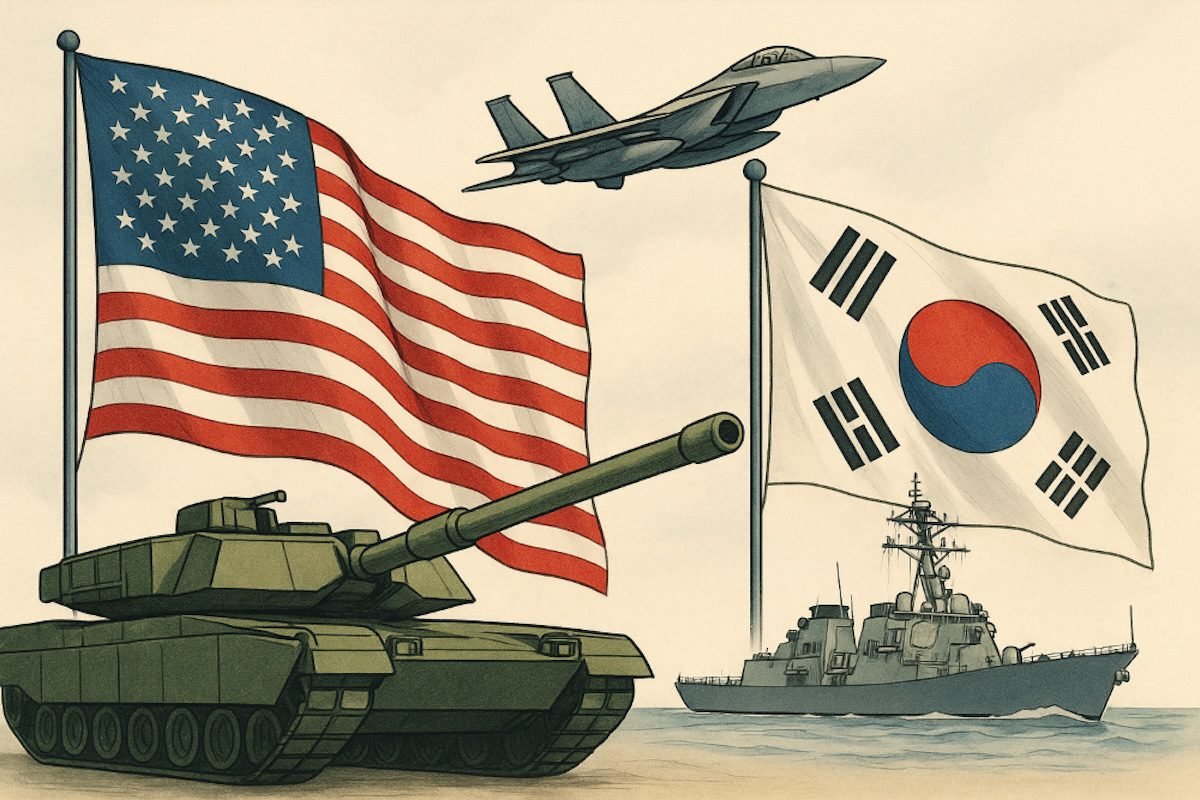
Indeed, for South Korea, such distancing is already happening. The South Korean military has a long history of cooperation with US forces, starting with fighting alongside them during the Chinese invasion of the Korean Peninsula in 1950. But now they have been effectively marginalized by President Trump’s policies of “America First” and “Make America Great Again (MAGA).”
Despite verbal assurances, the US security commitment to the combined defense posture against threats from North Korea has clearly been affected. Unsurprisingly, South Korea is rapidly expanding its autonomous defense capabilities, including the project to build nuclear-powered submarines. And popular opinion would prefer to move farther, with majority support for developing an indigenous nuclear deterrent.
American hegemony has suffered a significant dilution in recent years: US forces can still look impressive against tenth-rate powers like Venezuela, but President Trump’s spectacularly ill-advised decision to attack Iran has revealed the limits to the technological edge that US forces enjoy.
It is difficult to see how this adventure can end in anything other than a humiliating defeat for the US, and many US allies are now seeking to establish more independent security strategies, less reliant on US support.
Thus, South Korea has declined requests to participate in US-led maritime security operations in the Strait of Hormuz, pragmatically preferring to pursue its direct national interests without deferring to the US or China.
Such sentiments have been criticized as presenting China with an excuse to subvert the US alliance with South Korea. These arguments would have some merit were it not for the fact that Trump’s chaotic style of governance is already undermining the alliance, without the need for any Chinese assistance.
Just nine days after Operation Epic Fury was launched on February 28 against Iran, the US Armed Forces’ inventory of the so-called Exquisite Class weapons, such as PAC-3 and THAAD systems, had been massively depleted. As a consequence, THAAD components were relocated away from South Korea to the Middle-East, weakening the US-ROK joint defense posture against North Korea, and the shortage of PAC-3 missiles has forced the US to shift from an offensive to a defensive posture against Iran.
Clearly the US is a less reliable ally than it used to be, and this reality was directly reflected in the Beijing summit.
All prudent nations should understand that the time has come to start distancing themselves from the great powers, and to avoid tilting too much toward either of them. Thus, South Korea must step up to take the leading role in the military security of the Korean Peninsula, with the US as a backstop when required. There are several reasons why this change is necessary, and indeed inevitable, as detailed in the following paragraphs.
First, the fact sheet from the recent US-China summit draws a comparison between the nuclear ambitions of Iran and North Korea, advocating denuclearization for both, but the cases differ since North Korea has already acquired nuclear weapons. A division of roles is also confirmed, with China responsible for managing the threat from the North Korean regime and the US significantly less involved than in the past.
Second, South Korea is the only US ally in the Indo-Pacific region capable of providing the conditions for division-level maneuvers to be conducted. The Rodriguez Live Fire Complex in Pocheon allows massive troop formations to conduct combined dry and live-fire drills, including Apache helicopter strikes, drone operations, and armored unit maneuvering, without running into civilian or geographical limitations.
Indeed, the combined defense posture that South Korean and US forces maintain means that field training is conducted almost daily across nearly all doctrinal areas, from combat duties to bridge construction. The great value of such experiences has become clearer during US operations against Iran, and the South Korean military is uniquely ready to shoulder more responsibility.
Third, over the past 70 years, South Korea has accumulated formidable defense industrial experience. South Korean defense contractors now have development and production capabilities that rival and sometimes surpass those of Europe and Japan. The US has acknowledged this, for example by welcoming South Korean President Lee Jae Myung’s plan for South Korean shipbuilders to rejuvenate US shipbuilding in support of US naval forces. The Pentagon has canceled the troubled Constellation-class program, and is now considering partnering with South Korean defense companies to help design and build its next-generation frigate, the FF(X).
Finally, there are lessons to be learned from Japan’s recent missteps. Japanese Prime Minister Sanae Takaichi has aligned herself with Trump in ways that have caused the US considerable embarrassment, most notably with her clumsy remarks about how Japan would react to a Chinese attack on Taiwan.
Other regional US allies, such as the Philippines, also have concerns about Japan’s hawkish stance. Susceptible though he is to flattery, it is somewhat ironic that Trump does not want allies to depend so heavily on the US that they become a liability.
Other countries are already recognizing the need to lessen their reliance on US military support, which, during Trump’s presidency, has become steadily less dependable. Thus, when he threatened to reduce the size of the US garrison in Germany, the German Chancellor, Friedrich Merz, reacted very calmly. And a similar dynamic can be recognized in remarks made by the British monarch, King Charles, during his recent state visit to the US.
As for South Korea, the transfer of wartime operational control (OPCON) is a central focus of efforts to build greater military and geopolitical autonomy. Conspicuously, a former US ambassador to South Korea, Kathleen Stephens, has recently commented that OPCON will not signal the end of the alliance with the US. That she felt it necessary to make such a statement surely confirms that Pax Americana really is disintegrating.
The gradual decline of US power and influence is getting harder to ignore, though some who read my previous article are reluctant to face up to the implications.
South Korea can and must take the lead role in defending against conventional warfare, with the US playing a supporting role when required, in an arrangement similar to the way the Israeli military operates.
There really is no alternative. Trump’s America is distancing the US from South Korea, in fact from the whole region, so what else is South Korea to do but fully and deliberately accept the responsibility for its own defense?
Sukjoon Yoon is a senior fellow of the Korea Institute for Military Affairs, a member of the Ministry of National Defense policy advisory committee, and a retired ROK Navy captain.