Google is one of the major players in AI (meaning machine learning) weather forecast model space. The models it and others generate have their strengths and weaknesses, but the main advantage is that they can have forecast performance similar to traditional models while requiring far less computing horsepower to run. That means they can be run more frequently.
Google recently released version 3 of its WeatherNext model, with the biggest change being that it now ingests some satellite weather data, shortening the lag time between current weather conditions and generating a new forecast. The update is detailed in a white paper.
Reanalysis
Many weather models make use of what’s called a “reanalysis,” which is a sort of model of its own. Reanalyses take in all kinds of weather data and combine them into a single, consistent global snapshot of the atmosphere. That requires that they provide estimates for conditions over locations without real-world measurements, because weather forecast models need to work with a global picture.
Nearly all AI weather models have been relying entirely on reanalyses, with machine-learning algorithms training on global reanalyses and spitting out a weather map in the same format. There are some compromises there—the raw data sources themselves may contain some information that gets lost in the reanalysis blender, and these global snapshots are generally only produced every six hours.
Traditional weather forecast models often also take in other raw data, capturing as much information as possible to accurately represent the current state of the atmosphere so the model can use physics to simulate conditions forward. WeatherNext 3 now does some of this as well, adding in weather satellite data and upping the forecast frequency to hourly as a result.
There are some other changes, too. The spatial resolution has been increased, and the machine-learning model is larger, prompting some process tweaks to limit the increased computational demands. They also added a separate machine-learning model trained on satellite-based precipitation estimates, meaning there are multiple precipitation forecasts available.
Unlike traditional models that use physical properties in a location to simulate physical processes, machine-learning models are largely black boxes that train on past patterns and spit out predictions of future patterns. But WeatherNext 3 is adding a tiny bit of physical information to calculate surface temperature and dew point at any specific location you want to pull up. It checks whether that point is land or ocean and uses its surface elevation. By training on past weather station data tagged with that information, the team says they get better forecast predictions.
Some oddities
The white paper shows some results to document forecast performance improvements over WeatherNext 2, as well as the European Centre for Medium-Range Weather Forecasts (ECMWF) AI model.
They note a roughly 5 percent improvement in upper atmosphere condition accuracy over their previous model, for example, which they say equates to about six more hours of accurate forecast lead time. And their change to calculating surface temperature for a specific location improved accuracy by up to 30 percent. They’re generally beating the ECWMF model on these metrics as well.
There is one curious exception that the paper doesn’t even guess at the cause of. For a number of variables, their comparison to the initial six-hours-ahead forecast from the other models shows WeatherNext 3 doing worse before pulling ahead for the rest of a 15-day forecast.
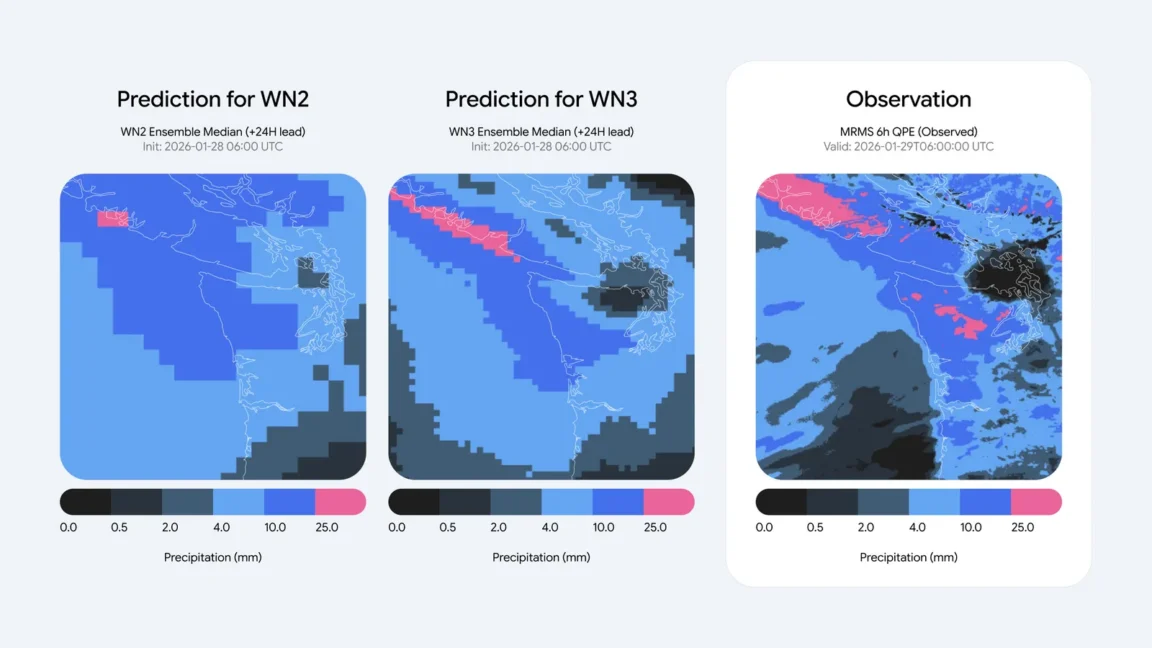
Larger-scale patterns are also not without some weirdness. You can see the shape of the model’s grid in some predictions, like the map of precipitation showing some distinctly hexagonal blobs. Their method of generating multiple surface temperature forecasts to represent the range of possible outcomes also has a habit of producing snapshots where the global average temperature is higher or lower. Normally, you would want to see the average be consistent, with local-scale variability that averages out across the globe.
Overall, the team says their new model “represents a major step forward for AI-based weather predictions by going beyond relying purely on analysis and utilizing information-dense, low-latency observation data.”
WeatherNext 3 is now the source of forecast information across Google services, including Search, Gemini, and Maps.