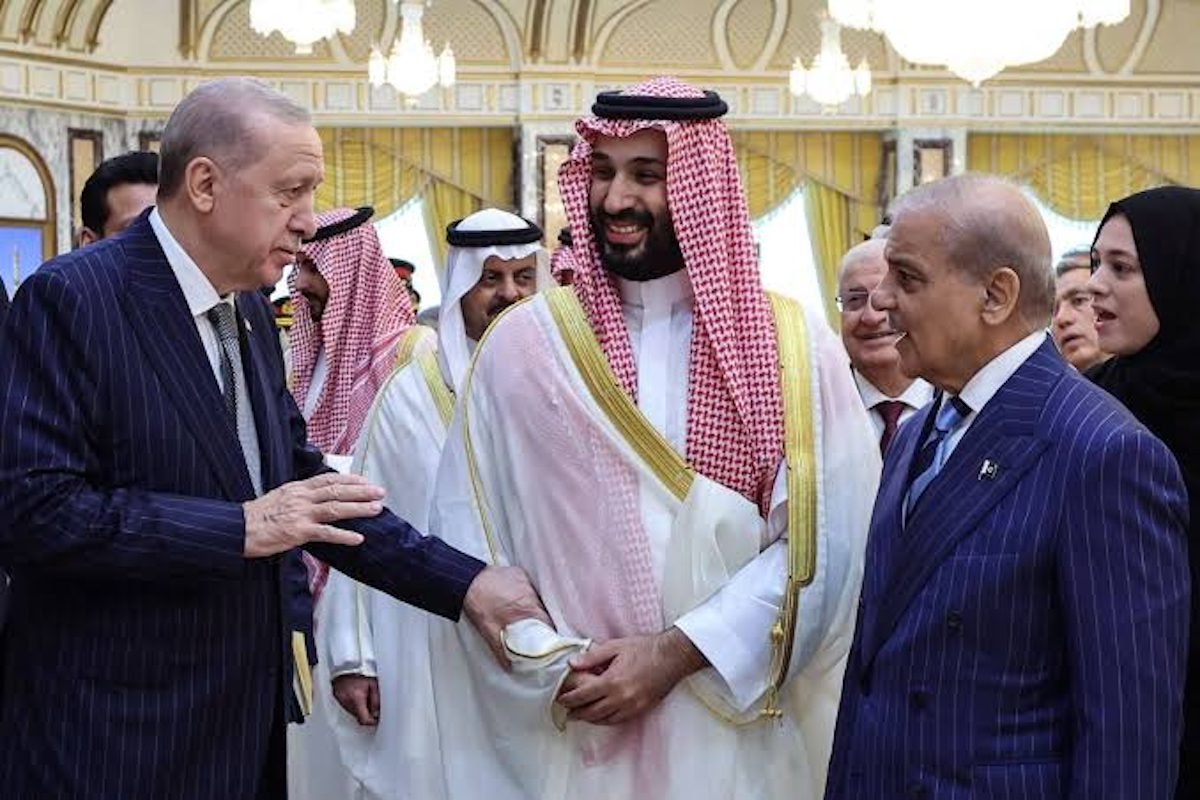
The recently signed Saudi Arabia-Pakistan-Turkey Joint Defense Agreement, concluded in Mecca on August 7, 2026, and referred to as the Makkah Joint Defense Agreement, marks a significant development in the evolving strategic architecture of the Middle East.
The agreement was signed by Saudi Crown Prince and Prime Minister Mohammed bin Salman, Pakistani Prime Minister Shehbaz Sharif and Turkish President Recep Tayyip Erdogan.
It establishes the principle that an armed attack on any one of the three countries would be treated as an attack on all three, reinforcing a collective defense commitment among the partners. It builds on the Strategic Mutual Defense Agreement signed between Saudi Arabia and Pakistan in September 2025 and seeks to broaden defense and security cooperation among the three countries.
While the agreement provides a framework for deeper military cooperation, including areas such as joint exercises, defense-industrial collaboration, technology transfer and intelligence sharing, its detailed operational mechanisms, specific military commitments and implementation provisions have not been publicly disclosed.
Saudi vulnerability, Turkish ambitions and Pakistan’s military role
The timing of the agreement is particularly important. The Middle East remains deeply unstable, with the ongoing US-Iran conflict showing no immediate signs of a durable resolution. Iran-backed Houthi forces have intensified their military activities and threats against Saudi Arabia and Saudi-linked interests.
At the same time, the recently signed US-Saudi civil nuclear cooperation agreement remains tied to the broader question of Saudi-Israeli normalization, with Washington linking the nuclear arrangement’s implementation to Riyadh joining the Abraham Accords.
The evolving Gaza situation, including discussions over the implementation of a possible peace framework, is also creating pressure on major Muslim countries to play a greater role in regional security and diplomacy.
For Saudi Arabia, the agreement reflects a growing concern about its vulnerability to threats from Iran and Iran-backed groups, particularly the Houthis. Riyadh has invested heavily in its economic transformation under Vision 2030, and prolonged regional insecurity directly threatens that ambition.
The closure of the Strait of Hormuz and renewed Houthi threats to Red Sea shipping have demonstrated how quickly regional conflict can disrupt Saudi trade, energy exports and investor confidence. Saudi Arabia therefore needs military partners capable of providing manpower, intelligence, technology and strategic depth.
Pakistan offers one component of this equation. It possesses a large military establishment, extensive operational experience and a long-standing defense relationship with Saudi Arabia. Turkey offers another. Under President Erdogan, Ankara has increasingly sought to expand its strategic influence beyond its immediate neighborhood and project itself as a major power across the Muslim world.
Turkey’s ambitions are particularly relevant. Ankara has become increasingly active in the Middle East, Africa, Central Asia and South Asia, seeking to strengthen its political, military and defense-industrial relationships with Muslim-majority countries.
Erdogan’s own drive to expand Turkey’s regional and international influence is an important factor behind this strategy. Its involvement in Syria, its confrontation with Kurdish groups and its broader regional reach demonstrate that Turkey has interests extending well beyond its borders.
Pakistan as a gateway for Turkey’s strategic expansion
This creates a different strategic equation from the earlier Saudi-Pakistan arrangement. One of the most important questions surrounding the new arrangement is what role Pakistan will actually play. Pakistan could provide the manpower and military capabilities that Saudi Arabia and Turkey may require in different theaters.
If the security commitments under the agreement translate into deployments beyond the traditional defense of Saudi territory, Pakistan could increasingly find itself involved in conflicts and security operations in Yemen, Syria or other theaters where Saudi or Turkish interests are directly challenged. This could effectively turn Pakistan into a military instrument for the strategic objectives of other powers.
For Pakistan, however, the arrangement offers considerable incentives. Islamabad desperately needs financial support. Its economy remains dependent on external assistance, bailout programs and financial inflows from friendly states.
The China-Pakistan Economic Corridor has not resolved Pakistan’s structural economic problems, while Beijing has become increasingly cautious about extending additional financing and has sought repayment of outstanding obligations. Pakistan has also struggled to secure the level of external financial assistance it needs from other partners.
In this environment, a defense arrangement with Saudi Arabia offers Islamabad an additional mechanism through which its military establishment can secure financial and strategic benefits.
Saudi financial assistance, energy supplies and investment could become increasingly important, while Turkey could provide defense technology, training, intelligence cooperation and military-industrial support.
The military can present the agreement domestically as evidence that Pakistan has regained strategic importance and international relevance. Field Marshal Asim Munir could also use the arrangement to strengthen the military’s domestic legitimacy and further consolidate its political influence.
But there is another side to this equation. The arrangement could also constrain Pakistan’s independent decision-making by tying its foreign and security policies more closely to the interests of its partners.
In fact, Turkey’s involvement changes the equation. The earlier Saudi-Pakistan defense relationship was primarily a bilateral arrangement in which Saudi Arabia provided financial and economic support while Pakistan offered military capabilities and manpower. Turkey’s entry introduces a much broader defense-industrial and geopolitical dimension.
Turkey has already developed a substantial defense relationship with Pakistan. The two countries cooperate in areas ranging from drones and naval platforms to broader defense-industrial projects, and their cooperation has also expanded into training, intelligence and military technology.
The relationship became especially significant during the India-Pakistan confrontation in May 2025. Turkey provided political support to Pakistan, while Turkish-origin defense systems and personnel reportedly featured in Pakistan’s military operations. The experience demonstrated the practical value of the growing Turkey-Pakistan security partnership.
A formal trilateral framework could now accelerate this cooperation. Pakistan could gain greater access to Turkish defense technology, expertise and training, while joint development of platforms could expand.
Cooperation involving drones, naval systems and future combat-aircraft programs could become increasingly important, and Turkey’s KAAN program and other advanced defense-industrial projects could become part of a broader trajectory of Turkey-Pakistan technological cooperation.
This matters because Turkey is not merely seeking commercial defense partnerships. Ankara is simultaneously attempting to expand its geopolitical influence across Asia through its “Asia Anew Initiative.” Turkey’s growing engagement with Bangladesh, Pakistan and other Muslim-majority countries demonstrates that its strategic reach is increasingly extending into South and Southeast Asia.
Its expanding maritime presence and defense relationships in the Indian Ocean also deserve closer attention from New Delhi. The recent visits of the Bangladesh Army chief and Pakistan’s field marshal to Turkey are part of this broader pattern of expanding military engagement.
For India, therefore, the concern is not simply that Pakistan is receiving additional military assistance. The larger concern is that Pakistan could increasingly become a conduit through which Turkey expands its strategic footprint in South Asia.
Why Saudi Arabia is different for India
At the same time, New Delhi should not interpret Saudi Arabia’s participation in the agreement as an indication that Riyadh intends to abandon its relationship with India.
Saudi Arabia has strong economic, energy and strategic interests in India. Its primary objective in entering a defense arrangement of this nature is likely to address the security challenges it faces in the Middle East, particularly those emanating from Iran and Iran-backed groups.
India therefore needs to distinguish between Saudi Arabia’s strategic requirements and Turkey’s broader geopolitical ambitions. The danger for New Delhi emerges from the interaction between the three countries. Saudi financial resources can strengthen Pakistan’s military capacity.
Pakistan can provide manpower, military infrastructure and geographical access. Turkey can provide advanced defense technology, training and intelligence cooperation. Together, these capabilities could create a substantially more capable Pakistani military ecosystem. That is a different equation from the earlier Saudi-Pakistan relationship.
Strategic entrapment
Ironically, the agreement that offers Pakistan financial and military benefits could simultaneously create new security problems for Islamabad. Pakistan already faces a deteriorating internal security environment, particularly in Balochistan and along its western frontier.
Greater involvement in Middle Eastern conflicts could stretch its military resources further. This concern is not merely theoretical. During the 2026 Iran conflict, Pakistan reportedly deployed around 8,000 troops, a fighter-jet squadron and an air-defense system to Saudi Arabia under its existing mutual defense arrangement with Riyadh.
More importantly, Pakistan’s closer alignment with Saudi Arabia and Turkey could complicate its relationship with Iran. Pakistan shares a roughly 900-kilometer border with Iran, making any deterioration in bilateral relations particularly sensitive for Islamabad.
Iran has historically viewed Saudi Arabia and Turkey through the prism of regional competition, while Iranian-backed armed groups remain central to several Middle Eastern conflicts. Tehran has already reacted critically to the new Saudi-Turkey-Pakistan defense agreement, warning that such an arrangement would not necessarily provide Saudi Arabia with greater security.
If Pakistan is perceived by Tehran as directly supporting Saudi or Turkish military objectives against Iranian interests, Islamabad could face increased diplomatic and security pressure along its western border.
This could have serious consequences for Pakistan’s already fragile security environment in Balochistan, where Islamabad is simultaneously confronting militant violence and separatist insurgency.
Pakistan may therefore find itself caught between competing strategic demands: securing Saudi financial assistance, deepening military cooperation with Turkey, maintaining its relationship with China, managing relations with the US, and avoiding a direct confrontation with Iran.
At the same time, Pakistan has attempted to position itself as a mediator in the Iran-related crisis, making its balancing act even more complicated.
Pakistan may believe that the agreement gives it strategic importance. But strategic importance can also become strategic entrapment. Once Pakistan commits military, intelligence and logistical capabilities to the security interests of Saudi Arabia and Turkey, withdrawing from those commitments could become increasingly difficult.
Its experience during the ongoing conflict already demonstrated how quickly its Saudi security commitments can intersect with its relations with Tehran. The country could gradually find itself fighting—or being expected to support operations—in theaters far removed from its own immediate national interests.
New strategic challenge for India
The agreement therefore needs to be viewed beyond its formal language. Behind the defense pact is a much larger geopolitical contest involving Iran, Saudi Arabia, Turkey, the US, Israel, Pakistan and other regional powers. Every country is attempting to build strategic depth and secure partners before the next phase of instability in the Middle East.
Turkey wants greater influence across the Muslim world. Saudi Arabia wants protection from regional threats while pursuing its economic transformation. Pakistan wants financial resources, military technology and international relevance. Their interests overlap, but they are not identical.
That creates both opportunities and risks. For Pakistan, the immediate benefits may be substantial: financial assistance from Saudi Arabia, energy support, greater military cooperation with Turkey, access to defense technology and enhanced international visibility. But the long-term costs could be equally significant if Pakistan becomes increasingly involved in conflicts that do not directly serve its national interests.
For India, meanwhile, the emergence of this trilateral security relationship creates a new strategic challenge.
Turkey has already demonstrated its willingness to support Pakistan politically and militarily. Ankara’s ambitions in South Asia, its engagement with other Muslim-majority countries and its growing maritime and defense presence in the Indian Ocean indicate that New Delhi cannot view Turkey’s relationship with Pakistan merely as a bilateral matter.
The convergence between Ankara and Islamabad on political Islam also adds another layer to this relationship, potentially creating greater ideological and strategic coordination across the region.
India therefore needs to closely monitor the agreement’s implementation and assess how it translates into practical cooperation in areas such as intelligence sharing, military exercises, defense-industrial cooperation, technology transfer and military deployments.
New Delhi should also deepen engagement with countries that share concerns about an expanding Turkish strategic footprint, strengthen its own defense, maritime and intelligence capabilities, and intensify engagement with other Gulf partners — particularly on defense, intelligence, maritime and economic cooperation — to ensure its strategic interests remain protected amid the region’s evolving security alignments.
New Delhi must also recognize that the Middle East has changed significantly. The region emerging from the Iran war is not the same strategic environment that existed before the conflict. Shifting threat perceptions and the search for new security partnerships mean India can no longer rely on previous assumptions about regional alignments.
At the same time, India should continue engaging Saudi Arabia. Riyadh has demonstrated that it values its relationship with New Delhi, and India should make clear that its growing strategic partnership with Saudi Arabia need not be undermined by the latter’s security arrangements with Pakistan.
The objective for India should not be to force Saudi Arabia to choose between India and Pakistan. Rather, New Delhi should ensure that Saudi Arabia understands the potential consequences of allowing its financial and strategic resources to strengthen capabilities that could ultimately be directed against Indian interests.
As the geopolitical chessboard grows more complicated and complex, Pakistan may believe it has gained strategic leverage by entering this arrangement, but it has stepped into a much larger game whose consequences it will find increasingly difficult to control.