<
article id=”post-953359″>
Instead of returning to their respective capitals, the leaders of Indonesia, Australia, Singapore, Malaysia, and Thailand converged on Shenzhen for intensive, extended bilateral meetings with Chinese President Xi Jinping.
Official readouts from Anadolu Agency and China Daily painted a picture of regional stabilization. Xi heralded a “full turnaround” in China-Australia relations, while Beijing and Jakarta formally launched negotiations for a Bilateral Comprehensive Economic Partnership.
But beneath these diplomatic pleasantries lies a much harder, calculated economic reality. Beijing is actively shifting its geopolitical leverage, moving away from just the digital realm to weaponize the physical foundation of developing economies.
To understand this shift, look at China’s Ministry of Commerce (MOFCOM) Announcement No. 50 of 2026. This directive, which took effect mid-APEC, placed export restrictions on the mechanical leviathans that make modern urbanization possible.
For years, geopolitical discourse has centered on semiconductors, artificial intelligence, and critical minerals. In 2025, Beijing flexed its muscles by tightening controls on metal-borne magnets and rare earths.
Now, the focus has shifted. Beijing is moving from raw components to massive, finished industrial products that dominate global market share.
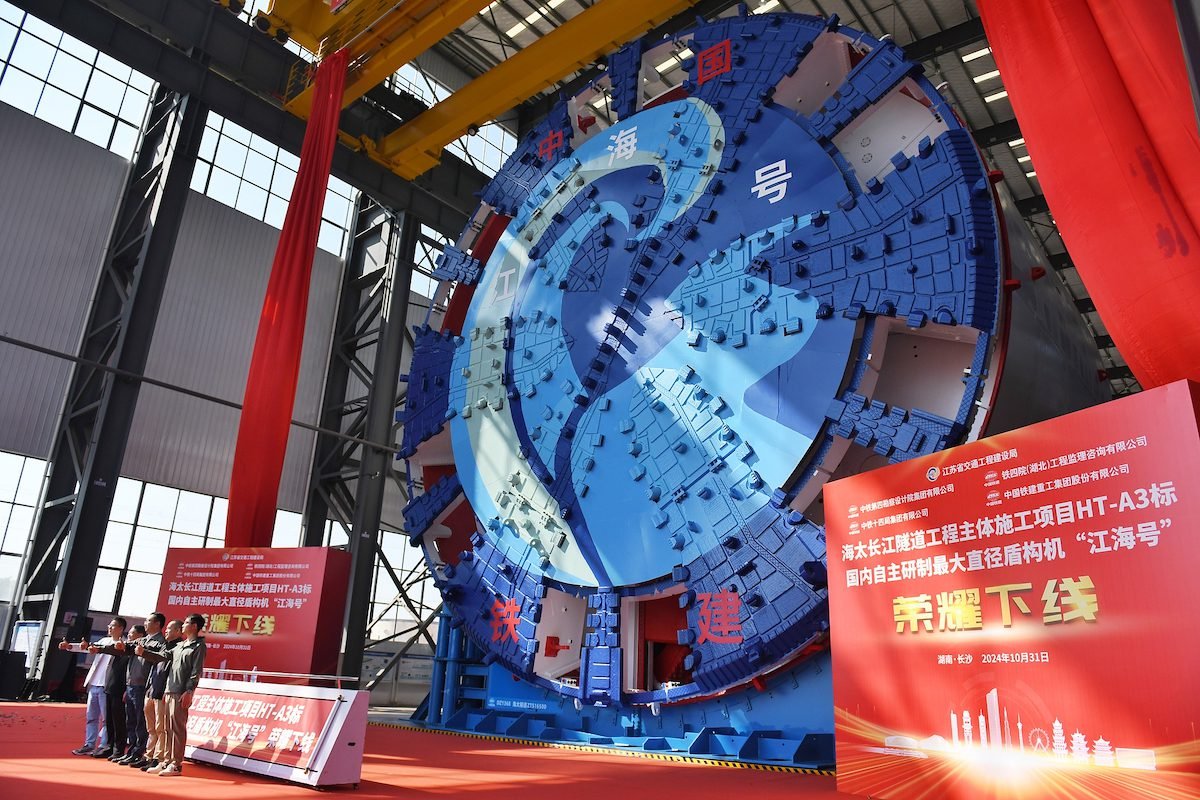
TBMs carve out the subway systems of Jakarta. They build the high-speed rail networks of India. They dig the subterranean arteries of Singapore and Malaysia.
And right now, China holds a near-monopoly on their production. According to data cited by the Payne Institute, Chinese manufacturers collectively account for roughly 70% of global TBM production. They churn out over 700 units annually. That is more than double the rest of the world combined.
China Railway Engineering Equipment Group (CREG) has ranked number one worldwide in TBM output and unit sales for nine consecutive years. Its main domestic rival, China Railway Construction Heavy Industry (CRCHI), follows closely behind.
The financial scale of this dominance is staggering. UN Comtrade data reveals that in 2025, China exported approximately US$793 million in tunneling machinery under HS code 843031. That is roughly seven times the $109 million exported by the United States in the same category.
However, the true value is likely much higher. These machines are rarely sold outright. Instead, they are bundled into massive design-build civil contracts, making their true commercial weight far larger than export statistics suggest.
Take a single underground metro package in the region, such as Manila’s $1.6 billion CP101 or Jakarta MRT Phase 2A’s $1.7 billion build-out. These multi-billion-dollar mega-projects are entirely anchored by the delivery of these machines.
Western firms still exist in this space. Germany’s Herrenknecht AG holds a 19% revenue share, and the US-based The Robbins Company holds about 15%, but these Western companies compete fiercely for ultra-high-value, specialized contracts in the West. They simply cannot match the mass-market volume and state-backed pricing power of their Chinese counterparts.
This is exactly why the extended stays of Southeast Asian leaders in Shenzhen make profound sense. Nations in the Global South are undergoing rapid, desperate urbanization. They need subways, sewers, and transit tunnels. Simply put, they need TBMs.
By placing these critical machines under export controls, MOFCOM has effectively created a new, highly potent diplomatic bargaining chip. This is not merely about protecting domestic technology. It is about raw geopolitical leverage.
When nations like Thailand, Indonesia, or Malaysia come to the table to discuss trade imbalances or border controls, Beijing now has a trump card.
The unspoken message is clear: If you align with Western regulatory policies or isolate our exports, the very machinery required to build your future cities could be delayed or denied.
Furthermore, the corporate architecture of China’s TBM dominance makes this leverage uniquely effective. Unlike Western competitors, CREG and CRCHI are state-owned enterprises. They do not merely answer to shareholders; they answer directly to Beijing.
This allows the Chinese government to align corporate export strategies seamlessly with national security and foreign policy objectives. It creates an unpredictable and formidable challenge for nations trying to negotiate fair trade terms.
For years, Western analysts have assumed that China’s domestic economic reforms are stalling. They argue that the country is overly reliant on exports for growth.
While there is truth to the assertion that deep domestic structural reforms remain elusive, Beijing is proving highly adept at a new game. It is maximizing the geopolitical yield of the exports it currently dominates.
The Shenzhen summit showed that the era of “soft” infrastructure diplomacy is evolving into something much harder. As the US and its allies continue to build fences around microchips and AI, China is quietly taking control of the literal bedrock of global development.
The leaders who shook hands and shared photo ops in Shenzhen know this all too well. In the 21st century, whoever controls the tools of urbanization shapes the future.
Dr. Johnson Juncheng Li is an independent researcher focusing on geopolitical risk and its economic spillover effects. He earned a PhD in business statistics from the Hong Kong University of Science and Technology.
Source: Iwpost.com