North America’s World Cup summer has begun, and China is once again outside the tournament rather than inside it.
That fact is familiar. But it should not be flattened into the usual joke about a country of 1.4 billion people failing to find eleven footballers. China did not vanish at the first hurdle. It narrowly reached the third round of Asian qualifying in 2024, preserving hopes of returning to the finals for the first time since 2002.
But the expanded 48-team format, and Asia’s wider doorway into the tournament, still were not enough. China’s campaign ended before the finals, leaving the same uncomfortable conclusion: vast population, wealth, infrastructure and sporting ambition have not yet produced a reliable World Cup team.
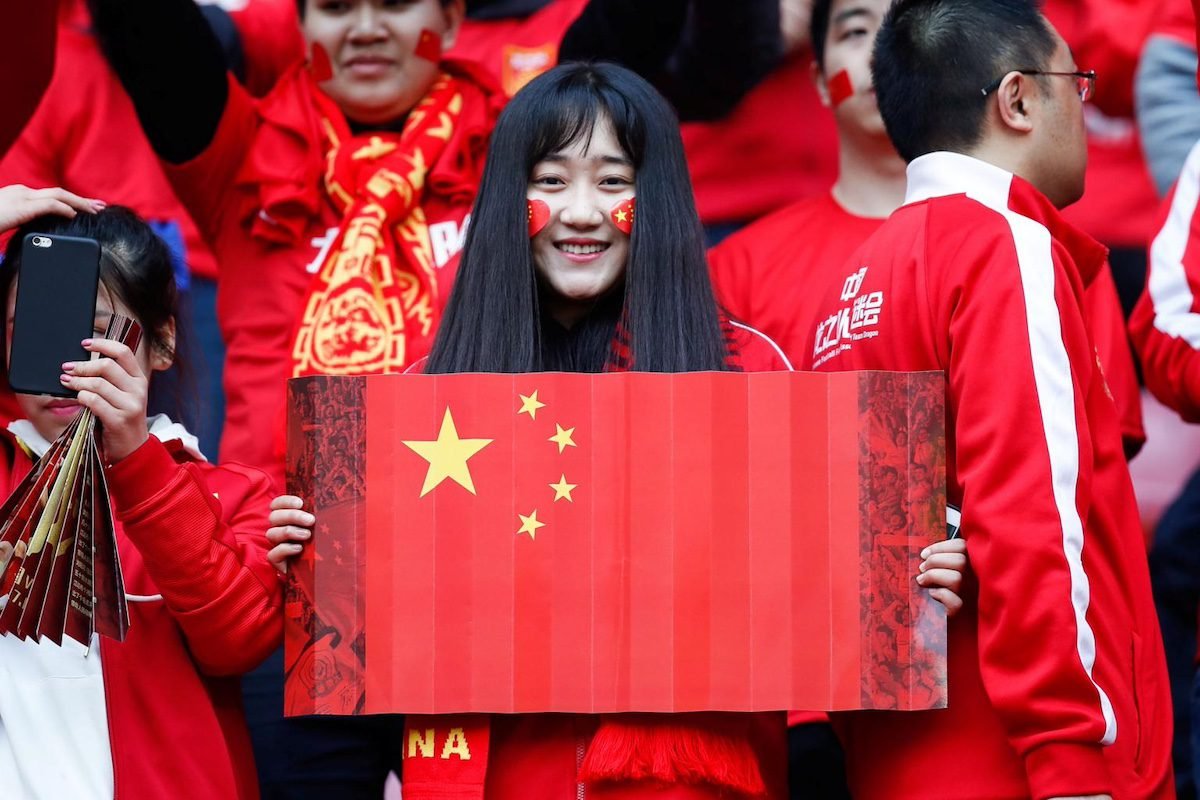
The more interesting point is that there are really two Chinas at this World Cup, and only one of them is missing. The absent China is obvious. It is the men’s national team, whose only World Cup appearance remains the goalless group-stage exit of 2002.
The other China is everywhere. It is in the tournament’s commercial architecture, technology systems, consumer branding, merchandise supply chains, broadcast infrastructure and officiating ranks.
Lenovo, Hisense and Mengniu are not peripheral names in the World Cup economy. They are part of the machinery through which the event is produced, watched and monetized.
Even Chinese referee Ma Ning has become an unlikely symbol of representation. With no Chinese team to support, some fans have treated an official as a national proxy. It is a small detail, but a revealing one: China is absent in the way football fans most want, yet present in almost every other way the modern World Cup operates.
This is the real paradox. China has not solved the problem of producing a World Cup-caliber side, but it has learned how to participate in the World Cup economy. It is peripheral on the pitch and central around it.
That distinction matters because it exposes the limits of a development model that has succeeded spectacularly elsewhere. China knows how to mobilize capital, set targets and scale infrastructure. It has built high-speed rail, electric vehicles, ports, solar supply chains and Olympic medal programs with astonishing speed.
Football resists that logic. China did not under-invest in football. If anything, it over-engineered it. A landmark 2016 football plan promised tens of thousands of pitches and tens of millions of schoolchildren playing the game. Chinese Super League clubs spent heavily on foreign stars, chasing global attention and quick prestige.
For a brief period, Chinese football looked like the next great market shock in the sport. Then the foundations cracked.
Many clubs were tied to property developers and local prestige projects rather than durable sporting institutions. When the property sector weakened and the pandemic hit, the professional game’s fragility became visible. Clubs folded, finances deteriorated, and corruption and match-fixing scandals deepened public cynicism.
The lesson is not that China cannot succeed in football. It is that football cannot be manufactured like an industrial output.
A football culture is not built only by counting pitches. It grows through neighborhood rivalries, trusted youth coaches, local clubs, family habits, unstructured play and competitive minutes accumulated over years. It requires enough organization to support talent, but enough looseness for creativity to appear.
That is where China has struggled. The same system that can train a diver through repetition or a gymnast through early specialization cannot easily produce the improvisation of a midfielder, the intuition of a striker or the collective trust of eleven players under pressure.
There is also an academic cliff. Around early adolescence, just as their football talent should be deepening, many Chinese children face intensifying exam pressure and drift out of sport. For families, football can look less like a pathway and more like a risk.
That narrows the talent pool before it matures. It also explains why China’s football problem is not really a mystery of population size. Large populations do not automatically produce elite teams. Football success comes from a pipeline, not a census.
The encouraging signs are not coming from another spending spree. They are coming from below.
Amateur and community football have begun to attract serious attention. Local leagues, including the widely discussed Suchao phenomenon in Jiangsu, have shown that football enthusiasm in China may be healthier socially than institutionally.
Teachers, coders, students and delivery drivers playing in front of packed crowds will not produce a national striker overnight. But they may do something more important: make football feel normal. That is the beginning of a real football culture.
China’s commercial presence at the World Cup should therefore be treated not as a consolation prize, but as a platform. Chinese companies that benefit from football’s global visibility could help fund open-access youth leagues, coaching exchanges, analytics tools for lower-tier clubs and scholarships that connect football with education.
The goal should not be another vanity cycle of marquee signings. It should be a patient ecosystem: school-community partnerships, stable local clubs, better coach education, transparent youth scouting, more girls’ and boys’ recreational leagues, and pathways that reassure parents that sport and academic mobility can coexist.
That last point is crucial. If football is framed as a threat to education, China’s player base will remain artificially thin. If it is framed as compatible with discipline, teamwork, health and opportunity, more families may let children stay in the game long enough to discover whether they are good.
So will China be at the 2030 World Cup? It is possible, but far from assured. The expanded format helps, but it does not erase the gap between commercial visibility and footballing depth. China does not need louder slogans about becoming a football power.
It needs more ordinary football: more children playing, more parents trusting the pathway, more clubs surviving, more coaches improving, and more local competitions that matter to communities.
The broader lesson travels beyond sport. Some things grow only when authority creates space for local institutions, families and clubs to do what central plans cannot. Football rewards patience, improvisation and social trust. Those are harder to command than investment, but they are exactly what the game requires.
China’s absence this summer is therefore not only a failure. It is also a mirror. Off the field, China is already a World Cup power: commercially sophisticated, technologically embedded and symbolically present. On the field, it remains unfinished.
If China eventually returns to football’s biggest stage, it will not be because it rediscovered how to spend. It will be because it learned how to cultivate. That would be a better story for China, a better story for Asian football and a better story for the World Cup itself.
Y. Tony Yang is an Endowed Professor at the George Washington University in Washington, D.C.