<
article id=”post-953449″>
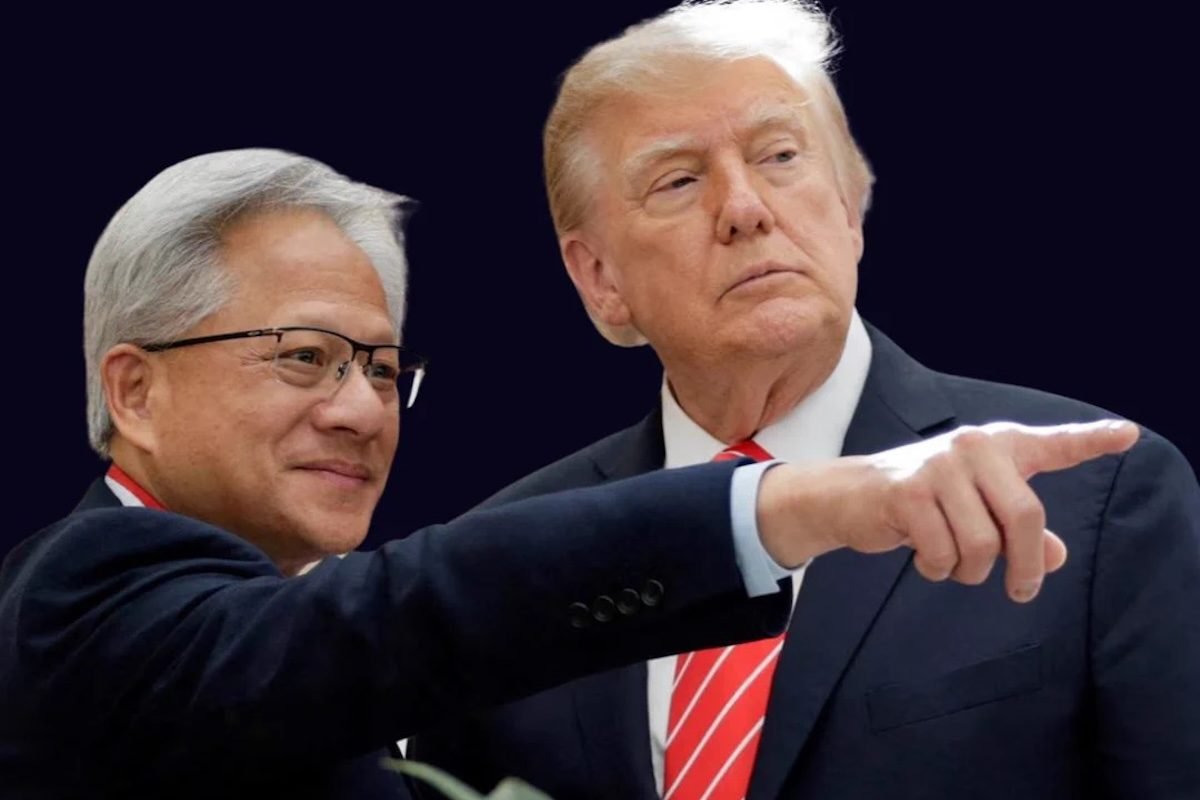
Trump, whose investment accounts owned up to 370,000 Nvidia shares as of September 30, publicly took credit for the board’s decision, telling CNBC that he “convinced them” and “made the deal” to bring back Huang. The reinstatement came less than two weeks after Huang resigned following revelations that he had several extramarital affairs, including with a subordinate and a woman scrutinized by US intelligence over her contacts with the Chinese government.
Nvidia’s stock price surged more than 30% on Monday after news of Huang’s reinstatement broke. The news also sparked a broad share price rally in the tech sector, which had sold off sharply in the wake of Huang’s exit and amid news that the semiconductor giant was facing a Securities and Exchange Commission probe over its accounting practices.
The Financial Times, which first reported Trump’s $15 million estimated gain from the Nvidia rally, noted that Trump “applied pressure” to the corporation’s board over the weekend “after watching what was once America’s most valuable company as well as the wider tech sector hemorrhage value last week.”
“Just to be clear: the president of the United States called into a private company’s board meeting and pressured them into reinstating a fired CEO whose actions his own government is investigating, and personally made 15 million dollars in the process,” wrote Zeteo’s Mehdi Hasan in response to FT’s reporting. “In any other era, a monumental political scandal for the president. But not in ours, apparently.”
Rep. Don Beyer (D-Va.) called Trump’s intervention “psychotically crooked,” arguing that the president once again put “private gain above the national interest.”
“He is attempting to grant functional immunity to Nvidia and declare Huang ‘exonerated’ even though ongoing investigations continue to reveal national security risks and a seeming contempt for the law,” Beyer wrote. “And the leaders of the tech industry are all too eager to exploit Trump’s corruption for their own ends, regardless of the consequences.”
A BBC analysis of Trump’s financial disclosures for the last two years found that the president’s investment accounts “purchased shares of Nvidia worth between $23 million and $86 million,” and that “he has bought Nvidia stock 85 separate times through a number of investment accounts.”
“Trump has also sold some of his stake in Nvidia since returning to the presidency,” BBC added. “Over 19 sales, Trump gained between $3.5 million and $10.2 million, according to his government disclosures.”
“We need to investigate what stock positions took place before the announcement,” US Sen. Ruben Gallego (D-Ariz.) said on Monday. “This White House is the most corrupt in history.”
Shortly after Nvidia announced that it was bringing Huang back, Trump called into CNBC to take credit for convincing the board to give its scandal-plagued CEO a second chance.
During the interview, Trump was asked if he gave an assurance to the board that Huang would not be prosecuted for any crimes he may have committed during his tenure.
“I didn’t use the word ‘prosecuted,’ but I said that… we believe he’s fine,” the president said. “He’s absolutely fine. I gave them enough assurance.”
Sen. Chris Van Hollen (D-Md.), who is vying to become the next Senate Majority Leader, said Trump’s moves to get Huang reinstated were just the latest example of his unprecedented corruption.
“This is what a rigged system looks like,” Van Hollen wrote in a social media post. “Trump trades NVIDIA stock, they give $25 million to his ballroom, and now Trump gets Huang hired back.”
Sen. Ron Wyden (D-Ore.), who is in line to become the next chair of the Senate Finance Committee, vowed the next Congress would get to the bottom of the Trump-Nvidia scandal.
“Jensen Huang’s reinstatement shows that under Trump, Vance, and Rubio, our national security is for sale,” he wrote. “In January, Democrats will hold this corrupt administration accountable.”
Sen. Ruben Gallego (D-Ariz.) called on Congress to “investigate what stock positions took place before the announcement” of Huang’s reinstatement, while labeling the Trump White House “the most corrupt in history.”
Rep. Pat Ryan (D-NY) vowed the US House of Representatives would also conduct a vigorous investigation of Trump’s actions.
“Trump literally called into a Nvidia board meeting to save Jensen Huang’s ass,” Ryan wrote. “All it cost was a $25 million donation to the ballroom. Blatant corruption. We need an independent investigation into how Huang may have sold our national security to a Chinese spy.”
Democratic lawmakers were not the only ones taking shots at Trump’s corruption, as many progressive advocacy groups weighed in as well.
Nidhi Hegde, executive director of the American Economic Liberties Project, said that Trump’s intervention showed that Nvidia had become “too big to fail,” and accused the president of caring “more about Wall Street than American national security.”
Hegde also predicted that the boost given to the stock market by Huang’s return would be short lived.
“However the market reacts today, this is not a healthy economy,” Hegde said. “It’s a monopoly that supports a bubble that will eventually pop, and take with it the retirement savings we’ve all allowed to get tangled up in this corrupt mess.”
Jeff Hauser, executive director of the Revolving Door Project, questioned the Trump administration’s loyalty to the United States.
“The entire justification for Trump’s artificial intelligence policies has been that the United States must win a purported ‘race’ with China,” noted Hauser, “but everything about the Nvidia story suggests that Trump and [US Secretary of Commerce Howard] Lutnick are okay assisting China’s AI development.”
“Given their stated policy preferences, history of corruption, and the wild disconnect with their stance on Nvidia,” Hauser continued, “patriots have to take very seriously the possibility that the administration is no longer fundamentally loyal to the American people.”
Source: Iwpost.com