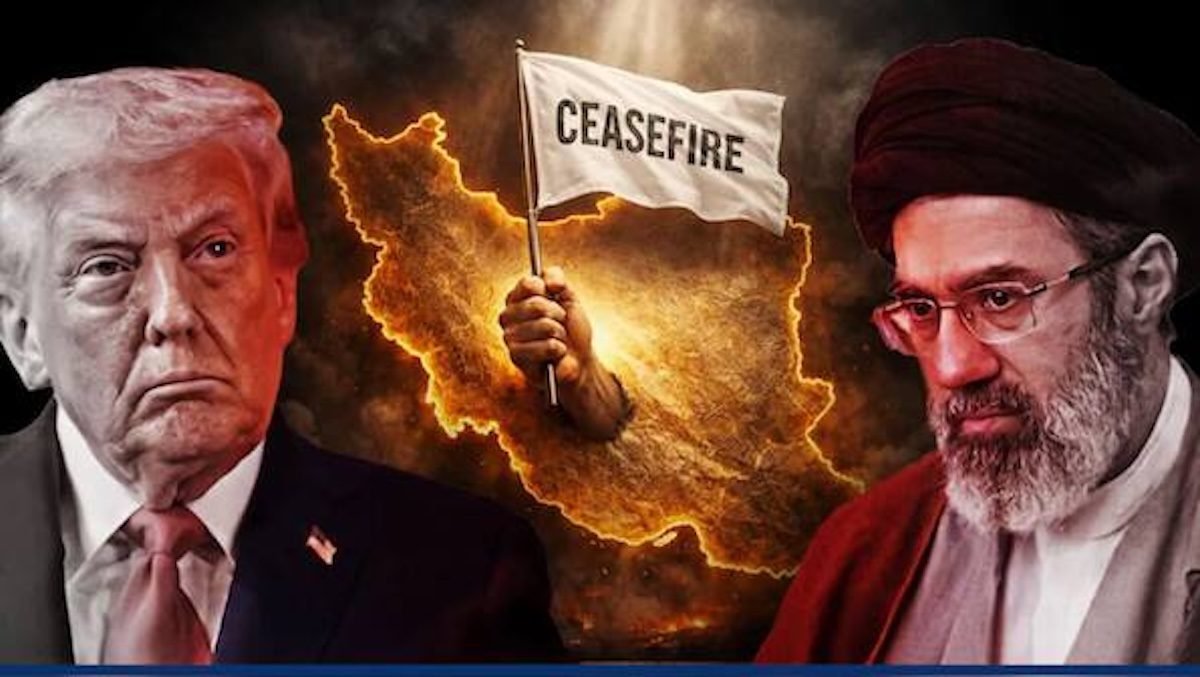
Iranian officials warned Sunday that US President Donald Trump’s newly announced plan to help “guide” stranded ships out of the Strait of Hormuz is an attempted provocation aimed at justifying additional military action against the Middle Eastern country.
An unnamed senior Iranian official told Drop Site that Trump’s plan, announced on Truth Social and confirmed by the US military, “is primarily intended to provoke Iran into taking an initial step toward confrontation, thereby creating a pretext for escalation and enabling him to justify further military action in response to an Iranian initiative.”
The official added that “our definitive position is that any commercial vessel attempting to transit through designated restricted routes without prior coordination will be promptly intercepted by Iranian forces.”
“Should US military vessels respond, such actions would be met with an immediate and corresponding response from Iran,” the official continued. “The US military vessels are far from the corridor area. If commercial vessels attempt to move, they would be engaged well before reaching any American ships,” the official added. “Trump has effectively turned them into bargaining tools in his political game.”
Ebrahim Azizi, who heads the national security commission of the Iranian Parliament, warned in response to Trump’s plan that “any American interference in the new maritime regime of the Strait of Hormuz will be considered a violation of the ceasefire” that took effect in early April.
“The Strait of Hormuz and the Persian Gulf would not be managed by Trump’s delusional posts,” Azizi added.
Trump wrote on his social media platform on Sunday that his administration has told countries with vessels stranded in the vital strait that “we will guide their Ships safely out of these restricted Waterways, so that they can freely and ably get on with their business.”
Iran closed the strait – through which around 25% of the world’s seaborne oil trade and a third of global fertilizer trade flows each year – in response to the US-Israeli war as well as the Trump administration’s naval blockade against Iran.
The US president characterized his plan, which is titled Project Freedom and set to take effect on Monday, as a “humanitarian gesture on behalf of the United States,” but provided few details on how it would work.
US Central Command (CENTCOM) said in a statement on Sunday that military support for Project Freedom would “include guided-missile destroyers, over 100 land and sea-based aircraft, multi-domain unmanned platforms, and 15,000 servicemembers.”
“Last week, the US Department of State announced a new initiative, in partnership with the Department of War, to enhance coordination and information sharing among international partners in support of maritime security in the strait,” CENTCOM said. “The Maritime Freedom Construct aims to combine diplomatic action with military coordination, which will be critical during Project Freedom.”
Brian Finucane, senior adviser to the US Program at the International Crisis Group, wrote that CENTCOM’s statement makes the president’s plan “sound like information-sharing backed by a vague threat of military action.”
The president’s scheme drew immediate support from one of the most vocal boosters of the Iran war, US Senator Lindsey Graham (R-SC), who said he “totally” agrees with Trump’s decision to launch Project Freedom.
“I hope this conflict can end diplomatically,” said Graham, “but it is now time to regain freedom of navigation and forcefully respond to Iran if they insist on terrorizing the world.”
‘No nuclear negotiations’ are happening at this stage, Iran says
A spokesperson for Iran’s Foreign Ministry had said on Sunday said the Iranian leadership was reviewing the response issued by the US government over the weekend following a 14-point plan offered by Tehran to bring the war – now in its third month – to an end.
“The Americans have given their answer to Iran’s 14-point plan to the Pakistani side, and we are currently reviewing it,” Foreign Ministry spokesman Esmaeil Baghaei said in an interview with Iranian television.
Baghaei said that the offered framework is strictly focused on ending the immediate hostilities and that the plan contains “absolutely no details regarding the country’s nuclear issues,” which he suggested could be discussed at a later time.
“We are not currently engaged in any negotiations over the nuclear issue, and decisions about the future will be made in due course,” he said, even though Trump and US Secretary of Defense Pete Hegseth have continued to claim the preventing the Iranians from having a nuclear weapons program – which Tehran denies having and US intelligence assessments have shown does not exist in the manner that US officials describe it – is central to their war aims.
“I will soon be reviewing the plan that Iran has just sent to us,” Trump said in a social media post on Saturday, “but can’t imagine that it would be acceptable in that they have not yet paid a big enough price for what they have done to Humanity and the World, over the last 47 years.”
Despite some reporting examining what’s purportedly in the Iranian proposal, the exact details of the 14-point plan remain murky or contentious, depending on who you ask. Trita Parsi, executive vice president of the Quincy Institute for Responsible Statecraft, gave his assessment of the current situation on Sunday by saying:
Overall, the Iranians appear to be pursuing a grand bargain—without labeling it as such. This is not merely a proposal aimed at securing a ceasefire, or even a formal end to the current conflict, but rather an attempt to resolve the broader US-Iran antagonism that has persisted for the past 47 years. Implicit in this approach is an expectation that both sides would also restrain their respective regional partners and proxies (Israel, Hezbollah, etc.). In many respects, framing the proposal in this way may align more effectively with Trump’s instincts and psychology.
Meanwhile, a poll out Friday showed that 61% of Americans believe Trump’s launching of the war was a mistake, and an even higher number (66%) disapprove of how he’s handling the conflict. The same ABC News/Washington Post/Ipsos poll also showed that Trump is now facing the lowest approval ratings of his presidency.
Speaking with Al-Jazeera over the weekend, Parsi explained that Trump’s maximalist demands, including the blockade that it has tried to impose on Iran near the Strait of Hormuz, have made negotiations much more difficult.
Over the weekend, archival footage from the 1990s shared online by journalist Séamus Malekafzali showed former Iranian Revolutionary Guard Corps commander Hossein Salami, who was killed by US-Israeli forces last year, talking to the IRGC’s staff college about the country’s strategy of “asymmetric warfare” if and when it ever faced an opponent that was perceived to have military superiority over it.
“The chance of conflict with American forces is very possible,” Salami says in the video, according to the English subtitles provided, but the “possibility of victory really exists” if Iranians are able to move the conflict toward “the area of our capabilities into the area of America’s weaknesses.”
That strategy, as Malekafzali paraphrases it, is “to drag out a war with the US by driving up economic costs and political turmoil,” thereby draining the US and sapping its power by inflicting economic pain and political pressure.
As many foreign policy observers have pointed out since Trump launched the war, the strategy of Iran to inflict pain on US allies in the region and economic pain at a global level – such as has been achieved by the closing of the Strait of Hormuz – is very much what Salami describes.
As geopolitical analyst Misbah Qasemi explained, Salami’s point was basically this: “Don’t match their strength (air power, technology). Attack their weaknesses (economic endurance, political will, domestic opinion). Drag them into your terrain – maritime, cyber, proxy networks – where their advantages neutralize themselves.”
This point was made explicitly by Harrison Mann, a fellow with the advocacy group Win Without War, during a Sunday appearance on CNN, where he explained how this plays out in practical terms.
“Iran can actually inflict pain back on the US,” said Mann. “In this case, via economic warfare, which is not sustainable for Trump in the long run.”