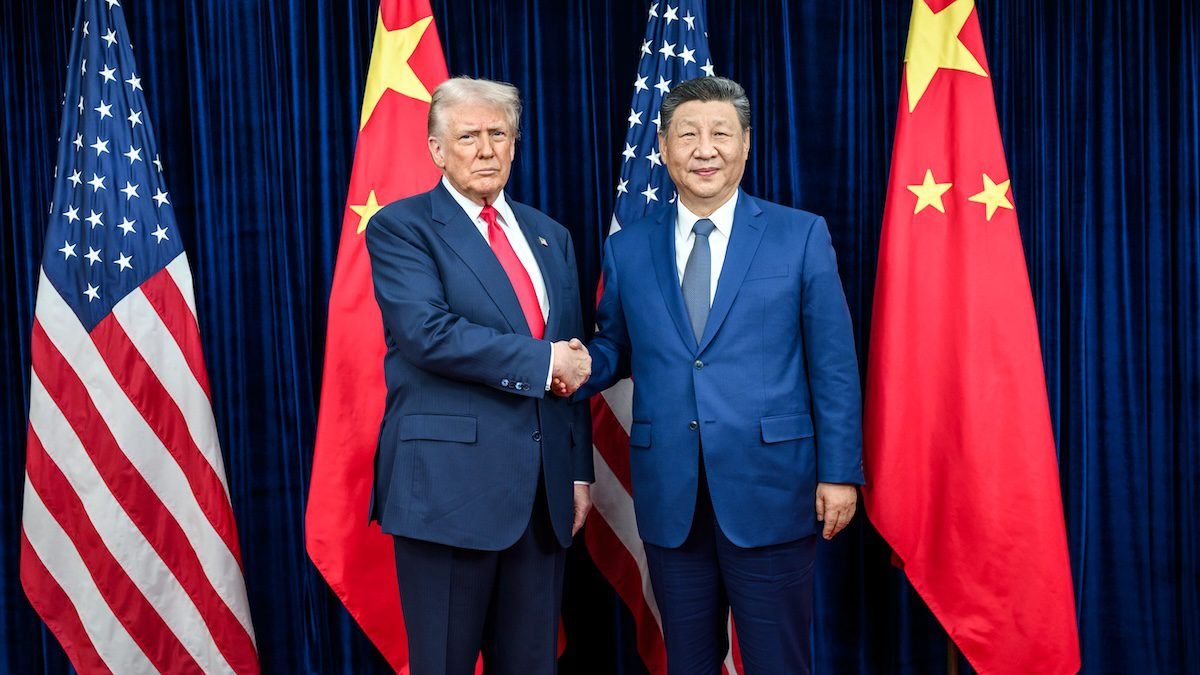
Energy partnership will be one of the key items on the agenda when United States President Donald Trump meets Chinese President Xi Jinping in Beijing from Wednesday to Friday, with Washington seeking Beijing’s commitment to resume regular purchases of American oil and gas.
US officials have recently said a deal for Beijing to buy more American energy is under consideration, as the war in Iran and the blockade around the Strait of Hormuz have raised fresh questions about China’s exposure to Middle Eastern supply routes.
Chinese imports of US oil and liquefied natural gas (LNG) amounted to US$8.4 billion in 2024, but were largely halted after the tariff war initiated by Trump in April 2025.
In 2024, China imported 193,000 barrels per day of US crude oil, worth about US$6 billion in total. But it has not imported any US oil since May 2025 due to a 20% import tariff imposed during the trade war, offsetting the shortfall with higher shipments from countries such as Canada and Brazil.
For US LNG, China’s imports have fluctuated sharply in recent years. In 2021, China imported about 7.04 million tons of US LNG, but the figure declined to 4.15 million tons in 2024 as Chinese buyers turned to suppliers such as Russia and Qatar, which offered more cost-effective cargoes than US spot shipments.
The figure fell further to 26,000 tons in 2025 after China imposed a 25% tariff on US LNG as part of the tit-for-tat trade war.
China’s imports of US ethane and propane, by contrast, have been less affected by rising political tensions between the two countries. It is because the US was China’s sole supplier of ethane and remained China’s largest propane supplier in 2025. Both materials are for making plastics.
The US has been pushing China to buy its energy through a carrot-and-stick strategy. On the one hand, the US Treasury Department in April sanctioned Chinese “teapot” oil refiners and dozens of ships and vessels linked to Iran’s shadow fleet, while also threatening secondary sanctions on Chinese banks that help settle transactions related to Iranian oil.
US Trade Representative Jamieson Greer said on May 6 that buyers of Iranian oil were contributing to Tehran’s terrorism activities and that China’s refusal to comply with US sanctions would have to become a key discussion item in the coming Trump-Xi meeting.
On the other hand, Trump said China is welcome to buy energy from the US. In a media briefing at the White House on May 5, he described Xi as a “tremendous guy” and said he got along well with Xi.
“We’ve offered that if he wants to send the ships to the US,” Trump said. “I made a statement: send your ships to Texas. It’s not that much further. Send your ships to Louisiana. Send your ships to Alaska. Alaska is actually very close to a lot of the Asian countries; people don’t realize it.”
Trump added that the US was making “tremendous” deals with South Korea and Japan, which lost their main source of oil supply due to transportation disruption in the Strait of Hormuz. He also said that although China had 60% of its imported oil from the Strait of Hormuz, Xi has been “very respectful” as the strait’s logistics have affected by the war in Iran.
Beijing’s responses
During a regular briefing, Chinese Foreign Ministry spokesperson Lin Jian was asked about Trump’s suggestion that Beijing should buy American oil rather than Iranian oil. Lin declined to give a direct answer and referred the media to the competent authorities.
Chinese commentators have mixed views on the matter. Some say the disruption in the Middle East has strengthened the case for China to diversify oil and gas supplies, including from the US.
A Hunan-based columnist using the pen name Xu Sanlang says China suspended most US energy imports as a countermeasure after Trump returned to the White House in early 2025. He says China’s last crude oil purchase from the US was in February 2025, while LNG imports stopped after December 2024.
Citing Chinese customs data, Xu says China imported about US$325 billion worth of crude oil in 2024, of which US crude accounted for only 1.8%, or about US$6 billion. The figure basically dropped to zero in 2025.
However, citing Kpler data, he says that nearly 600,000 barrels per day of US crude oil were loaded onto tankers bound for China in April 2026. He says the main reason was Iran’s move to close the Strait of Hormuz and its strikes on energy facilities in Saudi Arabia, the United Arab Emirates and Qatar.
“Faced with this situation, the most rational response is to diversify procurement sources,” Xu writes. “Although the US is China’s trade rival, it does have sufficient energy supplies. China’s purchases of US energy were previously interrupted by a tariff war in 2025, but the situation has since changed. Supply security is more important than anything else.”
“Trump has long asked China to buy more American agricultural products, aircraft and energy products but when the trade war was intense China could ignore those demands,” he adds. “Now the Middle East conflicts and global supply-chain tensions have made Trump’s energy-purchase request easier for Beijing to accept.”
He stresses that resuming US energy purchases would meet China’s own supply security needs while giving Trump some “face” during his visit to Beijing. “It kills two birds with one stone,” he said. “It protects energy security while creating favorable conditions for China-US negotiations.”
Other commentators argue that Beijing should not deepen its reliance on US energy, as Washington has illegitimately used force to control oil exports from Chinese allies, including Venezuela and Iran.
A Henan-based writer says Trump claimed earlier this month that the US was receiving “hundreds of millions of barrels of oil” from Venezuela and sending the crude to Houston for refining.
“Four months ago, US forces raided Caracas and took away Venezuelan President Nicolas Maduro and his wife,” he writes. “How can Trump now say that the US and Venezuela are partners?”
The writer says the US Treasury Department revoked Chevron’s license to operate in Venezuela on March 1 and issued a new general license that broadly authorizes US companies to do business with state-owned Petróleos de Venezuela.
“This is not normal international trade. This is naked plunder,” he says.
He says the US was tightening pressure on Iran and obstructing oil routes through Hormuz while asking other countries to buy the Venezuelan oil refined in Texas. As oil prices rise, he says, the Venezuelan crude controlled by the US becomes more valuable, making the arrangement look more like coercion than cooperation.
A Hebei-based writer says China did not necessarily have to buy US-refined Venezuelan crude because it had spent two decades building pipelines to import oil and gas from Central Asia. He says the Central Asia-China gas pipeline delivered 4.67 million tons of natural gas to China in January and February this year, or about 79,200 tons per day, and has operated steadily.
He says the pipeline starts in Turkmenistan and enters China through Uzbekistan, Kazakhstan and Horgos in Xinjiang, running entirely over land. In 2025, China imported US$8.41 billion worth of natural gas from Turkmenistan, making it China’s second-largest gas supplier after Russia, which supplied US$9.41 billion. He says the route does not pass through disputed waters and is not subject to shipping delays or higher insurance costs due to rising oil prices.
“Together with LNG imports from Australia, Qatar, Russia and other suppliers, China has effectively built a diversified energy network,” he says. “No matter how strong a maritime power is, it cannot cut off the steel pipelines running through the heart of Central Asia.”
Some commentators also say China can choose to increase its imports of heavy crude from Canada, although it is about US$10 per barrel more expensive than Venezuelan oil.
Read: New Trump sanctions on Chinese firms: leverage on Xi or overkill?
Follow Jeff Pao on X at @jeffpao3