U.S. Secretary of State Marco Rubio is scheduled to meet Russian Foreign Minister Sergey Lavrov in New York on Wednesday morning, the State Department announced, as diplomatic activity intensified around the United Nations General Assembly.
The meeting follows Tuesday’s talks between Ukrainian President Volodymyr Zelenskyy and President Donald Trump at U.N. headquarters, where the two discussed ending the four-year war with Russia, including the possibility of a bilateral ceasefire limited to energy-related targets.
Zelenskyy, Trump Signal Urgency Before Winter
Zelenskyy described his meeting with Trump as “positive and productive” in a post on social media platform X, saying both countries want the war ended before winter and that they discussed steps toward de-escalation that could open the door to diplomacy.
Zelenskyy said Ukrainian and American teams continue working to launch domestic production of Patriot interceptors, calling the effort essential to protecting lives if Russia rejects negotiations and continues missile attacks on civilians through the winter. He said the two leaders also discussed a winter package of air defense support.
Speaking to reporters after the 40-minute meeting, Zelenskyy said the leaders discussed a potential energy ceasefire, adding that Ukraine is prepared to accept “any kind of format” if Russia agrees to stop attacking its energy infrastructure.
Negotiations between Kyiv and Moscow remain stalled despite recent visits to both capitals by U.S. Special Envoy Steve Witkoff and Trump son-in-law Jared Kushner. Russia’s full-scale invasion of Ukraine will mark its fifth anniversary in February 2027.
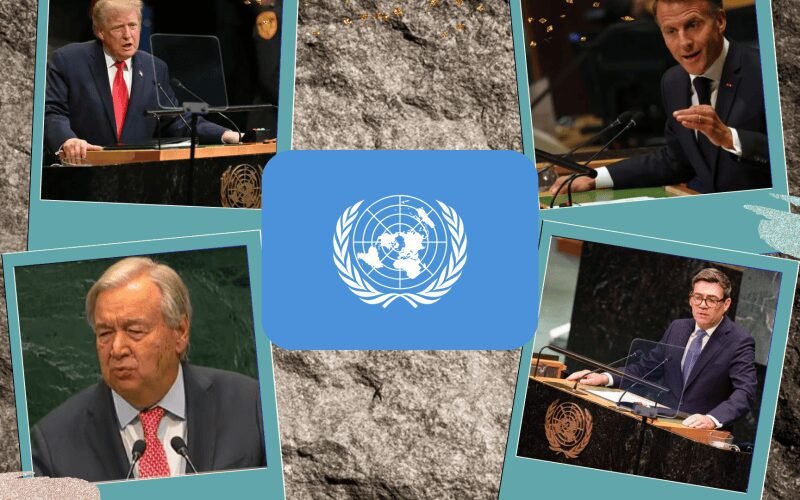
French President Emmanuel Macron, addressing the assembly for the final time before his term ends and elections approach next year, proposed a “double moratorium” in which Ukraine and Russia would agree to halt strikes on each other’s energy and civilian infrastructure as well as on Black Sea grain shipments, warning that winter is approaching for both agricultural exporters.
Burnham Marks Debut With “Britain Is Back” Message
In his first appearance at the U.N. debate as British prime minister, Andy Burnham declared “Britain is back” a decade after the country weathered the disruption of Brexit. He said the U.K. is restoring stability and building a more dynamic economy while pursuing trade and cooperation with other nations on shared challenges.
Burnham said Britain must confront forces of division, starting with increased defense spending as a NATO member and strengthened European capabilities. He also accused Russia-aligned actors of spreading disinformation online, saying Russian agencies have deployed bots, fake websites, falsified news articles and forged the branding of 28 British institutions, including universities and the BBC, while amplifying far-right narratives.
Burnham cited evidence of Russian interference in the 2019 U.K. general election and said the Kremlin spends roughly £1.3 billion ($1.7 billion) annually on disinformation efforts. In response, he announced a new National Centre for Information Defence to counter disinformation targeting British interests. He also called for global standards on artificial intelligence, saying decisions about the technology are too consequential to leave to chance, and pledged British efforts to build international consensus on AI transparency and access.
Asia-Pacific Leaders Address Nuclear Weapons, Security Council Reform
Japanese Prime Minister Sanae Takaichi, making her UNGA debut after predecessor Shigeru Ishiba’s address last year, said Japan has a mission to lead the world toward eliminating nuclear weapons, noting Japan remains the only country to have suffered atomic bombings in wartime. The 1945 U.S. bombings of Hiroshima and Nagasaki killed and injured hundreds of thousands of people, with radiation causing lasting illness among survivors.
Takaichi called for strengthening the Nuclear Non-Proliferation Treaty and warned that North Korea’s nuclear and missile programs pose a serious threat to international peace and security. She said Japan intends to host a future AI safety summit and called for expanding both permanent and non-permanent membership on the U.N. Security Council.
North Korean Vice Minister for Foreign Affairs Kim Son Gyong departed Pyongyang to attend the General Assembly debate, state media outlet KCNA reported, though it remains unclear whether he will meet with Trump administration officials. During his first term, Trump held three summits with North Korean leader Kim Jong Un in 2018 and 2019 seeking a denuclearization deal, but talks ultimately collapsed in Sweden in October 2019.
Macron Pushes for Independent AI Model, Criticizes Gaza Response
Macron called for nations to develop independent artificial intelligence capabilities rather than depend on the United States or China, pointing to France’s Mistral AI as a competitive frontier model. He urged countries including India, Brazil, Singapore, African nations and Gulf states to pool financial resources and data processing capacity to build a shared open-source AI model, saying no nation should become a vassal to a major power.
On Gaza, Macron referenced his prior U.N. appearance, when France and other nations announced plans to recognize Palestinian statehood, acknowledging skepticism that the move was symbolic. He argued that continued inaction on Gaza undermines credibility, criticizing the humanitarian situation despite claims that peace has been achieved. Macron said respect for Palestinian rights is a prerequisite for security for Palestinians and Israelis alike, warning that arguments justifying violations of neighboring states’ sovereignty in the name of Israeli security are mistaken and ultimately weaken it.
Trump Confirms US-Iran Talks, Reiterates “Annihilation” Warning
Hours after telling the assembly he was prepared to “annihilate” Iran if necessary, Trump told reporters that American and Iranian officials had held a lengthy, productive meeting on the sidelines of the General Assembly lasting roughly three hours, with another session planned soon.
Trump’s address mixed threats with openness to a negotiated settlement, saying he faces a major decision on whether to allow a deal permitting Iran to rebuild as a stronger nation or to move to eliminate the Islamic Republic.
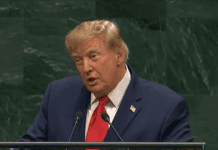
Trump framed much of his roughly 30-minute speech, including references to the capture of Nicolas Maduro, tensions with Iran, and hardline positions on Cuba, narcotics and migration, as expressions of American strength and resolve. The Cuban delegation walked out mid-speech. Trump opened and closed his address by invoking the 250th anniversary of U.S. independence, defending national sovereignty against what he called “globalism” in areas including global taxation, AI regulation and international bodies such as the International Criminal Court. He said the country was in far better shape than two years ago and urged other nations to follow his approach.
European and Gulf Leaders Warn Against Fragmentation
Finnish President Alexander Stubb told the assembly the world faces a choice between cooperation and conflict, saying healthy competition is natural but increasingly threatens the rules underpinning international order. He said both small and large nations depend on those rules to survive and thrive, warning against a drift toward a non-cooperative, multipolar order that he called short-sighted for powers of every size.
Lithuanian President Gitanas Nauseda, the first Baltic leader to speak, outlined his country’s support for demining efforts in the Strait of Hormuz and the Gaza peace process, but urged the assembly not to overlook Russia’s war against Ukraine, calling it the greatest threat to world order 12 years after the annexation of Crimea. He said Russian aggression has expanded from covert operations to mass killings and unprecedented drone attacks on civilian infrastructure, and that only Ukrainian victory can preserve principles embedded in the U.N. Charter. He also cited repeated Russian airspace violations and hybrid attacks against Lithuania.
Qatar’s Emir Tamim bin Hamad Al Thani said the Gulf is passing through one of its most dangerous phases, the cumulative result of years of deferred crisis management, referring to the U.S.-Iran conflict’s spillover into the region without naming either country directly. He said the absence of a regional collective security framework has allowed one party to drag its neighbors into a war not their own, and that restrictions on the Strait of Hormuz have turned global economic lifelines into bargaining chips, driving up costs for fuel, food and medicine worldwide.
Turkish President Recep Tayyip Erdogan renewed calls for recognition of a Palestinian state based on 1967 borders with East Jerusalem as its capital, saying attempts to suppress Palestinian statehood will fail. He said more than 1,500 people have been killed in Gaza since a ceasefire brokered with Turkish assistance last year, accusing Israel of stalling the peace plan’s second phase and describing a “genocidal mindset” in the conflict. He also cited rising settler violence in the West Bank. Israel has denied blocking the peace process and has accused Hamas of failing to meet security conditions.
Other leaders addressing the assembly included Mongolia’s President Ukhnaa Khurelsukh, who said his country is seeking a non-permanent Security Council seat; Vietnam’s To Lam, who voiced support for Palestinians and called for the U.S. to lift its embargo on Cuba; Bhutan’s Prime Minister Tshering Tobgay, who promoted the country’s Gelephu Mindfulness City project; Suriname’s President Jennifer Geerlings-Simons, who called for greater representation of small island and coastal states on a reformed Security Council; and Dominica’s Sylvanie Burton, who said her country is on track to reach 100% renewable energy by 2030.